



 by Tom Gurney
Tom Gurney BSc (Hons) is an art history expert with over 20 years experience
Published on June 19, 2020 / Updated on October 16, 2026
Email: tomgurney1@gmail.com / Phone: +44 7429 011000
Small Marauding and the Problem of a Borrowed Title
William-Adolphe Bouguereau's Small Marauding is best approached through its title history. The protected English route uses Small Marauding, but the stronger documentary trail points to the French title Petites maraudeuses, usually translated in English as Little Thieves, Little Marauders or The little pilferers. Those variants are not a problem to erase. They are part of the painting's route through Salon records, catalogue entries and reproductive prints.
The title suggests mischief, but a careful article should not turn that suggestion into a fixed story. Bouguereau gives the scene the polished finish expected of his mature academic work: smooth drawing, controlled flesh tones, clear arrangement and a strong sense of theatrical pause. The figures are presented with enough clarity for the viewer to read gesture and attitude, yet the painting does not need a documented anecdote to work. It depends on the small tension between innocence, secrecy and the act implied by the title.
For this page, Small Marauding remains the public heading because it protects the existing local route. The article can then explain that the source title family is Petites maraudeuses. That approach keeps the page useful for readers who arrive by the English title while avoiding the false impression that Small Marauding is the settled catalogue title in every source.
At a Glance
- ArtistWilliam-Adolphe Bouguereau
- Route TitleSmall Marauding
- Source TitlePetites maraudeuses
- English VariantsLittle Thieves; Little Marauders
- DateCommonly given as 1872
- MediumOil on canvas, source-specific
- Source SpineSalon, catalogue and print records
- Location NoteCurrent location is not asserted
Contents
- Introduction
- The Source Trail Behind Petites maraudeuses
- What the Painting Can Safely Discuss
- Date, Medium and Collection Caution
- Why a Restrained Page Is Stronger
- Related Childhood and Genre Pages
- Frequently Asked Questions
- References
The Source Trail Behind Petites maraudeuses
The most important captured record for the title is the Musee d'Orsay Salon database, which lists Petites maraudeuses among Bouguereau's Salon-related works. That record supports the French title and a historical exhibition route, but it does not supply a current museum object page or current location for the painting. The page therefore uses it as a title and Salon anchor, not as proof of present ownership or display. [1]
A second important route comes from the Smithsonian Institution's Pre-1877 Art Exhibition Catalogue Index. That record identifies Petites Maraudeuses by Bouguereau and gives the English phrase The little pilferers, with catalogue context tied to Powers' Art Gallery in Rochester, New York. The Smithsonian record is especially useful because it shows how the work circulated in historical catalogue language before many modern web titles hardened into single forms. [2]
The British Museum adds another kind of evidence through prints after Bouguereau's Petites Maraudeuses. Its records connect the subject to reproductive print culture, including work by Alfred Annedouche and publication routes associated with Goupil and Knoedler. For Bouguereau, that matters. Prints helped academic paintings travel beyond the original canvas and shaped the names under which later viewers knew them. This print circulation can be discussed without implying that the local page image has been separately cleared or that the print record is the painting itself. [3]
What the Painting Can Safely Discuss
The safest public reading begins with what the painting visibly does. Small Marauding presents a polished figure scene in which the title supplies a hint of trespass. Bouguereau does not stage violent action or broad comedy. Instead, he turns a small episode into a refined display of expression, posture and surface. The picture's interest lies in how ordinary mischief becomes formal composition.
That is different from saying the figures are documented relatives, a parent-child pair, or members of the artist's household. The accepted evidence does not support those claims. The article should also avoid saying that the child has been out without permission, that the scene records a conspiracy, or that the painting carries a fixed moral lesson. Those readings may be tempting because the title is vivid, but the available records give a title family and circulation history rather than a documented narrative.
Bouguereau's technique still gives the page plenty to say. His academic finish makes the figures feel carefully separated from daily disorder, even when the title points toward pilfering or wandering. The smooth surface, controlled light and composed pose make the implied act feel suspended rather than chaotic. The result is a work that sits between genre painting and idealized figure study: rooted in a small human episode, but arranged with the clarity and polish of a studio picture.
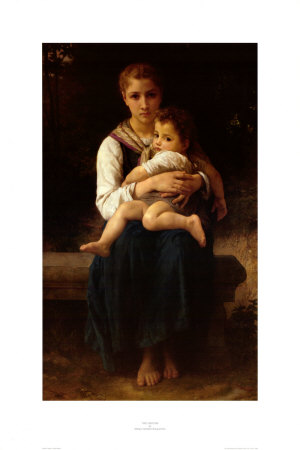
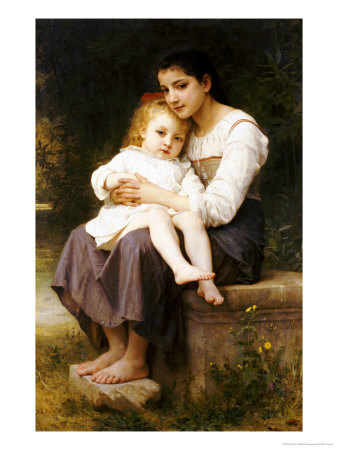
The painting also belongs beside Bouguereau's wider interest in young figures, rural settings and scenes of childhood. It can be read near pages such as Two Sisters, where companionship is handled through pose rather than documentation, and Elder Sister, where Bouguereau builds an image around childhood presence and direct appeal. It also makes a useful contrast with The Secret, another painting whose title invites interpretation without fully explaining the story.
Date, Medium and Collection Caution
Most secondary image routes identify the painting around 1872 and describe it as oil on canvas. WikiArt, Commons and reproduction routes also preserve dimensions in a broad cluster around a tall, large canvas. Those details are useful, but the page keeps them source-specific because the current route is not governed by a current museum object record. [4] [5]
The Smithsonian catalogue index includes an 1876 date in its exhibition-catalogue context. That should not be silently treated as the painting's date if the article uses 1872 from Commons and WikiArt-style routes. The clearer approach is to present 1872 as the commonly repeated painting date and to treat later catalogue and exhibition references as evidence of circulation. That keeps the chronology readable without forcing different record types into one fact.
The same caution applies to ownership and image use. Several routes describe the work as in a private collection, but that does not establish current owner, location or display. A later page can use the existing local image only under the recorded fallback posture unless separate media review supports stronger handling. The public article should not claim image approval, current on-view status or a full provenance.
Why a Restrained Page Is Stronger
Small Marauding does not need the overconfident language of the older page. Its value for readers is in the title bridge, the Salon and catalogue trail, the print-circulation evidence and a careful description of how Bouguereau makes minor mischief look poised and monumental. A restrained article can explain why the painting is memorable without inventing a family drama or moral code.
The completed page should therefore present Small Marauding as a protected English route title for Bouguereau's Petites maraudeuses, probably painted around 1872, known through Salon, catalogue and reproductive-print evidence, and supported by secondary image records. It should be honest that the present article is not based on a current museum object route. That honesty is not a weakness. It lets the page be useful, readable and source-led while keeping future media or object-record improvements open for later review.
Related Childhood and Genre Pages


Frequently Asked Questions
Discussion
Small Marauding rewards careful looking at Bouguereau's handling of title, gesture and source-backed circulation evidence.
Use the prompts below to compare this title-led scene with Bouguereau's other paintings of children and genre subjects.
Reader Insights
How do the English title variants change the way you read the scene?
What changes when a page is led by Salon, catalogue and print records rather than a current object page?
How does this painting compare with Bouguereau's other child-centered scenes?
Join the Conversation
Share your reading of Bouguereau's title, figure grouping and polished treatment below.
References
- Musee d'Orsay Salon database, Bouguereau exhibitor route, accessed 29 July 2026.
- Smithsonian Institution, Pre-1877 Art Exhibition Catalogue Index, Petites Maraudeuses, accessed 29 July 2026.
- British Museum, Bouguereau related-object route with Petites Maraudeuses print records, accessed 29 July 2026.
- Wikimedia Commons, Bouguereau, les petites maraudes, 1872 file page, accessed 29 July 2026.
- WikiArt, Little Marauders, accessed 29 July 2026.
- WikiArt, Small marauding, accessed 29 July 2026.


