


 by Tom Gurney
Tom Gurney BSc (Hons) is an art history expert with over 20 years experience
Published on June 19, 2020 / Updated on October 19, 2026
Email: tomgurney1@gmail.com / Phone: +44 7429 011000
John Key
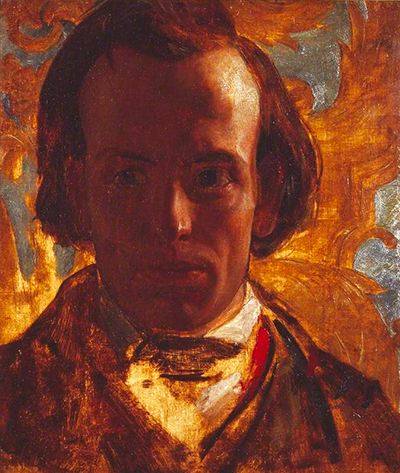
The man's head fills most of this small portrait. His dark hair frames a face directed almost straight at the viewer, while a white collar and flashes of red at his neck catch the light below. Behind him, warm orange-brown paint and curling forms make an active setting without explaining where he is. William Holman Hunt's John Key is in Tate's collection[1] as N03161. Tate lists the painting without a known date. The work is an oil on canvas, and the local image matches the [2].
The face and its surroundings
Hunt gives the sitter a close, frontal presence. One side of the forehead receives a broad, bright passage of light; the other falls into a brown shadow that passes over an eye and cheek. The effect does not conceal the face. It makes the viewer work across it, from the lit brow to the darker features and then to the mouth. The direct pose holds the attention even though the paint around the head remains unusually restless.
At a Glance
- ArtistWilliam Holman Hunt (1827–1910)
- TraditionBritish Pre-Raphaelite art
- Work or subjectJohn Key
- ContextIllustrated paintings guide
- Further readingArtist biography
The collar offers a second focus. Its light tone stands out under the chin, while a red strip at the neckline interrupts the browns of jacket and background. These small accents stop the head from floating free of the body. Hunt uses the dark jacket to merge figure and setting at the lower edge, so the crispest encounter remains with the sitter's face. The result is more immediate than a full-length, carefully furnished likeness.
It is easy to turn the orange shapes behind the head into a story. In the reproduction they look like curved marks and patches of bright colour, but their exact subject is unclear. Calling them flames, foliage or a particular room would ask the image to supply evidence it does not give. What matters visibly is their effect: they press warmth towards the dark hair and make the figure seem close to the picture plane. The contrast between modelled face and lively background gives this modest portrait much of its energy.
An undated portrait
Tate's list of Hunt's works[3] says “date not known” for John Key. That phrase should be kept rather than replaced with a date inferred from hairstyle, colour or a neighbouring picture. The portrait's scale and directness invite comparison with Hunt's other likenesses, but style alone does not establish when this one was made. The available collection references also do not establish a profession, family connection or occasion for John Key's sitting. His name is the title, not a complete biography.
This limit can make looking more exact. The sitter is presented as a particular person, not a generic figure in a religious or literary narrative. His head has its own shape, with the hair rising over a broad forehead and turning out at the sides. The eyes are steady but not strongly theatrical. Hunt's treatment of the mouth and the lit plane of the face gives the portrait individuality without surrounding it with attributes that would identify a public role. The image leaves the sitter's life outside the frame.
John Key and John Hunt
The name can be confused with another Tate portrait, John Hunt[4]. Tate lists them separately: John Hunt is N03160 and John Key is N03161. Both lack a secure date in the current artist listing, but they are different paintings of differently named sitters. The consecutive catalogue numbers do not tell us how the men knew one another or whether they sat at the same time. Keeping the two records separate is especially useful in a catalogue of Hunt's portraits, where a familiar surname could invite an unsupported family story.
Watch: William Holman Hunt
Begin with Hunt’s paintings, then place his work alongside two fellow Pre-Raphaelite founders.
William Holman Hunt Paintings
An overview of Hunt’s paintings from TheHistoryOfArt video archive.
Watch on YouTubeTate’s archived collection data records a later connection between the two canvases: Mrs Wyman presented both in 1917. This is a fact about their entry into Tate, not evidence that the men knew each other, that the portraits were painted together, or that either was made in 1917. The same data gives each support as 356 × 305 mm but leaves the date unknown. [5] [6]
This painting shows a side of Hunt that can be obscured by the elaborate symbols of works such as The Light of the World. Here the principal event is the exchange between painter, sitter and viewer. Light picks out a brow and collar; dark paint holds the rest close; the lively ground prevents the likeness from becoming inert. Its identity is secure through Tate's title and accession, while its date and the sitter's fuller story remain open questions.
The light and the unsettled ground
Tate's archived subject index includes shadow among the terms attached to John Key. That is a descriptive tag, not a date or a theory of what the warm background represents. It points to a real feature of the image: the face is divided by uneven illumination, with one side much harder to read in the inherited reproduction. A broad orange patch behind the hair makes the head's outline visible even where dark strands meet the shadowed cheek. Small bright accents at the collar and throat then draw the eye down and back up to the sitter. The contrast is more complicated than simply putting a light face on a dark wall. [5]
The uncertain shapes behind him deserve equally careful language. Curving forms, pale gaps and orange-brown paint make the ground visually active. They do not, in the accessible object record, have a named setting or established symbolic subject. The picture can therefore be enjoyed as an experiment in how a lively field presses against a still, frontal figure without turning it into a fire scene or a landscape. This is an inference from the visible composition, bounded by what Tate actually catalogues.
Same size, different encounter
The companion portrait John Hunt uses the same recorded 356 × 305 mm canvas support, entered Tate through the same 1917 Mrs Wyman gift, and likewise lacks a secure painting date. Its older-looking sitter emerges from a quieter, darker surround. John Key's bright, broken ground and stronger contrast between light and shadow create a different experience at nearly the same physical scale. These observations make a useful two-picture comparison, but neither the paired accession numbers nor the donor credit establish that Hunt painted them together. [5] [6]
Hunt's F. G. Stephens supplies a further contrast: it is a dated 1847 panel with a named sitter whose later career and early friendship with Hunt are documented. The John Key canvas has a title and a museum identity, but no comparable sourced biography or date. This does not make one portrait more finished or more valuable than the other. It shows the difference between what paint can reveal about an encounter and what documents can establish about a person. A careful page can describe both, and leave the unsupported parts of Key's story open. [7]
Discussion
Look closely at John Key, then compare your reading with the documented history.
Reader Insights
Which detail in John Key most affects your reading?
How do the date, medium and collection records shape that interpretation?
What remains uncertain about this work or its history?
Join the Conversation
Share a close observation or a source-backed question about John Key. The prompts above are starting points for discussion.
References
- Tate's collection. View source.
- Art UK-linked reproduction of this object. View source.
- Tate's list of Hunt's works. View source.
- John Hunt. View source.
- Tate, John Key collection data. View source.
- Tate, John Hunt collection data. View source.
- National Portrait Gallery, Stephens inventory. View source.







