


 by Tom Gurney
Tom Gurney BSc (Hons) is an art history expert with over 20 years experience
Published on June 19, 2020 / Updated on October 19, 2026
Email: tomgurney1@gmail.com / Phone: +44 7429 011000
John Hunt
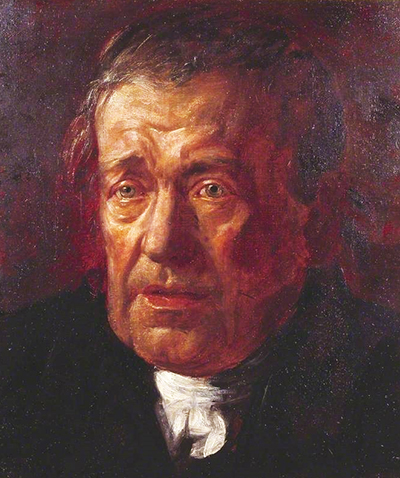
An older man turns towards us out of a dark background. Strong light crosses his forehead, eyes and cheeks; a pale neckcloth breaks the near-black mass of his coat. William Holman Hunt's John Hunt concentrates on a face rather than a setting. Art UK's record for the Tate painting[1] identifies it as an oil on canvas, 35.6 × 30.5 cm, accession N03160. The record says Mrs Wyman presented it in 1917. Tate's artist listing[2] gives its painting date as not known.
A close likeness
The portrait is tightly framed. The sitter's head and shoulders occupy almost the whole surface, leaving little room for furniture, landscape or possessions. His eyes meet ours, but the expression is difficult to reduce to a single word. Light brings out the folds under the eyes and around the mouth while the darker side of the face retains its shape. Hunt makes the features specific without turning them into a caricature of age.
At a Glance
- ArtistWilliam Holman Hunt (1827–1910)
- TraditionBritish Pre-Raphaelite art
- Work or subjectJohn Hunt
- ContextIllustrated paintings guide
- Further readingArtist biography
The white at the throat matters because so much else is dark. It catches a small patch of light below the face and gives the coat a clear upper edge. The jacket then sinks into shadow; the background is a muted reddish-brown rather than a sharply described wall. Across this narrow range, Hunt varies how much the viewer can see. The lit cheek and nose are immediate, while hair, collar and shoulders emerge gradually. This choice directs us back to the eyes.
Nothing in the painting itself fixes the man's profession or the occasion for the sitting. A tightly focused portrait can feel intimate, but intimacy is an effect of the composition, not proof of a particular relationship between painter and sitter. The name John Hunt appears in the title. The available direct collection records do not establish a family connection, so it should not be supplied merely because painter and sitter share a surname.
What the record tells us
The 1917 gift is a useful part of the object's history. It tells us when this canvas entered the Tate collection through Mrs Wyman, not when Hunt painted it. Tate's “date not known” is an important limit: neither the gift year nor the sitter's apparent age can supply a secure nineteenth-century date. The work belongs to Hunt's practice as a portrait painter, but it cannot be put into a particular decade on the evidence available here. [1] [2]
The record also protects the painting from a common title confusion. Tate has a second, separately catalogued Hunt portrait called John Key, N03161. That picture shows a younger-looking, dark-haired sitter before a much more active amber ground. John Hunt is N03160, with the older sitter, dark coat and subdued setting shown here. The neighbouring numbers and similar names are useful for checking identity; they do not demonstrate that the men sat together or knew each other.
Hunt's portraiture
Hunt is often approached through complex narrative pictures, where an interior, landscape or symbolic object carries much of the meaning. In John Hunt almost all that supporting material has fallen away. The image asks us to consider what careful description of a face can do on its own. Broad lit planes and smaller marks around the features work together; the dark surround keeps attention from dispersing. The portrait's small size reinforces the close encounter.
Look at the transition from the illuminated brow to the shadowed side, then at the short bright interruption of the neckcloth. These simple relationships give the likeness its visual force. Tate's record fixes the object and its later gift, while leaving the date and sitter's fuller story unresolved. The strongest reading stays with what Hunt made visible: an individual face, directly presented and closely observed.
Watch: William Holman Hunt
Begin with Hunt’s paintings, then place his work alongside two fellow Pre-Raphaelite founders.
William Holman Hunt Paintings
An overview of Hunt’s paintings from TheHistoryOfArt video archive.
Watch on YouTubeLooking slowly at the face
The eyes do not sit in equal light. A small highlight catches each, but the surrounding brow and cheek vary considerably from side to side. Hunt gives the forehead a sequence of furrows and brighter planes, then lets the lower cheeks and jaw settle into deeper red-brown tones. The mouth is closed without becoming a neat horizontal line: its corners and the folds around it make the expression harder to summarise as merely stern or gentle. The hair is much less separately described than the face, and the coat almost merges into the lower darkness. These differences in emphasis can be seen in the inherited reproduction without claiming to know the exact order of Hunt's brushwork. They explain why a small portrait can hold attention without narrative props.
The neckcloth supplies a useful point of return. Its crumpled white shape is not the largest light area, but it fixes where head meets chest and prevents the face from seeming detached from the dark coat. Above it, the nose and brow project into stronger light; below it, the body recedes. The composition gives the sitter a bodily presence while withholding nearly all information about his surroundings. Such restraint is a choice visible in the painting, not evidence that the man lived modestly or sat in a particular room.
What comparison adds, and what it cannot date
Hunt made other small portraits in which a face dominates, but they offer different documentary anchors. His F. G. Stephens is signed and dated 1847 and gives the sitter a chair-back pose; Portrait of William Pink has an old reverse label and a specialist approximate date. John Hunt has neither a dated inscription in Tate's archived object record nor a securely identified occasion in the accessible collection descriptions. Its dark setting and direct gaze may invite a stylistic comparison with those works, but resemblance cannot turn their dates into his. [3] [4]
The different portraits also show how much a surrounding object can change what we know. Stephens's clasped hands over a chair and Pink's waistcoat contribute to their individual compositions. John Hunt's near-absence of attributes makes the modelling of his face do more of that work. It does not make the sitter anonymous: Tate's title gives his name. It does mean a reader should resist using another portrait's props, patron or family story to fill this one's silence. Comparison clarifies Hunt's choices while the objects remain separate.
A later collection event, not a life story
Tate's archived metadata identifies the support as 356 × 305 mm, calls the medium oil paint on canvas, and records Mrs Wyman's 1917 gift. Art UK's Tate-linked entry gives the same height and width in centimetres and the accession N03160. These two institutional records provide a solid description of the object despite the missing painting date. The archived dataset is a catalogue snapshot, not a newly discovered nineteenth-century document; its silence about kinship should not be read as proof of any particular relationship. [3] [1]
Mrs Wyman gave the neighbouring John Key canvas in the same year. Their matching support dimensions and adjacent numbers make a helpful pair for looking, but the museum records identify two different named men and two different images. They do not explain when the donor acquired them or why she kept them together. The painting's public history begins securely with the gift; a fuller account of its earlier ownership would require correspondence, a dated exhibition record or another primary source not established here. The portrait remains worth close attention without that missing biography: the individual face, the restrained palette and the sharp white neckcloth are enough to distinguish it from its companion.
Discussion
Look closely at John Hunt, then compare your reading with the documented history.
Reader Insights
Which detail in John Hunt most affects your reading?
How do the date, medium and collection records shape that interpretation?
What remains uncertain about this work or its history?
Join the Conversation
Share a close observation or a source-backed question about John Hunt. The prompts above are starting points for discussion.
References
- Art UK's record for the Tate painting. View source.
- Tate's artist listing. View source.
- Tate, John Hunt collection data. View source.
- National Portrait Gallery, Stephens inventory. View source.







