



 by Tom Gurney
Tom Gurney BSc (Hons) is an art history expert with over 20 years experience
Published on June 19, 2020 / Updated on October 19, 2026
Email: tomgurney1@gmail.com / Phone: +44 7429 011000
The Ship
William Holman Hunt's The Ship turns a voyage at night into a study of competing lights. A low moon and scattered stars sit above the vessel, while lamps warm the deck beneath a broad dark sail or canopy. At the right, a sailor works near the wheel; figures and equipment recede through the crowded middle distance. The painting grew from sketches Hunt made while travelling east in 1875 with his new wife Edith. It belongs to Tate as accession N02120. [1] [2]
A deck at night
The composition asks the eye to move from darkness into pockets of illumination. A warm line runs along the underside of the great diagonal form overhead. Below it, lamps reveal the deck, machinery, a table-like structure and human figures. The right-hand wheel stands large and almost black against the light around the sailor. Toward the upper edge, a small pale moon and stars interrupt the dark sky. Hunt uses these different sources of light to make the space navigable without turning night into daylight.
At a Glance
- ArtistWilliam Holman Hunt (1827–1910)
- TraditionBritish Pre-Raphaelite art
- Work or subjectThe Ship
- ContextIllustrated paintings guide
- Further readingArtist biography
The ship is a working environment. The wheel, rigging, lamps and figures keep us aware of human activity, even though no one dominates the canvas as a portrait sitter would. The picture's darkness leaves some gestures uncertain. That uncertainty is part of the experience of looking: a viewer can distinguish the sailor's task and the lamps' glow without claiming to identify every person or piece of gear. Christie's description of a surviving moon study draws attention to the contrast between the vessel's warm lamps and cooler moonlight in the finished oil. [1]
From an outward voyage to an oil painting
Hunt and Edith travelled aboard the steamer Delhi in December 1875, passing from Venice toward Alexandria before going on to Jerusalem. A later catalogue quotes Hunt's report, written after he reached Jerusalem in March 1876, that he had made shipboard sketches and worked up a picture of the vessel. This makes the voyage a documented source for the composition, rather than a setting inferred only from the image. The finished painting took more work than a single night sketch. Tate conventionally dates The Ship 1875; another specialist caption gives a broader 1875–79 range. The safest distinction is between the 1875 journey and a painting that could be developed afterward. [1] [3]
Hunt described testing a piece of linen while his painting canvas had not yet arrived, using it for the picture he called The Ship. His recollection is valuable because it explains a practical circumstance of making art in transit. It should still be read as a later memoir, not a minute-by-minute record of the voyage. The canvas joins observations made aboard the ship to decisions taken when Hunt turned those observations into a composed night scene. [3]
Watch: William Holman Hunt
Begin with Hunt’s paintings, then place his work alongside two fellow Pre-Raphaelite founders.
William Holman Hunt Paintings
An overview of Hunt’s paintings from TheHistoryOfArt video archive.
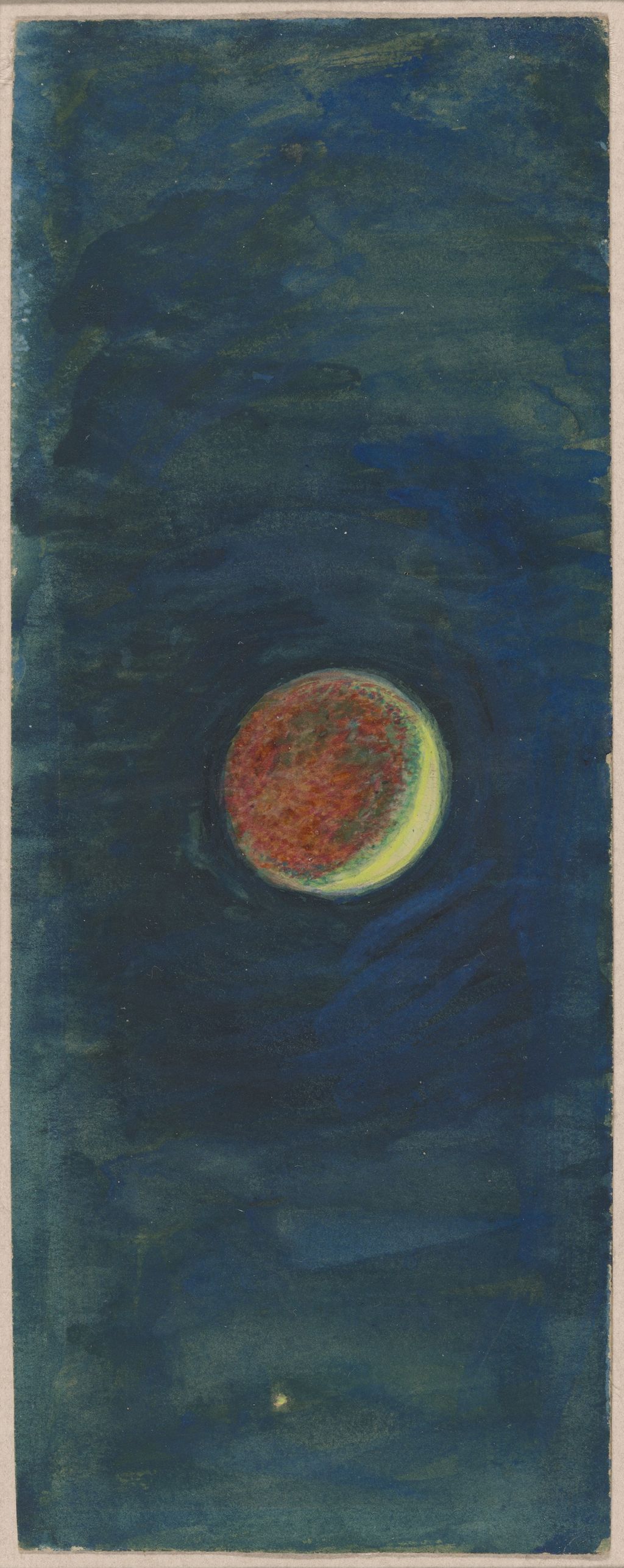
Watch on YouTubeThe small study for the crescent moon is a separate work on paper, now at the Art Institute of Chicago as 2021.320. The museum dates it to about 1875 and calls its medium opaque watercolour on cream wove paper. Its recorded provenance includes the same 1985 Sotheby's sale and 2010 Christie's lot cited in the earlier catalogue, establishing that these records follow one sheet despite their slightly different measurements and medium descriptions. The study's coloured crescent and dark blue ground differ from the oil's stronger white lunar light. This is evidence of Hunt testing a delicate effect, not a miniature of the whole painting. Compare the sheet with the Tate canvas without confusing the two objects. [4] [1]
A literary echo
Hunt later associated the scene with Alfred Tennyson's In Memoriam, citing a short passage that evokes the sound and lights of a ship at night and the sailor at its wheel. The association is useful because the painted vessel has many of the poem's sensory ingredients: a wheel, an illuminated cabin, darkness and travel. Yet Hunt's canvas is more than a literal set of labels for a stanza. Its long diagonal, dim figures and separate pools of light organise what the viewer can see and what remains hidden. [3]
Tennyson's poem is a work of mourning. That context can deepen the mood of the painted night, especially on a voyage that carried Hunt and Edith toward a new period of life. But neither poem nor painting identifies the people on deck as characters from one narrative, and the picture does not need an invented story for its effect. Hunt's visible subject is a vessel proceeding through darkness under the care of its crew. The literary connection adds a layer of resonance while the oil remains a closely worked observation of light, labour and travel.
A late gift to Tate
The Ship stayed with Hunt for decades. In 1907, friends and admirers bought it and presented it to Tate to mark his eightieth birthday. The gift moved a personal journey picture into a public collection near the end of his life. The work's approximate dimensions are reported somewhat differently in accessible catalogues, around 76 × 98 cm; its object identity, medium and Tate accession are more secure than a millimetre-perfect measurement in this source pass. [2] [5]
For readers following Hunt's career, this canvas offers a bridge between the travels behind religious pictures and a direct record of modern movement. Compare the brighter Egyptian river landscape of The Nile or the study of a different night setting in Fishing-Boats by Moonlight. The Ship is distinct from both: a deck shared by travellers and crew, held together by a few lights against an expansive dark. Its wheel and lamps keep the scene practical; the moon and long shadows make that practical scene memorable.
Hunt later gave the voyage image a larger, personal meaning. A specialist catalogue preserves his description of a heavily laden vessel guided towards a distant port under silent stars, using the ship as a figure for life's passage. That retrospective interpretation belongs beside, rather than in place of, the painted facts: the working wheel, crew, lamps and night sky. It also differs from the connection to Tennyson's poem, which Hunt separately associated with the scene. One painting could gather a travel memory, a literary echo and an artist's later metaphor without requiring every sailor to stand for a named character. [5] [3]
Discussion
Look closely at The Ship, then compare your reading with the documented history.
Reader Insights
Which detail in The Ship most affects your reading?
How do the date, medium and collection records shape that interpretation?
What remains uncertain about this work or its history?
Join the Conversation
Share a close observation or a source-backed question about The Ship. The prompts above are starting points for discussion.
References
- Christie's, catalogue for a related moon study. View source.
- Tate, William Holman Hunt artist record. View source.
- Victorian Web, object caption. View source.
- Art Institute of Chicago, object record. View source.
- Libson Yarker, Hunt catalogue. View source.


