 by Tom Gurney
Tom Gurney BSc (Hons) is an art history expert with over 20 years experience
Published on June 19, 2020 / Updated on October 19, 2026
Email: tomgurney1@gmail.com / Phone: +44 7429 011000
Tuscan Girl Plaiting Straw
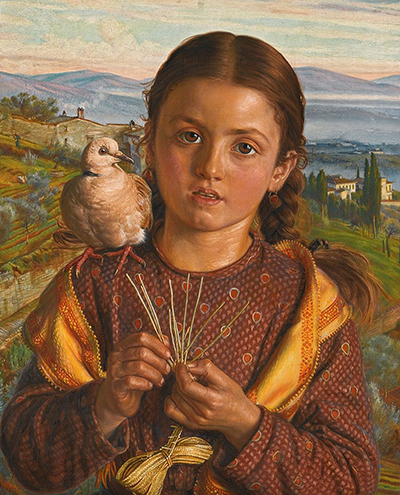
A young girl holds a length of plaited straw before a view of the hills around Florence. A dove sits on her shoulder, close to the face that catches most of the picture's light. William Holman Hunt made this small portrait-like painting in Fiesole during the winter of 1868–69 and signed it with his monogram and the date 1869. The canvas measures 53.5 × 43.5 cm. The title names an action rather than a sitter: we can see a child at work, but the picture does not give her name. Today Tuscan Girl Plaiting Straw is allocated to the Lady Lever Art Gallery, Port Sunlight. [1] [2]
A child, a bird and an occupation
The girl stands close to the front of the canvas. Hunt gives her an open gaze and a direct presence, while the hills and buildings behind her recede into softer light. Straw passes through her hands as a long strip. The task is specific: plaited straw could be made into hats and other goods, and straw work was a significant Tuscan cottage industry. The title therefore asks us to notice labour even while the girl's face, clothing and companion bird make the image appealing as a portrait. [1]
At a Glance
- ArtistWilliam Holman Hunt (1827–1910)
- TraditionBritish Pre-Raphaelite art
- Work or subjectTuscan Girl Plaiting Straw
- ContextIllustrated paintings guide
- Further readingArtist biography
The dove is perched so near her cheek that the two heads become a pair. Its pale feathers contrast with her darker hair and the saturated colour of her dress. It is possible to read the bird as a sign of peace, childhood or religious care; the Sotheby's catalogue develops such possibilities. None of these meanings is printed on the animal. Hunt also painted and studied pigeons in other works, including The Festival of St Swithin. Here the bird gives the child a living companion and makes her still pose feel more active. [1]
The landscape makes the girl's occupation local. Low buildings, trees and hills place her in a Tuscan setting without requiring us to identify a precise spot from the painting alone. Hunt's portrait and view work together: the figure is large enough to meet the viewer, and the land behind her explains why this is a Tuscan girl rather than a child in a neutral studio. That setting was observed during his stay at Fiesole, though the finished arrangement is a composed painting, not a documentary snapshot of a single instant.
Fiesole after Florence
Hunt arrived in Florence in 1868 after the death of his first wife, Fanny, there in December 1866. He returned to supervise her memorial and chose to stay in the hills at Fiesole, where he worked near the Villa Medici. The painting belongs to this period of grief, travel and renewed work. Its outward gentleness need not be read as a direct allegory of Fanny's death; the circumstances instead help locate Hunt's presence in Tuscany and explain why he was painting local subjects. [1]
According to the Sotheby's research, the model was one of two daughters of the gardener at the Villa Medici. Her sister posed for Caught, another child subject Hunt developed at about the same time. Three related pencil sketches at the Ashmolean include a child working with straw and a bird on her shoulder. They make the painting's basis in observation clearer, but they also show Hunt making choices about pose and composition. The surviving account identifies the family relationship, not the child's personal name. [1]
Watch: William Holman Hunt
Begin with Hunt’s paintings, then place his work alongside two fellow Pre-Raphaelite founders.
William Holman Hunt Paintings
An overview of Hunt’s paintings from TheHistoryOfArt video archive.
Watch on YouTubeHunt later recalled painting a Tuscan straw plaiter of the gentle-featured type he associated with Renaissance pictures. That memory reveals how he framed the encounter: a real child in Fiesole also became, for him, a figure through whom to revisit Italian art. His picture should be read with both sides in mind. Its observed face and working hands matter, while his choice of setting and pose carries an idealising view of rural childhood. [1]
Picturesque childhood and real work
The straw is easy to treat as a quaint accessory, particularly beside the dove. Yet it is the activity that gives the painting its name. Sotheby's catalogue proposes a social reading: the child's labour could stand for limited educational opportunity in a regional cottage industry. That is a useful question to bring to the image, though it is a modern catalogue interpretation rather than proof that Hunt meant one definite argument about this particular girl's future. The painter shows work without showing a school, an employer or an explicit hardship. [1]
This makes a comparison with The School-Girl's Hymn illuminating. That earlier picture shows a young person carrying a book and apparently singing as she moves through a landscape. Tuscan Girl instead places an unfinished product in the child's hands. Both combine a particular model with an attractive outdoor setting; their titles ask the viewer to think about different activities. The comparison should not turn either child into a simple emblem of prosperity or deprivation. Hunt's attention to their faces gives them more individuality than a single moral label can hold. [1]
Making, showing and framing the painting
The subject may look effortless, but Hunt's correspondence describes difficult sittings and revisions. Letters dated 23 February 1869 to his friends Frederic George Stephens and Thomas Combe, cited by Sotheby's, show him still working on the two child paintings and concerned about their finish and sale. The catalogue reports that they were completed by mid-March and shown through the dealer Ernest Gambart in April. Its discussion of a £600 bank record treats it as likely payment for the two works together, not a secure price for Tuscan Girl alone. [1]
In 1877, Hunt exhibited Tuscan Girl Plaiting Straw at the first Grosvenor Gallery exhibition in London. Reviewers responded to the child's face and to the care with which the picture had been carried through. The painting's presentation also mattered: its original gilt frame has daisy medallions designed by Hunt and made by Green & Co. The reproduction here concentrates on the painted image, so the frame is not a detail to judge from this crop. In the original object it extends the artist's choices beyond the canvas. [1]
The later ownership trail runs from John Francis Austen to the Leverhulme family. Austen's executors sold the painting at Christie's in 1931, when it was bought on behalf of the second Viscount Leverhulme. Sotheby's 2013 account naturally described its ownership as it stood before that sale. The later Arts Council record supplies the important update: the painting was accepted in lieu of tax and permanently allocated to the Lady Lever Art Gallery. This public collection history changes how it can now be encountered, without changing the unresolved identity of the girl who posed for it. [1] [2]
Look first at the girl's hands and then at the bird beside her face. One detail records an occupation; the other invites affection and interpretation. Hunt holds both in a closely studied Tuscan landscape. The picture remains most interesting when its apparent simplicity is allowed to carry that tension between a child presented for admiration and a child shown making something with her hands.
Discussion
Look closely at Tuscan Girl Plaiting Straw, then compare your reading with the documented history.
Reader Insights
Which detail in Tuscan Girl Plaiting Straw most affects your reading?
How do the date, medium and collection records shape that interpretation?
What remains uncertain about this work or its history?
Join the Conversation
Share a close observation or a source-backed question about Tuscan Girl Plaiting Straw. The prompts above are starting points for discussion.
References
- Sotheby's, 2013 specialist catalogue. View source.
- Arts Council England, 2014/15 Acceptance in Lieu report. View source.