 by Tom Gurney
Tom Gurney BSc (Hons) is an art history expert with over 20 years experience
Created on November 3, 2026 / Updated on November 3, 2026
Email: tomgurney1@gmail.com / Phone: +44 7429 011000
Kelmscott Press: Introduction
A Kelmscott book begins to make its argument before the first sentence is read. The weight of a letter, the interval between words, the width of a margin and the resistance of paper all belong to its design. William Morris founded the Kelmscott Press to bring those decisions together. His account of the undertaking starts with an ambition for books that were beautiful and easy to read; even an undecorated page, he believed, should give pleasure through typography alone. The familiar borders of curling foliage grew around that more fundamental concern. [1]
The Press began printing in Hammersmith in 1891 and continued until 1898, beyond Morris’s death in October 1896. Its books draw on medieval manuscripts and early printing, but their making involved an extensive contemporary network: a photographer and printing adviser, a punch cutter, papermakers, compositors, pressmen, illustrators, engravers and binders. The term “private press” describes an enterprise able to pursue particular artistic priorities; it should not suggest that Kelmscott was an amateur operation without skilled professional labour. [1] [2]
The University of Maryland’s catalogue lists fifty-three Kelmscott works, extending from medieval translations to modern poetry and Morris’s own romances. The celebrated Kelmscott Chaucer belongs within this larger experiment. Following the workshop’s methods and its less familiar books reveals how many different solutions could emerge from a remarkably consistent view of what a printed book should be. [3]
At a Glance
- Operating yearsBegan printing 1891; continued until 1898, after Morris’s death [1] [2]
- First typeGolden roman, informed by Jenson but newly designed by Morris [1]
- First issued bookThe Story of the Glittering Plain, 8 May 1891 [1]
- Catalogue countCustomary 53 works requires distinctions among works, editions and volumes [1] [3]
Contents
- A long ambition takes a London address
- Three types, developed through use
- The open book as the unit of design
- Ornament, pictures and the work between them
- Paper, ink and the book in the hand
- A workshop that grew with its books
- A catalogue wider than its famous Chaucer
- A future imagined in an old-looking book
- Finishing the Press after Morris
- Collecting a complete body of work
A long ambition takes a London address
Morris’s interest in making books preceded the Press by decades. Sydney Cockerell’s history, published with Morris’s own account, describes a projected illustrated Earthly Paradise in the 1860s. Burne-Jones supplied drawings and Morris himself engraved many of the blocks, alongside other members of their circle. Trial pages were prepared, but the ambitious folio never appeared. Another proposed illustrated edition, of Love Is Enough, also stopped short of publication. These projects brought writing, illustration, ornament and printing into the same conversation long before there was a Kelmscott workshop. [1]
The immediate preparation came through Morris’s friendship with Emery Walker, a neighbour with practical knowledge of printing and photographic reproduction. Cockerell describes their frequent discussions from about 1888 and Walker’s advice on the typography of The House of the Wolfings and The Roots of the Mountains, both printed at the Chiswick Press. Particular attention went to type, the absence of unnecessary spacing between lines, and the proportions of the page. These books allowed Morris to test improvements through an existing printer before taking responsibility for a press himself. Their literary development belongs to the wider history of Morris’s writing. [1]
Walker declined Morris’s invitation to become a business partner in December 1889, yet remained an essential adviser. Cockerell’s description of him as virtually a partner concerns that sustained practical and artistic contribution, rather than a financial partnership. Photographic enlargements of fifteenth-century printing helped Morris study individual letters closely. During 1890 he developed his first type, with the punch cutter Edward Prince turning the drawings into the tools needed to manufacture it. By the end of that year the fount was almost complete. Preparation in 1890 and printing in 1891 therefore mark different stages of the undertaking. [1]
The original Kelmscott account records the taking of a cottage at 16 Upper Mall on 12 January 1891. William Bowden, a retired master printer, had already been engaged. A trial page was printed on 31 January; his son W. H. Bowden joined him as compositor in February, and Cockerell places the first book sheet around 2 March, with some uncertainty. The pressman Giles joined the small staff during the first book’s production. The Bowdens’ setting and presswork made Morris’s new type into the pages of a book. [4]
This was a London press, close to Morris’s home, Kelmscott House. It was separate from Kelmscott Manor, his country retreat in Oxfordshire. The Manor supplied the name that he also gave to his Hammersmith house and the Press; it did not supply the workshop’s location. The distinction becomes particularly vivid in News from Nowhere, whose Kelmscott frontispiece depicts the country house within a book manufactured at Upper Mall. [2] [5]
Three types, developed through use
Morris began with a roman type, later named Golden after The Golden Legend, the book originally intended to inaugurate the Press. He looked particularly to the Venetian printer Nicolas Jenson. In his Note on His Aims, Morris explains that he enlarged and repeatedly drew early letters before designing his own. He wanted substantial, clearly formed characters, with less contrast between thick and thin strokes than he found in contemporary printing. His objective was to learn from the older type’s construction and then make a new alphabet. He explicitly acknowledged differences between his letters and Jenson’s. [1]
Prince’s contribution was indispensable. Drawing a letter and cutting its punch are distinct acts: the punch cutter had to preserve its form at the small size required for printing. Cockerell records that an early letter cut at the size called Great Primer was considered too large for the roman fount, and the smaller size called English was chosen. Such names are historical type sizes. They help explain why the finished letter was a practical manufacturing decision as well as a drawn shape. [1]
The second fount, Troy, developed in 1891. Its Gothic character drew on early German printing, including the work of Peter Schoeffer, Günther Zainer and Anton Koberger. Morris wished to make blackletter readable by avoiding excessive compression and sharp projections, and by restricting contractions and joined letters. The trial pages described by Cockerell show experimentation continuing after a general style had been chosen: one early capital was promptly discarded. The complete stock of Troy type was sent from the foundry on the last day of 1891. [1] [4]
The smaller Chaucer type answered another practical problem. Troy was too large for the projected double-columned Chaucer, so Prince cut the related design at pica size between February and May 1892. It was ready in June and appeared in the chapter list and glossary of The Recuyell of the Historyes of Troye before the Chaucer itself was finished. A type’s name can therefore commemorate a major purpose without identifying its first appearance. Across the Press, the larger and smaller Gothic types could work together, distinguishing main text from headings, glossaries or other supporting material. [1] [4]
These three Morris-designed types formed the Press’s lasting repertoire, but he continued to consider alternatives. Cockerell records an experimental alphabet based on a book printed at Subiaco, which Morris drew in 1892 and decided against having cut. The abandoned design is useful evidence of selection: the workshop’s coherent appearance emerged through rejected possibilities as well as successful ones. [1]
The open book as the unit of design
Type alone did not determine whether a page worked. Morris paid close attention to the gaps within and around it. He wanted the printed face of each letter to occupy its body generously, words separated clearly but narrowly, and intervals kept as even as possible. He objected to the conspicuous channels of white that can run through badly spaced text. His criticism directs attention to something easily overlooked in a handsome book: blank space has a pattern too. [1]
He was similarly restrained about inserting metal leads between lines of type. Extra space could serve a particular purpose, but he resisted its automatic use. The compact appearance of a Kelmscott page arose from the relationship between letter size, line spacing and word spacing. It was not achieved by choosing a dark alphabet and leaving everything else to the compositor. The smaller Chaucer type sometimes received a thin lead, with a still finer allowance in the Chaucer and other double-columned books. [1]
Margins extended that reasoning to the whole opening. Morris proposed the narrowest margin beside the binding, then progressively wider spaces at the top, outside and bottom. His explanation was that the reader sees a pair of facing pages together. The printed areas should belong to that shared field. This was his design principle, informed by his reading of older books; it need not be turned into a universal law for every historical book or every modern reader. [1]
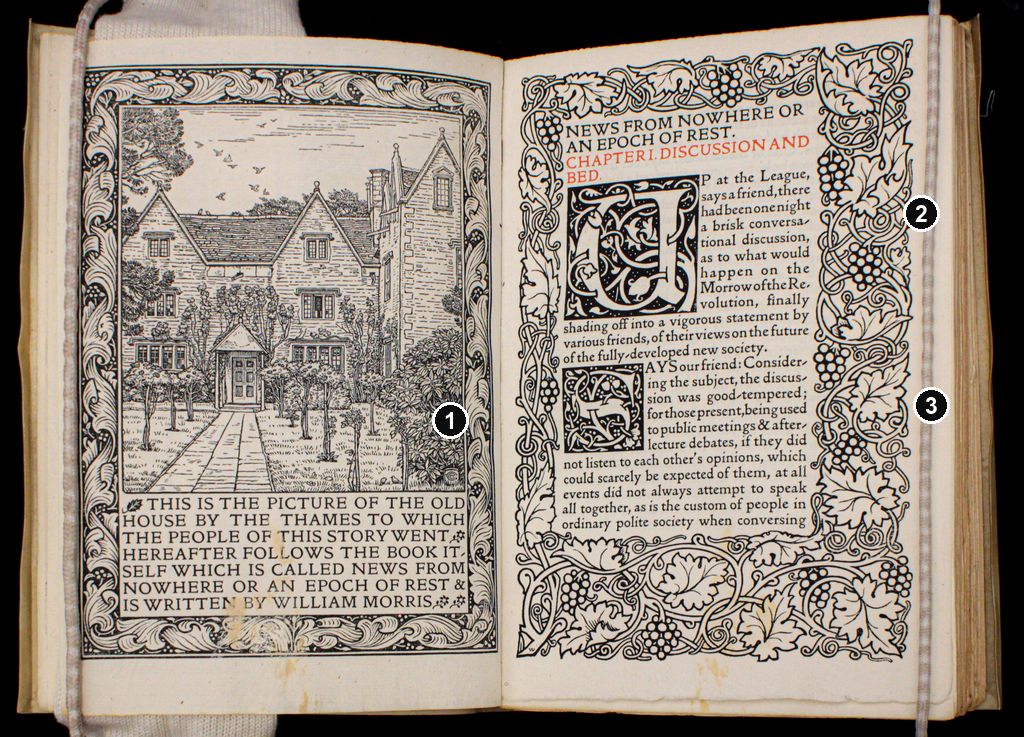
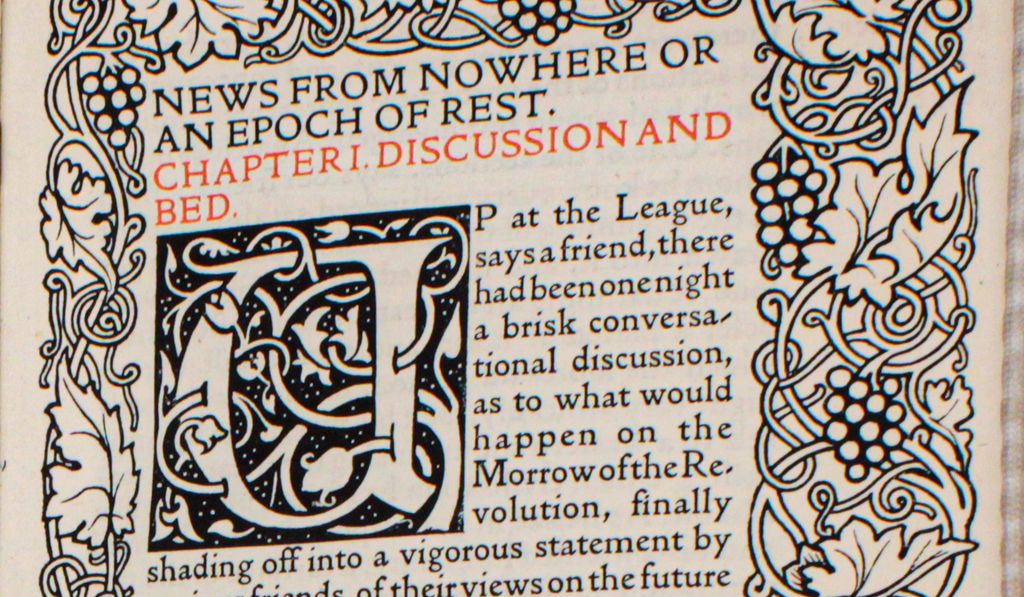
The Pequot Library opening of News from Nowhere makes the relationship tangible. A framed view of Kelmscott Manor occupies the left page above a block of explanatory lettering. On the right, the title and red chapter heading lead into text with a large decorated initial. Curling leaves and fruit surround this reading area, while the two unequal compositions face one another across the gutter. The picture and the first chapter each have their own task, yet the opening has been given a common visual weight. [6]
Morris’s demand that decoration belong to the page of type is especially important here. A border can establish the edge of the reading area, an initial can mark the beginning of a passage, and a heading can announce a change of scale or subject. Their usefulness depends on their relationships. The Press’s page design rewards looking at a whole opening before isolating an attractive leaf, letter or picture. [1]
Ornament, pictures and the work between them
The ornament evolved during the Press’s short life. Cockerell describes early initials related to fifteenth-century Italian manuscripts, followed by letters with grapes and vine leaves after Morris’s visit to Beauvais in 1891. He also identifies a practical change towards larger foliage and lighter backgrounds, because some early initials looked too dark beside the type. Botanical richness was being adjusted against the density of words. The aim was balance across the printed surface. [4]
His inventory records 384 initials, including a few engraved but unused, and thirty-four versions of the letter T. Such variety gave the workshop alternatives at different sizes and in different settings. It also warns against treating every decorated capital as an interchangeable emblem of a single “Morris style”. A letter used beside a short lyric, a long romance or a large illustration had to fit that particular composition. [1] [4]
The Press also depended on the translation of pictures between media. Cockerell explains that most of Burne-Jones’s designs began in pencil. Robert Catterson-Smith, and in some cases Charles Fairfax Murray, redrew them in ink; the artist revised them, and photography transferred the designs to wood. An engraver then made the printable block. Burne-Jones’s authorship of the image therefore coexisted with skilled work by people whose names are less conspicuous on the title page. [1]
Different books drew on different artists and engravers. Walter Crane designed the twenty-three illustrations for the second Kelmscott Glittering Plain, engraved by A. Leverett. Charles March Gere designed the Manor view for News from Nowhere, engraved by W. H. Hooper. Cockerell names Hooper, C. E. Keates and W. Spielmeyer among the principal engravers of the Press’s blocks, with G. F. Campfield responsible for some early initials. Attributing every Kelmscott picture to Burne-Jones, or every block to Hooper, would erase this variety. [1] [5]
Nor was everything printed directly from engraved wood. Repeated initials and ornaments were printed from electrotypes, metal duplicates of the relief designs, while most title pages and initial words were printed from wood. Gaskin’s illustrations for The Shepheardes Calender and the map in The Sundering Flood were among the images printed from process blocks. These distinctions matter because a commitment to fine hand printing did not entail excluding contemporary reproductive techniques. Photography and metal duplication helped carry carefully drawn designs into repeatable printed forms. [1]
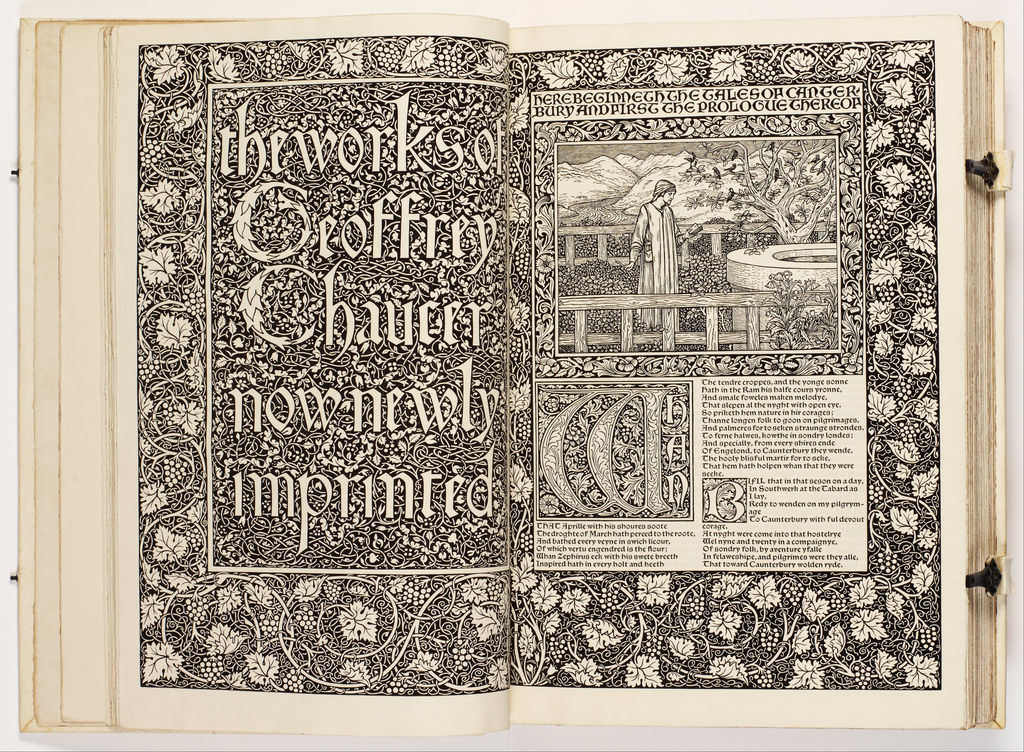
The Chaucer opening offers the most elaborate example: broad foliage surrounds a large title opposite a framed illustration, immense initial and small columns of verse. Its full development belongs to the individual edition, but within the Press’s history it demonstrates how shared methods could support an exceptionally demanding commission. [7]
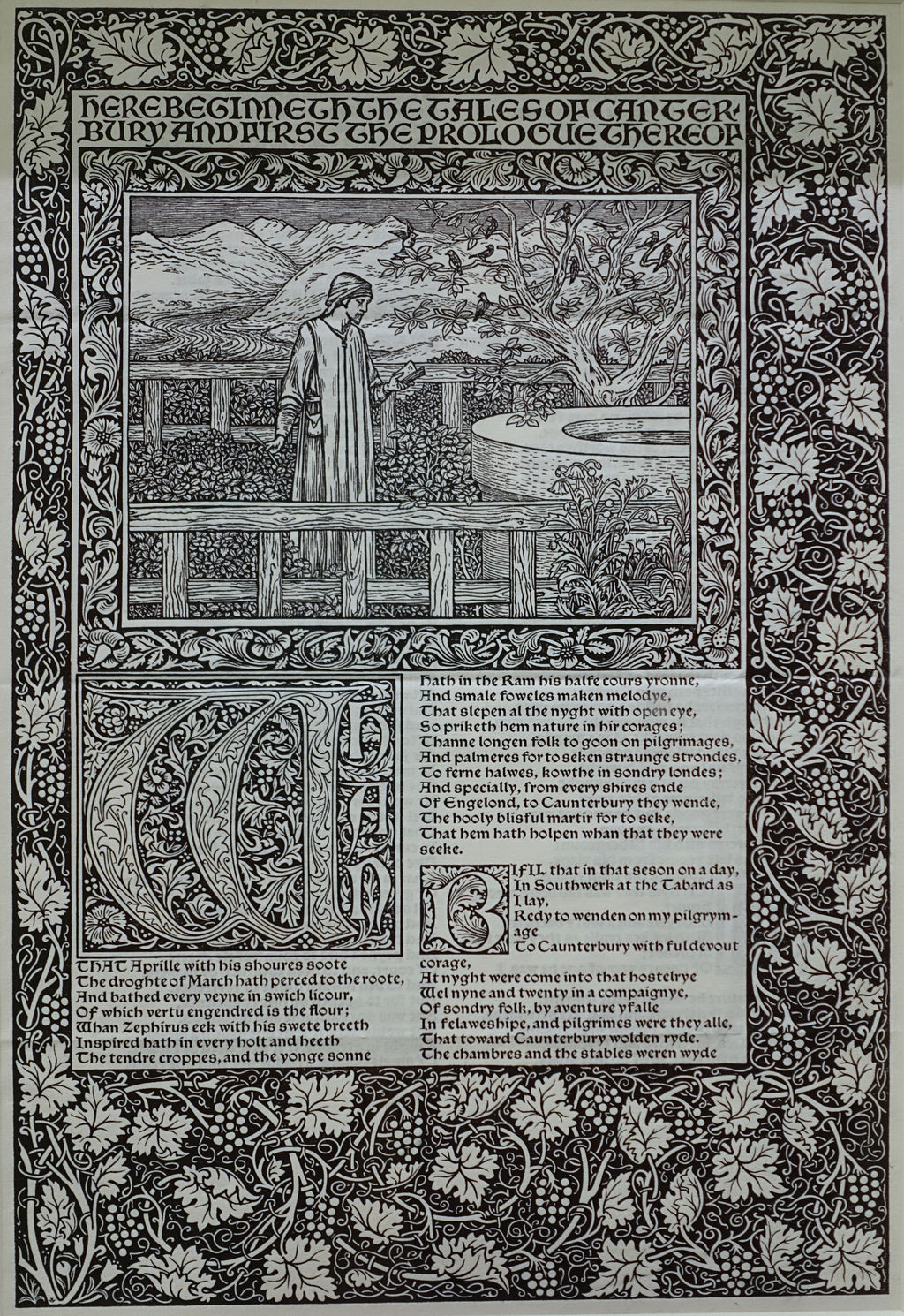
A separate leaf from the Kelmscott Chaucer, with a Burne-Jones illustration above the opening text of The Canterbury Tales and Morris’s surrounding ornament. Daderot. Image source. Public domain.
Paper, ink and the book in the hand
Morris specified handmade linen paper with a firm, well-sized surface. He preferred laid paper, formed on a wire mould, while wanting the resulting lines to avoid a strongly ribbed appearance. His model was a Bolognese paper of about 1473. J. Batchelor and Son made the paper in Kent. The historical example supplied a desired character; a contemporary specialist supplier had to achieve it for a working nineteenth-century press. Durability and appearance were connected in Morris’s explanation of this choice. [1]
The workshop needed several sheet sizes and weights. Its first stock carried a primrose watermark with Morris’s initials. The small sheets were unsuitable for printing The Golden Legend economically, since only two pages could be printed at once, so a larger size was ordered and The Glittering Plain went ahead first. A material constraint changed the order of the catalogue. The name Golden remained attached to the type even though the book that supplied it was published seventh. [1] [3]
Later projects required further adaptations. The Chaucer used a stouter, slightly larger paper with a perch-and-spray watermark; another paper, marked with an apple, served books including The Earthly Paradise and Sigurd the Volsung. The relationship between sheet and finished book is important: folding a sheet produces different formats, while a large folio imposes demands unlike those of a small octavo or sixteenth-size volume. The paper was part of planning a book’s size, thickness and presswork. [1]
Many titles also appeared in a small number of copies printed on vellum, although Cockerell identifies exceptions. A vellum binding does not establish that the pages inside are vellum. University College Oxford’s Maud, for example, is a paper copy bound in limp vellum; its edition comprised 500 copies on paper and five on vellum, the latter not offered for public sale. Distinguishing the material of the leaves from the covering prevents a common confusion when describing a photograph or catalogue entry. [2]
The ink and binding also came through specialist trades. After trying black inks from English suppliers, the Press found one from Hanover most satisfactory. Cockerell says Morris discussed making his own ink but never carried out the plan. J. & J. Leighton bound the books in vellum and in the paper-and-cloth form commonly described as half or quarter holland. Silk ties supplied colour and a means of closing many vellum bindings. These relatively plain coverings keep attention on the printed leaves, although the surviving books may also carry bindings commissioned by later owners. [1]
A workshop that grew with its books
The first cottage soon became too small. Cockerell records the taking of larger premises at 14 Upper Mall in May 1891, followed by the departure from number 16 in June. A second printing press arrived that November while the long Golden Legend was still in production. Later, number 21 Upper Mall provided additional space; Cockerell particularly valued its riverside light. The expanding sequence of rooms and equipment shows an enterprise responding to work in hand. [1]
The workshop used Albion hand presses. Their operation placed physical limits on the size and density of the assembled type and blocks, known as a forme. William S. Peterson’s account of the large Chaucer press draws on Cockerell’s diary and correspondence to explain the difficulty: the pressure needed for the great borders caused repeated trouble with the existing presses. A reinforced machine arrived in December 1894, itself needed repair, and by 8 January 1895 two presses were working on the Chaucer. The episode connects the visual ambition of the page directly to equipment, maintenance and staff. [8]
It also gives substance to the phrase “hand printed”. A book depended on people setting type, preparing formes and operating machinery, as well as on Morris’s design decisions. The Bowdens and the early pressman Giles belong to that history. So do the suppliers whose work reached Hammersmith in the form of paper, type, blocks, ink and bindings. Morris directed a production system in which judgement was distributed among trades. His close involvement does not make all those contributions acts of his own hand. [1] [4]
The Huntington’s surviving business records indicate how much coordination this required. Its guide identifies bills concerning printing equipment, paper and moulds, ink, vellum, wood engraving, binding and type, alongside agreements with dealers and correspondence with Gere. Its ephemera include proofs, developing illustrations, order forms and advertising circulars. These are evidence of the administrative and commercial work surrounding the finished objects. A beautiful opening was the visible result of a chain of orders, payments, corrections and deliveries. [9]
Kelmscott’s selective use of technology also qualifies an easy opposition between machinery and craft. The hand press was itself a machine, photographic enlargement helped the design of type, and electrotypes multiplied ornaments. The practical question was how a process affected the quality and character of the result. The wider arguments about labour and production belong to Morris’s politics and the Arts and Crafts movement; the workshop supplies concrete examples through which those arguments can be examined. [1]
A catalogue wider than its famous Chaucer
The first book issued by the Press was The Story of the Glittering Plain on 8 May 1891. Its Golden type, single principal border and decorated initials established a repertoire without the later edition’s series of pictures. In 1894 Morris returned to the same story in a larger format, with Troy type and Crane’s illustrations. These are two different editions. Comparing them reveals how format, type and illustration could alter the presentation of the same text, rather than merely adding more ornament to an unchanged object. [1]
The Golden Legend, issued in three volumes in November 1892, represents the recovery of earlier printing. It used William Caxton’s translation, edited by F. S. Ellis, and joined a group of Caxton reprints that also included The Recuyell of the Historyes of Troye, Reynard the Fox, The Order of Chivalry and Godefrey of Boloyne. Editors and textual sources mattered alongside the historic appearance of the page. The Press was producing new editions of readable works, with decisions about the text as well as its physical arrangement. [1]
Later writing brought a different range. Ruskin’s The Nature of Gothic appeared in 1892 with a preface by Morris. Rossetti, Keats, Shelley, Tennyson and Coleridge also entered the catalogue. In Maud, completed on 11 August 1893 and published by Macmillan on 30 September, Golden type and black-and-red printing framed Tennyson’s monodrama. The specifically designed borders and woodcut title gave this compact volume its own identity. Its dated colophon records completion, while the later publication date records when it was issued: two events that catalogue summaries can compress into a single year. [1] [2] [3]
The catalogue extended beyond English and medieval European literature. The Book of Wisdom and Lies presented traditional Georgian stories by Sulkhan-Saba Orbeliani in Oliver Wardrop’s translation. Sidonia the Sorceress used Lady Wilde’s translation of Wilhelm Meinhold. Morris’s own Beowulf was credited jointly with A. J. Wyatt. These books make translators and editors visible as participants in the Press’s literary choices; a consistent appearance did not mean a single author or a single textual tradition. [1]
Morris’s romances and poetry formed another substantial strand. The Wood Beyond the World, The Well at the World’s End, Child Christopher and Goldilind the Fair and the new Earthly Paradise brought his own writing into changing formats. Cockerell records that The Well at the World’s End remained in preparation for years while other projects proceeded alongside it. The catalogue is consequently a record of overlapping production, not a tidy queue in which one complete book always followed another. [1]
Printing and publishing were also separate responsibilities. Reeves and Turner sold early books, Quaritch published The Golden Legend, and Macmillan published Maud. Cockerell identifies Godefrey of Boloyne, issued in May 1893, as the first book published and sold at the Press itself. An announcement and order form included specimen pages, allowing potential buyers to see something of the proposed book. Across its life the Press issued lists of available and forthcoming works, alongside announcements for individual titles. Commercial communication became another use for its typography. [1]
Other small jobs carried the letters and ornament beyond books for collectors. Cockerell lists invitations for Hammersmith Socialist Society gatherings, a leaflet for the Ancoats Brotherhood and scholarship certificates for the London County Council’s Technical Education Board. The certificates used oblong borders designed for Chaucer illustrations, including one that did not appear in the book. A decorative form could move from literary illustration to an educational document while acquiring a different purpose. The Press’s output included this less conspicuous working print as well as bound volumes. [1]
A future imagined in an old-looking book
News from Nowhere brings the Press’s visual and literary concerns into unusually close contact. The story first appeared serially in Commonweal between January and October 1890, followed by Reeves and Turner’s book edition in 1891. The William Morris Gallery dates its Kelmscott copy to 1893 and explains that the Press set the text from the earlier book, with corrections. These stages should remain distinct: the Kelmscott volume was a particular material presentation of an already published work. [5]
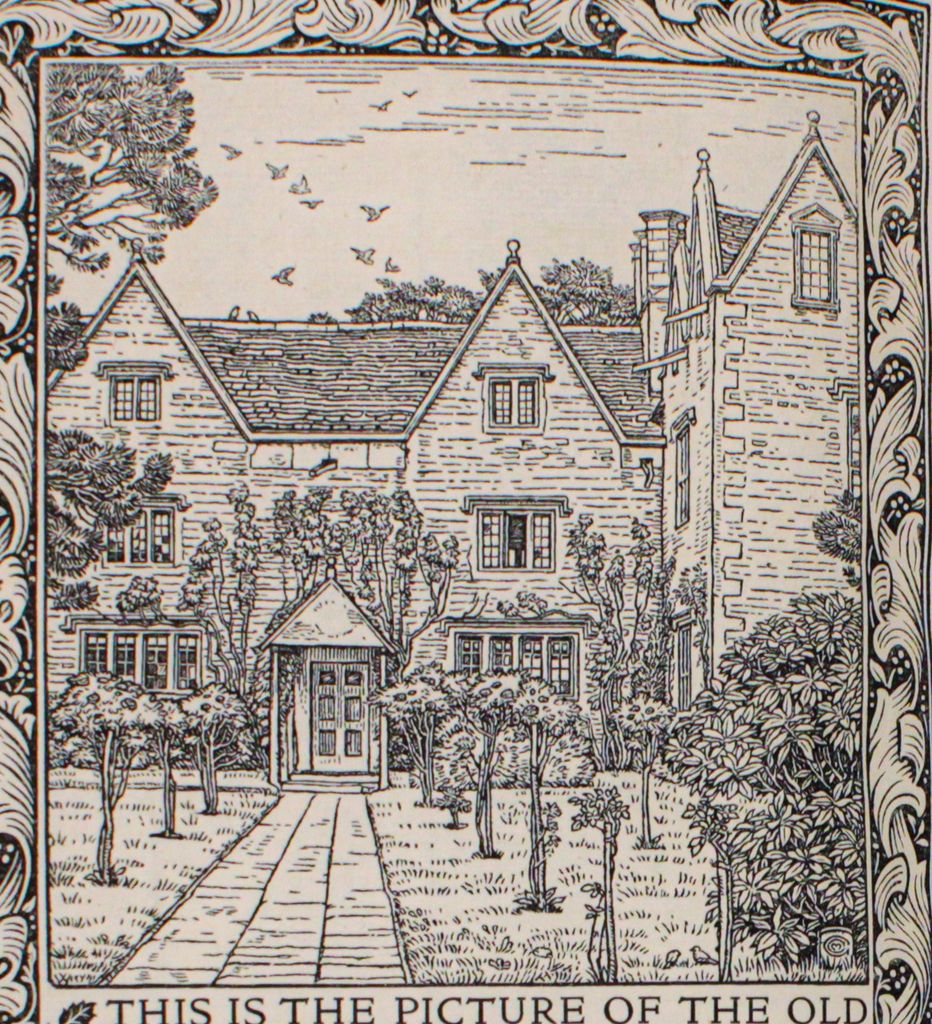
Gere’s frontispiece shows the approach to Kelmscott Manor. In the photographed Pequot opening, a path leads towards the central doorway; gables, windows and planted growth fill the image above Morris’s explanatory lettering. Opposite, the narrative starts with a discussion at the League, its chapter heading printed in red. An identifiable old house and the opening of a modern political romance meet across the fold. The appearance of a historic book accommodates a story concerned with an imagined future. [5] [6]
The picture’s production is equally revealing. Gere designed it, Hooper engraved it, and Morris supplied the surrounding lettering and narrow ornamental border. The Gallery identifies a later reuse of the house view without that border in Gossip about an Old House on the Upper Thames, printed elsewhere in 1895. The image could travel, but its meaning as a book opening depended on the particular frame and facing text. [5]
Its edition of 300 paper copies at two guineas, with ten vellum copies at ten guineas, also exposes a practical tension. Such limited, carefully made books did not offer the same access as newspaper serialisation. Kelmscott preserved and presented writing through a costly form of production; it did not replace every other way of circulating that writing. The Press’s political significance therefore requires attention both to what it printed and to the material conditions under which readers could obtain it. [5]
Prices varied across the catalogue. Cockerell lists Gothic Architecture, printed during the 1893 Arts and Crafts Exhibition, at two shillings and sixpence for a paper copy, against the two-guinea paper Maud. The small lecture book was set at Hammersmith and printed at the New Gallery, and was reprinted during the exhibition. This made the practice of printing publicly visible while producing a comparatively less expensive Kelmscott book. One price or format cannot stand for the whole enterprise. [1]
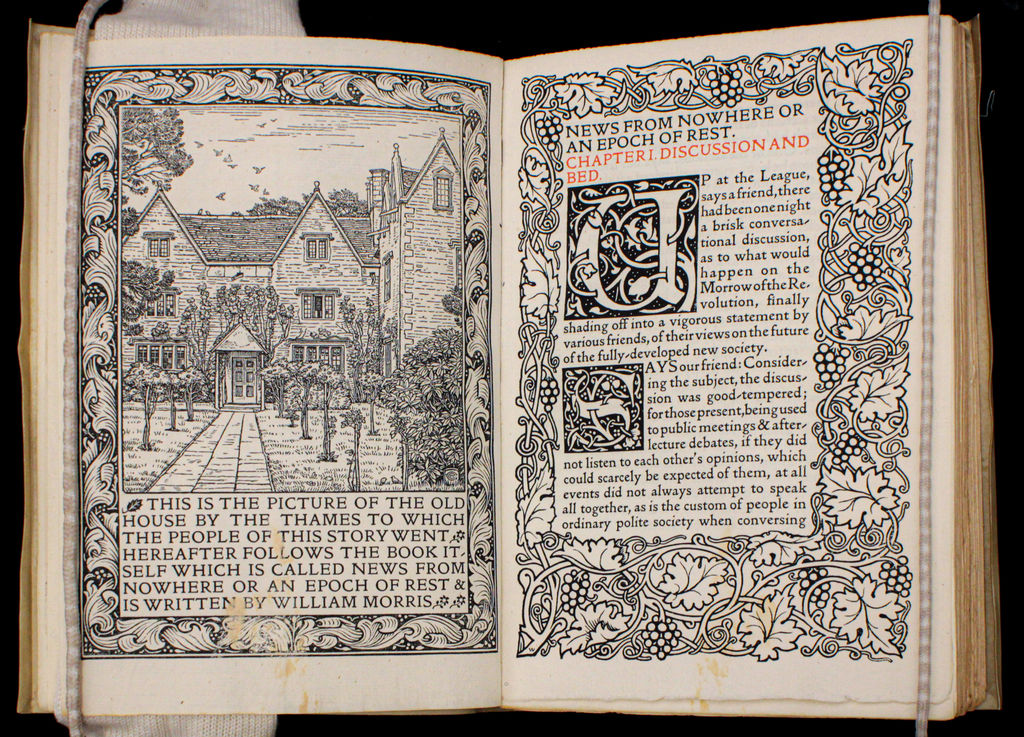
The Kelmscott Press News from Nowhere: a view of Kelmscott Manor faces the opening of Chapter I. Photographed in Pequot Library Special Collections. William Morris, author and book designer; Charles March Gere, frontispiece design; W. H. Hooper, wood engraving; photograph by Southport1639. Image source. CC BY-SA 4.0. Resized only; whole supplied source retained. No appearance changes.
Annotated Details from Kelmscott Press
The numbered points identify visible features discussed in this article. Return from each detail to the whole composition. The Kelmscott Press News from Nowhere: a view of Kelmscott Manor faces the opening of Chapter I. Photographed in Pequot Library Special Collections. William Morris, author and book designer; Charles March Gere, frontispiece design; W. H. Hooper, wood engraving; photograph by Southport1639. Image source. CC BY-SA 4.0. A separate overview adds numbered markers; detail images are crops of the source photograph. CC BY-SA 4.0; retain source credit and licence link. No recolouring, retouching or upscaling.
Details from KELMSCOTT PRESS
Compare the cropped details with the complete images above. Notice how their colours, shapes and positions contribute to the larger compositions.
Kelmscott Manor within the frontispiece
The house and garden path are enclosed by a leafy border. The picture gives the opening a specific place, while the surrounding ornament relates it to the facing page.
The large initial and the opening text
A large decorated initial begins the text beneath the chapter heading. The smaller type runs beside it, combining a strong opening shape with a compact reading column.
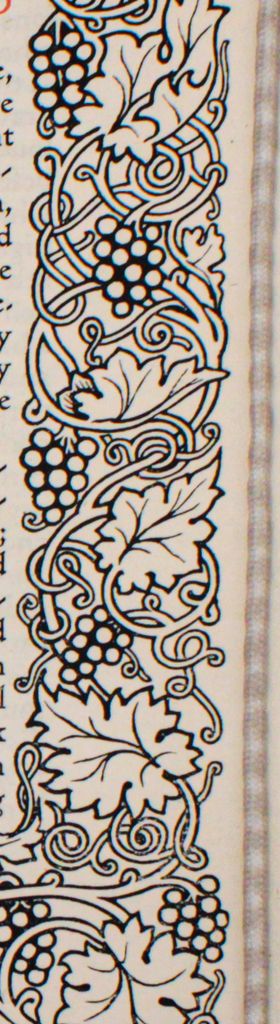
The leafy outer border
Leaves and clusters of round forms turn down the outer side of the page. Their broad black and pale shapes frame the finer text without becoming part of its lines.
Finishing the Press after Morris
Cockerell became secretary in July 1894. After Morris’s death he helped complete the remaining books as an executor, rather than allowing the workshop simply to stop. The posthumous volumes included The Sundering Flood, overseen for the press by May Morris, and Sigurd the Volsung. They belong to the actual Kelmscott production history, even though Morris did not live to see them issued. The closure date is 1898; accounts ending the Press in 1896 or 1897 leave that work out. The Fitzwilliam Museum recounts Cockerell’s decision against taking over the Press with Walker: he doubted whether its standards could be maintained. Completion of the existing work offered a deliberate ending. [1] [10] [11]
The last two issued books were Love Is Enough and A Note by William Morris on His Aims in Founding the Kelmscott Press, both released on 24 March 1898. Love Is Enough carries a December 1897 printing date. Morris’s own Note had been written on 11 November 1895; the final book joined it to Cockerell’s history and annotated list. Composition, printing and issue thus span different years. The Fitzwilliam Museum’s account places the winding up of the Press on 31 March 1898. March 1898 securely marks the conclusion of its seven years of production. [1] [11]
The final Note also returned to the much earlier illustrated Earthly Paradise. Its frontispiece, showing Psyche carried by Zephyrus, used a design by Burne-Jones engraved by Morris for that abandoned project. The William Morris Gallery identifies it as the last book printed at the Press. An early collaboration therefore entered the final volume, connecting an unrealised ambition of the 1860s with the retrospective account of what the workshop had achieved. [10]
Some plans remained unfinished. The Gallery records a posthumous attempt to print the story of Cupid and Psyche with the earlier engravings, for which trial pages were pulled in January 1897. After Kelmscott closed, printing was to pass to the Chiswick Press, but Burne-Jones’s death in June 1898 prevented the proposed revision of illustrations and the edition was abandoned. Completing the final Kelmscott books did not mean that every projected illustrated work reached publication. [10]
The dispersal of equipment was different from the continuation of the designs. Peterson records the sale of the presses to C. R. Ashbee after closure, excluding the types and ornaments. Cockerell’s history describes measures intended to preserve the Kelmscott series as a distinct body of work: recurring electrotypes were destroyed, while woodblocks were deposited under restrictions and type remained with the trustees. Ownership of a machine did not automatically confer the whole visual apparatus of the Press. [1] [8]
That distinction matters when considering its successors. Glasgow’s account places the Doves, Eragny, Ashendene and Vale presses within the wider revival of fine printing associated with Kelmscott. They could share the ambition to treat a book as a designed whole without needing to reproduce Morris’s foliage. The large reinforced Chaucer press itself had a further physical history, passing through other printers’ hands and eventually being acquired by Rochester Institute of Technology in 2013. The afterlife of equipment and the influence of a design principle followed different paths. [8] [12]
Collecting a complete body of work
The customary total of fifty-three Kelmscott works needs a little care. Maryland’s catalogue follows William S. Peterson’s bibliography, with numbered works, a supplementary number such as A20a for Rossetti, and multi-volume publications. Works, editions, volumes and individual copies consequently describe different things. The Golden Legend alone occupies three volumes, while the two versions of The Glittering Plain are separate editions of one literary work. The total should not be understood as fifty-three identical units of production. [1] [3]
A particularly revealing survival is the complete collection associated with a Morris & Co. oak cabinet at Huis van het boek in The Hague. The museum describes fifty-three editions in sixty-six volumes, retaining original vellum or half-linen bindings, together with two vellum proof sheets for an unpublished project. This is a count of that assembled collection, including the proofs as additional objects. It provides a physical counterpart to a bibliographical list. [13]
The cabinet bears the firm’s 449 Oxford Street address. The Dutch national library acquired it in 1954 and placed it on permanent loan to the museum. Books and furniture are joined here through collecting as well as design: the cabinet gathers the variety of formats into a single preserved ensemble. Its original coverings also retain evidence easily lost when books are rebound, separated into leaves or represented only by an especially decorative opening. [13]
Other collections preserve different parts of the process. At the Huntington, original books sit within a larger body of proofs, announcements, illustrations and business records; the collection distinguishes complete Chaucer copies from separate leaves and facsimiles. Each offers a different kind of evidence. A loose leaf allows close examination of type and impression, while an intact volume retains sequence, facing pages and binding. The Press’s insistence on the whole book makes those surviving relationships especially valuable. [9]
Further reading
Continue with historical writing and institutional research available to read online.
The workshop behind the book. William Morris and Sydney Cockerell, The Art and Craft of Printing (Elston Press, 1902).
This reprint joins Morris’s Note with Cockerell’s history and catalogue of the Kelmscott Press. Read the historical account.
Works and designs directory
This directory brings together 365 design, edition and collection records, plus 208 individually listed samples from three historical sample books. Design families, surviving objects, later printings and book editions have separate entries. It covers the research assembled for these articles, rather than the full output of Morris and his associates. Dates and attributions follow the named catalogues; differences are retained where they matter. Search by title, designer, material, collection, accession or colourway.
| Name | Date | Medium |
|---|---|---|
| Blackberry | Design: early twentieth century; specimens catalogued 1903 | Wallpaper |
| Hyacinth | Design: c.1900–12 | Wallpaper |
| Horn Poppy | Design: c.1885 | Wallpaper |
| Chrysanthemum | Design: 1877; some later catalogues say 1876 | Wallpaper |
| Fruit or Pomegranate | Design dates reported: 1862 / 1865–66 | Wallpaper |
| Jasmine | Design: 1871–72; wallpaper issued 1872 | Wallpaper |
| Larkspur | Design/issue dates reported: 1872–75 | Wallpaper |
| Marigold | Design: 1873–75; registered 1875 | Wallpaper |
| Pimpernel | Design/registration: 1876 | Wallpaper |
| Willow | Design: 1874 | Wallpaper |
| Wreath | Design: c.1876 | Wallpaper |
| Trellis | Design: November 1862; registered 1864 | Wallpaper |
| Bird | Design: 1877–78; registered 1878 | Textile |
| Bird — Met 23.163.15 | Design: 1877–78; registered 1878; specimen: unknown | Textile |
| Bird — DIA F1986.48 | Specimen: 1878 | Textile |
| Bird — WMG F283b | Design: 1877–78; registered 1878; specimen: unknown | Textile |
| Bird — Orsay OAO 1249 1 | Design: 1877–78; registered 1878; specimen: unknown | Textile |
| Cabbage and Vine | Design: 1879 | Textile |
| Cabbage and Vine — SAL KM032 | Specimen: 1879 | Textile |
| Cabbage and Vine — V&A E.45-1940 | Drawing/cartoon: 1879 | Drawing |
| Cabbage and Vine — V&A E.3472-1932 | Drawing/cartoon: 1879 | Drawing |
| Evenlode | Registered: 2 September 1883 | Textile |
| Evenlode — WMG F325a | Registered: 2 September 1883; specimen: unknown | Textile |
| Evenlode — Cincinnati 1993.144 | Specimen: 1883–1900 | Textile |
| La Belle Iseult | Painting: conventionally dated 1858 | Painting |
| Study for La Belle Iseult — Christie’s lot 5807506 | Study date: unknown | Drawing |
| Membland Hall Tile Panel | Design: 1876; Orsay model c.1876–77 | Drawing |
| Membland Hall Tile Panel — V&A C.36-1972 | Design/panel: 1876 | Ceramics |
| Membland Hall Tile Panel — WMG C176 | Design/panel: 1876 | Ceramics |
| Design for Membland Hall tile panel — WMG A31 | Drawing: 1876 | Drawing |
| Membland Hall Tile Panel — Orsay OAO 1210 | Model: c.1876–77; specimen: unknown | Ceramics |
| Membland Hall Tile Panel — Cologne E04941 | Design: 1876; specimen: unknown | Ceramics |
| Peacock and Dragon | Design: 1878 | Textile |
| Peacock and Dragon — WMG F26cii | Design: 1878; specimen: unknown | Textile |
| Peacock and Dragon — Met 30.95.52 | Design: 1878; specimen: unknown | Textile |
| Snakeshead | Design: 1876 | Textile |
| Snakeshead — WMG F345 | Design: 1876; specimen: unknown | Textile |
| Snakeshead — Huntington 2000.5.525 | Specimen: c.1876 | Textile |
| Snakeshead — Birmingham 1941M398 | Specimen: 1876–77 | Textile |
| Snakeshead — WMG F366 | Design: 1876; specimen printed after 1917 | Textile |
| Strawberry Thief | Design: 1883 | Textile |
| Strawberry Thief — WMG F422b | Design: 1883; specimen: unknown | Textile |
| Strawberry Thief — Huntington 2000.5.523 | Specimen: c.1883 | Textile |
| Strawberry Thief — Cleveland 1937.696 | Specimen: c.1936 | Textile |
| Tulip and Willow | Design: 1873 | Textile |
| Tulip and Willow — WMG F3 | Design: 1873; specimen printed after 1883 | Textile |
| Tulip and Willow — V&A CIRC.91-1933 | Catalogue date: 1873; manufacture unknown | Textile |
| The Attainment or Vision of the Holy Grail | Design cycle: 1890–91 | Textile |
| The Attainment or Vision of the Holy Grail — Birmingham 1907M131 | Specimen: 1895–96 | Textile |
| The Attainment or Vision of the Holy Grail — Stanmore original Attainment | Woven by 1893 (original Attainment) | Textile |
| The Attainment or Vision of the Holy Grail — McCulloch repeat group | Specimen: 1898–99 | Textile |
| The Attainment or Vision of the Holy Grail — Beecham Attainment/Summons | Specimen: 1927–32 | Textile |
| Wandle | Design: 1884 | Textile |
| Wandle — WMG F50 | Design: 1884; specimen: unknown | Textile |
| The Kelmscott Chaucer | Edition: 1896; issued 26 June | Book |
| The Kelmscott Chaucer — WMG K20 | Specimen: 1896 | Book |
| The Kelmscott Chaucer — Morgan PML76849 | Edition: 1896; issued 26 June; specimen: unknown | Book |
| The Kelmscott Chaucer — Birmingham special-bound copy | Edition: 1896; issued 26 June; specimen: unknown | Book |
| The Kelmscott Chaucer — UMD2010acquisition | Edition: 1896; issued 26 June; specimen: unknown | Book |
| Woodpecker Tapestry | Design/tapestry: 1885 | Textile |
| Woodpecker Tapestry — WMG F139 | Specimen: 1885 | Textile |
| Larkspur — V&A E.468-1919 | Design/issue dates reported: 1872–75; specimen: unknown | Wallpaper |
| Marigold — V&A E.478-1919 | Design: 1873–75; registered 1875; specimen: unknown | Wallpaper |
| Willow — V&A E.488-1919 | Specimen: 1874 (Produced) | Wallpaper |
| Pimpernel — V&A E.497-1919 | Design/registration: 1876; specimen: unknown | Wallpaper |
| Wreath — V&A E.501-1919 | Specimen: 1876 (Produced) | Wallpaper |
| Chrysanthemum — V&A E.802-1915 | Specimen: 1877 (made) | Wallpaper |
| Fruit — V&A E.2210-1913 | Specimen: 1866 (produced) | Wallpaper |
| Blackberry — V&A E.2793-1980 | Specimen: 1903 (made) | Furniture |
| Blackberry — V&A E.2794-1980 | Specimen: 1903 (made) | Furniture |
| Blackberry — V&A E.2839-1980 | Specimen: 1903 (made) | Furniture |
| Blackberry — V&A E.1415-1979 | Specimen: c. 1955 (printed) | Wallpaper |
| Hyacinth — V&A E.1416-1979 | Specimen: c. 1955 (printed) | Wallpaper |
| Trellis — V&A E.452-1919 | Specimen: 1864 (manufactured) | Wallpaper |
| Willow Bough | Design: 1887 | Wallpaper |
| Willow Bough — V&A E.558-1919 | Specimen: 1887 (made) | Wallpaper |
| Blackberry — B179 | Specimen: c.1960s | Wallpaper |
| Hyacinth — B101 | Specimen: 1968 | Wallpaper |
| Horn Poppy — B155 | Specimen: 1885–1920 | Wallpaper |
| Horn Poppy — B112b | Design: c.1885; specimen: unknown | Wallpaper |
| Chrysanthemum — B172 | Specimen: c.1960 | Wallpaper |
| Fruit — B9a | Design dates reported: 1862 / 1865–66; specimen: unknown | Wallpaper |
| Larkspur — B11c | Design/issue dates reported: 1872–75; specimen: unknown | Wallpaper |
| Marigold — B40 | Specimen: before 1940 | Wallpaper |
| Pimpernel — B13 | Specimen: before 1940 | Wallpaper |
| Willow — B69 | Specimen: before 1940 | Wallpaper |
| Willow Bough — B22 | Specimen: after 1940; presented 1950 | Wallpaper |
| Poppy or Wreath — B15 | Specimen: c.1950 | Wallpaper |
| Wreath — 20032D1 | Specimen: c.1876 | Drawing |
| Design for Chrysanthemum — A33 | Drawing: 1877 | Drawing |
| Design for Trellis — BLA472 | Drawing: 1862 | Drawing |
| Trellis — B31 | Specimen: before 1940 | Wallpaper |
| Larkspur printing block — R253 | Design/issue dates reported: 1872–75; specimen: unknown | Printing block |
| Jasmine — 23.163.4j | Catalogue date: 1872; manufacture unknown | Wallpaper |
| Marigold — 23.163.4c | Catalogue date: 1875; manufacture unknown | Wallpaper |
| Willow Bough — 23.163.4k | Catalogue date: 1887; manufacture unknown | Wallpaper |
| Larkspur — 23.163.4i | Catalogue date: 1875; manufacture unknown | Wallpaper |
| Fruit or Pomegranate — 23.163.4g | Catalogue date: c.1866; manufacture unknown | Wallpaper |
| Chrysanthemum drawing — 2000.5.61 | Specimen: c.1877 | Drawing |
| The Pimpernel — HH3016 | Specimen: c.1876 | Wallpaper |
| Marigold — M.2003.6.2 | Design: 1873–75; registered 1875; specimen: unknown | Wallpaper |
| Marigold textile — 1937.699 | Specimen: twentieth century | Textile |
| An Angel with a Harp — Tate A00815 | Work date: unknown | Drawing |
| An Angel with a Pipe — Tate A00816 | Work date: unknown | Drawing |
| A Girl with a Flute — Tate A00817 | Work date: unknown | Drawing |
| Design for Tapestry — Tate A00818 | Work date: unknown | Drawing |
| The Archangel Raphael — Tate A00819 | Work date: unknown | Drawing |
| The Archangel Gabriel — Tate A00820 | Work date: unknown | Drawing |
| La Belle Iseult — Tate N04999 | Work: 1858 | Painting |
| The Archangel Gabriel — Tate N05219 | Work date: unknown | Drawing |
| Figure of Guinevere — Tate N05221 | Work: c.1858 | Drawing |
| Guinevere and Iseult: Cartoon for Stained Glass — Tate N05222 | Work: 1862 | Drawing |
| Angel of the Resurrection: Cartoon for Stained Glass — Tate N05223 | Work: 1862 | Drawing |
| Daisy tile | Specimen: c. 1870 | Ceramics |
| Alceste tile | Specimen: c. 1862 | Ceramics |
| The Labours of the Month | Specimen: 1862 | Ceramics |
| Trellis — Met 23.163.4h | Catalogue date: 1864; manufacture unknown | Wallpaper |
| Trellis — William Morris Gallery B132a | Design: November 1862; registered 1864; specimen: unknown | Wallpaper |
| Trellis — Standen NT1213907 | Design: November 1862; registered 1864; specimen: unknown | Wallpaper |
| Trellis — loose sample-book page B133 | Specimen: printed before 1917 | Wallpaper |
| Sussex armchair — G29 | Design: c.1860s; specimen: unknown | Furniture |
| Sussex chair — G51 | Specimen: c.1868 | Furniture |
| Round-seated Sussex chair — 1214043.2 | Specimen: c.1870 | Furniture |
| Oval centre table — 1213993 | Specimen: c.1870 | Furniture |
| The Backgammon Players — 26.54 | Specimen: 1861 | Painting |
| Table de travail — OAO450 | Specimen: c.1860–68 | Furniture |
| King David the Poet — 1998.231 | Specimen: 1863 | Stained glass |
| Eve and the Virgin cartoon — A8 | Drawing: 1864 drawing; window installed 1865 | Drawing |
| Design for Mermaid woven fabric — A32b | Drawing: c.1880; mermaid figures 1875 | Drawing |
| Wreath carpet point paper — BlA477 | Drawing: c.1870 | Drawing |
| A Note by William Morris on His Aims in Founding the Kelmscott Press — K260 | Edition: March 1898; exact date statements differ | Book |
| Oak cabinet for Kelmscott Press books — no accession supplied | Design: unknown; specimen: unknown | Furniture |
| Stained-glass quarry design, Diplacus punicus / Nihil Desperandum — WMG BLA444 | Drawing date: unknown | Drawing |
| House of Retreat, Crowborough: rose window design — WMG BlA405 | Drawing: c.1913 | Drawing |
| Circular embroidery design with flower and butterfly — WMG A993 | Drawing date: unknown | Drawing |
| Aquilegia quarry design — WMG BLA447 | Drawing date: unknown | Drawing |
| Carnation textile design — WMG A1070 | Drawing: c.1875 | Drawing |
| Wallpaper design with roses and acanthus — WMG BlA503 | Drawing: c. 1880-1900 | Drawing |
| Rottingdean Grail cartoon, fourth panel — WMG A208.4 | Drawing: 1886 | Drawing |
| Rottingdean Grail cartoon, second panel — WMG A208.2 | Drawing: 1886 | Drawing |
| Rottingdean Grail cartoon, third panel — WMG A208.3 | Drawing: 1886 | Drawing |
| Thisbe embroidery design — WMG A211 | Drawing: c. 1863-4 | Drawing |
| Prophet predella cartoon for Jesus College Chapel — WMG A256 | Drawing: 1877 | Drawing |
| Rottingdean Grail cartoon, first panel — WMG A208.1 | Drawing: 1886 | Drawing |
| Designs for embroidery frames — WMG A307 | Drawing: c.1910s | Drawing |
| Flower Garden embroidery design — WMG A218 | Drawing: c.1892 | Drawing |
| Design possibly for painted panelling — WMG A476 | Drawing: 2.1.1886 | Drawing |
| Annunciation cartoon for St Michael and All Angels, Brighton — WMG A4 | Drawing: 1862 | Drawing |
| Design for reversible embroidered table cover — WMG BlA456 | Drawing: c. 1880 | Drawing |
| Combe Court panelled ceiling design — WMG A294 | Drawing: 1890s | Drawing |
| Circular embroidery design with flowers and leaves — WMG A249 | Drawing: 1880-90s | Drawing |
| Carpet design for Miss Beardmore — WMG BLA458 | Drawing: 1875-1877 | Drawing |
| Acanthus embroidery design — WMG A459 | Drawing: 1870s | Drawing |
| Stained-glass quarry design for Jesus College, Cambridge — WMG BlA439 | Drawing: 1873 | Drawing |
| Stained-glass quarry design for Duke of Westminster — WMG BlA440 | Drawing: 1876 | Drawing |
| Stained-glass roundel design with seated young man — WMG BLA487a | Drawing: c. 1930s | Drawing |
| Design for tapestry sofa upholstery — WMG A34 | Drawing: 1880s/early 1900s | Drawing |
| King Arthur and Sir Lancelot stained-glass design — WMG A262 | Drawing: 1862 | Drawing |
| Peacock embroidery-frieze design — WMG A209 | Drawing: c.1875 | Drawing |
| Drawing-room cornice, 9 Chesterfield Gardens — WMG A301 | Drawing: 1880s | Drawing |
| The Flight into Egypt stained-glass design — WMG A260 | Drawing: 1872 | Drawing |
| Lily and Pomegranate wallpaper design — WMG A30 | Drawing: 1886 | Drawing |
| Sideboard inlay design — WMG A1071 | Drawing: c1890 | Drawing |
| Pelican design from the Brampton east window — WMG A136 | Drawing: c.1880 | Drawing |
| African Marigold textile design — WMG BLA464 | Drawing: 1876 | Drawing |
| Medway textile design — WMG A38 | Drawing: 1885 | Drawing |
| East-window canopy, St John the Apostle — WMG BLA413 | Drawing: 1865 | Drawing |
| Window canopy for Christ Church — WMG BLA416 | Drawing: 1865 | Drawing |
| Canopy tracery design — WMG BlA410 | Drawing: 1863 | Drawing |
| Architectural canopy for All Saints Church — WMG A429 | Drawing: 1862 | Drawing |
| The Orchard embroidery design — WMG D294vi | Drawing: 1888 | Drawing |
| Medway working design for block cutters — WMG BLA453 | Drawing: 1885 | Drawing |
| Swivel woven-textile design — WMG BLA465 | Drawing: 1877 | Drawing |
| Red House corridor stained-glass panel designs — WMG BLA436a & b | Drawing: c.1861 | Drawing |
| Two-light window scale drawing — WMG BLA342 | Drawing date: unknown | Drawing |
| Dundee Parish Church memorial-window design — WMG BLA371 | Drawing: c.1874 | Drawing |
| Good Shepherd and Caritas cartoon — WMG BLA364 | Drawing date: unknown | Drawing |
| St Paul’s Montreal window design — WMG BLA354 | Drawing date: unknown | Drawing |
| Honeycomb carpet design — WMG A39 | Drawing: 11.02.1876 | Drawing |
| Wreath three-ply Kidderminster carpet design — WMG BLA480 | Drawing: 1875-1880 | Drawing |
| St Cecilia, Halewood window design — WMG A519 | Drawing: 1881 | Drawing |
| Stained-glass quarry design for 17 Charles Street — WMG BlA438 | Drawing: 1874 | Drawing |
| Parable of the Vineyard cartoon, A268 — WMG A268 | Drawing: 1861 | Drawing |
| Sailing-ship embroidery design — WMG A250 | Drawing date: unknown | Drawing |
| Parable of the Vineyard cartoon, A267 — WMG A267 | Drawing: c.1861 | Drawing |
| Formal net pattern with leaves and flowers — WMG BLA483 | Drawing date: unknown | Drawing |
| Wallpaper design and tracing with pink flowers — WMG A1424:1 | Drawing: 1908-1910 | Drawing |
| Panel-and-tile scheme for 1 Palace Green — WMG A25 | Drawing: c. 1879-80 | Drawing |
| Frieze scheme for 1 Palace Green — WMG A26 | Drawing: 1868-81 | Drawing |
| The Story of the Glittering Plain (first Kelmscott edition) — A1 | Edition: 1891 | Book |
| Poems by the Way — A2 | Edition: 1891 | Book |
| The Love-Lyrics and Songs of Proteus — A3 | Edition: 1892 | Book |
| The Nature of Gothic — A4 | Edition: 1892 | Book |
| The Defence of Guenevere and Other Poems — A5 | Edition: 1892 | Book |
| A Dream of John Ball and A King's Lesson — A6 | Edition: 1892 | Book |
| The Golden Legend — A7 | Edition: 1892 | Book |
| The Recuyell of the Historyes of Troye — A8 | Edition: 1892 | Book |
| Biblia Innocentium — A9 | Edition: 1892 | Book |
| The History of Reynard the Fox — A10 | Edition: 1892 | Book |
| The Poems of William Shakespeare — A11 | Edition: 1893 | Book |
| News from Nowhere — A12 | Edition: 1893 | Book |
| The Order of Chivalry, and L'Ordene de Chevalrie — A13 | Issued: 12 April 1893; catalogue year 1892 | Book |
| The Life of Thomas Wolsey, Cardinal Archbishop of York — A14 | Issued: 3 May 1893; catalogue year 1892 | Book |
| The History of Godefrey of Boloyne and of the Conquest of Iherusalem — A15 | Issued: 24 May 1893; catalogue year 1892 | Book |
| Utopia. — A16 | Edition: 1893 | Book |
| Maud: A Monodrama — A17 | Edition: 1893 | Book |
| Gothic Architecture: A Lecture for the Arts and Crafts Exhibition Society — A18 | Edition: 1893 | Book |
| Sidonia the sorceress — A19 | Edition: 1893 | Book |
| Ballads and Narrative Poems by Dante Gabriel Rossetti — A20 | Edition: 1893 | Book |
| Sonnets and Lyrical Poems — A20a | Edition: 1894 | Book |
| Of King Florus and the fair Jehane — A21 | Edition: 1893 | Book |
| The Story of the Glittering Plain (illustrated edition) — A22 | Edition: 1894 | Book |
| Of the Friendship of Amis and Amile — A23 | Edition: 1894 | Book |
| The Poems of John Keats — A24 | Edition: 1894 | Book |
| Atalanta in Calydon: a Tragedy — A25 | Edition: 1894 | Book |
| The Tale of the Emperor Coustans and of Over Sea — A26 | Edition: 1894 | Book |
| The Wood Beyond the World — A27 | Edition: 1894 | Book |
| The Book of Wisdom and Lies — A28 | Edition: 1894 | Book |
| The Poetical Works of Percy Bysshe Shelley — A29 | Edition: 1895 | Book |
| Psalmi penitentiales — A30 | Edition: 1894 | Book |
| Epistola de contemptu mundi — A31 | Edition: 1894 | Book |
| The tale of Beowulf — A32 | Edition: 1895 | Book |
| Syr Perecyvelle of Gales — A33 | Edition: 1895 | Book |
| The Life and Death of Jason. A Poem — A34 | Edition: 1895 | Book |
| Child Christopher and Goldilind the Fair — A35 | Edition: 1895 | Book |
| Hand & Soul — A36 | Edition: 1895 | Book |
| Poems Chosen Out of the Works of Robert Herrick — A37 | Edition: 1895 | Book |
| Poems Chosen Out of the Works of Samuel Taylor Coleridge — A38 | Edition: 1896 | Book |
| The Well at the World's End — A39 | Edition: 1896 | Book |
| The Earthly Paradise — A41 | Edition: 1896 | Book |
| Laudes Beatae Mariae Virginis — A42 | Edition: 1896 | Book |
| The Floure and the Leafe / The Boke of Cupide — A43 | Issued: 2 November 1896 | Book |
| The Shepheardes Calendar — A44 | Edition: 1896 | Book |
| The Water of the Wondrous Isles — A45 | Edition: 1897 | Book |
| Froissart Chronicles: specimen pages — A46 | Edition: 1896, 1897 | Book |
| Sire Degrevaunt — A47 | Edition: 1896 | Book |
| Syr Ysambrace — A48 | Edition: 1897 | Book |
| Some German Woodcuts of the Fifteenth Century — A49 | Edition: 1898 | Book |
| The Story of Sigurd the Volsung and the Fall of the Niblungs — A50 | Issued: 25 February 1898 | Book |
| The Sundering Flood — A51 | Issued: 25 February 1898; catalogue year 1897 | Book |
| Love is Enough, or the Freeing of Pharamond — A52 | Issued: 24 March 1898; catalogue year 1897 | Book |
| A Note on Aims / A Short Description of the Press — A53 | Issued: 24 March 1898 | Book |
| Wandle — 23.163.10 | Specimen: printed 1917–23 | Textile |
| Snakeshead — 1937.695 | Specimen: early twentieth century | Textile |
| Evenlode curtain — F325b | Registered: 2 September 1883; specimen: unknown | Textile |
| Snakeshead — 1972.395 | Specimen: manufactured 1925–40 | Textile |
| Helen (Flamma Troiae) drawing — E.571-1940 | Caption date: c. 1860; manufacture date unknown | Drawing |
| Lotus wall hanging — T.192-1953 | Caption date: 1875–1880; manufacture date unknown | Textile |
| Wall hanging made by Ada Phoebe Godman — T.166-1978 | Caption date: 1877; manufacture date unknown | Textile |
| Acanthus wall hanging — T.153-1979 | Caption date: c. 1880; manufacture date unknown | Textile |
| Flowerpot embroidered picture — T.68-1939 | Caption date: 1878–1880; manufacture date unknown | Textile |
| Small Stem furnishing textile — T.37-1979 | Caption date: c. 1868; manufacture date unknown | Textile |
| Jasmine Trellis — T.70-1953 | Caption date: 1868–1870; manufacture date unknown | Textile |
| Marigold textile — CIRC.496-1965 | Caption date: 1875; manufacture date unknown | Textile |
| Honeysuckle textile — CIRC.491-1965 | Caption date: 1876; manufacture date unknown | Textile |
| Rose and Thistle — T.634-1919 | Caption date: 1881; manufacture date unknown | Textile |
| Strawberry Thief — T.586-1919 | Caption date: 1883; manufacture date unknown | Textile |
| Cray — CIRC.82-1953 | Caption date: 1884; manufacture date unknown | Textile |
| Tulip and Rose — CIRC.390A-1970 | Caption date: 1876; manufacture date unknown | Textile |
| Peacock and Dragon curtains — T.64&A-1933 | Caption date: 1878; manufacture date unknown | Textile |
| Granada — T.4-1919 | Caption date: 1884; manufacture date unknown | Textile |
| The Forest — T.111-1926 | Caption date: 1887; manufacture date unknown | Textile |
| The Orchard tapestry — 154-1898 | Caption date: 1890; manufacture date unknown | Textile |
| Tulip and Lily — T.101-1953 | Caption date: 1875; manufacture date unknown | Textile |
| Artichoke carpet — T.188-1984 | Caption date: 1875–1880; manufacture date unknown | Textile |
| Floral tile — C.58-1931 | Caption date: 1862; manufacture date unknown | Ceramics |
| Sleeping Beauty tile panel — CIRC.520-1953 | Caption date: 1862–1865; manufacture date unknown | Ceramics |
| Table designed by Philip Webb — W.45-1926 | Caption date: c. 1865; manufacture date unknown | Furniture |
| St George Cabinet — 341:1–8-1906 | Caption date: 1861–1862; manufacture date unknown | Furniture |
| Sideboard — CIRC.540:1–5-1963 | Caption date: c. 1862; manufacture date unknown | Furniture |
| Sunflower — E.513-1919 | Caption date: 1879; manufacture date unknown | Wallpaper |
| St James’s — E.528-1919 | Caption date: 1881; commission 1880; manufacture date unknown | Wallpaper |
| Balmoral — CIRC.16-1961 | Work date: unknown | Wallpaper |
| Pink and Rose — E.708-1915 | Caption date: c. 1890; manufacture date unknown | Wallpaper |
| Compton — CIRC.290-1959 | Caption date: 1896; manufacture date unknown | Wallpaper |
| Tulip frieze (wallpaper design) | Design: unknown | Wallpaper |
| Branch (wallpaper design) | Design: unknown | Wallpaper |
| Daisy (wallpaper design) | Design: 1862 | Wallpaper |
| Scroll (wallpaper design) | Design: c. 1872 | Wallpaper |
| Lily (wallpaper design) | Design: unknown | Wallpaper |
| Powdered (wallpaper design) | Design: c. 1874 | Wallpaper |
| Vine (wallpaper design) | Design: c. 1873 | Wallpaper |
| Acanthus (wallpaper design) | Design: unknown | Wallpaper |
| Honeysuckle (wallpaper design) | Design: 1883 | Wallpaper |
| Wild Tulip (wallpaper design) | Design: unknown | Wallpaper |
| Garden Tulip (wallpaper design) | Design: 1885 | Wallpaper |
| Iris (wallpaper design) | Design: c. 1887 | Wallpaper |
| Autumn Flowers (wallpaper design) | Design: unknown | Wallpaper |
| Norwich (wallpaper design) | Design: c. 1862-96 | Wallpaper |
| Double Bough (wallpaper design) | Design: c. 1884 | Wallpaper |
| Flora (wallpaper design) | Design: late nineteenth century | Wallpaper |
| Blackthorn (wallpaper design) | Design: unknown | Wallpaper |
| Compton (wallpaper design) | Design: 1896 | Wallpaper |
| Celandine (wallpaper design) | Design: late nineteenth century | Wallpaper |
| Golden Lily (wallpaper design) | Design: c. 1880-1917 | Wallpaper |
| Orchard (wallpaper design) | Design: unknown | Wallpaper |
| Seaweed (wallpaper design) | Design: early twentieth century | Wallpaper |
| Daffodil (wallpaper design) | Design: unknown | Wallpaper |
| Meadow Sweet (wallpaper design) | Design: c. 1904 | Wallpaper |
| Persian (wallpaper design) | Design: late 19th century | Wallpaper |
| Sweet Pea (wallpaper design) | Design: c. 1908 | Wallpaper |
| Harebell (wallpaper design) | Design: c. 1911 | Wallpaper |
| Leicester (wallpaper design) | Design: c. 1911-12 | Wallpaper |
| Sweet Briar (wallpaper design) | Design: c. 1912 | Wallpaper |
| Arbutus (wallpaper design) | Design: unknown | Wallpaper |
| Bird and Pomegranate (wallpaper design) | Design: unknown | Wallpaper |
| Brentwood (wallpaper design) | Design: unknown | Wallpaper |
| Indian (wallpaper design) | Design: c. 1868-70 | Wallpaper |
| Morris & Co. Ltd. Wallpaper Pattern Book (post 1917) — B46 | Specimen: after 1917 | Wallpaper |
| Christchurch (wallpaper design) | Design: c. 1882 | Wallpaper |
| Rambler (wallpaper design) | Design: late nineteenth/early twentieth century | Wallpaper |
| Rose (wallpaper design) | Design: 1877 | Wallpaper |
| Brocade (wallpaper design) | Design: late nineteenth century | Wallpaper |
| Triple Net (wallpaper design) | Design: late nineteenth century | Wallpaper |
| Lechlade (wallpaper design) | Design: late nineteenth century | Wallpaper |
| Woodland Weeds (wallpaper design) | Design: late 19th century/early twentieth century | Wallpaper |
| Granville (wallpaper design) | Design: late nineteenth century | Wallpaper |
| Bower (wallpaper design) | Design: c. 1870s | Wallpaper |
| Clover (wallpaper design) | Design: 1903 | Wallpaper |
| Morris & Co. Ltd Wallpaper Pattern Book (c.1913–17) — BlB90 | Specimen: c.1913–17 | Wallpaper |
| Bruges (wallpaper design) | Design: c.1887 (catalogue states 1887–87) | Wallpaper |
| Planet (wallpaper design) | Design: late nineteenth century | Wallpaper |
| Net ceiling (wallpaper design) | Design: 1895 | Wallpaper |
| Sunflower (wallpaper design) | Design: 1879 | Wallpaper |
| Bachelor’s Button (wallpaper design) | Design: 1892 | Wallpaper |
| Bird and Anemone (wallpaper design) | Design: 1881 | Wallpaper |
| Michaelmas Daisy (wallpaper design) | Design: 1912 | Wallpaper |
| Queen Anne (wallpaper design) | Design: c.1868–70 | Wallpaper |
| Borage ceiling (wallpaper design) | Design: 1888-89 | Wallpaper |
| Pink and Rose (wallpaper design) | Design dates reported: c.1890 / 1891 | Wallpaper |
| Poppy (Pink and Poppy) (wallpaper design) | Design: 1880 | Wallpaper |
| Mallow (wallpaper design) | Design: 1879 (Sanderson sample-book catalogue) | Wallpaper |
| Acorn (wallpaper design) | Design: 1879 | Wallpaper |
| Sanderson & Sons Wallpaper Pattern Book (1964) — B89 | Specimen: 1964 | Wallpaper |
| Design for Honeysuckle wallpaper — D7 | Specimen: 1881 (current collection title) | Drawing |
| Arcadia | Design: 1886 | Wallpaper |
| Study of yellow-horned poppy | Specimen: 1882 | Drawing |
| Lily carpet sample — CIRC.65B-1959 | Caption date: c. 1875; manufacture date unknown | Textile |
| Bullerswood carpet — T.31-1923 | Caption date: c. 1889; manufacture date unknown | Textile |
| Design for Oxford Union Ceiling (curved rib of roof) — William Morris Society highlight | Index date: unknown | Drawing |
| Design for Bird, woven wool — William Morris Society highlight | Index date: 1878 | Drawing |
| Design for Windrush printed cotton — William Morris Society highlight | Index date: c.1881 | Drawing |
| Strawberry Thief printed cotton — William Morris Society highlight | Index date: design 1883 | Textile |
| Hammersmith rug — William Morris Society highlight | Index date: 1879 | Textile |
| Design for St Radagunda stained-glass window — William Morris Society highlight | Index date: 1866 | Drawing |
| Design for Ecce Agnus Dei embroidered altar frontal — William Morris Society highlight | Index date: 1868 | Drawing |
| Design for Lamb and Flag embroidered altar frontal — William Morris Society highlight | Index date: 1868 | Drawing |
| Westward Ho! embroidery — William Morris Society highlight | Index date: 1885 | Textile |
| Minstrel with Cymbals embroidery — William Morris Society highlight | Index date: 1885 | Textile |
| Sussex chair — William Morris Society highlight | Index date: c.1865 | Furniture |
| Socialist League membership card — William Morris Society highlight | Index date: 1885 | |
| Stained-glass quarries for Sandroyd — William Morris Society highlight | Index date: 1861 | Stained glass |
| Sussex chair — 2003.14 | Specimen: c.1870 | Furniture |
| Violet and Columbine reclining chair — 2005.2 | Specimen: c.1880 | Furniture |
| Cinderella tile panel — 2000.5.1872 | Specimen: 1862–65 | Ceramics |
| David Healey memorial window, Heywood — 2000.5.530 | Specimen: 1898 | Stained glass |
| Invitation for tapestry viewing — 2000.5.1554 | Design: unknown; specimen: unknown | |
| Pink and Rose printing block — 2000.5.1874 | Design: unknown; specimen: unknown | Printing block |
| Flower Garden embroidered panel — 1983.160a | Commissioned: 30 May 1892 | Textile |
| Flower Garden companion panel — 1983.160b | Commissioned: 30 May 1892 | Textile |
| Fruit Garden pair — Boston accession reported as 1893.160c & d | Design: before 1890; commissioned 30 May 1892 | Textile |
| The Orchard embroidered panel — CIRC.206-1964 | Specimen: 1894 | Textile |
| Peacock embroidery frieze — F430 | Design: unknown; specimen: unknown | Textile |
| Hammersmith rug belonging to Dorothy Walker — 02344 | Design: unknown; specimen: unknown | Textile |
| Garden Tulip original design — 1941p412 | Drawing date: unknown; related textile design 1885 | Drawing |
| Tulip frieze — B46, sample 1 | Sample book: after 1917 | Wallpaper |
| Tulip frieze — B46, sample 2 | Sample book: after 1917 | Wallpaper |
| Willow — B46, sample 3 | Sample book: after 1917 | Wallpaper |
| Willow — B46, sample 4 | Sample book: after 1917 | Wallpaper |
| Willow — B46, sample 5 | Sample book: after 1917 | Wallpaper |
| Willow — B46, sample 6 | Sample book: after 1917 | Wallpaper |
| Willow — B46, sample 7 | Sample book: after 1917 | Wallpaper |
| Willow — B46, sample 8 | Sample book: after 1917 | Wallpaper |
| Willow — B46, sample 9 | Sample book: after 1917 | Wallpaper |
| Willow — B46, sample 10 | Sample book: after 1917 | Wallpaper |
| Willow Bough — B46, sample 11 | Sample book: after 1917 | Wallpaper |
| Willow Bough — B46, sample 12 | Sample book: after 1917 | Wallpaper |
| Willow Bough — B46, sample 13 | Sample book: after 1917 | Wallpaper |
| Willow Bough — B46, sample 14 | Sample book: after 1917 | Wallpaper |
| Branch — B46, sample 15 | Sample book: after 1917 | Wallpaper |
| Daisy — B46, sample 16 | Sample book: after 1917 | Wallpaper |
| Daisy — B46, sample 17 | Sample book: after 1917 | Wallpaper |
| Daisy — B46, sample 18 | Sample book: after 1917 | Wallpaper |
| Daisy — B46, sample 19 | Sample book: after 1917 | Wallpaper |
| Fruit (Four Fruits or Pomegranate) — B46, sample 20 | Sample book: after 1917 | Wallpaper |
| Fruit (Four Fruits or Pomegranate) — B46, sample 21 | Sample book: after 1917 | Wallpaper |
| Fruit (Four Fruits or Pomegranate) — B46, sample 22 | Sample book: after 1917 | Wallpaper |
| Fruit (Four Fruits or Pomegranate) — B46, sample 23 | Sample book: after 1917 | Wallpaper |
| Fruit (Four Fruits or Pomegranate) — B46, sample 24 | Sample book: after 1917 | Wallpaper |
| Trellis — B46, sample 25 | Sample book: after 1917 | Wallpaper |
| Scroll — B46, sample 26 | Sample book: after 1917 | Wallpaper |
| Scroll — B46, sample 27 | Sample book: after 1917 | Wallpaper |
| Jasmine — B46, sample 28 | Sample book: after 1917 | Wallpaper |
| Jasmine — B46, sample 29 | Sample book: after 1917 | Wallpaper |
| Lily — B46, sample 30 | Sample book: after 1917 | Wallpaper |
| Larkspur — B46, sample 31 | Sample book: after 1917 | Wallpaper |
| Larkspur — B46, sample 32 | Sample book: after 1917 | Wallpaper |
| Larkspur — B46, sample 33 | Sample book: after 1917 | Wallpaper |
| Powdered — B46, sample 34 | Sample book: after 1917 | Wallpaper |
| Vine — B46, sample 35 | Sample book: after 1917 | Wallpaper |
| Acanthus — B46, sample 36 | Sample book: after 1917 | Wallpaper |
| Acanthus — B46, sample 37 | Sample book: after 1917 | Wallpaper |
| Pimpernel — B46, sample 38 | Sample book: after 1917 | Wallpaper |
| Chrysanthemum — B46, sample 39 | Sample book: after 1917 | Wallpaper |
| Honeysuckle — B46, sample 40 | Sample book: after 1917 | Wallpaper |
| Honeysuckle — B46, sample 41 | Sample book: after 1917 | Wallpaper |
| Honeysuckle — B46, sample 42 | Sample book: after 1917 | Wallpaper |
| Wild Tulip — B46, sample 43 | Sample book: after 1917 | Wallpaper |
| Wild Tulip — B46, sample 44 | Sample book: after 1917 | Wallpaper |
| Wild Tulip — B46, sample 45 | Sample book: after 1917 | Wallpaper |
| Wild Tulip — B46, sample 46 | Sample book: after 1917 | Wallpaper |
| Garden Tulip — B46, sample 47 | Sample book: after 1917 | Wallpaper |
| Garden Tulip — B46, sample 48 | Sample book: after 1917 | Wallpaper |
| Garden Tulip — B46, sample 49 | Sample book: after 1917 | Wallpaper |
| Iris — B46, sample 50 | Sample book: after 1917 | Wallpaper |
| Iris — B46, sample 51 | Sample book: after 1917 | Wallpaper |
| Autumn Flowers — B46, sample 52 | Sample book: after 1917 | Wallpaper |
| Autumn Flowers — B46, sample 53 | Sample book: after 1917 | Wallpaper |
| Norwich — B46, sample 54 | Sample book: after 1917 | Wallpaper |
| Norwich — B46, sample 55 | Sample book: after 1917 | Wallpaper |
| Double Bough — B46, sample 56 | Sample book: after 1917 | Wallpaper |
| Double Bough — B46, sample 57 | Sample book: after 1917 | Wallpaper |
| Double Bough — B46, sample 58 | Sample book: after 1917 | Wallpaper |
| Flora — B46, sample 59 | Sample book: after 1917 | Wallpaper |
| Blackthorn — B46, sample 60 | Sample book: after 1917 | Wallpaper |
| Compton — B46, sample 61 | Sample book: after 1917 | Wallpaper |
| Compton — B46, sample 62 | Sample book: after 1917 | Wallpaper |
| Celandine — B46, sample 63 | Sample book: after 1917 | Wallpaper |
| Golden Lily — B46, sample 64 | Sample book: after 1917 | Wallpaper |
| Golden Lily — B46, sample 65 | Sample book: after 1917 | Wallpaper |
| Golden Lily — B46, sample 66 | Sample book: after 1917 | Wallpaper |
| Orchard — B46, sample 67 | Sample book: after 1917 | Wallpaper |
| Seaweed — B46, sample 68 | Sample book: after 1917 | Wallpaper |
| Daffodil — B46, sample 69 | Sample book: after 1917 | Wallpaper |
| Meadow Sweet — B46, sample 70 | Sample book: after 1917 | Wallpaper |
| Persian — B46, sample 71 | Sample book: after 1917 | Wallpaper |
| Sweet Pea — B46, sample 72 | Sample book: after 1917 | Wallpaper |
| Harebell — B46, sample 73 | Sample book: after 1917 | Wallpaper |
| Harebell — B46, sample 74 | Sample book: after 1917 | Wallpaper |
| Leicester — B46, sample 75 | Sample book: after 1917 | Wallpaper |
| Sweet Briar — B46, sample 76 | Sample book: after 1917 | Wallpaper |
| Arbutus — B46, sample 77 | Sample book: after 1917 | Wallpaper |
| Bird and Pomegranate — B46, sample 78 | Sample book: after 1917 | Wallpaper |
| Bird and Pomegranate — B46, sample 79 | Sample book: after 1917 | Wallpaper |
| Brentwood — B46, sample 80 | Sample book: after 1917 | Wallpaper |
| Indian — B46, sample 81 | Sample book: after 1917 | Wallpaper |
| Indian — B46, sample 82 | Sample book: after 1917 | Wallpaper |
| Indian — B46, sample 83 | Sample book: after 1917 | Wallpaper |
| Christchurch — BlB90, sample 1 | Sample book: c.1913–17 | Wallpaper |
| Powdered — BlB90, sample 2 | Sample book: c.1913–17 | Wallpaper |
| Powdered — BlB90, sample 3 | Sample book: c.1913–17 | Wallpaper |
| Powdered — BlB90, sample 4 | Sample book: c.1913–17 | Wallpaper |
| Celandine — BlB90, sample 5 | Sample book: c.1913–17 | Wallpaper |
| Rambler — BlB90, sample 6 | Sample book: c.1913–17 | Wallpaper |
| Blackberry — BlB90, sample 7 | Sample book: c.1913–17 | Wallpaper |
| Blackberry — BlB90, sample 8 | Sample book: c.1913–17 | Wallpaper |
| Blackberry — BlB90, sample 9 | Sample book: c.1913–17 | Wallpaper |
| Meadow Sweet — BlB90, sample 10 | Sample book: c.1913–17 | Wallpaper |
| Meadow Sweet — BlB90, sample 11 | Sample book: c.1913–17 | Wallpaper |
| Willow — BlB90, sample 12 | Sample book: c.1913–17 | Wallpaper |
| Willow — BlB90, sample 13 | Sample book: c.1913–17 | Wallpaper |
| Willow — BlB90, sample 14 | Sample book: c.1913–17 | Wallpaper |
| Willow — BlB90, sample 15 | Sample book: c.1913–17 | Wallpaper |
| Willow — BlB90, sample 16 | Sample book: c.1913–17 | Wallpaper |
| Willow — BlB90, sample 17 | Sample book: c.1913–17 | Wallpaper |
| Willow Bough — BlB90, sample 18 | Sample book: c.1913–17 | Wallpaper |
| Willow Bough — BlB90, sample 19 | Sample book: c.1913–17 | Wallpaper |
| Willow Bough — BlB90, sample 20 | Sample book: c.1913–17 | Wallpaper |
| Willow Bough — BlB90, sample 21 | Sample book: c.1913–17 | Wallpaper |
| Willow — BlB90, sample 22 | Sample book: c.1913–17 | Wallpaper |
| Daisy — BlB90, sample 23 | Sample book: c.1913–17 | Wallpaper |
| Daisy — BlB90, sample 24 | Sample book: c.1913–17 | Wallpaper |
| Daisy — BlB90, sample 25 | Sample book: c.1913–17 | Wallpaper |
| Willow — BlB90, sample 26 | Sample book: c.1913–17 | Wallpaper |
| Sweet Briar — BlB90, sample 27 | Sample book: c.1913–17 | Wallpaper |
| Daisy — BlB90, sample 28 | Sample book: c.1913–17 | Wallpaper |
| Sweet Pea — BlB90, sample 29 | Sample book: c.1913–17 | Wallpaper |
| Sweet Pea — BlB90, sample 30 | Sample book: c.1913–17 | Wallpaper |
| Iris — BlB90, sample 31 | Sample book: c.1913–17 | Wallpaper |
| Iris — BlB90, sample 32 | Sample book: c.1913–17 | Wallpaper |
| Iris — BlB90, sample 33 | Sample book: c.1913–17 | Wallpaper |
| Rose — BlB90, sample 34 | Sample book: c.1913–17 | Wallpaper |
| Larkspur — BlB90, sample 35 | Sample book: c.1913–17 | Wallpaper |
| Larkspur — BlB90, sample 36 | Sample book: c.1913–17 | Wallpaper |
| Garden Tulip — BlB90, sample 37 | Sample book: c.1913–17 | Wallpaper |
| Honeysuckle — BlB90, sample 38 | Sample book: c.1913–17 | Wallpaper |
| Hyacinth — BlB90, sample 39 | Sample book: c.1913–17 | Wallpaper |
| Brocade — BlB90, sample 40 | Sample book: c.1913–17 | Wallpaper |
| Leicester — BlB90, sample 41 | Sample book: c.1913–17 | Wallpaper |
| Honeysuckle — BlB90, sample 42 | Sample book: c.1913–17 | Wallpaper |
| Rose — BlB90, sample 43 | Sample book: c.1913–17 | Wallpaper |
| Harebell — BlB90, sample 44 | Sample book: c.1913–17 | Wallpaper |
| Harebell — BlB90, sample 45 | Sample book: c.1913–17 | Wallpaper |
| Scroll (or Scroll and Flower) — BlB90, sample 46 | Sample book: c.1913–17 | Wallpaper |
| Garden Tulip — BlB90, sample 47 | Sample book: c.1913–17 | Wallpaper |
| Garden Tulip — BlB90, sample 48 | Sample book: c.1913–17 | Wallpaper |
| Triple Net — BlB90, sample 49 | Sample book: c.1913–17 | Wallpaper |
| Lechlade — BlB90, sample 50 | Sample book: c.1913–17 | Wallpaper |
| Persian — BlB90, sample 51 | Sample book: c.1913–17 | Wallpaper |
| Persian — BlB90, sample 52 | Sample book: c.1913–17 | Wallpaper |
| Woodland Weeds — BlB90, sample 53 | Sample book: c.1913–17 | Wallpaper |
| Chrysanthemum — BlB90, sample 54 | Sample book: c.1913–17 | Wallpaper |
| Double Bough — BlB90, sample 55 | Sample book: c.1913–17 | Wallpaper |
| Scroll (or Scroll and Flower) — BlB90, sample 56 | Sample book: c.1913–17 | Wallpaper |
| Honeysuckle — BlB90, sample 57 | Sample book: c.1913–17 | Wallpaper |
| Garden Tulip — BlB90, sample 58 | Sample book: c.1913–17 | Wallpaper |
| Granville — BlB90, sample 59 | Sample book: c.1913–17 | Wallpaper |
| Granville — BlB90, sample 60 | Sample book: c.1913–17 | Wallpaper |
| Flora — BlB90, sample 61 | Sample book: c.1913–17 | Wallpaper |
| Flora — BlB90, sample 62 | Sample book: c.1913–17 | Wallpaper |
| Bower — BlB90, sample 63 | Sample book: c.1913–17 | Wallpaper |
| Bower — BlB90, sample 64 | Sample book: c.1913–17 | Wallpaper |
| Clover — BlB90, sample 65 | Sample book: c.1913–17 | Wallpaper |
| Compton — B89, sample 1 | Sample book: 1964 | Wallpaper |
| Norwich — B89, sample 2 | Sample book: 1964 | Wallpaper |
| Pimpernel — B89, sample 3 | Sample book: 1964 | Wallpaper |
| Golden Lily — B89, sample 4 | Sample book: 1964 | Wallpaper |
| Seaweed — B89, sample 5 | Sample book: 1964 | Wallpaper |
| Fruit (Four Fruits or Pomegranate) — B89, sample 6 | Sample book: 1964 | Wallpaper |
| Honeysuckle — B89, sample 7 | Sample book: 1964 | Wallpaper |
| Vine — B89, sample 8 | Sample book: 1964 | Wallpaper |
| Celandine — B89, sample 9 | Sample book: 1964 | Wallpaper |
| Chrysanthemum — B89, sample 10 | Sample book: 1964 | Wallpaper |
| Persian — B89, sample 11 | Sample book: 1964 | Wallpaper |
| Garden Tulip — B89, sample 12 | Sample book: 1964 | Wallpaper |
| Garden Tulip — B89, sample 13 | Sample book: 1964 | Wallpaper |
| Harebell — B89, sample 14 | Sample book: 1964 | Wallpaper |
| Sweet Briar — B89, sample 15 | Sample book: 1964 | Wallpaper |
| Bruges — B89, sample 16 | Sample book: 1964 | Wallpaper |
| Bruges — B89, sample 17 | Sample book: 1964 | Wallpaper |
| Planet — B89, sample 18 | Sample book: 1964 | Wallpaper |
| Planet — B89, sample 19 | Sample book: 1964 | Wallpaper |
| Indian — B89, sample 20 | Sample book: 1964 | Wallpaper |
| Indian — B89, sample 21 | Sample book: 1964 | Wallpaper |
| Net ceiling — B89, sample 22 | Sample book: 1964 | Wallpaper |
| Net ceiling — B89, sample 23 | Sample book: 1964 | Wallpaper |
| Sunflower — B89, sample 24 | Sample book: 1964 | Wallpaper |
| Sunflower — B89, sample 25 | Sample book: 1964 | Wallpaper |
| Sunflower — B89, sample 26 | Sample book: 1964 | Wallpaper |
| Willow Bough — B89, sample 27 | Sample book: 1964 | Wallpaper |
| Willow — B89, sample 28 | Sample book: 1964 | Wallpaper |
| Willow — B89, sample 29 | Sample book: 1964 | Wallpaper |
| Horn Poppy — B89, sample 30 | Sample book: 1964 | Wallpaper |
| Horn Poppy — B89, sample 31 | Sample book: 1964 | Wallpaper |
| Marigold — B89, sample 32 | Sample book: 1964 | Wallpaper |
| Marigold — B89, sample 33 | Sample book: 1964 | Wallpaper |
| Marigold — B89, sample 34 | Sample book: 1964 | Wallpaper |
| Bachelor’s Button — B89, sample 35 | Sample book: 1964 | Wallpaper |
| Bachelor’s Button — B89, sample 36 | Sample book: 1964 | Wallpaper |
| Bird and Anemone — B89, sample 37 | Sample book: 1964 | Wallpaper |
| Bird and Anemone — B89, sample 38 | Sample book: 1964 | Wallpaper |
| Bird and Anemone — B89, sample 39 | Sample book: 1964 | Wallpaper |
| Michaelmas Daisy — B89, sample 40 | Sample book: 1964 | Wallpaper |
| Michaelmas Daisy — B89, sample 41 | Sample book: 1964 | Wallpaper |
| Queen Anne — B89, sample 42 | Sample book: 1964 | Wallpaper |
| Queen Anne — B89, sample 43 | Sample book: 1964 | Wallpaper |
| Indian — B89, sample 44 | Sample book: 1964 | Wallpaper |
| Indian — B89, sample 45 | Sample book: 1964 | Wallpaper |
| Indian — B89, sample 46 | Sample book: 1964 | Wallpaper |
| Larkspur — B89, sample 47 | Sample book: 1964 | Wallpaper |
| Larkspur — B89, sample 48 | Sample book: 1964 | Wallpaper |
| Larkspur — B89, sample 49 | Sample book: 1964 | Wallpaper |
| Larkspur — B89, sample 50 | Sample book: 1964 | Wallpaper |
| Borage ceiling — B89, sample 51 | Sample book: 1964 | Wallpaper |
| Borage ceiling — B89, sample 52 | Sample book: 1964 | Wallpaper |
| Pink and Rose — B89, sample 53 | Sample book: 1964 | Wallpaper |
| Pink and Rose — B89, sample 54 | Sample book: 1964 | Wallpaper |
| Poppy (Pink and Poppy) — B89, sample 55 | Sample book: 1964 | Wallpaper |
| Poppy (Pink and Poppy) — B89, sample 56 | Sample book: 1964 | Wallpaper |
| Poppy (Pink and Poppy) — B89, sample 57 | Sample book: 1964 | Wallpaper |
| Mallow — B89, sample 58 | Sample book: 1964 | Wallpaper |
| Mallow — B89, sample 59 | Sample book: 1964 | Wallpaper |
| Acorn — B89, sample 60 | Sample book: 1964 | Wallpaper |
Frequently Asked Questions
Morris designed Golden as a new roman type informed by Nicolas Jenson’s fifteenth-century printing. Edward Prince cut the punches needed to make it usable in type. [1]
The Story of the Glittering Plain was issued on 8 May 1891. It was the Press’s first published book. [1]
Discussion
Look again at the images and ideas explored in Kelmscott Press. These editorial prompts invite your observations.
Use the details, comparisons and questions below to begin your own reading of Kelmscott Press.
Reader Insights
Compare the Chaucer opening with News from Nowhere. How do picture, title and type divide the opening?
Where do the margins do work even when they contain no ornament?
How does the network of punch cutting, engraving, papermaking and printing change the idea of a private press?
Join the Conversation
Share a detail, comparison or question about Kelmscott Press below.
References
- William Morris and Sydney C. Cockerell, The Art and Craft of Printing, Elston Press, 1902, reprinting Morris’s Note dated 11 November 1895, Cockerell’s history, annotated catalogue and original endnotes. Consulted the Note, history of type, ornament, materials and premises, selected catalogue entries and endnotes; the endnote corrects the Chaucer’s misprinted 1893 issue year to 1896. Accessed 29 October 2026. View source.
- University College Oxford, “The Kelmscott Press”, 13 December 2013, feature and bibliographical description of Tennyson’s Maud, Peterson A17; includes transcribed colophon, binding, edition and publication details. Accessed 29 October 2026. View source.
- University of Maryland Libraries, “Publications: Kelmscott Press Books”, introduction and selected entries, using William S. Peterson’s bibliographical numbers. Accessed 29 October 2026. View source.
- William Morris and Sydney C. Cockerell, A Note … together with a Short Description of the Press … and an Annotated List of the Books Printed Thereat, Kelmscott Press, 1898, original-book scan, William Morris Archive, University of Iowa Libraries; printed pp. 12–15 visually consulted. The available scan is partial. Accessed 29 October 2026. View source.
- William Morris Gallery, News from Nowhere: or, An Epoch of Rest, K5, 1893; object record, edition history and frontispiece description. Accessed 29 October 2026. View source.
- Southport1639, photograph of the Kelmscott News from Nowhere opening in Pequot Library Special Collections, 8 June 2023, Wikimedia Commons, CC BY-SA 4.0. Exact opening inspected; the file description’s 1892 date is not used as a verified publication date. Accessed 29 October 2026. View source.
- The Works of Geoffrey Chaucer: photographed opening, 1896, Wikimedia Commons / Google Art Project, public domain. Exact opening inspected. Accessed 29 October 2026. View source.
- William S. Peterson, “Morris’s Albion press for sale”, The Kelmscott Chaucer, 18 October 2013, with December 2013 updates; includes reported Cockerell diary and correspondence evidence. Accessed 29 October 2026. View source.
- Huntington Library, “William Morris: Library Kelmscott Press Collections”, guide to books, ephemera and business records, updated 31 August 2026. Its 1897 closure statement is superseded here by the primary catalogue and specific 1898 records. Accessed 29 October 2026. View source.
- William Morris Gallery, A Note by William Morris on His Aims in Founding the Kelmscott Press …, K260, March 1898; final-book and frontispiece history. Accessed 29 October 2026. View source.
- Fitzwilliam Museum, “The pre-Raphaelites”, I Turned It into a Palace, archived exhibition account of Cockerell’s work at the Press and its closure. The introduction’s sixty-five-title total is not adopted. Accessed 29 October 2026. View source.
- University of Glasgow Library, “Kelmscott Press”, Private Press Books in Special Collections, historical overview and selected-book index. Accessed 29 October 2026. View source.
- Rijksmuseum Meermanno / Huis van het boek, “Kunstenaarsboeken: Boekenkast Kelmscott Press” (in Dutch), cabinet and complete-set history. Accessed 29 October 2026. View source.
- Splash image, The Kelmscott Chaucer, 1896: a complete opening brings the decorated title page together with the facing illustration, initial and text. William Morris. Image source. Public domain.


 William Morris.jpg)