 by Tom Gurney
Tom Gurney BSc (Hons) is an art history expert with over 20 years experience
Email: tomgurney1@gmail.com / Phone: +44 7429 011000
Overview
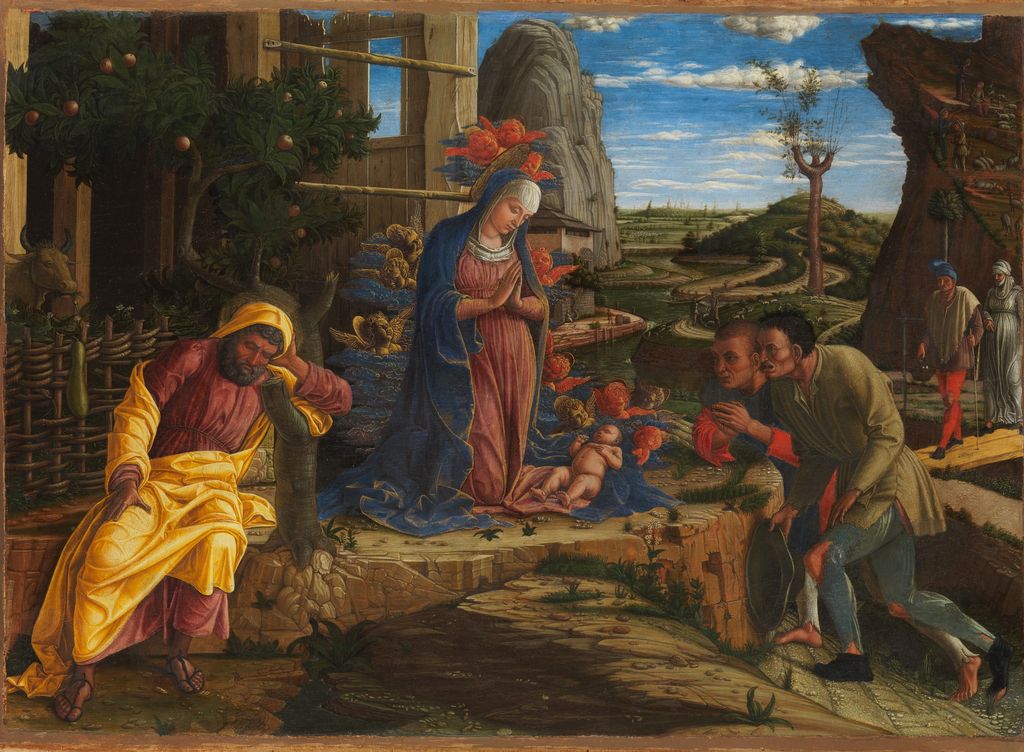
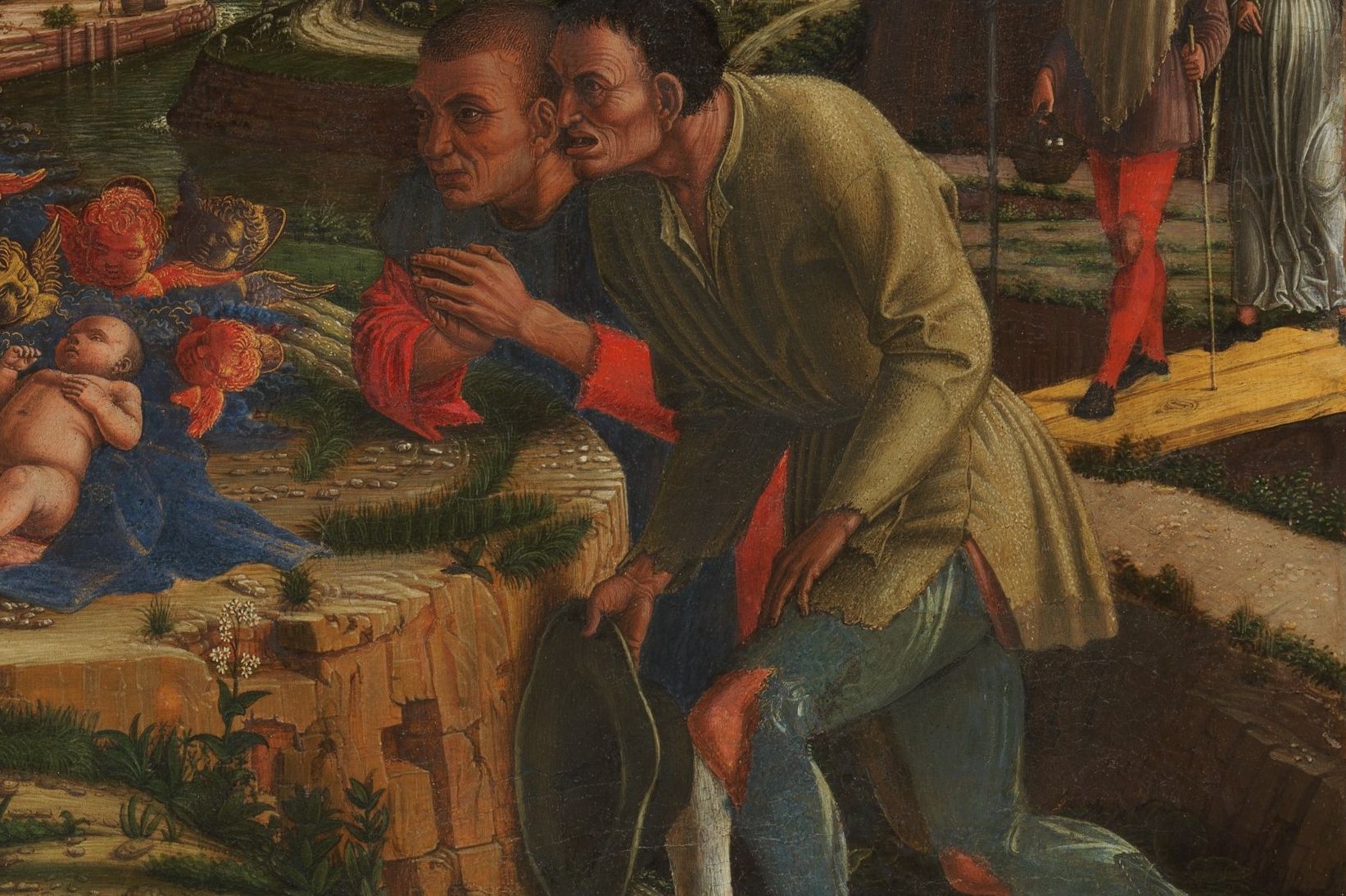
Two shepherds come down to the level of a newborn child. One presses his hands together. The other takes off his hat and leans so far forward that the torn knee of his stocking catches the eye. Beyond them, a pale track winds through the hills. High on the right, a tiny shepherd is still receiving the news that has brought the men to Mary. Andrea Mantegna fits the announcement, the journey and the act of adoration into a picture a little over half a metre wide. [1]
The Metropolitan Museum of Art in New York dates The Adoration of the Shepherds to shortly after 1450. It is tempera originally painted on wood and now carried on canvas. The work measures 40 × 55.6 centimetres overall, while the painted surface is 37.8 × 53.3 centimetres. It entered the Met in 1932 through an anonymous gift used for the purchase and is accessioned as 32.130.2. [1]
At a Glance
- DateShortly after 1450, according to the Met
- MediumTempera on canvas, transferred from wood
- Dimensions40 × 55.6 cm overall; painted surface 37.8 × 53.3 cm
- CollectionThe Metropolitan Museum of Art, New York
- Accession32.130.2
Andrea Mantegna in context
San Zeno Altarpiece
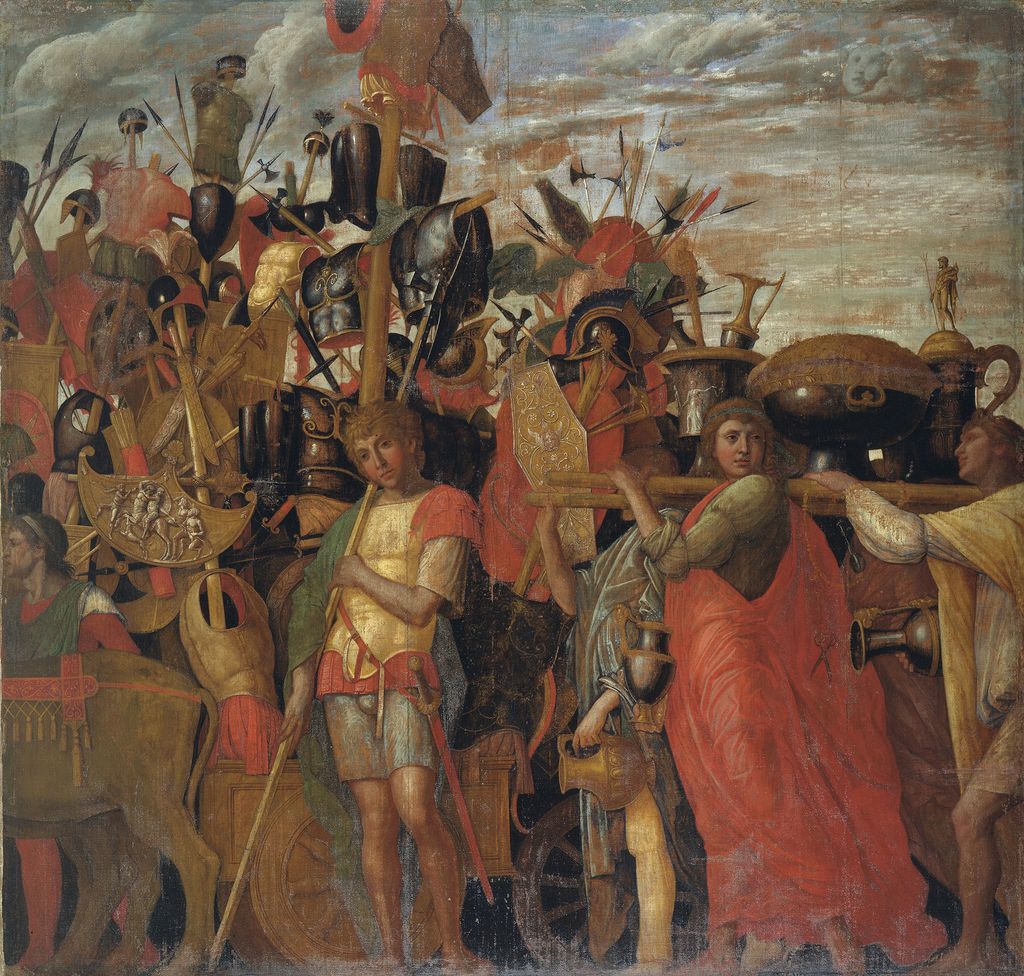
1457–59 [19]The Triumphs of Caesar
Mid-1480s–before 1506 [21]Madonna della Vittoria
1495–96 [22]The Adoration of the Shepherds
Shortly after 1450 [1]The shepherds lower themselves
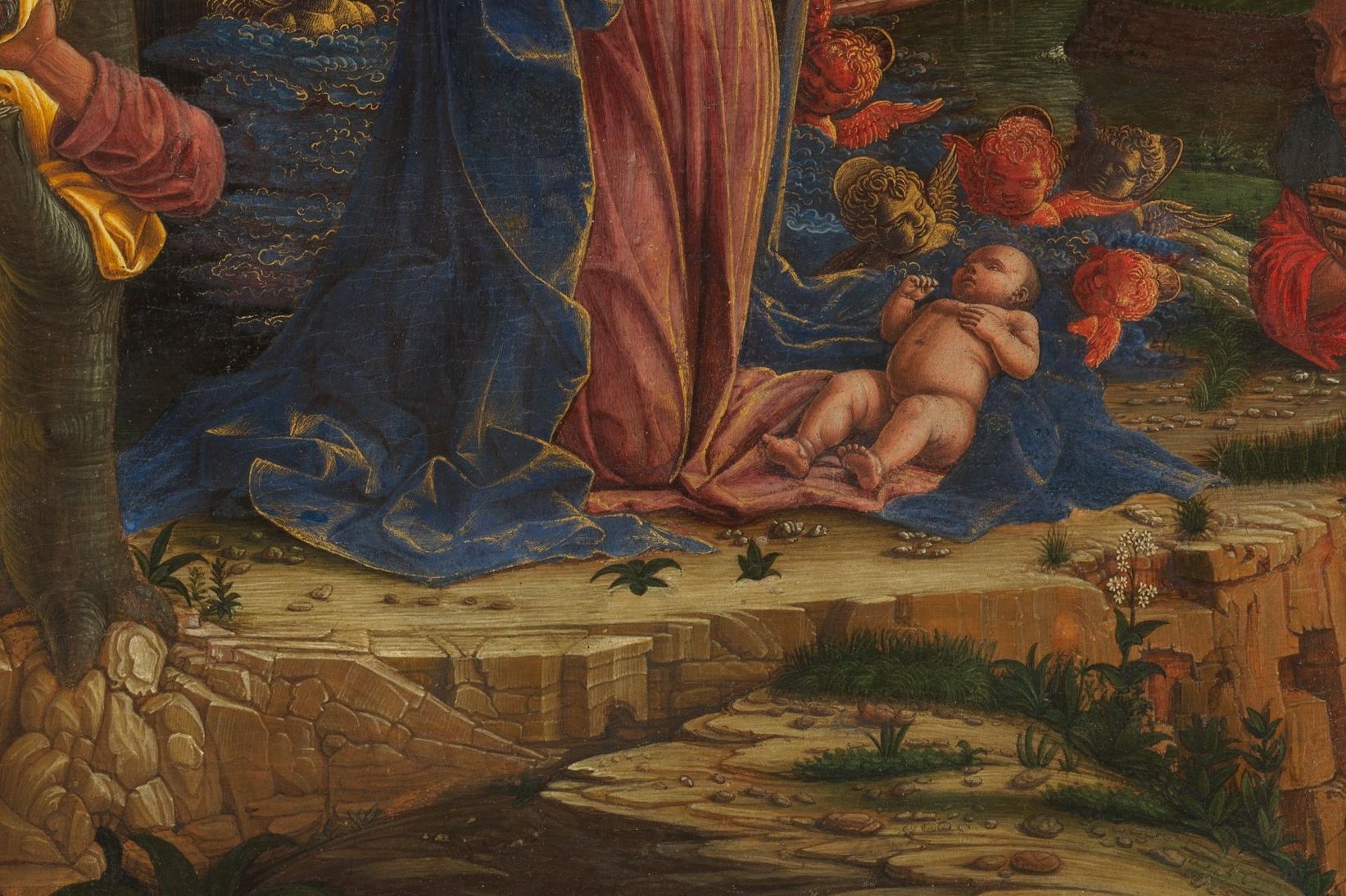
Start with the child. He is naked, with his legs turned towards us and his head nestled among the folds of Mary’s mantle. His small body lies across the foot of her kneeling figure, where blue cloth pools over a shelf of rock. Mary bows her head and joins her hands. Her movement brings her gaze down towards the infant and gives the men opposite her a posture to echo. The nearer shepherd still grips his hat low beside the ledge. Behind him, the other has raised his joined hands almost to his chin. Their faces are close enough to overlap, but the two gestures can be read separately. [1]
In Luke’s Gospel, an angel announces the birth to shepherds keeping watch at night. They hurry to Bethlehem, where they find Mary and Joseph with the baby lying in a manger. Mantegna shows the announcement in the distance and the visit in the foreground. He puts the infant on Mary’s clothing, in the low position associated with images of the Virgin adoring the child. The arrangement lets the worshippers gather very close to him while preserving the space around his body. The Met’s Jean Sorabella draws attention to the men’s bare feet, torn clothes and awestruck expressions. The man with the hat reaches the ledge with one knee thrust forward and the other leg stretched behind. You can see him bringing his weight down to the child’s level. [1] [2] [3]
On the left, Joseph props his head on his hand, asleep beneath a fruit tree. His ample yellow drapery spills down towards the ground. Beyond his shoulder the ox peers over the woven barrier, its mouth occupied with a tuft of grass. Joseph’s weight and the animal’s ordinary activity steady a scene in which something much stranger is happening in plain view. Winged faces emerge from clouds along the outside of Mary’s mantle. Some are red, others glint with gold. They gather at the level of the infant and reappear above her head. The Met reads the continuity of robe and cloud as a passage between the earthly and the divine. Look where little strokes of gold catch the folds of cloth and the wings. The transition is made through shared colour and line as much as through the presence of angels. [1] [4]
Dawn along the track
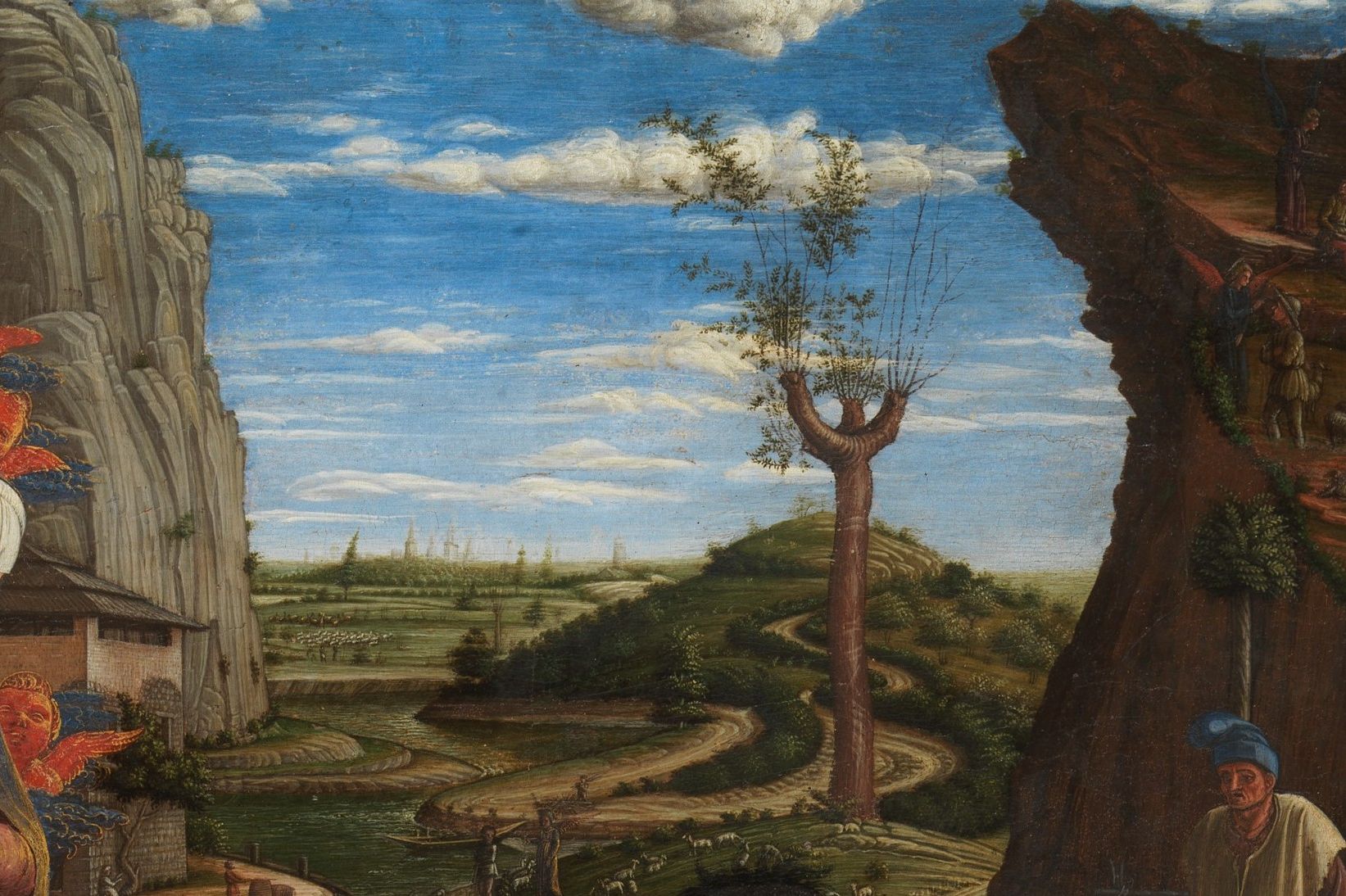
The rock behind Mary rises in curved, near-vertical ridges. At the far right a darker crag projects into the sky, with scattered sheep visible on the hillside beside it. Between these masses, the view opens to low fields and a thin, bright horizon. The clear blue overhead and the pale light behind the hills suggest dawn. Luke places the watch and the announcement at night. The painting sets the earlier event inside the same brightening landscape as the visit, giving the eye a route between moments that the story sets apart. [1] [2] [4]
A pale track curls around a slender, pollarded-looking tree and recedes in bends beyond it. The turn of the road pulls attention into the valley, where the river takes its own curving course. Keith Christiansen points out a man with barrels at the water’s edge and a boat approaching him. Farther forward, two people come across a plank bridge. Their small size marks the distance from the kneeling men, while the bright red of one walker’s hose makes him easy to find. In this busy distance Christiansen also picks out a woman sitting under a tree and spinning. People go on working while the shepherds stop to pray. [1] [4]
The foreground rewards a closer look. Tiny plants take hold in cracks in the rock, and the ledge breaks into almost rectangular faces. Its flat top accommodates Mary’s trailing cloth. Its edge shows just how low the approaching men have bent as they peer over it. Above Mary, the ridge behind her rises almost vertically, carrying her silhouette high into the landscape even as she bends towards the ground. Across the valley the fields merge into bands of green, and thin clouds lie almost parallel to the horizon. The scale changes from individually drawn leaves to fields that barely retain their edges. The same picture can feel broad when the eye follows the road and intimate when it stops at the child’s feet. [1] [4]
Padua and the Ferrara connection
The Adoration belongs to Mantegna’s early career, when he was undertaking the Ovetari Chapel frescoes in Padua. He joined that project in 1448, while still a teenager, and is documented in Ferrara in 1449 through a now-lost double portrait of Leonello d’Este and his chamberlain Folco da Villafora. The Met’s catalogue of northern Italian paintings places the Adoration before the San Zeno Altarpiece and suggests a possible connection in date with the early Saint James frescoes in the Ovetari Chapel. The Louvre’s 2008 exhibition gave the picture a later date, about 1455–56, and showed it in the context of the San Zeno paintings. The scale of the wooden panel gave him room for a different kind of detail from the chapel walls. The tip of a leaf or the flash of a wing can hold the eye before it moves back to the figures. [5] [6] [7] [8]
The Met sees a response to the taste for Netherlandish painting at Ferrara. Christiansen connects the shepherds’ individual features and the precision of the landscape with that tradition. A specific reason to consider Rogier van der Weyden is that, as the northern Italian catalogue notes from the testimony of the humanist Bartolomeo Facio, a Descent from the Cross by Rogier was recorded in Leonello’s collection by 1449. That puts a work by Rogier in a place Mantegna is documented visiting. The grain of the timber, the water at the riverbank and the creases around the shepherds’ eyes show what the comparison is about. The suggestion that a particular Rogier painting served as a model remains an inference. [1] [4] [7] [8]
The Met also names Leonello’s successor Borso d’Este as a possible patron. Christiansen points to the long gourd hanging on the woven fence beside Joseph. Federica Fanti, writing for the Ducato Estense, connects the fence with a paraduro, a barrier used against flooding and adopted by Borso as an emblem, and describes how a hollow gourd could serve as a float to indicate rising water. The Met’s northern Italian catalogue reads the gourd as a sign of the Resurrection and the orange tree as a sign of redemption. The painted gourd can be seen clearly, while the link to a patron depends on what the fence and gourd are understood to evoke. The commission itself remains undocumented. [1] [4] [7] [8]
The edge that moved
The transfer to canvas changed what carries the paint. The reduction of the right edge changed how the scene is composed. Esther Singleton’s 1929 account of the work in Clarence H. Mackay’s collection already describes it as transferred from panel to canvas. The Met’s 1983 study by Christiansen treats the date of the right-hand cut as uncertain. A Nativity by Mantegna recorded in Margherita Gonzaga’s chapel at Ferrara in the late sixteenth century may be this work. The first secure identification in the Met catalogue is Giovanni Battista Agucchi’s 1603 inventory of Cardinal Pietro Aldobrandini’s collection in Rome. The inventory gives no dimensions that would establish whether the picture had already been cut. By 1808 it had passed through the London art trade to Richard Payne Knight of Downton Castle, where it remained in the family collection until 1924. [1] [7] [9] [10]
Two early copies help explain what is gone. A painted fragment formerly in the Martin Le Roy collection repeats the upper-right area and shows a tree trunk and another person behind the couple on the bridge. A drawing at Windsor, catalogued by the Royal Collection as After Andrea Mantegna, preserves the two large shepherds and the figures behind them, including a trace of a third person. The copyist changes details of the bridge group, giving the woman a bird to carry. Christiansen noted a difference in her footing between the fragment and the Met painting and proposed that the Windsor drawing was taken from a fuller version of the replica. The resemblances tell us that the view once continued beyond the couple. The differences show how much judgment goes into reconstructing it. [7] [9] [11] [12]
Christiansen estimated that about six centimetres were lost at the right. In his reconstruction the foreground rise curved beneath the shepherds, and a large tree helped balance the space around them. Mary would have knelt farther to the left of the picture’s midpoint, and the men would have seemed less pressed against the frame. The catalogue raises the possibility that the left edge was also reduced, based on the absence of the ass that often accompanies the ox. Christiansen’s later examination judged the left edge apparently original. André Pératé, writing in 1909, described both animals in the painting then at Downton Castle, though his description drew in part on an earlier writer. The older account leaves room for doubt about what was seen on the left. The surviving copies give much firmer evidence for the right. [7] [9] [12]
The design also travelled in a form that invited alteration. Christiansen identifies an adaptation in an illumination from the missal of Barbara of Brandenburg, attributed to Girolamo da Cremona. The illustrator reverses the scene and preserves its off-centre grouping. The Diocese of Mantua records that Mantegna helped bring Girolamo into the manuscript project, which was completed around 1465. Christiansen also traces the design to a choir book at Siena Cathedral. There the ledge follows the curve of an illuminated initial P, and the shepherds move from the side to a position behind the ledge. The rock could be a raised place for prayer, a boundary between figures or, in a book, part of the shape of a letter. [7] [9] [13]
Rock, prayer and the distance to the child
The rocky shelter in St Jerome in the Wilderness gives the landscape a different devotional task. The Museu de Arte de São Paulo dates its panel to 1448–51. Jerome sits in a stony recess, with a cross, a candle and books helping define the place of his solitary prayer. A lion rests nearby. In the Adoration, the rock lifts Mary and the infant into view while the road and bridge admit people from outside their immediate circle. Jerome’s enclosure and Mary’s ledge use closely observed ground to set different terms for an encounter, one withdrawn and the other open to arrivals. [1] [14]
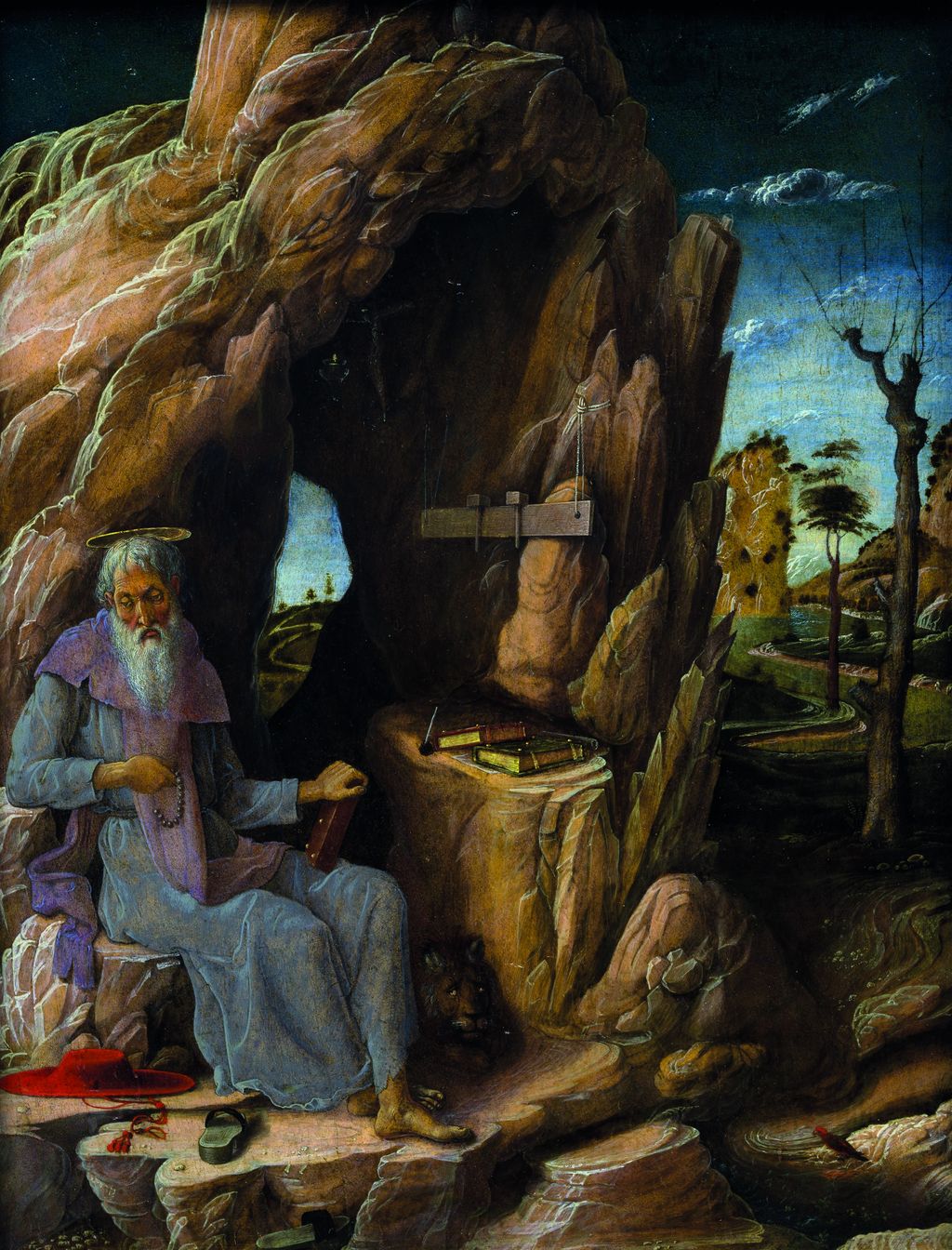
Saint Jerome Penitent in the Desert, Museu de Arte de São Paulo Image source. Public domain.
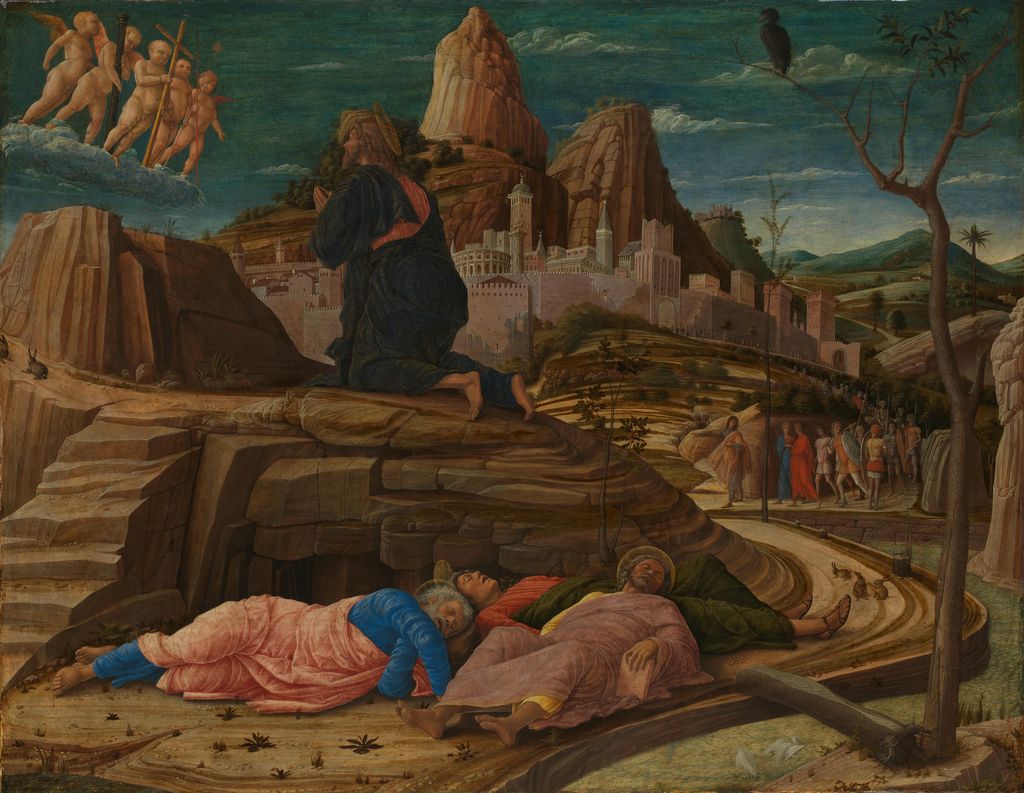
In Mantegna’s London Agony in the Garden, dated about 1455–56 by the National Gallery, Christ prays on a rock while sleeping disciples lie below and soldiers approach down a winding slope. Both paintings let a track carry the next decisive encounter towards a figure at prayer. Here the movement ends with a lowered hat and joined hands. In the Agony it brings an armed company into focus. Giovanni Bellini’s version of the Agony, also in London, makes a revealing comparison with the light in the Adoration. The National Gallery points out how the peach colour of Bellini’s dawn passes into Christ’s pink tunic. Mantegna’s distant opening stays cooler, and the incisive edges of his rock, cloth and wings keep their hold on the foreground. [1] [15] [16]
The separate Agony in the Garden from the San Zeno predella, now in Tours, brings the comparison back to Mantegna’s own handling of first light. The museum’s dossier describes touches of pink in the moving water and the interruption of their effect where a loss has been filled with dark colour. In the Adoration, the pale horizon opens a distant space behind the ledge. In Tours, daybreak is also something that happens at the surface of the stream. The shallow water takes on colour while the rock beside it remains in shadow. [1] [9] [17]
Decades later, in the Getty Adoration of the Magi, dated about 1495–1505, Mantegna draws the worshippers so close that the intervals between faces, hands and vessels do the work once given to paths and bridges. The kings bring gifts that can be inspected at close quarters, including Caspar’s blue-and-white porcelain cup. In the Met picture, the nearer shepherd holds his hat low beside his knee. After the long view through the landscape, the simple gesture tells us that he has reached the place he was looking for. [1] [18]
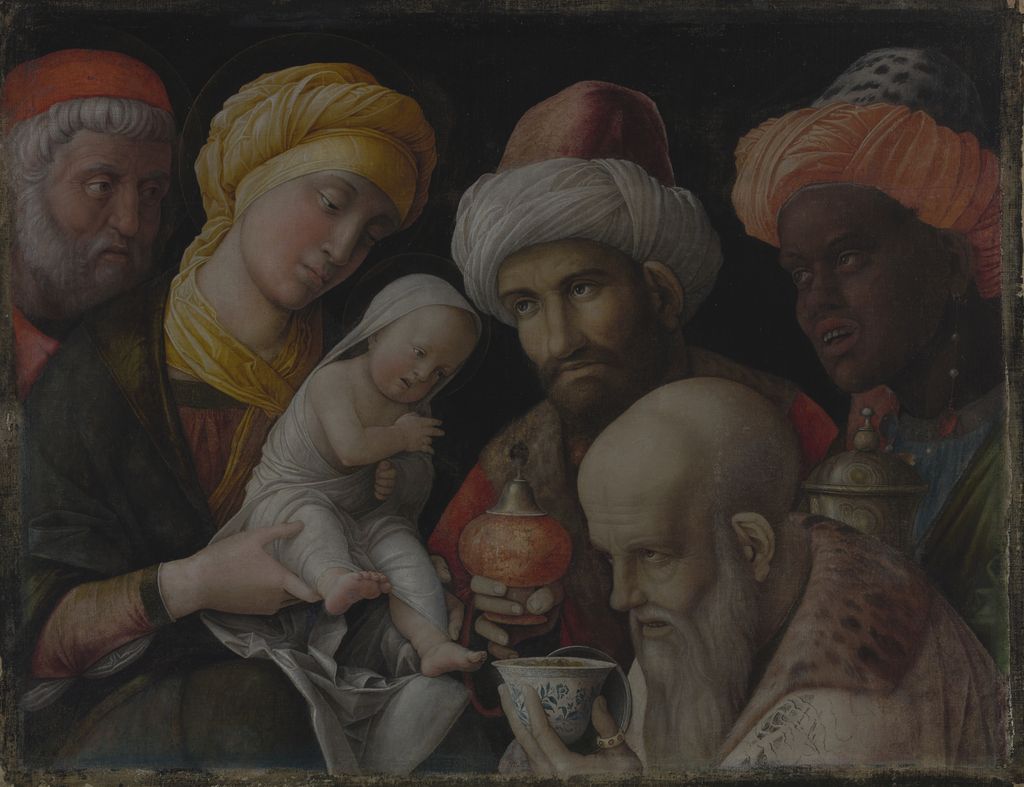
Adoration of the Magi, J. Paul Getty Museum Image source. Public domain.
Annotated Details from The Adoration of the Shepherds
The numbered points identify details to look at closely. The detail images below preserve the native scale of the selected crops.
The Adoration of the Shepherds
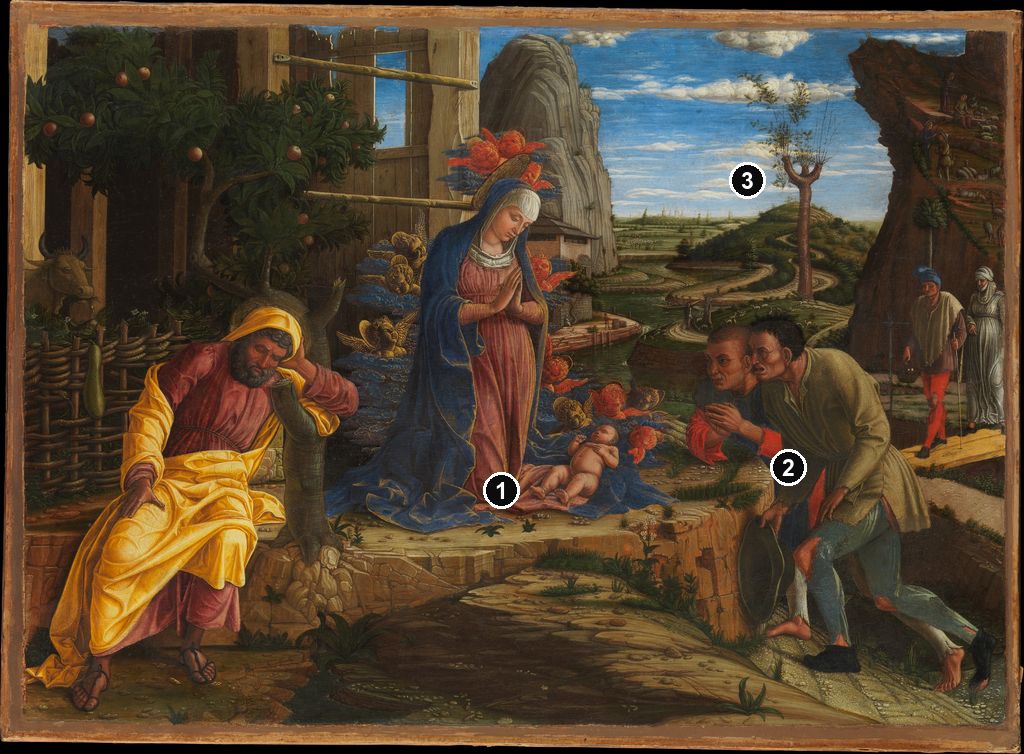
Details from THE ADORATION OF THE SHEPHERDS
Choose a detail to enlarge it.
The Adoration of the Shepherds
The child on the ground
The child occupies the low narrow space beside Mary. The nearby earth and plants make that placement especially visible.
The arriving shepherds
The two shepherds approach across the rough ground. Their stances and gestures differ as they near the child.
Distance beyond the rocks
A strip of blue opens beyond the rocky ledges. Tiny features establish the distance behind the foreground figures.
Artworks directory
| Name | Date | Medium and collection |
|---|---|---|
| The Adoration of the Shepherds | Shortly after 1450 | Painting · Metropolitan Museum of Art · 32.130.2 Catalogue. |
| Saint Mark the Evangelist | C. 1448–51 | Painting · Städel Museum · 1046 Catalogue. |
| Saint Jerome Penitent in the Desert | C. 1448–51 | Painting · Museu de Arte de São Paulo · MASP.00015 Catalogue. |
| Martyrdom and Transport of the Body of Saint Christopher | Mid-1450s | Painting · Ovetari Chapel, Padua Catalogue. |
| San Luca Altarpiece | 1453–55 | Painting · Pinacoteca di Brera · 176 Catalogue. |
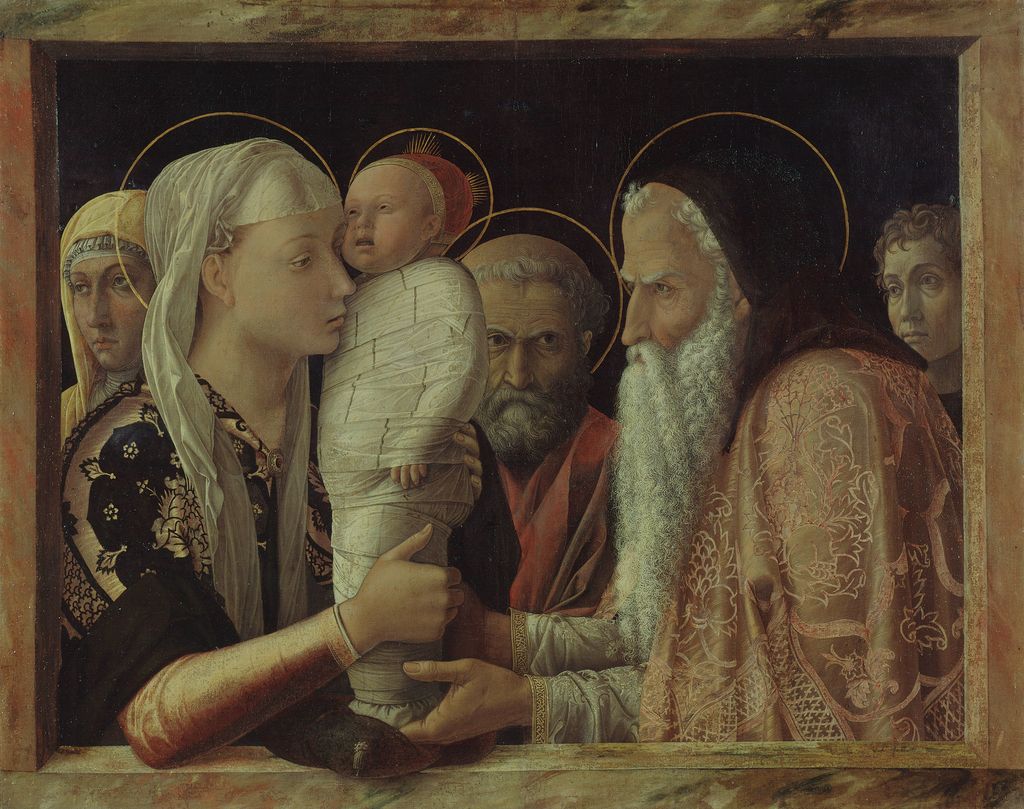
| The Presentation of Christ at the Temple | 1454 (Berlin dating) | Painting · Gemäldegalerie, Berlin · 29 Catalogue. |
| San Zeno Altarpiece | 1457–59 | Painting · Basilica of San Zeno, Verona Catalogue. |
| The Crucifixion | 1456–59 | Painting · Musée du Louvre · INV 368 Catalogue. |
| The Agony in the Garden (London) | C. 1455–56 | Painting · National Gallery, London · NG1417 Catalogue. |
| The Agony in the Garden (Tours) | 1459 (Tours dating) | Painting · Musée des Beaux-Arts de Tours · 1803-1-24 Catalogue. |
| The Resurrection | 1459 (Tours dating) | Painting · Musée des Beaux-Arts de Tours · 1803-1-25 Catalogue. |
| Saint Sebastian (Vienna) | C. 1457–59 | Painting · Kunsthistorisches Museum · GG 301 Catalogue. |
| Cardinal Ludovico Trevisan | C. 1459–60 (Berlin exhibition dating) | Painting · Gemäldegalerie, Berlin · 9 Catalogue. |
| The Death of the Virgin | C. 1462 | Painting · Museo Nacional del Prado · P000248 Catalogue. |
| Christ with the Soul of the Virgin | C. 1460–64 | Painting · Pinacoteca Nazionale, Ferrara Catalogue only. |
| Portrait of a Young Man (traditionally Francesco Gonzaga) | C. 1461 or 1470, depending on sitter | Painting · Museo di Capodimonte · Q 60 Catalogue. |
| Portrait of a Prelate (Carlo de’ Medici?) | C. 1465–70 | Painting · Uffizi Galleries · 1890 no. 8540 Catalogue. |
| Portrait of a Man | C. 1470 | Painting · National Gallery of Art, Washington · 1952.2.5 Catalogue. |
| Madonna with Sleeping Child (Berlin) | C. 1455–60 | Painting · Gemäldegalerie, Berlin · S.5 Catalogue. |
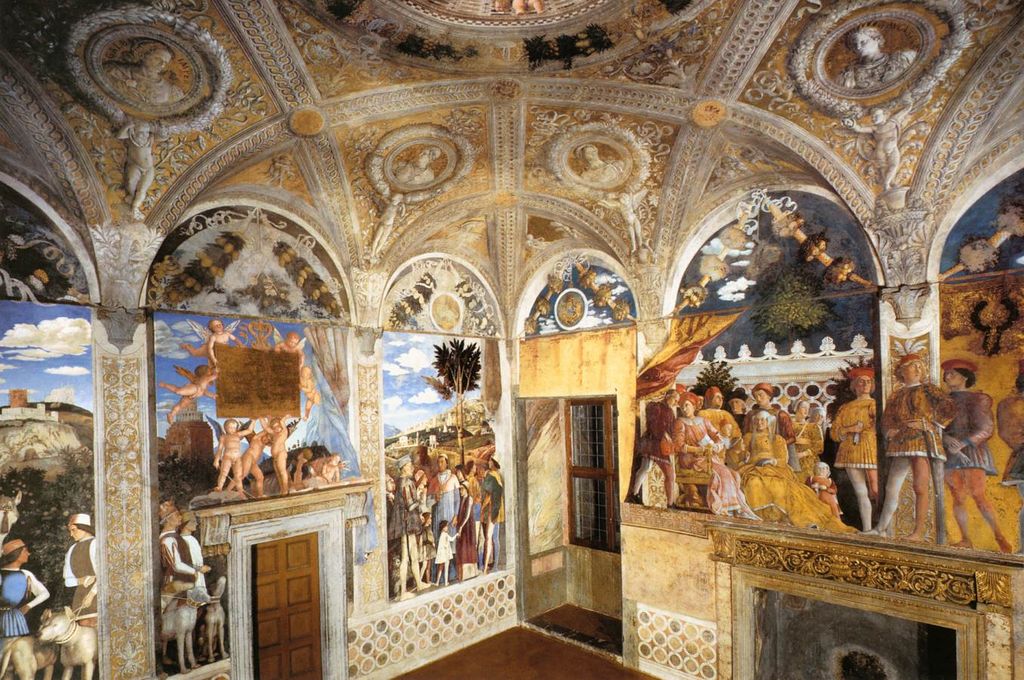
| Camera degli Sposi (Camera Picta) | 1465–74 | Painting · Palazzo Ducale, Mantua Catalogue. |
| Saint Sebastian (Louvre) | Around 1480 | Painting · Musée du Louvre · RF 1766 Catalogue. |
| Lamentation over the Dead Christ | C. 1483 (Brera dating) | Painting · Pinacoteca di Brera · 352 Catalogue. |
| The Triumphs of Caesar | About 1485–1506 | Painting · Royal Collection · RCIN 403958–403966 Catalogue. |
| Madonna of the Caves | C. 1488–90 | Painting · Uffizi Galleries · 1890 no. 1348 Catalogue. |
| Madonna and Child with a Choir of Cherubim | C. 1485 | Painting · Pinacoteca di Brera · 297 Catalogue. |
| Madonna and Child (Poldi Pezzoli) | Early 1490s (museum dating) | Painting · Museo Poldi Pezzoli · 1595 Catalogue. |
| The Holy Family with Saint Mary Magdalen | C. 1495–1500 | Painting · Metropolitan Museum of Art · 14.40.643 Catalogue. |
| The Virgin and Child with Saint Mary Magdalene and Saint John the Baptist | C. 1490–1505 | Painting · National Gallery, London · NG274 Catalogue. |
| Christ as the Suffering Redeemer | 1485–95 (SMK dating) | Painting · Statens Museum for Kunst · KMSsp69 Catalogue. |
| Ecce Homo | C. 1500 | Painting · Musée Jacquemart-André · MJAP-P 1840 Catalogue. |
| Judith with the Head of Holofernes (Mantegna or follower) | C. 1495–1500 | Painting · National Gallery of Art, Washington · 1942.9.42 Catalogue. |
| Madonna della Vittoria | 1495–96 | Painting · Musée du Louvre · INV 369 Catalogue. |
| Mars and Venus (Parnassus) | C. 1496–97 | Painting · Musée du Louvre · INV 370 Catalogue. |
| The Trivulzio Madonna | 1497 | Painting · Castello Sforzesco, Milan · 0554 Catalogue. |
| The Adoration of the Magi | C. 1495–1505 | Painting · J. Paul Getty Museum · 85.PA.417 Catalogue. |
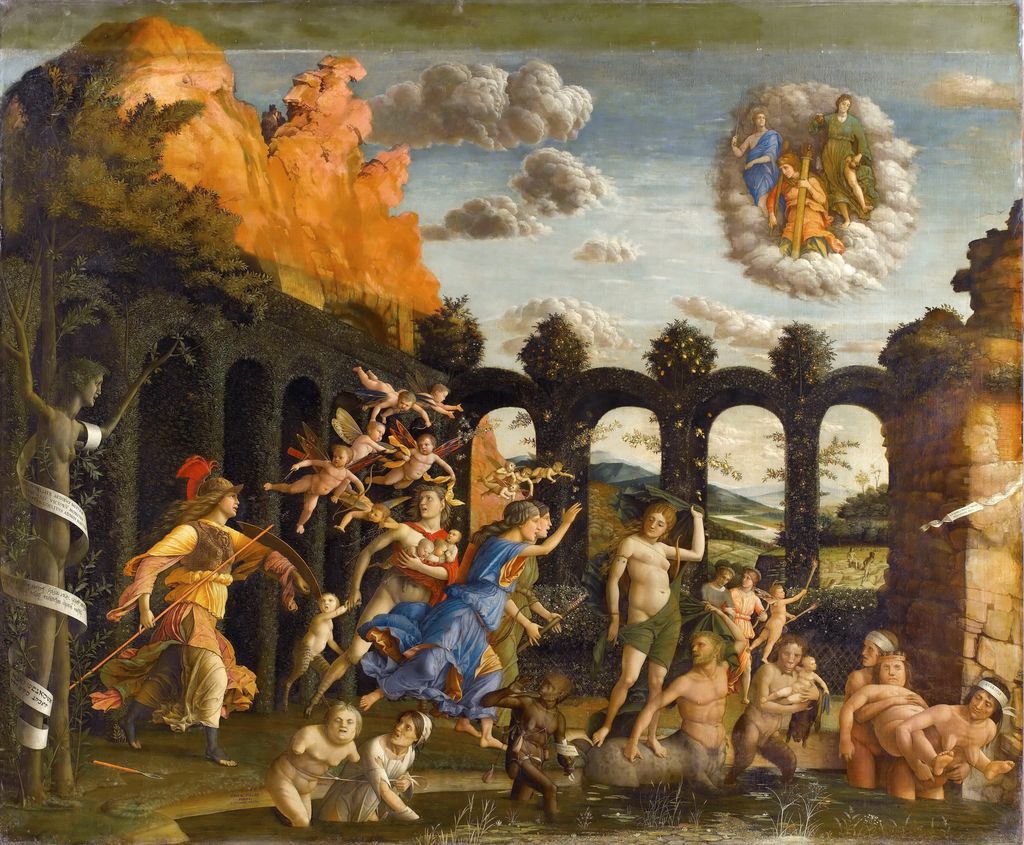
| Minerva Expelling the Vices from the Garden of Virtue | C. 1502 | Painting · Musée du Louvre · INV 371 Catalogue. |
| The Introduction of the Cult of Cybele at Rome | 1505–06 | Painting · National Gallery, London · NG902 Catalogue. |
| Saint Sebastian (Venice) | Probably c. 1504–06 | Painting · Galleria Giorgio Franchetti alla Ca’ d’Oro · D.11 Catalogue. |
| Samson and Delilah | C. 1500 | Painting · National Gallery, London · NG1145 Catalogue only. |
| A Woman Drinking (probably Sophonisba) | C. 1495–1506 | Painting · National Gallery, London · NG1125.2 Catalogue only. |
| The Vestal Virgin Tuccia with a Sieve | C. 1495–1506 | Painting · National Gallery, London · NG1125.1 Catalogue only. |
| Judith with the Head of Holofernes (Dublin) | C. 1495–1500 | Painting · National Gallery of Ireland · NGI.442 Catalogue only. |
| Battle of the Sea Gods, left half (Met impression) | Before 1481 (Met dating) | Print · Metropolitan Museum of Art · 18.12 Catalogue only. |
| Battle of the Sea Gods, right half (Met impression) | Before 1481 (Met dating) | Print · Metropolitan Museum of Art · 1984.1201.4 Catalogue only. |
| Battle of the Sea Gods, left half (Tokyo impression) | C. 1475 (Tokyo dating) | Print · National Museum of Western Art, Tokyo · G.1981-0002 Catalogue only. |
| Battle of the Sea Gods, left half (Washington impression) | C. 1485–88 (NGA dating) | Print · National Gallery of Art, Washington · 1941.1.6 Catalogue only. |
| The Entombment of Christ, second state of two | Before 1475 (Met dating) | Print · Metropolitan Museum of Art · 37.42.30 Catalogue only. |
| The Entombment of Christ (possibly Zoan Andrea, after Mantegna) | 1460–1549 (Rijksmuseum dating) | Print · Rijksmuseum · RP-P-1924-60 Catalogue only. |
| Four Dancing Muses (Gian Marco Cavalli after Mantegna) | C. 1497 | Print · Metropolitan Museum of Art · 20.5.3 Catalogue only. |
| Bacchanal with Silenus | Before 1475 (Met dating) | Print · Metropolitan Museum of Art · 29.44.15 Catalogue only. |
| Bacchanal with a Wine Vat | Before 1475 (Met dating) | Print · Metropolitan Museum of Art Catalogue only. |
| St James on His Way to Execution | C. 1453–57 | Drawing · British Museum · 1976,0616.1 Catalogue only. |
| Three Studies for a Dead Christ | C. 1455–65 | Drawing · British Museum · 1909,0406.3 Catalogue only. |
| Pietà (Venice) | C. 1456–65 (exhibition datings) | Drawing · Gallerie dell’Accademia, Venice · 115 Catalogue only. |
| Studies for Christ at the Column | 1460–65 | Drawing · The Courtauld · D.1978.PG.345 Catalogue only. |
| Virtus Combusta | C. 1490 (technical study) | Drawing · British Museum · Pp,1.23 Catalogue only. |
| Virtus Combusta (Giovanni Antonio da Brescia after Mantegna) | C. 1495–1506 | Print · Musée du Louvre · 3881 LR/ Recto Catalogue only. |
| The Calumny of Apelles | C. 1504–06 | Drawing · British Museum · 1860,0616.85 Catalogue only. |
Frequently Asked Questions
The Met records the support as canvas transferred from wood. The canvas is the painting’s current support.
The two visitors bend and kneel as they enter from the right. Mary keeps her attention on the child, with Joseph seated at the left.
Discussion
Look again at the images and ideas explored in Adoration of the Shepherds. These editorial prompts invite your observations.
Reader Insights
How do the track, the bridge and the raised ledge guide your eye from the distant announcement to the two men beside the child?
How would the restored space beyond the bridge in Christiansen’s reconstruction change your sense of the shepherds’ scale and Mary’s position?
Join the Conversation
Share a detail, comparison or question about Adoration of the Shepherds below.
References
- The Metropolitan Museum of Art, The Adoration of the Shepherds, 32.130.2. View source.
- The Holy See, Gospel of Luke, chapter 2. View source.
- The Metropolitan Museum of Art, Jean Sorabella, The Birth and Infancy of Christ in Italian Painting. View source.
- The Metropolitan Museum of Art, Keith Christiansen, The Genius of Andrea Mantegna, figs. 14–16. View source.
- Istituto della Enciclopedia Italiana, Andrea Mantegna, Dizionario Biografico degli Italiani. View source.
- Musée du Louvre, Mantegna, 1431–1506, Autour du triptyque de San Zeno de Vérone. View source.
- The Metropolitan Museum of Art, Italian Paintings, Volume IV, North Italian School, pp. 35–37 and plate 15. View source.
- Ducato Estense, Federica Fanti, Adorazione dei Pastori. View source.
- The Metropolitan Museum of Art, Keith Christiansen, Early Renaissance Narrative Painting in Italy, pp. 32–36 and figs. 25–30. View source.
- Internet Archive, Esther Singleton, Old World Masters in New World Collections, pp. 105–106. View source.
- Royal Collection Trust, Two Shepherds from an Adoration, RCIN 912794. View source.
- Collection Martin Le Roy, André Pératé, Les bergers se rendant à Bethléem, Catalogue raisonné, vol. V, no. 11. View source.
- Diocese of Mantua, Il Messale di Barbara. View source.
- Museu de Arte de São Paulo Assis Chateaubriand, São Jerônimo penitente no deserto, MASP.00015. View source.
- The National Gallery, Andrea Mantegna, The Agony in the Garden, NG1417. View source.
- The National Gallery, Giovanni Bellini, The Agony in the Garden, NG726. View source.
- Musée des Beaux-Arts de Tours, Mantegna, La prédelle de San Zeno de Vérone. View source.
- J. Paul Getty Museum, The Adoration of the Magi, Balthazar exhibition gallery text. View source.
- Basilica of San Zeno, Verona, San Zeno Altarpiece, View source.
- Palazzo Ducale, Mantua, Camera degli Sposi (Camera Picta), View source.
- Royal Collection, The Triumphs of Caesar, View source.
- Musée du Louvre, Madonna della Vittoria, View source.
- National Gallery, London, The Introduction of the Cult of Cybele at Rome, View source.
More MANTEGNA Paintings
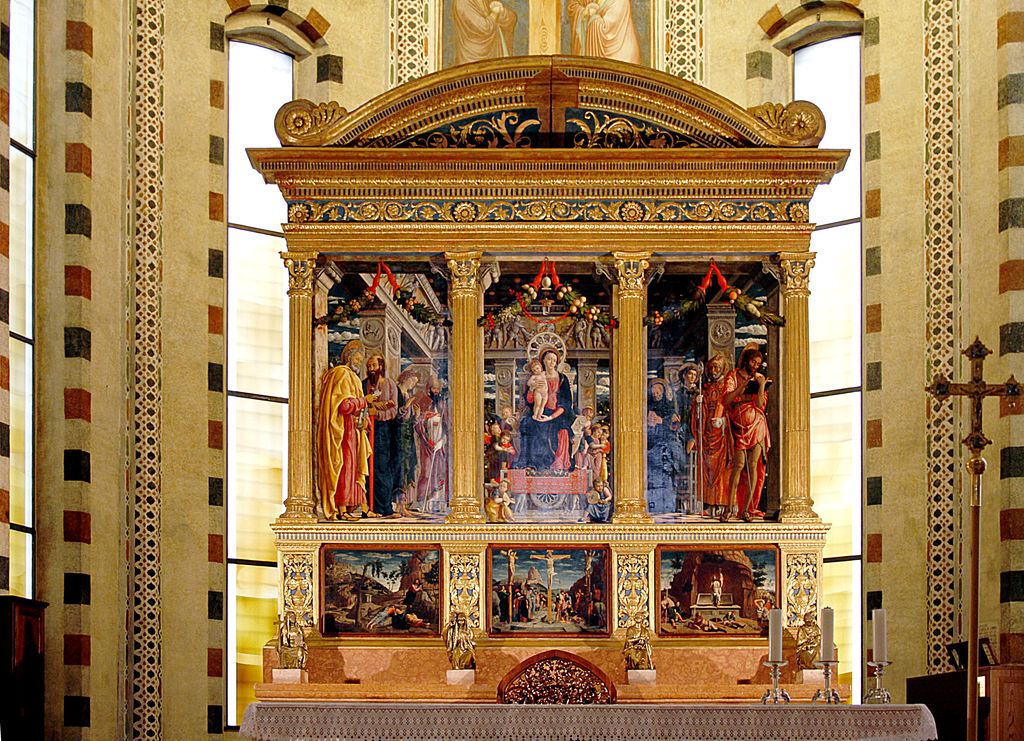
San Zeno Altarpiece
The San Zeno Altarpiece in its frame, Basilica of San Zeno, Verona José Luiz. Image source. CC BY-SA 4.0. Resized from the cited image.