 by Tom Gurney
Tom Gurney BSc (Hons) is an art history expert with over 20 years experience
Email: tomgurney1@gmail.com / Phone: +44 7429 011000
Overview
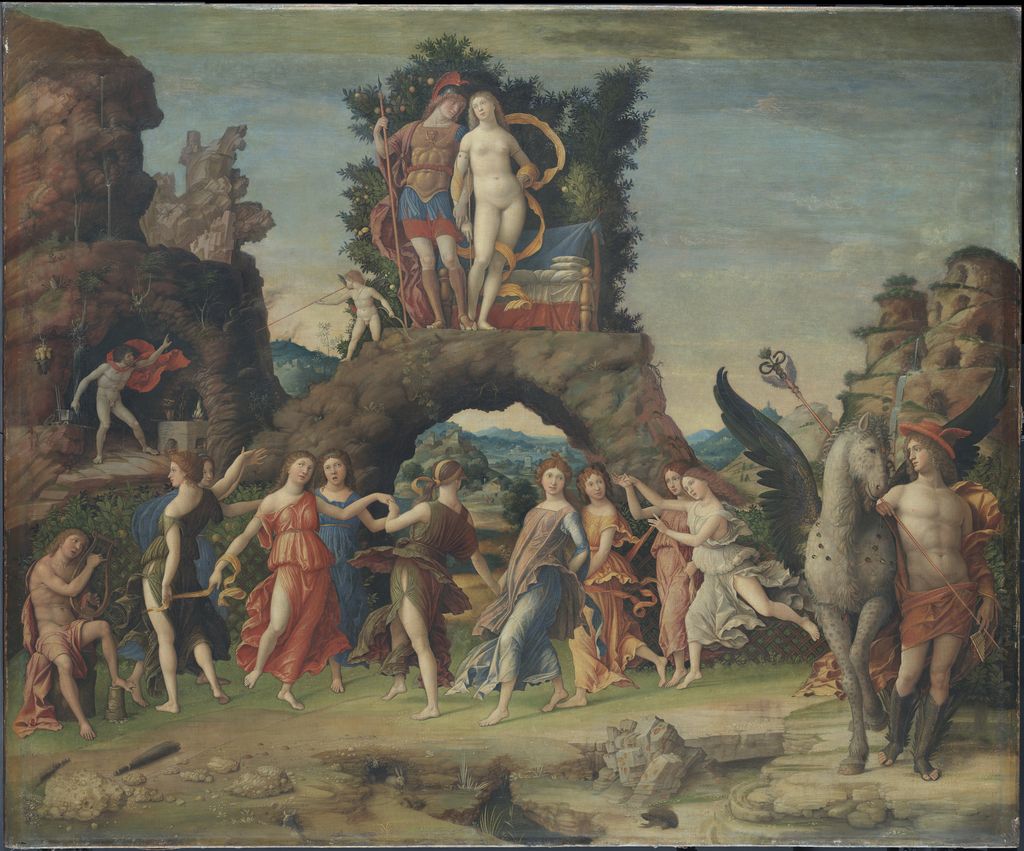
Nine women dance across a clearing while Mars and Venus stand above them on a bridge of rock. To the left, a smith breaks out of his cave in anger. To the right, a winged horse and a god watch from the edge of the dance. Andrea Mantegna makes room for all these incidents in a landscape that can be read from the ground at the dancers’ feet to the pale hills beyond the arch. [1]
The Louvre calls the painting Mars and Venus, known as Parnassus. Painted in tempera on canvas and measuring 159 × 192 cm, it was commissioned by Isabella d’Este in the winter of 1496–97 for her first studiolo in Mantua. The Louvre’s Mantegna retrospective dates its delivery, the first for the series, to 1497. It belongs to the museum’s Department of Paintings under the inventory number INV 370. [1] [2]
At a Glance
- DateCirca 1496–97, delivered in 1497 according to the Louvre retrospective
- MediumTempera on canvas
- Dimensions159 × 192 cm
- CollectionMusée du Louvre, Department of Paintings
- Inventory numberINV 370
Andrea Mantegna in context
San Zeno Altarpiece
1457–59 [26]The Triumphs of Caesar
Mid-1480s–before 1506 [28]Madonna della Vittoria
1495–96 [29]Mars and Venus (Parnassus)
C. 1496–97 [30]Mars and Venus above the clearing
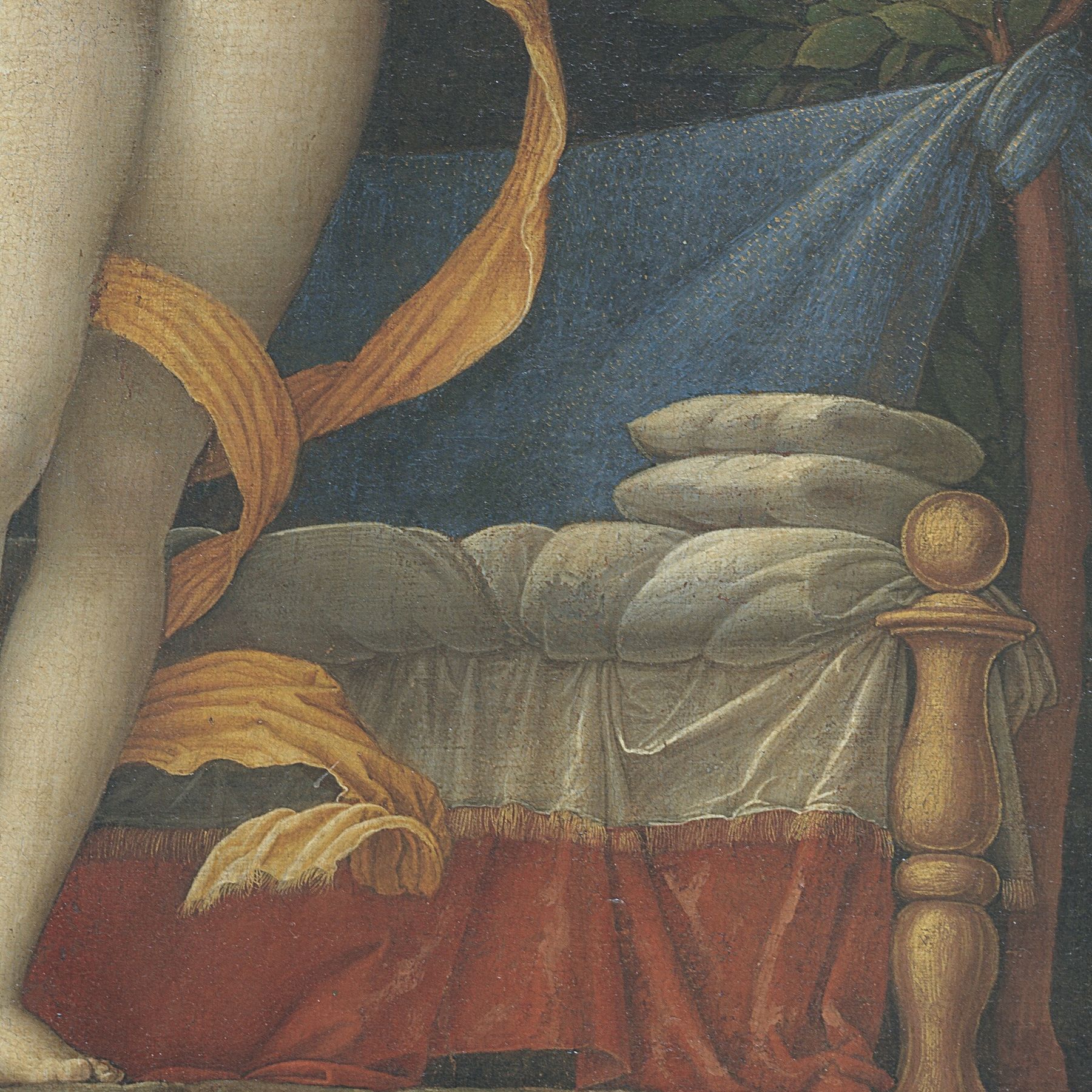
It takes a moment to notice the bed. Propped just behind Venus on the ledge, with pillows at one end, it turns an otherwise improbable perch into a place for a lovers’ meeting. The outline of Mars, in helmet and armour, is broken by the shaft of his weapon and the folds of his cloak. Venus’s pale body makes a continuous line against the dark leaves, while a strip of gold-coloured fabric loops out into the sky and winds back across her legs. The two incline their heads towards each other. Below the ledge, several of the dancers turn their heads in quite different directions. No single exchange of looks holds the whole painting together. [1]
The bed and Vulcan’s presence recall the affair sung by Demodocus in Book 8 of Homer’s Odyssey. In that account, the smith learns that his wife Aphrodite, the Greek Venus, is meeting Ares, the Greek Mars. He traps them in a net so fine that they cannot see it and summons the gods to witness their humiliation. Mantegna gives the lovers a much more composed appearance. The bed stands in the open air and the smith, at the far left, gestures from the mouth of his forge. The winged Cupid on the ledge directs a narrow tube towards him. Their exchange runs obliquely across the canvas, away from the lovers’ quiet intimacy and over the heads of the dancers. The French national collections database identifies the little figure more specifically as Anteros, a name associated with requited love. In that reading a god associated with mutual love takes the lovers’ side against the husband. [1] [3] [4] [5]
Steven J. Cody reads the fine strands by Vulcan’s hand in light of Ovid’s account of the smith’s nearly invisible snare. On that reading, the threat of discovery survives in a detail easily missed from across a room. The joke works at two distances. Vulcan’s outstretched arm and flying red cloth make his indignation obvious even from afar, while the paint near his hand repays the closer attention of a viewer who knows the story. The dance and the lovers’ composure give the scene a festive character, but the smith keeps the joke at their expense in play. [1] [4]
The dance and the rock bridge
The women are generally identified as the nine Muses. Mantegna lets the dance read as a gathering of distinct bodies before it reads as a single pattern. Follow the joined hands near the centre. A dancer in red offers her hand to a woman turning away from us, whose bent arm and raised heel carry the movement onwards. At the right a pale dress swirls around a dancer’s knees as she lifts one leg back. Elsewhere a fold pulls tightly against a shin or falls straight from a hip. The spacing keeps changing. The women approach in pairs, overlap, then open up again so that a hand or a lifted foot briefly stands out on its own. [1] [4]
The seated musician at the far left is usually called Apollo, as he is in the Louvre’s catalogue entry. Odoardo Stivini’s inventory, completed in 1542, describes him as Orpheus and calls the dancers nine nymphs. Andreas Hauser took that early identification seriously in his study of Orpheus and the figure of the inspired artist. The French national collections database also records a third identification, Linus. The musician’s place beside the nine women suits Apollo, but a stringed instrument alone supplies little grounds for choosing between mythic musicians. No individual labels identify the dancers. Their coordinated movement establishes their role more clearly than any effort to attach a separate name to each one. [1] [4] [5] [6] [7]
A drawing of the rightmost dancer in Berlin, dated around 1497, shows how much movement Mantegna’s design gives to one body. Fine dots associated with transferring a design survive on the sheet, which the Berlin exhibition checklist assigned to his studio. An engraving in the Louvre brings four of the dancers together in reverse and with variations. The museum’s print catalogue relates some of those variations to passages that X-rays show were repainted on the canvas. The print isolates the rhythm of the dance and also preserves clues to an earlier state of the painted figures. [8] [9] [10]
The natural-looking rock bridge does two jobs at once. Its upper edge gives Mars and Venus a narrow stage and its underside frames a view into a distant valley. The window of lighter country opens immediately behind the darker figure who turns her back on us. Her planted foot brings the eye back to the turf in front. The sides of the picture close in again, at the left around the smith’s cave and at the right behind the lifted wings of Pegasus. The bridge can look almost architectural because it separates these episodes so neatly. Its irregular edge and rough underside keep it part of the same broken ground as the stones and water in the foreground. [1]
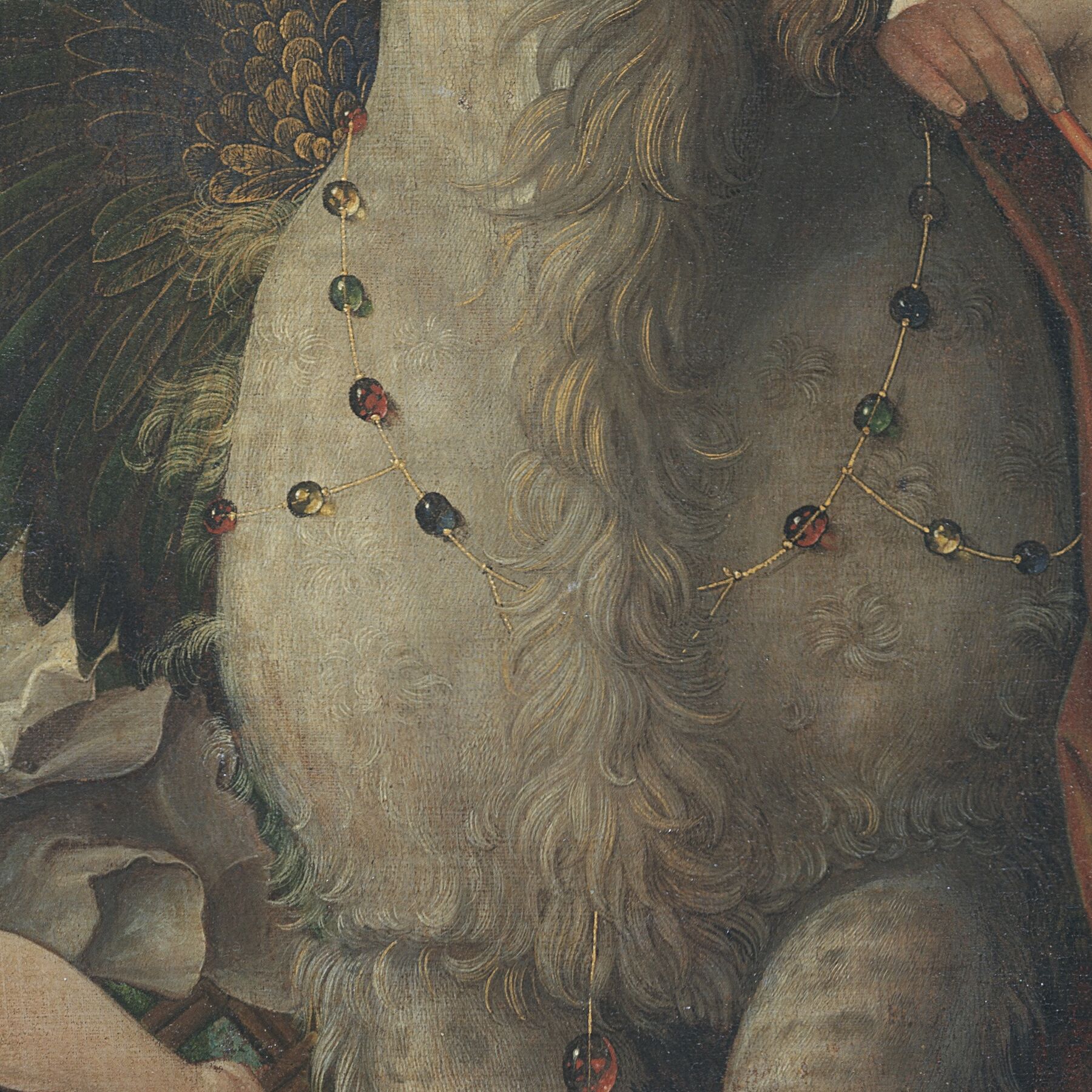
Mercury’s staff with its intertwined snakes rises against the sky on the right. Beside him the horse Pegasus faces almost out of the painting, with dark wings spreading behind a light head and chest. Ovid tells how a stroke of Pegasus’s hoof brought forth the spring of the Muses on Mount Helicon. That association makes the water near the horse a plausible reference to Hippocrene, the spring of poetic inspiration. The title Parnassus invokes a different mountain associated with poetry. Attempts to identify the various rocks and waters with specific mythical places differ, and the bridge itself offers no secure geographical marker. [1] [4] [7] [11]
The group of Mercury and Pegasus also has a history beyond the canvas. A drawing in Museum Boijmans Van Beuningen isolates the pair. It was once published as Mantegna’s preparatory study, but the museum now catalogues it as a later copy, probably of the eighteenth century and probably derived from a print. On paper the pair can stand alone. In the painting the dark wing gives the dance a strong vertical boundary on the right, while the god’s glance turns us back towards the dancers. [1] [12]
What Isabella’s letters tell us
Isabella’s first studiolo occupied part of the Castello di San Giorgio in the Gonzaga palace at Mantua. Such rooms served as private studies, and Isabella used hers in conjunction with the Grotta, a second intimate space for displaying her collections. Paintings made for this setting shared a patron’s attention with antiquities and other prized objects. Their scale matters. At nearly two metres wide, Parnassus had enough presence to shape a wall in a small room, yet its rabbits, plants, small ornaments and changes of expression reward the close scrutiny that a room like this allowed. Mantegna’s biography places the commission in his long career at the Gonzaga court. [1] [2] [13]
On 6 and 14 June 1497 Isabella wrote to Lorenzo da Pavia about varnish for Mantegna. On 3 July Alberto da Bologna wrote to her about fittings above a painting by the artist, which he expected to be in place when she returned. The exchange shows Isabella attending to the finish of a painting and the fittings for its display. The July letter refers to Mantegna’s picture without giving its subject. Taken with the other records, it supports the dating of Parnassus to around 1497 and helps explain why the Louvre dates its delivery to that year. It gives no exact day for the completion of the painting itself. [2] [4] [14]
Isabella’s exact part in devising the subject is harder to establish. Cody argues that the painter probably worked with Paride da Ceresara, a scholar associated with her court. In his reading, classical allusions and visual jokes gave educated visitors something to discuss, while the figures of the Muses made the room’s own cultivation of the arts part of the subject. That proposal makes sense of a picture designed to sustain conversation as well as contemplation. The identity of an adviser for this particular commission remains a scholarly attribution. [4] [14]
From a court poem to competing readings
Battista Fiera, a Mantuan physician and poet, offers an unusually early instance of how such a conversation could go awry. Roger Jones links a surviving poem by Fiera to this painting and proposes that it was written in late 1498 or early 1499. The poem looks back on a lost verse in which Fiera had likened Isabella to Venus. In the surviving text he retreats from the identification, and the discomfiting detail of Vulcan helps explain why a compliment could misfire. A marriage compliment gets complicated if it casts the patron as the goddess of an affair. The Louvre retrospective allows that the gods could evoke Isabella and her husband Francesco II Gonzaga. Fiera’s poem shows how readily a courtly viewer could make the connection. Whether either god carries a likeness remains uncertain. In Leonardo da Vinci’s portrait drawing of Isabella, made during his stay at Mantua around 1499–1500, her profile is the subject of the sheet. Even a resemblance to that drawing would leave open how much Mantegna asked his viewers to project on to Venus. [2] [15] [16]
The retrospective reads the canvas in terms of the victory of spiritual over earthly love and the celebration of the arts at Mantua. Ernst Gombrich traced a different route to the dance through an ancient allegorical reading of the affair in which the union of Mars and Venus gives rise to Harmony. Under this interpretation, the dancers make concord visible through their movement. Cody gives more weight to the picture’s wit and its mixture of poetic references. Both the comic action on the ledge and the measured dance below remain visible under these readings. The viewer can follow Cupid’s aim to the angry smith, then find the dancers keeping their rhythm across the clearing below. [1] [2] [4] [17]
Across the studiolo from Minerva
Mantegna’s other finished canvas for Isabella, Minerva Expelling the Vices from the Garden of Virtue, is also known as the Triumph of the Virtues. It was completed in 1502. Look at what happens to movement in the two pictures. The raised arms in Parnassus pass the impulse of the dance along from one figure to the next. In the garden a spear-bearing Minerva bursts in from the left, sending a crowd of grotesque figures fleeing before her. The garden makes room for inscriptions that help identify the forces at work. The dance asks the viewer to read gesture, attributes and the echoes of familiar stories. The Louvre’s retrospective argued that the canvases were meant to face one another, pointing to light from the left in Parnassus and from the right in Minerva. [1] [2] [18]
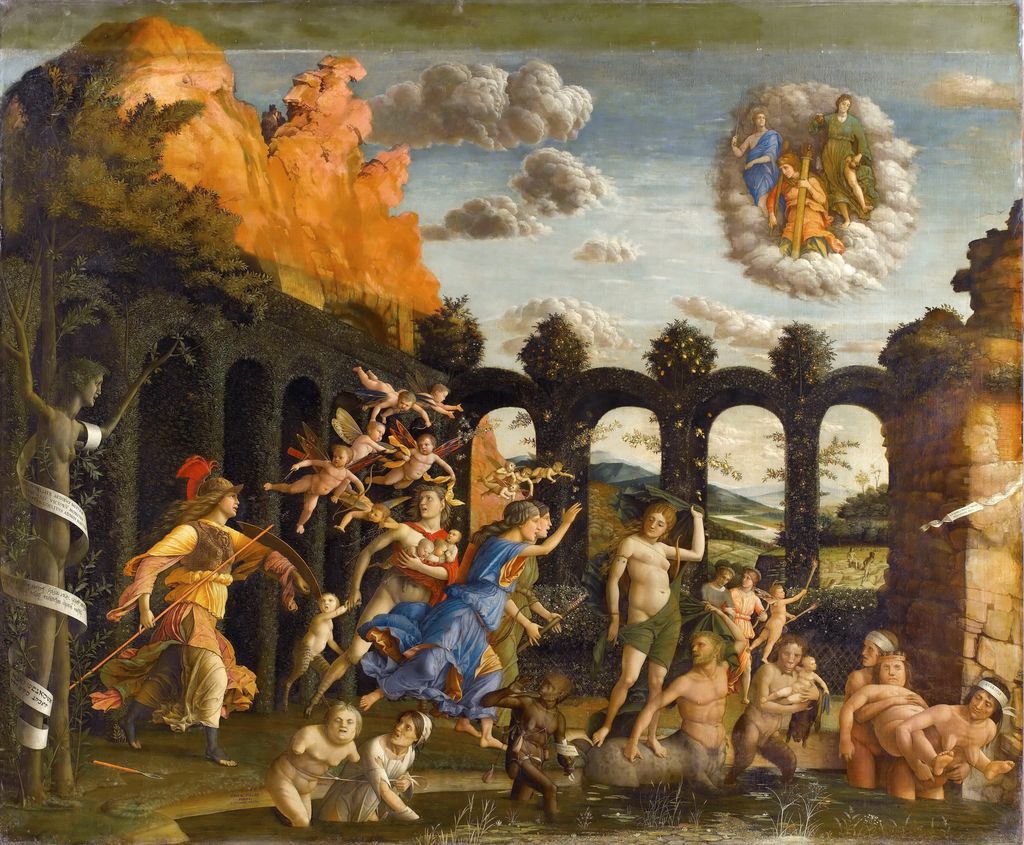
Minerva Expelling the Vices from the Garden of Virtue, Musée du Louvre Image source. Public domain.
Isabella was already asking Lorenzo da Pavia in April 1497 whether Perugino would paint a picture for her. The contract that eventually followed, in January 1503, incorporates detailed instructions for a fight between Chastity and Lust, with Pallas and Diana confronting Venus and Cupid. Perugino completed The Combat of Love and Chastity in 1505. In it Cupid can be seen struggling with Pallas, whereas in Parnassus he has ample freedom to make sport of Vulcan. Stivini’s inventory places the two canvases on the same wall in the later room. A visitor there could move from a battle in which Venus is expressly challenged to a scene in which she presides over a dance. [1] [6] [19] [20] [21]
The other two paintings associated with the first studiolo are Lorenzo Costa’s Allegory of the Court of Isabella d’Este and The Reign of Comus. In the Allegory, painted in 1505–06, a leafy setting encloses a company attending a crowning. The gathering and the attention paid to music offer a parallel with Mantegna’s assembly, though Costa draws the eye inward to the central ceremony while Mantegna’s dance stretches across the foreground. The Louvre identifies The Reign of Comus as probably the work Mantegna began shortly before his death and Costa likely finished in 1511. Costa sets an inscribed triumphal arch among his figures. It gives the gathering a ceremonial centre. In Parnassus, the bridge of rock carries the chief figures above the gathering and opens a view beneath them. [1] [2] [22] [23]
These paintings share an interest in how desire, pleasure and virtue coexist, though the Louvre’s curators left open whether an overall plan had been fixed at the outset. Mantegna’s late Introduction of the Cult of Cybele at Rome gives a further comparison from outside Isabella’s commissions. Made for the Venetian nobleman Francesco Cornaro, it presents a classical procession in the guise of carved relief. The dancing bodies of Parnassus likewise read as a band across the picture, but here the open air, deep view under the arch and alternating colours of the drapery keep breaking the line into separate movements. [1] [2] [24]
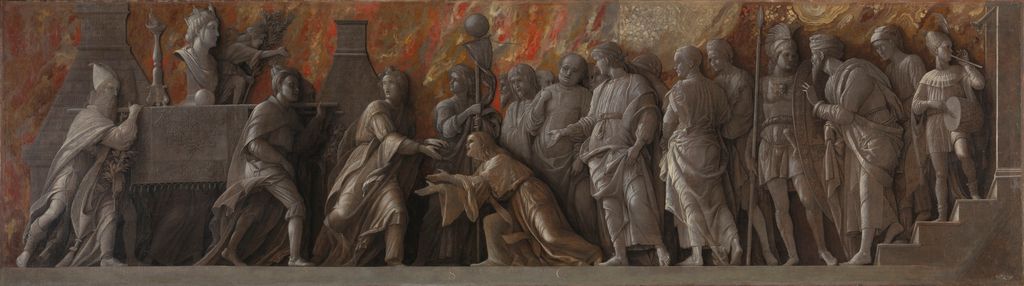
The Introduction of the Cult of Cybele at Rome, National Gallery, London Image source. Public domain.
A second room and a changed surface
After Francesco’s death in 1519, Isabella moved to the Corte Vecchia, where the paintings were installed in a second studiolo. She added two allegories by Correggio, painted around 1530. Stivini’s inventory records the collection in this later setting. The 2008 Louvre retrospective used the second room’s arrangement in its installation, reversing the visitor’s direction through the ensemble. That reconstruction brings out relationships between pictures which a single canvas in isolation can only suggest. It also represents the collection at a later stage, after Isabella had more than two decades to add to and rearrange the company in which Parnassus was seen. [1] [2] [6] [13]
The painted surface had a history of its own. The Louvre records oil repainting in parts of the landscape, in the figure of Venus and in the heads of Apollo and several Muses. Its print catalogue places later repainting around 1520, close to the move to the Corte Vecchia. The object record tentatively attributes these passages to Lorenzo Leonbruno, who worked on the decoration of Isabella’s later apartments. Even the face of Venus therefore belongs to the history of the canvas as it changed in Isabella’s collection. Small differences in features or expressions deserve particular care when comparing it with drawings or other portraits. [1] [10] [25]
The Louvre records the painting at the Château de Richelieu by 1632 and dates its seizure to 1801. It treats a 1627 reference to a dance by Mantegna in the Grotta as a possible mention of this canvas. That description singles out the detail the two familiar titles leave implicit. The gods stand still above the bridge, but from the ground on which the women dance, a rhythm of lifted feet and reaching hands gives the whole landscape its life. [1]
Annotated Details from Mars and Venus (Parnassus)
The numbered points identify details to look at closely. The detail images below preserve the native scale of the selected crops.
Mars and Venus (Parnassus)
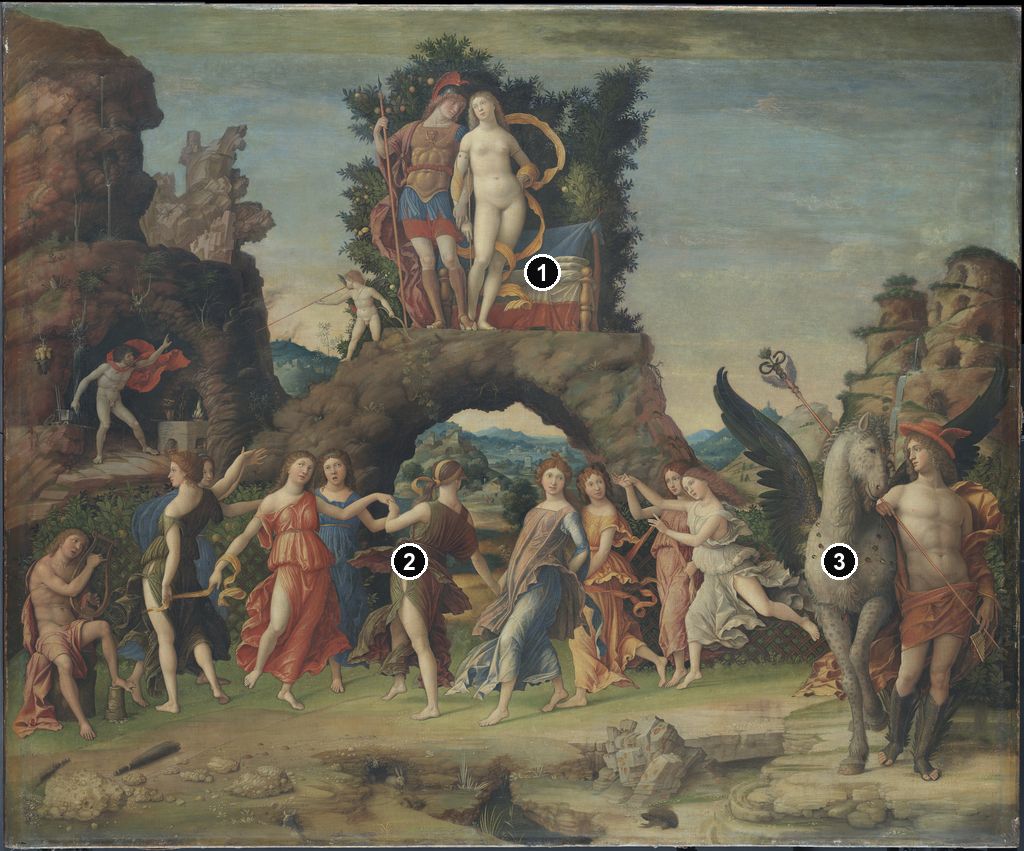
Details from MARS AND VENUS (PARNASSUS)
Choose a detail to enlarge it.
Mars and Venus (Parnassus)
Mars and Venus over the arch
The central couple stands above the rocky span. The elevated setting separates them from the dancers’ continuous movement below.
The linked dancers
Hands and arms connect several of the dancing figures. Their crossing steps repeat the rhythm of the curved draperies.
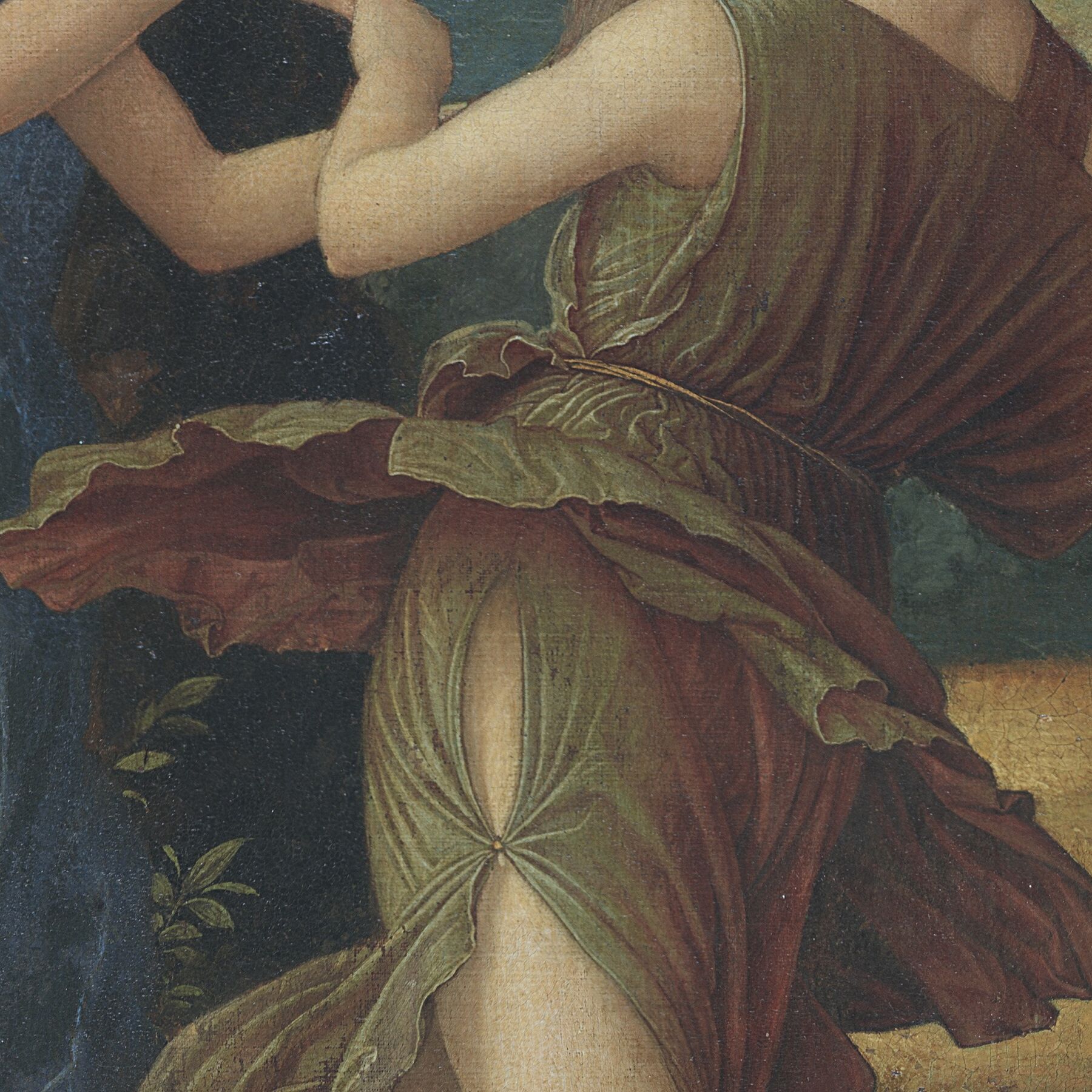
Mercury and Pegasus
The pair at right rises above the nearby dancers. This edge grouping creates a strong counterweight to the musician at left.
Artworks directory
| Name | Date | Medium and collection |
|---|---|---|
| The Adoration of the Shepherds | Shortly after 1450 | Painting · Metropolitan Museum of Art · 32.130.2 Catalogue. |
| Saint Mark the Evangelist | C. 1448–51 | Painting · Städel Museum · 1046 Catalogue. |
| Saint Jerome Penitent in the Desert | C. 1448–51 | Painting · Museu de Arte de São Paulo · MASP.00015 Catalogue. |
| Martyrdom and Transport of the Body of Saint Christopher | Mid-1450s | Painting · Ovetari Chapel, Padua Catalogue. |
| San Luca Altarpiece | 1453–55 | Painting · Pinacoteca di Brera · 176 Catalogue. |
| The Presentation of Christ at the Temple | 1454 (Berlin dating) | Painting · Gemäldegalerie, Berlin · 29 Catalogue. |
| San Zeno Altarpiece | 1457–59 | Painting · Basilica of San Zeno, Verona Catalogue. |
| The Crucifixion | 1456–59 | Painting · Musée du Louvre · INV 368 Catalogue. |
| The Agony in the Garden (London) | C. 1455–56 | Painting · National Gallery, London · NG1417 Catalogue. |
| The Agony in the Garden (Tours) | 1459 (Tours dating) | Painting · Musée des Beaux-Arts de Tours · 1803-1-24 Catalogue. |
| The Resurrection | 1459 (Tours dating) | Painting · Musée des Beaux-Arts de Tours · 1803-1-25 Catalogue. |
| Saint Sebastian (Vienna) | C. 1457–59 | Painting · Kunsthistorisches Museum · GG 301 Catalogue. |
| Cardinal Ludovico Trevisan | C. 1459–60 (Berlin exhibition dating) | Painting · Gemäldegalerie, Berlin · 9 Catalogue. |
| The Death of the Virgin | C. 1462 | Painting · Museo Nacional del Prado · P000248 Catalogue. |
| Christ with the Soul of the Virgin | C. 1460–64 | Painting · Pinacoteca Nazionale, Ferrara Catalogue only. |
| Portrait of a Young Man (traditionally Francesco Gonzaga) | C. 1461 or 1470, depending on sitter | Painting · Museo di Capodimonte · Q 60 Catalogue. |
| Portrait of a Prelate (Carlo de’ Medici?) | C. 1465–70 | Painting · Uffizi Galleries · 1890 no. 8540 Catalogue. |
| Portrait of a Man | C. 1470 | Painting · National Gallery of Art, Washington · 1952.2.5 Catalogue. |
| Madonna with Sleeping Child (Berlin) | C. 1455–60 | Painting · Gemäldegalerie, Berlin · S.5 Catalogue. |
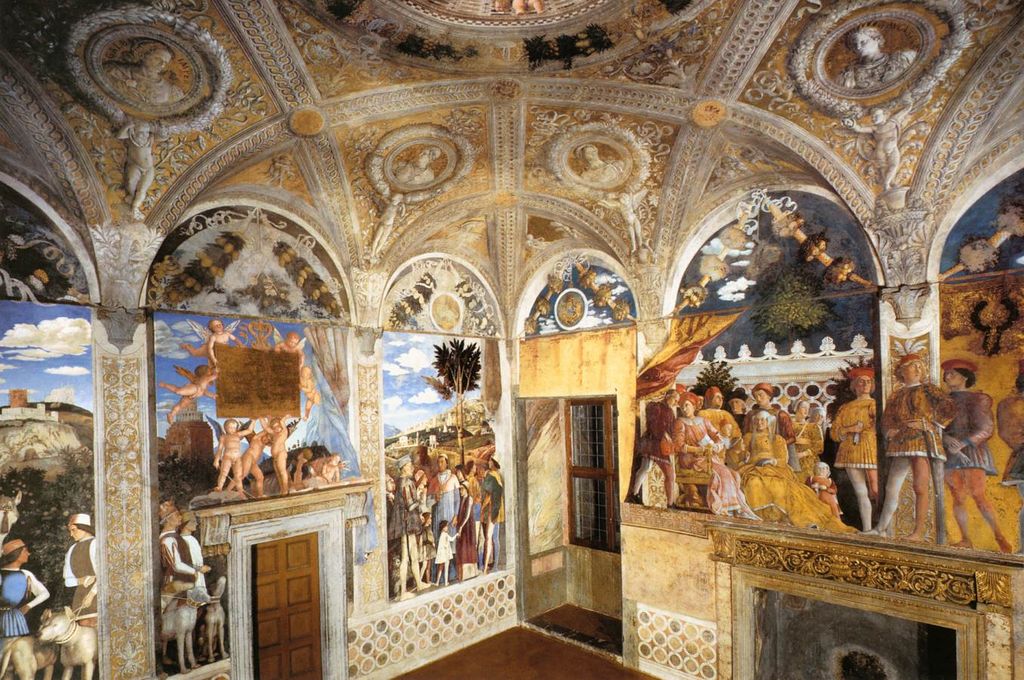
| Camera degli Sposi (Camera Picta) | 1465–74 | Painting · Palazzo Ducale, Mantua Catalogue. |
| Saint Sebastian (Louvre) | Around 1480 | Painting · Musée du Louvre · RF 1766 Catalogue. |
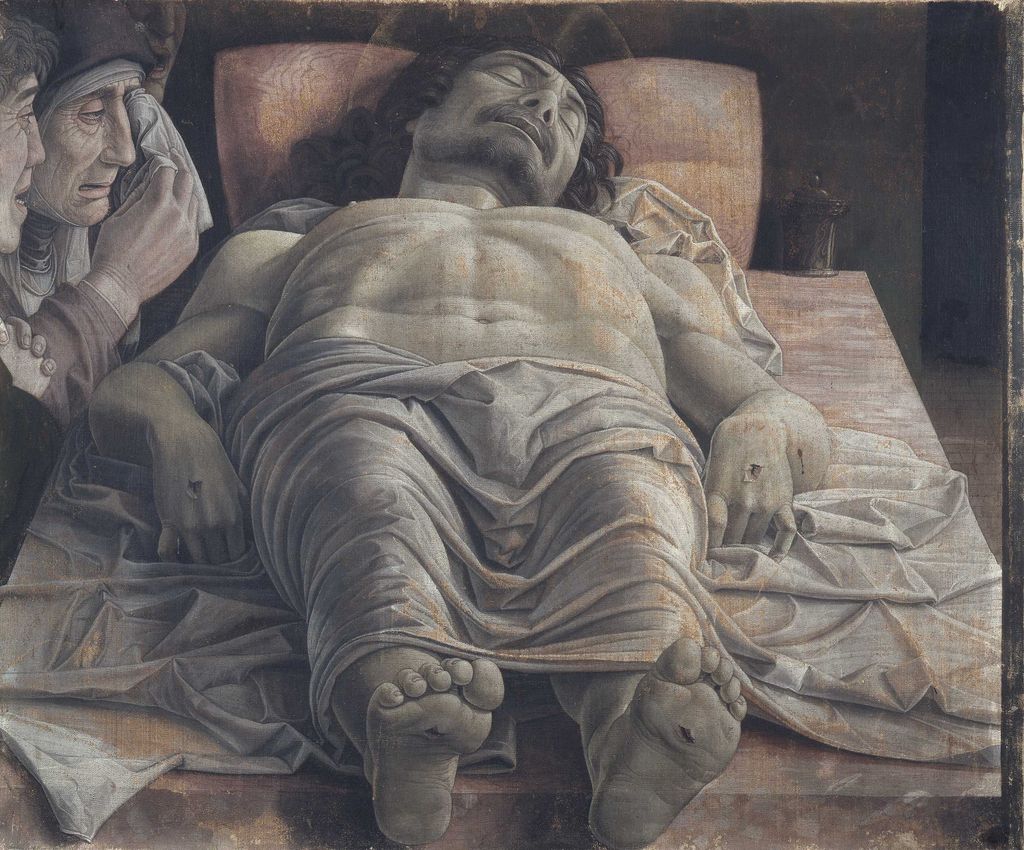
| Lamentation over the Dead Christ | C. 1483 (Brera dating) | Painting · Pinacoteca di Brera · 352 Catalogue. |
| The Triumphs of Caesar | About 1485–1506 | Painting · Royal Collection · RCIN 403958–403966 Catalogue. |
| Madonna of the Caves | C. 1488–90 | Painting · Uffizi Galleries · 1890 no. 1348 Catalogue. |
| Madonna and Child with a Choir of Cherubim | C. 1485 | Painting · Pinacoteca di Brera · 297 Catalogue. |
| Madonna and Child (Poldi Pezzoli) | Early 1490s (museum dating) | Painting · Museo Poldi Pezzoli · 1595 Catalogue. |
| The Holy Family with Saint Mary Magdalen | C. 1495–1500 | Painting · Metropolitan Museum of Art · 14.40.643 Catalogue. |
| The Virgin and Child with Saint Mary Magdalene and Saint John the Baptist | C. 1490–1505 | Painting · National Gallery, London · NG274 Catalogue. |
| Christ as the Suffering Redeemer | 1485–95 (SMK dating) | Painting · Statens Museum for Kunst · KMSsp69 Catalogue. |
| Ecce Homo | C. 1500 | Painting · Musée Jacquemart-André · MJAP-P 1840 Catalogue. |
| Judith with the Head of Holofernes (Mantegna or follower) | C. 1495–1500 | Painting · National Gallery of Art, Washington · 1942.9.42 Catalogue. |
| Madonna della Vittoria | 1495–96 | Painting · Musée du Louvre · INV 369 Catalogue. |
| Mars and Venus (Parnassus) | C. 1496–97 | Painting · Musée du Louvre · INV 370 Catalogue. |
| The Trivulzio Madonna | 1497 | Painting · Castello Sforzesco, Milan · 0554 Catalogue. |
| The Adoration of the Magi | C. 1495–1505 | Painting · J. Paul Getty Museum · 85.PA.417 Catalogue. |
| Minerva Expelling the Vices from the Garden of Virtue | C. 1502 | Painting · Musée du Louvre · INV 371 Catalogue. |
| The Introduction of the Cult of Cybele at Rome | 1505–06 | Painting · National Gallery, London · NG902 Catalogue. |
| Saint Sebastian (Venice) | Probably c. 1504–06 | Painting · Galleria Giorgio Franchetti alla Ca’ d’Oro · D.11 Catalogue. |
| Samson and Delilah | C. 1500 | Painting · National Gallery, London · NG1145 Catalogue only. |
| A Woman Drinking (probably Sophonisba) | C. 1495–1506 | Painting · National Gallery, London · NG1125.2 Catalogue only. |
| The Vestal Virgin Tuccia with a Sieve | C. 1495–1506 | Painting · National Gallery, London · NG1125.1 Catalogue only. |
| Judith with the Head of Holofernes (Dublin) | C. 1495–1500 | Painting · National Gallery of Ireland · NGI.442 Catalogue only. |
| Battle of the Sea Gods, left half (Met impression) | Before 1481 (Met dating) | Print · Metropolitan Museum of Art · 18.12 Catalogue only. |
| Battle of the Sea Gods, right half (Met impression) | Before 1481 (Met dating) | Print · Metropolitan Museum of Art · 1984.1201.4 Catalogue only. |
| Battle of the Sea Gods, left half (Tokyo impression) | C. 1475 (Tokyo dating) | Print · National Museum of Western Art, Tokyo · G.1981-0002 Catalogue only. |
| Battle of the Sea Gods, left half (Washington impression) | C. 1485–88 (NGA dating) | Print · National Gallery of Art, Washington · 1941.1.6 Catalogue only. |
| The Entombment of Christ, second state of two | Before 1475 (Met dating) | Print · Metropolitan Museum of Art · 37.42.30 Catalogue only. |
| The Entombment of Christ (possibly Zoan Andrea, after Mantegna) | 1460–1549 (Rijksmuseum dating) | Print · Rijksmuseum · RP-P-1924-60 Catalogue only. |
| Four Dancing Muses (Gian Marco Cavalli after Mantegna) | C. 1497 | Print · Metropolitan Museum of Art · 20.5.3 Catalogue only. |
| Bacchanal with Silenus | Before 1475 (Met dating) | Print · Metropolitan Museum of Art · 29.44.15 Catalogue only. |
| Bacchanal with a Wine Vat | Before 1475 (Met dating) | Print · Metropolitan Museum of Art Catalogue only. |
| St James on His Way to Execution | C. 1453–57 | Drawing · British Museum · 1976,0616.1 Catalogue only. |
| Three Studies for a Dead Christ | C. 1455–65 | Drawing · British Museum · 1909,0406.3 Catalogue only. |
| Pietà (Venice) | C. 1456–65 (exhibition datings) | Drawing · Gallerie dell’Accademia, Venice · 115 Catalogue only. |
| Studies for Christ at the Column | 1460–65 | Drawing · The Courtauld · D.1978.PG.345 Catalogue only. |
| Virtus Combusta | C. 1490 (technical study) | Drawing · British Museum · Pp,1.23 Catalogue only. |
| Virtus Combusta (Giovanni Antonio da Brescia after Mantegna) | C. 1495–1506 | Print · Musée du Louvre · 3881 LR/ Recto Catalogue only. |
| The Calumny of Apelles | C. 1504–06 | Drawing · British Museum · 1860,0616.85 Catalogue only. |
Frequently Asked Questions
The figures are generally identified as the nine Muses, dancing to Apollo’s music. Above them Mars and Venus stand on the rock arch.
The first title names the principal pair. Parnassus is the familiar later title, and the article explains why the whole scene has invited several readings.
Discussion
Look again at the images and ideas explored in Parnassus. These editorial prompts invite your observations.
Reader Insights
How does the rock bridge connect the lovers above it to the dance below, and which details keep the two groups apart?
What changes in the interpretation of Venus when the painting is read beside Fiera’s poem and Perugino’s Combat of Love and Chastity?
Join the Conversation
Share a detail, comparison or question about Parnassus below.
References
- Musée du Louvre, Mars et Vénus, dit Le Parnasse (INV 370). View source.
- Musée du Louvre, Le studiolo d’Isabelle d’Este, Mantegna retrospective. View source.
- Perseus Digital Library, Tufts University, Homer, Odyssey, Book 8. View source.
- Steven J. Cody, Mantegna and the Orators: The Invention of the Mars and Venus for Isabella d’Este Gonzaga. View source.
- Ministère de la Culture, France, Joconde entry for Mars et Vénus, dit Le Parnasse (000PE025683). View source.
- Romano Nanni, In margine alla mostra di Vinci «Leonardo e il mito di Leda», with excerpts from the Stivini inventory, p. 152. View source.
- Andreas Hauser, Andrea Mantegnas «Parnass»: Ein Programmbild orphischen Künstlertums. View source.
- Staatliche Museen zu Berlin, Mantegna und Bellini exhibition checklist, Tanzende Muse. View source.
- Kupferstichkabinett, Staatliche Museen zu Berlin, Dancing Muse (KdZ 5058). View source.
- Musée du Louvre, La danse de quatre femmes (13429 LR/ Recto). View source.
- University of Virginia, Ovid, Metamorphoses, Book V, Minerva on Helicon. View source.
- Museum Boijmans Van Beuningen, Mercury with Pegasus, catalogue entry by Giada Damen. View source.
- Isabella d’Este Archive, Virtual Studiolo. View source.
- Steven J. Cody, University of Maryland, Mantegna’s ‘Mars and Venus’: The Pursuit of Pictorial Eloquence. View source.
- Roger Jones, ‘What Venus Did with Mars’: Battista Fiera and Mantegna’s ‘Parnassus’. View source.
- Musée du Louvre, Leonardo da Vinci, Portrait d’Isabelle d’Este (MI 753, Recto). View source.
- E. H. Gombrich, An Interpretation of Mantegna’s ‘Parnassus’. View source.
- Musée du Louvre, Minerve chassant les Vices du Jardin de la Vertu (INV 371). View source.
- Italian Renaissance Document Site, Isabella d’Este to Lorenzo da Pavia about Perugino, 3 April 1497. View source.
- Italian Renaissance Document Site, Contract for Perugino’s Combat of Love and Chastity, 19 January 1503. View source.
- Musée du Louvre, Le Combat de l’Amour et de la Chasteté (INV 722). View source.
- Musée du Louvre, Allégorie de la cour d’Isabelle d’Este (INV 255). View source.
- Musée du Louvre, Le Règne de Comus (INV 256). View source.
- National Gallery, London, The Introduction of the Cult of Cybele at Rome (NG902). View source.
- Istituto Centrale per il Catalogo e la Documentazione, Corte Vecchia studiolo doorway and Isabella’s later apartments (ICCD13105577). View source.
- Basilica of San Zeno, Verona, San Zeno Altarpiece, View source.
- Palazzo Ducale, Mantua, Camera degli Sposi (Camera Picta), View source.
- Royal Collection, The Triumphs of Caesar, View source.
- Musée du Louvre, Madonna della Vittoria, View source.
- Musée du Louvre, Mars and Venus (Parnassus), View source.
More MANTEGNA Paintings
San Zeno Altarpiece
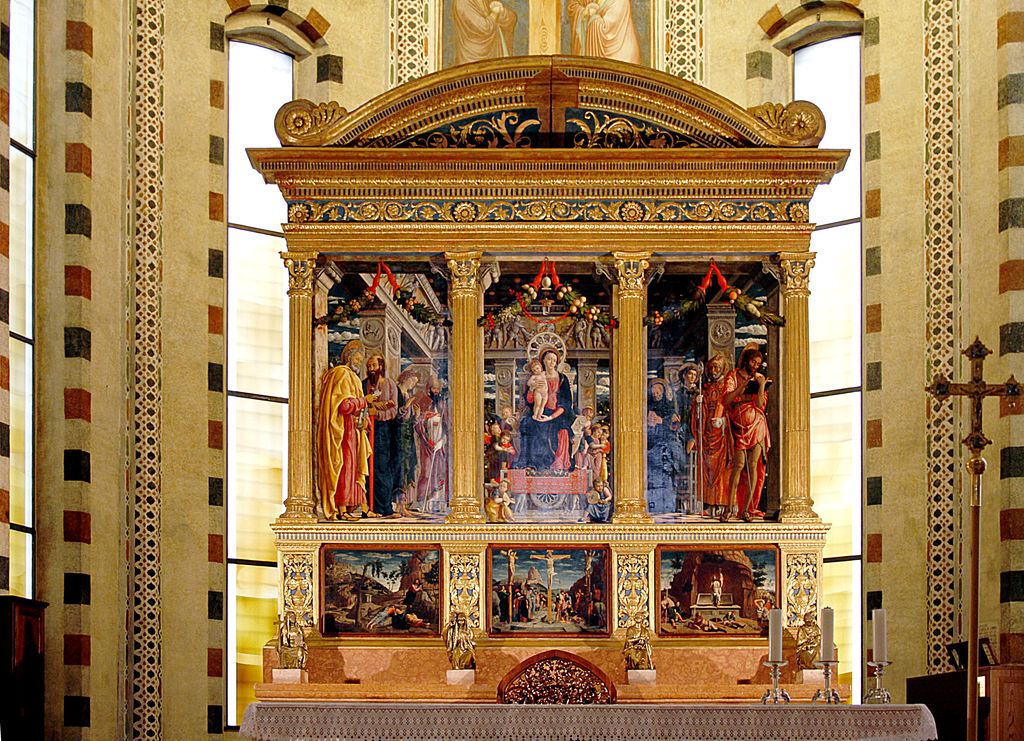
The San Zeno Altarpiece in its frame, Basilica of San Zeno, Verona José Luiz. Image source. CC BY-SA 4.0. Resized from the cited image.