 by Tom Gurney
Tom Gurney BSc (Hons) is an art history expert with over 20 years experience
Email: tomgurney1@gmail.com / Phone: +44 7429 011000
Overview
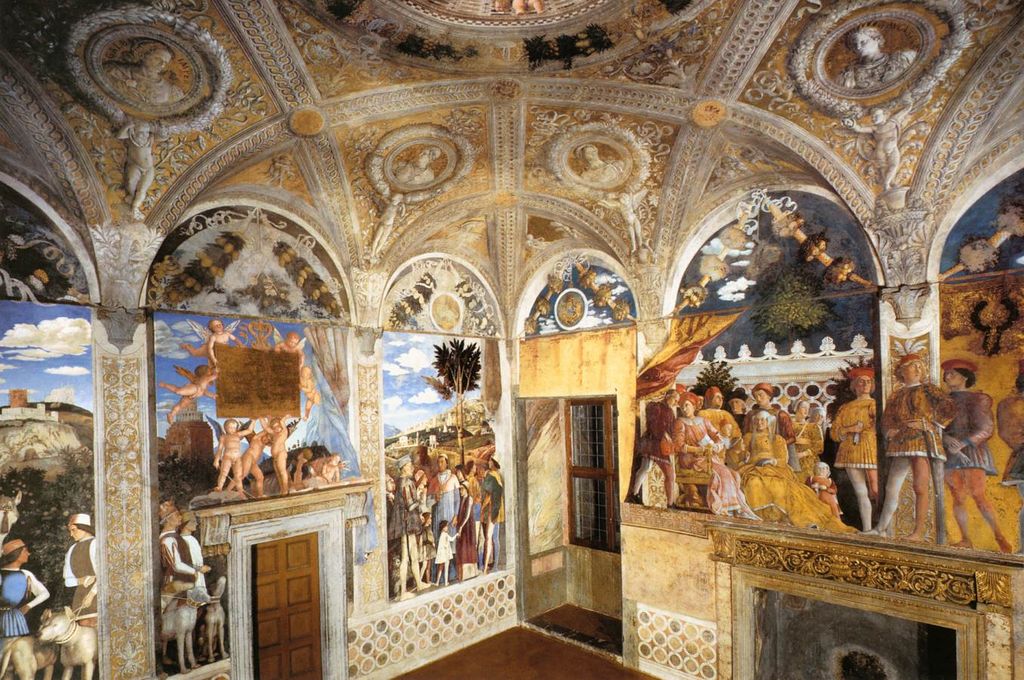
In the north-east tower of Mantua’s Castello di San Giorgio, Andrea Mantegna made a room about eight metres square seem to contain a court, a distant city and a patch of open sky. On one wall, a man bends to speak to the marquis above a real fireplace. On the next, horses stand apart from a family greeting. Look up and the people at a painted balustrade seem to look back down. The murals of the Camera degli Sposi, made between 1465 and 1474, still occupy the walls and vault for which Mantegna designed them. [1]
A letter in the marquis’s hand has sent historians to the Gonzaga archives. A boy near the cardinal on the adjoining wall has prompted questions about which generation he belongs to and how old he would have been at the two documented meetings proposed as the subject. Those questions begin in the room itself, with the way Mantegna places a piece of paper, a familiar face or a stretch of painted architecture where it can hold your attention.
At a Glance
- ArtistAndrea Mantegna
- Date1465–1474
- MediumMixed-technique mural painting on plaster
- DimensionsAbout eight metres on each side
- LocationCastello di San Giorgio, Palazzo Ducale, Mantua
Andrea Mantegna in context
San Zeno Altarpiece
1457–59 [27]Camera degli Sposi (Camera Picta)
1465–74 [1]The Triumphs of Caesar
About 1485–1506 [28]Madonna della Vittoria
1495–96 [29]The painted audience chamber in the Castello di San Giorgio
The room is on the castle’s principal floor, the piano nobile. Now part of the Palazzo Ducale, the Castello di San Giorgio was built between 1395 and 1406 to a design the palace attributes to Bartolino da Novara. The square chamber in its north-east tower is compact enough for a turn of the head to bring a second wall into view. Its walls are wide enough to accommodate a gathering of the ruling family and still leave room for people to seem to approach it. [2] [3]
Ludovico Gonzaga, the second marquis of Mantua, commissioned the murals. Some sources number him Ludovico II and others Ludovico III. The dedication pairs him with his wife, Barbara of Brandenburg, and both appear seated on the north wall, with members of the household grouped around them. Painting a room in which the Gonzaga conducted their affairs was a substantial undertaking in Mantegna’s career at the Gonzaga court. The castle gave him a particular set of surfaces and openings to work around. The family whose likenesses filled those surfaces also supplied the room’s first audience. [4] [3]
One visitor’s business survives in writing. A notarial deed of 1 July 1475 records a transaction in the camera magna picta audientie, the “large painted audience chamber”. Mantegna’s inscription dates completion to the previous year. By July the decorated room was already in use for audiences, a function that gives the north wall a particular immediacy. A person coming to conduct business entered a room in which an attendant was painted bending to address the marquis and others could be seen on the stairs. The painting makes access to the ruler visible at the very place where visitors might seek it. [5] (p. 112 n. 21)
An audience chamber could also have a princely domestic function. Hauser discusses this possibility and reconstructs the position of a state bed. Such a furnishing would have occupied part of the floor and shaped the paths visitors took through the room. It also changes how one imagines the murals being seen. Someone moving around a furnished chamber, or waiting in one part of it for an audience, would have taken in its painted openings from different positions. The deed confirms one use of the room, while the proposed bed gives a sense of the ceremonial and domestic arrangements that may have accompanied it. [6]
The earlier name, Camera Picta, means “painted chamber”. The familiar Camera degli Sposi, or “Bridal Chamber”, is attested in Carlo Ridolfi’s publication of 1648, although the origin of the later name is uncertain. A betrothal document of 1462 may refer to this room before it was painted. That document concerns Federico Gonzaga and Margherita of Bavaria, a different couple from the Ludovico and Barbara honoured on the plaque. The names document different stages in the room’s history. The fifteenth-century deed describes a chamber where an audience could take place. Ridolfi’s title gives the room the name by which it later became widely known. [5] (p. 112 n. 20) [7]
Where the castle walls give way to painted space
Start with the openings in the masonry. On the north wall are a window and the fireplace. A second window is on the east, and the doorways are on the west and south. The vault rises shallowly above them. Once you have located the sources of daylight and the possible paths through the room, a second architecture comes into focus. It runs continuously across the four walls and makes a place for the real openings within Mantegna’s design. [3] [6]
Follow the painted marble dado around the base of the room. Its level carries the eye past changes in the scenes above. Pilasters rise from this lower zone to capitals that project in stucco. Seen from below, the capital gives the upright beneath it the appearance of substance. At the same time the painted pilaster makes the actual relief look like the upper part of a much larger structure. The junction is where the eye most easily accepts two different kinds of work as one piece of architecture. At the south-east corner the base and the sequence of bays continue around a turn in the actual wall, making the system particularly easy to follow. [8]
On the south and east walls the curtains are drawn across the apparent bays. Their folds suggest fabric hanging between the pilasters and keep the eye near the surface, even though the real doorway and window break through those walls. Curtains open on the north and west, where people and landscape come into view. The same painted framework can therefore bring a hanging close to you on one side and seem to put a crowd several steps away on the other. You can see the closed and open bays as successive stretches of one decorated room because the base, the pilasters and their capitals carry on around it. [3] [6]
The fireplace gives the Court its elevation. The gathering rises above the real hearth, and the group on the painted stairs at the right gives that change of level a continuation within the scene. On the west wall the doorway takes up the lower part of the middle bay. Mantegna sets the inscription above it, with horses and retainers to the left and the greeting to the right. A person using that door would pass below the dedication, at the point where the wall turns from the company accompanying the journey to the people at its centre. Both the hearth and the doorway help determine where an action appears and how the eye reaches it.
That interplay accounts for the term trompe-l’œil. The surface at the foot of the wall looks like marble. A curtain fold seems to hang forward of the architectural framework. Through the parted curtains, a city appears to stand at a distance. The three effects are made with paint, yet each asks the eye to measure a different relation to the wall. The stucco capitals, hearth and window recesses supply actual edges and projections in much the same field of view. Their presence lends the painted structures some of their credibility.
Palazzo Ducale recommends standing near the centre to see the ensemble. From there the two principal walls can be read in relation to each other, with the bays providing a scale for the figures and the distance they seem to occupy. The palace’s historical and artistic report traces much of the painted illumination on the north wall to the direction of the east window. A viewer can locate the actual source from which the light in the Court seems to come. The report also records local variations across the walls and vault, including the shadow beside the figure conventionally identified as Federico at the west pilaster. The latter is an effect to inspect at the scale of a single figure and pier. The centre lets the sequences of bays come into view, while individual surfaces reward a change of angle or a closer look. [1] [9]
Mantegna had already used perspective to establish an architectural setting for the Martyrdom of Saint Christopher. In Mantua the building itself enters into the effect. A turn from the curtained east wall towards the north window and fireplace takes you from a painted textile to a gathering whose height and illumination make sense in relation to those features of the tower.
Videos
Smarthistory examines how Mantegna joins the real room to the space he painted.
Andrea Mantegna, Camera Picta
The presenters look at the Gonzaga household, the room’s architecture and the painted opening in the vault.
Watch on YouTubeThe north wall and the people approaching the marquis
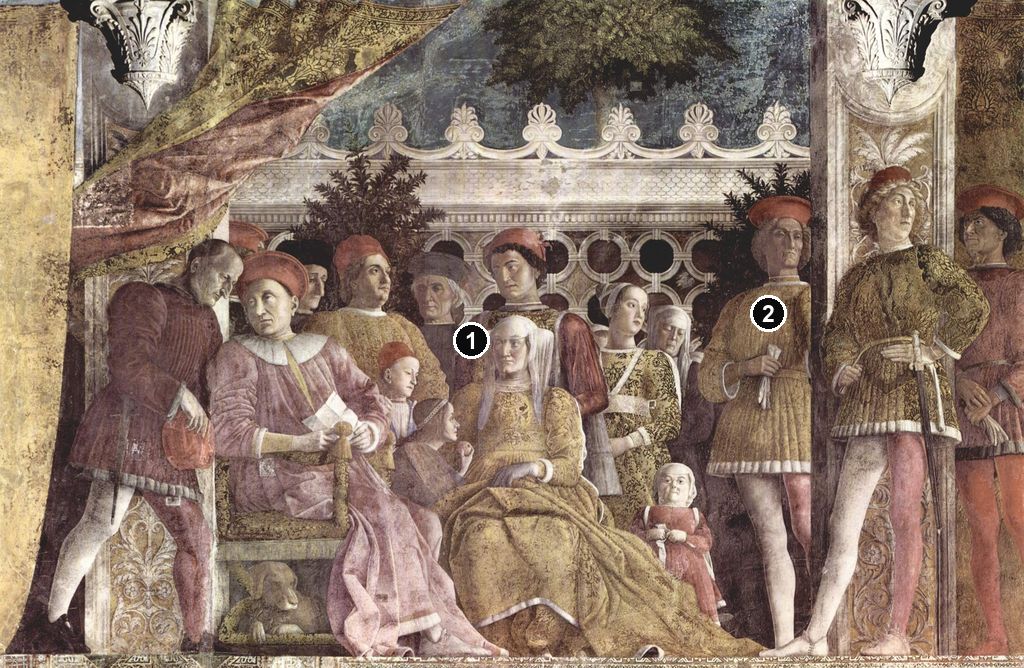
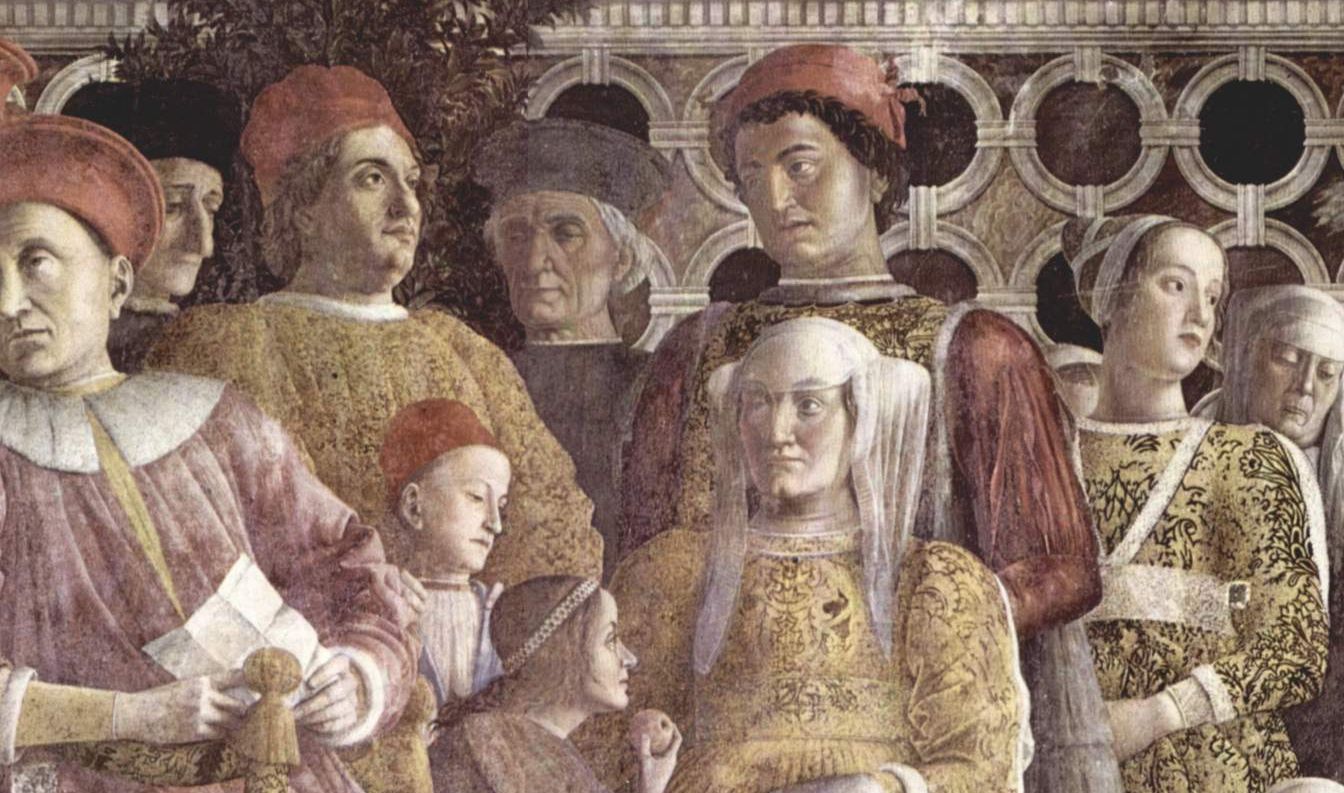
At the centre of attention in the Court is a small piece of paper. Ludovico sits holding it while a man leans towards him. Their heads come close enough for a conversation, and the letter gives the encounter a focus within the much larger assembly. The other figures are near enough to belong to the occasion. Some are at the level of the marquis and others are still approaching. You can begin to read the business of the gathering by following those differences in distance and posture. [3] [10]
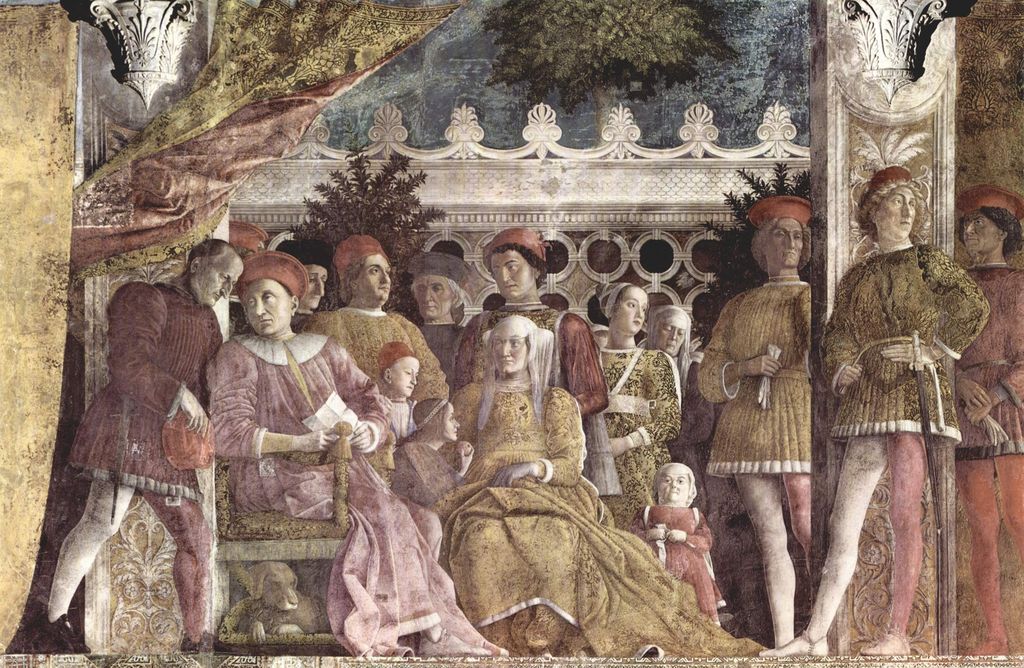
The Court scene, Camera degli Sposi, Palazzo Ducale, Mantua Image source. Public domain.
Barbara of Brandenburg sits alongside Ludovico. The paper and the leaning man draw the eye to him, while Barbara’s place among the children and attendants brings it back to the family. Below the marquis is a dog, settled beneath his chair. The animal gives a sense of the space under the seat and of the everyday life that can continue around a moment of business. Barbara’s presence and the dog under Ludovico’s chair help explain why the scene can look like a household even as the letter and the stairs suggest the workings of an audience chamber. [10]
A female court attendant with dwarfism looks out towards the room. The direction of her eyes briefly brings the spectator into the assembly, among faces otherwise turned variously towards their neighbours or the seated pair. At the right, people occupy the stairs. Their lower level gives the approaching group a different relation to Ludovico and Barbara from that of the figures already gathered around the chairs. You can follow a series of positions, from the people on the stairs through the household to the man who has come within speaking distance of the marquis. [10]
Stephen J. Campbell reads the restraint of the figures in the context of courtly deportment. That interpretation makes the smallness of certain gestures worth attending to. The lean towards Ludovico catches the eye because the figures around him are comparatively still. The grip on a letter and the turn of a face can carry much of the action. The stair group makes the approach legible through placement as much as movement. Each figure’s bearing tells you something about that person’s position in the gathering. At the oculus, where bodies bend and twist towards the room below, Mantegna makes the spectators below the focus of attention. [11]
The names attached to the figures vary in certainty. Ludovico and Barbara are securely identified. The man who leans towards the marquis is traditionally called Marsilio Andreasi, a Gonzaga secretary. The scene of a man speaking close to his ruler while the ruler holds a letter helps explain why the traditional identification has seemed plausible. Rodolfo Signorini proposed Alessandro Gonzaga or Raimondo di Lupi. A State Archives publication documents Andreasi’s career and questions whether the evidence can identify him as the sitter. The proximity of the two figures establishes the intimacy of the exchange. Who the man is and what he is saying remain open. [5] [12]
The Lombardy regional catalogue, SIRBeC, identifies children in the group as Gianfrancesco, Paola, who holds fruit, and Rodolfo, placed behind his mother. The fruit gives the eye a point of reference among the smaller figures. Rodolfo’s proposed position describes a family relationship through the way one figure stands in relation to another. Details like these give the household its variety of ages and scales, while the seating and the approaches help establish the distinctions of rank. [3]
The fair-haired woman is the younger Barbara in SIRBeC’s account. Signorini proposed Margherita of Bavaria, Federico’s wife. A black-capped figure has been proposed as Leon Battista Alberti, and an older woman has been read as a nurse or as Paola Malatesta. In the older woman’s case, the proposals would give the sitter quite different places in the gathering, either through a duty within the household or through kinship. The painting can sustain such close examination because it differentiates even the people standing back from the principal action. [3] [5] [13]
From the fireplace, the eye has travelled through an assembly arranged around two seated figures. On the adjoining wall the marquis stands outside, and the people closest to him are grouped around a greeting. There, too, distance from the centre of the action helps distinguish the members of the party.
Horses, dedication and dynastic portraits on the west wall
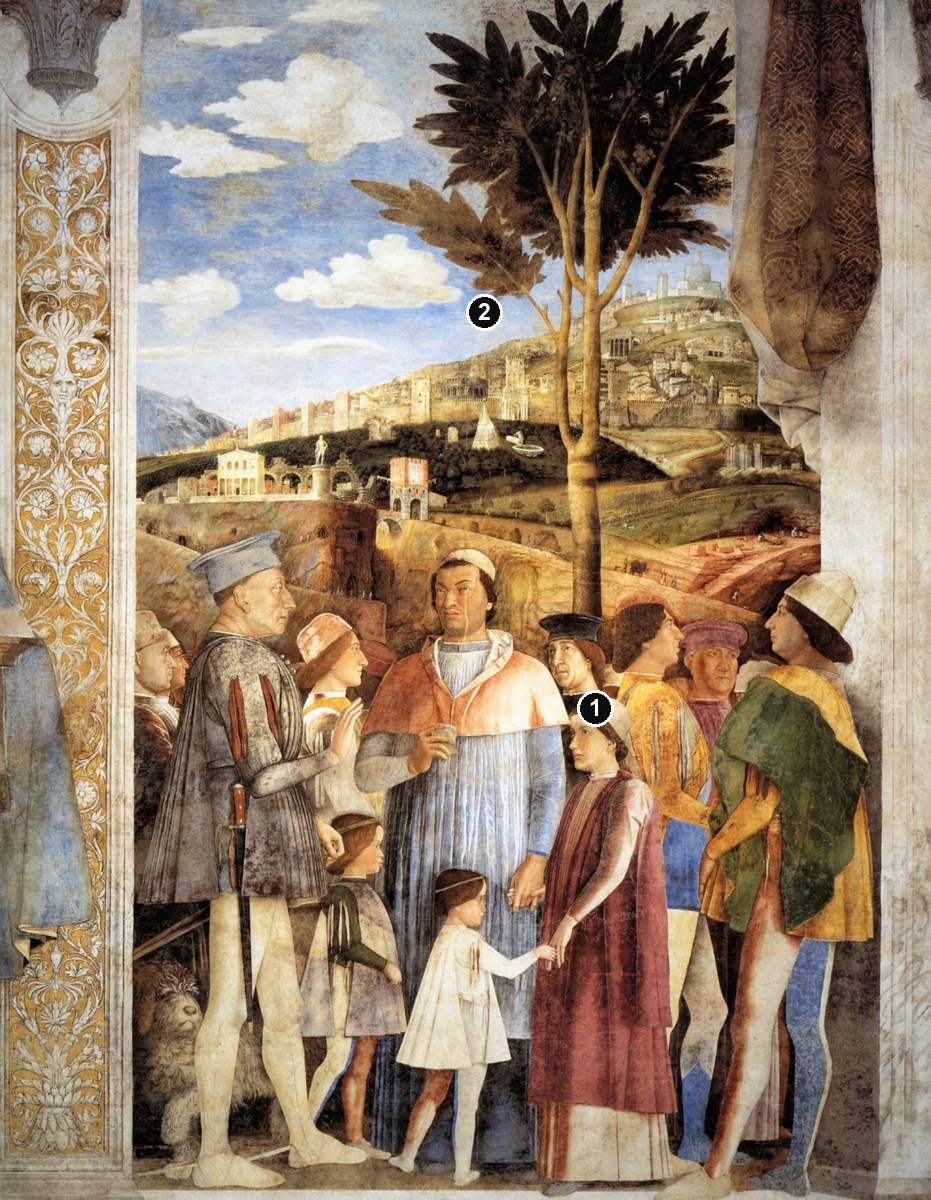
The Meeting spreads across three bays. Horses and retainers occupy the left. The animals suggest a party in transit and give the people accompanying it their own area, apart from the figures who greet each other. The actual doorway interrupts the wall in the middle. Above it, putti carry a plaque that addresses the patrons directly. The meeting takes place in the right bay, with a landscape behind it. Read across the wall, the three bays give the journey, the dedication and the greeting separate places within one composition. [3] [9]
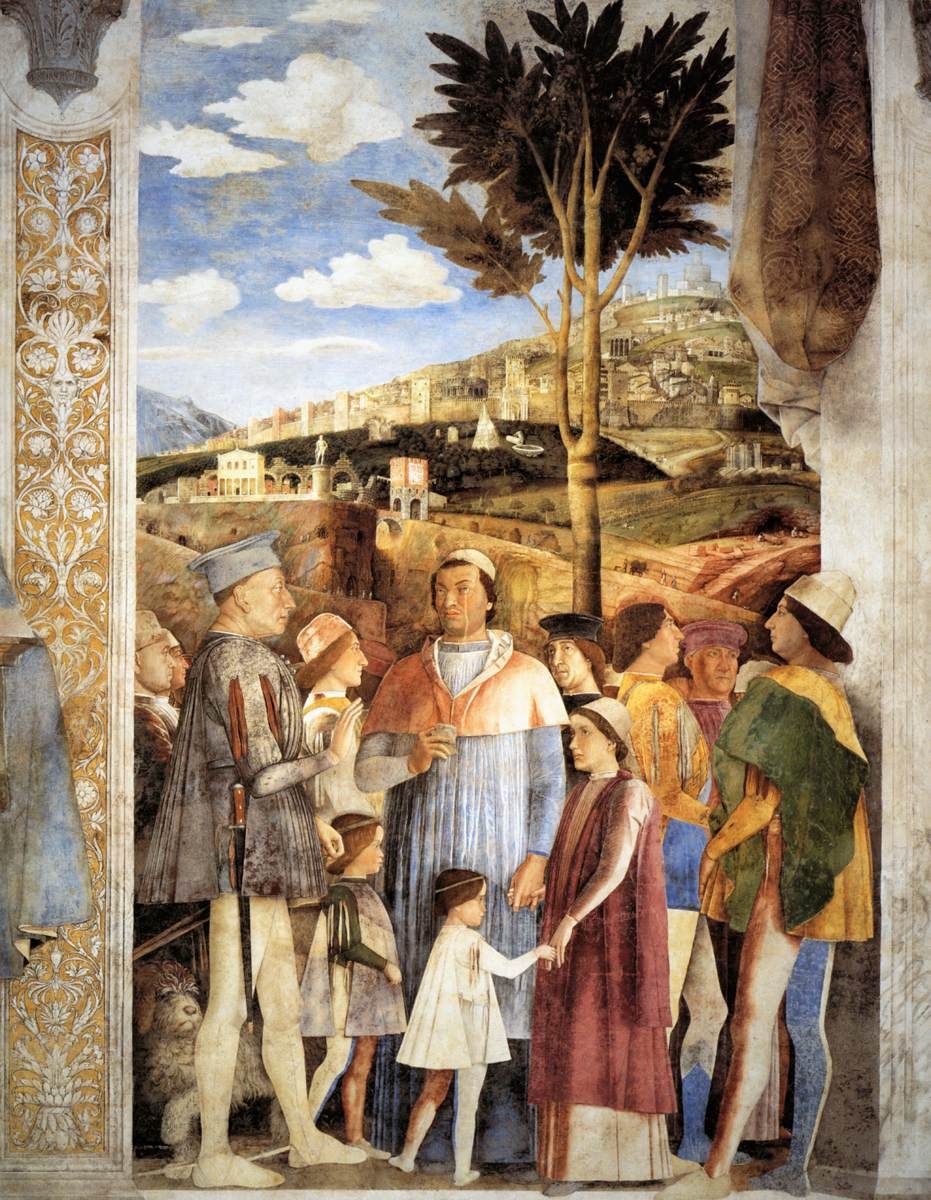
The Meeting wall, Camera degli Sposi, Palazzo Ducale, Mantua Image source. Public domain.
The Latin inscription names Ludovico and Barbara, identifies Mantegna as a Paduan and says he completed the work in their honour in 1474. OPVS HOC TENVE means “this modest work”. The words belong to the plaque, where the putti give a formal statement a conspicuous place over the door. Jérémie Koering discusses the dedication as an address to the patrons. It singles them out by name on the same wall that places the marquis among his relatives and possible guests. The inscription could be read by somebody passing through a real entrance, below figures painted as if they had lifted the words into position. [3] [14]
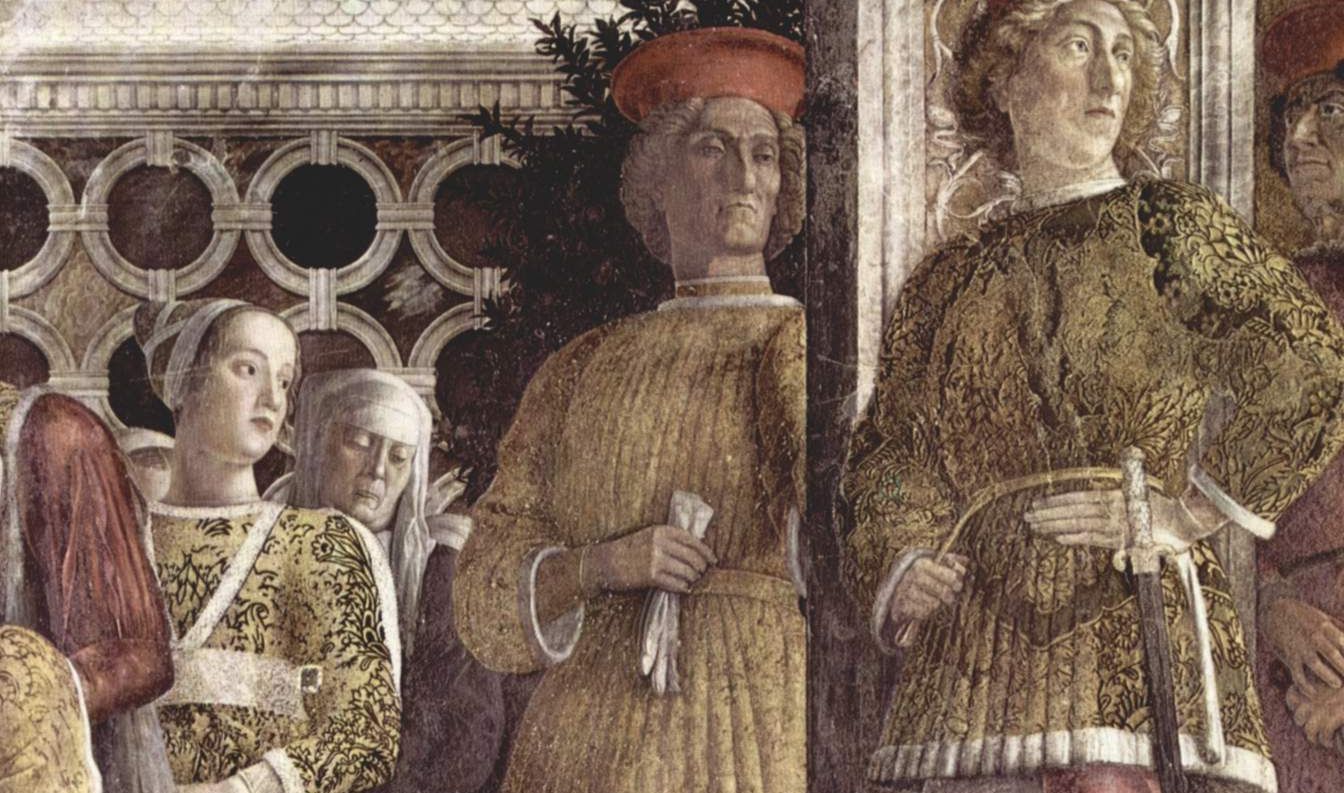
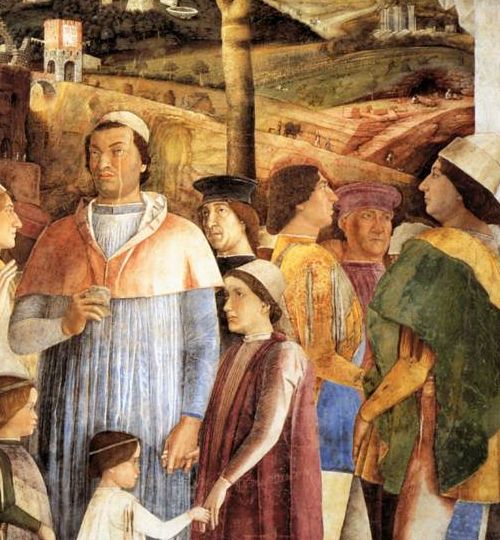
Ludovico and his son Cardinal Francesco Gonzaga are the central figures of the greeting. The cardinal lived from 1444 to 1483. In the Court his father is occupied with a letter. Here Ludovico is on his feet, facing the son whose office gives the encounter part of its significance. The cardinal is the figure considered in the discussion of a proposed portrait of Francesco Gonzaga. In the chamber his identity is bound up with his placement beside the marquis and among several generations of the same family. [9] [15]
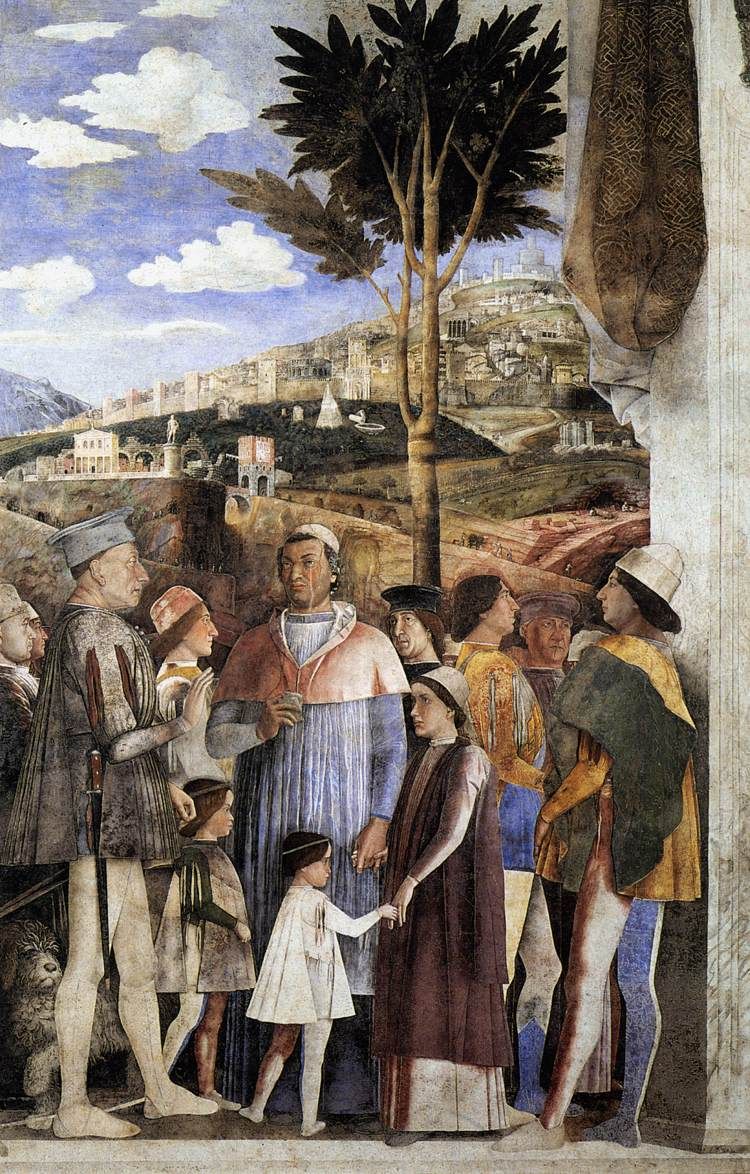
The Meeting scene, Camera degli Sposi, Palazzo Ducale, Mantua Image source. Public domain.
The man at the far right by the pilaster is conventionally identified as Federico I, Ludovico’s eldest son. The smaller figures have been identified as the marquis’s son Ludovico, later a bishop, and Federico’s sons Sigismondo and the future Marquis Francesco II. On that reading, there are three generations in the company. Two of them include a Ludovico, and two include a Francesco. The boy identified as Francesco II grew up to commission the Madonna della Vittoria. His proposed place in the group shows how a figure who takes up relatively little space can be consequential for the reading of the family’s succession. The adult cardinal and the boy belong to successive generations. [3] [9]
Two further names would extend the company beyond the family. Signorini compared painted figures with likenesses of Emperor Frederick III and Christian I of Denmark, identifications the palace report treats as possible. The proposals draw on resemblance as well as the historical relationships of the rulers to the Gonzaga. Christian I’s visit to Mantua in 1474 is independently documented, and the palace’s numismatic catalogue provides evidence for that visit. Its date puts him in the city in the year on the dedication. The visit establishes Christian’s presence in Mantua. The proposed portrait still depends on the comparison of likenesses. If the proposed identifications hold, the wall gathers people connected to the Gonzaga on different occasions as well as members of the family from different generations. [5] [9] [16]
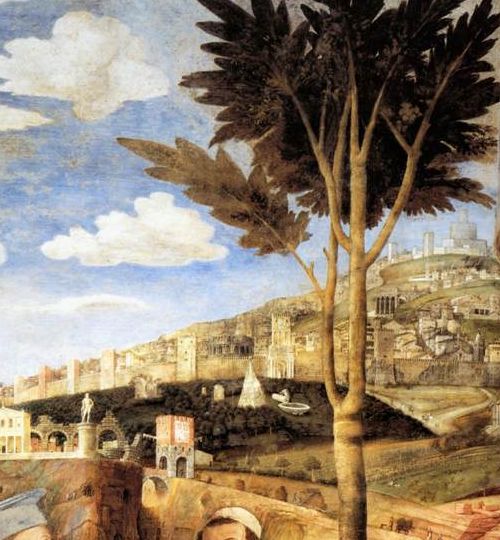
Beyond the people is a city with forms that recall Rome. The Pyramid of Cestius, the Colosseum and Castel Sant’Angelo have been proposed as reference points. It is possible to pick out such forms individually and still read the landscape as an imagined place put together by the painter. A possible echo of the Rocca Pia at Tivoli extends the comparison beyond Rome itself. The buildings can evoke antiquity and the Rome associated with the cardinal’s office. Their appearance within one view gives the encounter a setting rich in associations, while the documentary geography of the proposed meetings lies elsewhere. [3] [5] [17]
After looking into the distance, return to the west pilaster. A face emerges from its painted foliage. It has been read as a self-portrait of Mantegna, whose name appears above the doorway nearby. Agapiou studies it as an adaptation of an antique gorgoneion, an ornamental Gorgon head. The visible face is part of the foliage, and the proposed likeness depends on how that motif is interpreted. Its small scale makes it easy to pass over while taking in the people and horses. From close attention to the pilaster, the eye can move back to the company and its papers, where another distinction between a visible detail and a proposed identification matters. [5] [18]
Bozzolo, Bondanello and what the letters establish
On 18 December 1461 Pope Pius II created Francesco Gonzaga a cardinal. [15] On 30 December Bianca Maria Visconti wrote to Ludovico asking him to come to Milan because her husband, Francesco Sforza, was seriously ill. [5] (pp. 127–128 n. 90, pl. 22a) Letters from Barbara and Ludovico dated 1 January 1462 describe the request and Ludovico’s urgent departure. [5] (Barbara’s letters, pp. 126–127 nn. 86–88, and Ludovico’s reply, p. 128 n. 91) A further letter from Ludovico, written at Bozzolo on the same day, says that he arrived there at the same time as his son the cardinal and also refers to Federico. [5] (p. 130 n. 94) The events documented in those few days bring together a summons, a journey and an encounter soon after Francesco received his new dignity.
Signorini used that sequence to connect the two walls. Palazzo Ducale adopts his interpretation, reading the north-wall letter as Bianca Maria’s summons and the west-wall greeting as the encounter at Bozzolo. The case rests on more than the presence of a cardinal and a letter in the room. The correspondence identifies the cause of the journey and records the arrival of father and son at the same place. Barbara’s letter also puts her in the documented exchange about Milan, giving her a place in the sequence as well as a seat in the Court. On this reading the horses on the west wall belong to the world of travel into which the dispatch sends Ludovico. [1] [5] (pp. 129–131)
On the west wall the cardinal holds a sheet in his right hand. Signorini proposed that it is the same letter Ludovico holds on the north wall. The two painted sheets have no securely established shared identity. [5] (pp. 129–131) Ludovico’s correspondence records events and offers a way of reading their connection to the paintings. The sequence a viewer can trace in the room runs from business among the household to an encounter with people and horses in attendance. It can suggest a story continuing around the corner without requiring the same document to be carried into the next scene.
There is a second documented occasion. The chronicler Schivenoglia records a meeting at Bondanello sul Secchia on 22 August 1472. He records the company from Mirandola and estimates that about five hundred riders accompanied Ludovico. The compact painted greeting gives little sense of a party on that scale and cannot establish that the encounter took place at Bondanello. [5] (pp. 117–119) Earlier scholars proposed that occasion for the west wall and sometimes associated the north-wall letter with different news. Bondanello fell during the years of work on the chamber. Bozzolo preceded the early evidence of painting by more than three years. If the boy beside his grandfather is Francesco II, his documented birth in 1466 places him after the encounter at Bozzolo and would make him about six at Bondanello. That comparison depends on the proposed identification. [3] [19]
The identifications also suggest why ages alone may prove an uncertain guide. If the family’s younger generations appear for the relationships they embody, the painter could bring them into an encounter whose circumstances come from another moment. If Frederick III and Christian I are present, the span of occasions widens again, with the Danish king’s visit falling in 1474. The landscape introduces a similar distinction between association and location. Its Roman forms enrich the setting of a meeting with a cardinal, while the written records place the proposed encounters at Bozzolo and Bondanello. A historical occasion could supply the greeting and a wider family grouping could give it dynastic meaning. Federico’s place at the edge and the smaller figures nearer the action make the succession of generations legible whichever meeting is favoured. [3] [5] [9] [16]
Contemporary diplomatic correspondence records interest in the work itself. The exchanges discussed by Pelosi show interest in 1471, while the work was still in progress. [20] Saggi’s report of 26 November 1475, cited by Signorini, records praise for the finished chamber. [13] Together with the audience-chamber deed, it belongs to the history of the murals’ reception in 1475. The distinction is chronological and practical. The letters of 1461 and 1462 were written in the course of Gonzaga business and later became evidence for an interpretation of the painted letter. The chronicle supplies a second possible encounter in 1472. By 1475 the completed chamber was a place where visitors and officials carried on business of their own. [5]
The vault, eight ancient portraits and a painted sky
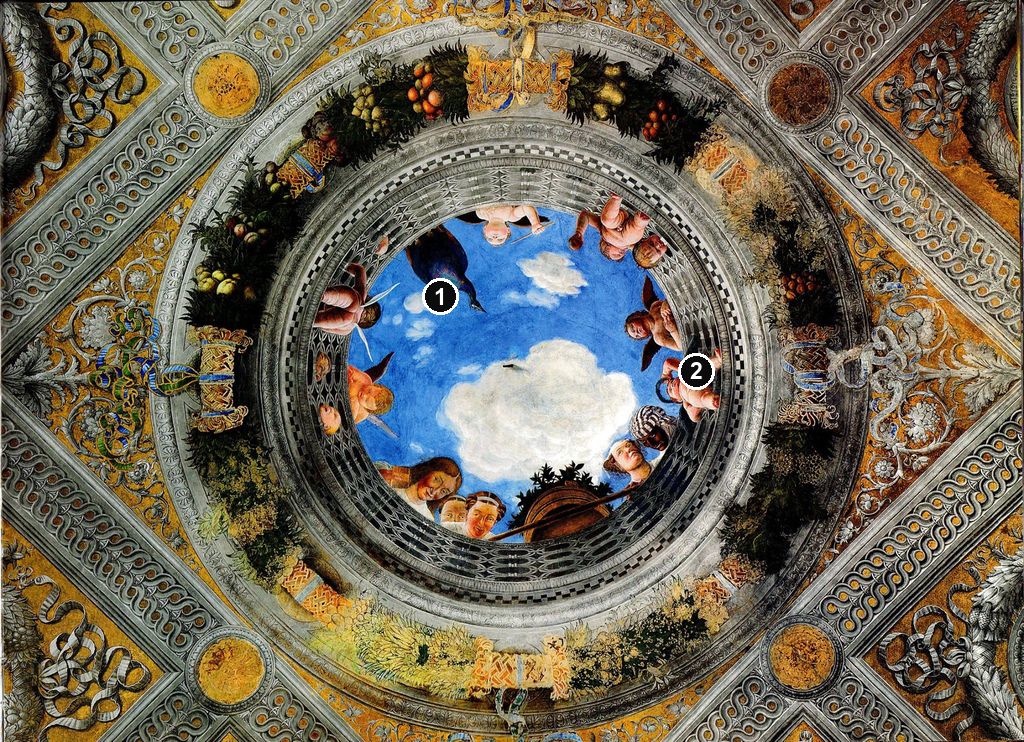
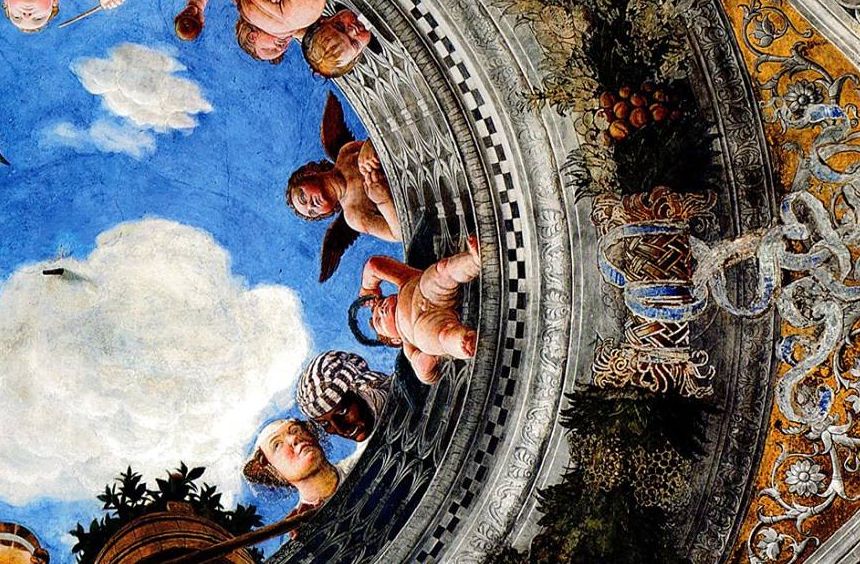
Looking up changes your relation to the figures. On the walls you look past curtains into spaces where people sit and stand. At the oculus you face a circular balustrade as though from beneath an opening. Adults lean over from its far side and look down, making the position from which you view the ceiling part of the illusion. The painted rim seems to rise clear of the shallow vault, with the sky farther away. The adults’ identities remain uncertain. [21]
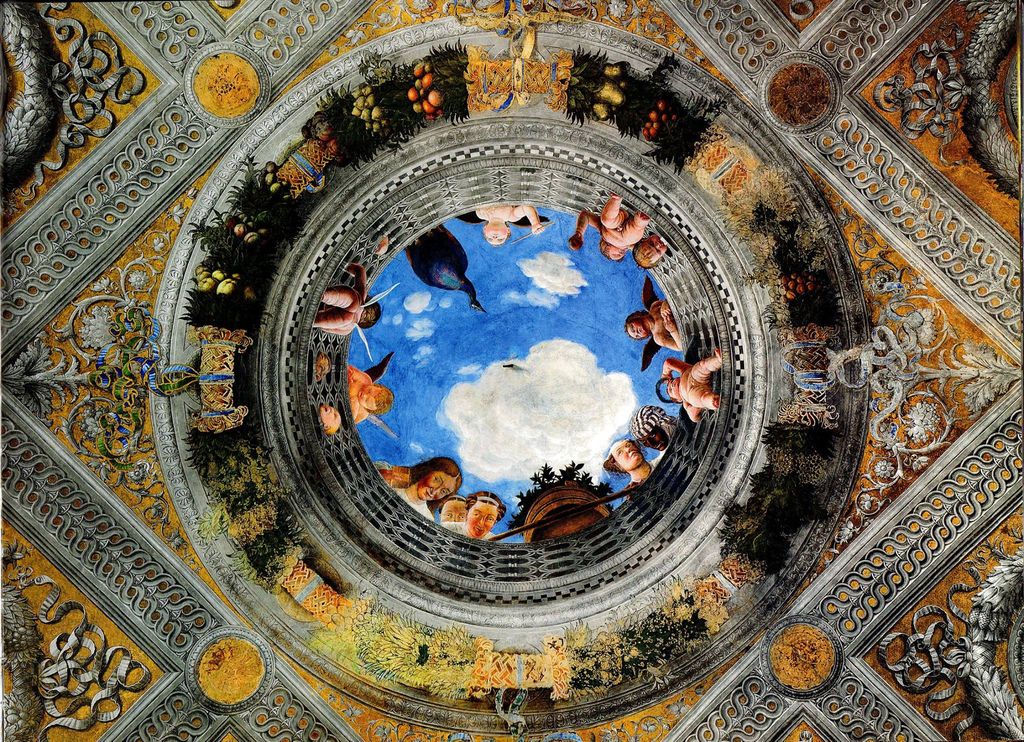
The Camera degli Sposi ceiling, Palazzo Ducale, Mantua Image source. Public domain.
The putti give the clearest sense of the distance Mantegna is asking the eye to imagine. Parts of their bodies appear large and close, while limbs angled away seem abruptly shortened. This steep foreshortening makes them look as though they occupy the narrow space just above the opening. Hands reach around the rail and bodies overlap it. Wherever a hand curls across an edge, the spectator has a way of judging what lies in front of what. The adults who angle their faces down create a related effect through their gaze. The court attendant on the north wall looks out towards the room, while the adults at the rim seem to see you from overhead. [10] [21]
The peacock and planted vessel give the upper surface of the rim a presence of its own. The bird perches on an apparent ledge, inviting the eye to find what supports it. The vessel looks poised close to the edge, where its weight and position become interesting from below. Mantegna gives a spectator reasons to imagine what might happen in the space, whether a head withdrawing, a hand loosening its grip or an object shifting on a ledge. Campbell places the more expressive bodies of the vault in relation to the restraint of the court portraits. A measured lean suffices for the man beside the marquis, whereas the twists and reaches around the opening make play out of a body’s relation to the spectator below. [11] [21]
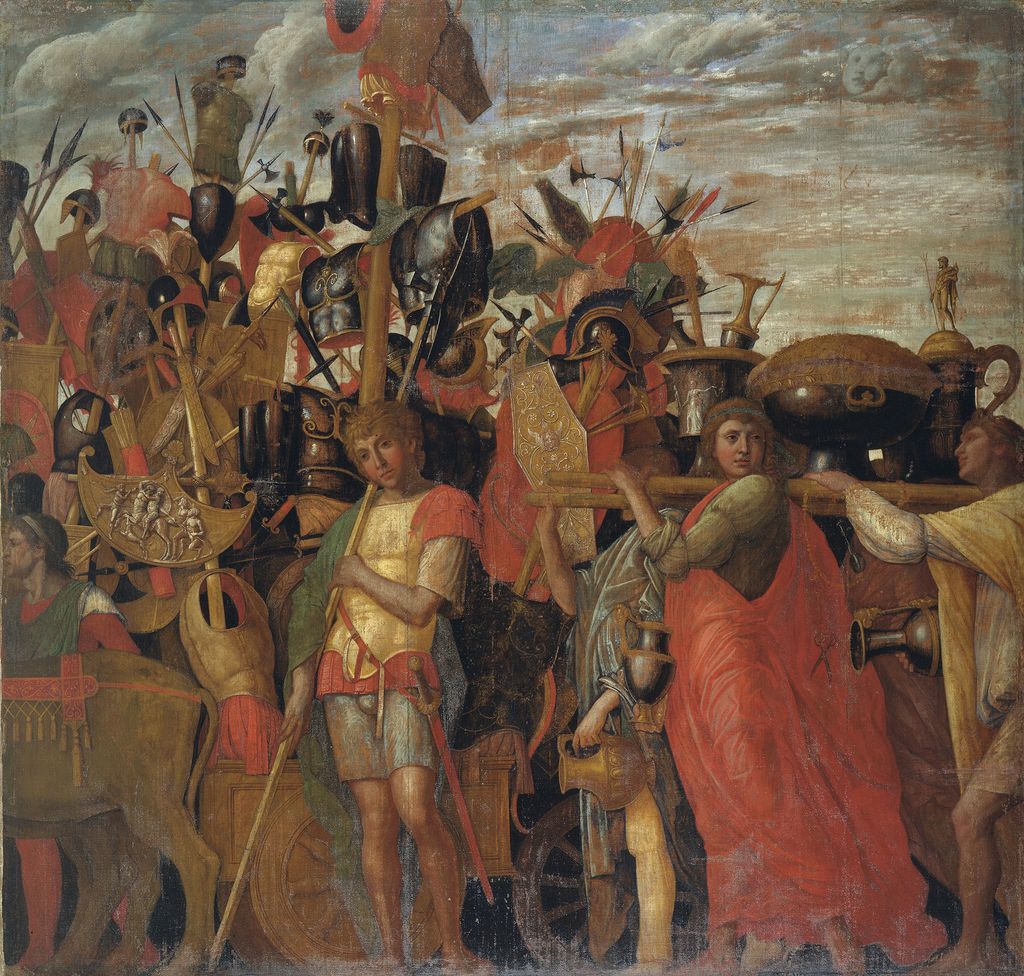
Around the oculus are eight portrait medallions. The palace’s numismatic catalogue identifies the heads individually as Julius Caesar, Augustus, Tiberius, Caligula, Claudius, Nero, Galba and Otho. Hauser’s drawings show how they are distributed in the vault. Wreaths and compartments give each head its own surround and make the portraits legible as a series. Mantegna also explored Roman antiquity on a very different scale in the separate canvases of the Triumphs of Caesar. In the chamber, Caesar occupies a small field within the vault and has to be sought among seven other ancient likenesses. [6] [16]
Biasion pairs each painted medallion with numismatic comparators. On the reverse of the denarius, Caesar’s head appears in profile. [16] (cat. 1, printed p. 230, PDF p. 231) Look from the coin to the turned bust inside the painted wreath [16] (fig. 1, printed p. 231, PDF p. 232) and compare how the two images show the face and the angle of the head. The denarius offers an ancient likeness for comparison. Seen from the floor, the regular spacing and wreaths hold the medallions together as a series. The catalogue’s side-by-side illustrations make it easier to study the individual heads within that pattern. [16]
Twelve mythological episodes occupy separate compartments. In Hauser’s scheme, Orpheus is to the north, Arion to the east, and Hercules to the south and west. In compartment E of Hauser’s fig. 5, Arion rides the dolphin above the closed east curtains. Moving from Orpheus above the Court to Arion takes the gaze around a corner, from above a wall that opens onto a gathering to one whose painted curtains stay closed. The Hercules compartments extend around the south and west, carrying the mythological decoration over the part of the room where the western doorway and dedication interrupt the wall below. Each episode asks to be read within a frame. The putti at the centre seem free to reach around an edge into the space occupied by the spectator. [6] [21]
Grisaille, or painting in shades of grey, gives passages the appearance of modelled relief. Gilded effects and wreaths distinguish surfaces and borders from the images they enclose. The eye passes from a head that looks raised, to a myth that seems worked into a surface, to an opening that appears to recede past the rim. The shallow vault supports those different impressions of depth, just as the stucco above the dado helps the painted architecture on the walls acquire substance. [3] [6] [16]
Plaster, paint and the conservation of the chamber
The murals are often called frescoes. As a description of how they were made, mixed-technique mural painting is more precise. In painting a fresco, colour is applied to fresh lime plaster and becomes incorporated in the surface as it sets. In painting a secco, the plaster is already dry, and a medium binds the colour to it. The regional catalogue includes tempera, a broad term for bound paint in this context. Different methods can coexist within the same painted wall, even where the eye sees an uninterrupted curtain or architectural surface. [3]
Ludovico’s request for lime on 26 April 1465 [5] (p. 111 n. 19) and the date of 16 June 1465 in the north window reveal [3] [5] (p. 111) put material preparation and a mark in the chamber within weeks of each other. The evidence establishes an early phase of the project. The day on which Mantegna first applied paint and the hand that wrote the June date remain uncertain. The place where the date survives is telling. The recess of a working window, one of the features that helps make sense of the room’s lighting, was itself part of the surface to be decorated.
An order of 19 July 1468 specifies linseed oil for preparing colours. [5] (p. 111 n. 18) On 22 October 1470 Ludovico complained about the pace of the work [5] (p. 110 n. 17), and on 25 October 1471 an order called for walnut oil. [5] (p. 109 n. 1, citing Kristeller) The orders support the technical evidence for mixed practice, while the binder in any given passage depends on evidence from that part of the wall. The complaint gives a different view of the project from the one Mantegna presents on the finished plaque. Over the door the work is complete and offered in the patrons’ honour. In the dated orders and the marquis’s complaint it is still a job with supplies to obtain and time left to spend. [3]
Photographs document some of what happened to the surfaces in later centuries. The Italian national catalogue suggests that preliminary photography began in late 1932 and tentatively links some photographs to Mauro Pellicioli’s intervention of 1938–1941. Knowing when a photograph was taken matters in comparing the condition of a detail. An image made in preparation for conservation may preserve a different appearance from one made during the work. The photographs also make it possible to examine passages, such as those high on the west wall, that a visitor ordinarily sees from the floor. [22]
A survey in 1980–82 measured temperature and relative humidity in the chamber. In the major mid-1980s campaign, Michele Cordaro and Vasco Fassina investigated the painted surfaces in relation to that interior environment. They documented dirt, salts, lifting paint and trials of cleaning methods. Their 1986 report records the effect of visitors on absolute humidity during the survey. [23] Surface dirt and lifting paint call for different responses, even where they occur in what looks from below like a continuous piece of painted architecture. The room’s environment, the plaster and the paint layers all enter into a judgement about how to treat a given area.
The earthquakes that struck Emilia in 2012 made the connection between the building and the murals particularly visible. A 2014 observation in the regional catalogue records an older fissure reopened through part of the Court and the loss of some painted plaster. [3] On 1 April 2015 the Ministry announced a reopening ceremony for the following day. [24] Biennial inspection and maintenance resumed in 2021. On 21 February 2025 the Opificio delle Pietre Dure announced a programme with Palazzo Ducale scheduled for 24 February to 7 March 2025 that included condition checks, surface mapping and the removal of superficial dust. The mapping was intended to help staff compare the condition of the same areas at later inspections. [25]
Palazzo Ducale includes the chamber in its Castello di San Giorgio visit. From the centre, a look from wall to wall and then upwards follows the design through the parts of the building on which it depends. A real corner carries the dado round, the north hearth raises the family gathering, the west door gives the dedication its place, and the shallow vault holds the balustrade and sky. The daylight and the plaster are still part of the means by which the Gonzaga room seems to open around you. [26]
Annotated Details from Camera degli Sposi
The numbered points identify details to look at closely. The detail images below preserve the native scale of the selected crops.
The Camera degli Sposi ceiling
The Court scene
The Meeting wall
Details from CAMERA DEGLI SPOSI
Choose a detail to enlarge it.
The Camera degli Sposi ceiling
The oculus and its balustrade
The painted rim and balusters form a boundary between the decorated ceiling and the opened sky. Figures look over from several positions.
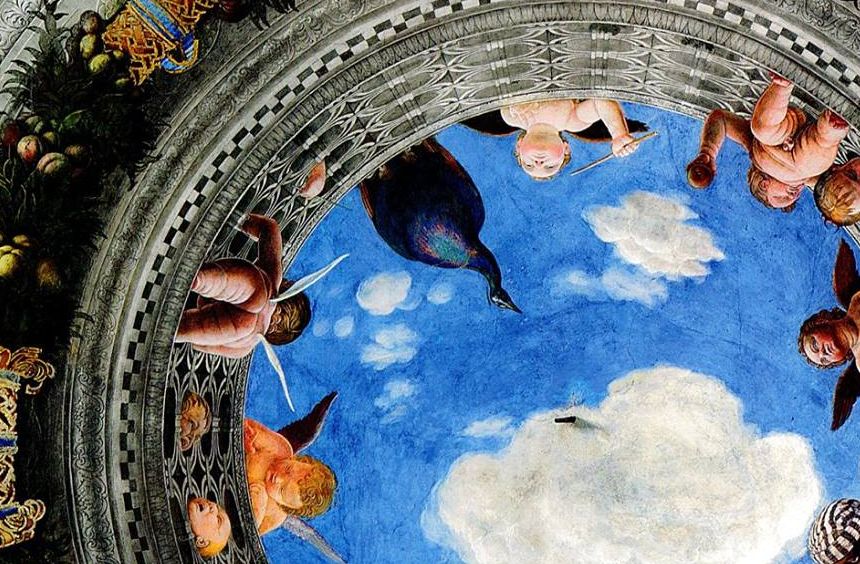
Figures on the painted rim
The angled limbs and leaning bodies work with a viewer’s position on the floor. Their apparent footing is part of the illusion.
The Court scene
The seated court group
Seated and standing people gather at different heights. The arrangement makes the audience and the exchange in front of it readable across the wall.
Figures by the opening
Grouping changes across the wall as figures overlap the covered and opened portions of the setting.
The Meeting wall
The family encounter
The bodies face across a narrow space. The profile and red costume give the group its visual centre.
The world above the figures
The foliage and distant setting fill the space above the meeting. Their scale extends the painted scene beyond the group.
Artworks directory
| Name | Date | Medium and collection |
|---|---|---|
| The Adoration of the Shepherds | Shortly after 1450 | Painting · Metropolitan Museum of Art · 32.130.2 Catalogue. |
| Saint Mark the Evangelist | C. 1448–51 | Painting · Städel Museum · 1046 Catalogue. |
| Saint Jerome Penitent in the Desert | C. 1448–51 | Painting · Museu de Arte de São Paulo · MASP.00015 Catalogue. |
| Martyrdom and Transport of the Body of Saint Christopher | Mid-1450s | Painting · Ovetari Chapel, Padua Catalogue. |
| San Luca Altarpiece | 1453–55 | Painting · Pinacoteca di Brera · 176 Catalogue. |
| The Presentation of Christ at the Temple | 1454 (Berlin dating) | Painting · Gemäldegalerie, Berlin · 29 Catalogue. |
| San Zeno Altarpiece | 1457–59 | Painting · Basilica of San Zeno, Verona Catalogue. |
| The Crucifixion | 1456–59 | Painting · Musée du Louvre · INV 368 Catalogue. |
| The Agony in the Garden (London) | C. 1455–56 | Painting · National Gallery, London · NG1417 Catalogue. |
| The Agony in the Garden (Tours) | 1459 (Tours dating) | Painting · Musée des Beaux-Arts de Tours · 1803-1-24 Catalogue. |
| The Resurrection | 1459 (Tours dating) | Painting · Musée des Beaux-Arts de Tours · 1803-1-25 Catalogue. |
| Saint Sebastian (Vienna) | C. 1457–59 | Painting · Kunsthistorisches Museum · GG 301 Catalogue. |
| Cardinal Ludovico Trevisan | C. 1459–60 (Berlin exhibition dating) | Painting · Gemäldegalerie, Berlin · 9 Catalogue. |
| The Death of the Virgin | C. 1462 | Painting · Museo Nacional del Prado · P000248 Catalogue. |
| Christ with the Soul of the Virgin | C. 1460–64 | Painting · Pinacoteca Nazionale, Ferrara Catalogue only. |
| Portrait of a Young Man (traditionally Francesco Gonzaga) | C. 1461 or 1470, depending on sitter | Painting · Museo di Capodimonte · Q 60 Catalogue. |
| Portrait of a Prelate (Carlo de’ Medici?) | C. 1465–70 | Painting · Uffizi Galleries · 1890 no. 8540 Catalogue. |
| Portrait of a Man | C. 1470 | Painting · National Gallery of Art, Washington · 1952.2.5 Catalogue. |
| Madonna with Sleeping Child (Berlin) | C. 1455–60 | Painting · Gemäldegalerie, Berlin · S.5 Catalogue. |
| Camera degli Sposi (Camera Picta) | 1465–74 | Painting · Palazzo Ducale, Mantua Catalogue. |
| Saint Sebastian (Louvre) | Around 1480 | Painting · Musée du Louvre · RF 1766 Catalogue. |
| Lamentation over the Dead Christ | C. 1483 (Brera dating) | Painting · Pinacoteca di Brera · 352 Catalogue. |
| The Triumphs of Caesar | About 1485–1506 | Painting · Royal Collection · RCIN 403958–403966 Catalogue. |
| Madonna of the Caves | C. 1488–90 | Painting · Uffizi Galleries · 1890 no. 1348 Catalogue. |
| Madonna and Child with a Choir of Cherubim | C. 1485 | Painting · Pinacoteca di Brera · 297 Catalogue. |
| Madonna and Child (Poldi Pezzoli) | Early 1490s (museum dating) | Painting · Museo Poldi Pezzoli · 1595 Catalogue. |
| The Holy Family with Saint Mary Magdalen | C. 1495–1500 | Painting · Metropolitan Museum of Art · 14.40.643 Catalogue. |
| The Virgin and Child with Saint Mary Magdalene and Saint John the Baptist | C. 1490–1505 | Painting · National Gallery, London · NG274 Catalogue. |
| Christ as the Suffering Redeemer | 1485–95 (SMK dating) | Painting · Statens Museum for Kunst · KMSsp69 Catalogue. |
| Ecce Homo | C. 1500 | Painting · Musée Jacquemart-André · MJAP-P 1840 Catalogue. |
| Judith with the Head of Holofernes (Mantegna or follower) | C. 1495–1500 | Painting · National Gallery of Art, Washington · 1942.9.42 Catalogue. |
| Madonna della Vittoria | 1495–96 | Painting · Musée du Louvre · INV 369 Catalogue. |
| Mars and Venus (Parnassus) | C. 1496–97 | Painting · Musée du Louvre · INV 370 Catalogue. |
| The Trivulzio Madonna | 1497 | Painting · Castello Sforzesco, Milan · 0554 Catalogue. |
| The Adoration of the Magi | C. 1495–1505 | Painting · J. Paul Getty Museum · 85.PA.417 Catalogue. |
| Minerva Expelling the Vices from the Garden of Virtue | C. 1502 | Painting · Musée du Louvre · INV 371 Catalogue. |
| The Introduction of the Cult of Cybele at Rome | 1505–06 | Painting · National Gallery, London · NG902 Catalogue. |
| Saint Sebastian (Venice) | Probably c. 1504–06 | Painting · Galleria Giorgio Franchetti alla Ca’ d’Oro · D.11 Catalogue. |
| Samson and Delilah | C. 1500 | Painting · National Gallery, London · NG1145 Catalogue only. |
| A Woman Drinking (probably Sophonisba) | C. 1495–1506 | Painting · National Gallery, London · NG1125.2 Catalogue only. |
| The Vestal Virgin Tuccia with a Sieve | C. 1495–1506 | Painting · National Gallery, London · NG1125.1 Catalogue only. |
| Judith with the Head of Holofernes (Dublin) | C. 1495–1500 | Painting · National Gallery of Ireland · NGI.442 Catalogue only. |
| Battle of the Sea Gods, left half (Met impression) | Before 1481 (Met dating) | Print · Metropolitan Museum of Art · 18.12 Catalogue only. |
| Battle of the Sea Gods, right half (Met impression) | Before 1481 (Met dating) | Print · Metropolitan Museum of Art · 1984.1201.4 Catalogue only. |
| Battle of the Sea Gods, left half (Tokyo impression) | C. 1475 (Tokyo dating) | Print · National Museum of Western Art, Tokyo · G.1981-0002 Catalogue only. |
| Battle of the Sea Gods, left half (Washington impression) | C. 1485–88 (NGA dating) | Print · National Gallery of Art, Washington · 1941.1.6 Catalogue only. |
| The Entombment of Christ, second state of two | Before 1475 (Met dating) | Print · Metropolitan Museum of Art · 37.42.30 Catalogue only. |
| The Entombment of Christ (possibly Zoan Andrea, after Mantegna) | 1460–1549 (Rijksmuseum dating) | Print · Rijksmuseum · RP-P-1924-60 Catalogue only. |
| Four Dancing Muses (Gian Marco Cavalli after Mantegna) | C. 1497 | Print · Metropolitan Museum of Art · 20.5.3 Catalogue only. |
| Bacchanal with Silenus | Before 1475 (Met dating) | Print · Metropolitan Museum of Art · 29.44.15 Catalogue only. |
| Bacchanal with a Wine Vat | Before 1475 (Met dating) | Print · Metropolitan Museum of Art Catalogue only. |
| St James on His Way to Execution | C. 1453–57 | Drawing · British Museum · 1976,0616.1 Catalogue only. |
| Three Studies for a Dead Christ | C. 1455–65 | Drawing · British Museum · 1909,0406.3 Catalogue only. |
| Pietà (Venice) | C. 1456–65 (exhibition datings) | Drawing · Gallerie dell’Accademia, Venice · 115 Catalogue only. |
| Studies for Christ at the Column | 1460–65 | Drawing · The Courtauld · D.1978.PG.345 Catalogue only. |
| Virtus Combusta | C. 1490 (technical study) | Drawing · British Museum · Pp,1.23 Catalogue only. |
| Virtus Combusta (Giovanni Antonio da Brescia after Mantegna) | C. 1495–1506 | Print · Musée du Louvre · 3881 LR/ Recto Catalogue only. |
| The Calumny of Apelles | C. 1504–06 | Drawing · British Museum · 1860,0616.85 Catalogue only. |
Frequently Asked Questions
“Bridal Chamber” is the later name attested by Carlo Ridolfi in 1648, although its origin is uncertain. A 1462 document concerning the betrothal of Federico Gonzaga and Margherita of Bavaria may refer to the room before it was painted. The 1475 deed records the decorated room in use as an audience chamber.
Ludovico Gonzaga greets his son Cardinal Francesco Gonzaga. Palazzo Ducale reads the scene as their encounter at Bozzolo on 1 January 1462. Earlier scholars proposed the meeting at Bondanello on 22 August 1472.
Discussion
Look again at the images and ideas explored in Camera degli Sposi. These editorial prompts invite your observations.
Reader Insights
Start at the real hearth and follow the figures on the painted stairs. How do their heights and positions shape your sense of who can approach Ludovico?
Compare the paper in Ludovico’s hand with the sheet in the cardinal’s right hand. Which details suggest a story continuing across the corner, and what would the letters have to establish for the two sheets to be identified as one?
Join the Conversation
Share a detail, comparison or question about Camera degli Sposi below.
References
- Palazzo Ducale di Mantova. Camera Picta, the chamber and its interpretation View source.
- Palazzo Ducale di Mantova. Le origini, the origins of the Palazzo Ducale and the Castello di San Giorgio View source.
- Regione Lombardia, SIRBeC. Camera degli Sposi, catalogue entry MN020-00085, pp. 4–8. Alternate SIRBeC catalogue export. View source 1. View source 2.
- Vatican Museums. Andrea Mantegna biography, chronology entry for 1465–1474 View source.
- The Warburg Institute, Journal of the Warburg and Courtauld Institutes 38 (1975), pp. 109–135. Rodolfo Signorini, Lettura storica degli affreschi della ‘Camera degli sposi’ di A. Mantegna. See p. 109 n. 1 for the walnut oil order cited from Kristeller, p. 110 n. 17 for the complaint, p. 111 nn. 18–19 for the linseed oil and lime orders, p. 111 for the June window mark, p. 112 nn. 20–24 for the chamber’s early use, pp. 117–119 for Bondanello and pp. 126–131 for the correspondence and the Bozzolo reading. View source.
- Heidelberg University Library, ART-Dok. Andreas Hauser, Andrea Mantegnas camera picta im Kastell von Mantua. Ein Kraftwerk für intelligentes Sehen, Vorträge aus dem Warburg-Haus 9 (2005), pp. 1–38. Article PDF, pp. 4–5 and figs. 3–8, including fig. 5 for the eight portrait labels and twelve myths. View source 1. View source 2.
- Gallerie degli Uffizi. Carlo Ridolfi, Le maraviglie dell’arte, 1648 edition. Getty Research Institute. Digitised 1648 edition, Part I, p. 70 and searchable text. View source 1. View source 2. View source 3.
- Istituto Centrale per il Catalogo e la Documentazione. Photograph of the southeast corner of the Camera degli Sposi, 0303230858. See also Hauser’s visual documentation, figs. 6–8. View source 1. View source 2.
- Palazzo Ducale di Mantova. All. 3 relazione storico-artistica, Camera degli Sposi, pp. 1–3. View source.
- Istituto Centrale per il Catalogo e la Documentazione. La corte di Ludovico Gonzaga, the Alinari photographic campaign. See also Hauser’s visual documentation, figs. 6–8. View source 1. View source 2.
- Association for Art History, Art History 37 (2014), pp. 314–332. Stephen J. Campbell, Mantegna’s Camera Picta: Visuality and Pathos. Author-posted text. View source 1. View source 2.
- Direzione generale per gli archivi. Antichi inventari dell’Archivio Gonzaga, p. 18 nn. 3–4 View source.
- Accademia Nazionale Virgiliana. Atti e memorie 50, pp. 113–114 nn. 66 and 70 View source.
- Association for Art History, Art History 37 (2014), pp. 294–312. Jérémie Koering, Changing Forms: Mantegna’s Poietics in the Camera Picta, n. 7 for the dedication. Author-posted text. View source 1. View source 2.
- Istituto dell’Enciclopedia Italiana, Dizionario Biografico degli Italiani. Francesco Gonzaga, cardinal View source.
- Palazzo Ducale di Mantova. Alessandro Biasion, “La Camera Picta”, in Palazzo Ducale di Mantova. Il Medagliere (2025), pp. 229–245 for the eight portrait comparisons, cat. 1, the coin with Caesar’s profile on the reverse, printed p. 230, PDF p. 231 and fig. 1, the painted bust in the wreath, printed p. 231, PDF p. 232. See also p. 300, cat. 34, for Christian I’s visit. View source 1. View source 2. View source 3.
- Lazio Soprintendenza. Rocca Pia, Tivoli View source.
- Studi Umanistici Piceni XXXII (2012), pp. 237–269. Natalia Agapiou, “L’autoritratto di Andrea Mantegna nella ‘Camera dipinta’ del Castello di San Giorgio a Mantova: le peripezie di un motivo ornamentale”. View source.
- Istituto dell’Enciclopedia Italiana, Dizionario Biografico degli Italiani. Francesco II Gonzaga, Marquis of Mantua. View source.
- Archivio di Stato di Milano, Annuario (2014). Pelosi on diplomatic correspondence concerning the Camera Picta, pp. 189–190 nn. 70–72 View source.
- Istituto Centrale per il Catalogo e la Documentazione. L’oculo della volta, the Alinari photographic campaign. See also Hauser’s visual documentation, figs. 6–8. View source 1. View source 2.
- Istituto Centrale per il Catalogo e la Documentazione. Photograph of the west wall, 0303230314, and matched comparison, 0303230286. View source 1. View source 2.
- International Institute for Conservation, Studies in Conservation 31, supplement 1 (1986), pp. 80–85. Michele Cordaro and Vasco Fassina, “The Wall Paintings by Andrea Mantegna in the ‘Camera degli Sposi’: First Results of the Cleaning and the Preliminary Scientific Investigation”. Author-posted full text. View source 1. View source 2.
- Ministero della Cultura. Announcement of the reopening of the Camera degli Sposi, 1 April 2015 View source.
- Opificio delle Pietre Dure. Biennial monitoring and maintenance of the Camera Picta, 21 February 2025. View source.
- Palazzo Ducale di Mantova. Accoglienza, visitor information for the Castello di San Giorgio View source.
- Basilica of San Zeno, Verona, San Zeno Altarpiece, View source.
- Royal Collection, The Triumphs of Caesar, View source.
- Musée du Louvre, Madonna della Vittoria, View source.
- National Gallery, London, The Introduction of the Cult of Cybele at Rome, View source.
More MANTEGNA Paintings
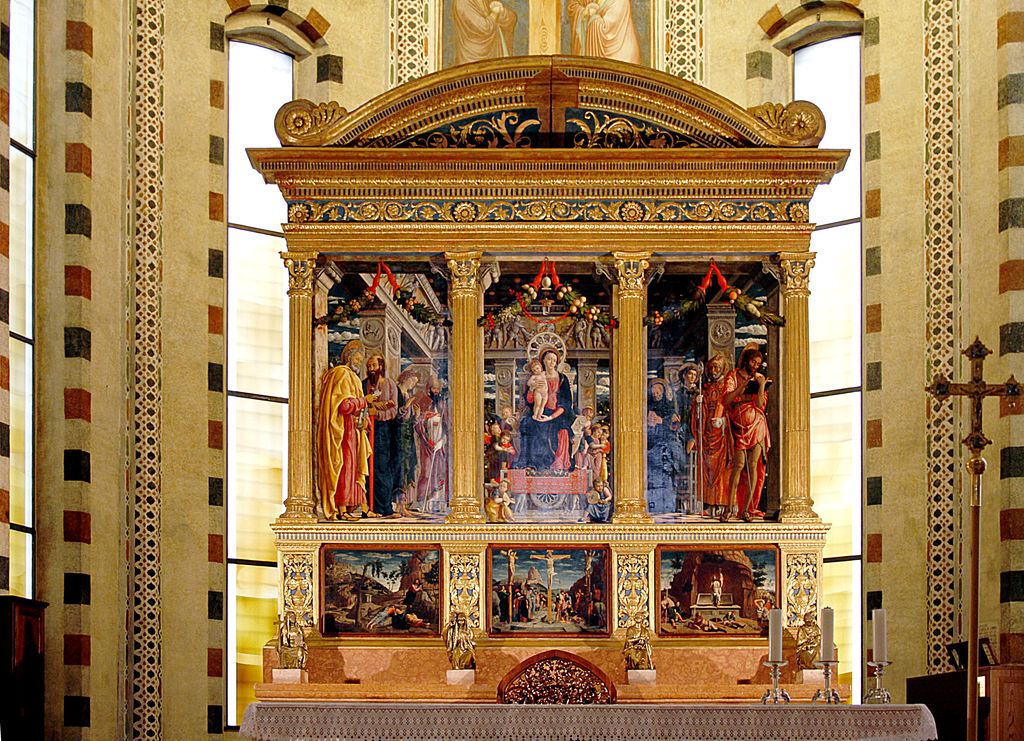
San Zeno Altarpiece
The San Zeno Altarpiece in its frame, Basilica of San Zeno, Verona José Luiz. Image source. CC BY-SA 4.0. Resized from the cited image.