 by Tom Gurney
Tom Gurney BSc (Hons) is an art history expert with over 20 years experience
Email: tomgurney1@gmail.com / Phone: +44 7429 011000
Overview
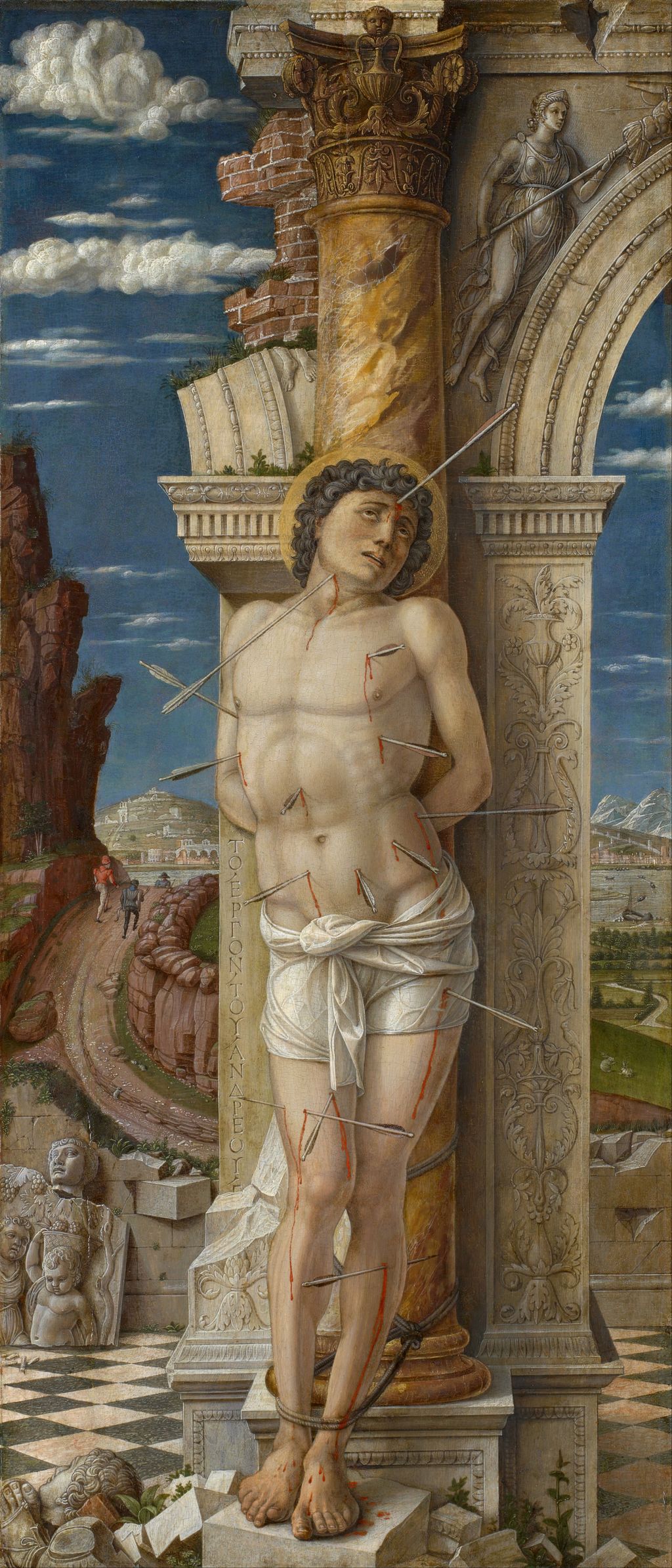
At Saint Sebastian’s feet, a broken stone head lies almost beyond the edge of the picture. High above him, a cloud takes the shape of a horse and rider. Between these small discoveries stands a figure who seems much larger than the panel that contains him. Andrea Mantegna painted this Saint Sebastian in egg tempera on poplar. The panel measures just 68 × 30 cm and belongs to the Kunsthistorisches Museum’s Picture Gallery in Vienna, where it is catalogued as GG 301. [1] [2]
Vienna dates the painting to about 1457–59. The London and Berlin exhibition Mantegna and Bellini placed it around 1459–60. These estimates put it near the end of Mantegna’s Paduan period, when his study of ancient sculpture and architecture was shaping how he painted Christian subjects. [1] [2] [3] [4]
At a Glance
- DateAbout 1457–59 (Kunsthistorisches Museum dating)
- MediumEgg tempera on poplar
- Dimensions68 × 30 cm
- CollectionKunsthistorisches Museum, Picture Gallery, Vienna
- Inventory numberGG 301
Andrea Mantegna in context
San Zeno Altarpiece
1457–59 [15]Saint Sebastian (Vienna)
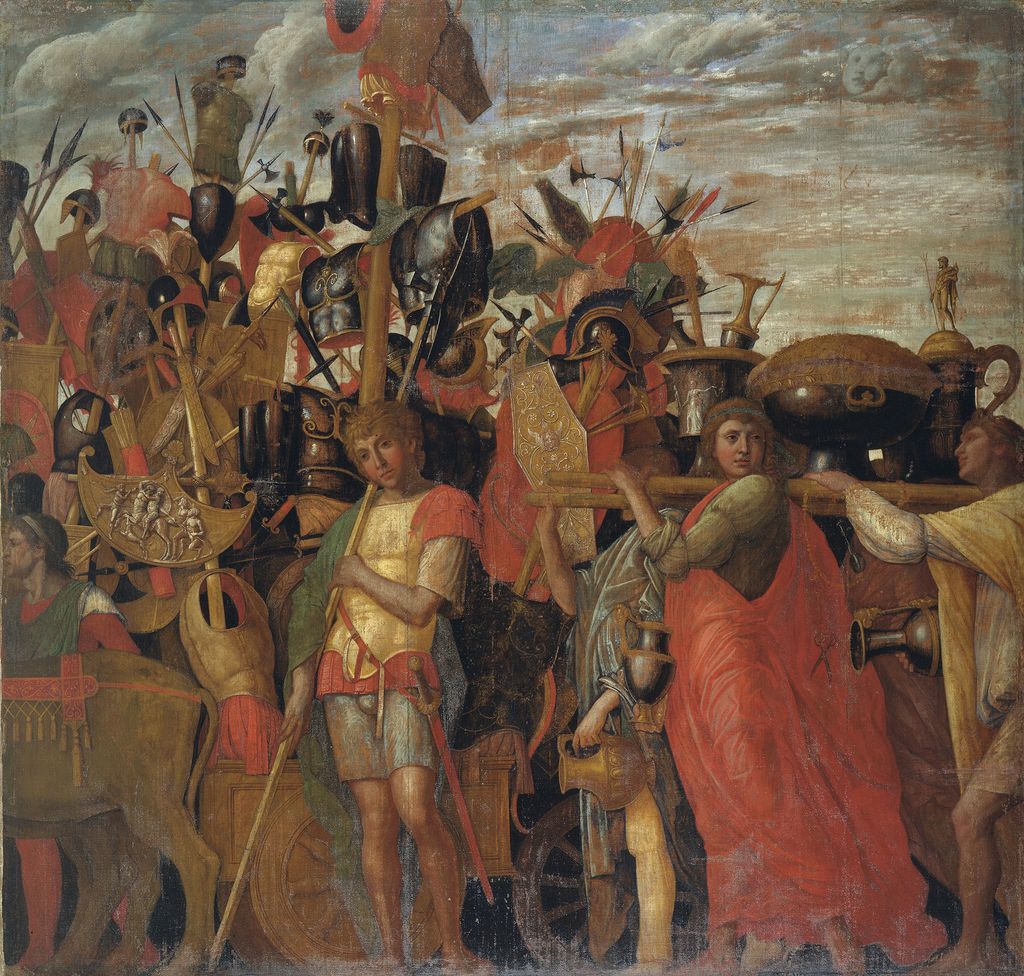
C. 1457–59 [1]The Triumphs of Caesar
Mid-1480s–before 1506 [17]Madonna della Vittoria
1495–96 [18]After the archers have left
The arrows identify Sebastian, a Roman officer condemned for his Christian faith under the emperor Diocletian in the account retold by the medieval Golden Legend. In that story he survives the arrows and is later beaten to death. Mantegna shows the aftermath of the shooting. The saint remains bound, his eyes open and directed upwards. In the distance at left, the Kunsthistorisches Museum’s gallery guide identifies three figures climbing the road as the departing archers. At that distance, the men who inflicted the wounds can almost pass for ordinary travellers. [4]
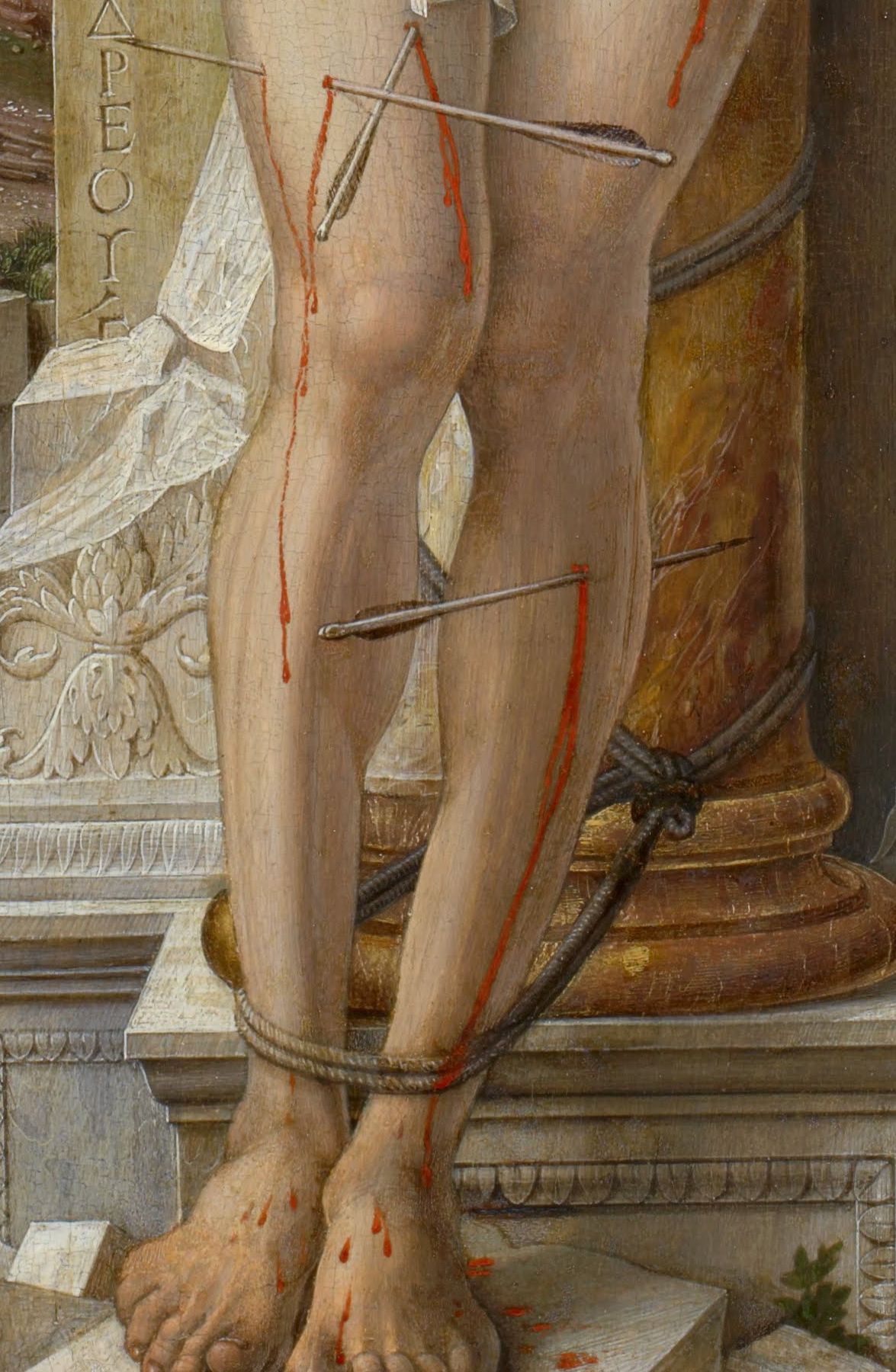
The pose holds together two impressions. Sebastian’s shoulders and chest have the firm contours of a carved figure, and the pale folds at his waist gather into a knot with the sharpness of cut stone. Yet the raised face, with parted lips and a slight tightening above the eyes, makes his pain particular. Thin streaks of red run down the body and collect by the feet. The long shafts draw diagonals across the upright figure, while some of the shorter-looking arrows project towards the viewer. Their varied angles make the body seem to occupy space in front of the column, even as the rope around his ankles fixes him to it. [4] [5]
The panel’s narrowness makes that restraint almost physical. The architecture rises past the top edge, while Sebastian’s bare toes approach the bottom. Through the gaps at either side of the ruin, a road, a hill town and a distant plain suggest room to move. The soldiers can take the curve out of sight. Sebastian has a single block of stone on which to stand. From across a room the body would dominate. The little figures on the road reward a much closer look. [1] [4]
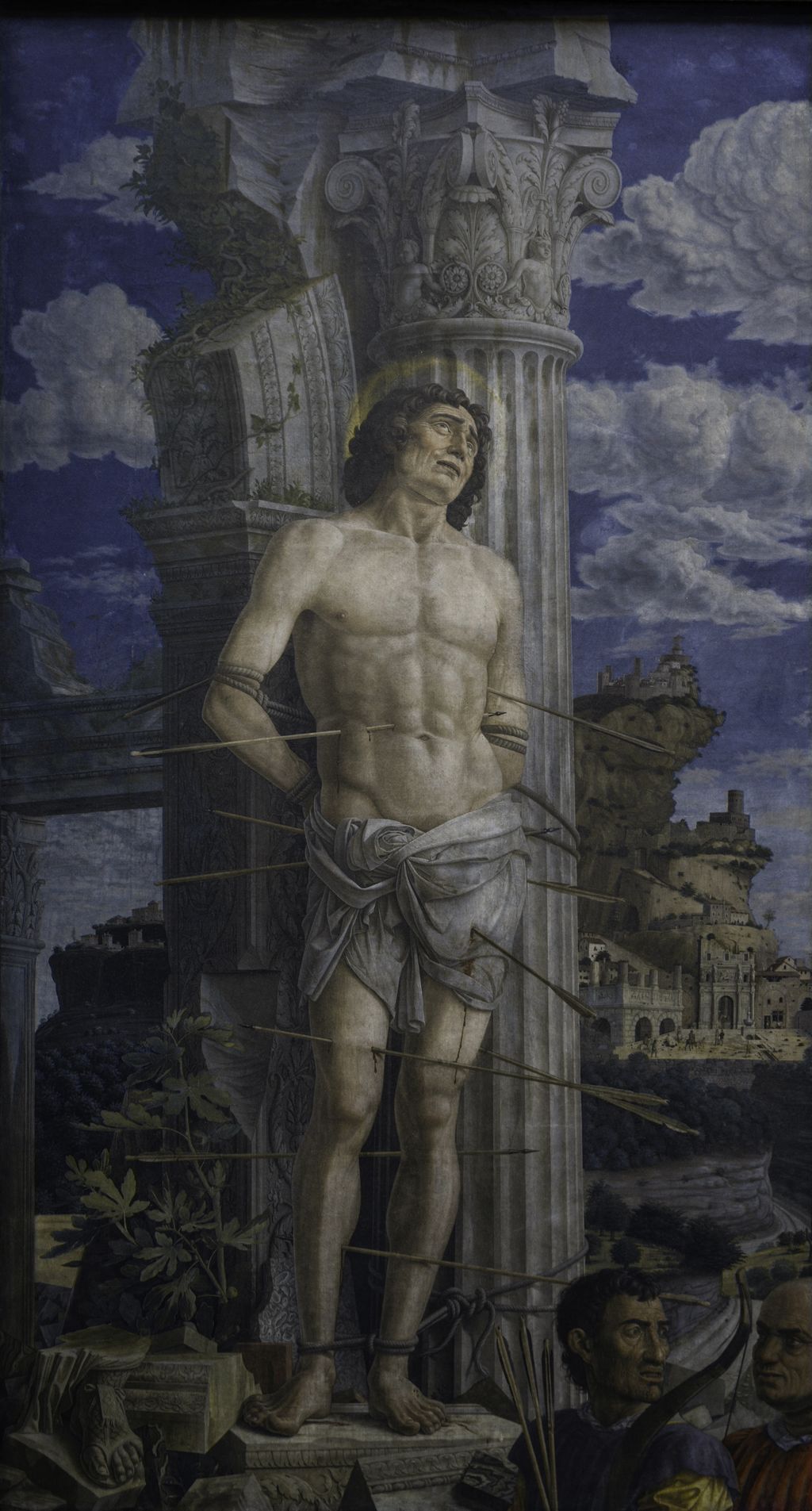
Saint Sebastian, Musée du Louvre Image source. Public domain.
Where the marble breaks
The column is a warm, veined yellow, set against pale mouldings and patches of exposed red brick. The patterned pavement recedes behind the column base, then gives way to the rough ground of the landscape. Look at the upper left edge of the building, where weeds grow from the masonry and courses of brick jut out from behind the dressed stone. The break exposes how the structure was put together. On the other side, a carved figure survives beside the curve of the arch. Mantegna lets fine ornament and structural damage occupy the same few inches of the panel. [4] [5]
The precise character of the building is open to interpretation. The Vienna gallery guide describes the ruins of a Roman basilica. The mouldings and sculpted figure beside the arch also recall a triumphal arch, and Andreas Hauser has argued that the painting can bring a basilica, a triumphal arch and a city gate to mind at once. The building is convincing because its parts look as though they have been observed closely, even when they cannot be assigned to a single monument. Mantegna gives the setting a Roman past while leaving enough of it broken for the landscape to show through. [4] [5] [6]
The scattered carvings suggest more than one way to connect the ruin to the saint. The Vienna gallery guide tentatively links them to the episode in which Sebastian destroyed idols in the house of the prefect Cromatius. Keith Christiansen reads the surviving figure of Victory beside the arch and the shattered sculpture below in terms of Christian victory over paganism. He also draws attention to the beauty that survives in the shattered carvings. The curls on the fallen head hold their shape even where the face is obscured. The sculpted foot in the debris invites comparison with the saint’s bloodied feet nearby. The care lavished on the stone makes its destruction felt. [4] [5]
Videos
Smarthistory takes a closer look at the Vienna panel’s figure, ruins and distant landscape.
Mantegna, Saint Sebastian
Beth Harris and Steven Zucker discuss Sebastian’s stance and the fragments of ancient sculpture in the Vienna painting.
Watch on YouTubeA signature cut into painted stone
Just to the viewer’s left of Sebastian’s torso, Greek capitals descend the edge of a pier. The Kunsthistorisches Museum transcribes them as To ergon tou Andreou, meaning “the work of Andrea”. The signature is painted to resemble an inscription cut into the architecture. From a distance the letters belong to the ruin much as the bands of carved foliage do. Close up, they name the fifteenth-century maker of the scene. [1] [5]
Christiansen takes the Greek as an address to a viewer learned in classical culture and as a sign of Mantegna’s ambition to measure himself against ancient artists. Its placement gives that ambition a material form. An arrow crosses the narrow strip of stone on which the letters appear, bringing the signature into the same space as the bound figure. A viewer can scan the inscription much as an antiquarian might read a fragment of ancient masonry, then look a few inches to the right and see how the painter has made flesh and marble reflect light differently. [1] [5]
The rider at the edge of the sky
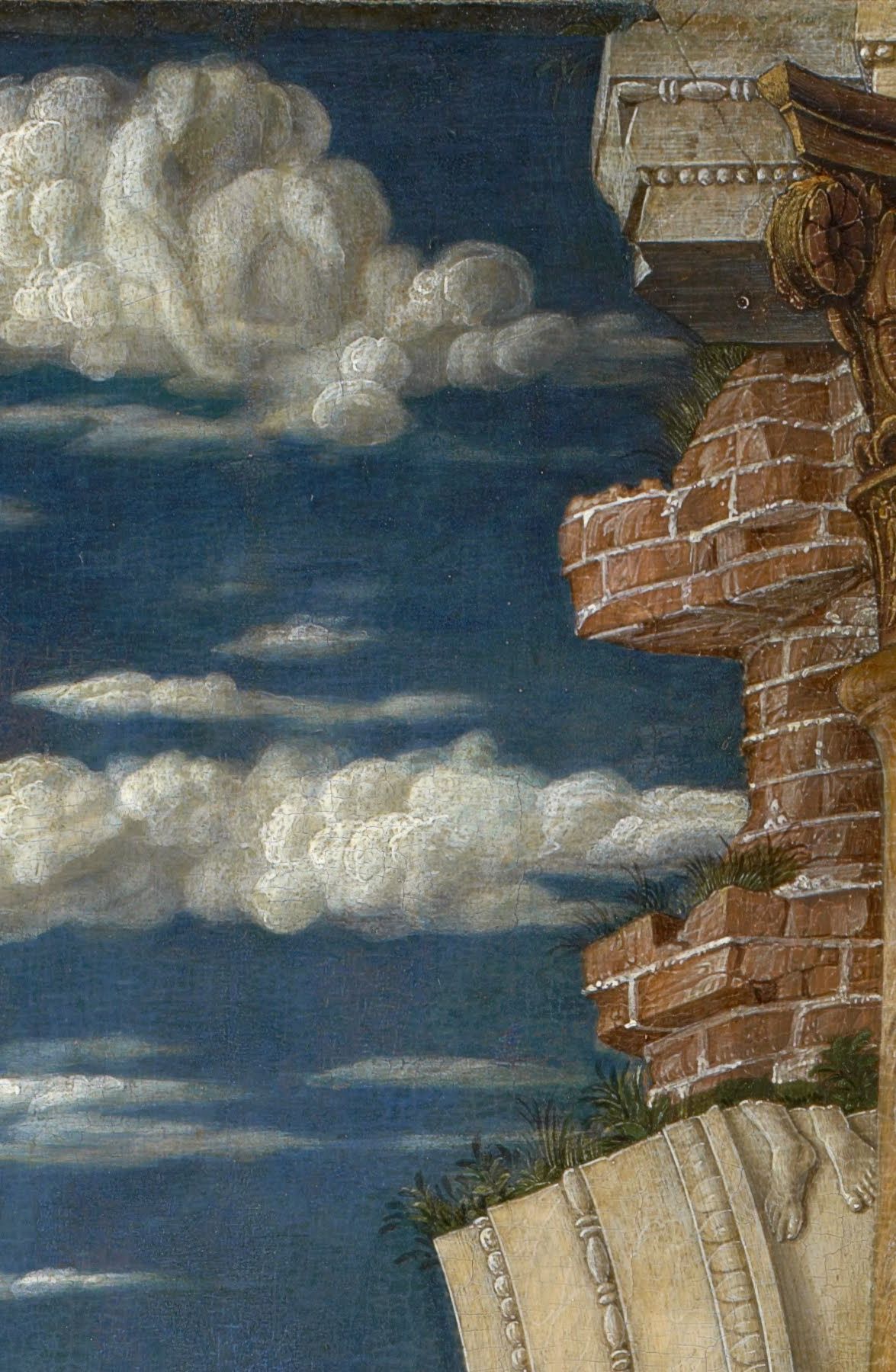
In the upper-left cloud, the rounded masses suggest the front of a horse and a bearded rider. The figure shares the pale colour and soft contours of the surrounding vapour. Once the likeness comes into focus, the eye can still return to the cloud and watch the image loosen. The sky there works differently from the wall opposite it. The broken brickwork and carved detail can be traced edge by edge, while the horseman depends on a few shapes coming together in the viewer’s eye. [4] [6]
Paul Kristeller linked the rider to the medieval relief of the hunt of Theodoric on the façade of San Zeno in Verona. As Hauser recounts, Horst W. Janson took a different approach. He saw a painted version of the accidental likenesses people find in natural forms and pointed out that the stag and the destination of the hunt, hell, have no counterparts in the painted cloud. Christiansen likewise reads the motif as a comparison between the shapes nature seems to make by chance and the painter’s ability to give a shape precision. That reading can be tested against the panel itself. Put the faint outlines of the rider beside the firmly drawn curls and features of Sebastian’s head and the degrees of likeness are immediately apparent. [5] [6]
The Kunsthistorisches Museum’s gallery guide suggests that the rider might allude to the brevity of human life. Mirella Levi D’Ancona proposed a more specific reading, associating the horseman with Saturn and the belief that the planet brought plague. Hauser explores a resemblance to the white riders of the Book of Revelation while leaving open what figure Mantegna meant the cloud to evoke. The rider’s shape is clear enough to recognise, but there is no equally clear attribute that settles his identity. [4] [6] [7]
What the plague records establish
Sebastian was invoked for protection from plague, and Vienna allows that the outbreak in Padua in 1456–57 might have occasioned the painting. The danger appears in contemporary correspondence. In January 1457 Ludovico III Gonzaga advised Mantegna to leave Padua for Verona because of the threat of plague. The letter shows how directly the threat entered Mantegna’s working life. Its subject is his safety and where he might go. [1] [8]
A separate piece of correspondence concerns a small work, an operetta, that Mantegna was making in 1459 for the Venetian Giacomo Antonio Marcello. Christiansen notes how well the Saint Sebastian would fit a man who had Roman inscriptions and reliefs on his property and ties to the painter’s circle in Padua. Herbert von Einem entertained the more specific possibility that Marcello ordered it as a votive offering in connection with the epidemic. The description operetta fits the scale of the panel and leaves the subject unspecified. The plague commission remains a hypothesis. [5] [8] [9]
The signature names the artist and gives no year. The Louvre’s 2008 retrospective dated this same Vienna panel to about 1470–75, when Mantegna was already working for the Gonzaga in Mantua. On that dating, the panel falls too late to be Marcello’s small work of 1459. The dimensions suit the close viewing Hauser associates with a private devotional picture, although the panel’s size alone cannot establish the room or the person for whom it was made. The published provenance becomes firmer centuries later. The National Gallery’s loan record places the panel in Archduke Leopold Wilhelm’s collection by 1659 and traces its passage to Leopold I and the Habsburg collections. [1] [2] [6] [10]
San Zeno and the other two Sebastians
The San Zeno Altarpiece brings the Vienna painting’s experiments with architecture into sharper focus. Gregorio Correr commissioned the altarpiece for the high altar of the Verona basilica, and Mantegna made its panels in Padua in the late 1450s. Across the main panels, the real columns of the frame and the painted architecture combine to place several groups of figures in one shared space. In Vienna the architectural illusion does a different job. The interrupted arch leaves a single body exposed, and the glimpses of landscape on either side draw attention to how little ground that body can occupy. Hauser notes that Ronald Lightbown dated the panel partly by comparing Sebastian’s pose with the penitent thief in the San Zeno Crucifixion. [6] [8] [11] [12]
In the Louvre Saint Sebastian, dated by the museum to the last quarter of the fifteenth century, the broken arch and sculptural debris recur on a tempera canvas 255 cm high, nearly four times the height of the Vienna panel. The two figures in the lower right are so close that the edge of the picture cuts them off. Vienna sends the departing men into the distance, leaving the viewer alone with Sebastian in the foreground. The Louvre canvas keeps the actors in the punishment uncomfortably near. Its apparent porphyry border is painted, adding another kind of stone to the composition. The Louvre proposes that the painting reached Aigueperse on the occasion of Chiara Gonzaga’s marriage to Gilbert de Bourbon in 1481. Its record lists secure references to the picture in the Sainte-Chapelle there from 1636. [4] [13]
In the late Venice Saint Sebastian, at the Galleria Giorgio Franchetti alla Ca’ d’Oro, a dark niche takes the place of the open landscape. The arrows crowd around the body, and a thin trail of smoke rises from an extinguished candle at lower right. The Latin inscription around it says that only the divine endures and everything else is smoke. Von Einem links the canvas to the Saint Sebastian that Mantegna’s son Lodovico described in an October 1506 letter as intended for the bishop of Mantua. The wording records an intended recipient and leaves the terms of any commission open. [8] [9] [14]
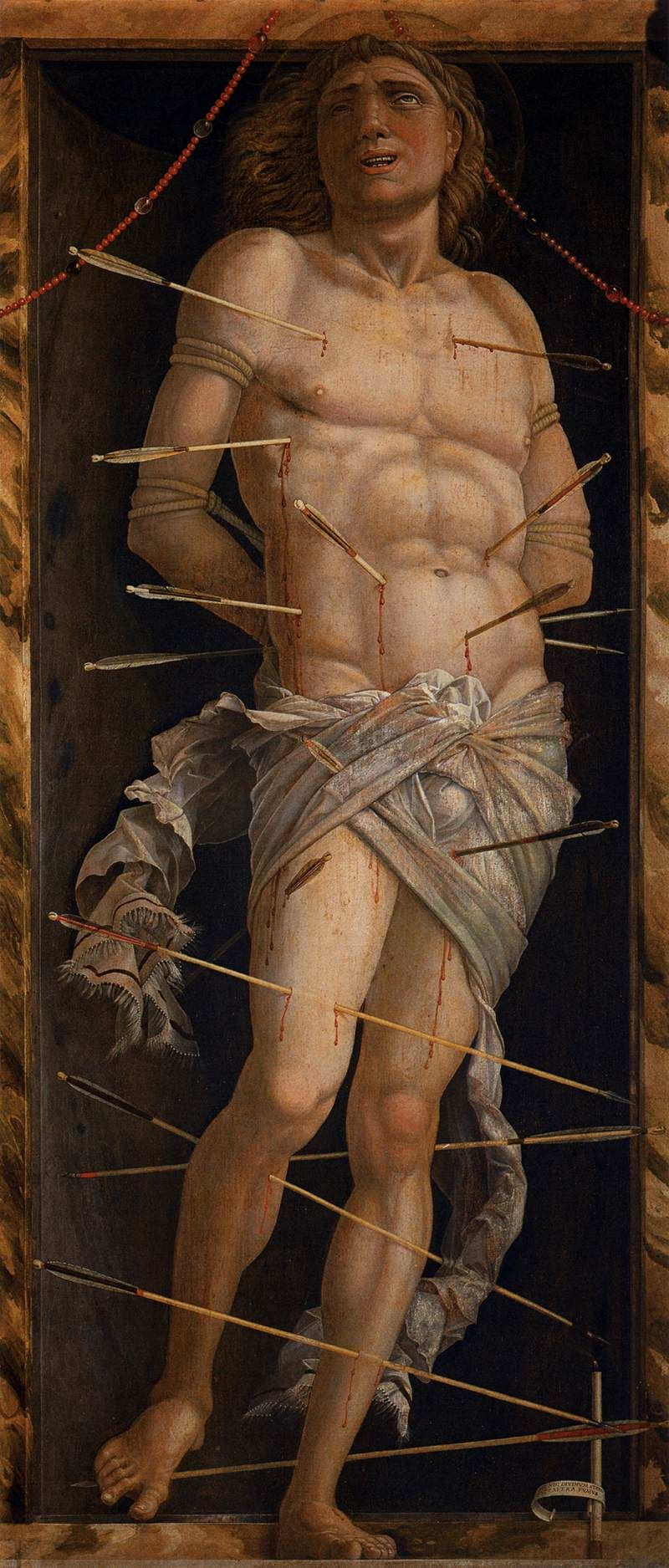
Saint Sebastian, Galleria Giorgio Franchetti alla Ca’ d’Oro, Venice Image source. Public domain.
Few subjects in Mantegna’s paintings let us follow a single motif across such different settings. Venice compresses the space until the eye has little room to leave the body. Paris pushes the figures at the lower edge into the viewer’s space. Vienna gives the eye a winding road, a broken arch and a patch of sky to explore, even as the rope holds the saint in place. [4] [13] [14]
Annotated Details from Saint Sebastian
The numbered points identify details to look at closely. The detail images below preserve the native scale of the selected crops.
Saint Sebastian
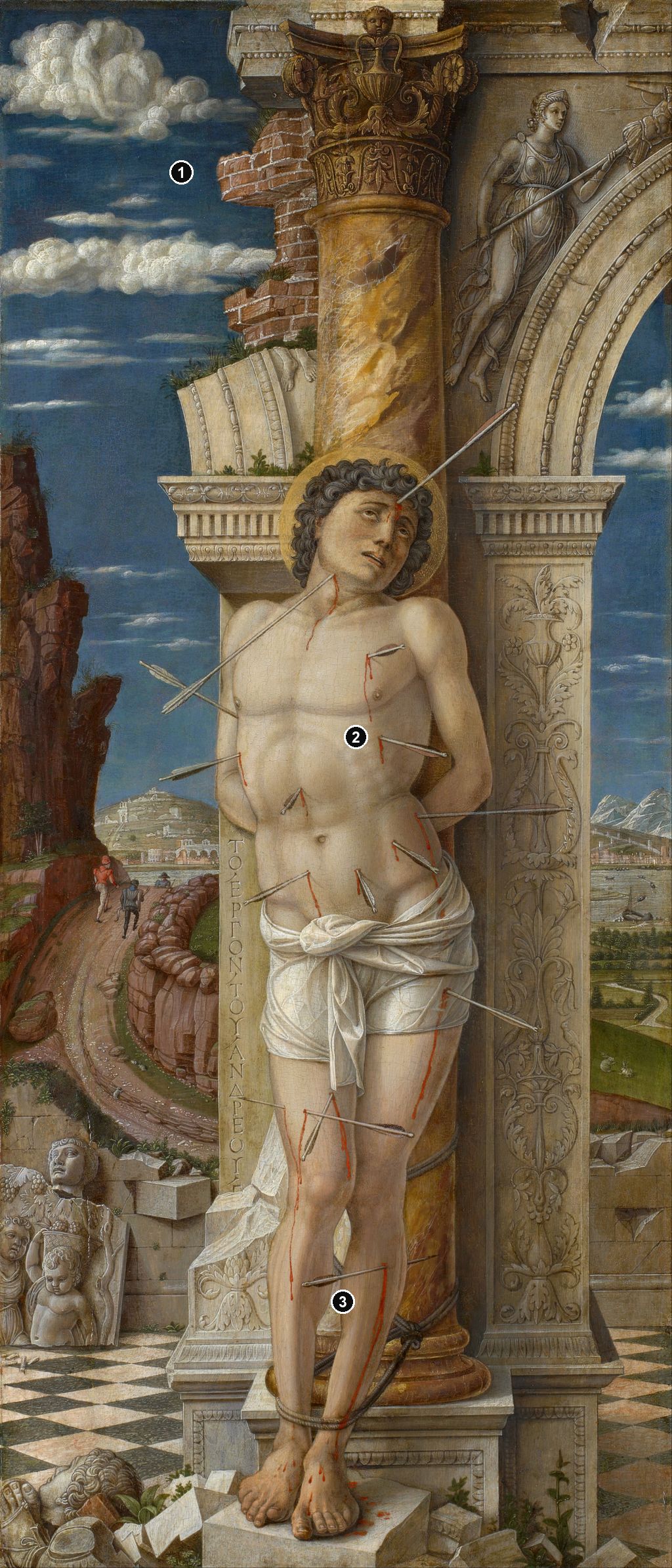
Details from SAINT SEBASTIAN
Choose a detail to enlarge it.
Saint Sebastian
A figure in the cloud
A small horse-and-rider shape appears at the upper left. Its visibility shifts when the cloud is seen at full scale and in close detail.
The body at the column
The narrow figure stands against the architectural upright. Its pose remains clear through the many crossing arrows.
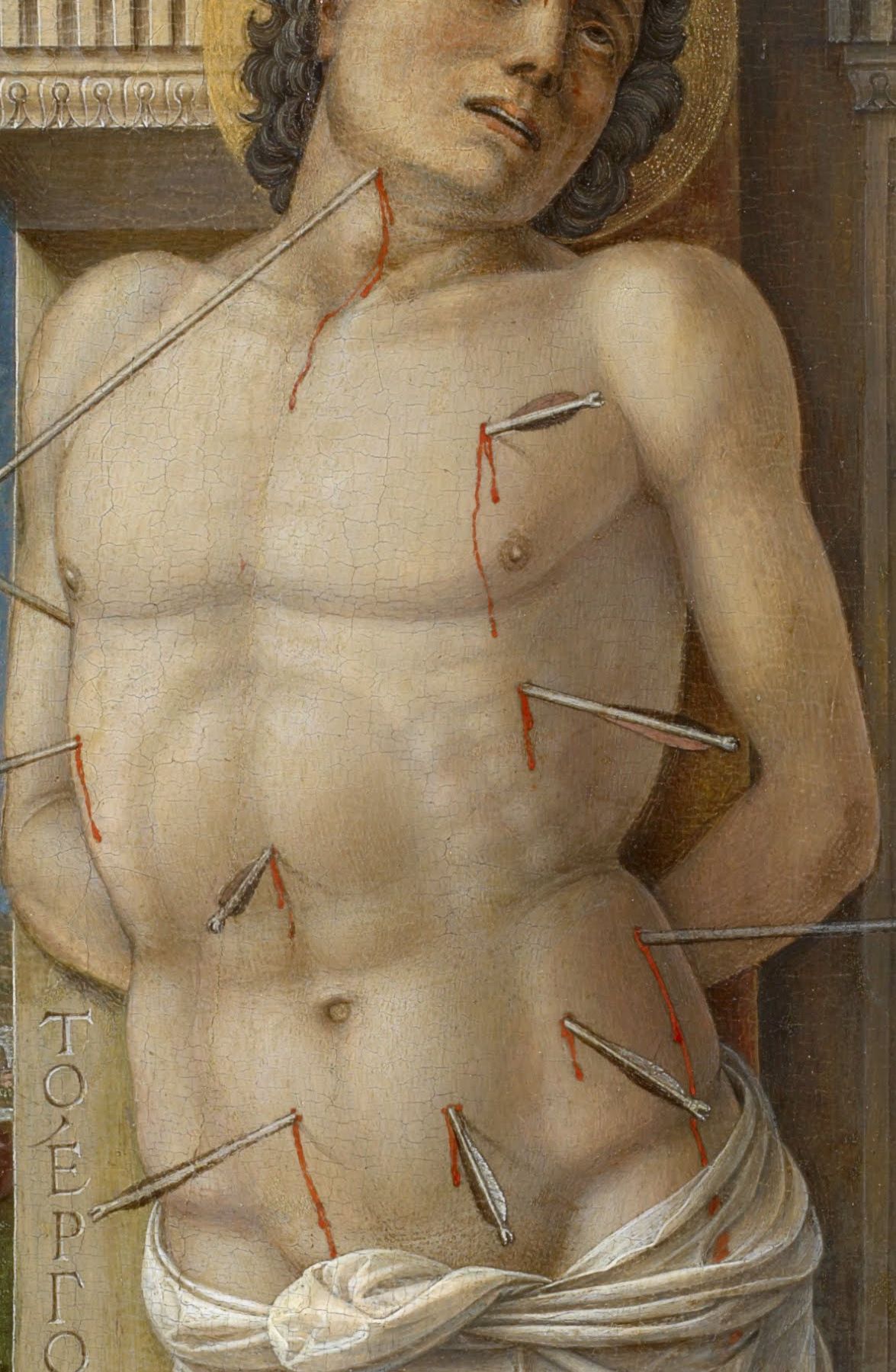
Fragments at the base
Broken stone and remnants of ornament gather at the saint’s feet. Their scale contrasts with the intact arch behind him.
Artworks directory
| Name | Date | Medium and collection |
|---|---|---|
| The Adoration of the Shepherds | Shortly after 1450 | Painting · Metropolitan Museum of Art · 32.130.2 Catalogue. |
| Saint Mark the Evangelist | C. 1448–51 | Painting · Städel Museum · 1046 Catalogue. |
| Saint Jerome Penitent in the Desert | C. 1448–51 | Painting · Museu de Arte de São Paulo · MASP.00015 Catalogue. |
| Martyrdom and Transport of the Body of Saint Christopher | Mid-1450s | Painting · Ovetari Chapel, Padua Catalogue. |
| San Luca Altarpiece | 1453–55 | Painting · Pinacoteca di Brera · 176 Catalogue. |
| The Presentation of Christ at the Temple | 1454 (Berlin dating) | Painting · Gemäldegalerie, Berlin · 29 Catalogue. |
| San Zeno Altarpiece | 1457–59 | Painting · Basilica of San Zeno, Verona Catalogue. |
| The Crucifixion | 1456–59 | Painting · Musée du Louvre · INV 368 Catalogue. |
| The Agony in the Garden (London) | C. 1455–56 | Painting · National Gallery, London · NG1417 Catalogue. |
| The Agony in the Garden (Tours) | 1459 (Tours dating) | Painting · Musée des Beaux-Arts de Tours · 1803-1-24 Catalogue. |
| The Resurrection | 1459 (Tours dating) | Painting · Musée des Beaux-Arts de Tours · 1803-1-25 Catalogue. |
| Saint Sebastian (Vienna) | C. 1457–59 | Painting · Kunsthistorisches Museum · GG 301 Catalogue. |
| Cardinal Ludovico Trevisan | C. 1459–60 (Berlin exhibition dating) | Painting · Gemäldegalerie, Berlin · 9 Catalogue. |
| The Death of the Virgin | C. 1462 | Painting · Museo Nacional del Prado · P000248 Catalogue. |
| Christ with the Soul of the Virgin | C. 1460–64 | Painting · Pinacoteca Nazionale, Ferrara Catalogue only. |
| Portrait of a Young Man (traditionally Francesco Gonzaga) | C. 1461 or 1470, depending on sitter | Painting · Museo di Capodimonte · Q 60 Catalogue. |
| Portrait of a Prelate (Carlo de’ Medici?) | C. 1465–70 | Painting · Uffizi Galleries · 1890 no. 8540 Catalogue. |
| Portrait of a Man | C. 1470 | Painting · National Gallery of Art, Washington · 1952.2.5 Catalogue. |
| Madonna with Sleeping Child (Berlin) | C. 1455–60 | Painting · Gemäldegalerie, Berlin · S.5 Catalogue. |
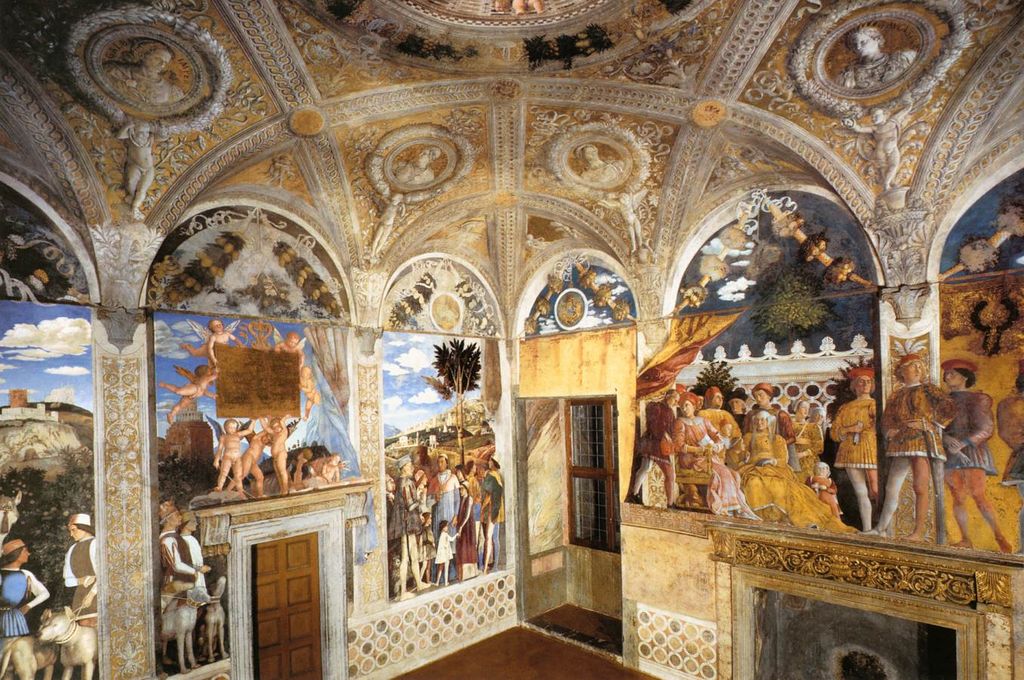
| Camera degli Sposi (Camera Picta) | 1465–74 | Painting · Palazzo Ducale, Mantua Catalogue. |
| Saint Sebastian (Louvre) | Around 1480 | Painting · Musée du Louvre · RF 1766 Catalogue. |
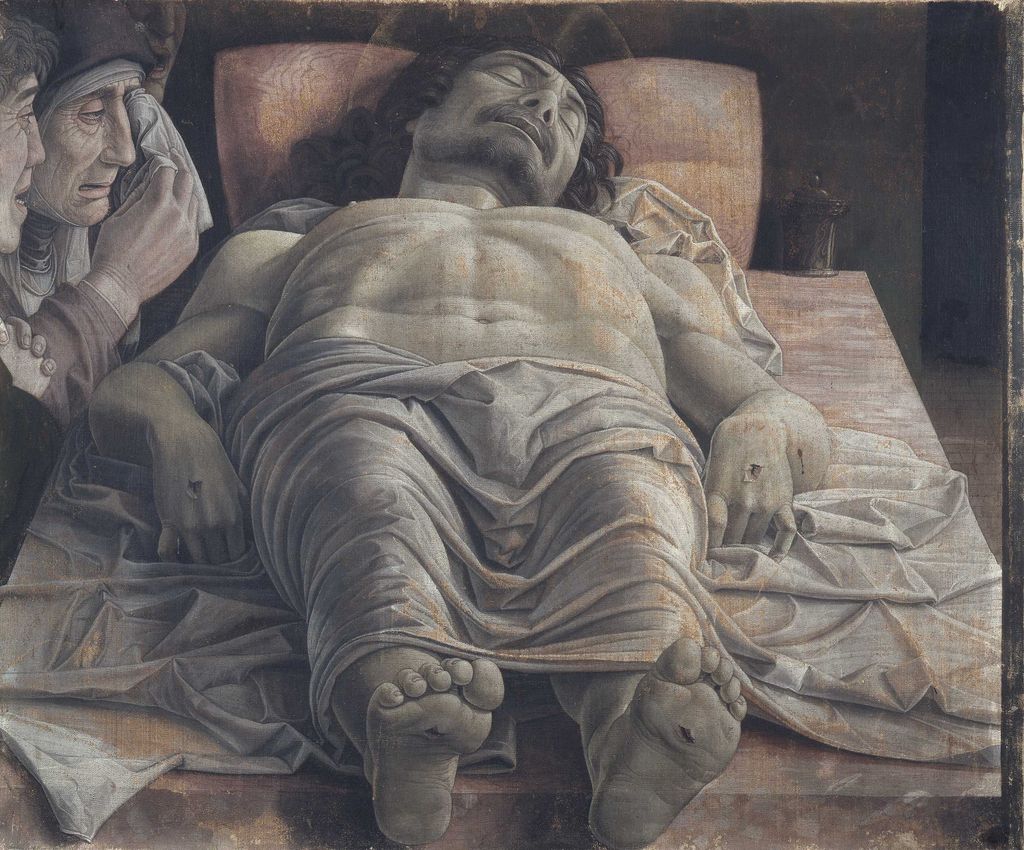
| Lamentation over the Dead Christ | C. 1483 (Brera dating) | Painting · Pinacoteca di Brera · 352 Catalogue. |
| The Triumphs of Caesar | About 1485–1506 | Painting · Royal Collection · RCIN 403958–403966 Catalogue. |
| Madonna of the Caves | C. 1488–90 | Painting · Uffizi Galleries · 1890 no. 1348 Catalogue. |
| Madonna and Child with a Choir of Cherubim | C. 1485 | Painting · Pinacoteca di Brera · 297 Catalogue. |
| Madonna and Child (Poldi Pezzoli) | Early 1490s (museum dating) | Painting · Museo Poldi Pezzoli · 1595 Catalogue. |
| The Holy Family with Saint Mary Magdalen | C. 1495–1500 | Painting · Metropolitan Museum of Art · 14.40.643 Catalogue. |
| The Virgin and Child with Saint Mary Magdalene and Saint John the Baptist | C. 1490–1505 | Painting · National Gallery, London · NG274 Catalogue. |
| Christ as the Suffering Redeemer | 1485–95 (SMK dating) | Painting · Statens Museum for Kunst · KMSsp69 Catalogue. |
| Ecce Homo | C. 1500 | Painting · Musée Jacquemart-André · MJAP-P 1840 Catalogue. |
| Judith with the Head of Holofernes (Mantegna or follower) | C. 1495–1500 | Painting · National Gallery of Art, Washington · 1942.9.42 Catalogue. |
| Madonna della Vittoria | 1495–96 | Painting · Musée du Louvre · INV 369 Catalogue. |
| Mars and Venus (Parnassus) | C. 1496–97 | Painting · Musée du Louvre · INV 370 Catalogue. |
| The Trivulzio Madonna | 1497 | Painting · Castello Sforzesco, Milan · 0554 Catalogue. |
| The Adoration of the Magi | C. 1495–1505 | Painting · J. Paul Getty Museum · 85.PA.417 Catalogue. |
| Minerva Expelling the Vices from the Garden of Virtue | C. 1502 | Painting · Musée du Louvre · INV 371 Catalogue. |
| The Introduction of the Cult of Cybele at Rome | 1505–06 | Painting · National Gallery, London · NG902 Catalogue. |
| Saint Sebastian (Venice) | Probably c. 1504–06 | Painting · Galleria Giorgio Franchetti alla Ca’ d’Oro · D.11 Catalogue. |
| Samson and Delilah | C. 1500 | Painting · National Gallery, London · NG1145 Catalogue only. |
| A Woman Drinking (probably Sophonisba) | C. 1495–1506 | Painting · National Gallery, London · NG1125.2 Catalogue only. |
| The Vestal Virgin Tuccia with a Sieve | C. 1495–1506 | Painting · National Gallery, London · NG1125.1 Catalogue only. |
| Judith with the Head of Holofernes (Dublin) | C. 1495–1500 | Painting · National Gallery of Ireland · NGI.442 Catalogue only. |
| Battle of the Sea Gods, left half (Met impression) | Before 1481 (Met dating) | Print · Metropolitan Museum of Art · 18.12 Catalogue only. |
| Battle of the Sea Gods, right half (Met impression) | Before 1481 (Met dating) | Print · Metropolitan Museum of Art · 1984.1201.4 Catalogue only. |
| Battle of the Sea Gods, left half (Tokyo impression) | C. 1475 (Tokyo dating) | Print · National Museum of Western Art, Tokyo · G.1981-0002 Catalogue only. |
| Battle of the Sea Gods, left half (Washington impression) | C. 1485–88 (NGA dating) | Print · National Gallery of Art, Washington · 1941.1.6 Catalogue only. |
| The Entombment of Christ, second state of two | Before 1475 (Met dating) | Print · Metropolitan Museum of Art · 37.42.30 Catalogue only. |
| The Entombment of Christ (possibly Zoan Andrea, after Mantegna) | 1460–1549 (Rijksmuseum dating) | Print · Rijksmuseum · RP-P-1924-60 Catalogue only. |
| Four Dancing Muses (Gian Marco Cavalli after Mantegna) | C. 1497 | Print · Metropolitan Museum of Art · 20.5.3 Catalogue only. |
| Bacchanal with Silenus | Before 1475 (Met dating) | Print · Metropolitan Museum of Art · 29.44.15 Catalogue only. |
| Bacchanal with a Wine Vat | Before 1475 (Met dating) | Print · Metropolitan Museum of Art Catalogue only. |
| St James on His Way to Execution | C. 1453–57 | Drawing · British Museum · 1976,0616.1 Catalogue only. |
| Three Studies for a Dead Christ | C. 1455–65 | Drawing · British Museum · 1909,0406.3 Catalogue only. |
| Pietà (Venice) | C. 1456–65 (exhibition datings) | Drawing · Gallerie dell’Accademia, Venice · 115 Catalogue only. |
| Studies for Christ at the Column | 1460–65 | Drawing · The Courtauld · D.1978.PG.345 Catalogue only. |
| Virtus Combusta | C. 1490 (technical study) | Drawing · British Museum · Pp,1.23 Catalogue only. |
| Virtus Combusta (Giovanni Antonio da Brescia after Mantegna) | C. 1495–1506 | Print · Musée du Louvre · 3881 LR/ Recto Catalogue only. |
| The Calumny of Apelles | C. 1504–06 | Drawing · British Museum · 1860,0616.85 Catalogue only. |
Frequently Asked Questions
Mantegna sets the Greek-letter signature into the painted masonry beside the saint. The signature runs down the edge of a pier just to the viewer’s left of the figure.
The cloud at the edge of the picture has the shape of a rider. Explanations of its meaning remain proposals, and the identification of the visible form is more secure than its purpose.
Discussion
Look again at the images and ideas explored in Saint Sebastian (Vienna). These editorial prompts invite your observations.
Reader Insights
What happens to the apparent shape of the horse and rider as you move your attention between the upper-left cloud and the carved figure beside the arch?
How does moving the archers from the distant road in Vienna to the lower foreground in the Louvre version change where you feel you are standing?
Join the Conversation
Share a detail, comparison or question about Saint Sebastian (Vienna) below.
References
- Kunsthistorisches Museum, Hl. Sebastian, Gemäldegalerie 301. View source.
- The National Gallery, Mantegna and Bellini immunity from seizure report, loan X9735. View source.
- Staatliche Museen zu Berlin, Mantegna and Bellini exhibition checklist. View source.
- Kunsthistorisches Museum, St. Sebastian, Picture Gallery guide by Cäcilia Bischoff. View source.
- The Metropolitan Museum of Art, Keith Christiansen, The Genius of Andrea Mantegna, pp. 41–47. View source.
- Heidelberg University Library, Andreas Hauser, Andrea Mantegnas „Wolkenreiter“. View source.
- CNRS / OpenBibArt, Mirella Levi D’Ancona, An Image Not Made by Chance: The Vienna St. Sebastian by Mantegna, author abstract. View source.
- Treccani, Mantegna, Andrea, Dizionario Biografico degli Italiani. View source.
- Heidelberg University Library, Herbert von Einem, Mantegnas „Sebastian“ in der Cà d’Oro. View source.
- Musée du Louvre, Saint Sébastien, Vienna inv. 301, Mantegna retrospective. View source.
- Opificio delle Pietre Dure, La Pala di San Zeno di Andrea Mantegna: Studio e conservazione. View source.
- Musée du Louvre, La Crucifixion, INV 368. View source.
- Musée du Louvre, Saint Sébastien, RF 1766. View source.
- Direzione regionale Musei nazionali Veneto, Galleria Giorgio Franchetti alla Ca’ d’Oro: The martyrdom of Saint Sebastian. View source.
- Basilica of San Zeno, Verona, San Zeno Altarpiece, View source.
- Palazzo Ducale, Mantua, Camera degli Sposi (Camera Picta), View source.
- Royal Collection, The Triumphs of Caesar, View source.
- Musée du Louvre, Madonna della Vittoria, View source.
- National Gallery, London, The Introduction of the Cult of Cybele at Rome, View source.
More MANTEGNA Paintings
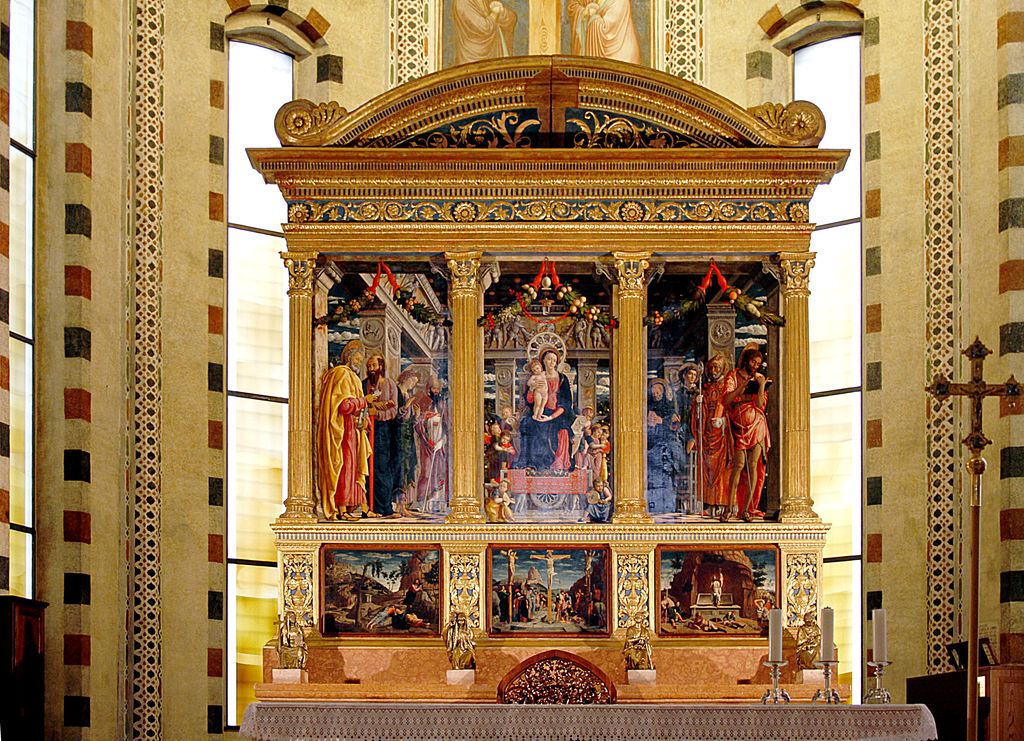
San Zeno Altarpiece
The San Zeno Altarpiece in its frame, Basilica of San Zeno, Verona José Luiz. Image source. CC BY-SA 4.0. Resized from the cited image.