 by Tom Gurney
Tom Gurney BSc (Hons) is an art history expert with over 20 years experience
Email: tomgurney1@gmail.com / Phone: +44 7429 011000
Overview
In Andrea Mantegna’s Agony in the Garden, a column of soldiers winds down from Jerusalem towards the sleeping disciples. In Giovanni Bellini’s painting of the same scene, the soldiers are still coming, but the first light along the horizon catches the undersides of the clouds. Both pictures are in the National Gallery in London. A second pair, divided between Berlin and Venice, brings the painters even closer. In their two Presentations at the Temple, the shape of the child held between Mary and Simeon is so alike that conservators could lay the outlines over one another. [1] [2] [3] [4]
The two men were brothers-in-law. By the time Bellini painted his Presentation, however, Mantegna had long since moved to Mantua. The four paintings tell a story that begins with the Bellini family workshop and outlasts the years when the two painters worked in neighbouring cities. They also show how much an artist could change while keeping another painter’s design recognisable. [3] [5] [6]
At a Glance
- Mantegna’s Agony in the GardenAbout 1455–56, egg tempera on wood, National Gallery, London, NG1417
- Bellini’s Agony in the GardenAbout 1458–60, egg tempera on wood, National Gallery, London, NG726
- Mantegna’s Presentation at the TempleAbout 1454, tempera on canvas, Gemäldegalerie, Berlin, inventory 29
- Bellini’s Presentation of Jesus in the TempleAround 1470, oil on wood panel, Fondazione Querini Stampalia, Venice
The dowry that linked two workshops
On 25 February 1453, in modern-year reckoning, the Venetian confraternity of San Giovanni Evangelista paid twenty ducats towards the marriage of Nicolosia Bellini, daughter of the painter Jacopo. The record dates the payment. The wedding itself is generally placed around this time. Jacopo belonged to the confraternity and held office in it, so the entry puts a family event within an institution that also commissioned paintings. Antonio Mazzotta, who examined the confraternity’s records and the pictures connected to them, argues that some of Giovanni’s earliest work can be understood through the commissions undertaken in his father’s workshop. He also discusses the possibility that the unusually generous payment recognised that workshop’s contribution to a painting cycle for the confraternity. The completion of its new meeting rooms was recorded less than two weeks after the payment. The proximity of the dates supports the suggestion, while the entry itself records money for the marriage. [5] [6] [7]
Mantegna brought connections of his own. He had trained in Francesco Squarcione’s workshop in Padua and was already working on the Ovetari Chapel frescoes when he married. In 1455 he was still pursuing a claim against his former master for earnings he said were owed from his time in the workshop. In Venice, Jacopo’s workshop gave the young painter access to another established artistic family. In Padua, contact went both ways. In 1460 Jacopo and his sons Gentile and Giovanni were named together on a now-lost altarpiece for the Gattamelata chapel in the Basilica of Saint Anthony. The commission gives the Venetian family a documented presence in the city where Mantegna had made his reputation. [6] [7]
Drawings help explain what could pass between these circles. A page in Jacopo’s British Museum album shows Christ kneeling on an outcrop in Gethsemane, with a slope extending away into the distance. The National Gallery sees the drawing as a possible source for Mantegna’s Agony and identifies the altar-like outcrop in both London paintings as a feature the two artists drew from Jacopo. In Giovanni’s version, the direction Christ faces and the sweep of the terrain are closer to Jacopo’s design. A single painting could therefore carry something of Giovanni’s father and something of his brother-in-law, even in adjacent passages. [1] [2] [8]
The chronology of Mantegna’s early career helps explain why the relationship is so visible in these pictures. He was taking on major commissions in Padua and Verona at the same time as the Bellini family was working in Venice and on the mainland. Around 1460 he settled at the Gonzaga court in Mantua. Giovanni Bellini built his career chiefly in Venice. From this point the familiar designs matter all the more, because the paintings show that what the men had learned from one another remained available when their working lives had taken different directions. [5] [6] [7]
Gethsemane in two kinds of light
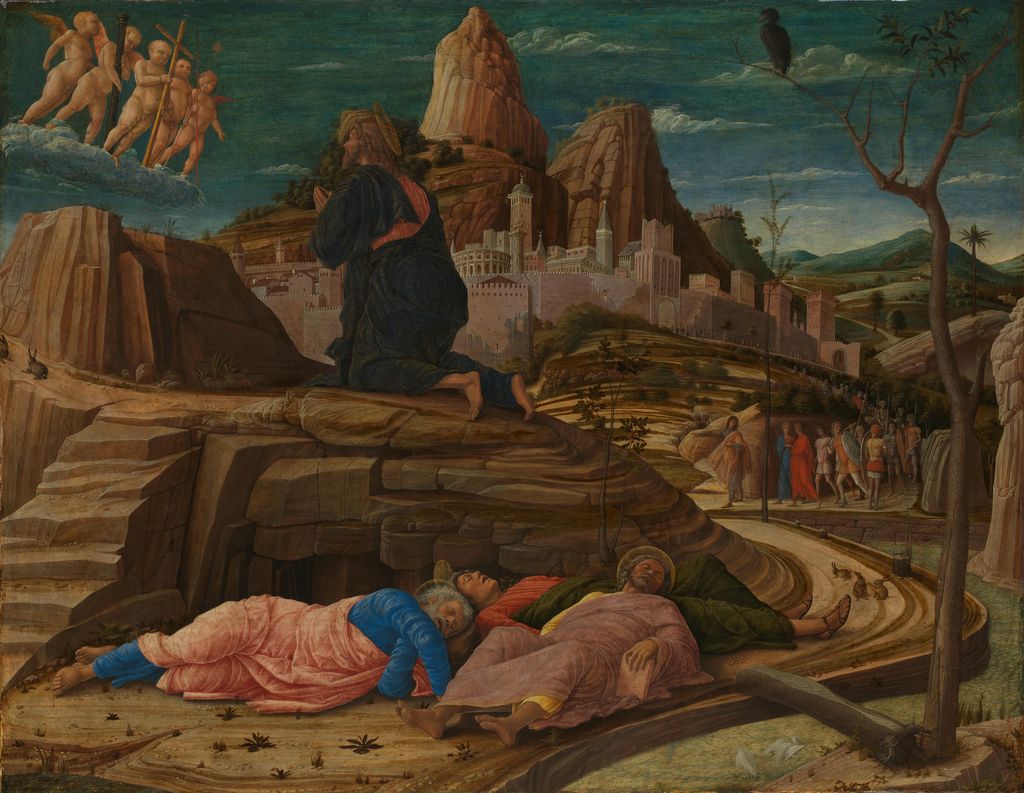
The National Gallery dates Mantegna’s Agony in the Garden to about 1455–56 and Bellini’s to about 1458–60. Mantegna’s signed picture (NG1417) measures 62.9 by 80 centimetres. Bellini’s (NG726), at 80.4 by 127 centimetres, is larger and markedly wider. Both are painted in egg tempera on wood. Mantegna also painted the subject for the lower tier, or predella, of the San Zeno altarpiece in Verona. That panel, dated 1457–59 by the Musée des Beaux-Arts de Tours, is in Tours today. It belongs to the same period of invention as the London picture and was made to be seen alongside the Crucifixion and Resurrection. [1] [2] [9]
The Agony in the Garden, National Gallery, London Image source. Public domain.
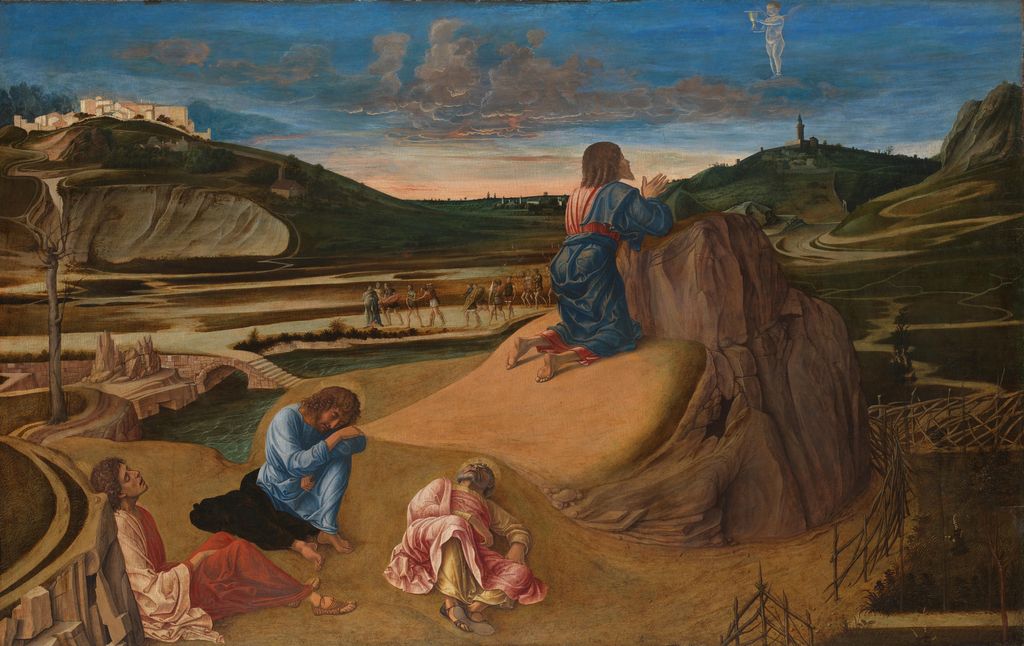
Giovanni Bellini’s Agony in the Garden, National Gallery, London Image source. Public domain.
In the Gospel episode the disciples fall asleep while Christ prays, knowing that Judas has betrayed him. Mantegna makes the interval before the arrest visible. The soldiers start as small marks at the gate of the walled city. As the column turns down the slope, arms, faces and armour become legible. By following the route in that order, we see successive stages of an approach condensed into a single view. Christ, still and intent on his prayer, faces cherubs who bring the instruments of the Passion. The particulars of the coming violence are already in front of him while the men who will take him are still a little way off. [1]
The nearest sleeper has his legs directed out of the picture. His pose gives the viewer a place on the ground from which to take in the rock, Christ, the path and the far walls. The National Gallery compares the disciples’ heavy bodies and sharply folded clothes to toppled Roman statues. That analogy suits a Jerusalem furnished with antiquities, including a gilded horseman high on a column. Yet the same eye that makes the city’s masonry legible gives plants room to take hold in cracks and puts little white strokes on the bark of the fig sapling. The rocks have weight and age, as well as the precise edges needed to set one figure in front of another. [1]
Bellini retains the three sleepers, the elevated shelf of rock and the approaching band. The closest echo of Mantegna, in the National Gallery’s reading, is a sleeping disciple seen in foreshortening. Infrared reflectography also shows careful preparation beneath the sharp folds of clothing and the angular foreground rocks. These are places where Bellini deliberately worked through problems that the earlier picture had posed. Even the handling of light has a precise precedent. The Gallery traces the fine strokes of powdered gold on clothing to a practice Bellini learned from Mantegna. The gleam on Christ’s garment works as a local highlight within Bellini’s much broader treatment of dawn. [2]
A single angel brings Bellini’s Christ a chalice. The cup gives visible form to the plea that his suffering might pass and, as the National Gallery points out, evokes the wine of the Eucharist. The ledge takes on the appearance of an altar. Beyond it, pale light catches the undersides of the clouds and finds an echo in Christ’s pink tunic. The sleeping bodies, the water and the remote buildings all lie within the same hour. It takes a moment to locate the men beyond the river. Once they come into view, the brightness at the horizon measures the little time that remains before they reach him. [2]
Place corresponding details of the sleepers side by side and the hard edges of Bellini’s drapery hold their own against Mantegna’s. Then look above the rocky ledges. In Mantegna the bank of cloud carries an array of objects that can be picked out individually. In Bellini the angel and cup occupy a small part of a sky whose changing colour reaches almost everything below it. Their common use of egg tempera makes the comparison particularly revealing. The luminous distance in Bellini’s picture was already attainable within the same basic painting medium as Mantegna’s crisp walls and foreground folds. [1] [2]
Videos
Start with Caroline Campbell’s exhibition introduction, then look closely at a drawing by Mantegna.
Curator's introduction | Mantegna and Bellini
Curator Caroline Campbell introduces the joint exhibition and the two painters’ exchange of ideas.
Watch on YouTubeA child at the edge of the picture
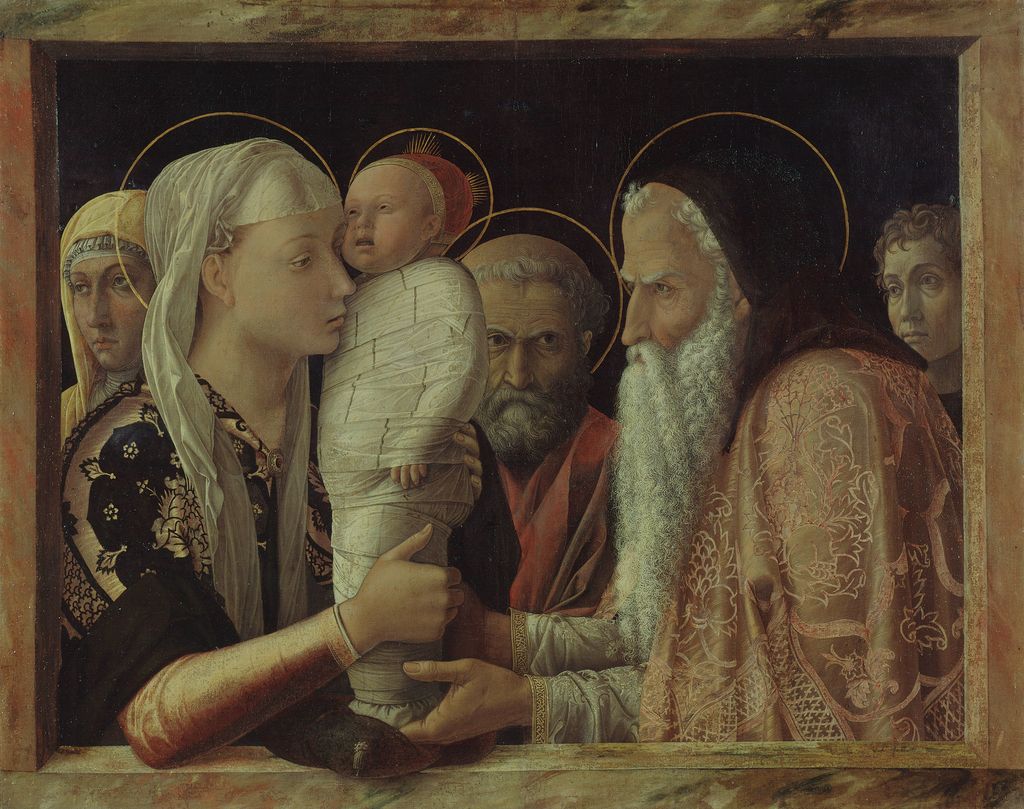
In the Gospel of Luke, Mary and Joseph bring the infant Jesus to the Temple in Jerusalem, where Simeon recognises him as the Messiah and foretells suffering for his mother. Mantegna’s Presentation at the Temple, a tempera painting on canvas dated about 1454 by Berlin’s Gemäldegalerie (inventory 29), places the encounter just above a painted marble sill. A cushion supports the tightly wrapped child. Mary’s elbow comes forward over the stone while her hands hold him close and Simeon’s hands reach across to take him. A dark background leaves the bodies visible only from around the waist up. The imagined architecture is all at the picture’s edge. [3] [10]
The arrangement concentrates attention on the small distance the child must travel from one person to the other. His body is almost upright, his head tips towards Mary, and his wrappings give Simeon little to take hold of. Joseph looks on from just behind the opening between the two adults. Neville Rowley reads the tight swaddling and stone sill as anticipations of the burial shroud and tomb. On that reading, the furniture of the scene has the force of prophecy. Rowley also compares the fictive window and the closeness of mother and child with Donatello’s Pazzi Madonna, a shallow marble relief also in Berlin. The resemblance helps explain what Mantegna could achieve with painted stone and overlapping forms. An X-ray shows that Mantegna moved Mary’s head closer to the child as he worked, intensifying the contact that makes Donatello’s relief such a persuasive comparison. Rowley leaves open the possibility that a related work by the sculptor in Padua supplied the model. [3] [11]
The two observers at the sides have long invited a second reading. The man on the right has been proposed as Mantegna, partly on the strength of a resemblance to the presumed self-portrait in the Ovetari Chapel. The woman on the left is often identified as Nicolosia. Investigations in Berlin found changes made directly on the canvas, and the conservation department interprets the incorporation of the side figures as the addition of portraits of the painter and his wife. Those changes establish that the composition evolved during painting. The names are identifications based on resemblance, position and circumstance. The further suggestion that the work marked the birth or expected birth of a child remains a hypothesis. Even with the figures unnamed, the sideward glances are striking. The two observers inhabit the same narrow space as the holy figures and seem absorbed in thoughts of their own. [3] [6] [12]
What Bellini kept when he widened the scene
The Fondazione Querini Stampalia in Venice dates Bellini’s Presentation of Jesus in the Temple to around 1470, while Berlin’s conservation exhibition placed it around 1470–75. It is painted in oil on a wooden panel. A much later inventory, in 1809, recorded it as a Mantegna, an understandable judgement given the fidelity of the central group. The debt now rests on something more tangible than the old attribution. The contours of the central figures correspond at full scale, and the Venetian panel preserves traces of pouncing, the transfer of a design by dusting powder through holes pricked along its outlines. Brigit Blass-Simmen argues that Bellini used a full-size drawing derived from Mantegna’s composition. The comparison shows how closely the design travelled. Who made or carried the intervening drawing is uncertain. [3] [4] [10] [13] [14]
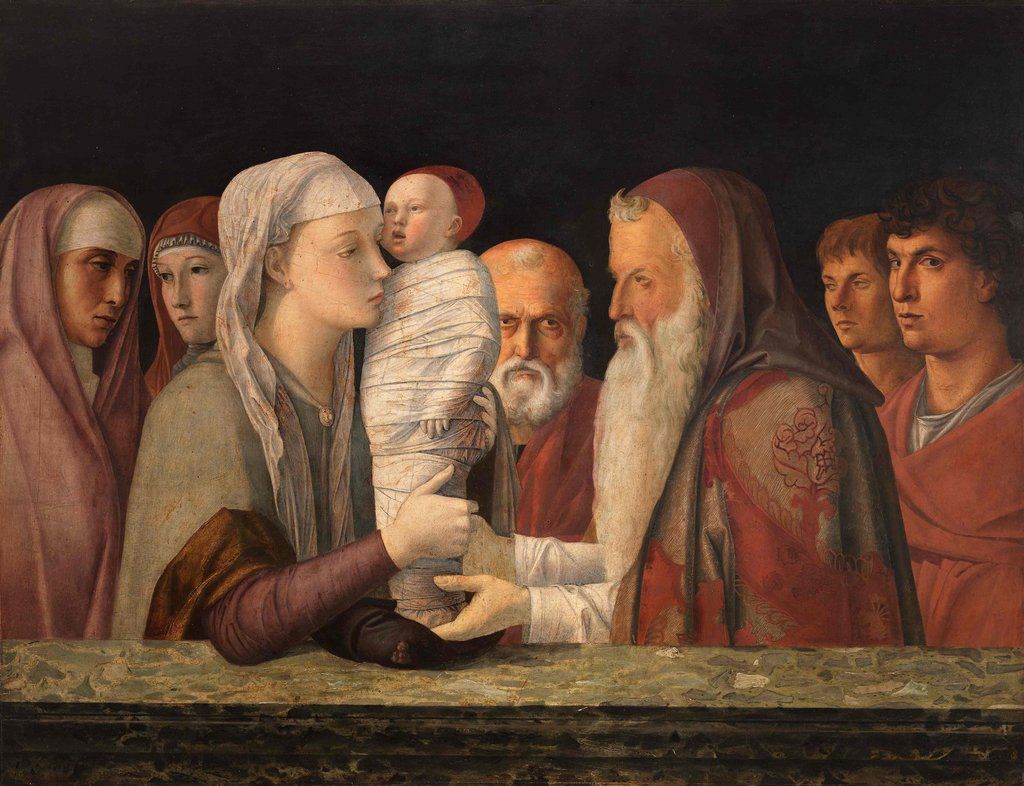
Giovanni Bellini’s Presentation at the Temple, Fondazione Querini Stampalia, Venice Image source. Public domain.
The transferred figures still span the centre, but the setting around them has changed. Bellini keeps a low parapet and removes the encompassing marble window. He gives the assembly more room to either side and increases the two onlookers to four. Where Mantegna’s frame sets up the illusion of bodies leaning towards us through an opening, Bellini’s uninterrupted dark makes the outer faces part of the same space as the central encounter. The heads extend in a broken line from one end of the panel to the other, and a glance directed outwards at the right makes the viewer one more witness. [3] [4]
The difference is also visible close up. Around Mary’s veil and Simeon’s face, Bellini allows shadow to carry some of the transitions that Mantegna marks with firmer edges. The hands and the bandaged body remain recognisable when one picture is laid over the other. Around them, warm reds and softer modelling change how the group holds together. The exchange still takes place at the same spot, but once the panel widens, the eye is free to linger on the people gathered around it. There are several proposals for naming Bellini’s witnesses, including family members, but even the tempting identification of the rightmost man as the painter is questioned by Rowley. The Fondazione reads the panel within the tradition of private devotion. A family likeness could have deepened that intimacy, wherever the picture was first kept. [3] [4] [10] [13]
What travelled back towards Mantua
The London and Berlin curators found evidence of exchange in the other direction in Mantegna’s treatment of landscape. The National Gallery set particular store by The Death of the Virgin, now in the Museo Nacional del Prado. Beyond the bed and the standing apostles, the opening frames a view of the water around Mantua and the bridge of San Giorgio. Bellini’s Agony had shown what a view into the distance could do for a sacred subject. Mantegna gives the effect a local precision of his own. The lake and bridge are recognisable features of the Gonzaga city, seen through architecture as a view from a particular place. The comparison is a curatorial argument about how landscape can give a religious event the character of lived experience. Its evidence is pictorial, of a different order from the matched contours of the Presentations. [15] [16] [17]
The paintings of Christ supported by angels make the comparison sharper. In Bellini’s small London panel of about 1465–70, two angels support the exposed upper body and draw their faces close to Christ’s. The National Gallery places the picture in a devotional tradition with Byzantine roots and points to Donatello as a source for its sculptural force. In Mantegna’s Christ as the Suffering Redeemer, dated 1485–95 by the Statens Museum for Kunst in Copenhagen, the wounded figure and the two angels occupy the foreground on and around a red stone sarcophagus. An extensive landscape opens behind them. The Copenhagen museum reads the distant episode and the close devotional image as two kinds of sacred representation brought together in one panel. London’s exhibition cited this painting as an example of Bellini’s lasting effect on Mantegna. [18] [19] [20]
The landscape in the Copenhagen picture gives an early morning setting to a figure who is already marked by the Crucifixion. That combination recalls how Bellini’s dawn in Gethsemane locates a moment in the Passion at daybreak. The intervals do different work. One dawn lights an approach towards arrest, while the other belongs to the world after the burial. Mantegna keeps Christ and the angels monumental and the sarcophagus insistently solid, while opening a route into the painted distance beside them. The example brings Bellini’s attention to the world beyond the figures into contact with Mantegna’s way of making a body and its support present at the front of the picture. [2] [19] [20]
The exhibition offered a further clue to how a design might survive the move to Mantua. In Bellini’s Descent of Christ into Limbo, at Bristol Museum & Art Gallery, Christ steps across the gates of the underworld to release the souls waiting there. The paint lies over an ink drawing on vellum attached to the panel. The Berlin curators assigned the drawing to Mantegna’s studio. Bristol describes its relationship to Mantegna’s painting and to the surviving drawings and engravings as unresolved. The 2018–19 exhibition dated the surviving painting by Mantegna, in a private collection, later than the Bristol panel. On the Berlin reading, the drawing underneath Bellini’s version preserves a link to the Mantuan painter’s studio. The two completed paintings, taken by themselves, would give a much less straightforward account of what passed between the artists. [17] [20] [21]
When the four paintings came together
The two Presentations were exhibited together at the Fondazione Querini Stampalia from 21 March to 1 July 2018, before the larger exhibition Mantegna and Bellini opened at London’s National Gallery from 1 October 2018 to 27 January 2019. It travelled to the Gemäldegalerie in Berlin from 1 March to 30 June 2019. The two museums organised the exhibition with the British Museum, whose loans included Jacopo’s album. Caroline Campbell, Dagmar Korbacher, Neville Rowley and Sarah Vowles edited the accompanying catalogue. The drawings and technical studies gave the comparisons a dimension that the finished surfaces alone would have been unable to supply. [10] [14] [15] [22] [23] [24]
The London Agonies entered the National Gallery separately, with Bellini’s acquired in 1863 and Mantegna’s in 1894. The exhibition renewed that longstanding London comparison and supplied its counterpart from Berlin and Venice. In the garden pair, start with the tilted rock and the reclining disciples, then let the road and sky carry the eye outwards. In the Temple pair, start with the hands and the swaddled child, then see where the frame and the extra faces lead the eye. The design is easiest to recognise at the centre of the Venetian panel. Much of what makes it a Bellini takes place around the edges. [1] [2] [3] [4] [15]
Further reading
The exhibition puts related works side by side.
Mantegna and Bellini. Caroline Campbell, Dagmar Korbacher, Neville Rowley and Sarah Vowles, with contributors. National Gallery Company, 2018.
The catalogue explores how the two painters developed shared compositions and different approaches to landscape and light. Read the publisher’s description.
Artworks directory
| Name | Date | Medium and collection |
|---|---|---|
| The Adoration of the Shepherds | Shortly after 1450 | Painting · Metropolitan Museum of Art · 32.130.2 Catalogue. |
| Saint Mark the Evangelist | C. 1448–51 | Painting · Städel Museum · 1046 Catalogue. |
| Saint Jerome Penitent in the Desert | C. 1448–51 | Painting · Museu de Arte de São Paulo · MASP.00015 Catalogue. |
| Martyrdom and Transport of the Body of Saint Christopher | Mid-1450s | Painting · Ovetari Chapel, Padua Catalogue. |
| San Luca Altarpiece | 1453–55 | Painting · Pinacoteca di Brera · 176 Catalogue. |
| The Presentation of Christ at the Temple | 1454 (Berlin dating) | Painting · Gemäldegalerie, Berlin · 29 Catalogue. |
| San Zeno Altarpiece | 1457–59 | Painting · Basilica of San Zeno, Verona Catalogue. |
| The Crucifixion | 1456–59 | Painting · Musée du Louvre · INV 368 Catalogue. |
| The Agony in the Garden (London) | C. 1455–56 | Painting · National Gallery, London · NG1417 Catalogue. |
| The Agony in the Garden (Tours) | 1459 (Tours dating) | Painting · Musée des Beaux-Arts de Tours · 1803-1-24 Catalogue. |
| The Resurrection | 1459 (Tours dating) | Painting · Musée des Beaux-Arts de Tours · 1803-1-25 Catalogue. |
| Saint Sebastian (Vienna) | C. 1457–59 | Painting · Kunsthistorisches Museum · GG 301 Catalogue. |
| Cardinal Ludovico Trevisan | C. 1459–60 (Berlin exhibition dating) | Painting · Gemäldegalerie, Berlin · 9 Catalogue. |
| The Death of the Virgin | C. 1462 | Painting · Museo Nacional del Prado · P000248 Catalogue. |
| Christ with the Soul of the Virgin | C. 1460–64 | Painting · Pinacoteca Nazionale, Ferrara Catalogue only. |
| Portrait of a Young Man (traditionally Francesco Gonzaga) | C. 1461 or 1470, depending on sitter | Painting · Museo di Capodimonte · Q 60 Catalogue. |
| Portrait of a Prelate (Carlo de’ Medici?) | C. 1465–70 | Painting · Uffizi Galleries · 1890 no. 8540 Catalogue. |
| Portrait of a Man | C. 1470 | Painting · National Gallery of Art, Washington · 1952.2.5 Catalogue. |
| Madonna with Sleeping Child (Berlin) | C. 1455–60 | Painting · Gemäldegalerie, Berlin · S.5 Catalogue. |
| Camera degli Sposi (Camera Picta) | 1465–74 | Painting · Palazzo Ducale, Mantua Catalogue. |
| Saint Sebastian (Louvre) | Around 1480 | Painting · Musée du Louvre · RF 1766 Catalogue. |
| Lamentation over the Dead Christ | C. 1483 (Brera dating) | Painting · Pinacoteca di Brera · 352 Catalogue. |
| The Triumphs of Caesar | About 1485–1506 | Painting · Royal Collection · RCIN 403958–403966 Catalogue. |
| Madonna of the Caves | C. 1488–90 | Painting · Uffizi Galleries · 1890 no. 1348 Catalogue. |
| Madonna and Child with a Choir of Cherubim | C. 1485 | Painting · Pinacoteca di Brera · 297 Catalogue. |
| Madonna and Child (Poldi Pezzoli) | Early 1490s (museum dating) | Painting · Museo Poldi Pezzoli · 1595 Catalogue. |
| The Holy Family with Saint Mary Magdalen | C. 1495–1500 | Painting · Metropolitan Museum of Art · 14.40.643 Catalogue. |
| The Virgin and Child with Saint Mary Magdalene and Saint John the Baptist | C. 1490–1505 | Painting · National Gallery, London · NG274 Catalogue. |
| Christ as the Suffering Redeemer | 1485–95 (SMK dating) | Painting · Statens Museum for Kunst · KMSsp69 Catalogue. |
| Ecce Homo | C. 1500 | Painting · Musée Jacquemart-André · MJAP-P 1840 Catalogue. |
| Judith with the Head of Holofernes (Mantegna or follower) | C. 1495–1500 | Painting · National Gallery of Art, Washington · 1942.9.42 Catalogue. |
| Madonna della Vittoria | 1495–96 | Painting · Musée du Louvre · INV 369 Catalogue. |
| Mars and Venus (Parnassus) | C. 1496–97 | Painting · Musée du Louvre · INV 370 Catalogue. |
| The Trivulzio Madonna | 1497 | Painting · Castello Sforzesco, Milan · 0554 Catalogue. |
| The Adoration of the Magi | C. 1495–1505 | Painting · J. Paul Getty Museum · 85.PA.417 Catalogue. |
| Minerva Expelling the Vices from the Garden of Virtue | C. 1502 | Painting · Musée du Louvre · INV 371 Catalogue. |
| The Introduction of the Cult of Cybele at Rome | 1505–06 | Painting · National Gallery, London · NG902 Catalogue. |
| Saint Sebastian (Venice) | Probably c. 1504–06 | Painting · Galleria Giorgio Franchetti alla Ca’ d’Oro · D.11 Catalogue. |
| Samson and Delilah | C. 1500 | Painting · National Gallery, London · NG1145 Catalogue only. |
| A Woman Drinking (probably Sophonisba) | C. 1495–1506 | Painting · National Gallery, London · NG1125.2 Catalogue only. |
| The Vestal Virgin Tuccia with a Sieve | C. 1495–1506 | Painting · National Gallery, London · NG1125.1 Catalogue only. |
| Judith with the Head of Holofernes (Dublin) | C. 1495–1500 | Painting · National Gallery of Ireland · NGI.442 Catalogue only. |
| Battle of the Sea Gods, left half (Met impression) | Before 1481 (Met dating) | Print · Metropolitan Museum of Art · 18.12 Catalogue only. |
| Battle of the Sea Gods, right half (Met impression) | Before 1481 (Met dating) | Print · Metropolitan Museum of Art · 1984.1201.4 Catalogue only. |
| Battle of the Sea Gods, left half (Tokyo impression) | C. 1475 (Tokyo dating) | Print · National Museum of Western Art, Tokyo · G.1981-0002 Catalogue only. |
| Battle of the Sea Gods, left half (Washington impression) | C. 1485–88 (NGA dating) | Print · National Gallery of Art, Washington · 1941.1.6 Catalogue only. |
| The Entombment of Christ, second state of two | Before 1475 (Met dating) | Print · Metropolitan Museum of Art · 37.42.30 Catalogue only. |
| The Entombment of Christ (possibly Zoan Andrea, after Mantegna) | 1460–1549 (Rijksmuseum dating) | Print · Rijksmuseum · RP-P-1924-60 Catalogue only. |
| Four Dancing Muses (Gian Marco Cavalli after Mantegna) | C. 1497 | Print · Metropolitan Museum of Art · 20.5.3 Catalogue only. |
| Bacchanal with Silenus | Before 1475 (Met dating) | Print · Metropolitan Museum of Art · 29.44.15 Catalogue only. |
| Bacchanal with a Wine Vat | Before 1475 (Met dating) | Print · Metropolitan Museum of Art Catalogue only. |
| St James on His Way to Execution | C. 1453–57 | Drawing · British Museum · 1976,0616.1 Catalogue only. |
| Three Studies for a Dead Christ | C. 1455–65 | Drawing · British Museum · 1909,0406.3 Catalogue only. |
| Pietà (Venice) | C. 1456–65 (exhibition datings) | Drawing · Gallerie dell’Accademia, Venice · 115 Catalogue only. |
| Studies for Christ at the Column | 1460–65 | Drawing · The Courtauld · D.1978.PG.345 Catalogue only. |
| Virtus Combusta | C. 1490 (technical study) | Drawing · British Museum · Pp,1.23 Catalogue only. |
| Virtus Combusta (Giovanni Antonio da Brescia after Mantegna) | C. 1495–1506 | Print · Musée du Louvre · 3881 LR/ Recto Catalogue only. |
| The Calumny of Apelles | C. 1504–06 | Drawing · British Museum · 1860,0616.85 Catalogue only. |
Frequently Asked Questions
The surviving paintings establish close relationships between designs. Berlin’s comparison of the Presentations makes the shared outlines visible, while Bellini changes the framing and the company around the child.
Begin with the two Agonies at the National Gallery, then compare Mantegna’s Berlin Presentation with Bellini’s wider version in Venice.
Discussion
Look again at the images and ideas explored in Mantegna and Bellini. These editorial prompts invite your observations.
Reader Insights
How do the direction of the soldiers’ march and the placement of dawn light change your sense of how much time Christ has left in the two Agonies?
What changes about the encounter between Mary and Simeon when Bellini keeps the central contours but replaces Mantegna’s painted window with a low parapet and adds two witnesses?
Join the Conversation
Share a detail, comparison or question about Mantegna and Bellini below.
References
- National Gallery, London, Andrea Mantegna, The Agony in the Garden (NG1417). View source.
- National Gallery, London, Giovanni Bellini, The Agony in the Garden (NG726). View source.
- Staatliche Museen zu Berlin, Gemäldegalerie, Andrea Mantegna, Die Darbringung Christi im Tempel, with catalogue text by Neville Rowley. View source.
- Fondazione Querini Stampalia, Giovanni Bellini, Presentazione di Gesù al Tempio. View source.
- Antonio Mazzotta, In his father’s workshop: Giovanni Bellini’s paintings for the Scuola di S. Giovanni Evangelista, Venice. View source.
- Istituto della Enciclopedia Italiana, Andrea Mantegna, Dizionario Biografico degli Italiani. View source.
- Istituto della Enciclopedia Italiana, Iacopo Bellini, Dizionario Biografico degli Italiani. View source.
- Fabio Franz, University of Warwick, Reassessing Connoisseurship Before and After the Manchester Art Treasures Exhibition of 1857, p. 123 and fig. 109. View source.
- Musée des Beaux-Arts de Tours, Mantegna, La prédelle de San Zeno. View source.
- Fondazione Querini Stampalia, Masterpieces side by side: Bellini / Mantegna, Presentation at the Temple. View source.
- Staatliche Museen zu Berlin, Skulpturensammlung, Donatello, Madonna und Kind (Die Pazzi Madonna). View source.
- Staatliche Museen zu Berlin, Gemäldegalerie, Paintings by Andrea Mantegna, Giovanni Bellini and Their Circles. View source.
- Brigit Blass-Simmen, Un cartone, due dipinti. View source.
- Staatliche Museen zu Berlin, Gemäldegalerie, Around Mantegna and Bellini: Provenance, Art Technology and Conservation. View source.
- National Gallery, London, Mantegna & Bellini, June 2018 exhibition announcement. View source.
- Musée du Louvre, Mantegna exhibition: First years in Mantua. View source.
- Staatliche Museen zu Berlin, Gemäldegalerie, Mantegna and Bellini: Masters of the Renaissance, exhibition texts. View source.
- National Gallery, London, Giovanni Bellini, The Dead Christ supported by Two Angels (NG3912). View source.
- Statens Museum for Kunst, Andrea Mantegna, Kristus som den lidende frelser (KMSsp69). View source.
- National Gallery, London, Annual Review 2018–2019, Mantegna and Bellini. View source.
- Bristol Museum & Art Gallery, Giovanni Bellini, The Descent of Christ into Limbo. View source.
- National Gallery, London, Mantegna and Bellini, exhibition record. View source.
- Staatliche Museen zu Berlin, Gemäldegalerie, Mantegna und Bellini: Meister der Renaissance. View source.
- National Gallery Company and Yale University Press, Mantegna and Bellini, exhibition catalogue. View source.
More MANTEGNA Paintings
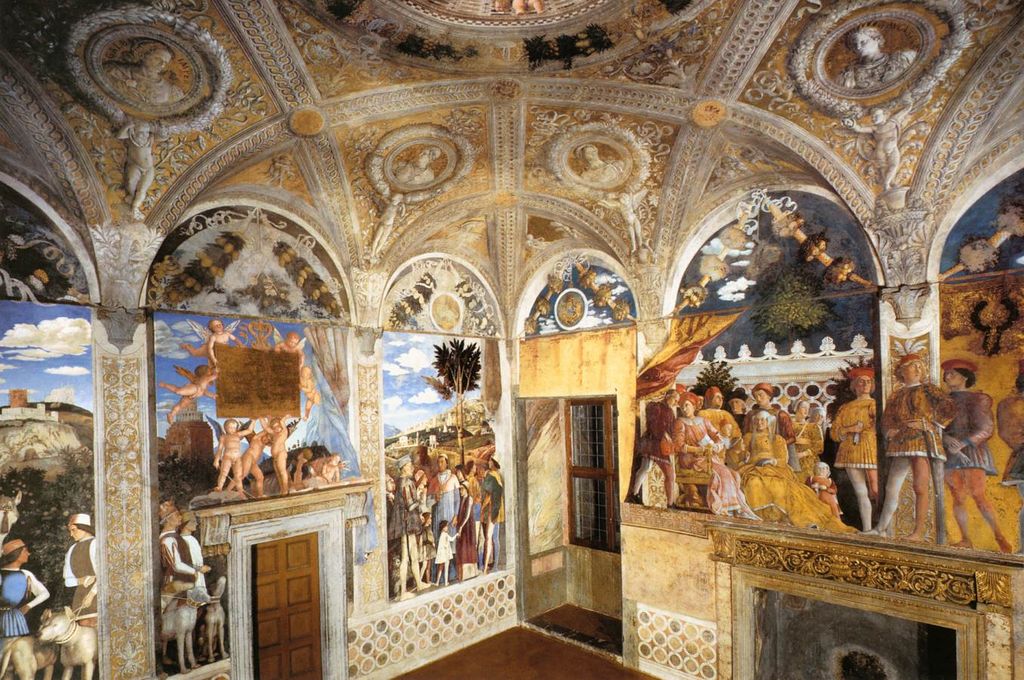
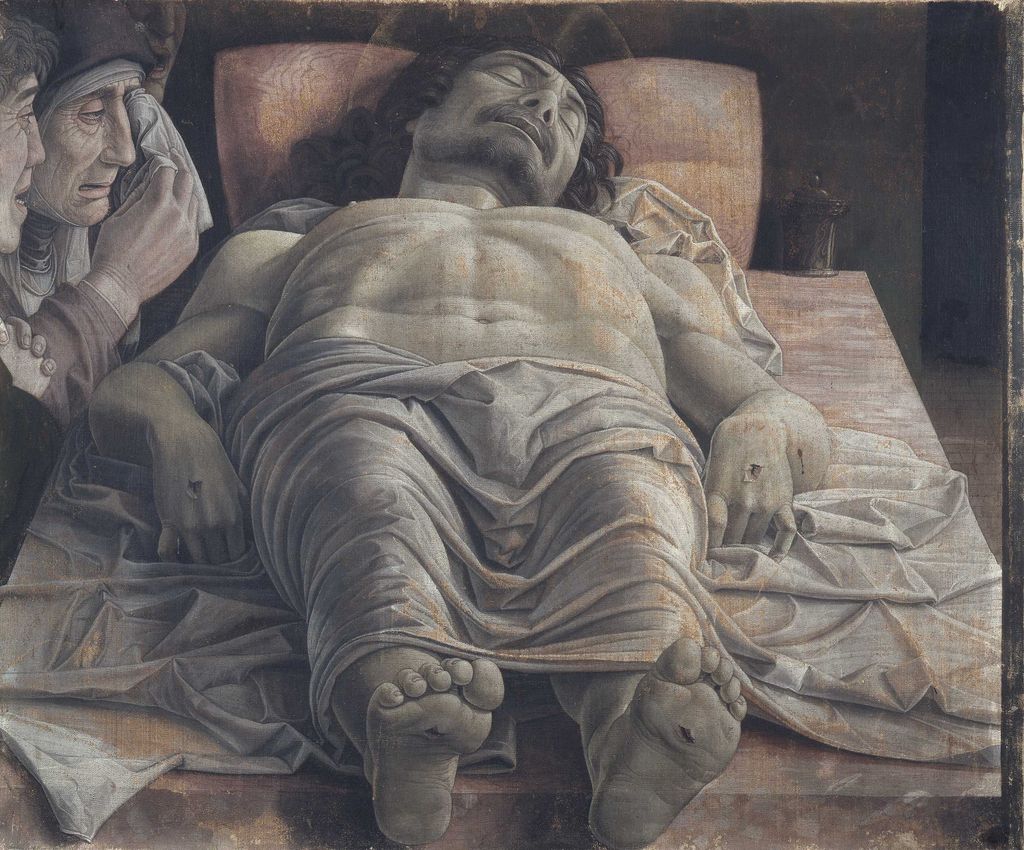
San Zeno Altarpiece
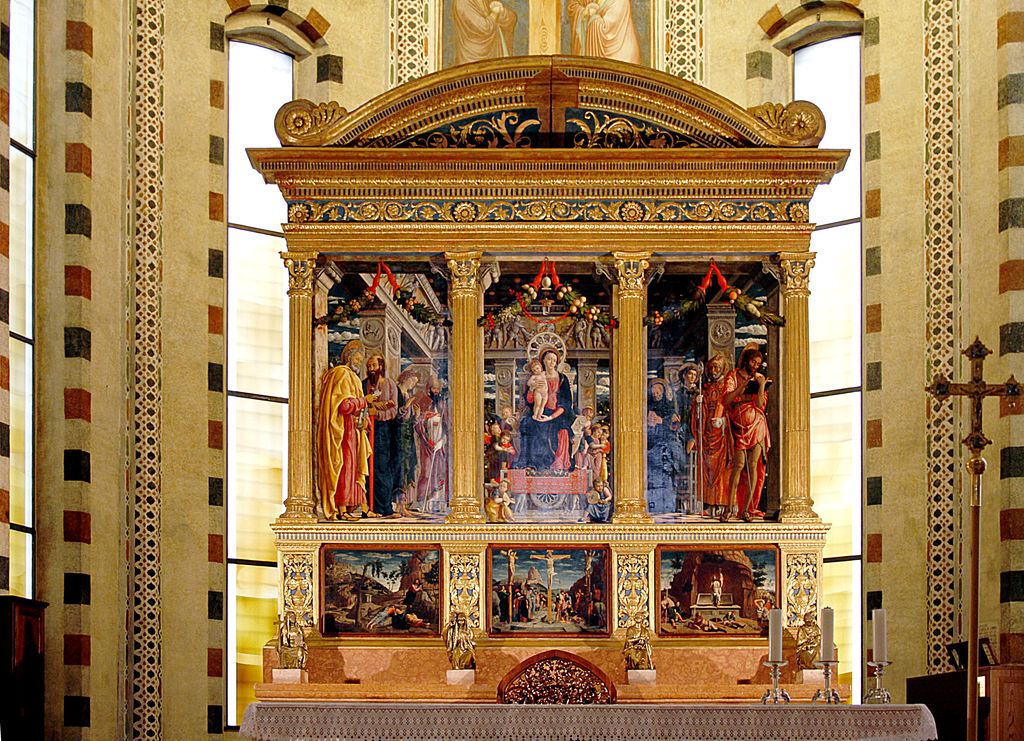
The San Zeno Altarpiece in its frame, Basilica of San Zeno, Verona José Luiz. Image source. CC BY-SA 4.0. Resized from the cited image.