by Tom Gurney
Tom Gurney BSc (Hons) is an art history expert with over 20 years experience
Published on June 19, 2020 / Updated on November 5, 2026
Email: tomgurney1@gmail.com / Phone: +44 7429 011000
Detroit Industry, South Wall
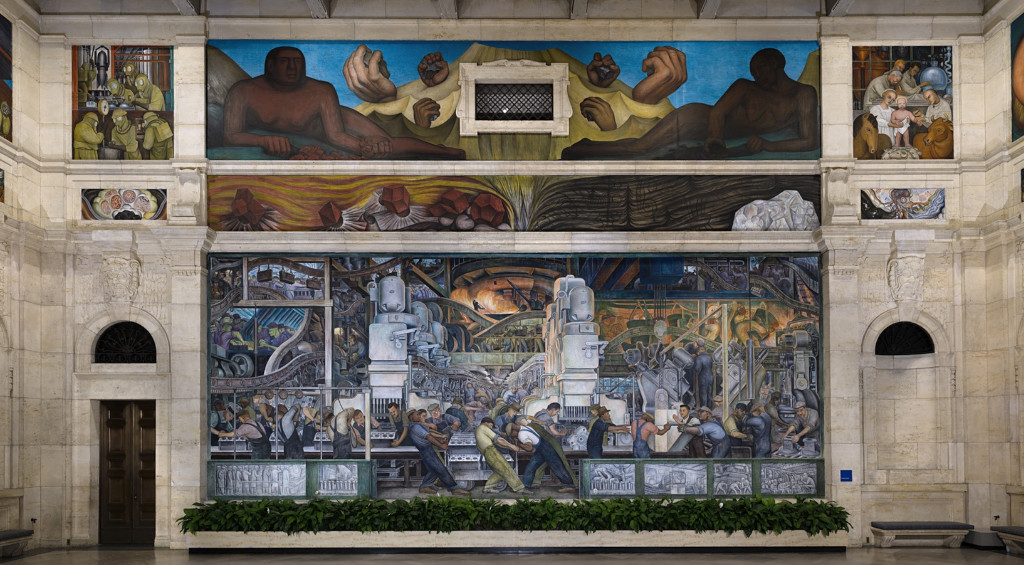
A vast silver press rises on the right, wheels crowd the left, and between them workers bend, lift and reach through a dense framework of metal. Diego Rivera's Detroit Industry, South Wall makes the construction of a car feel like an event occupying an entire world. Painted in fresco in 1932–1933, it remains in the Detroit Institute of Arts, in the court for which it was created. [1]
This is the side of Rivera's twenty-seven-panel cycle devoted, in its major industrial scene, to producing the automobile's exterior. Across the room, the north wall concentrates on the engine and transmission. The distinction gives the south wall its particular interest: here, material is being shaped into the enclosing body of the modern car. The Detroit Institute of Arts also draws attention to a second identity within its enormous stamping press, connecting the machine with the Aztec deity Coatlicue. [2]
At a Glance
Two industrial and political mural projects
Contents
A car body takes shape
Start near the middle of the main factory scene, where the workers' bodies create a cluster of intersecting diagonals. A man bends forward, another reaches across the equipment, and others gather behind them. Their limbs repeatedly disappear into the crowded machinery. The eye keeps finding a shoulder, a hand or a head amid the pipes and frames, then losing it again. This makes looking unusually active: we have to search for the people who keep the factory moving. [3]
Above them, a pale vehicle body offers a more recognisable shape. Its upright sides and framed windows contrast with the fragmented pieces and mechanisms below. Rivera lets us glimpse the object taking form without clearing away the work that produces it. The picture is crowded right up to the edges; there is scarcely a neutral patch in which the eye can rest. [3]
The factory also has a strong underlying order. Large circular forms on the left answer the press's rounded shoulders on the right. Horizontal platforms divide the activity into levels, while conveyors and curved tracks turn the eye into the distance. Small figures occupy spaces behind larger ones, giving the scene the compressed depth of a building whose front has been removed. Rivera makes different operations available to us simultaneously. [3]
Those curves help explain why the machinery feels animated. In its summary of Rivera's contemporary essay Dynamic Detroit, the Museum of Fine Arts, Houston's ICAA archive identifies undulating lines as a means of joining the cycle's imagery and expressing speed. On the south wall, this is something the eye can follow: a curving track interrupts the straight framework, wheels lead into loops, and the factory's activity seems to circulate. [6]
The people inside the machinery
For all its mechanical abundance, the mural continually returns to human effort. Near the centre, the exposed forearms and bent backs make work legible through posture. Farther left, cables and suspended equipment form a web around the figures. Different heights and angles prevent the workers from becoming a single repeating pattern. One turns toward us, another away; one leans into a task while another stands upright. [3]
Notice how little space separates the foreground figures from the equipment. The press is too big to take in as casually as a handheld tool, and the men beside it look vulnerable in comparison. Yet their activity remains sharply defined. Rivera gives us both the scale of industrial power and the practical concentration of those who work within it. That tension can be felt before any symbolic meaning is explained. [3]
Some faces have documented identities. The DIA identifies the stern foreground foreman at the left as M. L. Bricker, a Ford production manager associated with accelerating the assembly line. At the far right stand Edsel Ford and museum director William Valentiner. Below the main scene, Henry Ford appears teaching a group about an engine, although the museum cautions that he was never actually a teacher. These are constructed roles within a mural, even when the faces belong to recognisable people. [5]
The distinction matters throughout the cycle. A painted workforce cannot be treated as a transparent record of employment conditions. The DIA's curator Benjamin Colman points out that Rivera's vision of workers together idealised a factory historically divided by race. His example concerns the north wall, but the warning helps us approach the whole room: portraiture, observation and social aspiration can occupy the same painted factory. [5]
The stamping press and Coatlicue
The great press is the south wall's most commanding individual machine. Its upper curves suggest broad shoulders, and its vertical supports give it an almost bodily presence. Beneath its central mass, a dark opening and shaped metal parts draw attention toward the place where force is exerted. The adjacent workers supply its measure. It appears massive because we can compare it with a human back, head and arm. [3]
The DIA interprets its resemblance to Coatlicue, the Aztec goddess it associates with creation and war, as a suggestion that industrial machinery has taken the place of ancient gods. This is the museum's reading of Rivera's deliberate association. It invites us to see the press as a source of formidable creative power whose demands fall on human beings. [2]
Graham W. J. Beal, writing as director of the DIA, adds a revealing qualification: the particular press Rivera depicted had already been superseded by a sleeker model. Its older form mattered because it recalled Coatlicue. Beal also describes the rush of air from the descending press and reads the workers' proximity to it through the idea of sacrifice. The machine therefore carries both a physical explanation and an allegorical charge. [4]
That combination gives the scene its unease. The finished car promises mobility, but the bodies making it are tightly confined. Rounded metal forms can look elegant from a distance; closer attention brings us back to the men beneath them. Rivera allows admiration for a powerful industrial system to coexist with an awareness of the effort it consumes. [3]
Looking above and below the factory
A reproduction cropped to the main industrial panel misses the south wall's changes of scale. Higher up, two enormous reclining figures extend across a blue ground. Hands rise behind them around an existing architectural opening. Below is a long band of pale, layered forms and small organic shapes. The busy factory occupies another distinct zone farther down. Looking upward makes the workers seem part of a much larger order, though the image does not give up all its meanings at once. [3]
The contrasts are worth enjoying before trying to decode them. The reclining bodies are comparatively still, the hands isolated and emphatic. Beneath them, the pale bands seem to fold across the wall. Then comes the tightly packed factory, where almost every line meets another line. Rivera varies the pace of attention as well as the size of his figures. [3]
At the base, small grey scenes sit in green frames. Their limited colour and modest scale encourage a slower, closer look after the enormous central spectacle. There are further discoveries in the upper corners: the museum records Rivera's dated signature on a pharmacist's nameplate in the upper-left panel, 20 September 1932. The south wall rewards looking beyond its most famous machine. [1] [3]
Fresco fitted to a room
The wall's stone divisions, openings and projecting architectural features are essential to its effect. The painted zones fit between them, making the picture part of the room's structure. A visitor experiences its huge bodies and crowded factory in relation to real doors, ledges and floor space. The scale changes again when we imagine standing beside those doors instead of looking at the whole wall on a screen. [3]
Fresco also makes the relationship physical. MoMA conservator Anny Aviram explains true fresco as finely ground pigment mixed with water and brushed onto wet plaster. Dry-plaster painting uses a binder and constitutes a different procedure. Beal describes the Detroit murals as principally true fresco, with some later work on dried surfaces, and records the assistants' role in preparing the walls. [8] [4]
The practical support behind the painting survives in museum documentation. The Henry Ford's collection brings together preparatory drawings and correspondence concerning a plasterer and supplies of sand and glass. Even the logistics of making this immense image required cooperation. That material work offers a quiet parallel to the collective effort Rivera placed before the viewer. [7]
The patrons within the picture
Edsel Ford commissioned the cycle at Valentiner's suggestion, according to the ICAA's historical annotations. Their portraits at the right of the south wall make that relationship visible inside the industrial scene. The nearby painted document records the fresco campaign from 25 July 1932 to 13 March 1933 and identifies Ford's gift to the city. Patronage becomes part of the wall's own historical record. [6] [1]
Their small, composed figures offer a telling counterweight to the labour around them. The paper introduces an act of giving and a written record into a scene otherwise dominated by physical action. Our attention shifts from those who manufacture cars to those who made this public work possible. [3]
The commission also demanded support after completion. Beal recounts Edsel Ford's public defence of the murals during the controversy surrounding their unveiling. Seen in that light, the donor's presence carries more than ceremonial importance. The south wall preserves an encounter between industrial wealth, museum ambition and Rivera's searching image of labour—an encounter still visible in the space between the monumental press and the people working beneath it. [4] [3]
Artworks directory
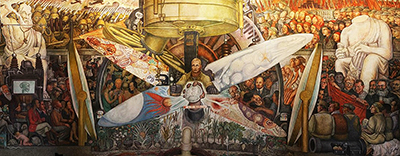
The South Wall in Detroit and the two distinct New York and Mexico City mural projects. The Rockefeller Center mural was destroyed; the Mexican painting is a revised work. Additional entries labelled Tate retain that museum’s unmaintained October 2014 catalogue snapshot. This selection does not enumerate Rivera’s complete work. [10]
| Name | Date | Medium |
|---|---|---|
| Detroit Industry, South Wall | 1932–33 | Painting |
| Man at the Crossroads (New York; destroyed) | 1933; destroyed February 1934 | Painting |
| Man, Controller of the Universe (Mexico City) | 1934 | Painting |
| Mrs Helen Wills Moody (Tate T00200) | 1930 | Drawing |
| Still Life (Tate T00317) | 1916 | Painting |
Frequently Asked Questions
Its main factory panel concentrates on the automobile's exterior, complementing the engine and transmission manufacture on the north wall. [2]
Discussion
Follow the workers through the machinery, then consider the press’s physical presence and the museum’s Coatlicue interpretation.
Where does your eye settle first: on the press, the workers, or the car taking shape? How does that first impression change when you look at the wall's smaller scenes?
Reader Insights
Where do people first emerge from the crowded machinery?
How does the press change when it is read as a bodily form?
What changes between the South Wall’s car body and the North Wall’s engine?
Join the Conversation
Share a detail, comparison or question about Detroit Industry, South Wall below.
References
- Detroit Institute of Arts. Detroit Industry, South Wall: collection record, inscription and image gallery. English. View source.Splash image: View the South Wall at the Detroit Institute of Arts
- Detroit Institute of Arts. Detroit Industry Murals: the subjects of the four walls. English. View source.
- Detroit Institute of Arts. Detroit Industry, South Wall: full-wall collection photograph. Visual source for close looking. View source.
- Graham W. J. Beal. Mutual Admiration, Mutual Exploitation: Rivera, Ford and the Detroit Industry Murals. Berkeley Review of Latin American Studies, Spring–Summer 2010, pp. 34–43. English. View source.
- Detroit Institute of Arts. 5 Details in the Detroit Industry Murals Most Visitors Miss. 11 March 2026. English. View source.
- ICAA, Museum of Fine Arts, Houston. Dynamic Detroit: an interpretation—archival synopsis and historical annotations. Record for Diego Rivera's essay in Creative Art 12, April 1933, pp. 289–295. English. View source.
- The Henry Ford Staff. Detroit Industry Frescoes: The Backstory—drawings, photographs and working correspondence. English. View source.
- Museum of Modern Art. Technique (Indian Warrior, 1931): conservator Anny Aviram explains fresco. Diego Rivera: Murals for The Museum of Modern Art, audio transcript. English. View source.
- Museo del Palacio de Bellas Artes, Murales, pp. 2–3, El hombre controlador del universo, 1934. Museum-authored guide used for the career comparison; accessed 28 October 2026. View source.
- Tate, Tate Collection metadata, artwork_data.csv, October 2014 snapshot, released under CC0. Repository readme states that this dataset is no longer maintained. Downloaded and artist rows inspected 28 October 2026. View source.


 Diego Rivera.jpg)