


 by Tom Gurney
Tom Gurney BSc (Hons) is an art history expert with over 20 years experience
Published on June 19, 2020 / Updated on November 5, 2026
Email: tomgurney1@gmail.com / Phone: +44 7429 011000
Man, Controller of the Universe
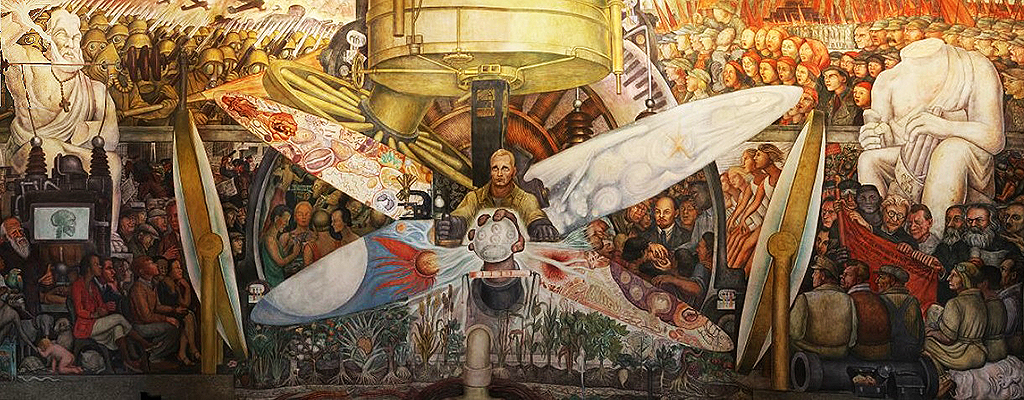
A worker faces us beneath a great machine, his gloved hands reaching towards its controls. Around him, enormous crossing ellipses open views into worlds too small or too distant for the unaided eye. Crowds, soldiers, scientists and revolutionary leaders occupy the spaces beyond. Diego Rivera gives this single operator an extraordinary position: he stands at the meeting point of human labour, natural processes and rival visions of society.
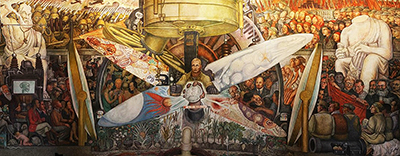
El hombre controlador del universo, usually translated as Man, Controller of the Universe, is the mural Rivera painted in 1934 for the Palacio de Bellas Artes in Mexico City. It is a fresco on a transportable metal framework, measuring 4.80 by 11.45 metres according to the museum's mural guide. Its subject grew out of Man at the Crossroads, the unfinished Rockefeller Center mural destroyed in New York. The painting in Mexico is a separate, revised work, made for a different setting and audience. [1] [2]
At a Glance
From the New York mural to the Mexican revision
Contents
Begin with the operator
The central worker offers the clearest way into an image that can initially seem overwhelming. His face looks out towards us while his arms spread across the machinery. An immense cylindrical structure descends above his head. Beneath it, the mechanism surrounds him with wheels, cables and metal surfaces. Yet his head remains small beside the equipment: the picture grants him responsibility without pretending that the forces around him are modest or easily mastered. This relationship is visible in the museum-authorised photograph reproduced by the art historian Jacob A. Zumoff. [3]
Look next at the hand and transparent sphere immediately in front of him. Their rounded shapes interrupt the longer diagonal forms. From this busy centre, the composition opens outward in four directions, leaving the worker poised where the ellipses cross. Rivera gives the eye several possible journeys through the painting, but each returns to the same human presence. The operator supplies a point of orientation inside the crowds and machinery. [3]
The foreground changes the scale again. Along its lower edge, plants and roots bring the viewer back towards the earth, below the heightened spectacle of the central apparatus. This low strip matters visually: the world of cultivation occupies the same composition as the machine and the fantastic scientific views. Bodies, crops and instruments belong to one field of attention. The mural's expansiveness begins with these changes of scale, before a viewer identifies any of its famous faces.
Seeing beyond ordinary sight
The crossing ellipses resemble immense lenses laid across the wall. Their pale surfaces and illuminated contents contrast with the dense groups of people behind them. One contains recognisable spiral forms associated with astronomical imagery; another offers an intricate field of small biological shapes. Their stretched outlines make these different orders of life appear to sweep past the operator. The painting has the visual energy of a mechanism in motion, although it remains anchored by his frontal figure. [3]
The museum's guide identifies these forms with the macrocosm and microcosm: the immense universe and the minute structures of life. Scientific vision allows the mural to move between them without leaving its central human subject. The guide contrasts diseased cells on the capitalist side with healthy forms on the socialist side: a political analogy, rather than a neutral scientific classification. [1]
A later museum discussion approached the centre from another direction. In a 2023 lecture, the musicologist Elena Kopylova described its futuristic machinery through associations with the atom and nuclear physics. She treated the union of microcosm and macrocosm as a visual metaphor, linking it to the period's hope for a better collective future. Her account helps explain why the central apparatus feels larger than a depiction of any particular industrial machine. It gathers scientific possibility into a single compelling image. [4]
Kopylova also noted the historical distance between that confidence in a luminous future and the way the phrase sounds today. A viewer can recognise the ambition while questioning its certainty. The mural offers a useful place to consider that difference: its human controller looks composed, but the forces surrounding him remain immense. The image invites admiration for knowledge and an awareness of the responsibility that accompanies it. [4]
Political choices around the machine
Moving outward from the centre, the crowds become easier to distinguish. On the viewer's left, military formations and scenes of social conflict occupy a different visual world from the joined hands and red banners on the right. The two sides are connected by the same broad pictorial structure. The machine does not seal the worker away from politics; it places him between competing uses of human power. [3]
The museum guide reads the left as an indictment of capitalism through repression and war, and the right as an idealised socialist future. It identifies Darwin among the figures on the left and Lenin organising workers on the right. Science thus appears within a contested social world. The presence of knowledge does not, by itself, determine what a society will do with it. [1]
Hands provide a particularly direct way to read the opposition. The operator's hands engage the controls; nearby, Lenin joins the hands of people around him. One action concerns the organisation of machinery, the other the organisation of human relationships. Seen together, these gestures make control and cooperation visible through bodily movement. A reader need not decipher every portrait to notice how Rivera makes an abstract political argument tangible.
The revolutionary company also has a more specific history. Zumoff draws attention to the group containing Marx, Engels, Trotsky and the American communist James P. Cannon, alongside a banner calling for international workers' unity. He disputes an earlier identification of Cannon as Jay Lovestone. His correction matters because these men belonged to rival currents on the revolutionary left. The faces cannot all be treated as interchangeable emblems of one united communist movement. [3]
From Rockefeller Center to Mexico
The New York controversy unfolded in stages. MoMA's chronology records Nelson Rockefeller's request of 4 May 1933 that Rivera remove Lenin's portrait. Rivera refused. On 9 May the building's management stopped his work, and the mural was covered. Its destruction followed in February 1934. Keeping those events separate restores the interval in which a suspended work might still have survived. [2]
MoMA also records an unsuccessful attempt to arrange its transfer to the museum. The precise reasons that this proposal failed remain unclear. The story therefore involves more than an immediate disagreement followed by instantaneous destruction: negotiations, public protests and competing possibilities intervened. Lucienne Bloch's photographs preserve views of the unfinished painting that would otherwise have been lost. [2]
The Mexican government subsequently enabled Rivera to make a revised version at Bellas Artes. The result recovered the central premise and Lenin's place in the composition while giving the work a new material existence. Calling it a reproduction can obscure that act of reworking. A fresh fresco had to be designed and executed for its architectural destination; the destroyed wall was not brought from New York. [2]
The surviving mural also carries a different title. Man at the Crossroads emphasises a choice of direction; Man, Controller of the Universe gives greater prominence to the human figure handling the forces before him. Read against the two compositions' history, the change encourages attention to agency as well as decision. It does not erase the social alternatives that remain spread across the wall.
A fresco built around a centre
At more than eleven metres wide, the Bellas Artes mural asks for both distance and concentration. From a distance, its crossing diagonals and symmetrical arrangement establish a readable whole. Closer looking reveals groups with their own activities and directions of movement. The design makes room for these smaller narratives without surrendering its powerful centre. [1] [3]
The museum describes the metal support as transportable. This fresco therefore differs materially from a painting on a building's structural wall. Its survival acquires particular poignancy after the loss of its predecessor. [1]
Two pale monumental figures stand near the outer edges. Their broad bodies and relatively empty surfaces interrupt the compressed clusters of human faces. They help hold the crowded picture open at its margins, while the ellipses stretch inward across it. The contrast between these large forms and the many small figures is another reason to begin with the composition before attempting a complete catalogue of symbols.
An argument that kept changing
The Mexican mural did not win universal agreement among artists on the left. Zumoff documents David Alfaro Siqueiros's attack on it in 1935, including his objection that Rivera had failed to confront capitalist suffering in Mexico. The dispute reveals a significant tension: restoring a censored revolutionary image to a prestigious national building could itself become a target of revolutionary criticism. Political agreement about workers' emancipation did not guarantee agreement about patronage, artistic method or subject. [3]
Bellas Artes has continued to reopen those questions through research. Its 2024 exhibition, Diego Rivera. Nueva vida a un mural destruido 1933/1934, brought drawings, photographs, printed documents and sound material into conversation with the surviving mural. Work associated with Rivera's 1927 Moscow visit helped place the commission within a longer history of revolutionary imagery. Visitors could compare early designs and photographs with the Mexican recreation, seeing the composition as something that changed through successive decisions. [5]
Associated discussions considered historical research, the visual culture of the period and contemporary artistic responses. Verónica Gerber Bicecci's contribution formed part of that broader reconsideration. These approaches treated the mural as an active source of questions about memory and artistic heritage, as well as a famous survivor of censorship. [6]
Another strand of the museum's programme paired it with films by Dziga Vertov, Joris Ivens and Sergei Eisenstein. Curator Álvaro Vázquez Mantecón brought the painting into dialogue with cinema concerned with industrial construction, engineering and agricultural transformation. The comparison offers an illuminating way to look: Rivera compresses multiple processes and opposing societies into one surface, while film can make relationships through successive images. The museum presented these as connections within a shared visual culture, rather than proof that a particular movie supplied a particular painted detail. [7]
Returning to the worker after these histories, his position feels less comfortable than the title might suggest. He has access to extraordinary instruments, but the societies around him disagree profoundly about their purposes. The painting's lasting force lies in that combination of confidence and conflict: human beings can discover, organise and transform their world, while the question of who directs those powers remains open to argument.
Artworks directory
The South Wall in Detroit and the two distinct New York and Mexico City mural projects. The Rockefeller Center mural was destroyed; the Mexican painting is a revised work. Additional entries labelled Tate retain that museum’s unmaintained October 2014 catalogue snapshot. This selection does not enumerate Rivera’s complete work. [8]
| Name | Date | Medium |
|---|---|---|
| Detroit Industry, South Wall | 1932–33 | Painting |
| Man at the Crossroads (New York; destroyed) | 1933; destroyed February 1934 | Painting |
| Man, Controller of the Universe (Mexico City) | 1934 | Painting |
| Mrs Helen Wills Moody (Tate T00200) | 1930 | Drawing |
| Still Life (Tate T00317) | 1916 | Painting |
Frequently Asked Questions
It is in the Palacio de Bellas Artes in Mexico City. [1]
The museum guide connects them with the macrocosm and microcosm: the vast universe and minute forms of life. [1]
Discussion
Follow the operator’s position among the scientific views and political crowds, keeping the Mexican work distinct from the destroyed New York mural.
Reader Insights
Where do your eyes first leave the central worker?
How do the crossing ellipses join different scales of life?
What changes when the work is understood as a revision for Mexico City?
Join the Conversation
Share a detail, comparison or question about Man, Controller of the Universe below.
References
- Museo del Palacio de Bellas Artes, Murales, pp. 2–3, Diego Rivera, “El hombre controlador del universo.” Museum guide, accessible through Proyecto Patrimonio's hosted PDF. Spanish. Object medium, dimensions and institutional iconographic interpretation. View source.
- The Museum of Modern Art, “Chronology,” Diego Rivera: Murals for The Museum of Modern Art, 2011, entries for 1933 and 1934. English. Commission dispute, proposed transfer, destruction and Mexican revision. View source.
- Jacob A. Zumoff, “Between a Rockefeller and a Hard Place: Diego Rivera's Man at the Crossroads and the Left in the 1930s”, Anales del Instituto de Investigaciones Estéticas 44, no. 121 (2022), pp. 219–262; especially fig. 3 on p. 233 and pp. 254–255, 258–259. English, with Spanish abstract. Museum-authorised photograph, political portrait identification and contemporary criticism. View source.
- Secretaría de Cultura / Instituto Nacional de Bellas Artes y Literatura, “Abordan tema de ciencia y música a partir del mural El hombre controlador del universo”, 7 December 2023. Spanish. Account of Elena Kopylova's lecture and the museum's interpretive programme. View source.
- Secretaría de Cultura / Instituto Nacional de Bellas Artes y Literatura, “La exposición Diego Rivera. Nueva vida a un mural destruido concluye el domingo 8 de septiembre”, 30 August 2024. Spanish. Exhibition sources, preparatory studies and comparison of successive versions. View source.
- Secretaría de Cultura / Instituto Nacional de Bellas Artes y Literatura, “Dialogarán sobre tres aproximaciones narrativas que se desprenden del mural ‘El hombre controlador del universo’”, 26 August 2024. Spanish. Historical, audiovisual and contemporary artistic approaches to the mural. View source.
- Secretaría de Cultura / Instituto Nacional de Bellas Artes y Literatura, “El Museo del Palacio de Bellas Artes presenta el ciclo ‘Rivera y el cine de vanguardia’ en la Cineteca Nacional”, 6 August 2024. Spanish. Álvaro Vázquez Mantecón's comparative film programme and its interpretation of art, politics and technology. View source.
- Tate, Tate Collection metadata, artwork_data.csv, October 2014 snapshot, released under CC0. Repository readme states that this dataset is no longer maintained. Downloaded and artist rows inspected 28 October 2026. View source.


 Diego Rivera.jpg)


