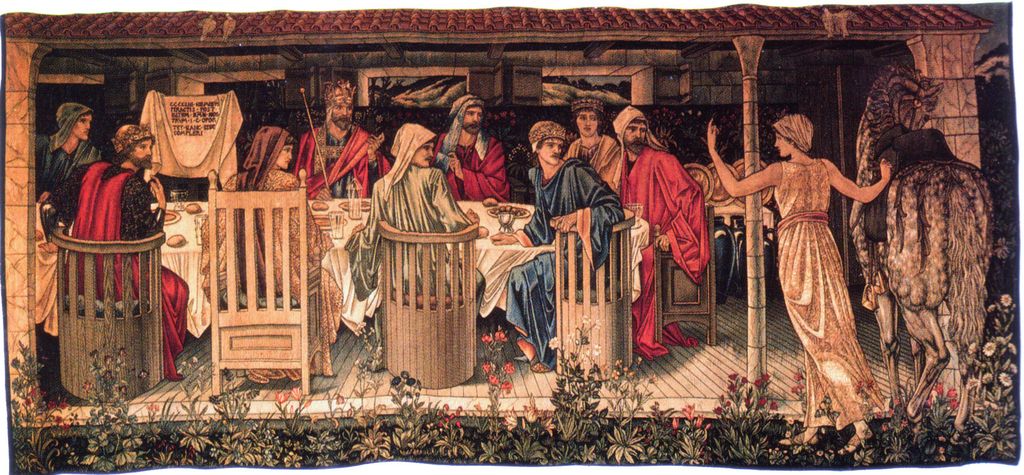
Morris & Co., The Summons, from the Holy Grail tapestries. Image source. Public domain.
 by Tom Gurney
Tom Gurney BSc (Hons) is an art history expert with over 20 years experience
Email: tomgurney1@gmail.com / Phone: +44 7429 011000
Edward Burne-Jones’s Tapestries: Introduction
Edward Burne-Jones drew the knights and angels of some of the most ambitious tapestries made in Victorian Britain. John Henry Dearle designed much of the vegetation and scenery around them. William Morris brought his knowledge of colour, pattern and historical textiles to the work, and at Merton Abbey trained weavers turned their designs into hangings large enough to cover walls. The resulting tapestries belong to several histories at once. The Holy Grail series began as decoration for a private dining room, while The Adoration of the Magi began as a commission for an Oxford chapel and went on to furnish collectors’ houses and appear at international exhibitions. [1]
At a Glance
- ArtistEdward Burne-Jones
- FocusDesign and weaving
- ExploreStanmore Hall, the Grail and Adoration variants
Contents
- From Burne-Jones’s drawing to the loom
- The Holy Grail tapestries at Stanmore Hall
- Reading the six scenes
- Why Birmingham’s panels have different dates
- The Adoration of the Magi, from Exeter to Paris
- Flora, Pomona and designs shared with other crafts
- Annotated details
From Burne-Jones’s drawing to the loom
Morris taught himself tapestry weaving and brought it into larger-scale production when Morris & Co. concentrated its manufacturing at Merton Abbey in 1881. Dearle went from apprentice to manager of production. The firm sold smaller woven pieces through its Oxford Street premises, but a commission on the scale of the Holy Grail series could occupy the workshop for years. A drawing that fitted on a desk had to work across a span of wall. The figures needed strong enough outlines to be read from a distance, and the weavers needed guidance on details that would be visible only at much closer range. [1]
On a high-warp loom, the threads that form the warp are stretched vertically between rollers. The weaver passes coloured wefts around the warp threads, working each colour back and forth over the part of the design where it belongs. The compacted weft conceals the warp across the surface. A change in colour is therefore also a change in the yarn being woven. Embroidery uses stitches to build a design on fabric that already exists. Tapestry makes the fabric and the picture together. A hand, an eyelid or a gleam on a strand of hair depends on how much detail the weaver can carry through those small changes in coloured yarn. [2]
In his essay Textiles, Morris described tapestry as a kind of mosaic made with dyed threads and valued both clearly defined shapes and the gradations of tone possible in weaving. At Stanmore the two qualities work at different distances. From across the room, a wing or a bend in the neck tells you how to follow the story. Up close, the shadows folded into a sleeve and the small changes in colour along a face reward lingering over the material itself. Wool carries broad areas of colour, while the light caught by silk can help an ornament or a fold come forward. [2] [3]
The Holy Grail tapestries at Stanmore Hall
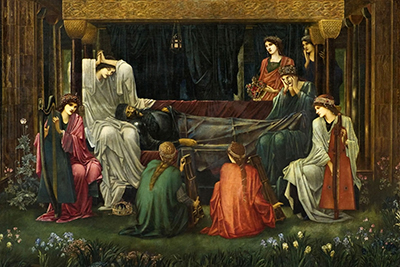
Around 1890, the mining financier William Knox D’Arcy commissioned the first set for the dining room at Stanmore Hall in Middlesex. It drew on Sir Thomas Malory’s Le Morte Darthur, a book that Morris and Burne-Jones had read together as students. Burne-Jones returned repeatedly to Arthurian subjects, including in his painting The Last Sleep of Arthur in Avalon. At Stanmore he had a different task. The quest had to be broken into scenes that a person could follow around a furnished room, with doors and fittings fixing the space available for each scene. [4] [5] [6]
The William Morris Gallery preserves a portion of the full-scale photographic cartoon for The Summons, the opening panel. The firm of Walker & Boutall enlarged the drawings photographically, and Burne-Jones strengthened details in the enlargements, including with ink, sepia and white. On heads and hands, the artist could recover nuances that risked being lost when the design was enlarged. Morris supplied heraldic details, drawing on a book of Arthurian chivalry printed in Paris in 1520. Dearle worked on the flowers and greenery. Each contribution gave the people at the loom something different to resolve in yarn, from patterns on a shield to the transitions between light and shade in a face. [5] [7] [8]
The names of individual weavers survive unevenly. Sotheby’s research on the Stanmore series names William Harold Knight, William Sleath, John Martin, Robert Ellis, John Keech and Walter Taylor among the people involved. The catalogue for the original Failure of Sir Gawain and Sir Ewain gives an object-specific list that includes Martin, Ellis, John Keich and George Merritt. Keech and Keich are forms used in the records. This panel has a cotton warp with wool and silk used to make its image. A later linen backing belongs to its history as an object that has been hung and cared for. In an interview reported when The Attainment was first shown, Morris said that three workshop-trained weavers had worked on it for two years. He singled out Dearle’s hand in some of the faces and hands. On so broad a panel, the three weavers each had part of the warp in front of them and had to make their work agree across the hanging. [6] [8]
The original scheme had six narrative subjects and lower panels of verdure, or greenery. A scroll in the lower register could supply the words that made sense of the scene above, while foliage, animals and heraldic shields carried the design down towards eye level. Period photographs show how wide panels were balanced against the architecture. The large Attainment was shaped to accommodate a doorway, and its upward sweep carries the eye towards the Grail. It was the climax of the story and the first scene the workshop completed, in time for the 1893 Arts and Crafts Exhibition. The remaining scenes were finished in 1894 and the greenery panels followed in 1895. The whole scheme cost D’Arcy £3,500, including £1,000 for Burne-Jones’s designs. In 1920 the original set was sold to the second Duke of Westminster for Eaton Hall. [5] [6] [8]
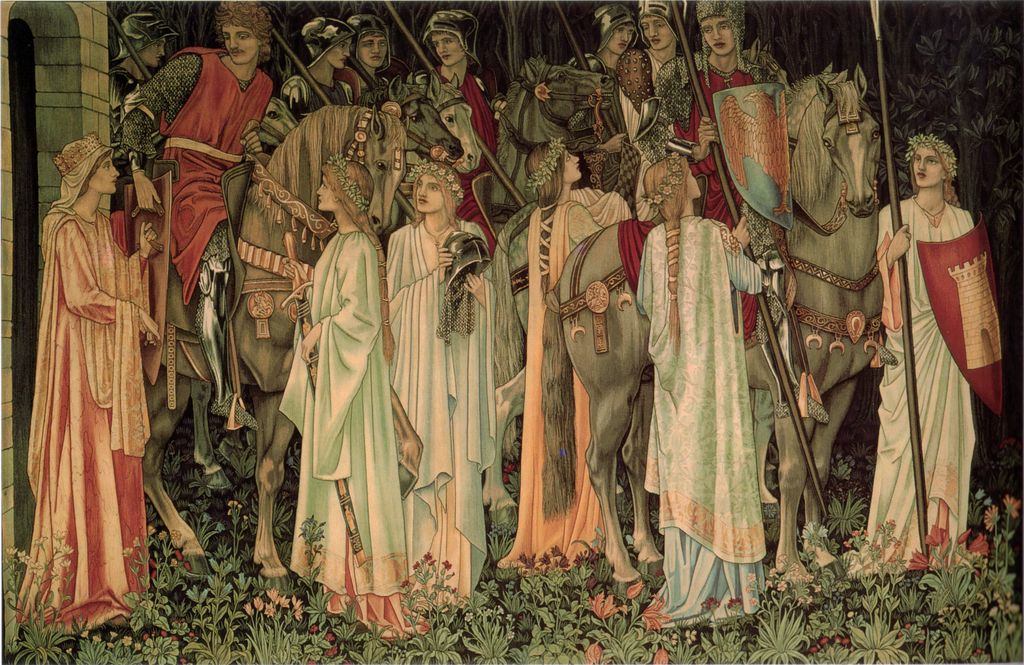
Morris & Co., The Arming and Departure of the Knights, from the Holy Grail tapestries. Image source. Public domain.
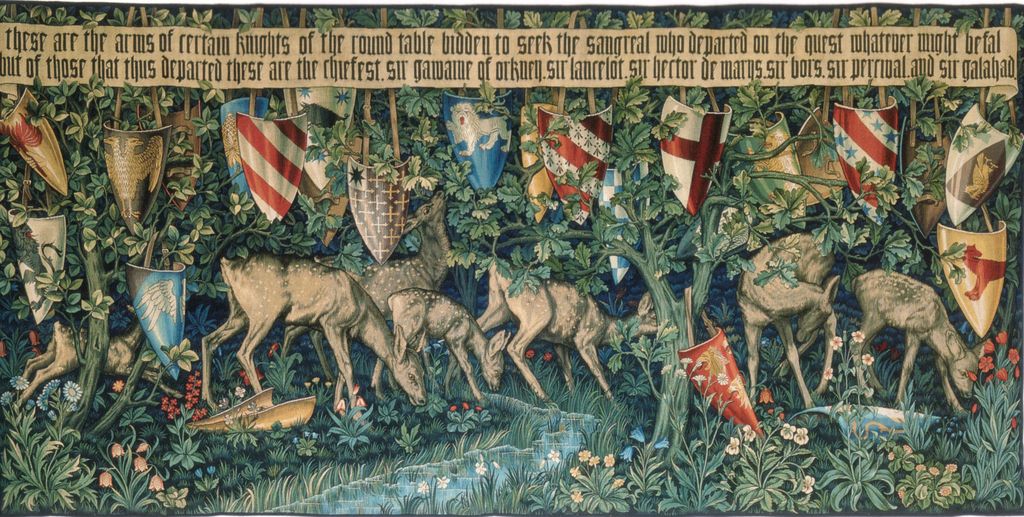
Morris & Co., Verdure from the Holy Grail scheme. Image source. Public domain.
Annotated Details from Edward Burne-Jones’s Tapestries
The numbered points identify visible features discussed in this article. Return from each detail to the numbered overview. Morris & Co., The Arming and Departure of the Knights, from the Holy Grail tapestries. Image source. Public domain.
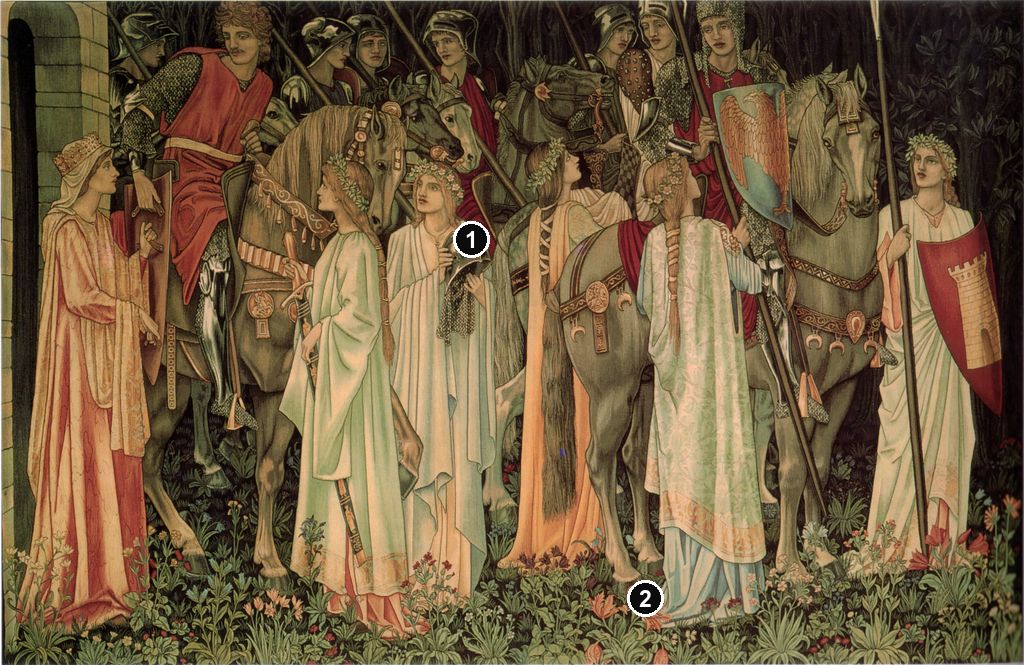
Details from EDWARD BURNE-JONES’S TAPESTRIES
Compare the cropped details with the source images above. Notice how their colours, shapes and positions contribute to the larger compositions.
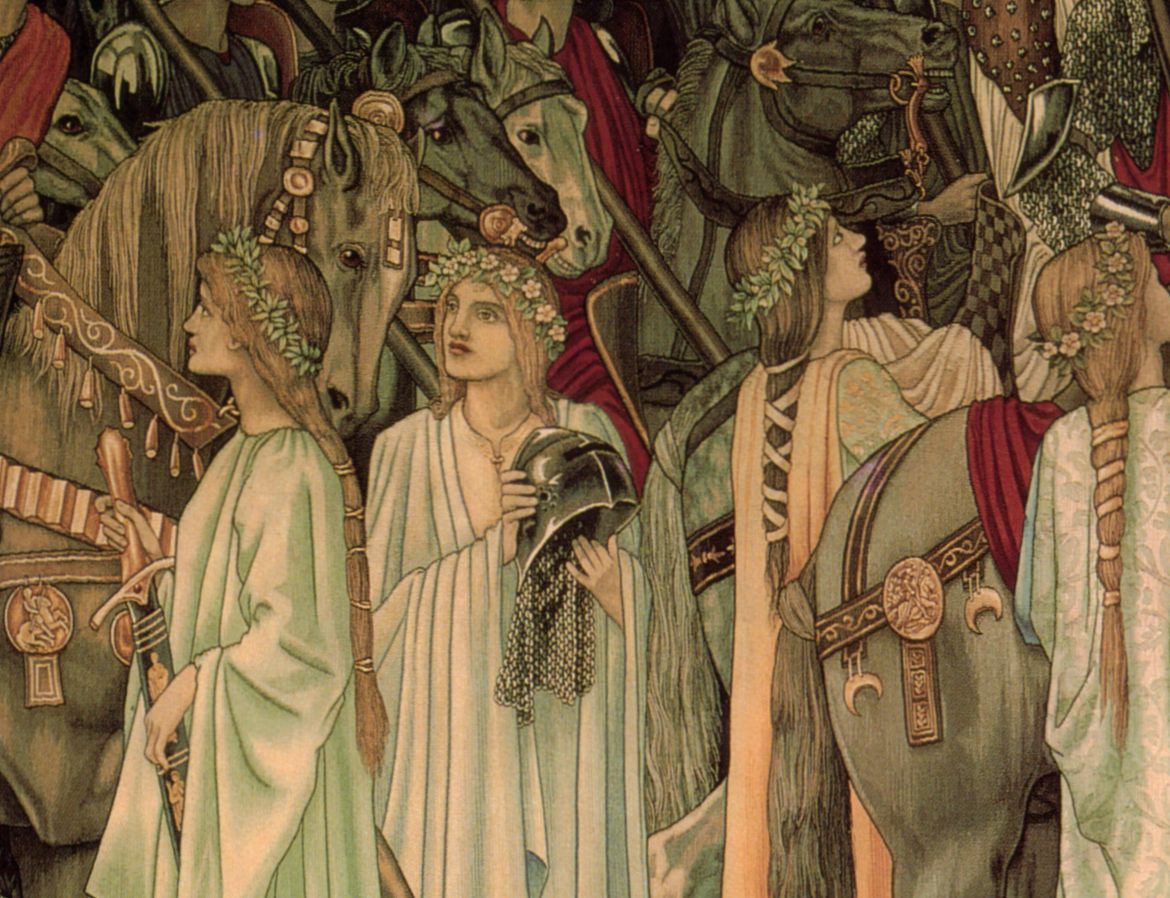
The standing group
The slim upright figures are legible close together because sleeves and faces break the repeated arrangement.
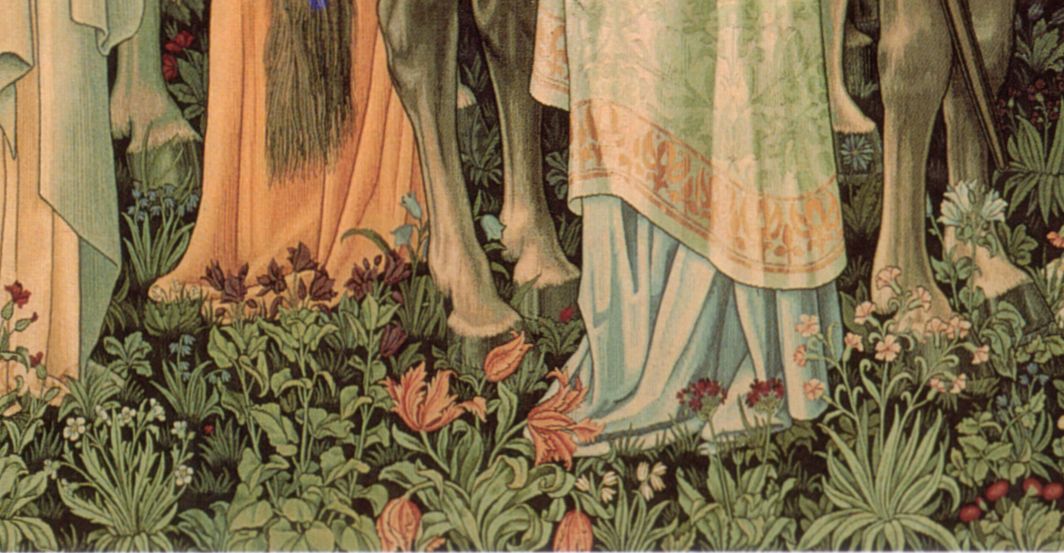
Pattern on the ground
The low band of repeated flowers shows how a woven ground can bridge the space between different figures.
Reading the six scenes
In The Summons, the knights are still gathered at the Round Table. A young woman enters and the heads of the company turn towards her. The design holds a group of men seated at a common table just as a demand arrives that will send them out on separate roads. In The Arming and Departure of the Knights, women hand over equipment as the knights ready themselves. Where the first panel makes attention swing towards an individual, the second distributes it across the acts of preparation. The armour and heraldry make the undertaking look like the kind of challenge at which a knight should excel. [7] [9] [10] [11]
The two failures change the terms of the quest. In The Failure of Sir Gawain and Sir Ewain, the men come up against an angel at a chapel door. Burne-Jones turned the warning voice in Malory’s story into a figure the knights can see, and introduced briar roses around the place they cannot reach. The arms on the shield identify Ewain, even though Malory pairs Gawain with Ector de Maris in the corresponding episode. The choice of companion shows that the designers took liberties with the printed story. The two men have come armed to the threshold, and the formal upright figure facing them makes their equipment seem beside the point. The colour has a quieter part in the story. Morris used silk for the light coming from the chapel window, while Dearle’s foreground flowers were distinct enough for D’Arcy’s gardener, W. Tidy, to identify foxgloves, snowdrops and tulips among them. Light and vegetation give this episode a physical setting even as the angel makes the place inaccessible. [8]
The panel usually called The Failure of Sir Lancelot to Enter the Chapel of the Holy Grail brings the eye down to the armoured knight lying asleep against a stone cistern. A single guardian stands at the door. In the description reprinted in The Studio during the 1890s, light through the door reaches the grass and Lancelot’s armour. The knight has come close enough to share the light. His posture and the shut door give the viewer the terms of his exclusion in one glance. Compare Burne-Jones’s later oil of the subject in Southampton, where the arrangement of the sleeper and the guardian also makes the episode feel suspended in the moment before waking. [5] [12]
The Ship lets the eye rest on an anchored vessel and a stretch of shore. It also carries the story towards Sarras, where the quest ends, and gives a room with so many standing figures a moment of relative stillness. In The Attainment, Galahad kneels closest to the vision, with Bors and Percival held farther away. The positions of the knights and the angels express different degrees of access within a single scene. Seen at Stanmore above the doorway, the upper part of the hanging would have made the separation particularly marked. The Birmingham weaving of The Attainment gives a closer look at the culminating design. [4] [5] [6] [8]
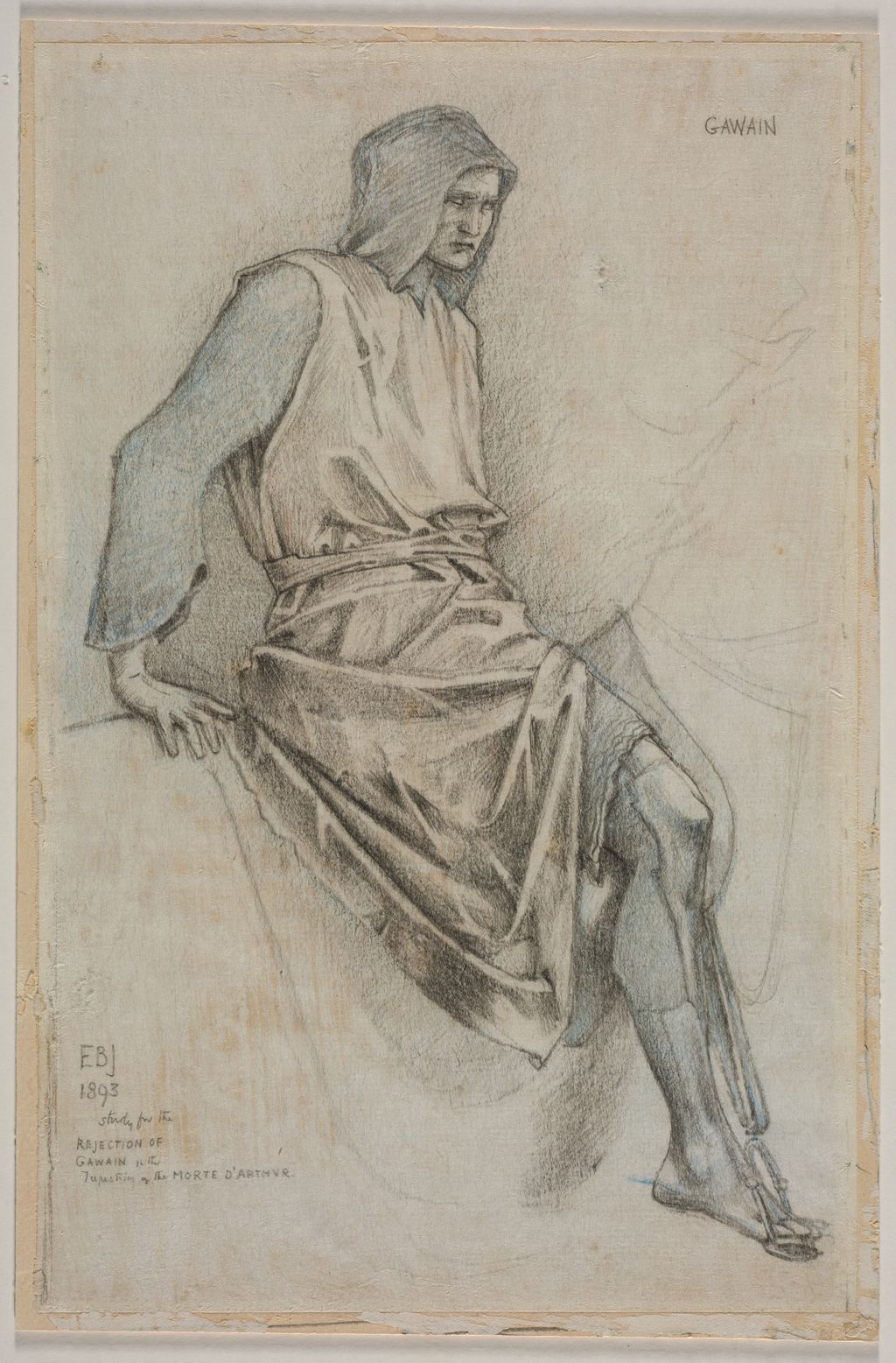
Edward Burne-Jones, Study for the Failure of Gawain. Cleveland Museum of Art, 2013.248. Image source. CC0 / Public domain.
Why Birmingham’s panels have different dates
Birmingham’s holdings bring together work from several commissions. Laurence Hodson ordered three subjects for Compton Hall near Wolverhampton. His Arming and Departure, Failure of Sir Lancelot and Attainment were woven in 1895–96. George McCulloch, D’Arcy’s mining partner, commissioned all six narrative designs and one verdure for his London house in 1898–99. His set won a Grand Prix at the 1900 Paris Exposition. Birmingham’s Summons comes from that order. Its record lists wool, silk, mohair and camel hair in the weft on a cotton warp, a material specification for that weaving. Birmingham’s Ship comes from another commission, placed by Mrs Middlemore in 1900. The panels share a story and a set of designs, and their dates and patrons identify different textiles. [8] [9] [10] [11]
The cartoons kept the designs available after Burne-Jones and Morris had died. A photograph in the William Morris Gallery shows Percy Sheldrick at the loom around 1929–32, when he and Sidney Mears worked on fresh weavings of The Summons and The Attainment for Lympne Castle. Earlier photographs by Frederick Hollyer preserve the Stanmore textiles themselves. The gallery suggests that the photographs may have been useful to the showroom or to weavers working on later versions. Images of Hollyer’s series from the William Morris Society were also included in the Museu Nacional d’Art de Catalunya’s exhibition checklist. A photograph of a finished tapestry records one weaving, while a photograph enlarged and revised as a cartoon records part of the design process. Both can circulate under the name of the same scene. [4] [7] [13] [14]
The Adoration of the Magi, from Exeter to Paris
John Prideaux Lightfoot, rector of Exeter College, Oxford, commissioned The Adoration of the Magi in 1886 for the college chapel. Burne-Jones and Morris had both studied at Exeter. The finished hanging was put up in May 1890, according to a contemporary account reprinted by the college. Mary and the child sit at one end, close to Joseph. The three kings approach with their gifts in a procession interrupted by the angel bearing the star. The heads, crowns and vessels form a line across the tapestry, while the greenery threads together the figures and the shelter. The Huntington’s small watercolour design gives an idea of how early the essential spacing of that procession was established. [15] [16] [17]
The Exeter hanging had to live with daylight, dust and the practical difficulties of fitting a very large textile in a chapel. In 2018, Exeter reported that conservators Georgie Dennis and Jonathan Tetley had helped rehouse it behind lighter, ultraviolet-filtering acrylic. The glazing was joined to make a panel large enough to cover the whole work and light enough to fit the existing frame. Earlier, two separate panes interrupted the view. The alteration matters particularly to a composition that asks the eye to travel across the figures from one end of the hanging to the other. [15]
The Anbetung der Könige in the Museum für Kunst und Gewerbe Hamburg is a separate weaving, made at Merton Abbey in 1900 and acquired at that year’s Paris Exposition. It measures 255 by 382 centimetres and uses wool and silk with a cotton warp. The museum identifies Dearle’s part in the flower meadow, background and border. Its photographs make it possible to examine what the weavers contributed as well. Short changes in colour give the patterned clothing and jewellery their flashes of light. The upper border names Burne-Jones as designer, the firm as maker and Merton Abbey as the place of weaving, providing a means of identification within the object itself. [18]
The Musée d’Orsay’s L’Adoration des Mages was woven in 1904. It is a high-warp tapestry, 258 centimetres high and 377.5 centimetres wide. The Orsay record identifies the figures and arrangement with Burne-Jones and discusses the roles of Morris and Dearle in the landscape, foreground and clothing ornament. The banker Guillaume Mallet commissioned this version for Le Bois des Moutiers, the house in Normandy designed by Edwin Lutyens. The workshop’s name and the date are woven at the lower right. The work stayed in Mallet’s family until it entered the collection of Yves Saint Laurent and Pierre Bergé. Bergé gave it to the museum in 2009. Two dates therefore identify two distinct appearances of the design in Paris. The Hamburg weaving was already made and acquired at the Exposition in 1900, four years before the Orsay textile was woven. [18] [19]
Other versions show how far a chapel commission travelled. Manchester Metropolitan University holds an 1894 weaving, listed in the 2012 Mitsubishi Ichigokan Museum exhibition in Tokyo. The Art Gallery of South Australia’s version was ordered by Sir George Brookman and arrived in Adelaide in 1902 to hang in his house, Ivanhoe. According to the gallery, four artisans spent two years making it. The Hermitage also records an example in its collection. Images of any of these versions can look much alike at a glance. When two examples are available to compare, look at the border, the ground between the figures and the size recorded by the collection. Those clues help identify the textile even when a caption supplies only the artist’s name and a design date. [20] [21] [22] [23]
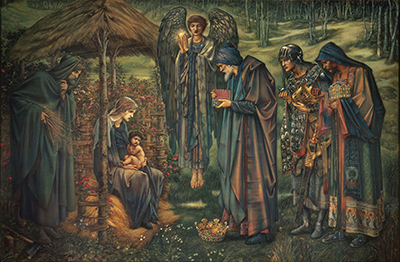
Burne-Jones took up the same composition for his large watercolour The Star of Bethlehem, completed in 1890 and held by Birmingham Museums. The relationship is especially clear in the long line of figures and the angel’s position in it. In the watercolour, the gleam among the angel’s hands and the shadows in fabric are painted effects. In a weaving such as Hamburg’s, the choice of fibre and the direction and packing of the threads give the fabric its own response to light. The two media give different weight to the star, the richness of the clothes and the growth of flowers across the foreground. [18] [24]
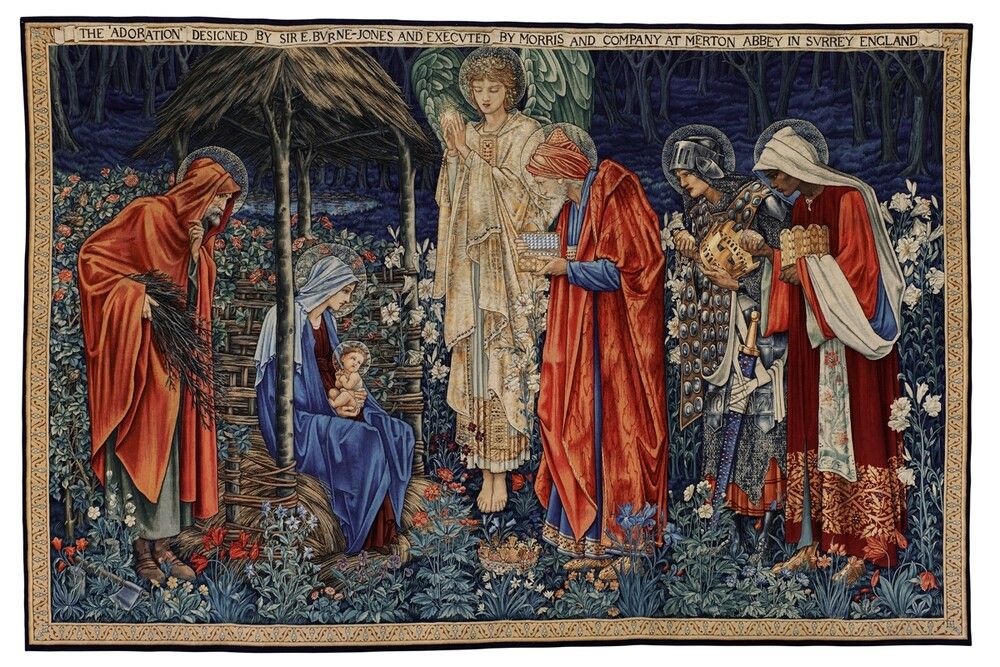
Morris & Co., The Adoration of the Magi, designed by Edward Burne-Jones and John Henry Dearle, woven 1900. Museum für Kunst und Gewerbe Hamburg, 1901.136. Image source. Public domain.
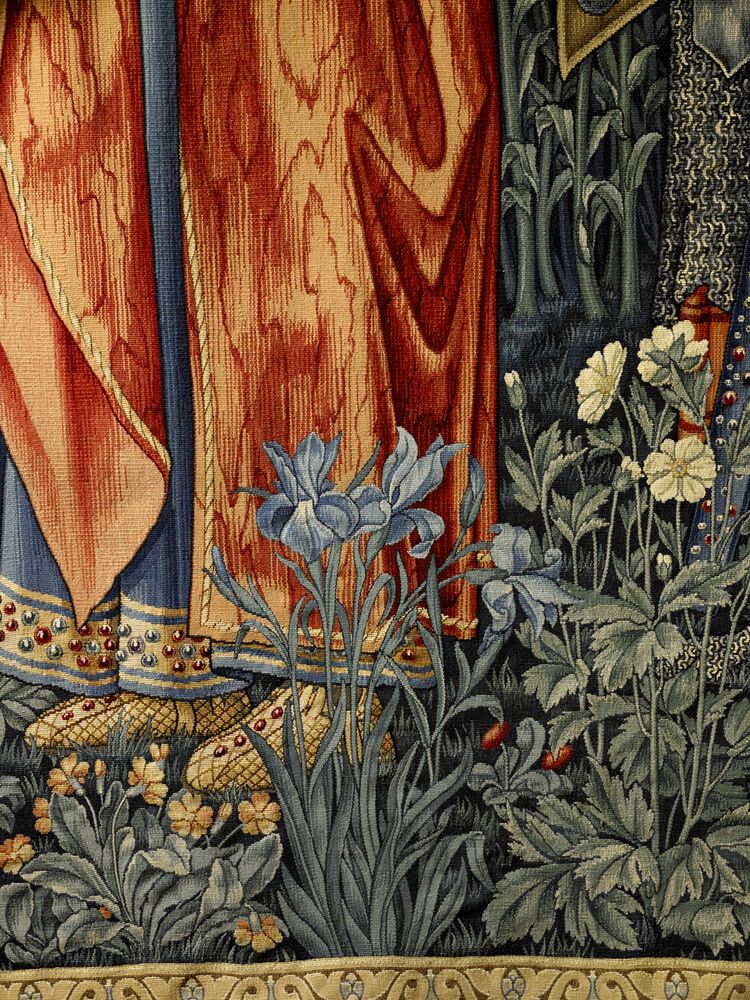
Woven irises and the lower edge of a robe in The Adoration of the Magi, detail of the 1900 Morris & Co. tapestry. Museum für Kunst und Gewerbe Hamburg, 1901.136. Image source. Public domain.
Flora, Pomona and designs shared with other crafts
The histories of Flora and Pomona give unusually direct evidence of the division of work. Burne-Jones’s account book records payment for each figure design in the winter of 1882–83. Morris wrote to his daughter Jenny in February 1883 about the two figures Burne-Jones had supplied and the background he still had to create. A design for Flora at the Morgan Library & Museum shows the solitary figure in a surround of Morris’s foliage. William Knight, William Sleath and John Martin wove the first versions in 1884–85. Later hangings used altered grounds by Dearle, sometimes leaving out the verses. In the Art Institute of Chicago’s Pomona, the credit to Walter Taylor and John Keich as weavers allows an individual production team to be identified alongside the designers. [25] [26] [27]
Pomona appears in embroidery too. The Royal School of Needlework preserves a photograph of an embroidered version in which the figure carries apples in her skirt and holds a bough. A similar arrangement appears in the Whitworth’s woven Pomona, complete with English banners. That resemblance makes technique worth checking whenever a hanging is illustrated. And in Angels Praising, the figures crossed over from stained glass. Burne-Jones had drawn the angels for Salisbury Cathedral. Dearle adapted them to a tapestry cartoon in 1894 by placing them amid a field of flowers, and the Met’s 1898 weaving credits John Martin, Robert Ellis and Merritt for its manufacture. The figures retain the tall symmetry of window lights. The loom gave their harps, robes and wings a new kind of pattern and scale. [2] [28] [29] [30]
The survival of Burne-Jones’s designs in the workshop is particularly clear in Passing of Venus. The tapestry at the Detroit Institute of Arts was commissioned in 1922 and completed in 1926, decades after the artist’s death. Cupid strides ahead of the chariot, bow drawn, while the doves and drapery pull the eye along the wide hanging. Under Dearle’s supervision, Percy Sheldrick wove the design in wool, silk and linen. His initials are in the lower right edge, a small mark on a hanging over nineteen feet wide. The signature gives a name to the work at the loom and a reason to look all the way to the edge of the tapestry. [31]
Further reading on design and the decorative arts
Follow the commissions, surviving objects and workshop practices behind the finished works.
The Radical Vision of Edward Burne-Jones. Andrea Wolk Rager. Paul Mellon Centre for Studies in British Art, 2022.
The book examines the decorative arts within the social and industrial life of Victorian Britain. View the publisher’s record.
Edward Burne-Jones: Victorian Artist-Dreamer. Stephen Wildman and John Christian, with essays by Alan Crawford and Laurence des Cars. Metropolitan Museum of Art, 1998.
The retrospective catalogue brings together collection histories, working studies and different versions of individual works. Read the catalogue at The Met.
Edward Burne-Jones on film
Explore Burne-Jones’s paintings, illustrated stories and stained-glass designs.
Edward Burne-Jones: Pre-Raphaelite Visionary | Exhibitions | Showcase
A look at Burne-Jones’s paintings and the Tate retrospective.
Watch on YouTubeArtworks directory
This directory records paintings, studies, designs and collaborative works, with separate entries for documented versions and series where known.
| Name | Date | Medium |
|---|---|---|
| Sidonia von Bork 1560 | 1860 | Watercolour and bodycolour |
| Clara von Bork 1560 | 1860 | Watercolour and bodycolour |
| The Merciful Knight | 1863 | Watercolour |
| Sibylla Delphica | c. 1886 | Oil on panel |
| Phyllis and Demophoön | 1870 | Watercolour and bodycolour |
| The Legend of the Briar Rose (Buscot series) | 1870s–1890 | Oils on canvas |
| The Briar Wood (Buscot series) | By 1890 | Oil on canvas |
| The Council Chamber (Buscot series) | By 1890 | Oil on canvas |
| The Garden Court (Buscot series) | By 1890 | Oil on canvas |
| The Rose Bower (Buscot series) | By 1890 | Oil on canvas |
| Group of Women, study for The Golden Stairs | 1872 | Drawing |
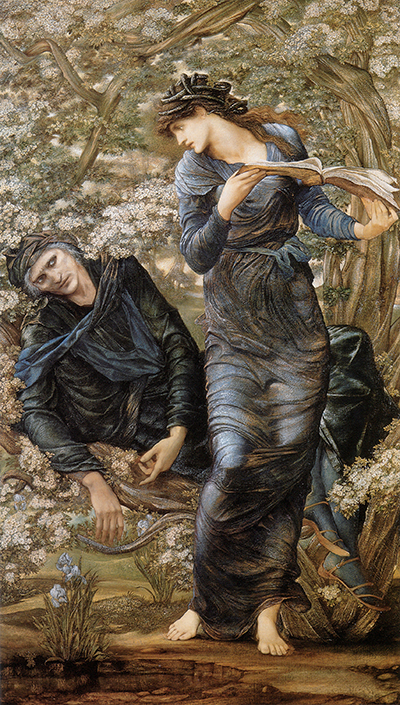
| The Beguiling of Merlin | 1870s | Oil on canvas |
| The Perseus Cycle | From 1875 | Paintings and full-scale designs |
| The Call of Perseus (Stuttgart) | From 1875 | Oil painting |
| Perseus and the Graeae (Stuttgart) | From 1875 | Oil painting |
| The Rock of Doom (Stuttgart) | 1884–88 | Oil on canvas |
| The Doom Fulfilled (Stuttgart) | 1888 | Oil on canvas |
| The Baleful Head (Stuttgart) | 1885–87 | Oil on canvas |
| The Baleful Head (Southampton design) | 1880s | Bodycolour |
| The Rock of Doom (Southampton design) | 1880s | Bodycolour |
| The Doom Fulfilled (Southampton design) | 1880s | Bodycolour |
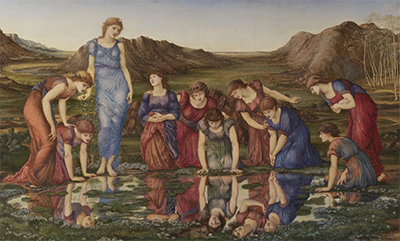
| The Mirror of Venus (Gulbenkian) | 1870s | Oil on canvas |
| Drawing associated with The Mirror of Venus | 1870s | Drawing |
| Laus Veneris (Laing) | 1873–78 | Oil on canvas |
| The Days of Creation | 1870s | Watercolour and bodycolour |
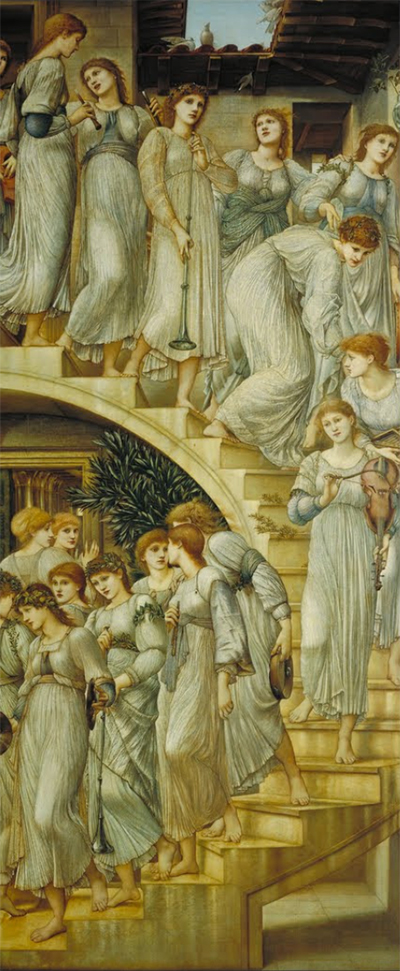
| The Golden Stairs | 1880 | Oil on canvas |
| An Angel Playing a Flageolet | 1878 | Watercolour, bodycolour and gold |
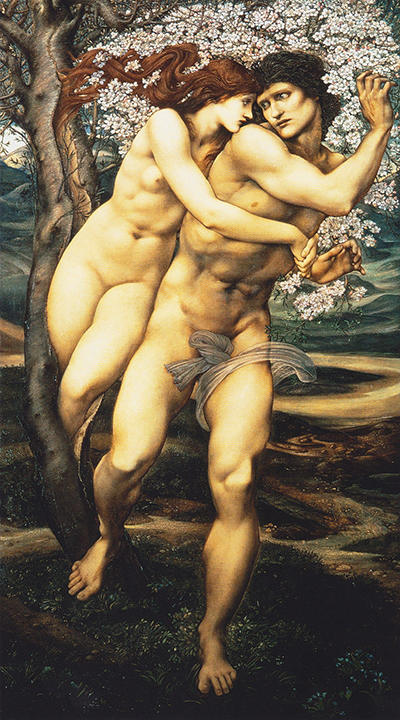
| The Tree of Forgiveness | 1881–82 | Oil on canvas |
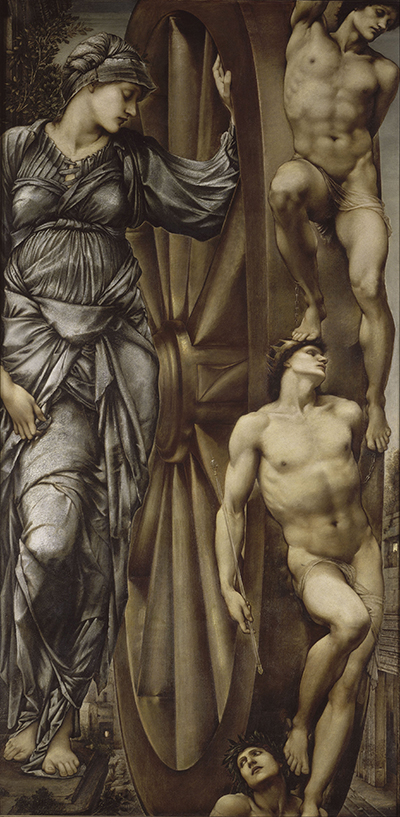
| The Wheel of Fortune (Orsay) | 1875–83 | Oil on canvas |
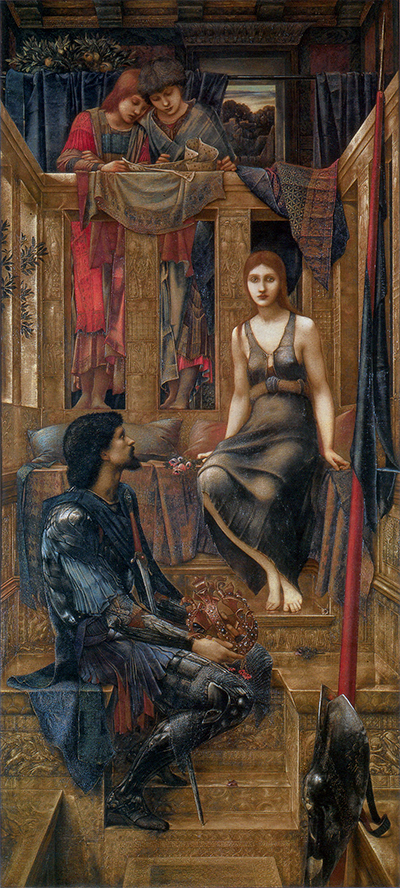
| King Cophetua and the Beggar Maid | 1884 | Oil on canvas |
| The Depths of the Sea (oil) | 1886 | Oil |
| The Morning of the Resurrection | 1886 | Oil on panel |
| Study for the Head of Mary Magdalene | c. 1882 | Oil study |
| The Sleep of King Arthur in Avalon | 1880s–1898 | Oil on canvas |
| The Sleep of King Arthur in Avalon (modello) | ca. 1881 | Oil on canvas (modello) |
| The Star of Bethlehem | Signed 1890 | Watercolour and bodycolour |
| Study for The Star of Bethlehem | About 1887–91 | Drawing |
| Sponsa de Libano | 1891 | Watercolour and bodycolour |
| The Summons (Holy Grail tapestries) | 1890s | Tapestry |
| The Failure of Sir Gawaine (Holy Grail tapestries) | 1890s | Tapestry |
| Hope (Boston) | 1896 | Oil on canvas |
| La Belle au bois dormant (theatre programme) | 1894 | Collotype |
| The Wedding of Psyche | 1895 | Oil on canvas |
| The Works of Geoffrey Chaucer (Kelmscott edition) | 1896 | Illustrated book |
| The Ascension (Birmingham Cathedral) | 1885 | Stained glass |
| The Last Judgement (Birmingham Cathedral) | 1897 | Stained glass |
| Adoration of the Magi (Huntington) | 1890s | Tapestry |
| Love among the Ruins (Wightwick) | 1894 | Oil on canvas |
| The Merciful Knight (photogravure after Burne-Jones) | 1900 | Photogravure |
| The Garden Court (preparatory work) | 1870–75 | Graphite and watercolour with white gouache |
| Study of a Female Figure | 1885 | Graphite drawing |
| Psyche Throwing Herself into the River | 1865–68 | Wood engraving |
| Beauty | 1887–89 | Colour lithograph |
| Study for the Failure of Gawain | 1893 | Crayon and graphite on Japanese paper |
| The Prince Enters the Briar Wood (after Burne-Jones) | After 1890 | Photogravure |
| The Rose Bower (after Burne-Jones) | 1892 | Photogravure |
| Adoration of the Magi (Musée d’Orsay) | 1904 | Tapestry |
| Answers to Prayer (Lyndhurst) | 1860s | Stained glass |
| The Depths of the Sea (photogravure after Burne-Jones) | 1900 | Photogravure |
| Perseus and Andromeda (Adelaide composite) | 1876 | Oil on canvas |
| The Adoration of the Magi (Hamburg) | Woven 1900 | Tapestry |
| Love leading the Pilgrim through the Briars | 1874–76 | Embroidery |
| Musica (worked by Lady Jane Cory) | 1906 | Embroidery |
| Pomona (worked by Lady Jane Cory) | 1907 | Embroidery |
| Flora (worked by Lady Jane Cory) | 1909 | Embroidery |
| The Fourth Day of Creation (photogravure after Burne-Jones) | 1900 | Photogravure |
| The Morning of the Resurrection (photogravure after Burne-Jones) | 1900 | Photogravure |
| Musical angels of the St Catherine window (Christ Church) | Designed 1877 | Stained glass |
Discussion
Look again at the images and ideas explored in Edward Burne-Jones’s Tapestries. These editorial prompts invite your observations.
Reader Insights
Where can you see the work of both the figure designer and the tapestry workshop in one panel?
How does the arrangement of flowers change the way you look at the figures?
Join the Conversation
Share a detail, comparison or question about Edward Burne-Jones’s Tapestries below.
References
- Victoria and Albert Museum, William Morris textiles, embroidery and tapestry sections. View source.
- Victoria and Albert Museum, What is tapestry?, materials, loom types and cartoons. View source.
- William Morris, Textiles, in Arts and Crafts Essays (1893), opening discussion of tapestry. View source.
- William Morris Gallery, Photograph of the Holy Grail tapestries, Frederick Hollyer, P829.2. View source.
- The Studio, The Arras Tapestries of the San Graal at Stanmore Hall, vol. 15, pp. 98–104, text and photographs reproduced by Stanmore Hall. View source.
- Sotheby’s, The Attainment, first Stanmore weaving, lot 86 (2008), provenance and catalogue note. View source.
- William Morris Gallery, Photographic Cartoon of a Detail of the Panel of Tapestry ‘The Summons’, BLPhA527a and related cartoons. View source.
- Burne-Jones Catalogue Raisonné, The Failure of Sir Gawaine and Sir Uwaine, first Stanmore weaving, work record, technique and later commissions. View source.
- Christie’s, The Arming and Departure of the Knights, McCulloch weaving, lot essay and technical entry. View source.
- National Heritage Memorial Fund, The Knights of the Round Table Summoned to the Quest, Birmingham acquisition. View source.
- Burne-Jones Catalogue Raisonné, The Summons, Birmingham’s McCulloch weaving, materials and catalogue commentary. View source.
- Southampton City Art Gallery, Launcelot at the Chapel of the Holy Grail, SOTAG 1958/3. View source.
- William Morris Gallery, Percy Sheldrick weaving Holy Grail tapestry, Merton Abbey, P810. View source.
- Museu Nacional d’Art de Catalunya, William Morris y el movimiento Arts & Crafts en Gran Bretaña, exhibition dossier, Frederick Hollyer entries in the works list. View source.
- Exeter College, Oxford, Morris and Burne-Jones tapestry housed in museum-quality display conditions in College chapel, 2018 conservation and installation report. View source.
- Exeter College, Oxford, The New Tapestry at Exeter College, Oxford, period account reprinted in the college’s Register 2025. View source.
- The Huntington, Adoration of the Magi, small watercolour design, 2000.5.521. View source.
- Museum für Kunst und Gewerbe Hamburg, Tapisserie “Anbetung der Könige”, 1901.136, acquisition, materials, inscription and detail photographs. View source.
- Musée d’Orsay, L’Adoration des Mages, 1904, technique, dimensions, attribution and provenance. View source.
- Manchester Metropolitan University, Special Collections tapestry features in major new Tate exhibition, identification and dimensions of the 1894 weaving. View source.
- Mitsubishi Ichigokan Museum, Annual Report 2012, Burne-Jones exhibition checklist, nos. 58 and 60–61. View source.
- Art Gallery of South Australia, The Adoration of the Magi, 1900–02, entry and curator’s account of the Brookman commission. View source.
- State Hermitage Museum, announcement of its Art Nouveau galleries, Поклонение волхвов tapestry. View source.
- Birmingham Museums, Secrets revealed from beneath the glass: Edward Burne-Jones’ The Star of Bethlehem, conservator’s account and dated signature. View source.
- Stephen Wildman, Flora tapestry (Whitworth), exhibition catalogue entry reprinted by the Burne-Jones Catalogue Raisonné, account book, correspondence and early weavings. View source.
- Morgan Library & Museum, Study for the Flora Tapestry, 1975.46. View source.
- Art Institute of Chicago, Pomona (From Flora and Pomona), design and weaving credits. View source.
- Royal School of Needlework, Pomona, D1/020, photograph and related embroidered and woven versions. View source.
- Metropolitan Museum of Art, Angels Praising (Angeli Laudantes), 2008.8a–c, window source and tapestry adaptation. View source.
- Metropolitan Museum of Art, The New British Galleries, fig. 31, weaving credits for Angels Praising. View source.
- Detroit Institute of Arts, Passing of Venus, 27.152, commission, completion, materials and Sheldrick’s inscription. View source.