


 by Tom Gurney
Tom Gurney BSc (Hons) is an art history expert with over 20 years experience
Published on June 19, 2020 / Updated on July 9, 2026
Email: tomgurney1@gmail.com / Phone: +44 7429 011000
Filippo Brunelleschi Biography: Introduction
Filippo Brunelleschi's biography is the story of a Florentine maker who became one of the defining architects of the early Renaissance. Born in Florence in 1377 and active in a city of guilds, churches, workshops and public commissions, Brunelleschi is remembered above all for the dome of Florence Cathedral. But his life cannot be reduced to one monument. He moved through the worlds of craft, sculpture, architecture, engineering and perspective, and his career helped reshape how space could be built and understood. [1]
The best way to read Brunelleschi's life is as a series of transformations. He began in a Florentine culture of skilled making. He became associated with sculpture and technical design. He entered the architectural history of the city through projects that still stand: the Hospital of the Innocents, San Lorenzo, Santo Spirito and, most famously, the dome of Santa Maria del Fiore. [2]
His biography also requires caution. Some of the best-known stories about Brunelleschi come through later writers and traditions. They are part of his historical reputation, but they should not be flattened into simple fact without context. The same is true of linear perspective: Brunelleschi is traditionally credited with decisive experiments, but the original panels do not survive. [9]
At a Glance
- Name: Filippo Brunelleschi
- Dates: 1377-1446
- Birthplace: Florence
- Main field: architecture and engineering
- Related fields: sculpture, goldsmith training traditions, perspective
- Most famous work: dome of Florence Cathedral
- Major buildings: Hospital of the Innocents, San Lorenzo Basilica, Old Sacristy, Santo Spirito
- Editorial caution: later anecdotes should be labelled as historical accounts or traditions where source support is uncertain
Contents
- Early Florence
- From Craft to Architecture
- The Cathedral Dome
- San Lorenzo and the Problem of Church Space
- Santo Spirito and Late Brunelleschi
- Linear Perspective
- A Life in Florence's Surviving Places
- Legacy
- Things You Might Miss
- What was Filippo Brunelleschi famous for?
Early Florence
Brunelleschi's life began in Florence, a city whose institutions mattered deeply to his later career. This was not a setting where art and architecture floated free from public life. Guilds, churches, charitable foundations and civic pride all shaped what could be built and who could build it.
That context is important because Brunelleschi's mature architecture was rarely private in spirit. Even when he worked on religious buildings, the results belonged to the visible life of the city. The cathedral dome changed Florence's skyline. The Hospital of the Innocents gave form to a charitable institution. San Lorenzo and Santo Spirito turned architectural order into public religious space.
The early part of Brunelleschi's career is often discussed through craft and sculpture. Later accounts connect him with technical skill, goldsmith training and the famous Baptistery competition with Lorenzo Ghiberti. This episode matters because it places Brunelleschi in the world of early Renaissance making before his mature architectural career. It should be treated as an important turning point, but not as a simple story of one artist defeating another.
For the biography, the safest point is broader: Brunelleschi emerged from a Florentine environment where skill, design, geometry and public commissions were closely linked. His later architecture did not come from pure theory alone. It came from the practical culture of making.
From Craft to Architecture
Brunelleschi's move toward architecture should not be imagined as a neat break from craft. His later buildings reveal a mind trained to think through materials, structure and sequence. The dome of Florence Cathedral is the clearest example, but the same practical intelligence appears in smaller works.
The Hospital of the Innocents shows this transition beautifully. The Museo degli Innocenti connects the 1419 commission with the Arte della Seta and Brunelleschi's role, making it one of the strongest early architectural anchors in his career. [5] The building's long loggia, repeated arches and public-facing order show an architect thinking about institution, city and proportion together.
This project also gives Brunelleschi's biography a social dimension. The hospital was not merely a formal exercise. It belonged to a charitable mission associated with the care of abandoned children, and the museum's history connects the institution to a wider social story. [6]
The move from craft to architecture therefore becomes more than a career change. It becomes a change in scale. Brunelleschi's skills were applied to the organisation of public space, institutional identity and civic meaning.
The Cathedral Dome
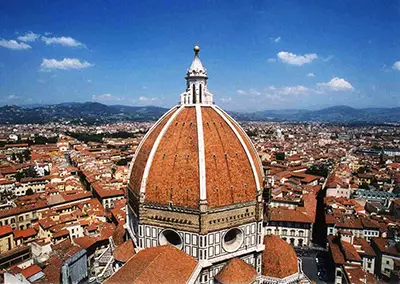
The dome of Florence Cathedral is the central event in Brunelleschi's biography. Opera di Santa Maria del Fiore presents the project as an architectural and technical solution to the cathedral's great building problem, identifying features such as the double-shell structure and herringbone brickwork. [2]
The dome made Brunelleschi famous because it required more than design elegance. It demanded a way of building at enormous scale. The crossing of the cathedral needed to be covered, and the solution had to be structurally plausible, visually powerful and worthy of Florence's ambition.
This is why Brunelleschi's biography should not treat the dome as a simple "masterpiece" label. It was a career-defining project because it joined technical judgement, architectural form and civic identity. The dome became part of how Florence saw itself.
The date 1436 is a crucial milestone. Opera di Santa Maria del Fiore marks 30 August 1436 in relation to the conclusion of the dome works. [3] By that point, Brunelleschi's reputation was tied to one of the most ambitious architectural achievements of the age.
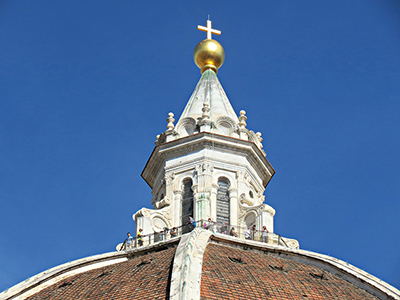
The lantern continued the architectural story above the dome. Opera di Santa Maria del Fiore treats it as a significant project in its own right, and it helps readers understand the dome as a sequence of design and completion rather than a single isolated date. [4]
San Lorenzo and the Problem of Church Space
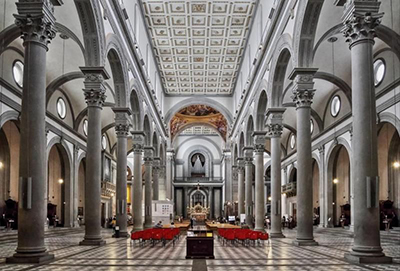
Brunelleschi's biography also moves through San Lorenzo. The San Lorenzo source connects the basilica's reconstruction with Brunelleschi's direction and with later completion by Manetti. [7] That detail is important because it reminds readers to separate design, direction and later execution.
San Lorenzo reveals Brunelleschi's interest in architectural rhythm. Repeated columns, arches and bays make the church interior feel ordered and legible. This is not the same achievement as the dome. It is quieter, more spatial and more experiential.
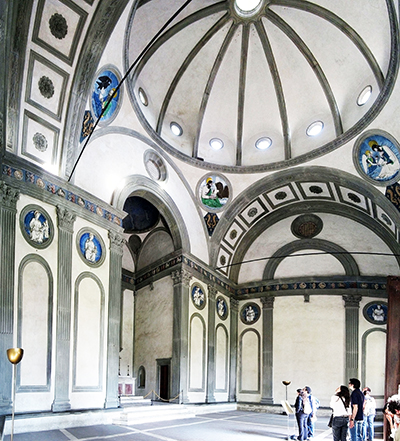
The Old Sacristy, associated with the San Lorenzo complex, is another key route through his career. It brings geometry, dome, square and circle into a concentrated sacred space. It also prepares readers to compare Brunelleschi's architecture at different scales: the cathedral dome, the civic facade of the hospital, the church interior and the compact sacristy.
The biography should therefore treat San Lorenzo as more than another entry in a list. It shows how Brunelleschi's architectural thinking could organise a complete interior world.
Santo Spirito and Late Brunelleschi
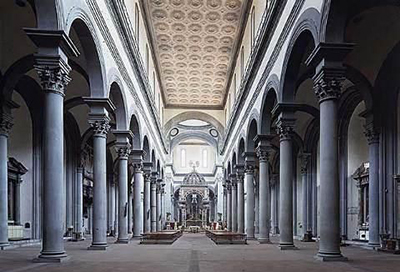
Santo Spirito belongs to the later part of Brunelleschi's story. The basilica's official history places the project in a sequence that continued after his death in 1446, while its architecture page describes the church through rhythm, proportion and light. [8] [10]
This makes Santo Spirito especially useful for a careful biography. It shows Brunelleschi's continuing architectural influence, but it also requires care about what was designed, what was built later and what changed after his death.
The building's importance lies in spatial order. Like San Lorenzo, it uses repeated architectural elements to shape the viewer's experience. But Santo Spirito has its own character, with a broad rhythm and a powerful sense of interior sequence.
Late Brunelleschi should not be presented as a decline. His later projects show the persistence of the same architectural concerns: clarity, proportion, repeatable forms and the ordering of space.
Linear Perspective
Brunelleschi's biography is also connected to linear perspective. This is one of the most famous parts of his reputation, but it is also one of the areas where careful wording matters most.
Smarthistory explains Brunelleschi's perspective experiment as a reconstructed tradition involving lost panels and a specific viewing method. [9] The safest wording is that Brunelleschi is traditionally credited with decisive experiments in linear perspective. It is less safe to say simply that he "invented perspective" as if the evidence were straightforward and the development complete in one moment.
This perspective story matters because it connects Brunelleschi's architecture with Renaissance painting and visual measurement. Architecture provided measurable space; perspective gave artists a way to organise that space on a flat surface.
In biography terms, perspective shows that Brunelleschi's importance was not only physical construction. He also belongs to the history of how artists and architects thought about seeing.
A Life in Florence's Surviving Places
One of the strengths of Brunelleschi's biography is that it can still be followed through places. The dome remains part of the cathedral complex. The Hospital of the Innocents is interpreted by its museum. San Lorenzo and Santo Spirito remain living architectural settings. The lantern still crowns the dome's profile.
This makes the biography concrete. Rather than becoming a sequence of anecdotes, it can move through buildings that readers can still encounter. Brunelleschi's life is not only a paper chronology. It is embedded in Florence.
The museum perspective also helps the page avoid over-romanticising him. Each building had patrons, functions, later phases and institutional histories. Brunelleschi was a remarkable individual, but his work existed inside a network of city institutions and practical demands.
Legacy
Brunelleschi's legacy lies in architecture as ordered space. He helped make proportion, clarity and structural intelligence central to the visual language of Renaissance Florence.
His dome became a model of ambition and technical possibility. His hospital facade showed how public architecture could serve a social institution. His church interiors showed how repeated forms could create calm spatial rhythm. His perspective experiments, known through later accounts, helped shape the Renaissance understanding of measurable pictorial space.
That range explains why Brunelleschi remains so important. He was not simply the creator of one famous dome. He was a figure through whom architecture, engineering and visual thought met.
Things You Might Miss
Brunelleschi's biography is strongest when read through buildings, not anecdotes.
The dome was a practical construction problem as well as a visual triumph.
The Hospital of the Innocents gives his career a social and civic dimension.
San Lorenzo and Santo Spirito show architecture as rhythm and proportion.
Perspective should be described carefully because the original demonstration panels are lost.
Later writers helped shape Brunelleschi's reputation, but their stories need careful framing.
FAQs
Brunelleschi was most famous for the dome of Florence Cathedral, one of the great architectural achievements of early Renaissance Florence. Opera di Santa Maria del Fiore presents the dome as both a technical and architectural solution. [2]
Brunelleschi was primarily an architect and engineer, but his career is also connected with sculpture, craft training and perspective. His importance lies in the way he brought practical making, geometry and architectural design together.
It is safer to say that Brunelleschi is traditionally credited with decisive experiments in linear perspective. The original panels do not survive, and the story depends on later accounts and reconstruction. [9]
Major Brunelleschi projects include the dome of Florence Cathedral, the Hospital of the Innocents, San Lorenzo Basilica, the Old Sacristy, Santo Spirito and the Florence Cathedral Lantern. Several of these buildings also have later phases, so design and execution should be handled carefully.
Brunelleschi died in 1446. Santo Spirito's official history is useful for understanding how some architectural projects connected with him continued beyond his lifetime. [8]
Discussion
Brunelleschi's life is difficult to separate from later stories about genius, rivalry and invention. Which biographical episode helps you understand the real historical figure most clearly?
Reader Insights
His biography becomes more interesting when it is read as a movement between craft, sculpture, architecture and civic engineering rather than as a simple rise toward fame.
How much should later stories by writers such as Manetti and Vasari shape the way modern readers imagine Brunelleschi?
Join the Conversation
Have a thought or observation about Brunelleschi's Biography? Share it below. Thoughtful responses may be added to this section.
References
- Encyclopaedia Britannica, Filippo Brunelleschi, https://www.britannica.com/biography/Filippo-Brunelleschi.
- Opera di Santa Maria del Fiore, Brunelleschi e la genesi di un capolavoro, https://duomo.firenze.it/it/opera-magazine/post/4743/brunelleschi-e-la-genesi-di-un-capolavoro (in Italian).
- Opera di Santa Maria del Fiore, Il 30 agosto 1436 si concludevano i lavori della Cupola di Brunelleschi, https://duomo.firenze.it/it/opera-magazine/post/4649/il-30-agosto-1436-si-concludevano-i-lavori-della-cupola-di-brunelleschi (in Italian).
- Opera di Santa Maria del Fiore, Una Lanterna per la Cupola del Duomo di Firenze, https://duomo.firenze.it/it/opera-magazine/post/4459/una-lanterna-per-la-cupola-del-duomo-di-firenze (in Italian).
- Museo degli Innocenti, Architettura, https://www.museodeglinnocenti.it/museo/percorsi-espositivi/architettura/ (in Italian).
- Museo degli Innocenti, Storia, https://www.museodeglinnocenti.it/museo/storia/ (in Italian).
- San Lorenzo Firenze, La Basilica di San Lorenzo, https://sanlorenzofirenze.it/la-basilica-di-san-lorenzo/ (in Italian).
- Basilica di Santo Spirito, History, https://www.basilicasantospirito.it/en/the-basilica/history-of-the-basilica-of-santo-spirito/.
- Smarthistory, Linear Perspective: Brunelleschi's Experiment, https://smarthistory.org/linear-perspective-brunelleschis-experiment/.
- Basilica di Santo Spirito, Architecture of the Basilica of Santo Spirito, https://www.basilicasantospirito.it/en/the-basilica/architecture-of-the-basilica-of-santo-spirito/.
 Filippo Brunelleschi.jpg)
 Filippo Brunelleschi.jpg)
 Filippo Brunelleschi.jpg)