



 by Tom Gurney
Tom Gurney BSc (Hons) is an art history expert with over 20 years experience
Published on July 9, 2026 / Updated on July 9, 2026
Email: tomgurney1@gmail.com / Phone: +44 7429 011000
Brunelleschi and Linear Perspective: Introduction
Filippo Brunelleschi's linear perspective experiment is one of the most famous turning points in Renaissance art. It belongs to the history of painting, architecture and visual measurement at once. The usual story places Brunelleschi in front of the Baptistery in Florence, testing whether a two-dimensional image could reproduce the appearance of three-dimensional space with convincing accuracy. [1]
This page needs careful wording from the beginning. Brunelleschi's original demonstration panels do not survive, and the story is known through later accounts and reconstruction. It is therefore safer to say that Brunelleschi is traditionally credited with decisive experiments in linear perspective, rather than writing that he simply "invented perspective" as if the evidence were complete and uncomplicated. [1]
The importance of the experiment lies in what it made possible. Linear perspective offered artists a practical system for translating the visible world onto a flat surface. Architecture was central to that achievement because buildings, streets and squares provide measurable forms: lines, edges, facades, distances and viewing positions.
At a Glance
- Topic: Brunelleschi's linear perspective experiment
- Approximate date: c. 1420, in the traditional account
- Location: Florence, associated with the Baptistery and cathedral area
- Key idea: a system for representing three-dimensional space on a two-dimensional surface
- Main elements: fixed viewpoint, vanishing point, horizon line, orthogonals and mirror test
- Evidence caution: original demonstration panels are lost
- Cluster role: connects Brunelleschi's architecture with Renaissance painting, Masaccio, Donatello and Alberti
Contents
- Why Linear Perspective Matters
- The Baptistery Experiment
- The Mirror and the Viewing Hole
- Vanishing Point and Orthogonals
- Why Architecture Was So Useful
- What Survives and What Does Not
- Impact on Renaissance Art
- Comparison with Brunelleschi's Architecture
- Things You Might Miss
- Interpretation
Why Linear Perspective Matters
Linear perspective matters because it gave artists a disciplined way to organise space. Earlier painters had created convincing figures and suggested depth, but Brunelleschi's experiment belongs to a more mathematical and repeatable approach to pictorial space. Smarthistory frames the achievement as a system that could translate the volumetric world into a two-dimensional image with striking accuracy. [1]
That system changed the relationship between viewer and image. Perspective depends on a fixed viewing position. The picture is not simply a collection of objects. It is a constructed space organised around where the viewer stands.
This is why the experiment matters beyond Brunelleschi's own biography. It shaped the way Renaissance artists could build believable worlds on panels, walls and altarpieces. Within a few decades, Leon Battista Alberti would codify ideas about perspective in writing, turning the experiment's implications into a broader artistic method. [1]
For TheHistoryOfArt.org, the page also matters because it links architecture and painting. Brunelleschi's built work shows order in real space. Linear perspective shows how space could be measured and recreated in art.
The Baptistery Experiment
The most famous version of the experiment concerns the Florence Baptistery. Smarthistory describes Brunelleschi as creating a perspectively accurate image of the Baptistery and its surroundings. [1]
The setting was ideal because architecture offers strong measurable forms. The Baptistery, cathedral area and surrounding urban space provided straight lines, edges and fixed relationships. Those features made it possible to test whether a picture could match the viewer's actual optical experience.
The experiment was not only about drawing a building well. It was about proving a system. If the image could align with the real Baptistery from a fixed viewpoint, then pictorial space could be made mathematically convincing.
This is why the story has such power. Brunelleschi was not merely making a pretty view of Florence. He was demonstrating that the visual world could be translated by rule.
The Mirror and the Viewing Hole
Smarthistory's explanation of the viewing device is central to understanding the experiment. Brunelleschi's image had a small hole at the center. The viewer looked through the hole while holding the panel and used a mirror to compare the painted reflection with the actual Baptistery. [1]
The logic is beautifully direct. If the reflected image and the real building aligned convincingly, the system worked. The test was not merely theoretical. It used the viewer's eye, a fixed position, a panel, a mirror and the real architecture of Florence.
This is also why the experiment belongs to architecture as well as painting. The Baptistery was not an arbitrary subject. Its geometric clarity helped make the test possible.
The viewing device also helps modern readers understand why perspective is not simply "things get smaller far away". It is a system built around the relationship between image, viewer and space.
Vanishing Point and Orthogonals
Linear perspective depends on a few essential elements. Smarthistory identifies the vanishing point at the viewer's horizon line and orthogonals, or receding diagonals, as part of Brunelleschi's system. [1]
The vanishing point gives the image a spatial centre of gravity. It is the point toward which parallel lines appear to converge. Orthogonals guide the eye into depth, creating the illusion that the flat picture surface opens into space.
This is the key difference between approximate depth and systematic perspective. A painter can suggest depth intuitively, but linear perspective gives a repeatable structure. It lets space be organised according to a rule.
For readers, this is the most useful practical lesson. When looking at Renaissance painting, follow the floor tiles, roof beams, walls, roads or architectural edges. They often reveal how the artist has built space around a vanishing point.
Why Architecture Was So Useful
Architecture is the natural subject for perspective because it has clear edges and measurable intervals. A human figure can be modelled with light and shadow, but a building tests spatial order more directly. Facades, doors, windows, pavements and receding walls all make the system visible.
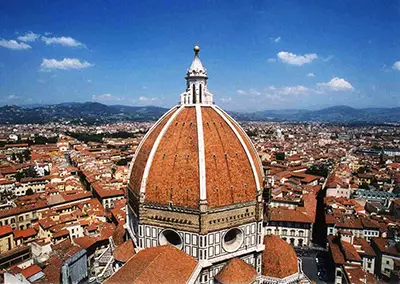
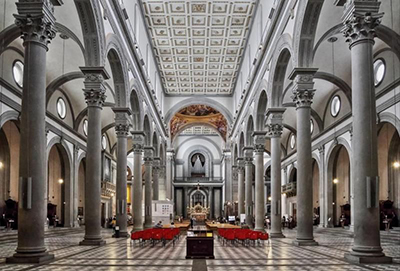
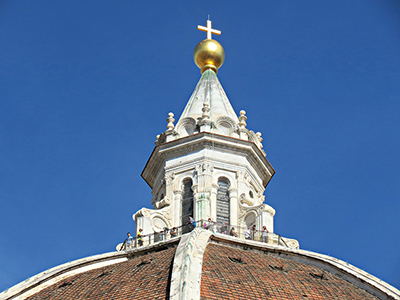
Brunelleschi's architectural mind matters here. He was not only interested in making images look real. He was concerned with measurement, structure and the organisation of space. The same intelligence that could think through the dome of Florence Cathedral or the rhythm of San Lorenzo could also think through the geometry of sight. [2]
This connection is one of the reasons Brunelleschi is such a powerful cluster subject. His work links built space and represented space. The dome, hospital, churches and perspective experiment all ask related questions: how can space be made intelligible?
What Survives and What Does Not
The original perspective panels do not survive. That fact is not a weakness to hide. It is one of the most important things for readers to know. The experiment is famous, but our knowledge of it depends on later accounts, reconstruction and art-historical interpretation. [1]
This is why the subject requires restraint. The experiment can be described, but the lost status of the panels remains part of the story.
The loss also makes the story more interesting. Brunelleschi's perspective experiment survives not as a physical object, but as a method and a memory. Its influence can be traced through later Renaissance art even though the demonstration itself is gone.
This makes the page different from a normal artwork page. There is no surviving painting to analyse as an object. Instead, the page explains a demonstration, a system and a historical turning point.
Impact on Renaissance Art
The impact of linear perspective was enormous. Smarthistory describes later Western painting as responding to perspective, whether by adopting it or consciously rejecting it. [1]
For Renaissance artists, perspective offered a new way to construct convincing spaces. It could make a church interior, city street, palace room or landscape appear coherent from a viewer's point of view. It also gave artists a tool for organising narrative scenes with greater spatial control.
Masaccio is one of the most important figures to connect with this story because his paintings show a powerful command of architectural space. Alberti is another key figure because he helped codify perspective theory after Brunelleschi's experiment. [1]
The broader point is that perspective made painting more architectural. It allowed artists to build space inside an image.
Comparison with Brunelleschi's Architecture
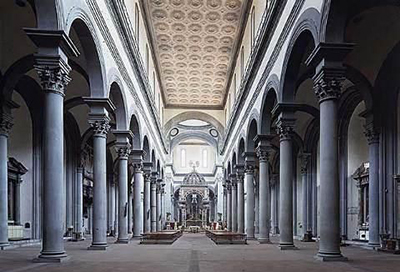
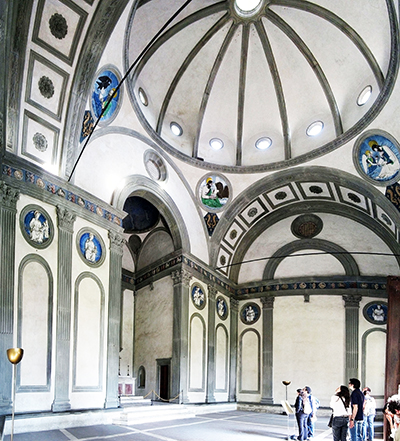
Brunelleschi's architecture and perspective experiment belong together because both are concerned with ordered space. The dome of Florence Cathedral solves space structurally and visually on a monumental scale. [2] San Lorenzo and Santo Spirito organise space through repeated bays, columns, arches and light. [3] [4]
Perspective translates that concern into representation. Instead of walking through real space, the viewer looks into pictorial space. Instead of columns and arches physically surrounding the viewer, painted orthogonals guide the eye inward.
This comparison helps explain why Brunelleschi's importance crosses categories. He was not only an architect of buildings. He was part of a larger Renaissance shift toward measured, rational and convincing space.
Things You Might Miss
The original perspective panels are lost.
The experiment depends on a fixed viewer position.
Architecture was a perfect subject because it offered measurable lines and edges.
The mirror test was a practical demonstration, not just an abstract theory.
Brunelleschi is better described as traditionally credited with decisive experiments in perspective than as the simple inventor of perspective.
The experiment connects him to later painting, especially the construction of believable architectural space.
Interpretation
Brunelleschi's perspective experiment is best interpreted as a bridge between seeing and building. It takes the measured world of architecture and turns it into a method for pictorial space.
Its importance lies in repeatability. A convincing image was no longer only a matter of intuition or talent. Space could be constructed according to a system, with a viewpoint, vanishing point and receding lines.
That system transformed Renaissance art because it gave painters a new kind of authority over space. It also helps explain why Brunelleschi belongs not only to architectural history, but to the history of vision itself.
FAQs
It is safer to say that Brunelleschi is traditionally credited with decisive experiments in linear perspective. Smarthistory presents the experiment as central to the modern history of linear perspective, while also making clear that the discussion includes questions of ancient precedent and rediscovery. [1]
The most famous experiment involved a perspectively accurate image of the Florence Baptistery, a small hole in the panel and a mirror used to compare the image with the real building. [1]
No. The original demonstration panels do not survive, so the experiment is known through later accounts, reconstruction and art-historical explanation. [1]
A vanishing point is the point toward which parallel lines appear to converge in a perspective image. Smarthistory identifies the vanishing point, horizon line and orthogonals as essential elements in Brunelleschi's system. [1]
Perspective gave artists a systematic way to represent three-dimensional space on a flat surface. It helped painters build convincing interiors, streets, architecture and narrative settings.
Discussion
Brunelleschi's perspective experiment is famous partly because it links architecture, measurement and vision. Why does this lost experiment still matter?
Reader Insights
The experiment matters because it suggests that sight itself could be studied, ordered and translated into a convincing image.
Is linear perspective mainly a technical discovery, or a new way of thinking about the world?
Join the Conversation
Have a thought or observation about Linear Perspective? Share it below. Thoughtful responses may be added to this section.
References
- Smarthistory, Dr. Steven Zucker and Dr. Beth Harris, Linear Perspective: Brunelleschi's Experiment, https://smarthistory.org/linear-perspective-brunelleschis-experiment/.
- Opera di Santa Maria del Fiore, Brunelleschi e la genesi di un capolavoro, https://duomo.firenze.it/it/opera-magazine/post/4743/brunelleschi-e-la-genesi-di-un-capolavoro (in Italian).
- San Lorenzo Firenze, La Basilica di San Lorenzo, https://sanlorenzofirenze.it/la-basilica-di-san-lorenzo/ (in Italian).
- Basilica di Santo Spirito, Architecture of the Basilica of Santo Spirito, https://www.basilicasantospirito.it/en/the-basilica/architecture-of-the-basilica-of-santo-spirito/.
 Filippo Brunelleschi.jpg)
 Filippo Brunelleschi.jpg)
 Filippo Brunelleschi.jpg)