


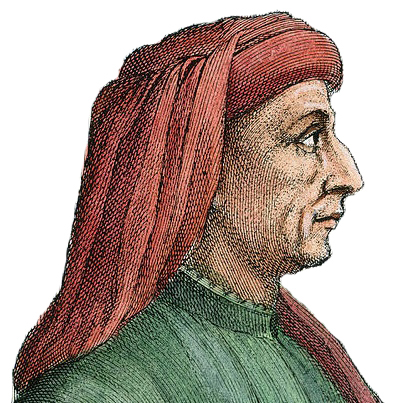
 by Tom Gurney
Tom Gurney BSc (Hons) is an art history expert with over 20 years experience
Published on July 9, 2026 / Updated on July 9, 2026
Email: tomgurney1@gmail.com / Phone: +44 7429 011000
Brunelleschi's Influence and Legacy: Introduction
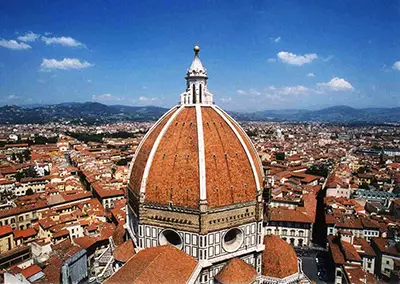
Filippo Brunelleschi's influence rests on more than one achievement. He transformed the skyline of Florence with the dome of Santa Maria del Fiore, helped define a new architectural language in buildings such as the Hospital of the Innocents, San Lorenzo, Santo Spirito and the Pazzi Chapel, and is traditionally linked with decisive experiments in linear perspective. [1] [2] [3] [4] [5]
His legacy is therefore both practical and intellectual. Brunelleschi changed how buildings could be made, how space could be ordered and how artists could think about the visible world. His influence reaches architecture, sculpture, painting, engineering and the broader Renaissance belief that art could be governed by reason, measurement and disciplined invention.
This page looks at that influence in two directions. First, it considers what shaped Brunelleschi: Florence, Roman antiquity, craft training, building problems and artistic rivalry. Then it considers who and what he influenced: Renaissance architecture, perspective, church design, civic buildings and later artists who inherited his language of ordered space.
At a Glance
- Topic: Brunelleschi's influences and later influence
- Main location: Florence
- Main influences on Brunelleschi: Roman architecture, Florentine craft culture, cathedral building problems, artistic competition and the study of visible space
- Main areas he influenced: architecture, engineering, church design, civic architecture and linear perspective
- Key works: Florence Cathedral Dome, Hospital of the Innocents, San Lorenzo, Santo Spirito, Pazzi Chapel and linear perspective experiment
- Cluster role: supports the homepage, biography, architecture hub and future Connections Engine
Contents
- What Influenced Brunelleschi?
- Rivalry and Collaboration
- Influence on Architecture
- Influence on Engineering
- Influence on Painting and Perspective
- Later Renaissance Legacy
- Connections to Other Artists
- Things You Might Miss
- Interpretation
- Who influenced Brunelleschi?
What Influenced Brunelleschi?
Brunelleschi was shaped by Florence, but not by Florence alone. His work shows the pressure of different forces: classical precedent, local craft, public building problems, religious institutions and artistic competition.
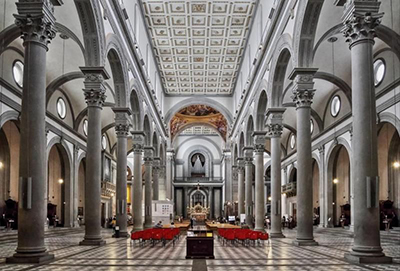
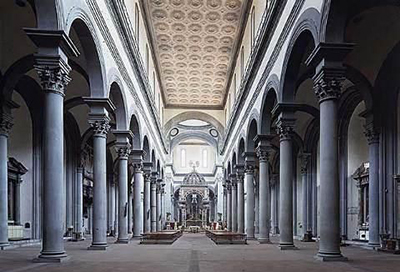
Roman antiquity is central to the usual account of Renaissance architecture. Brunelleschi's buildings do not copy ancient Rome mechanically, but they show a renewed interest in proportion, arches, columns, domes and clear spatial order. That interest appears in the calm logic of San Lorenzo and Santo Spirito, where repeated elements create measured architectural rhythm. [3] [5]
Florentine craft culture also mattered. Brunelleschi belonged to a world in which artists moved between design, object-making, construction, measurement and problem solving. This helps explain why his career cannot be boxed into a single category. He was an architect, but he was also a thinker about machines, vision and spatial representation.
The city itself supplied the major challenges. The unfinished dome of Florence Cathedral required an extraordinary structural solution. [1] The Hospital of the Innocents required a dignified public front for a charitable institution. [2] Churches and chapels required ordered sacred spaces. The influence on Brunelleschi was therefore not only artistic; it was practical and civic.
Rivalry and Collaboration
Brunelleschi's career also belongs to a competitive Florentine world. His name is often placed beside Lorenzo Ghiberti, Donatello and other major figures of early fifteenth-century Florence. The famous Baptistery competition and the wider artistic culture around sculpture, metalwork and architecture matter because they show Brunelleschi working in a city where artistic ambition was public and comparative.
Rivalry can be over-romanticised, but it is still useful. It reminds us that Brunelleschi's achievements did not emerge in isolation. They were tested against other artists, public expectations and institutional demands.
Collaboration and continuation are just as important. Many Brunelleschi projects involved later execution, workshop participation or completion after his death. San Lorenzo and Santo Spirito both require attention to the difference between design and later building history. [3] [5]
That complexity does not weaken his legacy. It makes it more realistic. Brunelleschi influenced architecture not only by making finished objects, but by establishing architectural ideas that others could continue.
Influence on Architecture
Brunelleschi's architectural influence begins with spatial clarity. His buildings made proportion visible. They showed how repeated arches, columns, bays, domes and stone articulation could create spaces that felt ordered and intelligible.
The Hospital of the Innocents is a useful starting point. Its loggia gives a charitable institution a public face built from repeated arches and balanced proportions. [2] That type of architecture did not need excessive ornament to be memorable. Its authority came from rhythm and measure.
San Lorenzo extends similar ideas through a basilican interior. [3] Santo Spirito shows another version of ordered church space, with official interpretation emphasising proportion, rhythm and light. [5]
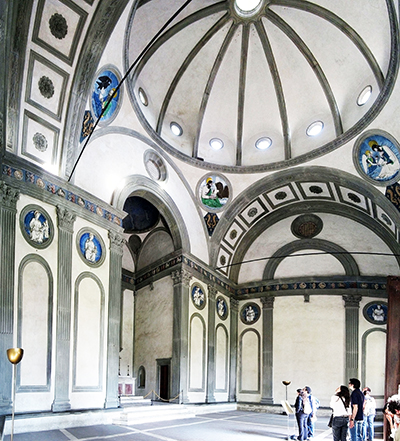
The Pazzi Chapel shows the same language at a compact scale. In that room, dome, square, arch and pietra serena create a concentrated lesson in Renaissance order. [4]
Together, these works made Brunelleschi a model for architecture as rational space rather than surface display.
Influence on Engineering
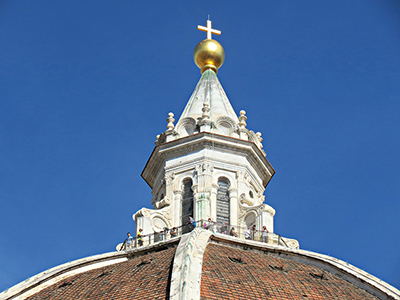
The dome of Florence Cathedral gave Brunelleschi's legacy a different kind of force. It was not only a beautiful form. It was an answer to a construction problem that had occupied Florence for decades. Opera di Santa Maria del Fiore's account of the dome makes clear how closely the project is tied to Brunelleschi's reputation and to the making of a Renaissance masterpiece. [1]
The dome's influence lies in its union of imagination and method. Brunelleschi did not simply draw an ideal form. He had to solve how that form could be built.
This matters for his later reputation because it makes him a figure of practical intelligence. He belongs to the history of design and to the history of construction. The dome shows that Renaissance invention could be technical as well as artistic.
The later lantern continued the visual and structural completion of the cathedral project, reinforcing the connection between Brunelleschi's name and Florence's skyline. [1]
Influence on Painting and Perspective
Brunelleschi's influence on painting comes through linear perspective. Smarthistory presents his perspective experiment as one of the central events in the history of representing three-dimensional space on a flat surface. [6]
This influence is different from designing a building. Perspective gave artists a system. It allowed painters to construct believable interiors, streets, squares and architectural settings according to a fixed viewpoint.
The connection with architecture is crucial. Brunelleschi's experiment is traditionally linked with the Florence Baptistery, a building whose forms could be tested visually. [6] Architecture became the subject through which pictorial space could be measured.
This helps explain why Brunelleschi's legacy crosses disciplines. He influenced not only what buildings looked like, but how artists imagined space.
Later Renaissance Legacy
Brunelleschi's later legacy is visible whenever Renaissance architecture values clear proportion, legible structure and measured space. His work prepared the ground for architects and theorists who treated architecture as an intellectual discipline as well as a practical craft.
Leon Battista Alberti is an important figure to mention in this context because perspective and architectural order became codified more systematically in the decades after Brunelleschi's experiments. Smarthistory links Brunelleschi's perspective experiment to the broader history of perspective theory and later Renaissance art. [6]
Michelangelo is another long-range comparison, especially through Florence and San Lorenzo. The relationship is not a simple line of direct imitation, but Brunelleschi's buildings helped create the architectural world that later Florentine artists inherited.
The strongest legacy claim is therefore not that every later architect copied Brunelleschi. It is that he helped establish a way of thinking about architecture: measured, spatial, rational and deeply tied to the experience of the viewer.
Connections to Other Artists
Brunelleschi's closest connection points include Ghiberti, Donatello, Alberti, Masaccio and Michelangelo.
Ghiberti is important as a rival and alternative path through early Renaissance sculpture and public competition.
Donatello belongs to the same Florentine artistic world and helps show how sculpture, architecture and spatial thinking overlapped.
Alberti matters because he gave theoretical form to ideas about art, architecture and perspective that became central to Renaissance culture.
Masaccio matters because perspective and architectural space became crucial to early Renaissance painting.
Michelangelo matters as a later Florentine figure who inherited a city already transformed by Brunelleschi's architectural achievements.
These connections should be read as a network, not a simple chain. Brunelleschi's influence was strongest because it moved through buildings, methods, problems and ideas.
Things You Might Miss
Brunelleschi was influenced by practical building problems as much as by ancient models.
His legacy includes engineering, not only architectural style. [1]
The Hospital of the Innocents shows his influence on civic architecture and public-facing institutions. [2]
San Lorenzo, Santo Spirito and the Pazzi Chapel show how his language of proportion could work across different sacred spaces. [3] [4] [5]
Linear perspective makes his influence important for painters as well as architects. [6]
Interpretation
Brunelleschi's influence is best understood as a change in architectural thinking. He did not simply create attractive buildings. He made space feel governed by order.
That order could be monumental, as in the cathedral dome. It could be civic, as at the Hospital of the Innocents. It could be ecclesiastical, as in San Lorenzo and Santo Spirito. It could be intimate, as in the Pazzi Chapel. It could even become pictorial, through linear perspective.
This is why Brunelleschi's legacy remains so broad. He changed the way Florence looked, but also the way Renaissance artists thought about space itself.
FAQs
Brunelleschi was shaped by Roman architectural precedent, Florentine craft culture, public building problems, artistic rivalry and the civic-religious institutions of Florence.
His influence touched Renaissance architects, painters and theorists through his buildings, the Florence Cathedral dome and the development of linear perspective. Later figures such as Alberti, Masaccio and Michelangelo belong to the wider world shaped by his architectural and spatial ideas. [6]
He helped establish a Renaissance language of proportion, rhythm, legible structure and ordered space, visible in works such as the Hospital of the Innocents, San Lorenzo, Santo Spirito and the Pazzi Chapel. [2] [3] [4] [5]
He is traditionally credited with decisive experiments in linear perspective, which helped artists construct convincing three-dimensional space on a flat surface. [6]
He remains important because his work joins architecture, engineering and visual thought. His buildings and perspective experiments helped define how Renaissance art understood space.
Discussion
Brunelleschi's influence reaches architecture, painting, engineering and later ideas of artistic invention. Which legacy feels most visible today?
Reader Insights
His influence is strongest when seen as a change in method: measuring, ordering and solving visual or structural problems with unusual discipline.
Is Brunelleschi's greatest legacy a set of buildings, or a way of thinking that other artists and architects could adapt?
Join the Conversation
Have a thought or observation about Brunelleschi's Influence? Share it below. Thoughtful responses may be added to this section.
References
- Opera di Santa Maria del Fiore, Brunelleschi e la genesi di un capolavoro, https://duomo.firenze.it/it/opera-magazine/post/4743/brunelleschi-e-la-genesi-di-un-capolavoro (in Italian).
- Museo degli Innocenti, Architettura, https://www.museodeglinnocenti.it/museo/percorsi-espositivi/architettura/ (in Italian).
- San Lorenzo Firenze, La Basilica di San Lorenzo, https://sanlorenzofirenze.it/la-basilica-di-san-lorenzo/ (in Italian).
- Opera di Santa Croce, Cloisters, https://www.santacroceopera.it/en/places/cloisters/.
- Basilica di Santo Spirito, Architecture of the Basilica of Santo Spirito, https://www.basilicasantospirito.it/en/the-basilica/architecture-of-the-basilica-of-santo-spirito/.
- Smarthistory, Dr. Steven Zucker and Dr. Beth Harris, Linear Perspective: Brunelleschi's Experiment, https://smarthistory.org/linear-perspective-brunelleschis-experiment/.
 Filippo Brunelleschi.jpg)
 Filippo Brunelleschi.jpg)
 Filippo Brunelleschi.jpg)