



 by Tom Gurney
Tom Gurney BSc (Hons) is an art history expert with over 20 years experience
Published on July 9, 2026 / Updated on July 9, 2026
Email: tomgurney1@gmail.com / Phone: +44 7429 011000
Brunelleschi and Renaissance Florence: Introduction
Filippo Brunelleschi's career cannot be separated from Florence. His most important projects were not private experiments carried out away from public life. They were woven into the city's churches, hospitals, religious houses, guild ambitions and civic identity. Florence gave him problems large enough to transform architecture: the unfinished cathedral dome, the public loggia of the Hospital of the Innocents, the ordered interiors of San Lorenzo and Santo Spirito, and the more intimate sacred world of the Pazzi Chapel at Santa Croce. [1] [2] [3] [4]
This page looks at Florence as the setting that made Brunelleschi possible. It avoids treating the Renaissance as a vague golden age. Instead, it follows the specific institutions and spaces in which Brunelleschi's architecture took form: cathedral, hospital, basilica, sacristy, cloister and city square.
That matters because Brunelleschi did not merely decorate Florence. He helped change how the city understood architectural order. His buildings show a new confidence in proportion, rhythm, clear structure and measured space.
At a Glance
- Topic: Brunelleschi's relationship with Renaissance Florence
- Main city: Florence
- Key institutions: cathedral works, charitable hospital, religious orders, parish basilicas and patron families
- Key sites: Florence Cathedral, Hospital of the Innocents, San Lorenzo, Santo Spirito and Santa Croce
- Main themes: civic ambition, patronage, religious function, geometry, public architecture and urban identity
- Cluster role: supports the biography, architecture hub, dome page, Pazzi Chapel and individual church pages
Contents
- Florence as a City of Building Problems
- Cathedral, City and Civic Ambition
- Public Charity and the Hospital of the Innocents
- Churches, Families and Religious Space
- Patronage Without Simplification
- Florence as a Workshop Culture
- Comparison Works
- Things You Might Miss
- Interpretation
- Why was Florence important to Brunelleschi?
Florence as a City of Building Problems
Florence was not just a backdrop to Brunelleschi's career. It was a city full of architectural problems waiting to be solved.
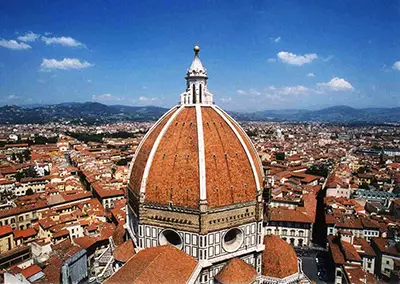
The most famous problem was the dome of Santa Maria del Fiore. The cathedral had reached a point where its vast crossing required a covering unlike anything ordinary building practice could easily supply. Opera di Santa Maria del Fiore's account of Brunelleschi and the dome stresses the difficulty and ambition of the project, which became one of the defining achievements of Renaissance architecture. [1]
That kind of challenge suited Brunelleschi. He was not only designing facades or decorative schemes. He was thinking about how architecture could organise structure, space and public meaning at once.
Other Florentine commissions posed different problems. The Hospital of the Innocents needed a dignified public face for a charitable institution. [2] San Lorenzo and Santo Spirito required church spaces shaped by rhythm, proportion and repeated architectural elements. [3] [5] The Pazzi Chapel concentrated a related language inside the Santa Croce complex. [4]
Together, these projects show Florence as a working laboratory for architectural invention.
Cathedral, City and Civic Ambition
The cathedral dome was both a religious and civic project. It completed the city's great cathedral visually and symbolically, and it required a solution that would be visible across Florence. [1]
This is why the dome cannot be understood only as an engineering puzzle. Its success mattered to the identity of Florence. The city needed the cathedral to be completed, and the completed dome became a public sign of confidence.
Brunelleschi's role in that project made him more than a builder. He became associated with the city's ability to overcome a long-standing architectural challenge. The dome linked technical intelligence to civic pride.
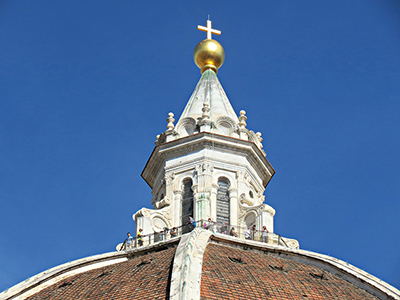
The later lantern continued that relationship between engineering, skyline and public meaning. Even when discussed separately, the lantern belongs to the same larger story: Florence's cathedral was an architectural project that carried the city's ambition into stone, brick and light. [1]
Public Charity and the Hospital of the Innocents
The Hospital of the Innocents reveals another side of Renaissance Florence. This was not architecture for a ruler's palace. It was architecture for a charitable institution concerned with abandoned children. Museo degli Innocenti's own account connects the building with the institution's public and social role. [2]
The loggia is especially important because it faces the city. Its repeated arches, measured bays and calm proportions create a public edge that is both orderly and humane.
That combination is easy to miss. The building is not merely elegant. It gives dignity to an institution of care. In that sense, Brunelleschi's architectural order has a civic and ethical dimension. The design suggests that public charity deserves clarity, beauty and presence.
The hospital also shows how architecture could shape urban experience. A passer-by did not need to enter the building to feel its order. The loggia made the institution visible in the square.
Churches, Families and Religious Space
Florence's churches gave Brunelleschi different opportunities from the cathedral and the hospital. San Lorenzo and Santo Spirito are not simply containers for worship. They are architectural systems.
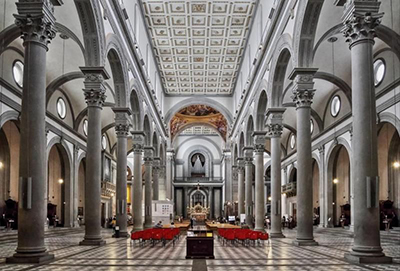
San Lorenzo is closely associated with Brunelleschi's direction and with later completion. [3] Its importance lies partly in how repeated elements create a calm interior rhythm. The architecture teaches the eye to move through space.
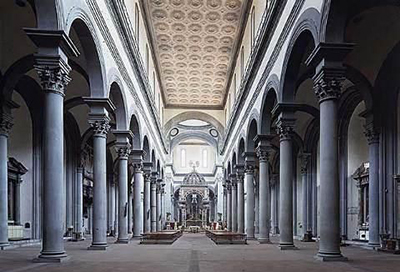
Santo Spirito offers another version of the same concern. The official basilica architecture page emphasises the ordered nature of the interior, with attention to proportion, rhythm and light. [5]
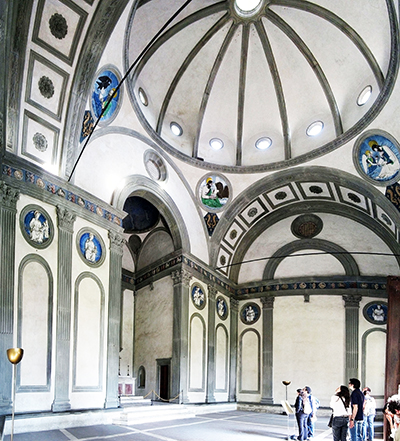
The Pazzi Chapel belongs to yet another religious context, the Santa Croce complex. [4] It shows how family patronage, Franciscan space and Brunelleschian geometry could come together in a compact chapel and chapter-house setting.
These buildings remind us that Renaissance Florence was not one thing. It included parish life, monastic and mendicant communities, private patrons, public institutions and civic committees. Brunelleschi's architecture moved across all of them.
Patronage Without Simplification
Patronage shaped Brunelleschi's career, but it should not be reduced to a single name or family. The Medici matter in the broader history of Florentine art, but Brunelleschi's cluster is wider than Medici patronage alone.
The cathedral works, the Innocenti, San Lorenzo, Santo Spirito and Santa Croce each involve different institutional settings. Some are tied to guild or civic structures, some to religious communities, some to family identity and some to public charity.
This range matters for understanding Brunelleschi's achievement. His architecture was flexible enough to serve different social purposes while retaining a recognisable language of clarity and proportion.
That is one reason the cluster benefits from separate project pages. A single biography can say that Brunelleschi transformed Florentine architecture, but the separate buildings show how that transformation worked in practice.
Florence as a Workshop Culture
Florence also shaped Brunelleschi through its workshop culture. Architecture, sculpture, metalwork, drawing, perspective and construction were not sealed off from one another. Brunelleschi's career sits in a world where artistic and technical skills overlapped.
His link with linear perspective is especially important here. The famous perspective experiment associated with the Florence Baptistery shows how architecture and visual representation could meet in the same city. [6]
The point is not that Florence automatically produced genius. It is that the city created dense opportunities for contact: buildings to solve, objects to make, competitions to enter, patrons to satisfy and public spaces to transform.
That density helps explain Brunelleschi's range. He was not only a cathedral engineer or a church designer. He belonged to a city where art, craft, geometry and civic ambition constantly met.
Comparison Works
The Florence Cathedral Dome shows the city at its most ambitious. It made Brunelleschi's name inseparable from Florence's skyline. [1]
The Hospital of the Innocents shows architecture facing the city as a public and charitable institution. [2]
San Lorenzo and Santo Spirito show how repeated architectural rhythm could shape worship spaces across extended interiors. [3] [5]
The Pazzi Chapel shows the same concern with order in a compact Santa Croce setting. [4]
Linear Perspective connects Brunelleschi's Florence to the history of seeing. The Baptistery experiment is a reminder that the city's architecture could become a test case for pictorial space. [6]
Things You Might Miss
Brunelleschi's Florence was not only Medici Florence.
The cathedral dome was a civic, religious and technical challenge at once. [1]
The Hospital of the Innocents shows public architecture serving charity, not only prestige. [2]
San Lorenzo and Santo Spirito turn proportion into an experience of moving through church interiors. [3] [5]
The Pazzi Chapel shows that small spaces could carry major Renaissance ideas. [4]
Perspective links Florence's architecture to the way painters built believable space. [6]
Interpretation
Brunelleschi's Florence was a city of institutions, problems and opportunities. Its cathedral needed a dome. Its charitable hospital needed a public face. Its churches needed ordered interiors. Its patrons and religious communities needed spaces that expressed dignity, devotion and identity.
Brunelleschi's genius was to answer these different needs with a language that still feels coherent. The dome, hospital, basilicas and chapel do not look identical, but they share an intellectual atmosphere: clarity, measurement, proportion and the belief that architecture can make order visible.
That is why Florence is not just the place where Brunelleschi worked. It is part of the content of his architecture.
FAQs
Florence gave Brunelleschi his major architectural problems and settings, including the cathedral dome, Hospital of the Innocents, San Lorenzo, Santo Spirito and the Santa Croce context of the Pazzi Chapel. [1] [2] [3] [4] [5]
No. The dome is his most famous achievement, but his architecture also shaped hospitals, churches, sacristies, chapels and the history of perspective.
Florence offered a dense setting of civic institutions, churches, patrons, workshops and public spaces. Brunelleschi's buildings show how architectural order could serve many different civic and religious purposes.
Start with the Florence Cathedral Dome, Hospital of the Innocents, San Lorenzo Basilica, Old Sacristy, Santo Spirito and Pazzi Chapel. They show different scales and functions within the same Florentine architectural culture.
Discussion
Brunelleschi's Florence was a city of churches, guilds, hospitals, patrons and public ambitions. Which part of that setting seems most important to his career?
Reader Insights
Florence matters here because Brunelleschi's projects were not isolated monuments. They belonged to institutions and spaces that shaped public life.
Could Brunelleschi's career have happened in the same way outside Florence, or was the city itself part of the invention?
Join the Conversation
Have a thought or observation about Renaissance Florence? Share it below. Thoughtful responses may be added to this section.
References
- Opera di Santa Maria del Fiore, Brunelleschi e la genesi di un capolavoro, https://duomo.firenze.it/it/opera-magazine/post/4743/brunelleschi-e-la-genesi-di-un-capolavoro (in Italian).
- Museo degli Innocenti, Architettura, https://www.museodeglinnocenti.it/museo/percorsi-espositivi/architettura/ (in Italian).
- San Lorenzo Firenze, La Basilica di San Lorenzo, https://sanlorenzofirenze.it/la-basilica-di-san-lorenzo/ (in Italian).
- Opera di Santa Croce, Cloisters, https://www.santacroceopera.it/en/places/cloisters/.
- Basilica di Santo Spirito, Architecture of the Basilica of Santo Spirito, https://www.basilicasantospirito.it/en/the-basilica/architecture-of-the-basilica-of-santo-spirito/.
- Smarthistory, Dr. Steven Zucker and Dr. Beth Harris, Linear Perspective: Brunelleschi's Experiment, https://smarthistory.org/linear-perspective-brunelleschis-experiment/.
 Filippo Brunelleschi.jpg)
 Filippo Brunelleschi.jpg)
 Filippo Brunelleschi.jpg)