


 by Tom Gurney
Tom Gurney BSc (Hons) is an art history expert with over 20 years experience
Published on June 19, 2020 / Updated on July 9, 2026
Email: tomgurney1@gmail.com / Phone: +44 7429 011000
Pazzi Chapel: Introduction
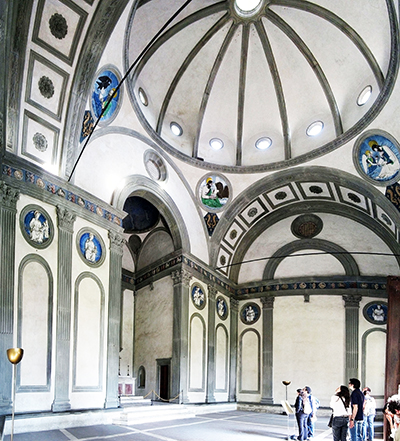
The Pazzi Chapel is one of the clearest small-scale statements of early Renaissance architecture in Florence. Set within the Santa Croce complex, it is traditionally associated with Filippo Brunelleschi and the Pazzi family, and it condenses many of the qualities that make his architecture so influential: measured geometry, calm proportion, restrained surfaces and the precise use of grey pietra serena against pale wall planes. [1]
The chapel matters because it asks visitors to slow down. It does not impress through size in the way the dome of Florence Cathedral does. Instead, it creates authority through order. Squares, circles, arches, ribs and cornices all help the eye understand the room. The result is a space that feels disciplined without becoming cold.
This page treats the attribution carefully. The Pazzi Chapel is strongly linked with Brunelleschi, but the project was completed after his death and includes later decorative work. The safest way to read it is as a Brunelleschian design and workshop-era building whose finished form also records the longer life of the Santa Croce complex. [1]
At a Glance
- Project: Pazzi Chapel
- Location: Santa Croce complex, Florence
- Patron context: Pazzi family
- Traditional attribution: Filippo Brunelleschi
- Type: chapel and chapter-house space
- Key materials: pale plaster surfaces and grey pietra serena
- Main architectural ideas: proportion, centralised geometry, dome, arches and clear structural articulation
- Important caution: Brunelleschi died before the chapel was fully completed
- Best comparison pages: Old Sacristy, San Lorenzo Basilica, Hospital of the Innocents and Florence Cathedral Dome
Contents
- Why the Pazzi Chapel Matters
- Santa Croce and the Pazzi Family
- Brunelleschi's Role
- Plan and Geometry
- Pietra Serena and Pale Surfaces
- Dome and Interior Rhythm
- Decoration and Della Robbia Elements
- Looking Carefully
- Comparison Works
- Things You Might Miss
Why the Pazzi Chapel Matters
The Pazzi Chapel matters because it shows that Renaissance architecture was not only a matter of monumental engineering. Brunelleschi could transform a compact room into a demonstration of spatial order. The chapel's importance lies in its ability to make geometry visible and meaningful.
In a larger church, architectural rhythm can unfold through a nave, side aisles and repeated bays. In the Pazzi Chapel, the same concern with order is compressed into a smaller sacred and communal space. The visitor reads the room almost at once: the central bay, the dome, the subsidiary spaces, the grey structural lines and the calm surfaces.
This is why the chapel is so useful for students of Renaissance architecture. It is easier to grasp than a huge cathedral project, but it still raises major Brunelleschian questions. How is a sacred space proportioned? How is structure made legible? How can ornament support architecture rather than overwhelm it?
The chapel also has a strong educational role because it is tied to Santa Croce, one of Florence's major religious and civic complexes. It is not an isolated design exercise. It belonged to a living Franciscan site, a patron family and a city in which architecture, memory and status were closely connected. [1]
Santa Croce and the Pazzi Family
The official Santa Croce context is essential. The chapel stands within the cloistered part of the complex, where architecture, worship, memory and institutional life overlap. [1]
The Pazzi family connection gives the building its name and social meaning. In Renaissance Florence, architecture could act as a form of public identity. A chapel attached to a major religious complex was not simply private devotion; it was also a visible statement of family presence, piety and prestige.
The chapel is not only a form of social display. Its architectural power comes from the way patronage is absorbed into form. The room is not loud. It does not announce wealth through excessive surface richness. Instead, it presents order as dignity.
This is one of the reasons the Pazzi Chapel feels different from later, more theatrical religious interiors. Its drama is quiet. The architecture persuades through proportion and restraint.
Brunelleschi's Role
Brunelleschi is traditionally linked with the design of the Pazzi Chapel, but the chronology demands care. The chapel was not a project he personally carried through to completion. It belongs to the later part of his career and to a construction history that continued beyond him. [1]
That matters because two opposite simplifications can distort the building. The first is to detach the chapel from Brunelleschi altogether, which would make little sense given its long-standing place in the history of his architecture. The second is to describe every part of the finished chapel as if it were directly executed by him.
The more accurate middle position is also the more interesting one. The chapel shows how Brunelleschi's architectural language could continue through a building process involving patrons, craftsmen, later decorators and the institutional setting of Santa Croce.
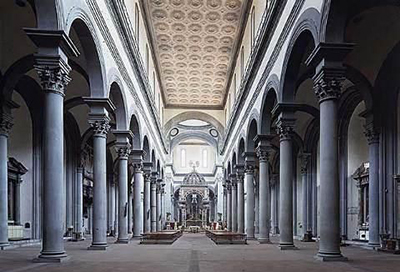
The same issue appears elsewhere in his architecture. San Lorenzo and Santo Spirito both require attention to the difference between design, direction, completion and later execution. [3] [4] Brunelleschi's importance does not depend on pretending that every finished surface was personally supervised by him.
Plan and Geometry
The Pazzi Chapel is often admired because its geometry is unusually readable. The room is organised through clear shapes and relationships: central space, flanking zones, dome, arches and repeated lines of pietra serena.
The geometry does not feel like an abstract diagram. It gives the room a human pace. The eye can move from the floor to the walls, from the arches to the dome, and from the darker stone lines to the pale surfaces. Each part helps the visitor understand the whole.
This is one of Brunelleschi's great contributions to Renaissance architecture. Structure and proportion become visible. Instead of hiding the logic of the room behind decoration, the architecture turns that logic into the main experience.
The result is a space that rewards close looking. Even a visitor who knows little about Renaissance theory can sense that the room is carefully measured. Its calm is not accidental. It is made.
Pietra Serena and Pale Surfaces
Pietra serena is one of the chapel's most important visual tools. The grey stone does more than decorate the room. It draws the architectural skeleton: arches, ribs, pilasters, cornices and framing lines.
Against the pale wall surfaces, the grey stone makes the structure legible. The eye can see what supports, frames and divides the space. This is why the material contrast matters so much. It turns architectural order into a visible pattern.
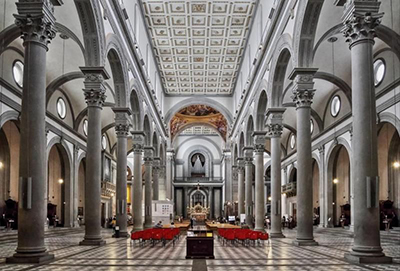
The same language appears elsewhere in Brunelleschi's Florentine architecture. San Lorenzo uses repeated forms and clear stone articulation to create order across a larger church interior. [3] The Old Sacristy concentrates related ideas into a compact, domed sacred space. [3]
The Pazzi Chapel belongs in that family of works, but it has its own mood. It feels quieter, more contained and more meditative. The architecture seems to ask less for awe than for attention.
Dome and Interior Rhythm
The dome is central to the chapel's effect. It crowns the main space and draws the eye upward, but it does not overwhelm the room. Its scale remains tied to the proportions below.
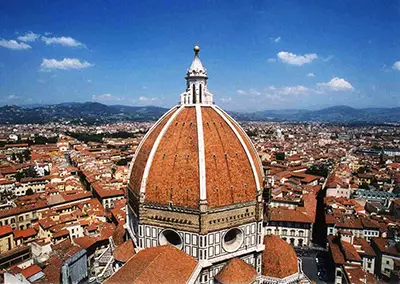
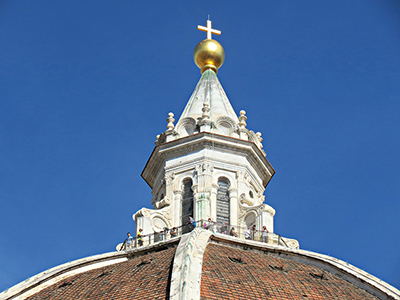
This is very different from the dome of Florence Cathedral, where Brunelleschi faced an enormous engineering and symbolic problem. [5] In the Pazzi Chapel, the dome works at a more intimate level. It completes the room's geometry rather than dominating the city skyline.
The comparison is useful because it shows the range of Brunelleschi's architectural imagination. The same architect associated with one of the largest and boldest construction projects in Renaissance Florence is also linked to a chapel whose achievement lies in compact harmony.
The interior rhythm is equally important. The chapel is not just a domed box. It is a coordinated sequence of surfaces, openings and framing elements. This rhythm gives the space a sense of calm movement.
Decoration and Della Robbia Elements
The Pazzi Chapel includes decorative elements associated with the Della Robbia workshop, including glazed terracotta work that forms part of the chapel's finished visual identity. [1]
These details require care. They are important to the visitor's experience, but they do not erase the distinction between Brunelleschi's architectural framework and later or associated decorative contributions.
The best way to read the chapel is to see decoration as working within an architectural order. The roundels and coloured accents do not dissolve the structure. They are set into a room whose primary power still comes from geometry, proportion and material contrast.
This makes the Pazzi Chapel a good example of how Renaissance architecture could welcome ornament while keeping architecture in command. The decoration enriches the room, but the room's order remains clear.
Looking Carefully
Start with the grey stone lines. They tell you how the room is organised.
Then look at the dome. Notice how it crowns the central area without making the space feel top-heavy.
Follow the arches and framing elements around the walls. Their repetition helps create a rhythm that is calm rather than restless.
Compare the chapel with the Old Sacristy at San Lorenzo. Both show how a relatively small room can carry major architectural ideas. [3]
Finally, notice the restraint. The Pazzi Chapel is not trying to dazzle at first glance. Its beauty depends on the satisfaction of recognising order.
Comparison Works
The closest comparison is the Old Sacristy of San Lorenzo. Both spaces bring together square, dome, stone articulation and sacred function at a compact scale. [3]
San Lorenzo Basilica offers the larger church comparison. It shows how Brunelleschi's interest in rhythm and proportion could organise an extended interior, not only a chapel-like room. [3]
The Hospital of the Innocents offers a civic comparison. Its loggia uses repeated arches and proportional clarity to shape a public face for a charitable institution. [2]
The Florence Cathedral Dome provides the opposite scale. It shows Brunelleschi solving a vast structural problem, while the Pazzi Chapel shows the power of proportion in a smaller space. [5]
Together, these comparisons make the chapel easier to understand. It is not an isolated masterpiece. It is part of a wider architectural language.
Things You Might Miss
The Pazzi Chapel stands inside the Santa Croce complex, so its meaning is tied to a larger religious and civic setting. [1]
Its beauty depends more on proportion than on decorative richness.
The grey pietra serena lines make the structure visible.
The project needs careful attribution because completion and decoration continued beyond his direct lifetime.
The chapel helps explain why small Renaissance buildings can be as important as monumental ones.
The Della Robbia elements are part of the finished experience, but they are distinct from the underlying architectural framework. [1]
Interpretation
The Pazzi Chapel is best understood as architecture of disciplined calm. Its achievement is not only that it is beautiful, but that its beauty feels intelligible. The room teaches the eye how to read it.
That intelligibility is central to early Renaissance architecture. The visitor is not left inside a mysterious mass of effects. Instead, the chapel uses proportion, geometry and material contrast to make space feel ordered.
Its emotional tone matters too. The Pazzi Chapel does not feel coldly mathematical. Its restraint produces a kind of quiet concentration. It is a place where architecture becomes a form of attention.
For Brunelleschi's career, the chapel shows why his reputation cannot rest only on the dome of Florence Cathedral. He was not simply a master of engineering. He helped define a new language of architectural clarity.
FAQs
The Pazzi Chapel is a Renaissance chapel and chapter-house space in the Santa Croce complex in Florence. It is traditionally associated with Filippo Brunelleschi and the Pazzi family. [1]
The chapel is traditionally linked with Brunelleschi's design, but it was completed after his death and includes later decorative work. It is best described with careful wording rather than treating every part of the finished building as personally executed by him. [1]
It is important because it condenses early Renaissance architectural ideas into a compact, legible space. Proportion, geometry, dome, arches and pietra serena all work together to create a calm and ordered interior.
The Pazzi Chapel is in the Santa Croce complex in Florence, within the cloistered area of the site. [1]
Look for the grey pietra serena lines, the central dome, the measured wall divisions, the restrained decoration and the way the whole room feels organised by clear geometry.
Both spaces show Brunelleschi's architectural language at a compact scale, especially the use of geometry, dome, proportion and clear stone articulation. The Old Sacristy belongs to the San Lorenzo complex, while the Pazzi Chapel belongs to Santa Croce. [3]
Discussion
The Pazzi Chapel is a compact space with a large reputation. Does its power come from Brunelleschi's design, from later completion, or from the way both histories meet?
Reader Insights
The chapel is especially useful because it asks readers to think carefully about design, workshop practice, completion and later decoration.
Does knowing that a building was completed after Brunelleschi change how you judge its connection with him?
Join the Conversation
Have a thought or observation about Pazzi Chapel? Share it below. Thoughtful responses may be added to this section.
References
- Opera di Santa Croce, Cloisters, https://www.santacroceopera.it/en/places/cloisters/.
- Museo degli Innocenti, Architettura, https://www.museodeglinnocenti.it/museo/percorsi-espositivi/architettura/ (in Italian).
- San Lorenzo Firenze, La Basilica di San Lorenzo, https://sanlorenzofirenze.it/la-basilica-di-san-lorenzo/ (in Italian).
- Basilica di Santo Spirito, Architecture of the Basilica of Santo Spirito, https://www.basilicasantospirito.it/en/the-basilica/architecture-of-the-basilica-of-santo-spirito/.
- Opera di Santa Maria del Fiore, Brunelleschi e la genesi di un capolavoro, https://duomo.firenze.it/it/opera-magazine/post/4743/brunelleschi-e-la-genesi-di-un-capolavoro (in Italian).
 Filippo Brunelleschi.jpg)
 Filippo Brunelleschi.jpg)
 Filippo Brunelleschi.jpg)