 by Tom Gurney
Tom Gurney BSc (Hons) is an art history expert with over 20 years experience
Published on November 6, 2026 / Updated on November 6, 2026
Email: tomgurney1@gmail.com / Phone: +44 7429 011000
Introduction
Fra Angelico’s Saint Lawrence cycle occupies the lower register of the Niccoline Chapel and forms the Roman counterpart to the Saint Stephen narrative above. The Vatican explicitly treats the two lives as parallel. Both saints are deacons. Both receive sacred responsibility. Both serve Christian communities. Both confront political authority. Both culminate in martyrdom. Lawrence, however, brings the programme directly into the history of Rome. He serves Pope Sixtus II. He receives responsibility for Church treasure.
He distributes wealth to the poor. He faces imperial persecution. For Pope Nicholas V, this was an exceptionally resonant sequence. A Renaissance pope surrounded by the wealth and authority of the Apostolic Palace contemplated a saint who defined the true treasure of the Church through charity. The cycle therefore carries ethical weight. It does not reject wealth or institution. It asks what Christian wealth and authority are for. Angelico translates that argument into monumental Renaissance history painting. [1]
At a Glance
- ArtistFra Angelico, with workshop collaboration [1]
- Locationlower register, Niccoline Chapel, Vatican [1]
- Dateprincipally 1448–50 [3]
- PatronPope Nicholas V [2]
- SaintLawrence, Roman deacon and martyr [1]
- Parallelpaired rhetorically with Saint Stephen above [1]
- Key episodesdiaconal consecration, reception of Church treasure, distribution to poor, confrontation and martyrdom [1]
- Important papal figurePope Sixtus II [1]
- Core themeChristian stewardship, charity and witness [1]
- Roman significanceconnects Nicholas V’s papacy with the ancient Church of Rome [2]
Contents
- Introduction
- Lawrence and Rome
- Diaconal Consecration
- Pope Sixtus II
- Receiving the Church’s Treasure
- The True Treasure of the Church
- Saint Lawrence Giving Alms
- Confrontation with Authority
- Lawrence and Stephen
- Why the Saint Lawrence Cycle Matters
Lawrence and Rome
Lawrence was one of the most revered martyrs of the Roman Church. His cult was deeply embedded in the sacred geography of the city. For a papal chapel, he was therefore not one martyr among many. He represented Roman Christian identity. His life allowed Nicholas V’s chapel to connect contemporary papal authority with the age of persecution. [1]
Lawrence’s office as deacon establishes the parallel with Stephen. He serves rather than rules. This distinction is important. The chapel repeatedly presents Christian authority through responsibility. Lawrence’s eventual martyrdom grows from the way he performs that responsibility. [1]
Diaconal Consecration
The cycle begins with Lawrence’s consecration as deacon. Pope Sixtus II occupies a central role. The scene represents ecclesiastical authority transmitted through ritual. Lawrence receives office from the Church. The papal connection is therefore built into the cycle from the beginning. [1]
Pope Sixtus II
Sixtus II was himself martyred during persecution. His presence gives the Lawrence story another layer of sacrificial authority. The pope who ordains Lawrence will also suffer. Nicholas V therefore sees a model of papal office grounded in martyrdom rather than worldly security. [1]
This relationship would have been especially powerful in the private chapel. Nicholas V could look at a painted predecessor conferring sacred responsibility. The historic pope becomes a mirror of contemporary office. Yet the scene is not triumphalist. Sixtus belongs to a Church under persecution. Papal authority is shown as vulnerable and morally demanding. [2]
Receiving the Church’s Treasure
Lawrence is entrusted with material resources. This is one of the most important moments in the cycle. The Church possesses wealth. The question becomes how it should be used. Lawrence’s answer defines the moral centre of his biography. [1]
The True Treasure of the Church
According to the traditional story, Roman authorities demand the Church’s treasure. Lawrence presents the poor. The story redefines wealth. The true treasure is not precious metal. It is the people cared for by the Christian community. In a richly decorated papal chapel, this image has extraordinary force. [1]
Saint Lawrence Giving Alms
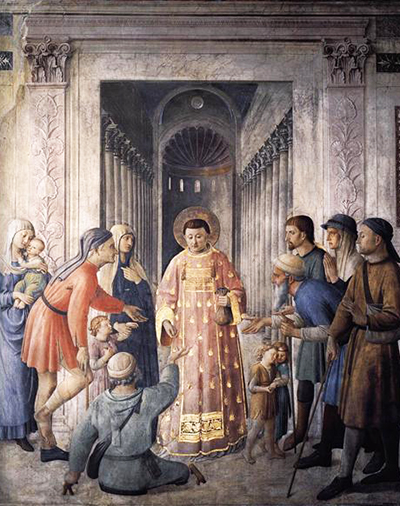
The almsgiving scene is one of Angelico’s finest public narratives. Poor men, women and vulnerable figures gather. Lawrence distributes material aid. The action is practical. Christian charity is not represented as vague compassion. It moves objects and resources between people. [1]
The poor occupy real visual space. They are not decorative symbols. Their bodies differ. Their needs are visible. This gives the scene moral specificity. The Church’s duty becomes embodied. For a pope viewing the fresco, charity is made impossible to ignore. [1]
The almsgiving takes place within dignified architecture. This juxtaposition matters. Monumental Renaissance space frames humble recipients. The poor are not placed outside civilisation. They stand inside a world of public dignity. Angelico therefore makes charity a civic Christian act. [4]
Lawrence’s role can be understood through stewardship. He does not own the Church’s wealth privately. He is responsible for it. Christian office is therefore defined through administration for others. This has obvious relevance to papal government. [1]
Confrontation with Authority
The story then moves from charity to persecution. Roman officials demand compliance. Lawrence refuses to treat sacred responsibility as imperial property. The conflict becomes one between different understandings of power. One authority commands. The saint obeys a higher moral law. [1]
Angelico’s classical architecture gives imperial authority visual grandeur. This makes the conflict more interesting. The state is not represented as visually ridiculous. Its buildings and officials possess order. The moral distinction lies not in ugliness versus beauty but in ethical purpose. Renaissance humanism can admire antiquity while judging persecution. [1]
Lawrence’s death completes the sequence. Tradition associates his martyrdom with burning on a gridiron. The horror of the punishment became one of the saint’s most recognisable attributes. Angelico’s treatment places violence within a larger narrative of service. The martyrdom is meaningful because the viewer already knows how Lawrence used office and treasure. [1]
The Vatican emphasises the heroic dignity of the chapel’s figures. Lawrence therefore suffers without losing moral authority. The state controls his body. It does not control the meaning of his life. This is the fundamental logic of martyrdom. [1]
Lawrence and Stephen
The comparison with Stephen sharpens the programme. Stephen represents apostolic preaching. Lawrence represents Roman Christian stewardship. Stephen confronts a council. Lawrence confronts imperial power. Both die as witnesses. Together they cover a broad spectrum of Christian public action. [1]
The structure from consecration to martyrdom gives the cycle almost architectural moral logic. Office is conferred. Responsibility is exercised. Conflict tests that responsibility. Martyrdom confirms it. The saint’s death is therefore the end of a sequence, not an isolated dramatic climax. [1]
The almsgiving scene inevitably raises questions about papal wealth. Nicholas V was a major patron of books, architecture and urban renewal. His papacy invested substantially in cultural magnificence. Lawrence’s story does not necessarily condemn such patronage. It places it within a larger theology of responsibility. Wealth must ultimately serve Christian community. [2]
Humanism and Charity
This is where the chapel’s Christian humanism becomes particularly concrete. Classical architecture and civic dignity frame acts of charity. Humanist form does not turn attention away from the poor. It gives their care public significance. The Renaissance city becomes a stage for Christian ethics. [2]
Lawrence’s story allows Nicholas V to imagine contemporary Rome through ancient Christian Rome. The pope is rebuilding a city filled with classical ruins and Christian monuments. Angelico’s frescoes visually reconcile these histories. Antique architecture becomes the setting for martyrdom that defines Christian Rome. [2]
Lawrence acts publicly. He receives office publicly. He distributes aid publicly. He faces authority publicly. This makes the cycle a history of Christian behaviour within civic space. Faith is not confined to private contemplation. It becomes social action. [1]
Gesture
Angelico uses gesture to clarify every phase. Sixtus ordains. Lawrence receives. Lawrence gives. The poor accept. Officials command. The saint resists. These gestures create moral readability. [4]
The Lawrence cycle contains some of Angelico’s most varied social groups. Clergy. Officials. Poor recipients. Attendants. Persecutors. The crowd broadens his human world far beyond the quiet San Marco cell. This is one reason the Vatican describes the varied humanity of the frescoes as fully Renaissance. [4]
The Roman architectural settings are expansive and classical. They give Lawrence’s story the scale of civic history. Columns and arcades establish perspective and order. The saint appears within a world worthy of historical protagonists. [4]
Rich colour differentiates social roles and sacred hierarchy. The frescoes retain Angelico’s luminous palette while becoming more monumental. This demonstrates the maturity of his Roman technique. [4]
Workshop collaboration is part of the Roman project. Benozzo Gozzoli worked closely with Angelico during these years. The mature chapel should therefore be understood as an Angelico-designed enterprise executed through a collaborative team. This was normal for large fresco campaigns. [4]
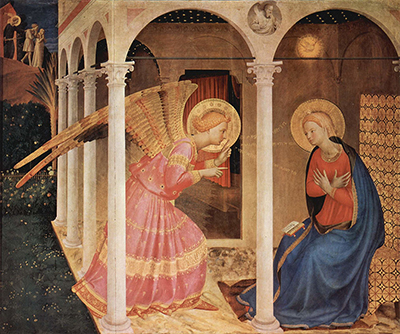
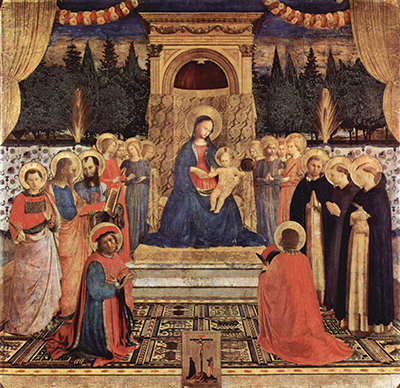
The San Marco Altarpiece also centres Medici saints Cosmas and Damian, who were healers and charitable figures. The Lawrence cycle extends Angelico’s interest in sacred service into papal Rome. Charity is therefore a recurring institutional theme across very different commissions. [1]
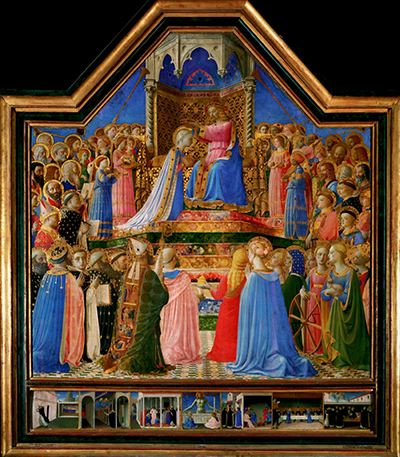
The late Armadio again combines narrative, Medici patronage and theological structure. But the Lawrence cycle is monumental and public in tone. The Armadio is intimate and densely textual. The comparison shows Angelico changing scale without abandoning intellectual organisation. [1]
Why the Saint Lawrence Cycle Matters
The Saint Lawrence cycle matters because it gives the Niccoline Chapel its strongest ethical confrontation with wealth and authority. Lawrence is a church officer. He receives treasure. He gives it away in service. He confronts political power. He dies. The story therefore asks what makes institutional authority Christian. The answer is not possession. It is stewardship. For Nicholas V, this was a powerful image to place inside a private papal chapel.
The frescoes do not deny the magnificence surrounding them. They define the moral purpose that magnificence must serve. Artistically, the cycle also demonstrates Angelico’s mature ability to make charity and administration visually heroic. He gives the poor, clergy and civic officials the dignity of Renaissance history painting. This is one of the clearest examples of Christian humanism operating as lived ethics rather than abstract philosophy. [1]
Frequently Asked Questions
Discussion
How does Fra Angelico use Saint Lawrence’s stewardship of Church treasure to test the relationship between papal authority, wealth and charity?
Reader Insights
How does the cycle distinguish possession of wealth from its rightful Christian use?
What force would the almsgiving scene have carried for a pope viewing it in a richly decorated private chapel?
How does pairing Lawrence with Stephen turn two martyr stories into one argument about service?
Join the Conversation
Share your reading of Fra Angelico’s Saint Lawrence cycle below.
References
- Vatican Museums, Niccoline Chapel, institutional description. Vatican Museums Niccoline Chapel collection record.
- Vatican Museums, History of the Vatican Museums: Nicholas V. Vatican Museums history of Nicholas V and the chapel.
- Vatican Museums, Department of XV–XVI Century Art. Vatican Museums XV–XVI Century Art restoration chronology.
- Vatican Museums, Fra Angelico and the Chapel of Nicholas V: Recent Restorations. Vatican Museums Fra Angelico and the Chapel of Nicholas V restoration volume.
.jpg)
 Fra Angelico.jpg)