 by Tom Gurney
Tom Gurney BSc (Hons) is an art history expert with over 20 years experience
Published on November 6, 2026 / Updated on November 6, 2026
Email: tomgurney1@gmail.com / Phone: +44 7429 011000
Introduction
Fra Angelico’s Saint Stephen cycle in the Niccoline Chapel forms the upper half of one of the most carefully structured fresco programmes of the Early Renaissance. The Vatican presents Stephen’s story in deliberate parallel with the life of Saint Lawrence below. Both saints are deacons. Both serve the Church. Both preach or witness publicly. Both confront hostile authority. Both die as martyrs. This parallel is not incidental.
The Vatican describes the entire chapel as organised according to a rhetorical law of correspondence. Stephen therefore needs to be read not as an isolated saintly biography but as one half of a visual argument about Christian service, authority and martyrdom. The story derives principally from the Acts of the Apostles. Stephen is chosen among the seven. He distributes aid and serves the Christian community. He preaches. He is brought before the council.
He sees the heavens opened. He is stoned to death. Angelico turns this sequence into a public historical drama. The architecture is monumental. Crowds gather. Figures speak and respond. This is very different from the intimate San Marco cells. Yet the same intellectual discipline remains. Angelico strips each scene down to a clear moral action. Service. Preaching. Trial. Martyrdom. The result is one of the most forceful visual biographies of the first Christian martyr in Renaissance art. [1]
At a Glance
- ArtistFra Angelico, with workshop collaboration [4]
- Locationupper register, Niccoline Chapel, Vatican [1]
- Dateprincipally 1448–50 [3]
- PatronPope Nicholas V [2]
- SourceActs of the Apostles [1]
- SaintStephen, one of the first seven deacons and first Christian martyr [1]
- Structurepaired rhetorically with Saint Lawrence below [1]
- Key episodesdiaconal consecration, preaching, trial or council confrontation, vision and martyrdom [1]
- Functionpapal devotional and ideological narrative [2]
- Stylemonumental Renaissance architecture, heroic figures and clear public gesture [1]
- Key themeservice transformed into witness and martyrdom [1]
Contents
- Introduction
- Stephen in Acts
- Diaconal Consecration
- Stephen Preaching
- Stephen before the Council
- Stephen’s Vision
- Martyrdom by Stoning
- Stephen and Lawrence
- Nicholas V and Stephen
- Why the Saint Stephen Cycle Matters
Stephen in Acts
Stephen enters Christian history through the Acts of the Apostles. The early Christian community needs men to assist with practical distribution and care. Stephen is chosen among seven. He is described as filled with faith and spiritual power. His role therefore begins in service. The story quickly expands beyond administration. Stephen becomes preacher, controversialist and martyr. This progression makes him ideal for the Niccoline programme. Christian office leads to public witness. [1]
Later Christian tradition identifies Stephen as one of the first deacons. The Niccoline Chapel emphasises this identity because Lawrence, the saint paired with him, is also a deacon. The parallel begins in office before it reaches martyrdom. Both men receive responsibility within the Church. Their deaths only make sense after this service has been established. [1]
Diaconal Consecration
The first Stephen scene concerns consecration. The act establishes institutional continuity. Authority is conferred. The saint does not appoint himself. He receives office within the Church. For a papal chapel, this principle matters. Christian authority is transmitted through ordered institution. [1]
Angelico makes ordination visible through gesture. Hands confer office. Bodies arrange themselves hierarchically. The sacred act becomes intelligible to the viewer without extensive written explanation. This is one of the strengths of the Niccoline Chapel. Institutional theology becomes public action. [1]
The role of the deacon historically involved service, especially care for the community and assistance in liturgical life. This provides the moral foundation for Stephen’s later preaching. He is not heroic because he seeks prominence. He becomes heroic through service. The chapel therefore creates a model of authority grounded in duty. [1]
Stephen Preaching
Stephen then appears as a public speaker. This is one of the most humanist aspects of the cycle. The preacher stands before listeners in an ordered architectural world. Gesture and stance give him rhetorical authority. The scene can be read through the Renaissance revival of classical oratory. Christian preaching receives the visual dignity of civic speech. [1]
This relationship is central to Nicholas V’s humanist environment. Rhetoric was one of the great arts of classical education. Stephen’s preaching allows Angelico to represent Christian truth through the visual language of persuasive public speech. The result is not secularisation. Classical rhetoric becomes a form for apostolic witness. [2]
Listeners gather around Stephen. Their responses vary. Some attend. Some question. Some resist. Angelico uses the crowd to make rhetoric visible. A sermon exists through relation between speaker and audience. The scene therefore becomes social rather than merely iconic. [1]
The architectural setting reinforces civic dignity. Columns, arches and broad public spaces create a world comparable to Renaissance ideas of classical urban life. The martyr does not preach in an undefined sacred void. He acts within history. Christianity appears as a public force inside the city. [1]
Stephen before the Council
Conflict develops as Stephen’s preaching provokes opposition. He is brought before the council. The story now becomes judicial. Christian witness confronts institutional power. Angelico uses architecture and seated or standing officials to make the encounter legible. The saint’s moral authority contrasts with the formal authority of the court. [1]
This conflict is one of the cycle’s central themes. Institutions possess power. Stephen claims truth. The chapel does not reject institution generally—the papacy itself is an institution. Instead, it distinguishes legitimate authority from authority that resists divine truth. This distinction would have been especially resonant in a papal setting. [1]
Stephen’s Vision
Before his death, Stephen sees the heavens opened and Christ in glory. This revelation confirms his testimony. The earthly court condemns him. The heavenly court vindicates him. Angelico therefore creates another parallel between visible and invisible authority. Martyrdom appears not as failure but as recognition by heaven. [1]
Martyrdom by Stoning
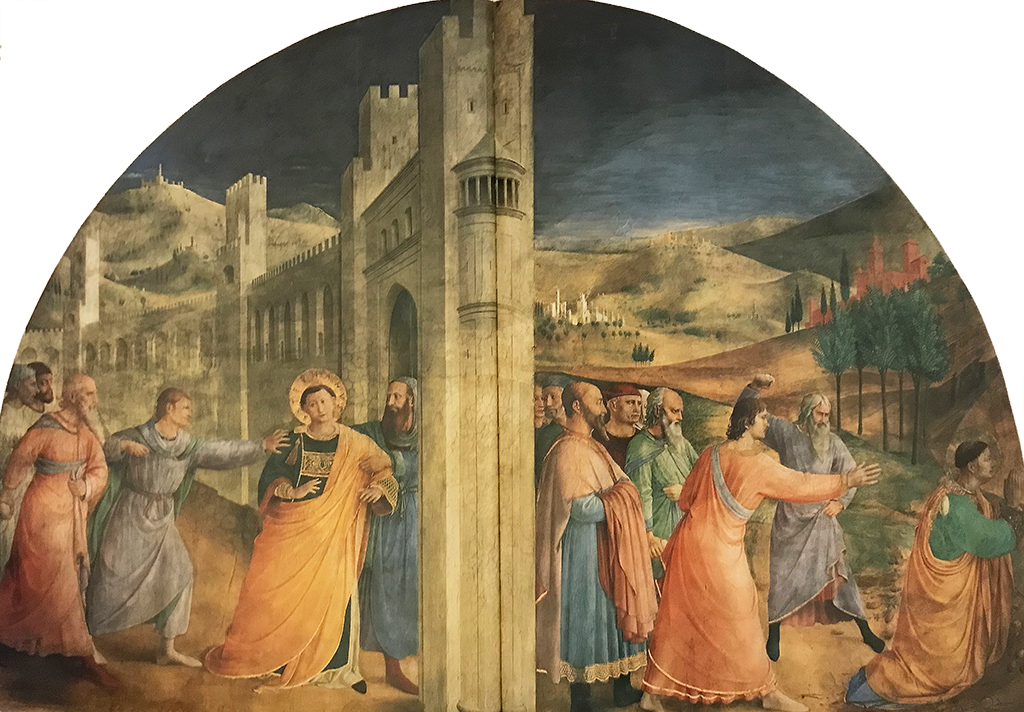
Stephen is stoned outside the city. The violence contrasts sharply with the ordered scenes of consecration and preaching. His body is attacked by a crowd. Yet his spiritual dignity remains. The martyr accepts death within a larger sacred framework. [1]
The Acts narrative associates the young Saul with the persecution. He later becomes Paul. This detail gives the martyrdom extraordinary historical irony. One of Christianity’s greatest future apostles is present on the side of persecution. Sacred history can therefore reverse human roles dramatically. [1]
Stephen’s final response echoes Christ. He prays for those killing him. This imitation is central to his sanctity. Martyrdom becomes not simply endurance but transformed moral action. He answers violence with intercession. For Christian viewers, this is the deepest proof of witness. [1]
The relationship with Christ is fundamental. Stephen’s death consciously echoes the Passion. He is falsely accused. He faces hostile authorities. He prays for enemies. He entrusts himself to God. The first martyr therefore becomes an imitator of Christ. [1]
Stephen and Lawrence
Every major phase in Stephen’s cycle has a conceptual counterpart below in Lawrence. Consecration answers consecration. Public service answers charitable distribution. Confrontation answers confrontation. Martyrdom answers martyrdom. The two saints therefore form one combined typology of the deacon. [1]
Stephen occupies the upper zone of the wall programme. This does not necessarily make him spiritually superior to Lawrence. The two are conceived as parallels. The vertical division instead allows the viewer to compare them while following separate narratives. The chapel therefore requires both horizontal and vertical reading. [1]
Public History
The Stephen cycle is fundamentally public. Its scenes occur before groups. Consecration is institutional. Preaching has an audience. Trial involves officials. Martyrdom attracts persecutors. This makes the cycle especially appropriate to papal ideology. Christian holiness is shown operating within society rather than retreating from it. [2]
The Vatican emphasises the heroic dignity of the chapel’s figures. Stephen therefore resembles a protagonist of classical history. His moral force is visible through posture and composure. The Renaissance revival of antiquity gives Christian biography a new public grandeur. [2]
The architectural settings evoke antiquity through Renaissance reconstruction. The effect links the apostolic Church with the admired civilisation of the ancient world. Christianity is presented as historically continuous with Rome’s monumental past while morally transforming it. [2]
Perspective
Perspective gives the public spaces coherence. Buildings recede. Crowds occupy ground logically. The eye can understand where Stephen stands relative to listeners and authorities. This spatial clarity supports narrative clarity. [4]
Bright garments distinguish groups and social roles. Stephen remains visually identifiable across changing scenes. Colour therefore assists continuity. The viewer follows the saint through a complex multi-scene biography. [4]
As with the wider chapel, assistants participated. Benozzo Gozzoli is closely associated with Angelico’s Roman workshop and with portions of the Niccoline project. The programme is best understood as Angelico’s design and major execution within a collaborative production. This is normal for a project of such scale. [4]
Stephen’s preaching is almost the opposite of the San Marco cell frescoes. There, silence dominates. Here, rhetoric dominates. There, one friar contemplates. Here, crowds listen and argue. Yet both are disciplined visual systems. Angelico changes mode without losing clarity. [1]
Lawrence’s cycle is more explicitly Roman and papal. Stephen’s is more apostolic. Together they connect the earliest Church with Rome. This chronological span gives Nicholas V’s chapel a powerful historical claim. The papal Church is presented as heir to apostolic martyrdom. [1]
Nicholas V and Stephen
For Nicholas V, Stephen’s story carried several useful values. Service. Preaching. Learning. Courage before authority. Martyrdom. These were not abstract virtues. They helped define an ideal Christian institution. The pope’s private chapel therefore surrounds him with moral exempla. [2]
Why the Saint Stephen Cycle Matters
The Saint Stephen cycle matters because it transforms one of Christianity’s earliest martyr stories into a Renaissance history of public moral action. Stephen begins as deacon. He becomes preacher. He confronts institutional hostility. He receives heavenly vision. He dies forgiving his persecutors. Angelico gives each stage civic and rhetorical dignity. The cycle also becomes much richer when read with Lawrence. Stephen is not alone.
He is one half of a visual argument about what a deacon should be. Service leads to witness. Witness may lead to martyrdom. Martyrdom becomes victory. For Nicholas V, the sequence could support a vision of Christian authority grounded not merely in office but in moral responsibility. This is why the cycle remains one of the most intellectually powerful parts of the Niccoline Chapel. [1]
Frequently Asked Questions
Discussion
How does Fra Angelico turn Saint Stephen’s movement from service to martyrdom into a coherent visual argument about Christian authority?
Reader Insights
How do gesture, audience and architecture give Stephen’s preaching the dignity of classical public speech?
Where does the cycle distinguish legitimate institution from power that resists truth?
How does pairing Stephen with Lawrence reshape the meaning of each saint’s story?
Join the Conversation
Share your reading of Fra Angelico’s Saint Stephen cycle below.
References
- Vatican Museums, Niccoline Chapel, institutional description of the Stephen and Lawrence cycles. Vatican Museums Niccoline Chapel collection record.
- Vatican Museums, History of the Vatican Museums: Nicholas V. Vatican Museums history of Nicholas V and the chapel.
- Vatican Museums, Department of XV–XVI Century Art, Niccoline Chapel chronology. Vatican Museums XV–XVI Century Art restoration chronology.
- Vatican Museums, Fra Angelico and the Chapel of Nicholas V: Recent Restorations. Vatican Museums Fra Angelico and the Chapel of Nicholas V restoration volume.
.jpg)
 Fra Angelico.jpg)