.jpg)
 by Tom Gurney
Tom Gurney BSc (Hons) is an art history expert with over 20 years experience
Published on November 6, 2026 / Updated on November 6, 2026
Email: tomgurney1@gmail.com / Phone: +44 7429 011000
Introduction
The Dominican convent of San Marco in Florence preserves the most complete surviving environment associated with Fra Angelico and one of the most extraordinary relationships between painting, architecture, patronage and religious life in the Early Renaissance. San Marco is not simply a museum containing many works by Angelico. It is a place in which painting was designed for specific rooms, specific communities and specific forms of behaviour.
The great corridor Annunciation belonged to the upper dormitory itself; the monumental staircase from which modern visitors now approach it was added later. The cell frescoes were made for individual prayer and meditation. The Chapter House Crucifixion served communal Dominican life. The San Marco Altarpiece belonged to the church’s high altar. The library embodied the order’s intellectual culture and Cosimo de’ Medici’s patronage. Even the distribution of images across the dormitory reflected different groups of friars.
The present Museo di San Marco confirms that the dormitory contained forty-four cells and distinguishes different devotional programmes for clerics, novices and lay brothers. The same museum also preserves Cosimo de’ Medici’s double cell, used during spiritual retreats, and describes the corridor Annunciation as the symbolic image of Dominican faith and the emblematic masterpiece of the complex. This makes San Marco fundamentally different from a museum assembled centuries later. Many of Angelico’s paintings elsewhere have been detached from altars, frames, predellas and chapels. At San Marco, architecture still explains why the images look the way they do.
The convent therefore provides the best place to understand one of Angelico’s greatest artistic achievements: his ability to vary style according to devotional function. The same painter who created the enormous and materially rich San Marco Altarpiece could reduce a cell fresco to Christ, a few witnesses and bare architecture. This was not inconsistency. It was intelligence. Angelico understood that images designed for a high altar, a communal chapter meeting and a friar’s private cell should not behave identically. San Marco is where that distinction becomes visible across an entire building. [1]
At a Glance
- LocationPiazza San Marco, Florence [1]
- InstitutionDominican convent, now Museo di San Marco [1]
- Rebuildingpromoted by Cosimo de’ Medici and carried out by Michelozzo [1]
- Principal reconstruction period1437–43 [1]
- Fra Angelico’s main San Marco activitybroadly late 1430s to mid-1440s [1]
- Dormitory44 cells [1]
- Different cell programmesclerics, novices and lay brothers [1]
- Major dormitory-corridor workAnnunciation [3]
- Major communal frescoCrucifixion and Saints, Chapter House [3]
- Major church panelSan Marco Altarpiece [4]
- Altarpiece date1438–43 [4]
- Altarpiece scaleapproximately 3.5 metres high in its original ensemble [4]
- Original altarpiece componentsat least 26 paintings [4]
- Principal Medici saintsCosmas and Damian [4]
- Cosimo de’ Medicimaintained a double cell for spiritual retreats [2]
- Librarydesigned by Michelozzo; major centre of Dominican and humanist study [7]
- Modern significancelargest concentration of Fra Angelico works in the world [1]
Contents
- Introduction
- Cosimo de’ Medici and the Rebuilding
- The Forty-Four Cells
- The Dormitory-Corridor Annunciation
- Cell 1: Noli me Tangere
- The Chapter House
- The San Marco Altarpiece
- The Library
- The Museo di San Marco
- Why Fra Angelico at San Marco Matters
San Marco had a religious history before the Dominican reconstruction that made the convent famous. The site was occupied by an earlier religious community before the Observant Dominicans were installed there in the 1430s. Their arrival belonged to a broader movement of Dominican reform. Observant communities sought stricter adherence to religious discipline and renewed emphasis on prayer, study and communal life. The physical rebuilding of San Marco therefore had a spiritual purpose. Architecture was expected to support reformed religious practice. This is crucial to understanding Angelico’s frescoes. They were not added to a neutral building after construction. Painting and architecture developed within one institutional programme. [1]
Cosimo de’ Medici and the Rebuilding
Cosimo de’ Medici was the dominant patron behind the rebuilding of San Marco. His support gave the Dominican community a radically renewed convent in the centre of Florence. Michelozzo was entrusted with the architectural project. The resulting complex was clear, ordered and comparatively restrained. Cloister, dormitory, cells, Chapter House, library and church were organised around the practical needs of Dominican life. Cosimo’s patronage therefore extended far beyond paying for individual paintings. He funded an environment.
Angelico’s work became part of that environment. The relationship between Medici patronage and Dominican observance is one of the most important paradoxes of San Marco. One of Florence’s wealthiest and most politically powerful men supported a community committed to disciplined religious life and personal austerity. That tension should not be simplified into hypocrisy or contradiction. Renaissance patronage regularly joined wealth, status, salvation and genuine religious commitment. San Marco is one of the clearest surviving examples. [1]
Michelozzo’s architecture gives Angelico’s frescoes their physical framework. The convent avoids excessive decoration. Repeated arches, pale walls, stone architectural details and controlled natural light create an environment of order. Angelico responds to this architecture rather than fighting it. Painted loggias resemble real convent architecture. Figures stand within clear spaces. Large areas of unfilled wall are allowed to remain visually quiet. This is particularly important in the cell frescoes. The walls themselves participate in meditation. The paintings are not windows onto crowded worlds. They are concentrated sacred presences embedded within architectural silence. [1]
Fra Angelico’s position at San Marco was unusual because he belonged to the same religious order for which much of the art was made. He was not an outside contractor arriving briefly to decorate a monastery he did not understand. He knew Dominican practice from within. This does not mean every iconographic decision must have been his alone.
The convent’s leadership, theological priorities and patronage all shaped the programme. But Angelico possessed an unusual ability to translate religious practice into visual form because he shared the institutional world of his audience. The resulting frescoes feel different from ordinary commissioned church decoration partly for this reason. They are images produced within a community for that community. [1]
The Forty-Four Cells
The dormitory contained forty-four cells. Each cell was a small private space used for rest, prayer and contemplation. The fresco programme therefore addressed individuals repeatedly. A friar did not walk into a public chapel filled with spectators. He returned daily to one image or one small group of images within his own cell. This radically changes what painting needs to accomplish. Novelty becomes less important than depth. The image must sustain repeated looking. Angelico’s cell frescoes often achieve this through simplification. Few figures. Controlled gesture. Limited architecture. Concentrated emotional action. These paintings are deliberately unlike the densely populated altarpieces he could produce elsewhere. [2]
The present museum distinguishes several programmes within the dormitory. The clerics’ corridor contains stories from the life of Christ. The novices’ corridor gives particular emphasis to the Crucifixion with Saint Dominic in prayer. The lay brothers’ corridor contains more narrative Gospel imagery. This variation is one of the most important facts about San Marco.
The frescoes were not simply distributed randomly. Different types of religious life were given different visual material. The programme therefore reflects pedagogy as well as devotion. Novices encounter repeated images of the Crucifixion and Dominican meditation. Clerics receive a broader Christological sequence. Lay brothers encounter more explicit narrative. Painting becomes part of the formation of different members of the order. [2]
The cell frescoes can be understood as aids to repeated spiritual exercise. They do not merely tell viewers what happened in the Bible. They model how to look. Saint Dominic often appears inside scenes from Christ’s life even though he lived more than a millennium later. Historically, this is impossible. Devotionally, it is entirely coherent. Dominic functions as the friar’s model. He kneels. He contemplates. He grieves. He witnesses. The friar looking at the fresco is invited to imitate this response. Angelico therefore inserts the Dominican viewer symbolically into sacred history through the founder of the order. [1]
The Dormitory-Corridor Annunciation
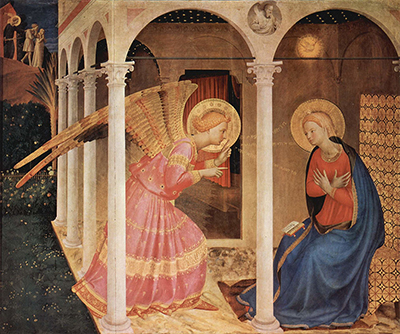
The most famous fresco at San Marco is the Annunciation painted on the north dormitory corridor. Its architectural position is fundamental, but its original setting needs to be distinguished from the modern route. The large monumental staircase used by visitors today did not exist when Angelico painted the fresco. The original dormitory was reached by other stairs, including a principal route from the sacristy area.
The current dramatic view up the later staircase is therefore part of the fresco’s architectural afterlife rather than Angelico’s original staging. The painting was conceived for the dormitory corridor itself, within the friars’ upper-floor devotional environment. The effect remains powerful for modern visitors. The museum itself describes the fresco as an icon of Dominican faith and the emblematic work of San Marco. The scene is strikingly restrained. Gabriel kneels. Mary responds. The architecture is simple and measured. The garden is controlled. There is no courtly accumulation of objects. The mystery is carried by gesture, gaze, architecture and silence. [3]
The painted loggia resembles the real architectural language of San Marco. This creates a powerful visual continuity. The sacred event seems almost capable of happening inside the convent itself. Mary does not occupy an exotic biblical palace. She appears within a quiet architecture familiar to the Dominican viewer. This translation collapses historical distance. The Annunciation becomes spiritually present. The architecture also organises the relationship between Gabriel and Mary. Columns separate without isolating them. Perspective gives the encounter depth. The emptiness around the figures slows the eye. [3]
The Annunciation had special relevance for a religious community concerned with obedience, humility and contemplation. Mary listens. She accepts. The scene therefore models a disciplined response to divine will. Angelico’s restraint reinforces that meaning. The painting does not dramatise Gabriel’s arrival as spectacle. It emphasises attention. For friars passing towards their cells, Mary becomes an example of receptive contemplation. [3]
Cell 1: Noli me Tangere
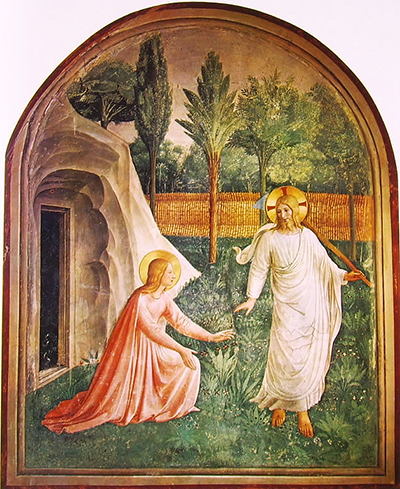
The Noli me Tangere in cell 1 presents the risen Christ and Mary Magdalene. The garden is luminous and sparse. Mary reaches towards Christ. He withdraws while acknowledging her. The encounter is emotionally intense because it is restrained. There is no crowd. No architectural spectacle competes with the two figures. Mary Magdalene also held an important place in Dominican spirituality. Her role as witness to the Resurrection and model of penitence made her especially suitable for meditative imagery. The fresco therefore combines Gospel event with Dominican devotional identity. [1]
The scene centres on a paradox. Mary recognises Christ and wants to approach him. Christ prevents the old form of physical attachment. The Resurrection transforms their relationship. Angelico communicates this through movement. Mary advances. Christ steps away. Their gestures almost meet. The small space between them becomes the emotional centre of the fresco. This is one of the best examples of Angelico using minimal composition to create psychological depth. [1]
The Mocking of Christ is among the most radical frescoes at San Marco. Christ sits blindfolded while torment is represented through disembodied fragments: hands, a head and the instruments or gestures of abuse. The physical perpetrators are largely absent. This changes the scene from historical narrative into meditative symbol. The viewer does not watch a realistic mob. He confronts Christ’s humiliation directly. The abbreviated torment seems almost like memory or vision. Saint Dominic appears below as a model of contemplation. The fresco teaches the friar how to transform narrative into meditation. [1]
Removing full human bodies from the tormentors has a practical spiritual effect. The viewer cannot become distracted by costume, character or narrative action. Attention remains on Christ. The fragmented hands and gestures make violence feel universal rather than anecdotal. The image is therefore psychologically more concentrated than a literal reconstruction would be. This is one of the clearest examples of Angelico simplifying visual information deliberately. [1]
The Transfiguration
The Transfiguration presents Christ in radiant glory. Peter, James and John witness the event. Moses and Elijah establish scriptural continuity. Mary and Saint Dominic appear within the expanded devotional structure. The composition is symmetrical and stable. Christ dominates the centre. The witnesses are arranged below and around him. Again, Angelico uses formal order to support contemplation. The fresco is not attempting to reproduce the confusion of a sudden supernatural event realistically. It makes revelation intelligible. [1]
The Transfiguration could easily become visually spectacular. Angelico chooses stillness. The effect is theological. Divine glory is not represented as chaos. It appears as perfect order. The viewer is invited to contemplate rather than recoil. This quality distinguishes Angelico from painters who would later use violent light and dramatic movement to represent supernatural revelation. At San Marco, revelation is structured for meditation. [1]
The novices’ corridor repeatedly uses the Crucifixion with Saint Dominic in prayer. This repetition is significant. A novice entering Dominican life was asked to return visually to Christ’s sacrifice and to the founder’s response. The image becomes almost a devotional exercise repeated across rooms. Variation exists, but the core remains stable. This use of repetition shows that the San Marco programme was pedagogical. The aim was not to provide maximum iconographic variety. It was to form religious attention. [3]
Dominic’s repeated presence also creates an important visual bridge. He is both figure inside the fresco and model outside it. The real novice looks at Dominic looking at Christ. Devotion becomes layered. Christ is the sacred object. Dominic demonstrates correct response. The novice imitates Dominic. Angelico therefore structures viewing itself. This is one of San Marco’s most sophisticated achievements. [1]
The Chapter House
The Chapter House served communal Dominican governance and institutional life. Friars gathered there for meetings, readings and matters affecting the community. The image painted for this room therefore needed a different scale and authority from a private cell fresco. Angelico responded with the monumental Crucifixion and Saints. The work is one of the defining frescoes of San Marco. The museum dates it around 1441–42. Its solemnity reflects communal function. [3]
Christ hangs at the centre of a vast sacred assembly. A large company of saints gathers around the Crucifixion. Dominican figures occupy important positions. The composition links Christ’s sacrifice with the historical Church and the identity of the order. This is not one individual friar’s meditation. It is institutional memory. The Chapter House becomes visually connected with centuries of Christian witness. [3]
The difference between the Chapter House Crucifixion and a cell Crucifixion demonstrates Angelico’s sensitivity to audience. The cell image is private and concentrated. The Chapter House fresco is public within the community and expansive. Both represent the same central Christian event. Their visual forms differ because their audiences differ. This is perhaps the clearest single lesson San Marco offers about Angelico’s artistic intelligence. [1]
The San Marco Altarpiece
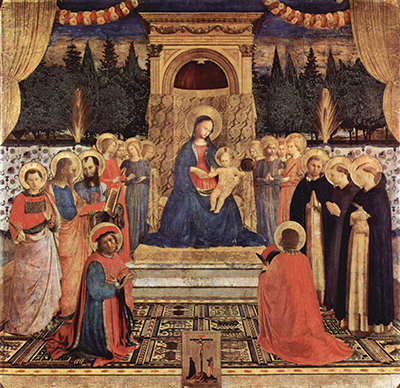
The San Marco Altarpiece was the most ambitious panel-painting component of the Medici reconstruction. In 1438 Cosimo and Lorenzo de’ Medici obtained patronage of the church’s principal chapel. Michelozzo renovated the space. Angelico was commissioned to provide a new high-altarpiece dedicated to Saint Mark and Saints Cosmas and Damian. The work was completed before the church and high altar were consecrated at Epiphany 1443. The consecration took place in the presence of Pope Eugene IV and the cardinal college. The commission therefore carried enormous religious and social prestige. [4]
The original San Marco Altarpiece was not simply the surviving central panel now familiar from museum display. The museum describes it as a complex wooden machine approximately three and a half metres high and consisting of at least twenty-six paintings. These included saints on the side elements, predella scenes and the principal sacred image. This original scale matters. The work belonged to architecture. It towered above the high altar. The modern museum presentation preserves important pieces but cannot reproduce every aspect of its original liturgical presence. [4]
Saint Mark was the titular saint of the church. His inclusion anchors the altarpiece to institutional identity. He is not merely one saint among many. The church itself is named for him. This is a recurring principle in Renaissance altarpieces. Saint selection often reflects the specific altar and community rather than a painter’s private preference. [4]
Cosmas and Damian carried special significance for the Medici. Their prominence ties family patronage directly into the church’s sacred programme. They were physician saints and martyrs, celebrated for healing without payment. Their stories formed the subject of the predella. This made Medici devotional identity visible not only through heraldry but through narrative. The saints’ lives unfolded beneath the principal sacred assembly. [4]
Both Cosimo and his brother Lorenzo were involved in the patronage of the high altar. Lorenzo died in September 1440 before the altarpiece was completed. Cosimo survived to see the finished work. The museum has suggested that the contrasting attitudes of Cosmas and Damian may preserve a reflection of this family circumstance, with one saint addressing the viewer while the other is prostrate. This is an attractive interpretation, but it remains interpretive rather than securely documented. It is not necessary to the work’s secure meaning. The secure point is that Cosmas and Damian were central Medici saints within a Medici-funded altar. [1]
The Predella of Cosmas and Damian
The predella narrated episodes from the lives of the two healer saints. Individual panels later became dispersed. This dispersal can make them look like independent small paintings. Originally they formed one sequence. Their meaning depended upon order. Healing, persecution, miracles and martyrdom developed across the lower register of the high altarpiece. Reconstructing the sequence restores both narrative and patronal meaning. [4]
The scale of San Marco makes workshop participation unavoidable. The high altarpiece alone involved numerous panels. The dormitory programme extended across dozens of cells. Angelico worked with assistants and collaborators. This does not weaken the attribution of the complex to him. Renaissance mastery included design, supervision and organisation. A large programme could be recognisably the master’s work without every brushstroke being autograph. The right historical question is therefore not “Did Angelico paint every centimetre?” but “How did Angelico’s design system organise the work of a community of painters?” [10]
Assigning individual cell frescoes to specific hands remains difficult. Some works are widely regarded as strongly autograph. Others show clearer workshop participation. The safest language for the whole dormitory programme is “Fra Angelico and his workshop, under Angelico’s design and supervision”. Individual pages can use stronger attribution where current scholarship supports it. This distinction prevents false precision. It also reflects how workshop production actually functioned. [9]
Cosimo de’ Medici maintained a double cell at San Marco and stayed there during spiritual retreats. This is one of the most fascinating aspects of Medici patronage in the convent. Cosimo was not simply the wealthy outsider paying for religious architecture. He used the institution. The cell allowed him temporary withdrawal from political and domestic life. The physical presence of such a powerful lay patron inside the dormitory complicates the simple division between monastery and city. San Marco was a place where elite Florentine power and Dominican austerity could intersect personally. [2]
Cosimo’s retreat should not be romanticised. Medici patronage brought enormous social prestige. Funding San Marco also placed the family at the centre of a major religious institution. Yet political calculation and sincere devotion need not be mutually exclusive. Renaissance patrons could experience both. San Marco is especially useful because the architecture preserves evidence for public magnificence and private withdrawal at once. [1]
The Library
Michelozzo’s library is one of San Marco’s defining spaces. It was built as a monumental room for study and manuscripts. Cosimo supported its creation. The collection incorporated books associated with the humanist Niccolò Niccoli. The library became one of the most important intellectual spaces of Renaissance Florence. Its existence makes clear that Dominican observance did not imply hostility to learning. Study belonged to the order’s mission. Preaching required theology, scripture and disciplined intellectual formation. [7]
The library also connected Dominican culture with Florentine humanism. San Marco later became associated with figures such as Marsilio Ficino and Pico della Mirandola. This intellectual history belongs to the same building as Angelico’s cell frescoes. The juxtaposition is important. Quiet devotional painting and humanist scholarship are not opposing worlds here. They coexist physically. This helps prepare the later Christian-humanist synthesis of the Niccoline Chapel in Rome. [7]
The library would also have resonated strongly with Angelico’s own early training as an illuminator. Books were not foreign to his artistic identity. His career began in manuscript culture. San Marco therefore reunited several aspects of his life: painting, Dominican study and illuminated books. The present museum continues to preserve important manuscripts within the library complex. This material connection strengthens the case for treating illumination as a major part of Angelico’s technique rather than a minor youthful episode. [7]
Antonino Pierozzi was one of the leading Dominican figures associated with San Marco. He served as prior and later became Archbishop of Florence. His presence reinforces the institutional seriousness of the convent. San Marco was not simply a Medici cultural project decorated by a famous painter. It became a major centre of Dominican reform and leadership. Angelico’s images should therefore be interpreted in relation to a community with strong theological and administrative identity. [1]
Girolamo Savonarola belongs to a later generation. He arrived at San Marco long after Angelico’s principal painting campaigns. Yet his later association with the convent changed its historical reputation. Modern visitors often encounter San Marco through both Angelico and Savonarola. The two should not be collapsed chronologically. Angelico’s San Marco belongs primarily to the Dominican and Medici world of the 1430s and 1440s. Savonarola’s dramatic political-religious role belongs to the late fifteenth century. The building accumulated histories. [1]
Cell 44 offers a powerful reminder that the San Marco cycle has not survived unchanged. The present museum notes that only the figure of Saint Dominic remains from Angelico’s fresco there. Much of the composition was lost when later architectural changes altered the wall and window arrangement. This is important because modern visitors may imagine the convent as an untouched fifteenth-century time capsule. It is not. San Marco has been altered, restored and reinterpreted across centuries. Survival is substantial but incomplete. [6]
Fresco Technique
The dormitory paintings were produced primarily through fresco technique. Pigments applied to fresh plaster became bound into the wall as the surface dried. This required careful planning. Only a manageable section of plaster could be painted while fresh. Large programmes therefore depended upon organisation. Cartoons, drawings and transfer systems helped coordinate work. Assistants could prepare surfaces and execute areas under the master’s direction. The technical demands support the historical case for workshop production. [1]
Fresco also suited San Marco conceptually. The image became physically part of the wall. Unlike a portable panel, it could not be casually moved. The sacred scene belonged permanently to the friar’s architectural environment. This made the cell itself a devotional object. Painting, wall and room were inseparable. That integration is one reason reproductions lose so much of San Marco’s effect. [1]
Angelico is famous for brilliant colour, but the cell frescoes often use colour with exceptional discipline. White walls remain visible. Colour accents guide attention. The simplicity suits both fresco technique and the contemplative purpose of the rooms. This does not mean the paintings were colourless or austere in a modern minimalist sense. Rather, colour is controlled. It serves hierarchy. [1]
Natural light is another essential element. The cells were illuminated by real windows. Painted figures therefore existed within changing daylight. This condition matters especially in the corridor Annunciation, where painted architecture and the real dormitory environment interact strongly. Modern museum lighting can preserve visibility, but the original experience changed through the day. The convent’s light was part of the work. [1]
San Marco’s power comes partly through repetition. A visitor moves from one sacred scene to another. For the friars, this repetition was lived over years. Images were not consumed once. They became familiar. The repeated Crucifixions, appearances of Dominic and episodes from Christ’s life formed an environment of sustained memory. This helps explain why Angelico often avoids excessive novelty. The goal was formation. [1]
The contrast between private cells and communal rooms structures the entire complex. Cells cultivate individual meditation. The Chapter House cultivates shared institutional identity. The church high altar supports liturgy. The library supports study. The cloister regulates movement. San Marco is therefore best understood as a network of functions. Angelico’s paintings change because the functions change. [1]
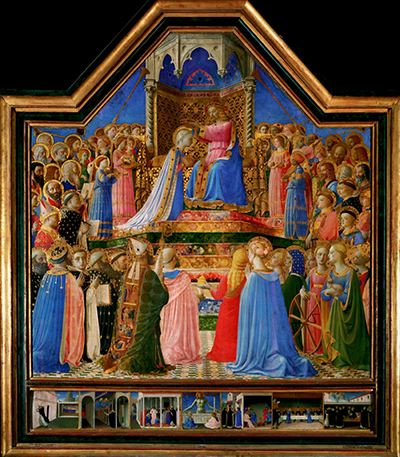
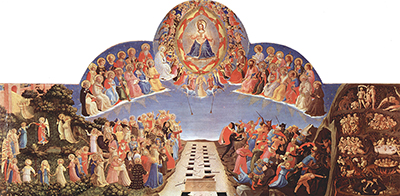
The present Sala dell’Ospizio houses the museum’s great collection of Angelico panel paintings. This is a modern museum use layered onto the historic convent. Works from different original settings are now brought together. The arrangement gives visitors extraordinary chronological comparison. The Last Judgement, San Marco Altarpiece, Annalena and other works can be studied in relation to one another. Yet this convenience also changes function. Altarpieces become museum pictures. The modern viewer needs scholarship to reconstruct the lost altar and patronal setting. [8]
The Museo di San Marco
San Marco became a museum in the nineteenth century. Its museum identity preserved the convent and concentrated important Angelico works there. Today it holds the richest collection of his paintings and the unique dormitory fresco cycle. The museum therefore serves two roles simultaneously. It preserves an original architectural environment. It also functions as a collecting institution containing displaced panel paintings from elsewhere. Understanding this dual identity helps visitors distinguish what remains in situ from what was moved there later. [1]
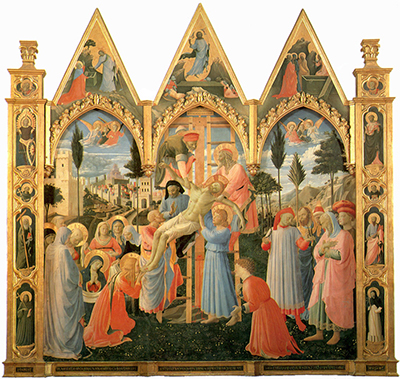
San Marco has been the site of continuous conservation. The San Marco Altarpiece underwent major restoration by the Opificio delle Pietre Dure. The Last Judgement has been conserved and scientifically studied. The Santa Trinita Deposition returned after a major recent restoration. Individual cell frescoes have also required treatment. These interventions do more than preserve appearance. They generate art-historical evidence about materials, earlier alterations and workshop practice. [8]
The restoration of the San Marco Altarpiece allowed the surviving central panel and related elements to be studied with renewed clarity. Its brilliant colour and complex original structure became easier to understand. The museum’s reconstruction of the original ensemble emphasises its extraordinary scale. This has helped shift interpretation away from viewing the surviving central image as a self-contained panel. The altarpiece was a multimedia liturgical construction. [5]
The major 2025 Florence exhibition gave San Marco renewed international importance. Works were reunited, restored and reconsidered through new research. San Marco formed one half of the exhibition with Palazzo Strozzi. The project was the first major Florence monographic exhibition devoted to Angelico in seventy years. This recent scholarship makes the current moment unusually good for reassessing the convent. The paintings are being studied not as static canonical icons but as complex objects with material and institutional histories. [11]
San Marco and the Early Renaissance
San Marco is also one of the best places to understand the Early Renaissance as something broader than perspective. Michelozzo’s architecture matters. Cosimo’s patronage matters. Dominican reform matters. The library matters. Angelico’s frescoes matter. These elements form one system. The Renaissance here is architectural, artistic, religious, intellectual and social at the same time. [1]
San Marco is often used to reinforce the legend of Angelico as a secluded holy painter. In fact, the convent demonstrates how connected he was. The Medici were involved. Michelozzo was involved. A major Dominican community was involved. Workshop assistants were involved. Humanist books filled the library. Papal visitors attended the church’s consecration. San Marco was not isolation. It was a network. Angelico’s genius lay partly in giving this complex network a coherent devotional visual language. [9]
The completion of the new church and high altar culminated in the Epiphany consecration of 1443. Pope Eugene IV and the cardinal college were present. This ceremonial setting dramatically enlarges the social meaning of the San Marco Altarpiece. The work was not unveiled privately to a few Dominican friars.
It stood at the centre of a major ecclesiastical event attended by the pope and leading churchmen. The Medici commission therefore operated simultaneously as devotion, civic prestige and public religious patronage. Angelico’s painting had to answer all three. The high altar was the visual and liturgical focus of the rebuilt church. Its scale and splendour make much more sense when understood within this ceremonial environment. [4]
San Marco as a Medici Monument without Becoming a Medici Palace
Cosimo’s financial role at San Marco was enormous, yet the architecture does not resemble a palace transferred into a convent. This distinction is important. Medici patronage supports restraint. Michelozzo’s design serves Dominican functions rather than turning religious space into courtly display. Angelico follows the same principle in much of the fresco programme.
The result demonstrates that magnificence in Renaissance patronage does not always mean visual excess. Funding could also support disciplined simplicity. This is one reason San Marco is so useful for understanding Cosimo’s cultural strategy. The family could associate itself with learning, reform, piety and artistic excellence through a building whose dominant visual language remained monastic. [1]
The library has another significance for Angelico personally. His career began in manuscript culture. At San Marco, manuscripts became part of the mature Dominican environment in which his monumental frescoes were produced. This creates an elegant continuity. The young Guido di Pietro learned to organise colour, gold, text and sacred imagery on the page. The mature Fra Giovanni worked inside a convent whose intellectual life depended upon books.
The library therefore connects his earliest technical formation with his mature institutional identity. The frescoes are not simply enlarged manuscript pages; their media, scale and architectural functions are fundamentally different. Their media and functions differ. But the discipline of illumination—clarity, compression, luminous colour and careful sacred sequencing—remained deeply compatible with the culture of San Marco. [7]
The Chapter House as Institutional Memory
The Chapter House Crucifixion also deserves to be understood as a memory structure. The saints gathered around Christ create a community extending beyond the living friars who met in the room. Present-day Dominicans, founders, martyrs and holy predecessors are symbolically brought into one assembly. A chapter meeting therefore occurred beneath an image of a much larger sacred community.
This gives the fresco a disciplinary function as well as a devotional one. The friars were reminded that their local decisions belonged to a historical religious order and ultimately to the sacrifice of Christ. The communal fresco is therefore almost the opposite of the private cell image. The cell turns sacred history inward. The Chapter House expands the present community outward into sacred history. [3]
San Marco also offers a rare opportunity to compare paintings that remain in their original architectural positions with panels that have been displaced from their original contexts and later collected in the museum. The corridor Annunciation still depends upon its dormitory wall and architectural setting, even though the monumental staircase through which visitors now approach it is a later intervention. The dormitory frescoes still depend upon the cells.
The Chapter House Crucifixion still depends upon its room. By contrast, works such as the Last Judgement or Santa Trinita Deposition are now encountered within a museum display rather than at their original sites. This contrast makes San Marco unusually instructive. Visitors can experience both kinds of art history in one institution. The frescoes teach what original context preserves. The panel galleries teach what scholarship and conservation can recover after context has been lost. [8]
Why Fra Angelico at San Marco Matters
San Marco matters because it is the place where Fra Angelico’s religious identity, artistic intelligence and institutional environment become inseparable. No isolated panel can show the full range. At San Marco, viewers encounter: a high-altarpiece designed for public liturgy; a monumental Chapter House Crucifixion designed for communal Dominican memory; a dormitory-corridor Annunciation whose modern approach differs from its original fifteenth-century route;
private cell frescoes designed for sustained meditation; repeated images tailored to different groups within the order; a library connecting Dominican study with Florentine humanism; and Cosimo de’ Medici’s own retreat cell inside the convent he helped rebuild. This range explains why Angelico should not be characterised through one “spiritual style”. He possessed multiple visual registers. Richness when richness served the altar. Simplicity when simplicity served meditation.
Monumentality when community required it. Repetition when religious formation benefited from it. San Marco is therefore not merely the place containing the largest surviving concentration of his art. It is the clearest demonstration of how he thought images should function. The convent turns painting into architecture, pedagogy, memory and prayer. That is why San Marco remains the single most important place for understanding Fra Angelico. [1]
Frequently Asked Questions
Discussion
Which part of San Marco best reveals how Fra Angelico adapted painting to place and purpose?
Reader Insights
How does the quiet of a cell fresco change the experience of its subject?
What changes when Angelico paints for the Chapter House or high altar?
Which matters most at San Marco: architecture, patronage or Dominican practice?
Join the Conversation
Share your reading of Fra Angelico at San Marco below.
References
- Direzione regionale Musei nazionali Toscana, Museo di San Marco, institutional history and collection resources. Museo di San Marco.
- Direzione regionale Musei nazionali Toscana, “Museo di San Marco: tutto esaurito per la mostra Beato Angelico,” dormitory programme, forty-four cells and Cosimo de’ Medici’s double cell. Museum report on the dormitory programme.
- Direzione regionale Musei nazionali Toscana and Museo di San Marco research on the dormitory-corridor Annunciation, its present staircase approach and the Chapter House Crucifixion. Museum report on the dormitory programme.
- Direzione regionale Musei nazionali Toscana, “Il museo festeggia i 150 anni con il ritorno della Pala di San Marco,” altarpiece history, Medici patronage, scale and 1443 consecration. San Marco Altarpiece restoration record.
- Direzione regionale Musei nazionali Toscana, “Beato Angelico visto da… La Pala di San Marco.” San Marco Altarpiece research.
- Direzione regionale Musei nazionali Toscana, reopening and conservation information for cell 44. Cell 44 reopening and conservation.
- Direzione regionale Musei nazionali Toscana, Biblioteca di Michelozzo and Sala Greca resources. Michelozzo Library collection display.
- Direzione regionale Musei nazionali Toscana, Sala del Beato Angelico collection and restoration resources. Museo di San Marco collection.
- National Gallery, London, Fra Angelico artist biography and workshop research. National Gallery artist record.
- National Gallery, London, Fiesole San Domenico Altarpiece catalogue, for comparison with Angelico’s Dominican workshop practice. National Gallery catalogue.
- Palazzo Strozzi and Museo di San Marco, Beato Angelico, 2025 exhibition and restoration programme. Palazzo Strozzi exhibition record.
 Fra Angelico.jpg)