


 by Tom Gurney
Tom Gurney BSc (Hons) is an art history expert with over 20 years experience
Page Created on / Page Updated on
Email: tomgurney1@gmail.com / Phone: +44 7429 011000
Ivan Aivazovsky: Introduction
Ivan Aivazovsky (1817–1900) made the sea his principal subject without reducing it to a single mood. Across calm harbours, moonlit passages, shipwrecks and rising storms, water becomes a field of changing light and human uncertainty. His most convincing pictures do more than record waves. They arrange recollected observation into an encounter in which distance, weather and illumination carry the emotional weight. That approach made him one of the nineteenth century’s most recognisable marine painters, yet the familiar spectacle is only one part of his story.[1][2][3]
He was an Armenian artist born at Feodosia in Crimea, then part of the Russian Empire and now in Ukraine; professionally central to nineteenth-century Russian art while sustaining Armenian religious, cultural and civic commitments. He travelled and exhibited widely, worked with the Russian navy, and received imperial patronage, but repeatedly returned to Feodosia. His career therefore belongs to several connected histories rather than one exclusive national label. The paintings are best approached in the same way: through exact objects, particular journeys and the remembered Black Sea, not through legend alone.[1][4]
At a Glance
- BornFeodosia, Crimea, in 1817; he died there in 1900.[1][2]
- NamesBorn Hovhannes Aivazian, he appears in English-language sources under several transliterations, including Ivan Ayvazovsky and Ivan Aivazovskii.[1][4]
- TrainingHe entered the Imperial Academy of Arts in St Petersburg in 1833 and studied landscape under Maxim Vorobyov.[4][8]
- SpecialismMarine painting shaped through observation, strong visual memory, carefully graded colour and constructed effects of light.[3][5]
- Public roleAn artist attached to the Russian Naval Staff and a long-term benefactor of Feodosia.[6][8]
- Where to beginThe six paintings introduced below move from moonlit travel and naval history to shipwreck, rescue, open water and a monumental late storm.
Ivan Aivazovsky in context
Romanticism
c. 1780–1850Imperial Academy and marine painting
c. 1800–1900Realism
c. 1840–1900J. M. W. Turner
1775–1851Caspar David Friedrich
1774–1840Mikhail Vorobiev
1787–1855Ivan Aivazovsky
1817–1900Alexey Bogolyubov
1824–1896Arkhip Kuindzhi
1842–1910Contents
- Introduction
- A Feodosia Painter with Several Names
- Learning to Construct the Sea
- Light, Danger and the Remembered Wave
- Naval History and Human Scale
- An International Career Rooted in One City
- Six Essential Works
- Legacy without the Numbers Myth
A Feodosia Painter with Several Names
The painter now usually called Ivan Aivazovsky was baptised Hovhannes, the son of Gevorg Aivazian, in Feodosia’s Armenian community. Museum records and scholarship preserve different versions of both names: Hovhannes Aivazian or Ayvazyan, Ivan Ayvazovsky, Ivan Aivazovskii and other spellings. These are not different artists. They reflect Armenian and Russian forms passing through several systems of transliteration. Aivazovsky is used here because it is the established English form, while the variants remain important for research and historical understanding.[1][4]
The names also open onto a genuinely layered identity. His first education was connected with the Armenian parish in Feodosia, and Armenian was part of his early cultural world. His brother Gabriel became a prominent Armenian cleric and scholar; their encounters in Venice, including at the Armenian Mekhitarist monastery on San Lazzaro, strengthened Ivan’s engagement with Armenian history and culture. Later he assisted Armenian churches, schools and community institutions as well as making Armenian subjects.[2][4]
None of this places his Russian career in brackets. He trained in St Petersburg, became an academician, enjoyed court patronage and painted for audiences who understood the Russian fleet and empire as major parts of his public identity. The point is not to choose which affiliation was “real”. It is to recognise how an Armenian upbringing, imperial institutions, Black Sea geography and international travel all operated within one life. The dedicated biography follows that chronology, while the account of his Armenian identity examines family, church and civic commitments in greater depth.[2][3][4]
Feodosia was more than the place of his birth. Its harbour gave him an early intimacy with the Black Sea, and its position connected local experience to shipping routes, naval movement and distant coasts. Even after professional success made long journeys possible, he chose the town as his enduring base. This persistent attachment helps explain why apparently universal visions of water retain a strong sense of a particular shore.[1][6]
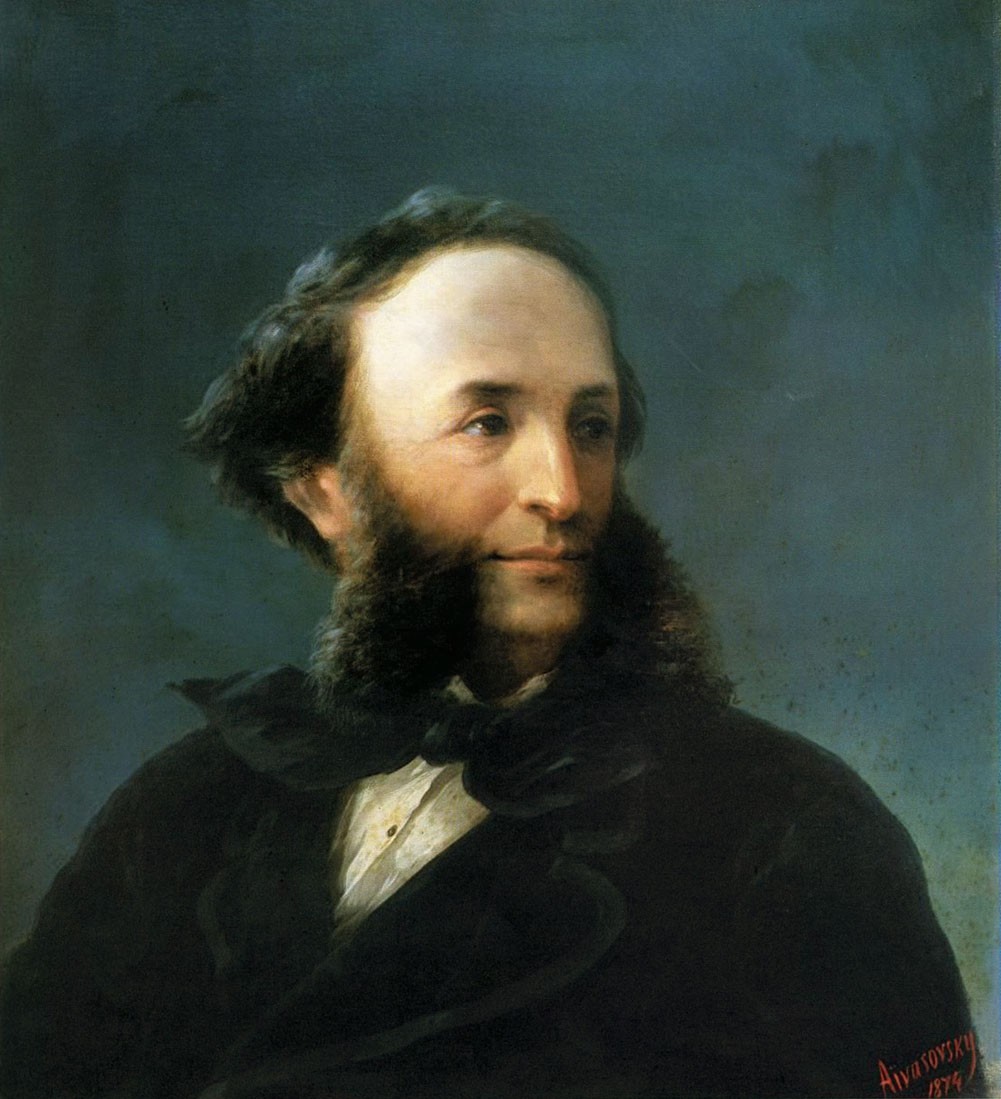
His self-presentation also moved between local attachment and international standing. A self-portrait that he gave to the Uffizi placed him within the Florentine museum’s collection of artists’ likenesses, while the Feodosia house and gallery presented a quite different public image: the successful traveller returning resources and attention to his home town. Neither setting supplies a complete identity on its own. One locates him in a European tradition of artistic fame; the other shows reputation converted into a durable institution beside the Black Sea.[6][9]
Learning to Construct the Sea
Aivazovsky’s talent attracted support beyond his family. The Feodosia official Alexander Kaznacheyev helped him continue his education in Simferopol and then reach the Imperial Academy of Arts in 1833. In Maxim Vorobyov’s landscape class he encountered an academic tradition that treated composition, atmosphere and tonal unity as teachable disciplines. Voyages and coastal studies supplied another kind of knowledge: the behaviour of ships, changing weather and the relationship between sea and sky.[4][8]
His connection with the navy enlarged that practical education. During an 1836 voyage with the future admiral Fyodor Litke, he gained experience of navigation and ship design as well as maritime conditions. After a long period in Italy and elsewhere in Europe, he returned to St Petersburg in 1844 and was appointed painter to the Naval Staff. The role gave him access to vessels, ports and naval narratives without turning every picture into a technical report.[7][8]
Direct study was only the beginning of his method. Scholarship repeatedly emphasises his unusually strong visual and emotional memory. Rather than attempting to complete large canvases before a changing sea, he retained observed effects and recomposed them in the studio. A convincing wave could therefore combine knowledge gathered at different moments: the lift of water before it breaks, a translucent crest, clouded distance and a shaft of light that organises the whole scene.[3][5]
This distinction matters because “painted from memory” can sound like “invented without knowledge”. In Aivazovsky’s practice, memory was a means of selection. It allowed him to simplify an expanse of water, control the interval between waves and make illumination legible. Some views still depend on identifiable places and journeys, but their weather and drama have been deliberately constructed. The guide to light, memory and marine technique looks closely at that transformation from observation to image.[5]
Construction also explains the unusual readability of his water. A crest is rarely an isolated strip of white paint. Its brightness depends on the darker body of the wave beneath it, the transparency of its turning edge and the colour carried from the sky. Near and distant waves are given different rhythms, creating scale without covering every surface with equal detail. Even in dramatic scenes, these tonal relationships let viewers understand where the sea rises, where it breaks and how a small vessel is positioned within it.[3][5]
Light, Danger and the Remembered Wave
Light is often the real protagonist of an Aivazovsky seascape. It may widen a calm horizon, silver a night passage or enter a storm as a fragile promise of survival. Gradations of colour connect sky and water, while bright crests give moving waves a momentary structure. The result can appear effortless, but its clarity depends on careful staging: a low horizon enlarges the heavens, a dark foreground makes distant radiance more intense, and repeated curves lead the eye into depth.[2][3][5]
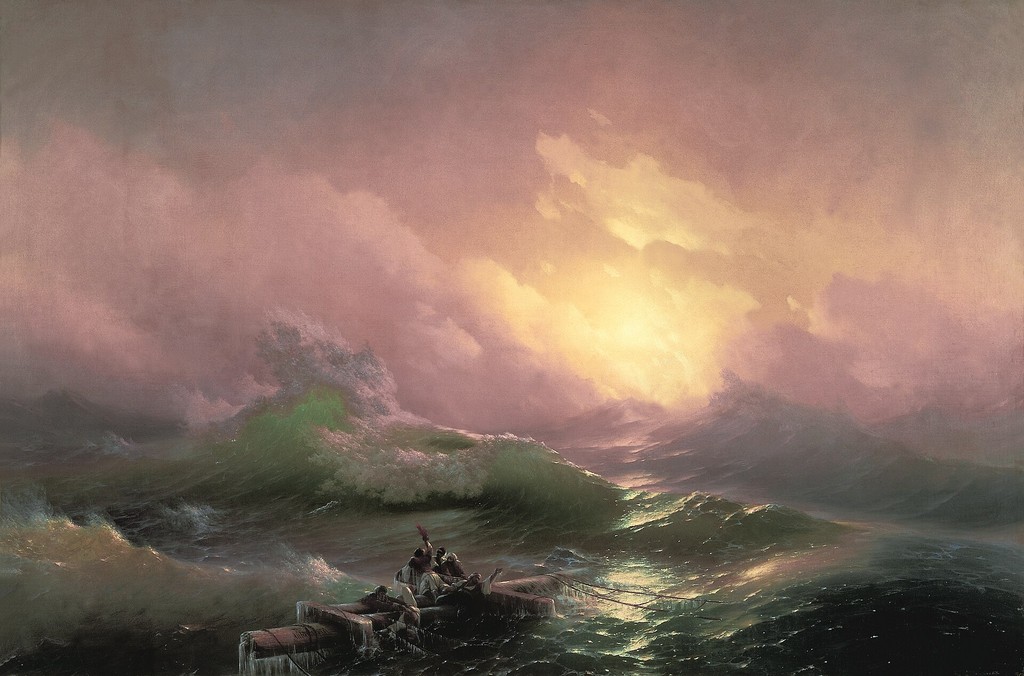
That staging reached a celebrated Romantic form in The Ninth Wave, painted in 1850. Survivors cling to wreckage as a great wave approaches, yet dawn warms the sea with gold and rose. The danger remains real; hope comes through colour and light rather than through any guarantee of rescue. The State Russian Museum identifies the work as a 221 by 332 centimetre canvas, large enough for the opposition between vulnerable bodies and an immense, luminous sea to unfold at public scale.[10]
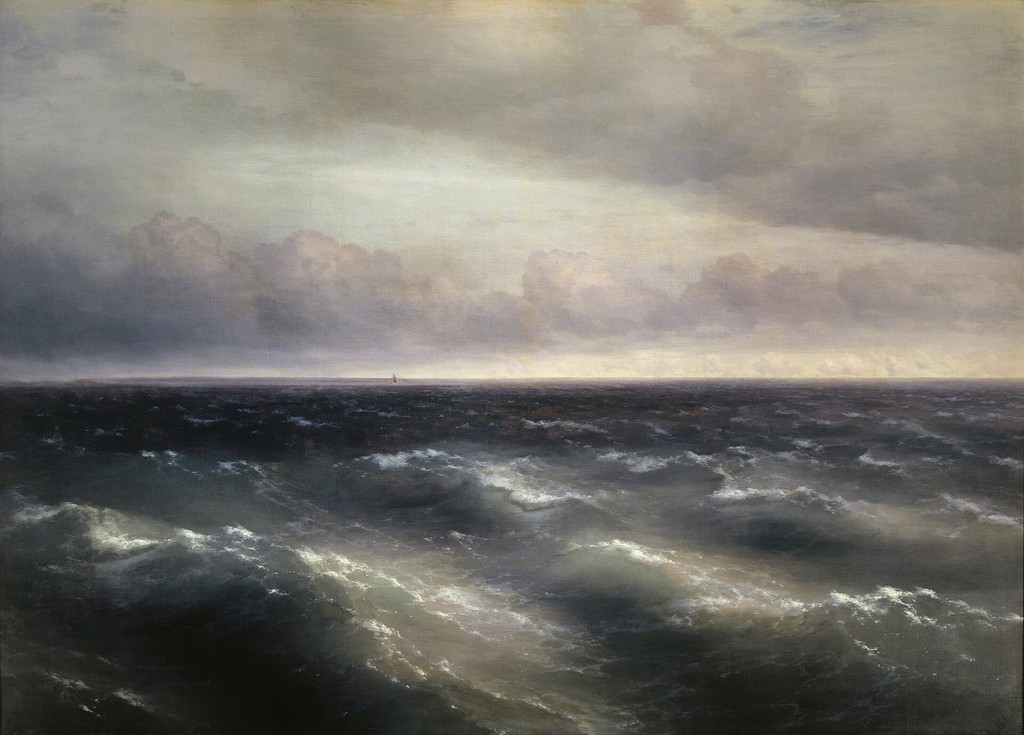
Later paintings could be more restrained. The Black Sea of 1881 largely abandons narrative incident for swelling water beneath a burdened sky. The Tretyakov Gallery’s current object record identifies it as inventory 803 and gives its dimensions as 149 by 210 centimetres; a separate institutional catalogue entry records 149 by 208 centimetres. The small published discrepancy should not obscure the secure identity of the painting. Its sparseness is central: weather gathers across an apparently simple division of sea and sky.[14][15]
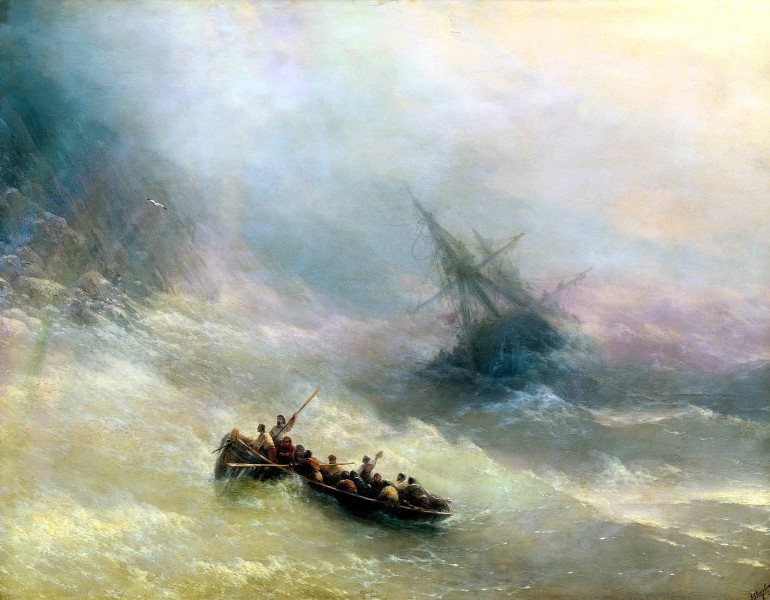
At the other end of the emotional range, Rainbow of 1873 places a boat and scattered figures within mist, spray and refracted light. The rainbow is not decorative punctuation but a change in the painting’s conditions, turning catastrophe towards the possibility of rescue. The current Tretyakov record, inventory 801, gives 105 by 136 centimetres and notes an earlier title, Sunrise on the Black Sea; another institutional catalogue entry gives 102 by 132 centimetres. These records anchor the work despite variation in published dimensions and title history.[16][17]
Naval History and Human Scale
Ships gave Aivazovsky more than picturesque silhouettes. They made human purpose visible against weather and distance, and they connected his marine art to historical events understood by naval audiences. His official relationship with the fleet and his experience aboard vessels helped him distinguish rig, hull and manoeuvre, although he could subordinate such detail to atmosphere when the story required it.[8]
Mercury Brig Meeting a Russian Squadron after her Victory over Two Turkish Vessels is a precise example. Painted in 1848 and now in the State Russian Museum, inventory Ж-2209, it measures 123.5 by 190 centimetres. The canvas does not show the famous combat itself. It presents the damaged brig under sail at the moment of reunion with the squadron. Recognition, endurance and return therefore replace battlefield action as the emotional centre.[13]
This choice is characteristic. Even when a title supplies a naval episode, the human scale often emerges through aftermath: a ship moving out of peril, wreckage after a storm, or small figures attempting to survive. Aivazovsky could celebrate seamanship and naval history while making nature feel larger than command. The tension between competence and exposure gives his most effective narrative seas their urgency.
The vessels therefore require two kinds of looking. Their profiles and rigging connect a scene to maritime knowledge, but their position inside the composition determines its meaning. A ship seen against open radiance can appear to have escaped danger; the same hull beneath compressed cloud can become precarious. People may be tiny, yet a raised arm, crowded boat or fragment of mast gives the eye a measure for the surrounding water. Narrative enters through proportion as much as through incident.[5][8]
An International Career Rooted in One City
Italy was decisive to Aivazovsky’s early maturity. Between 1840 and 1844 he worked there, developed the Romantic language of his marine painting and attracted collectors and public attention. Travel subsequently took him across Europe, the Mediterranean and the Ottoman world, and later to the United States. Exhibitions in numerous cities turned a painter from a Crimean port into an international figure, while subjects drawn from Constantinople, the Aegean and other coasts widened his visual geography.[5][9]
This reach was sustained rather than confined to one youthful tour. In later life, displays in American cities including New York, Chicago, San Francisco and Washington brought his work before audiences far beyond the European networks that had first established his reputation. The appeal did not depend on knowledge of every named coastline or naval event. Calm, danger, nocturnal distance and rescue could cross linguistic boundaries, even as titles and landmarks retained their geographical specificity.[9]
A View of Constantinople by Moonlight belongs to this outward-looking career. The State Russian Museum dates the 124 by 192.5 centimetre painting to 1846 and records it as inventory Ж-1787. Architecture and shipping are held within a nocturnal atmosphere in which reflected light connects the city to the water. The view is tied to travel in the Ottoman region, but its measured radiance also demonstrates how Aivazovsky translated place into a studio construction.[12]
Travel did not dissolve his attachment to Feodosia. By 1846–47 he had established a house and studio there, and visitors entered an active cultural centre rather than a retreat from professional life. In 1880 he added a public picture gallery. He also supported the town’s water supply, archaeology and urban improvements, and ultimately left the gallery to Feodosia. His civic identity was expressed through infrastructure and institutions as well as images.[6][7]
The contrast between movement and return is therefore more useful than the cliché of a solitary painter mesmerised by waves. Foreign courts, international exhibitions, naval voyages, Armenian communities and imperial networks all passed through his career; Feodosia remained its centre of gravity. Explore that geography through Black Sea and Feodosia and the longer account of his travel and international career.[1][4][9]
Six Essential Works
The six paintings in this collection do not pretend to summarise every phase of a long career. Together, however, they provide a strong route through his central problems. A View of Constantinople by Moonlight shows travel converted into atmosphere. The Mercury brig painting uses a particular naval episode but selects reunion instead of combat. The Ninth Wave makes shipwreck monumental while allowing dawn to carry hope.[10][12][13]
The three later works shift the balance. In Rainbow, figures remain within a rescue narrative, but vapour and refracted light complicate the boundary between sea and air. The Black Sea strips away almost every anecdotal cue so that the gathering movement of water becomes the subject. Finally, Wave of 1889 confronts the viewer with a 304 by 505 centimetre storm canvas. The State Russian Museum records it as inventory Ж-2200; its cold darkness and struggling figures make it distinct from Aivazovsky’s similarly titled late seascapes.[11][14][16]
Read chronologically, the group challenges the idea that he merely repeated a successful formula. Moonlight in 1846 is spatial and contemplative; sunrise in 1850 transforms disaster; the 1873 rainbow emerges through spray; the 1881 open sea is austere; the enormous 1889 wave pushes human effort towards the edge of visibility. Recurring devices remain, yet their dramatic functions change.[5][10][11]
The sequence also demonstrates why exact titles and collections matter. A generic reference to “a storm by Aivazovsky” loses the difference between an identifiable historical aftermath and an imagined struggle for survival. It can also confuse versions, similarly named paintings or measurements repeated from older publications. Dates, inventory numbers and current institutional records keep interpretation attached to the right object. For a comparative route through the group, use the paintings guide.[10][11][12][13][14][15][16][17]
Legacy without the Numbers Myth
Aivazovsky’s reputation rests on a large and widely dispersed body of work, but its extent should not be reduced to the often repeated claim that he painted about 6,000 pictures. Museum scholarship identifies that figure as an estimate whose contents cannot now be securely reconstructed. Workshop practice, copies, variants, changing attributions and incomplete documentation make a confident total misleading.[9]
A more useful legacy begins with what can be tested. His paintings joined academic composition to remembered experience, made light a structural force, and brought the Black Sea into dialogue with Mediterranean and international routes. His public gallery and civic work tied artistic fame back to Feodosia, while his Armenian commitments complicate any single national account. Close attention to verified objects reveals both continuity and change across the career without requiring a spectacular total.[1][2][5][6]
That object-led approach also leaves room for revision. Attributions can change, records can disagree over dimensions, and historical titles can reappear beside familiar modern ones. Such differences are reasons to identify collections and inventory numbers, not reasons to abandon interpretation. Once the object is secure, questions of colour, scale, memory and historical setting become sharper rather than narrower.[14][15][16][17]
Follow Ivan Aivazovsky's career through four stages
A Black Sea childhood, academy study and first fleet experience
Born into an Armenian family in Feodosia, Aivazovsky moved from local encouragement to the Imperial Academy of Arts in St Petersburg. Landscape teaching and work around the Crimean coast and fleet gave him both academic structure and direct knowledge of marine conditions.
An academy fellowship becomes an international apprenticeship
Travel in Italy brought Aivazovsky into an active European exhibition world and expanded his repertoire of Mediterranean light, ports and historic coastlines. Recognition abroad arrived before his return to an official career within the Russian Empire.
Gallery, community projects and paintings of growing scale
In later decades Aivazovsky joined artistic production to civic work in Feodosia, opened a public gallery and maintained international contacts. Paintings such as The Black Sea and Wave pared back or darkened earlier Romantic effects without abandoning the sea as his central imaginative subject.
Essential works
The Ninth Wave
1850 · Survivors cling to wreckage as dawn turns an immense oncoming wave into a scene poised between catastrophe and hope.
The Black Sea
1881 · A low horizon, one remote sail and a field of darkening waves replace narrative incident with gathering weather and scale.
Rainbow
1873 · Refracted colour enters a wreck and rescue scene through spray, altering visibility without removing danger.
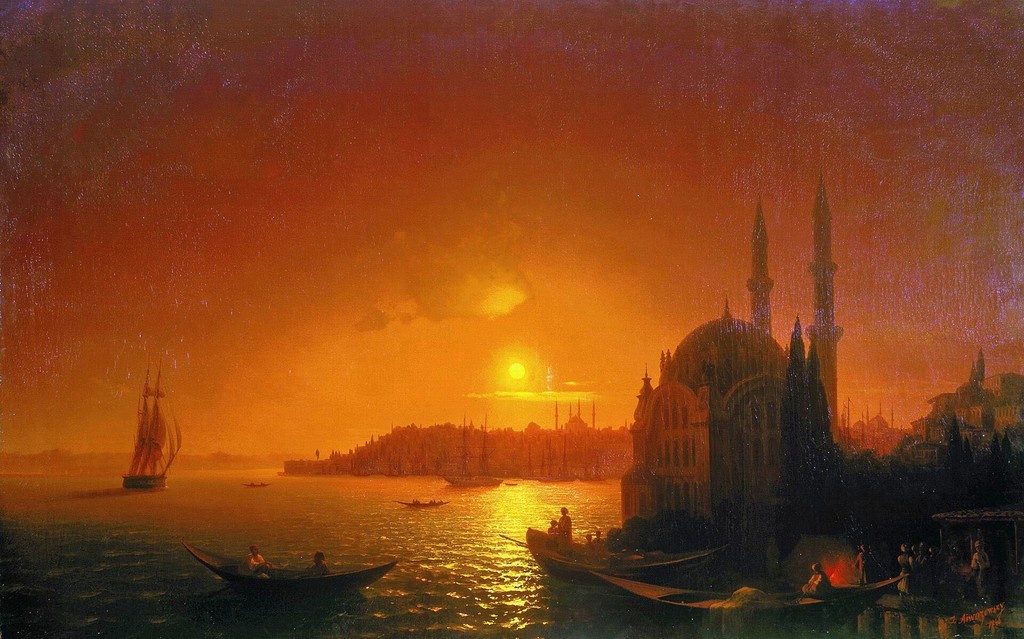
A View of Constantinople by Moonlight
1846 · Moon, reflective water, mosque silhouette, boats and a shore fire turn a travelled city into a concentrated nocturne.
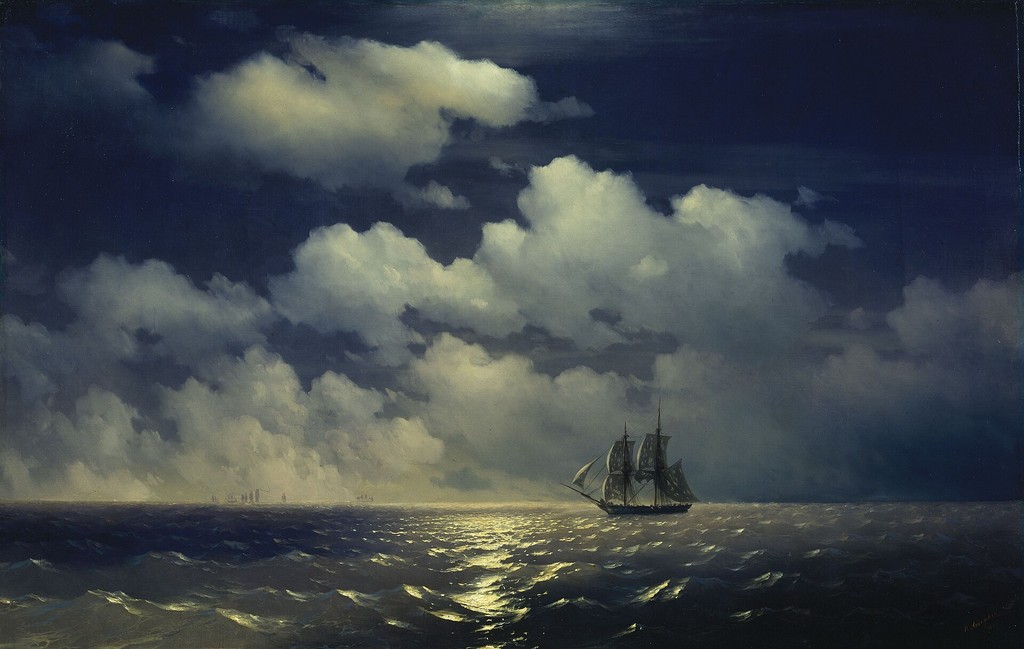
Mercury Brig Meeting the Russian Squadron
1848 · The damaged brig returns after combat, making distance, moonlight and aftermath more important than a battle climax.
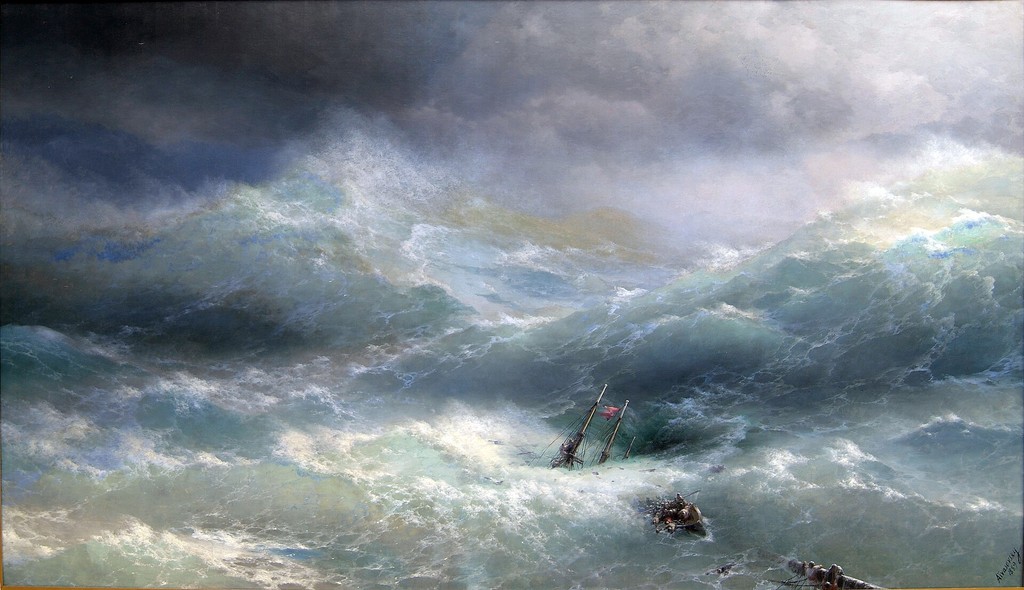
Wave
1889 · A monumental cold sea almost overwhelms wreckage and survivors in one of the artist's starkest late pictures.
Researched works directory
This searchable evidence census was assembled from public museum records and a reproducible Wikidata snapshot. It is not a catalogue raisonné, not a claim to complete oeuvre coverage, and not a substitute for the published catalogue literature, which was not used to claim absolute completeness.
| Name | Date | Medium |
|---|---|---|
| A bay at dawn. | 1896 | Painting |
| A bay near Venice | 1842 | Painting |
| A Moonlit Night at Sea | 1885 | Painting |
| A Moonlit Night on the Bosphorus | 1894 | Painting |
| A Moonlit Night on the Crimean Coast | Date unknown | Painting |
| A Rocky Coastal Landscape in the Aegean with Ships in the Distance (detail) | 1884 | Painting |
| A. S. Pushkin and Countess M. N. Raevskaya by the sea near Gurzuf | 1886 | Painting |
| A. S. Pushkin at the Black Sea coast | 1887 | Painting |
| A. S. Pushkin at the Black Sea coast | 1897 | Painting |
| A Ship in a Stormy Sea | 1892 | Painting |
| A ship in peril | 1894 | Painting |
| A Ship of the Russian Navy off the Coast | Date unknown | Painting |
| A storm on rocky shores | 1875 | Painting |
| A Summer’s Day in Crimea | 1867 | Painting |
| A View of Constantinople by Moonlight | 1846 | Painting |
| A View of the Bosporus with the Hagia Sophia and the Maiden's Tower in the Moonlight | 1884 | Painting |
| A Wagon Train in the Desert | Date unknown | Painting |
| Abandoning Ship | 1882 | Painting |
| After the Storm | 1854 | Painting |
| Aiju-Dag | Date unknown | Painting |
| Aivazovsky Ivan Konstantinovic - Colon Sortint de Palos | 1892 | Painting |
| Aivazovsky - Oath befory Battle of Avarayr | 1892 | Painting |
| Aivazovsky with Friends | 1893 | Painting |
| Alexander II Crossing the Danube | 1878 | Painting |
| Alexander Pushkin at the Top of Ai-Petri at Sunrise | 1899 | Painting |
| Along the Coast | 1850 | Painting |
| Alushta | 1878 | Painting |
| American Shipping off the Rock of Gibraltar | 1873 | Painting |
| Among the Waves | 1898 | Painting |
| Arrival of Catherine II in Feodosia | 1883 | Painting |
| Azure Grotto, Naples | 1841 | Painting |
| Barge at Sea Shore | 1860–1870 | Painting |
| Battle of Chesma | 1848 | Painting |
| Battle of Chesma (1886) | Date unknown | Painting |
| Battle of Chios on 24 June, 1770 | 1848 | Painting |
| Battle of Sinope | 1853 | Painting |
| Beach | 1845 | Painting |
| Before the Storm: Theodosia | Date unknown | Painting |
| Biarritz | 1889 | Painting |
| Black Sea Fleet in the Bay of Theodosia, just before the Crimean War | 1890 | Painting |
| Boat Ride by Kumkapi in Constantinople | 1846 | Painting |
| Bosphorus | 1878 | Painting |
| Bosporuse väin öösel. | 1890 | Painting |
| Bracing The Waves | Date unknown | Painting |
| Breaking Wave | Date unknown | Painting |
| Brig “Mercury” Attacked by Two Turkish Ships | 1892 | Painting |
| Brig ''Mercury'' meets with the Russian squadron after the victory over two Turkish ships | 1848 | Painting |
| Broad landscape with settlers | 1856 | Painting |
| Byron in Venice | Date unknown | Painting |
| Byron's visit to the Mekhitarists in Surb Ghazar Island | 1899 | Painting |
| Byron's visit to the Mekhitarists on San Lazzaro | 1899 | Painting |
| Ca d'Oro | 1878 | Painting |
| Calm early evening sea | 1884 | Painting |
| Calm Sea | 1887 | Painting |
| Carriage in a Storm | Date unknown | Painting |
| Catholicos Khrimyan Airik near Echmiadzin | 1895 | Painting |
| Caucasus from the Sea | 1894 | Painting |
| Chaos. The Genesis | 1841 | Painting |
| Chapel by the sea | 1847 | Painting |
| Chumaks in Little Russia | Date unknown | Painting |
| Chumaks leisure | 1885 | Painting |
| Chumaks Waggons | 1862 | Painting |
| Clashes between the Shirvans and the Murids on Gunib | 1869 | Painting |
| Clouds | 1865 | Painting |
| Clouds Over a Calm Sea | 1873 | Painting |
| Clouds over the Sea, Calm | 1889 | Painting |
| Coast | 1840 | Painting |
| Coast of Amalfi | 1841 | Painting |
| Coffee-house by the Ortaköy Mosque in Constantinople | 1846 | Painting |
| Constantinople, la mosquée de Top-Kahné | 1884 | Painting |
| Constantinople Sunset | 1899 | Painting |
| Crimean coast by moonlight | 1853 | Painting |
| Crimean Coast by Moonlight | 1898 | Painting |
| Crimean scene. Gurzuf at night | 1865 | Painting |
| Crimean Tartars on the Sea Shore | 1850 | Painting |
| Crimean Views | 1850 | Painting |
| Cruiser in the sea at night | 1844 | Painting |
| Dante Shows an Artist Some Unusual Clouds | 1883 | Painting |
| Daryal Gorge | 1868 | Painting |
| Deluge | 1864 | Painting |
| Der Fluss Rioni in Georgien | 1870 | Painting |
| Descent of Noah from Ararat | 1887 | Painting |
| Destruction of Pompeii | 1889 | Painting |
| Distributing Supplies | 1892 | Painting |
| Dusk on the Golden Horn | 1845 | Painting |
| End of Storm | 1839 | Painting |
| Entrance to the Sevastopol Bay. | 1852 | Painting |
| Entrée de port | 1846 | Painting |
| Exchange Of Peterburg | 1840–1847 | Painting |
| Exploding Ship | 1900 | Painting |
| Farm House and Windmill by moonlight | 1863 | Painting |
| Fight of the steamer Vesta with the Turkish battleship Fehti-Bulend in the Black Sea on July 11, 1877 | 1877 | Painting |
| Figures on a moonlit coast | 1858 | Painting |
| Fishermen and their Families on the Shore of the Bay of Naples | 1873 | Painting |
| Fishermen on the Beach | 1852 | Painting |
| Fishermen on the shore | Date unknown | Painting |
| Fishermen Returning Near Naples | 1874 | Painting |
| Fishing Boats In A Harbor | 1854 | Painting |
| Foggy day on the shores of Italy | Date unknown | Painting |
| French Ships Departing the Black Sea | 1871 | Painting |
| Frigate under sail | 1838 | Painting |
| From Mleta to Gudauri | 1868 | Painting |
| Frozen Bosphorus Under Snow (detail) | 1874 | Painting |
| Gathering Storm | 1899 | Painting |
| Golden Horn Bay Turkey | 1846 | Painting |
| Gondolier on the Sea at Night | 1843 | Painting |
| Gulf of Naples | 1874 | Painting |
| Gunboat off Crete | 1897 | Painting |
| Gurzuf at night | 1849 | Painting |
| Harbour Scene | Date unknown | Painting |
| Ice-Breakers on the Frozen Neva in St. Petersburg | 1877 | Painting |
| Ice on Dnipro | 1872 | Painting |
| Icebergs in the Atlantic | 1870 | Painting |
| In the harbor | 1840 | Painting |
| In the roads, Evening | 1867 | Painting |
| Italian Landscape | 1855 | Painting |
| Italian Landscape (Lago Maggiore), Evening | 1858 | Painting |
| Iwan Konstantinowitsch Aiwasowskij 001 | 1864 | Painting |
| Jalta | 1838 | Painting |
| Jude's the Apostol betrayal | 1834 | Drawing |
| La Vague | 1886 | Painting |
| Landscape in Crimea. | 1860 | Painting |
| Landscape with Windmills | 1860 | Painting |
| Large raid in Kronstadt | 1836 | Painting |
| Little Russian Ox Cart in Winter | 1866 | Painting |
| Loading Provisions off the Crimean Coast | 1876 | Painting |
| Look to the Large Cascade and Large Petergof Palace | 1837 | Painting |
| Marine scene | Date unknown | Painting |
| Marine View | 1899 | Painting |
| Mercury Brig Meeting a Russian Squadron after her Victory over Two Turkish Vessels | 1848 | Painting |
| Meri | Date unknown | Painting |
| Mine attack by boats of the steamer Grand Duke Constantine on the Turkish battleship Assari-Shevket on the Sukhum roadstead on August 12, 1877 | 1877 | Painting |
| Moon night on the Crimea, Gurzuf | 1839 | Painting |
| Moonlight at night near the spring | 1877 | Painting |
| Moonlight in Naples | 1842 | Painting |
| Moonlit coast | 1864 | Painting |
| Moonlit Landing | 1895 | Painting |
| Moonlit Night | 1850 | Painting |
| Moonlit Night | 1878 | Painting |
| Moonlit Night (1958) | 1858 | Painting |
| Moonlit Night (Aivazovsky) | Date unknown | Painting |
| Moonlit night in Crimea | 1859 | Painting |
| Moonlit night on the seashore in Crimea | 1852 | Painting |
| Moonlit Seascape With Shipwreck | 1863 | Painting |
| Morning on the sea | 1883 | Painting |
| Morning on the shore of the bay | 1853 | Painting |
| Mountain Village Gunib in Daghestan. View from the East. | 1869 | Painting |
| Naples Bay | 1842 | Painting |
| Naples with a poet amongst fishermen | 1845 | Painting |
| Naufragiul 1886 | 1886 | Painting |
| Neapolitan lighthouse. | 1842 | Painting |
| Night at Gurzof | 1891 | Painting |
| Night at the Rodos island | 1850 | Painting |
| Night in Constantinople | 1862 | Painting |
| Night in Venice | 1847 | Painting |
| Night. The Tragedy at the Sea of Marmara | 1897 | Painting |
| Nocturnal Voyage | Date unknown | Painting |
| Odessa at Moonlight | 1846 | Painting |
| Odessa, view from the Sea | 1865 | Painting |
| Old Feodosia | 1839 | Painting |
| Old Theodosia | 1845 | Painting |
| Ox-carts in the Ukrainian steppe | 1888 | Painting |
| Panorama of Constantinopole (detail) | 1856 | Painting |
| Parade of the Black Sea Fleet | 1886 | Painting |
| Passage of the Jews through the Red Sea | 1891 | Painting |
| Passing Ship on a Moonlit Night | 1868 | Painting |
| Peter | 1846 | Painting |
| Peter I at Krasnaya Gorka Lighting a Fire on the Shore to Signal to his Sinking Ships | 1900 | Painting |
| Petersburg. Crossing the Neva. | 1870 | Painting |
| Port of Theodosia | Date unknown | Painting |
| Portrait of A. Kaznacheev | 1847 | Painting |
| Portrait of a man | Date unknown | Drawing |
| Portrait of a Teenager | Date unknown | Painting |
| Portrait of archbishop Gabriel Aivazyan (brother of I. Aivazovsky) | 1883 | Painting |
| Portrait of the grandmother of painter Ashhen | 1858 | Painting |
| Portrait of vice admiral M.P. Lazarev | 1839 | Painting |
| Pushkin and Raevskaya in Gurzuf | 1900 | Painting |
| Pushkin in Crimea near Gurzuf rocks | 1880 | Painting |
| Pushkin's Farewell to the sea | 1887 | Painting |
| Q108330660 | 1847 | Painting |
| Q138511047 | 1857 | Painting |
| Q27074794 | Date unknown | Painting |
| Quiet Night: Armenians Thrown Overboard off the Turkish Ships | 1897 | Painting |
| Rainbow | 1873 | Painting |
| Reeds on the Dnieper | 1857 | Painting |
| Rescuers from the shipwreck | 1844 | Painting |
| Reval (Tallinn) | 1845 | Painting |
| Road in the Forest | 1857 | Painting |
| Rocky Cliffs | 1891 | Painting |
| Rocky Seashore | 1876 | Painting |
| Russian squadron at the Sevastopol roadstead | 1849 | Painting |
| Sailboat . | 1859 | Painting |
| Sailing Boat | Date unknown | Drawing |
| Sailing Ship on a calm sea by Moonlight | 1897 | Painting |
| Sailing Ship on the Sea at Moonlight. | 1840 | Painting |
| Sailing Ships on a Calm Day. | 1887 | Painting |
| Sarkizova Ann, second wife of I. Aivazovsky | 1882 | Painting |
| Scenes from Cairo's life | 1881 | Painting |
| Sea | 1864 | Painting |
| Sea Battle at Navarino on October 20, 1827 | 1846 | Painting |
| Sea coast | 1886 | Painting |
| Sea coast at night. Near the beacon | 1837 | Painting |
| Sea on a Moonlit Night | 1857 | Painting |
| Sea on a Moonlit Night | 1858 | Painting |
| Sea View | 1855 | Painting |
| Sea View | 1875 | Painting |
| Sea view from the chapel on the shore | 1845 | Painting |
| Seascape | 1885 | Painting |
| Seascape | Date unknown | Painting |
| Seascape with a steamer. | 1897 | Painting |
| Seascape with full moon | 1857 | Painting |
| Sebastopol | 1852 | Painting |
| Selbstportrait | 1881 | Painting |
| Selbstporträt | 1892 | Painting |
| Self-portrait | 1874 | Painting |
| Self-Portrait | 1898 | Painting |
| Sheep driven by the storm into the sea. | 1855 | Painting |
| Shepherds' Camp | 1858 | Painting |
| Shepherds with a flock of sheep. | 1872 | Painting |
| Ship Amid the Stormy Sea | 1887 | Painting |
| Ship by Moonlight | 1868 | Painting |
| Ship, castle and sea | 1847 | Painting |
| Ship ''Empress Maria'' in a Storm | 1892 | Painting |
| Ship in a storm | 1899 | Painting |
| Ship in a Stormy Sea off the Coast | 1895 | Painting |
| Ship on Stormy Seas | 1850 | Painting |
| Ship "Twelve Apostles | 1897 | Painting |
| Ships at the raging sea | 1866 | Painting |
| Ships on a misty morning | Date unknown | Painting |
| Ships on Stormy Sea, Sunrise | 1871 | Painting |
| Shipwreck | 1843 | Painting |
| shipwreck | 1876 | Painting |
| Shipwreck in the North Sea | 1875 | Painting |
| Shipwreck of "Lefort | 1858 | Painting |
| Shipwreck off the Black Sea Coast | 1887 | Painting |
| Shipwreck on a Stormy Morning | 1895 | Painting |
| Shipwreck on Stormy Seas | 1886 | Painting |
| Shoreline | 1851 | Painting |
| Sinking Ship | 1854 | Drawing |
| Smolny Abbey. Sunset. | 1847 | Painting |
| Solar Eclipse in Feodosia | 1876 | Painting |
| St. George Monastery. Cape Fiolent | 1846 | Painting |
| St. Petersburg | 1850 | Painting |
| St. Petersburg - Galleon on the docks | 1850 | Painting |
| Steamboat on a Moonlit Night | 1884 | Painting |
| Storm | 1851 | Painting |
| Storm | 1854 | Drawing |
| Storm | 1861 | Painting |
| Storm | 1872 | Painting |
| Storm | 1880 | Painting |
| Storm | 1886 | Painting |
| Storm | 1899 | Painting |
| Storm (1871) | 1871 | Painting |
| Storm at sea | 1850 | Painting |
| Storm at sea | 1873 | Painting |
| Storm at Sea on a Moonlit Night | 1866 | Painting |
| Storm off the coast of Odessa | 1898 | Painting |
| Storm on Sea | 1899 | Painting |
| Storm on the Sea | 1876 | Painting |
| Storm over Eupatoria | 1900 | Painting |
| Stormy Sea | 1844 | Painting |
| Stormy Sea | 1850 | Painting |
| Stormy sea at night | 1849 | Painting |
| Strong Wind | 1856 | Painting |
| Stürmische See im Abendrot. | 1896 | Painting |
| Suez Canal | 1869 | Painting |
| Sunny Day | 1884 | Painting |
| Sunset | 1879 | Artwork |
| Sunset at Sea | 1851 | Painting |
| Sunset at sea | 1877 | Painting |
| Sunset at the Sea | 1848 | Painting |
| Sunset over the Golden Horn | 1866 | Painting |
| Sunset over Yalta | 1861 | Painting |
| Survivors | 1844 | Painting |
| Sveaborg | 1844 | Painting |
| The Baptism of the Armenian People. Gregory the Illuminator | 1892 | Painting |
| The Battle of Revel | 1846 | Painting |
| The Battle of Sinope on 18 November 1853 (Night after Battle) | 1853 | Painting |
| The Battle of Vyborg Bay in 1790. | Date unknown | Painting |
| The Battle of Wyborg Bay | 1846 | Painting |
| The Bay of Naples | 1841 | Painting |
| The Bay of Naples | 1844 | Painting |
| The Bay of Naples | 1845 | Painting |
| The Bay of Naples | 1878 | Painting |
| The Bay of Naples. | Date unknown | Painting |
| The Bay of Naples with Capri | 1891 | Painting |
| The Bay of Yalta with the Magobi and Ai Petri mountains | 1850 | Painting |
| The Beach at Biarritz | Date unknown | Painting |
| The birth of Aphrodite | Date unknown | Painting |
| The Black Sea | 1881 | Painting |
| The Black Sea at night | 1879 | Painting |
| The Black Sea Fleet in Feodosia | 1890 | Painting |
| The Black Sea (Marina) | 1882 | Painting |
| The Burning of the Turkish Flagship by Kanaris | 1881 | Painting |
| The Canal Grande with a view of Santa Maria della Salute at sunset. | 1848 | Painting |
| The Caucasus | 1863 | Painting |
| The Disembarkation of Christopher Columbus with Companions on Three Launches, on Friday 12th October 1492, At Sunrise, on an American Island Named San Salvador by Him on the Very Same Day | Date unknown | Painting |
| The Galata Tower by Moonlight | 1845 | Painting |
| The Great Pyramid at Giza | 1871 | Painting |
| The Harbor at Odessa on the Black Sea | 1852 | Painting |
| The Island of Ischia at Sunset (Sunset over Ischia) | 1857 | Painting |
| The Island of Rhodes | 1861 | Painting |
| The Landing of N. N. Raevskyi at Subashi | 1839 | Painting |
| The Maiden's Tower | 1848 | Painting |
| The Massacre of Armenians in Trebizond in 1895 | 1897 | Painting |
| The Mekhitarist Fathers on Lazarus Island, Venice | 1843 | Painting |
| The Mekhitarist Fathers on San Lazzaro Island. Venice | 1843 | Painting |
| The Ninth Wave | 1850 | Painting |
| The Relief Ship | 1892 | Painting |
| The Rescue | Date unknown | Painting |
| The Russian Squadron on the Sebastopol Roads | 1846 | Painting |
| The Sea | 1865 | Painting |
| The Shipwreck | 1873 | Painting |
| The Shipwreck | Date unknown | Painting |
| The Shores of the Mediterranean | 1892 | Painting |
| The storm at Cape Aya | 1899 | Painting |
| The storm at sea | 1850 | Painting |
| The Storm on the Turkish Coast | 1858 | Painting |
| The strip "Swetlana | Date unknown | Painting |
| The Survivor | 1880 | Painting |
| The survivors | 1895 | Painting |
| The Tide | 1870 | Painting |
| The Wrath of the Seas | 1886 | Painting |
| Theodosia Bay, sunrise | 1855 | Painting |
| Theodosia, end of day | 1865 | Painting |
| Theodosia. Moonlight night | 1852 | Painting |
| Trebizond from the sea | 1875 | Painting |
| Ukrainian Landscape at Night | 1870 | Painting |
| Ukrainian landscape with chumaks in the moonlight | 1869 | Painting |
| untitled | Date unknown | Painting |
| Venetian lagoon. View of the island of San Giorgio. | 1844 | Painting |
| Venice | 1844 | Painting |
| Venice at Sunset | 1873 | Painting |
| View in Crimea at sunset | 1862 | Painting |
| View of a bay with numerous sailing-ships (Feodosia?) | Date unknown | Drawing |
| View of Constantinople and the Bosphorus | 1856 | Painting |
| View of Constantinople by evening light | 1846 | Painting |
| View of Moscow from the Sparrow Hills | 1851 | Painting |
| View of Odessa on a moonlit night | 1855 | Painting |
| View Of The Ayu Dag Crimea | 1868 | Painting |
| View Of The Sea From The Mountains At Sunset. Crimea | 1900 | Painting |
| View of Vico near Naples | 1855 | Painting |
| View to the Crim | 1851 | Painting |
| View to the sea coast near St. Petersburg | 1835 | Painting |
| Volga near the Zhiguli Mountains | 1887 | Painting |
| Walking on Water | 1888 | Painting |
| Walking on Water | 1890 | Painting |
| Wave | 1889 | Painting |
| Wave hitting a Rock | 1860 | Painting |
| Wave. Two Ships | Date unknown | Painting |
| Windmill by the Sea | 1837 | Painting |
| Winter Caravan on Road | 1857 | Painting |
| Winter in Ukraine | 1874 | Drawing |
| Winter landscape | 1876 | Painting |
| Winter Scene in Little Russia | 1868 | Painting |
| Wreck of the ship "Ingermanland" in Skagerrak on the night of August 30, 1842. | Date unknown | Painting |
| Yalta | 1899 | Painting |
Frequently Asked Questions
Ivan Aivazovsky was a nineteenth-century Armenian marine painter born in Feodosia in 1817. He trained at the Imperial Academy of Arts, became closely associated with Russian artistic and naval institutions, travelled and exhibited internationally, and maintained Armenian cultural and civic commitments throughout his life.[1][2][4][8]
Those modern alternatives do not adequately describe his historical position. He was Armenian, was born in Crimea when it belonged to the Russian Empire, built a central career within Russian art, and lived chiefly in Feodosia, which is now in Ukraine. Keeping all those facts visible is more accurate than assigning him one exclusive label.[1][4]
He observed coasts, ships and weather directly, including during voyages, but generally constructed major paintings in the studio through visual and emotional memory. Memory helped him select and combine effects rather than copy one passing instant. His seas are grounded in experience and deliberately composed.[3][5][8]
The Ninth Wave of 1850 is generally his best-known work. Its scale, shipwreck subject and glowing dawn make it an emblem of his Romantic approach. It should be seen alongside quieter and later paintings, particularly The Black Sea and Wave, which show how far his treatment of water could change.[5][10][11][14]
The number is widely repeated but should not be treated as an audited total. Institutional scholarship explains that the estimate is difficult to define and verify. It is safer to discuss documented paintings with secure collection identities, dates and provenance than to turn uncertain quantity into the measure of his achievement.[9]
Discussion
Use this evidence-led guide as a starting point for close looking rather than a final verdict.
Share an observation about Ivan Aivazovsky or a source that adds useful context.
Reader Insights
Which work most clearly complicates the familiar image of Aivazovsky as a painter of spectacular storms?
Where do Feodosia, Armenian identity, academy training, travel or naval service most productively alter your reading?
Which source or surviving object would you investigate next?
Join the Conversation
Add your reading below, keeping observations specific and evidence clear.
References
- Metropolitan Museum of Art, “Ship by Moonlight”, accessed 30 August 2026.
- Ararat Aghasyan, Enchanted by the Sea: Ivan (Hovhannes) Aivazovsky, National Academy of Sciences of Armenia, accessed 30 August 2026.
- Ararat Aghasyan, “The Exceptional Master of Seascapes”, National Academy of Sciences of Armenia, accessed 30 August 2026.
- Tretyakov Gallery Magazine, “The Aivazovsky Brothers”, accessed 30 August 2026.
- Tretyakov Gallery Magazine, “Artist of the Hellenic Spirit”, accessed 30 August 2026.
- Tretyakov Gallery Magazine, “Father of the Town: Ivan Aivazovsky and Feodosia”, accessed 30 August 2026.
- Tretyakov Gallery Magazine, “Aivazovsky’s House and Guests”, accessed 30 August 2026.
- Tretyakov Gallery Magazine, “The Great Seascape Artist and the Russian Imperial Family”, accessed 30 August 2026.
- Tretyakov Gallery Magazine, “Aivazovsky Outside Russia”, accessed 30 August 2026.
- State Russian Museum, “The Ninth Wave”, accessed 30 August 2026.
- State Russian Museum, “Wave”, accessed 30 August 2026.
- State Russian Museum, “A View of Constantinople by Moonlight”, accessed 30 August 2026.
- State Russian Museum, “Mercury Brig Meeting a Russian Squadron after her Victory over Two Turkish Vessels”, accessed 30 August 2026.
- State Tretyakov Gallery, “The Black Sea”, accessed 30 August 2026.
- Tretyakov Gallery Magazine, “The Black Sea” catalogue entry, accessed 30 August 2026.
- State Tretyakov Gallery, “Rainbow”, accessed 30 August 2026.
- Tretyakov Gallery Magazine, “Rainbow” catalogue entry, accessed 30 August 2026.