 by Tom Gurney
Tom Gurney BSc (Hons) is an art history expert with over 20 years experience
Page Created on / Page Updated on
Email: tomgurney1@gmail.com / Phone: +44 7429 011000
The Black Sea: Introduction
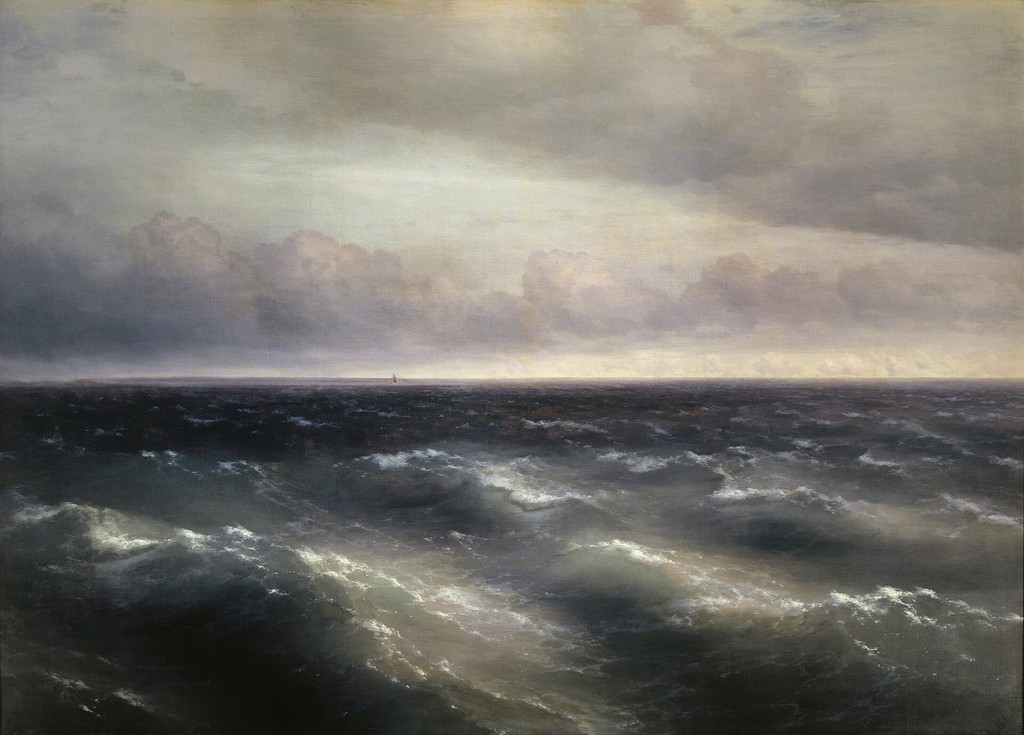
Ivan Aivazovsky’s The Black Sea makes approaching weather compelling without showing a wreck, rescue or named event. Dark water advances across the foreground in uneven ridges; a minute sail interrupts the remote distance; cloud occupies the sky above a narrow, pallid opening. The storm is not yet at its height. By choosing its onset, Aivazovsky turns an almost empty marine view into an image of pressure gathering over time.
The painting dates from 1881 and belongs to the State Tretyakov Gallery as inventory 803. Its fuller institutional title includes A Storm Begins to Whip Up in the Black Sea, wording that makes transition part of the subject.[1] Two Tretyakov-associated records publish different widths: the current object page gives 149 by 210 centimetres, while an affiliated catalogue lists 149 by 208 centimetres.[1][2] Neither figure needs to displace the other; date, collection and inventory securely identify the oil on canvas.
At a Glance
- ArtistIvan Aivazovsky (1817–1900).
- Date and medium1881, oil on canvas.[1][2]
- CollectionState Tretyakov Gallery, inventory 803.[1]
- Published dimensions149 by 210 centimetres in the current record; 149 by 208 centimetres in the affiliated catalogue.[1][2]
- Expanded titleA Storm Begins to Whip Up in the Black Sea.[1]
- ProvenancePavel Tretyakov acquired the picture directly from Aivazovsky in 1881.[1]
Ivan Aivazovsky in context
Contents
- Introduction
- One Object, Two Published Widths
- A Composition with Almost No Incident
- The Low Horizon and the Distant Sail
- Movement without a Shipwreck
- Grey Light and Withholding Sky
- Tretyakov, Kramskoi and the Painting’s Reception
- A Late Alternative to The Ninth Wave
One Object, Two Published Widths
The familiar short title, The Black Sea, names a place but not a coast. Its expanded form describes a weather change rather than supplying a narrative: a storm begins to rise over that body of water. No harbour, town or headland in the image identifies a viewpoint. The absence of landmarks matters because the exact object should not be converted into a supposed view from Aivazovsky’s house or assigned to a particular voyage.
Inventory 803 provides the firmest key. The State Tretyakov Gallery records the canvas as 149 centimetres high and 210 wide, with oil on canvas as its medium.[1] A separate Tretyakov Gallery Magazine illustration record gives the same title, year, medium and collection, but a width of 208 centimetres.[2] The two-centimetre difference is a bibliographical fact, not an invitation to guess which record reflects trimming, rounding or error. Neither source explains the variation.
Both measurements describe a broad horizontal format. That proportion allows the visible sea to extend well beyond the solitary vessel and gives the weather room to develop laterally. Interpretation can proceed from that stable shape while the precise published width remains openly unresolved.
A Composition with Almost No Incident
The canvas is built from two immense fields, water and air. There is no foreground shore from which the viewer can feel protected, no large ship to dominate the centre and no wreckage to establish a dramatic episode. Even the sailboat is so small that it is first encountered as a vertical accent near the horizon. Emptiness is therefore not a lack of subject; it is the condition that lets scale become the subject.
Within the sea, simplicity gives way to variation. Broad, dark swells cross the foreground at oblique angles. Their crests do not align into decorative stripes: some lift into pale foam, some dissolve before breaking, and others remain heavy green-grey masses. Farther away, these intervals become tighter until the surface gathers into a darker band. The change in size allows depth to emerge without a coastline.
The sky is comparably spare but not uniform. Long cloud banks sit over the horizon, with a larger grey canopy spreading above them. A light passage persists between those layers and the water. Nothing in the picture is still, yet nothing depends on a single theatrical gesture. For a broader comparison of calm, storm and shipwreck structures, see the paintings guide.
The frame contributes to this exposure. Water meets the entire lower edge, cutting through swells before their forms can be contained. Cloud is likewise cropped across the top and sides. The view consequently feels like a selected portion of conditions continuing beyond the canvas, whereas the isolated sail remains fully surrounded by open space. With no dry foreground or enclosing coast, the viewer receives no equivalent place of stability within the scene.
The Low Horizon and the Distant Sail
Aivazovsky keeps the horizon low and almost uninterrupted, making it a prolonged interval rather than a destination. The pale strip immediately above it separates dark sea from descending cloud, but it does not open towards visible land. Distance remains available to the eye while withholding any promised refuge.
Against this long division, the sail is extraordinarily economical. Its mast and warm-toned canvas make a slight upright mark left of centre. Because almost every surrounding form runs horizontally or diagonally, that small vertical registers clearly despite its size. It supplies a familiar unit against which the reach of water and sky can be felt.
The vessel also introduces vulnerability without telling a complete story. Its name, crew, route and relation to the coming storm are unknown. It may be moving across the water or simply holding its course; the still image does not resolve the distinction. What matters is proportional: human navigation occupies a tiny portion of an environment already changing around it.
The eye reaches that vessel through alternating obstacles and openings. Foreground crests repeatedly interrupt recession, while smoother intervals between them permit brief sightlines towards the pale distance. The sail is not positioned at the end of one obvious path. Searching for it becomes part of experiencing the scale: an almost negligible mark must be recovered from a much broader field of weather.
The title locates that encounter on the Black Sea, but the image offers no evidence for a specific shore. Aivazovsky’s connection to the region was both biographical and imaginative, as the account of the Black Sea and Feodosia explains. That history can inform the painting without turning its anonymous horizon into topographical documentation.
Movement without a Shipwreck
Many famous Aivazovsky storms concentrate force in one towering breaker or stage danger around damaged people and vessels. Here movement is distributed. The nearest ridges rise at different angles, then recur in reduced form towards the horizon. Broken foam appears across several zones, so the eye cannot settle on one wave as the decisive event. The whole surface seems to be entering a more agitated state.
The expanded title reinforces this duration. “Begins” places the scene before culmination: the wind and water are gathering strength, but the eventual severity remains unseen. That choice creates suspense without an aftermath. No broken mast proves that disaster has occurred, and no rescue boat channels attention towards survival. The solitary sail makes the possibility of danger intelligible while leaving its outcome entirely outside the picture.
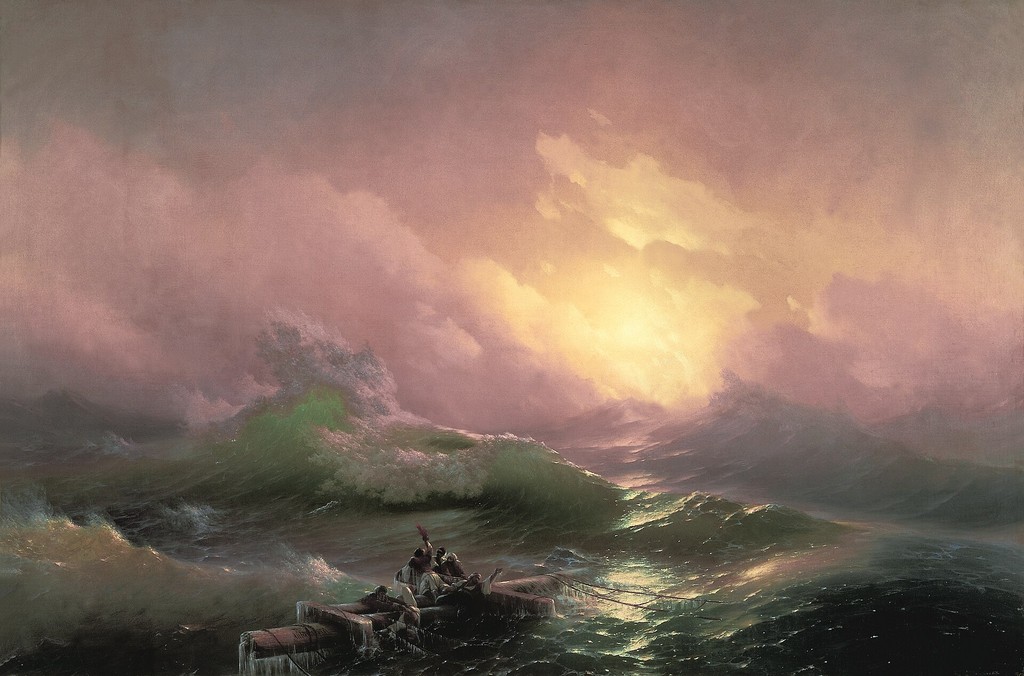
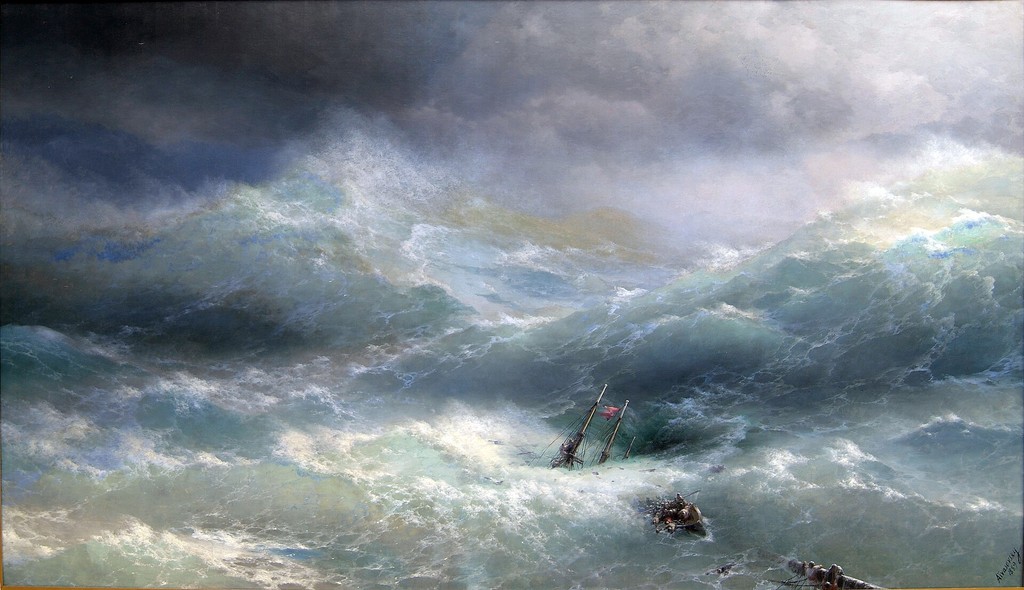
This restraint distinguishes the work from The Ninth Wave. In the 1850 canvas, people already cling to wreckage as a culminating swell approaches. The Black Sea offers neither a past catastrophe nor an individually legible ordeal. Its time is meteorological rather than anecdotal: successive changes in the wave field make the coming storm imaginable.
Grey Light and Withholding Sky
Light does not enter this painting as a radiant disc, a moonlit track or a saturated dawn. It spreads diffusely through grey, violet and muted yellow passages. Near the horizon, the brightest zone remains thin and remote. Across the foreground, cooler glints catch raised water only briefly before sinking back into darker troughs. Illumination clarifies the swell without promising that the weather will clear.
The clouds make that light feel conditional. A low procession of denser forms crosses the distance, while the upper mass extends beyond the frame. Their edges are softened enough to belong to one atmosphere, but tonal differences prevent the sky from becoming an undivided ceiling. The effect is pressure rather than sudden impact: visibility persists beneath a burden that appears to be increasing.
Restraint does not make the painting colourless. Green enters the darkest water, violet-brown tones warm portions of the cloud, and subdued cream light touches selected crests. None of these hues forms an isolated display. Each is absorbed into an extensive grey range, allowing chromatic difference to describe depth and motion without breaking the picture’s sombre unity.
Tretyakov scholarship places The Black Sea among the works in which Aivazovsky exchanged conspicuous display for a more searching treatment of nature. Galina Churak describes its moving ocean as carrying a wider meditation on human life and fate, and links later paintings to increasingly universal ideas of natural power.[3] That is a scholarly interpretation, not a literal programme supplied by the title. The visual basis for it lies in the disproportion between the minute vessel and the two vast elements around it.
The page on light, memory and marine technique follows how tonal sequence and atmosphere operate across several works. Here their effect is unusually severe: light tells us where the sea turns, yet refuses the brilliant release familiar from some earlier storms.
Tretyakov, Kramskoi and the Painting’s Reception
The gallery records that Pavel Tretyakov bought The Black Sea from Aivazovsky in the year it was painted.[1] Direct acquisition establishes a concise provenance, although it does not by itself prove that Tretyakov commissioned the work. The institution’s account also notes that the collector had been cautious about adding many Aivazovsky paintings, concerned by the artist’s tendency to repeat successful effects. This canvas attracted him through its distinctiveness.[1]
Ivan Kramskoi provides another revealing response. Tretyakov scholarship reports his earlier scepticism about Aivazovsky’s exceptionally pure colour, followed by profound admiration when he encountered The Black Sea.[3] His reaction suggests that contemporaries could recognise the painting’s austerity as a fresh achievement rather than a failure to supply familiar spectacle.
Such reception does not replace close looking, but it helps locate the work within debates around Aivazovsky’s popularity. A picture with virtually no event impressed viewers accustomed to judging both his technical brilliance and his repetitions. Its force depended on reduction: sea, cloud, a distant sail and the expectation of change.
A Late Alternative to The Ninth Wave
Thirty-one years separate The Black Sea from The Ninth Wave. The earlier painting uses warm dawn, exposed survivors and broken timber to hold terror beside hope. The later canvas removes the rescue narrative and keeps illumination subdued. Both make human scale vulnerable, but one does so through bodies near the foreground and the other through a sail nearly absorbed by distance.[3]
That difference should not become a simple claim that Aivazovsky abandoned Romanticism for truth. The later painting still enlarges nature emotionally, and its ordered wave field is no neutral weather report. What changes is the means: anticipation replaces aftermath, repetition across water replaces one emblematic crest, and grey atmosphere replaces prismatic colour.
The 1889 Wave develops another late answer, returning to wreckage and human exposure within a far more monumental mass of water.[3] Seen between the radiant 1850 picture and that later storm, The Black Sea occupies a distinct position. It achieves gravity through a nearly empty horizon and an event that has only begun.
Researched works directory
This searchable evidence census was assembled from public museum records and a reproducible Wikidata snapshot. It is not a catalogue raisonné, not a claim to complete oeuvre coverage, and not a substitute for the published catalogue literature, which was not used to claim absolute completeness.
| Name | Date | Medium |
|---|---|---|
| A bay at dawn. | 1896 | Painting |
| A bay near Venice | 1842 | Painting |
| A Moonlit Night at Sea | 1885 | Painting |
| A Moonlit Night on the Bosphorus | 1894 | Painting |
| A Moonlit Night on the Crimean Coast | Date unknown | Painting |
| A Rocky Coastal Landscape in the Aegean with Ships in the Distance (detail) | 1884 | Painting |
| A. S. Pushkin and Countess M. N. Raevskaya by the sea near Gurzuf | 1886 | Painting |
| A. S. Pushkin at the Black Sea coast | 1887 | Painting |
| A. S. Pushkin at the Black Sea coast | 1897 | Painting |
| A Ship in a Stormy Sea | 1892 | Painting |
| A ship in peril | 1894 | Painting |
| A Ship of the Russian Navy off the Coast | Date unknown | Painting |
| A storm on rocky shores | 1875 | Painting |
| A Summer’s Day in Crimea | 1867 | Painting |
| A View of Constantinople by Moonlight | 1846 | Painting |
| A View of the Bosporus with the Hagia Sophia and the Maiden's Tower in the Moonlight | 1884 | Painting |
| A Wagon Train in the Desert | Date unknown | Painting |
| Abandoning Ship | 1882 | Painting |
| After the Storm | 1854 | Painting |
| Aiju-Dag | Date unknown | Painting |
| Aivazovsky Ivan Konstantinovic - Colon Sortint de Palos | 1892 | Painting |
| Aivazovsky - Oath befory Battle of Avarayr | 1892 | Painting |
| Aivazovsky with Friends | 1893 | Painting |
| Alexander II Crossing the Danube | 1878 | Painting |
| Alexander Pushkin at the Top of Ai-Petri at Sunrise | 1899 | Painting |
| Along the Coast | 1850 | Painting |
| Alushta | 1878 | Painting |
| American Shipping off the Rock of Gibraltar | 1873 | Painting |
| Among the Waves | 1898 | Painting |
| Arrival of Catherine II in Feodosia | 1883 | Painting |
| Azure Grotto, Naples | 1841 | Painting |
| Barge at Sea Shore | 1860–1870 | Painting |
| Battle of Chesma | 1848 | Painting |
| Battle of Chesma (1886) | Date unknown | Painting |
| Battle of Chios on 24 June, 1770 | 1848 | Painting |
| Battle of Sinope | 1853 | Painting |
| Beach | 1845 | Painting |
| Before the Storm: Theodosia | Date unknown | Painting |
| Biarritz | 1889 | Painting |
| Black Sea Fleet in the Bay of Theodosia, just before the Crimean War | 1890 | Painting |
| Boat Ride by Kumkapi in Constantinople | 1846 | Painting |
| Bosphorus | 1878 | Painting |
| Bosporuse väin öösel. | 1890 | Painting |
| Bracing The Waves | Date unknown | Painting |
| Breaking Wave | Date unknown | Painting |
| Brig “Mercury” Attacked by Two Turkish Ships | 1892 | Painting |
| Brig ''Mercury'' meets with the Russian squadron after the victory over two Turkish ships | 1848 | Painting |
| Broad landscape with settlers | 1856 | Painting |
| Byron in Venice | Date unknown | Painting |
| Byron's visit to the Mekhitarists in Surb Ghazar Island | 1899 | Painting |
| Byron's visit to the Mekhitarists on San Lazzaro | 1899 | Painting |
| Ca d'Oro | 1878 | Painting |
| Calm early evening sea | 1884 | Painting |
| Calm Sea | 1887 | Painting |
| Carriage in a Storm | Date unknown | Painting |
| Catholicos Khrimyan Airik near Echmiadzin | 1895 | Painting |
| Caucasus from the Sea | 1894 | Painting |
| Chaos. The Genesis | 1841 | Painting |
| Chapel by the sea | 1847 | Painting |
| Chumaks in Little Russia | Date unknown | Painting |
| Chumaks leisure | 1885 | Painting |
| Chumaks Waggons | 1862 | Painting |
| Clashes between the Shirvans and the Murids on Gunib | 1869 | Painting |
| Clouds | 1865 | Painting |
| Clouds Over a Calm Sea | 1873 | Painting |
| Clouds over the Sea, Calm | 1889 | Painting |
| Coast | 1840 | Painting |
| Coast of Amalfi | 1841 | Painting |
| Coffee-house by the Ortaköy Mosque in Constantinople | 1846 | Painting |
| Constantinople, la mosquée de Top-Kahné | 1884 | Painting |
| Constantinople Sunset | 1899 | Painting |
| Crimean coast by moonlight | 1853 | Painting |
| Crimean Coast by Moonlight | 1898 | Painting |
| Crimean scene. Gurzuf at night | 1865 | Painting |
| Crimean Tartars on the Sea Shore | 1850 | Painting |
| Crimean Views | 1850 | Painting |
| Cruiser in the sea at night | 1844 | Painting |
| Dante Shows an Artist Some Unusual Clouds | 1883 | Painting |
| Daryal Gorge | 1868 | Painting |
| Deluge | 1864 | Painting |
| Der Fluss Rioni in Georgien | 1870 | Painting |
| Descent of Noah from Ararat | 1887 | Painting |
| Destruction of Pompeii | 1889 | Painting |
| Distributing Supplies | 1892 | Painting |
| Dusk on the Golden Horn | 1845 | Painting |
| End of Storm | 1839 | Painting |
| Entrance to the Sevastopol Bay. | 1852 | Painting |
| Entrée de port | 1846 | Painting |
| Exchange Of Peterburg | 1840–1847 | Painting |
| Exploding Ship | 1900 | Painting |
| Farm House and Windmill by moonlight | 1863 | Painting |
| Fight of the steamer Vesta with the Turkish battleship Fehti-Bulend in the Black Sea on July 11, 1877 | 1877 | Painting |
| Figures on a moonlit coast | 1858 | Painting |
| Fishermen and their Families on the Shore of the Bay of Naples | 1873 | Painting |
| Fishermen on the Beach | 1852 | Painting |
| Fishermen on the shore | Date unknown | Painting |
| Fishermen Returning Near Naples | 1874 | Painting |
| Fishing Boats In A Harbor | 1854 | Painting |
| Foggy day on the shores of Italy | Date unknown | Painting |
| French Ships Departing the Black Sea | 1871 | Painting |
| Frigate under sail | 1838 | Painting |
| From Mleta to Gudauri | 1868 | Painting |
| Frozen Bosphorus Under Snow (detail) | 1874 | Painting |
| Gathering Storm | 1899 | Painting |
| Golden Horn Bay Turkey | 1846 | Painting |
| Gondolier on the Sea at Night | 1843 | Painting |
| Gulf of Naples | 1874 | Painting |
| Gunboat off Crete | 1897 | Painting |
| Gurzuf at night | 1849 | Painting |
| Harbour Scene | Date unknown | Painting |
| Ice-Breakers on the Frozen Neva in St. Petersburg | 1877 | Painting |
| Ice on Dnipro | 1872 | Painting |
| Icebergs in the Atlantic | 1870 | Painting |
| In the harbor | 1840 | Painting |
| In the roads, Evening | 1867 | Painting |
| Italian Landscape | 1855 | Painting |
| Italian Landscape (Lago Maggiore), Evening | 1858 | Painting |
| Iwan Konstantinowitsch Aiwasowskij 001 | 1864 | Painting |
| Jalta | 1838 | Painting |
| Jude's the Apostol betrayal | 1834 | Drawing |
| La Vague | 1886 | Painting |
| Landscape in Crimea. | 1860 | Painting |
| Landscape with Windmills | 1860 | Painting |
| Large raid in Kronstadt | 1836 | Painting |
| Little Russian Ox Cart in Winter | 1866 | Painting |
| Loading Provisions off the Crimean Coast | 1876 | Painting |
| Look to the Large Cascade and Large Petergof Palace | 1837 | Painting |
| Marine scene | Date unknown | Painting |
| Marine View | 1899 | Painting |
| Mercury Brig Meeting a Russian Squadron after her Victory over Two Turkish Vessels | 1848 | Painting |
| Meri | Date unknown | Painting |
| Mine attack by boats of the steamer Grand Duke Constantine on the Turkish battleship Assari-Shevket on the Sukhum roadstead on August 12, 1877 | 1877 | Painting |
| Moon night on the Crimea, Gurzuf | 1839 | Painting |
| Moonlight at night near the spring | 1877 | Painting |
| Moonlight in Naples | 1842 | Painting |
| Moonlit coast | 1864 | Painting |
| Moonlit Landing | 1895 | Painting |
| Moonlit Night | 1850 | Painting |
| Moonlit Night | 1878 | Painting |
| Moonlit Night (1958) | 1858 | Painting |
| Moonlit Night (Aivazovsky) | Date unknown | Painting |
| Moonlit night in Crimea | 1859 | Painting |
| Moonlit night on the seashore in Crimea | 1852 | Painting |
| Moonlit Seascape With Shipwreck | 1863 | Painting |
| Morning on the sea | 1883 | Painting |
| Morning on the shore of the bay | 1853 | Painting |
| Mountain Village Gunib in Daghestan. View from the East. | 1869 | Painting |
| Naples Bay | 1842 | Painting |
| Naples with a poet amongst fishermen | 1845 | Painting |
| Naufragiul 1886 | 1886 | Painting |
| Neapolitan lighthouse. | 1842 | Painting |
| Night at Gurzof | 1891 | Painting |
| Night at the Rodos island | 1850 | Painting |
| Night in Constantinople | 1862 | Painting |
| Night in Venice | 1847 | Painting |
| Night. The Tragedy at the Sea of Marmara | 1897 | Painting |
| Nocturnal Voyage | Date unknown | Painting |
| Odessa at Moonlight | 1846 | Painting |
| Odessa, view from the Sea | 1865 | Painting |
| Old Feodosia | 1839 | Painting |
| Old Theodosia | 1845 | Painting |
| Ox-carts in the Ukrainian steppe | 1888 | Painting |
| Panorama of Constantinopole (detail) | 1856 | Painting |
| Parade of the Black Sea Fleet | 1886 | Painting |
| Passage of the Jews through the Red Sea | 1891 | Painting |
| Passing Ship on a Moonlit Night | 1868 | Painting |
| Peter | 1846 | Painting |
| Peter I at Krasnaya Gorka Lighting a Fire on the Shore to Signal to his Sinking Ships | 1900 | Painting |
| Petersburg. Crossing the Neva. | 1870 | Painting |
| Port of Theodosia | Date unknown | Painting |
| Portrait of A. Kaznacheev | 1847 | Painting |
| Portrait of a man | Date unknown | Drawing |
| Portrait of a Teenager | Date unknown | Painting |
| Portrait of archbishop Gabriel Aivazyan (brother of I. Aivazovsky) | 1883 | Painting |
| Portrait of the grandmother of painter Ashhen | 1858 | Painting |
| Portrait of vice admiral M.P. Lazarev | 1839 | Painting |
| Pushkin and Raevskaya in Gurzuf | 1900 | Painting |
| Pushkin in Crimea near Gurzuf rocks | 1880 | Painting |
| Pushkin's Farewell to the sea | 1887 | Painting |
| Q108330660 | 1847 | Painting |
| Q138511047 | 1857 | Painting |
| Q27074794 | Date unknown | Painting |
| Quiet Night: Armenians Thrown Overboard off the Turkish Ships | 1897 | Painting |
| Rainbow | 1873 | Painting |
| Reeds on the Dnieper | 1857 | Painting |
| Rescuers from the shipwreck | 1844 | Painting |
| Reval (Tallinn) | 1845 | Painting |
| Road in the Forest | 1857 | Painting |
| Rocky Cliffs | 1891 | Painting |
| Rocky Seashore | 1876 | Painting |
| Russian squadron at the Sevastopol roadstead | 1849 | Painting |
| Sailboat . | 1859 | Painting |
| Sailing Boat | Date unknown | Drawing |
| Sailing Ship on a calm sea by Moonlight | 1897 | Painting |
| Sailing Ship on the Sea at Moonlight. | 1840 | Painting |
| Sailing Ships on a Calm Day. | 1887 | Painting |
| Sarkizova Ann, second wife of I. Aivazovsky | 1882 | Painting |
| Scenes from Cairo's life | 1881 | Painting |
| Sea | 1864 | Painting |
| Sea Battle at Navarino on October 20, 1827 | 1846 | Painting |
| Sea coast | 1886 | Painting |
| Sea coast at night. Near the beacon | 1837 | Painting |
| Sea on a Moonlit Night | 1857 | Painting |
| Sea on a Moonlit Night | 1858 | Painting |
| Sea View | 1855 | Painting |
| Sea View | 1875 | Painting |
| Sea view from the chapel on the shore | 1845 | Painting |
| Seascape | 1885 | Painting |
| Seascape | Date unknown | Painting |
| Seascape with a steamer. | 1897 | Painting |
| Seascape with full moon | 1857 | Painting |
| Sebastopol | 1852 | Painting |
| Selbstportrait | 1881 | Painting |
| Selbstporträt | 1892 | Painting |
| Self-portrait | 1874 | Painting |
| Self-Portrait | 1898 | Painting |
| Sheep driven by the storm into the sea. | 1855 | Painting |
| Shepherds' Camp | 1858 | Painting |
| Shepherds with a flock of sheep. | 1872 | Painting |
| Ship Amid the Stormy Sea | 1887 | Painting |
| Ship by Moonlight | 1868 | Painting |
| Ship, castle and sea | 1847 | Painting |
| Ship ''Empress Maria'' in a Storm | 1892 | Painting |
| Ship in a storm | 1899 | Painting |
| Ship in a Stormy Sea off the Coast | 1895 | Painting |
| Ship on Stormy Seas | 1850 | Painting |
| Ship "Twelve Apostles | 1897 | Painting |
| Ships at the raging sea | 1866 | Painting |
| Ships on a misty morning | Date unknown | Painting |
| Ships on Stormy Sea, Sunrise | 1871 | Painting |
| Shipwreck | 1843 | Painting |
| shipwreck | 1876 | Painting |
| Shipwreck in the North Sea | 1875 | Painting |
| Shipwreck of "Lefort | 1858 | Painting |
| Shipwreck off the Black Sea Coast | 1887 | Painting |
| Shipwreck on a Stormy Morning | 1895 | Painting |
| Shipwreck on Stormy Seas | 1886 | Painting |
| Shoreline | 1851 | Painting |
| Sinking Ship | 1854 | Drawing |
| Smolny Abbey. Sunset. | 1847 | Painting |
| Solar Eclipse in Feodosia | 1876 | Painting |
| St. George Monastery. Cape Fiolent | 1846 | Painting |
| St. Petersburg | 1850 | Painting |
| St. Petersburg - Galleon on the docks | 1850 | Painting |
| Steamboat on a Moonlit Night | 1884 | Painting |
| Storm | 1851 | Painting |
| Storm | 1854 | Drawing |
| Storm | 1861 | Painting |
| Storm | 1872 | Painting |
| Storm | 1880 | Painting |
| Storm | 1886 | Painting |
| Storm | 1899 | Painting |
| Storm (1871) | 1871 | Painting |
| Storm at sea | 1850 | Painting |
| Storm at sea | 1873 | Painting |
| Storm at Sea on a Moonlit Night | 1866 | Painting |
| Storm off the coast of Odessa | 1898 | Painting |
| Storm on Sea | 1899 | Painting |
| Storm on the Sea | 1876 | Painting |
| Storm over Eupatoria | 1900 | Painting |
| Stormy Sea | 1844 | Painting |
| Stormy Sea | 1850 | Painting |
| Stormy sea at night | 1849 | Painting |
| Strong Wind | 1856 | Painting |
| Stürmische See im Abendrot. | 1896 | Painting |
| Suez Canal | 1869 | Painting |
| Sunny Day | 1884 | Painting |
| Sunset | 1879 | Artwork |
| Sunset at Sea | 1851 | Painting |
| Sunset at sea | 1877 | Painting |
| Sunset at the Sea | 1848 | Painting |
| Sunset over the Golden Horn | 1866 | Painting |
| Sunset over Yalta | 1861 | Painting |
| Survivors | 1844 | Painting |
| Sveaborg | 1844 | Painting |
| The Baptism of the Armenian People. Gregory the Illuminator | 1892 | Painting |
| The Battle of Revel | 1846 | Painting |
| The Battle of Sinope on 18 November 1853 (Night after Battle) | 1853 | Painting |
| The Battle of Vyborg Bay in 1790. | Date unknown | Painting |
| The Battle of Wyborg Bay | 1846 | Painting |
| The Bay of Naples | 1841 | Painting |
| The Bay of Naples | 1844 | Painting |
| The Bay of Naples | 1845 | Painting |
| The Bay of Naples | 1878 | Painting |
| The Bay of Naples. | Date unknown | Painting |
| The Bay of Naples with Capri | 1891 | Painting |
| The Bay of Yalta with the Magobi and Ai Petri mountains | 1850 | Painting |
| The Beach at Biarritz | Date unknown | Painting |
| The birth of Aphrodite | Date unknown | Painting |
| The Black Sea | 1881 | Painting |
| The Black Sea at night | 1879 | Painting |
| The Black Sea Fleet in Feodosia | 1890 | Painting |
| The Black Sea (Marina) | 1882 | Painting |
| The Burning of the Turkish Flagship by Kanaris | 1881 | Painting |
| The Canal Grande with a view of Santa Maria della Salute at sunset. | 1848 | Painting |
| The Caucasus | 1863 | Painting |
| The Disembarkation of Christopher Columbus with Companions on Three Launches, on Friday 12th October 1492, At Sunrise, on an American Island Named San Salvador by Him on the Very Same Day | Date unknown | Painting |
| The Galata Tower by Moonlight | 1845 | Painting |
| The Great Pyramid at Giza | 1871 | Painting |
| The Harbor at Odessa on the Black Sea | 1852 | Painting |
| The Island of Ischia at Sunset (Sunset over Ischia) | 1857 | Painting |
| The Island of Rhodes | 1861 | Painting |
| The Landing of N. N. Raevskyi at Subashi | 1839 | Painting |
| The Maiden's Tower | 1848 | Painting |
| The Massacre of Armenians in Trebizond in 1895 | 1897 | Painting |
| The Mekhitarist Fathers on Lazarus Island, Venice | 1843 | Painting |
| The Mekhitarist Fathers on San Lazzaro Island. Venice | 1843 | Painting |
| The Ninth Wave | 1850 | Painting |
| The Relief Ship | 1892 | Painting |
| The Rescue | Date unknown | Painting |
| The Russian Squadron on the Sebastopol Roads | 1846 | Painting |
| The Sea | 1865 | Painting |
| The Shipwreck | 1873 | Painting |
| The Shipwreck | Date unknown | Painting |
| The Shores of the Mediterranean | 1892 | Painting |
| The storm at Cape Aya | 1899 | Painting |
| The storm at sea | 1850 | Painting |
| The Storm on the Turkish Coast | 1858 | Painting |
| The strip "Swetlana | Date unknown | Painting |
| The Survivor | 1880 | Painting |
| The survivors | 1895 | Painting |
| The Tide | 1870 | Painting |
| The Wrath of the Seas | 1886 | Painting |
| Theodosia Bay, sunrise | 1855 | Painting |
| Theodosia, end of day | 1865 | Painting |
| Theodosia. Moonlight night | 1852 | Painting |
| Trebizond from the sea | 1875 | Painting |
| Ukrainian Landscape at Night | 1870 | Painting |
| Ukrainian landscape with chumaks in the moonlight | 1869 | Painting |
| untitled | Date unknown | Painting |
| Venetian lagoon. View of the island of San Giorgio. | 1844 | Painting |
| Venice | 1844 | Painting |
| Venice at Sunset | 1873 | Painting |
| View in Crimea at sunset | 1862 | Painting |
| View of a bay with numerous sailing-ships (Feodosia?) | Date unknown | Drawing |
| View of Constantinople and the Bosphorus | 1856 | Painting |
| View of Constantinople by evening light | 1846 | Painting |
| View of Moscow from the Sparrow Hills | 1851 | Painting |
| View of Odessa on a moonlit night | 1855 | Painting |
| View Of The Ayu Dag Crimea | 1868 | Painting |
| View Of The Sea From The Mountains At Sunset. Crimea | 1900 | Painting |
| View of Vico near Naples | 1855 | Painting |
| View to the Crim | 1851 | Painting |
| View to the sea coast near St. Petersburg | 1835 | Painting |
| Volga near the Zhiguli Mountains | 1887 | Painting |
| Walking on Water | 1888 | Painting |
| Walking on Water | 1890 | Painting |
| Wave | 1889 | Painting |
| Wave hitting a Rock | 1860 | Painting |
| Wave. Two Ships | Date unknown | Painting |
| Windmill by the Sea | 1837 | Painting |
| Winter Caravan on Road | 1857 | Painting |
| Winter in Ukraine | 1874 | Drawing |
| Winter landscape | 1876 | Painting |
| Winter Scene in Little Russia | 1868 | Painting |
| Wreck of the ship "Ingermanland" in Skagerrak on the night of August 30, 1842. | Date unknown | Painting |
| Yalta | 1899 | Painting |
Frequently Asked Questions
The State Tretyakov Gallery presents it as The Black Sea, with the expanded wording A Storm Begins to Whip Up in the Black Sea. The longer form describes the onset of changing weather; it does not identify a dated storm or particular shoreline.[1]
The gallery’s current object record gives 149 by 210 centimetres. An affiliated Tretyakov Gallery Magazine record publishes 149 by 208 centimetres.[1][2] Because neither source accounts for the difference, both widths should remain visible rather than being silently harmonised.
No recognisable landmark establishes Feodosia or any other precise viewpoint. The title identifies the Black Sea, and Aivazovsky’s long relationship with Feodosia is relevant context, but the coast cannot be inferred from open water, cloud and a remote sail alone.
It gives the eye a human unit of scale. Its slight upright form interrupts the extensive horizon and makes the surrounding sea and sky appear larger. Because no crew or destination can be read, the boat evokes exposure without fixing a detailed narrative.
The Ninth Wave stages survival after shipwreck beneath a luminous dawn. The Black Sea removes the wreck, visible figures and warm colour drama, concentrating instead on a storm beginning across open water. Its suspense comes from approaching change rather than a known catastrophe.[3]
Discussion
Use this evidence-led guide as a starting point for close looking rather than a final verdict.
Share an observation about The Black Sea or a source that adds useful context.
Reader Insights
Which detail most changes your reading of The Black Sea?
How do scale, support, medium or present museum evidence shape the encounter?
What remains uncertain when visual inference is separated from documented fact?
Join the Conversation
Add your reading below, keeping observations specific and evidence clear.
References
- State Tretyakov Gallery, “The Black Sea”, accessed 30 August 2026.
- Tretyakov Gallery Magazine, “The Black Sea” catalogue record, accessed 30 August 2026.
- Galina Churak, “An Artist of ‘Hellenic’ Spirit”, Tretyakov Gallery Magazine, accessed 30 August 2026.