 by Tom Gurney
Tom Gurney BSc (Hons) is an art history expert with over 20 years experience
Page Created on / Page Updated on
Email: tomgurney1@gmail.com / Phone: +44 7429 011000
Travel and International Career: Introduction
Travel changed both what Ivan Aivazovsky could paint and where his paintings could be seen. Academy fellowships brought new coasts into his education; naval and imperial connections placed him aboard ships; exhibitions created audiences across Europe and later the United States. Italy, Constantinople and the Mediterranean became recurring subjects, but the value of the journeys lies in more than a long list of destinations. Each route joined observation to a professional network of teachers, patrons, collectors and communities.[3][4][6][9][10]
Movement did not make Aivazovsky an artist without a fixed place. His Armenian family life began in Feodosia, Crimea, under Russian imperial rule; that Crimean city lies in present-day Ukraine. His prominence developed within nineteenth-century Russian art while Armenian cultural, religious and civic commitments continued to shape his life. Feodosia remained the working centre to which studies, memories and international recognition returned.[1][3][5]
At a Glance
- Academy formationA Crimean fellowship followed his St Petersburg training, before study in Italy and western European travel.[6][9]
- Italian yearsRome, Naples and Venice gave him Mediterranean subjects, artistic models and an international market during the early 1840s.[3][6]
- Ottoman watersA naval journey in 1845 included Constantinople, Asia Minor and islands of the Greek archipelago.[9]
- European reputationExhibitions and memberships of foreign academies placed his work before audiences far beyond the Russian Empire.[3][4][10]
- American visitIn 1892 he travelled to the United States and exhibited in several cities.[2][10]
- Permanent baseHowever far he travelled, his house, studio and later public gallery remained in Feodosia.[1][7][8]
Contents
- Introduction
- Travel as Academy Formation
- Italy and the Mediterranean
- Constantinople and Ottoman Waters
- Exhibitions and European Recognition
- Naval Expeditions and Imperial Networks
- America in 1892
- Returning Subjects to the Feodosia Studio
Travel as Academy Formation
Aivazovsky’s earliest journeys were structured by the Imperial Academy of Arts rather than by independent tourism. After winning its highest gold medal for a marine subject in 1837, he was released from the normal course early and sent south to study Crimean coasts. The Academy expected new work in return. Travel therefore began as a supervised extension of the classroom: a way to test landscape training against real harbours, ships and changing conditions.[6][9]
An earlier voyage had already shown what learning at sea could offer. In 1836 the young painter joined Grand Duke Konstantin Nikolayevich aboard a Baltic expedition led by Fyodor Litke. Tretyakov scholarship records instruction in astronomy, navigation and ship design alongside daily sketching. Such knowledge helped him understand how a vessel occupied water, how rigging responded to wind and how distance altered a ship’s profile.[9]
The next stages enlarged both geography and status. Aivazovsky’s Academy period led through Crimea to Italy, then to France, England and the Netherlands before his return in 1844. These were not interchangeable stops. Coastal study supplied visual knowledge, museum visits exposed him to earlier painting, and public displays tested his marine art before unfamiliar audiences. The biography places those journeys within the sequence of his training and appointments.[3][6][9]
Italy and the Mediterranean
Aivazovsky arrived in Italy in 1840 as an Academy pensioner. Rome became a principal base, while Naples and Venice offered different maritime settings and opportunities to exhibit. Museum scholarship describes strong public and elite interest in his work during these years. Mediterranean light mattered, but so did contact with collectors and artists: the young painter acquired a European reputation before turning thirty.[3][6]
Venice also renewed a family and Armenian connection. At the Mekhitarist monastery of San Lazzaro he met his elder brother Gabriel, a cleric and scholar, and encountered collections devoted to Armenian history and language. This was international movement without cultural detachment. The same journey that broadened Aivazovsky’s European artistic field also deepened his involvement with Armenian institutions, a relationship explored through his Armenian identity.[5]
Italian subjects did not end when the pension period closed. Fishermen and Their Families on the Shore of the Bay of Naples, now Museum of Fine Arts Boston accession 1981.509, is dated 1873—nearly three decades after his initial Italian residence.[12] It is evidence of a durable subject, not proof of a particular 1873 visit or an image finished in front of the bay. Object date and travel date must remain separate.
That distinction applies across the Mediterranean work. A named coast may preserve specific architecture or geography, while its light and weather can be reorganised from several observations. Travel stocked the studio with motifs and relationships; it did not require the finished canvas to behave as an eyewitness diary.[6]
Constantinople and Ottoman Waters
In 1845 Aivazovsky travelled with Grand Duke Konstantin on another Litke expedition. The route included the Turkish shore, Asia Minor and Greek islands, with Constantinople as an especially important encounter.[9] The historical name is appropriate for his itinerary and titles; the city is present-day Istanbul. Studies made during the voyage continued to generate paintings after the party returned.
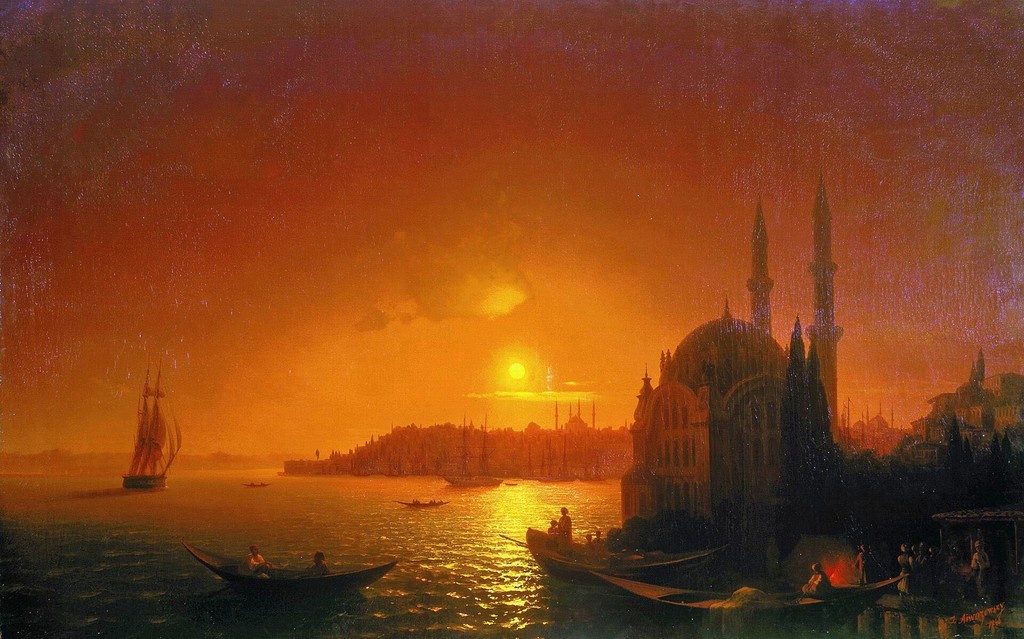
The exact chronology of A View of Constantinople by Moonlight demonstrates the process. The Russian Museum identifies it as a 124 by 192.5 centimetre oil painting, inventory Ж-1787, begun on 15 January and finished on 16 March 1846. It was displayed in Feodosia two days later.[11] The journey belongs to 1845; the object belongs to 1846.
In the complete composition, a path of warm moonlight crosses the harbour towards small boats, while domes and minarets rise in dark silhouette at the right. The image is geographically named, yet its sustained nocturnal order is a studio construction rather than a claim to one instantaneous view. A remembered city has been made coherent through water, architecture and illumination.[11]
Later visits and Ottoman patronage kept Constantinople within Aivazovsky’s career. His city views could interest local, Russian and western European audiences for different reasons, joining a recognisable place to a marine language already associated with his name.[9][10]
Exhibitions and European Recognition
Exhibiting turned travel into a durable public career. Early Italian displays established attention; Paris, London, Amsterdam and other centres extended it. Tretyakov scholarship also records an unusually wide geographical distribution of his pictures in private collections, partly because he showed work so frequently outside Russia.[6][10] International recognition was therefore built through repeated appearances, not a single triumph abroad.
The pattern linked distant capitals with towns closer to home. In 1846 alone Aivazovsky organised displays in Feodosia and Odessa while also showing work in St Petersburg, Berlin and Paris.[8] Audiences could encounter the same painter through different institutional frames: Academy artist, Russian naval painter, Armenian figure from Crimea, Mediterranean traveller or virtuoso of universally legible sea effects.
Honours provide another measure of reach. Aghasyan records associations with academies in Rome, Florence, Paris, Amsterdam and Stuttgart, as well as distinctions from more than one government.[3][4] These memberships should not be confused with continuous residence in each city. They reveal how reputation circulated even when Aivazovsky himself had returned to the Black Sea.
Nor was his international audience culturally uniform. Armenian networks, Russian patrons, Ottoman collectors and European buyers approached the work through different histories. The broad appeal of sea, weather and coastal cities helped the paintings cross borders, while their subjects retained particular political and geographical associations.[5][10]
Naval Expeditions and Imperial Networks
Naval service created opportunities unavailable to a studio painter travelling alone. Aivazovsky received an honorary appointment to the Naval Staff in 1844, after his Baltic experience and European fellowship. Access to working vessels, exercises, officers and port commissions expanded his technical knowledge and placed official subjects within reach.[9]
Court patronage was equally practical. Nicholas I supported his training and purchased work; members of the imperial family travelled with him and later visited Feodosia. The 1836 and 1845 voyages with Grand Duke Konstantin joined education, court connection and maritime observation in one relationship.[9] Patronage supplied mobility, commissions and status, but it also shaped destinations and the kinds of history he was asked to represent.
Not all movement followed that official channel. Academy travel, personal exhibitions, visits to Armenian communities and journeys undertaken for new subjects had distinct purposes. Treating them separately prevents “international career” from becoming a flattering blur. It also clarifies why a naval expedition could produce a moonlit cityscape rather than only fleet pictures.
America in 1892
Aivazovsky crossed the Atlantic in 1892, when he was in his mid-seventies. Scholarship connects the American programme with exhibitions in New York, Chicago, San Francisco and Washington.[10] The journey extended a reputation already established through decades of European display; it was not the first moment at which his work became international.
A tiny surviving object gives the visit unusual precision. The Metropolitan Museum of Art dates A Ship in a Stormy Sea to 1892 and records it as a card measuring only 26 by 53 millimetres, object 13.130. The museum cautiously describes it as probably given to the writer and translator Isabel Hapgood during Aivazovsky’s time in New York. Hapgood donated it to the Met in 1913.[2]
Its scale is useful evidence. International activity did not consist solely of large canvases dispatched to exhibitions; it also operated through personal gifts, introductions and individual relationships. At the same time, the miniature should not be made to prove more than its record permits. Its date matches the visit and its presumed recipient supplies a New York connection, but “presumably” remains part of the provenance account.[2]
The American journey also brought Aivazovsky into a society containing Armenian and Russian communities as well as new collectors. More generally, his practice of seeking Armenian institutions while abroad complicates any picture of travel as entry into a culturally neutral cosmopolitan world.[5][10]
Returning Subjects to the Feodosia Studio
The most important pattern in Aivazovsky’s itinerary is return. The Met notes both his extensive work and exhibition history and his continuing rootedness in Feodosia.[1] There he completed a seafront house and studio in 1847; visiting artists, collectors and musicians later made it a point of exchange. A public gallery added in 1880 gave international fame a local institutional form.[7][8]
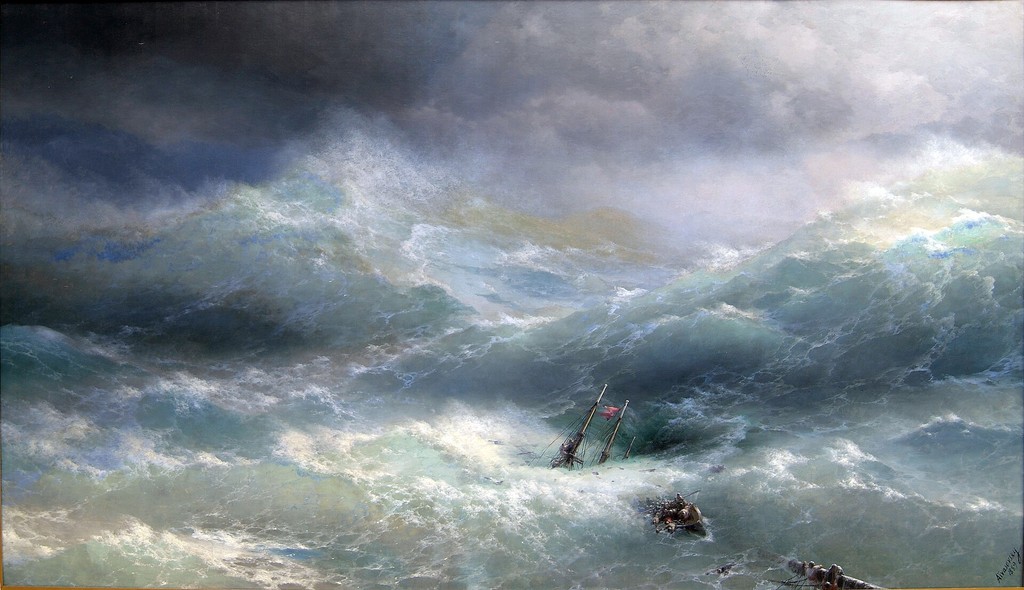
Feodosia was also where travel could become painting. Tretyakov scholarship describes a visual and emotional memory capable of combining impressions from different coasts.[6] A study made during a voyage might remain useful for years, while the weather remembered from one sea could clarify a composition set beside another. This method explains why exact place names matter without turning every named view into a report made on site.
The 1846 Constantinople picture provides a compact example: an Ottoman itinerary supplied the subject, a Feodosia display introduced the finished canvas, and imperial ownership may have followed.[11] The movement is circular rather than one-directional. Experience left Crimea, returned through the studio, then travelled again as an exhibited or collected object.
Seen this way, the house was not a retreat from an international career. It was the place where distant material was organised and from which pictures entered wider circulation. The Black Sea and Feodosia examines that local infrastructure, while the paintings guide shows how travel subjects sit beside remembered storms, naval histories and open water.[1][6][8]
Researched works directory
This searchable evidence census was assembled from public museum records and a reproducible Wikidata snapshot. It is not a catalogue raisonné, not a claim to complete oeuvre coverage, and not a substitute for the published catalogue literature, which was not used to claim absolute completeness.
| Name | Date | Medium |
|---|---|---|
| A bay at dawn. | 1896 | Painting |
| A bay near Venice | 1842 | Painting |
| A Moonlit Night at Sea | 1885 | Painting |
| A Moonlit Night on the Bosphorus | 1894 | Painting |
| A Moonlit Night on the Crimean Coast | Date unknown | Painting |
| A Rocky Coastal Landscape in the Aegean with Ships in the Distance (detail) | 1884 | Painting |
| A. S. Pushkin and Countess M. N. Raevskaya by the sea near Gurzuf | 1886 | Painting |
| A. S. Pushkin at the Black Sea coast | 1887 | Painting |
| A. S. Pushkin at the Black Sea coast | 1897 | Painting |
| A Ship in a Stormy Sea | 1892 | Painting |
| A ship in peril | 1894 | Painting |
| A Ship of the Russian Navy off the Coast | Date unknown | Painting |
| A storm on rocky shores | 1875 | Painting |
| A Summer’s Day in Crimea | 1867 | Painting |
| A View of Constantinople by Moonlight | 1846 | Painting |
| A View of the Bosporus with the Hagia Sophia and the Maiden's Tower in the Moonlight | 1884 | Painting |
| A Wagon Train in the Desert | Date unknown | Painting |
| Abandoning Ship | 1882 | Painting |
| After the Storm | 1854 | Painting |
| Aiju-Dag | Date unknown | Painting |
| Aivazovsky Ivan Konstantinovic - Colon Sortint de Palos | 1892 | Painting |
| Aivazovsky - Oath befory Battle of Avarayr | 1892 | Painting |
| Aivazovsky with Friends | 1893 | Painting |
| Alexander II Crossing the Danube | 1878 | Painting |
| Alexander Pushkin at the Top of Ai-Petri at Sunrise | 1899 | Painting |
| Along the Coast | 1850 | Painting |
| Alushta | 1878 | Painting |
| American Shipping off the Rock of Gibraltar | 1873 | Painting |
| Among the Waves | 1898 | Painting |
| Arrival of Catherine II in Feodosia | 1883 | Painting |
| Azure Grotto, Naples | 1841 | Painting |
| Barge at Sea Shore | 1860–1870 | Painting |
| Battle of Chesma | 1848 | Painting |
| Battle of Chesma (1886) | Date unknown | Painting |
| Battle of Chios on 24 June, 1770 | 1848 | Painting |
| Battle of Sinope | 1853 | Painting |
| Beach | 1845 | Painting |
| Before the Storm: Theodosia | Date unknown | Painting |
| Biarritz | 1889 | Painting |
| Black Sea Fleet in the Bay of Theodosia, just before the Crimean War | 1890 | Painting |
| Boat Ride by Kumkapi in Constantinople | 1846 | Painting |
| Bosphorus | 1878 | Painting |
| Bosporuse väin öösel. | 1890 | Painting |
| Bracing The Waves | Date unknown | Painting |
| Breaking Wave | Date unknown | Painting |
| Brig “Mercury” Attacked by Two Turkish Ships | 1892 | Painting |
| Brig ''Mercury'' meets with the Russian squadron after the victory over two Turkish ships | 1848 | Painting |
| Broad landscape with settlers | 1856 | Painting |
| Byron in Venice | Date unknown | Painting |
| Byron's visit to the Mekhitarists in Surb Ghazar Island | 1899 | Painting |
| Byron's visit to the Mekhitarists on San Lazzaro | 1899 | Painting |
| Ca d'Oro | 1878 | Painting |
| Calm early evening sea | 1884 | Painting |
| Calm Sea | 1887 | Painting |
| Carriage in a Storm | Date unknown | Painting |
| Catholicos Khrimyan Airik near Echmiadzin | 1895 | Painting |
| Caucasus from the Sea | 1894 | Painting |
| Chaos. The Genesis | 1841 | Painting |
| Chapel by the sea | 1847 | Painting |
| Chumaks in Little Russia | Date unknown | Painting |
| Chumaks leisure | 1885 | Painting |
| Chumaks Waggons | 1862 | Painting |
| Clashes between the Shirvans and the Murids on Gunib | 1869 | Painting |
| Clouds | 1865 | Painting |
| Clouds Over a Calm Sea | 1873 | Painting |
| Clouds over the Sea, Calm | 1889 | Painting |
| Coast | 1840 | Painting |
| Coast of Amalfi | 1841 | Painting |
| Coffee-house by the Ortaköy Mosque in Constantinople | 1846 | Painting |
| Constantinople, la mosquée de Top-Kahné | 1884 | Painting |
| Constantinople Sunset | 1899 | Painting |
| Crimean coast by moonlight | 1853 | Painting |
| Crimean Coast by Moonlight | 1898 | Painting |
| Crimean scene. Gurzuf at night | 1865 | Painting |
| Crimean Tartars on the Sea Shore | 1850 | Painting |
| Crimean Views | 1850 | Painting |
| Cruiser in the sea at night | 1844 | Painting |
| Dante Shows an Artist Some Unusual Clouds | 1883 | Painting |
| Daryal Gorge | 1868 | Painting |
| Deluge | 1864 | Painting |
| Der Fluss Rioni in Georgien | 1870 | Painting |
| Descent of Noah from Ararat | 1887 | Painting |
| Destruction of Pompeii | 1889 | Painting |
| Distributing Supplies | 1892 | Painting |
| Dusk on the Golden Horn | 1845 | Painting |
| End of Storm | 1839 | Painting |
| Entrance to the Sevastopol Bay. | 1852 | Painting |
| Entrée de port | 1846 | Painting |
| Exchange Of Peterburg | 1840–1847 | Painting |
| Exploding Ship | 1900 | Painting |
| Farm House and Windmill by moonlight | 1863 | Painting |
| Fight of the steamer Vesta with the Turkish battleship Fehti-Bulend in the Black Sea on July 11, 1877 | 1877 | Painting |
| Figures on a moonlit coast | 1858 | Painting |
| Fishermen and their Families on the Shore of the Bay of Naples | 1873 | Painting |
| Fishermen on the Beach | 1852 | Painting |
| Fishermen on the shore | Date unknown | Painting |
| Fishermen Returning Near Naples | 1874 | Painting |
| Fishing Boats In A Harbor | 1854 | Painting |
| Foggy day on the shores of Italy | Date unknown | Painting |
| French Ships Departing the Black Sea | 1871 | Painting |
| Frigate under sail | 1838 | Painting |
| From Mleta to Gudauri | 1868 | Painting |
| Frozen Bosphorus Under Snow (detail) | 1874 | Painting |
| Gathering Storm | 1899 | Painting |
| Golden Horn Bay Turkey | 1846 | Painting |
| Gondolier on the Sea at Night | 1843 | Painting |
| Gulf of Naples | 1874 | Painting |
| Gunboat off Crete | 1897 | Painting |
| Gurzuf at night | 1849 | Painting |
| Harbour Scene | Date unknown | Painting |
| Ice-Breakers on the Frozen Neva in St. Petersburg | 1877 | Painting |
| Ice on Dnipro | 1872 | Painting |
| Icebergs in the Atlantic | 1870 | Painting |
| In the harbor | 1840 | Painting |
| In the roads, Evening | 1867 | Painting |
| Italian Landscape | 1855 | Painting |
| Italian Landscape (Lago Maggiore), Evening | 1858 | Painting |
| Iwan Konstantinowitsch Aiwasowskij 001 | 1864 | Painting |
| Jalta | 1838 | Painting |
| Jude's the Apostol betrayal | 1834 | Drawing |
| La Vague | 1886 | Painting |
| Landscape in Crimea. | 1860 | Painting |
| Landscape with Windmills | 1860 | Painting |
| Large raid in Kronstadt | 1836 | Painting |
| Little Russian Ox Cart in Winter | 1866 | Painting |
| Loading Provisions off the Crimean Coast | 1876 | Painting |
| Look to the Large Cascade and Large Petergof Palace | 1837 | Painting |
| Marine scene | Date unknown | Painting |
| Marine View | 1899 | Painting |
| Mercury Brig Meeting a Russian Squadron after her Victory over Two Turkish Vessels | 1848 | Painting |
| Meri | Date unknown | Painting |
| Mine attack by boats of the steamer Grand Duke Constantine on the Turkish battleship Assari-Shevket on the Sukhum roadstead on August 12, 1877 | 1877 | Painting |
| Moon night on the Crimea, Gurzuf | 1839 | Painting |
| Moonlight at night near the spring | 1877 | Painting |
| Moonlight in Naples | 1842 | Painting |
| Moonlit coast | 1864 | Painting |
| Moonlit Landing | 1895 | Painting |
| Moonlit Night | 1850 | Painting |
| Moonlit Night | 1878 | Painting |
| Moonlit Night (1958) | 1858 | Painting |
| Moonlit Night (Aivazovsky) | Date unknown | Painting |
| Moonlit night in Crimea | 1859 | Painting |
| Moonlit night on the seashore in Crimea | 1852 | Painting |
| Moonlit Seascape With Shipwreck | 1863 | Painting |
| Morning on the sea | 1883 | Painting |
| Morning on the shore of the bay | 1853 | Painting |
| Mountain Village Gunib in Daghestan. View from the East. | 1869 | Painting |
| Naples Bay | 1842 | Painting |
| Naples with a poet amongst fishermen | 1845 | Painting |
| Naufragiul 1886 | 1886 | Painting |
| Neapolitan lighthouse. | 1842 | Painting |
| Night at Gurzof | 1891 | Painting |
| Night at the Rodos island | 1850 | Painting |
| Night in Constantinople | 1862 | Painting |
| Night in Venice | 1847 | Painting |
| Night. The Tragedy at the Sea of Marmara | 1897 | Painting |
| Nocturnal Voyage | Date unknown | Painting |
| Odessa at Moonlight | 1846 | Painting |
| Odessa, view from the Sea | 1865 | Painting |
| Old Feodosia | 1839 | Painting |
| Old Theodosia | 1845 | Painting |
| Ox-carts in the Ukrainian steppe | 1888 | Painting |
| Panorama of Constantinopole (detail) | 1856 | Painting |
| Parade of the Black Sea Fleet | 1886 | Painting |
| Passage of the Jews through the Red Sea | 1891 | Painting |
| Passing Ship on a Moonlit Night | 1868 | Painting |
| Peter | 1846 | Painting |
| Peter I at Krasnaya Gorka Lighting a Fire on the Shore to Signal to his Sinking Ships | 1900 | Painting |
| Petersburg. Crossing the Neva. | 1870 | Painting |
| Port of Theodosia | Date unknown | Painting |
| Portrait of A. Kaznacheev | 1847 | Painting |
| Portrait of a man | Date unknown | Drawing |
| Portrait of a Teenager | Date unknown | Painting |
| Portrait of archbishop Gabriel Aivazyan (brother of I. Aivazovsky) | 1883 | Painting |
| Portrait of the grandmother of painter Ashhen | 1858 | Painting |
| Portrait of vice admiral M.P. Lazarev | 1839 | Painting |
| Pushkin and Raevskaya in Gurzuf | 1900 | Painting |
| Pushkin in Crimea near Gurzuf rocks | 1880 | Painting |
| Pushkin's Farewell to the sea | 1887 | Painting |
| Q108330660 | 1847 | Painting |
| Q138511047 | 1857 | Painting |
| Q27074794 | Date unknown | Painting |
| Quiet Night: Armenians Thrown Overboard off the Turkish Ships | 1897 | Painting |
| Rainbow | 1873 | Painting |
| Reeds on the Dnieper | 1857 | Painting |
| Rescuers from the shipwreck | 1844 | Painting |
| Reval (Tallinn) | 1845 | Painting |
| Road in the Forest | 1857 | Painting |
| Rocky Cliffs | 1891 | Painting |
| Rocky Seashore | 1876 | Painting |
| Russian squadron at the Sevastopol roadstead | 1849 | Painting |
| Sailboat . | 1859 | Painting |
| Sailing Boat | Date unknown | Drawing |
| Sailing Ship on a calm sea by Moonlight | 1897 | Painting |
| Sailing Ship on the Sea at Moonlight. | 1840 | Painting |
| Sailing Ships on a Calm Day. | 1887 | Painting |
| Sarkizova Ann, second wife of I. Aivazovsky | 1882 | Painting |
| Scenes from Cairo's life | 1881 | Painting |
| Sea | 1864 | Painting |
| Sea Battle at Navarino on October 20, 1827 | 1846 | Painting |
| Sea coast | 1886 | Painting |
| Sea coast at night. Near the beacon | 1837 | Painting |
| Sea on a Moonlit Night | 1857 | Painting |
| Sea on a Moonlit Night | 1858 | Painting |
| Sea View | 1855 | Painting |
| Sea View | 1875 | Painting |
| Sea view from the chapel on the shore | 1845 | Painting |
| Seascape | 1885 | Painting |
| Seascape | Date unknown | Painting |
| Seascape with a steamer. | 1897 | Painting |
| Seascape with full moon | 1857 | Painting |
| Sebastopol | 1852 | Painting |
| Selbstportrait | 1881 | Painting |
| Selbstporträt | 1892 | Painting |
| Self-portrait | 1874 | Painting |
| Self-Portrait | 1898 | Painting |
| Sheep driven by the storm into the sea. | 1855 | Painting |
| Shepherds' Camp | 1858 | Painting |
| Shepherds with a flock of sheep. | 1872 | Painting |
| Ship Amid the Stormy Sea | 1887 | Painting |
| Ship by Moonlight | 1868 | Painting |
| Ship, castle and sea | 1847 | Painting |
| Ship ''Empress Maria'' in a Storm | 1892 | Painting |
| Ship in a storm | 1899 | Painting |
| Ship in a Stormy Sea off the Coast | 1895 | Painting |
| Ship on Stormy Seas | 1850 | Painting |
| Ship "Twelve Apostles | 1897 | Painting |
| Ships at the raging sea | 1866 | Painting |
| Ships on a misty morning | Date unknown | Painting |
| Ships on Stormy Sea, Sunrise | 1871 | Painting |
| Shipwreck | 1843 | Painting |
| shipwreck | 1876 | Painting |
| Shipwreck in the North Sea | 1875 | Painting |
| Shipwreck of "Lefort | 1858 | Painting |
| Shipwreck off the Black Sea Coast | 1887 | Painting |
| Shipwreck on a Stormy Morning | 1895 | Painting |
| Shipwreck on Stormy Seas | 1886 | Painting |
| Shoreline | 1851 | Painting |
| Sinking Ship | 1854 | Drawing |
| Smolny Abbey. Sunset. | 1847 | Painting |
| Solar Eclipse in Feodosia | 1876 | Painting |
| St. George Monastery. Cape Fiolent | 1846 | Painting |
| St. Petersburg | 1850 | Painting |
| St. Petersburg - Galleon on the docks | 1850 | Painting |
| Steamboat on a Moonlit Night | 1884 | Painting |
| Storm | 1851 | Painting |
| Storm | 1854 | Drawing |
| Storm | 1861 | Painting |
| Storm | 1872 | Painting |
| Storm | 1880 | Painting |
| Storm | 1886 | Painting |
| Storm | 1899 | Painting |
| Storm (1871) | 1871 | Painting |
| Storm at sea | 1850 | Painting |
| Storm at sea | 1873 | Painting |
| Storm at Sea on a Moonlit Night | 1866 | Painting |
| Storm off the coast of Odessa | 1898 | Painting |
| Storm on Sea | 1899 | Painting |
| Storm on the Sea | 1876 | Painting |
| Storm over Eupatoria | 1900 | Painting |
| Stormy Sea | 1844 | Painting |
| Stormy Sea | 1850 | Painting |
| Stormy sea at night | 1849 | Painting |
| Strong Wind | 1856 | Painting |
| Stürmische See im Abendrot. | 1896 | Painting |
| Suez Canal | 1869 | Painting |
| Sunny Day | 1884 | Painting |
| Sunset | 1879 | Artwork |
| Sunset at Sea | 1851 | Painting |
| Sunset at sea | 1877 | Painting |
| Sunset at the Sea | 1848 | Painting |
| Sunset over the Golden Horn | 1866 | Painting |
| Sunset over Yalta | 1861 | Painting |
| Survivors | 1844 | Painting |
| Sveaborg | 1844 | Painting |
| The Baptism of the Armenian People. Gregory the Illuminator | 1892 | Painting |
| The Battle of Revel | 1846 | Painting |
| The Battle of Sinope on 18 November 1853 (Night after Battle) | 1853 | Painting |
| The Battle of Vyborg Bay in 1790. | Date unknown | Painting |
| The Battle of Wyborg Bay | 1846 | Painting |
| The Bay of Naples | 1841 | Painting |
| The Bay of Naples | 1844 | Painting |
| The Bay of Naples | 1845 | Painting |
| The Bay of Naples | 1878 | Painting |
| The Bay of Naples. | Date unknown | Painting |
| The Bay of Naples with Capri | 1891 | Painting |
| The Bay of Yalta with the Magobi and Ai Petri mountains | 1850 | Painting |
| The Beach at Biarritz | Date unknown | Painting |
| The birth of Aphrodite | Date unknown | Painting |
| The Black Sea | 1881 | Painting |
| The Black Sea at night | 1879 | Painting |
| The Black Sea Fleet in Feodosia | 1890 | Painting |
| The Black Sea (Marina) | 1882 | Painting |
| The Burning of the Turkish Flagship by Kanaris | 1881 | Painting |
| The Canal Grande with a view of Santa Maria della Salute at sunset. | 1848 | Painting |
| The Caucasus | 1863 | Painting |
| The Disembarkation of Christopher Columbus with Companions on Three Launches, on Friday 12th October 1492, At Sunrise, on an American Island Named San Salvador by Him on the Very Same Day | Date unknown | Painting |
| The Galata Tower by Moonlight | 1845 | Painting |
| The Great Pyramid at Giza | 1871 | Painting |
| The Harbor at Odessa on the Black Sea | 1852 | Painting |
| The Island of Ischia at Sunset (Sunset over Ischia) | 1857 | Painting |
| The Island of Rhodes | 1861 | Painting |
| The Landing of N. N. Raevskyi at Subashi | 1839 | Painting |
| The Maiden's Tower | 1848 | Painting |
| The Massacre of Armenians in Trebizond in 1895 | 1897 | Painting |
| The Mekhitarist Fathers on Lazarus Island, Venice | 1843 | Painting |
| The Mekhitarist Fathers on San Lazzaro Island. Venice | 1843 | Painting |
| The Ninth Wave | 1850 | Painting |
| The Relief Ship | 1892 | Painting |
| The Rescue | Date unknown | Painting |
| The Russian Squadron on the Sebastopol Roads | 1846 | Painting |
| The Sea | 1865 | Painting |
| The Shipwreck | 1873 | Painting |
| The Shipwreck | Date unknown | Painting |
| The Shores of the Mediterranean | 1892 | Painting |
| The storm at Cape Aya | 1899 | Painting |
| The storm at sea | 1850 | Painting |
| The Storm on the Turkish Coast | 1858 | Painting |
| The strip "Swetlana | Date unknown | Painting |
| The Survivor | 1880 | Painting |
| The survivors | 1895 | Painting |
| The Tide | 1870 | Painting |
| The Wrath of the Seas | 1886 | Painting |
| Theodosia Bay, sunrise | 1855 | Painting |
| Theodosia, end of day | 1865 | Painting |
| Theodosia. Moonlight night | 1852 | Painting |
| Trebizond from the sea | 1875 | Painting |
| Ukrainian Landscape at Night | 1870 | Painting |
| Ukrainian landscape with chumaks in the moonlight | 1869 | Painting |
| untitled | Date unknown | Painting |
| Venetian lagoon. View of the island of San Giorgio. | 1844 | Painting |
| Venice | 1844 | Painting |
| Venice at Sunset | 1873 | Painting |
| View in Crimea at sunset | 1862 | Painting |
| View of a bay with numerous sailing-ships (Feodosia?) | Date unknown | Drawing |
| View of Constantinople and the Bosphorus | 1856 | Painting |
| View of Constantinople by evening light | 1846 | Painting |
| View of Moscow from the Sparrow Hills | 1851 | Painting |
| View of Odessa on a moonlit night | 1855 | Painting |
| View Of The Ayu Dag Crimea | 1868 | Painting |
| View Of The Sea From The Mountains At Sunset. Crimea | 1900 | Painting |
| View of Vico near Naples | 1855 | Painting |
| View to the Crim | 1851 | Painting |
| View to the sea coast near St. Petersburg | 1835 | Painting |
| Volga near the Zhiguli Mountains | 1887 | Painting |
| Walking on Water | 1888 | Painting |
| Walking on Water | 1890 | Painting |
| Wave | 1889 | Painting |
| Wave hitting a Rock | 1860 | Painting |
| Wave. Two Ships | Date unknown | Painting |
| Windmill by the Sea | 1837 | Painting |
| Winter Caravan on Road | 1857 | Painting |
| Winter in Ukraine | 1874 | Drawing |
| Winter landscape | 1876 | Painting |
| Winter Scene in Little Russia | 1868 | Painting |
| Wreck of the ship "Ingermanland" in Skagerrak on the night of August 30, 1842. | Date unknown | Painting |
| Yalta | 1899 | Painting |
Frequently Asked Questions
His documented journeys included Crimea, Italy, France, England, the Netherlands, Constantinople and other Ottoman or Greek ports, the Caucasus, Egypt and the United States. Different trips served Academy study, naval expeditions, court travel, exhibitions or personal research, so they should not be treated as one continuous tour.[3][6][9][10]
Italy gave him sustained access to Mediterranean coasts, major collections and an international audience during the formative years of the early 1840s. Rome, Naples and Venice were artistic and professional environments, while San Lazzaro reconnected him with his brother Gabriel and Armenian scholarship.[3][5][6]
He made studies during travel, but the finished paintings were normally constructed through memory. The Russian Museum’s 1846 moonlit view postdates the 1845 expedition and was shown in Feodosia immediately after completion. Its precise city identity does not make it an open-air transcript.[6][11]
Yes. He travelled there in 1892 and exhibited in several American cities. The Met miniature A Ship in a Stormy Sea, dated that year and probably given to Isabel Hapgood during the New York stay, provides a securely identified material trace of the visit.[2][10]
Feodosia joined family and Armenian community life to a practical studio, house and gallery beside the Black Sea. It gave him a stable base from which to travel and a place where accumulated impressions could become finished compositions. His return strengthened rather than limited the career’s international reach.[1][7][8]
Discussion
Use this evidence-led guide as a starting point for close looking rather than a final verdict.
Share an observation about Travel and International Career or a source that adds useful context.
Reader Insights
Which work most clearly complicates the familiar image of Aivazovsky as a painter of spectacular storms?
Where do Feodosia, Armenian identity, academy training, travel or naval service most productively alter your reading?
Which source or surviving object would you investigate next?
Join the Conversation
Add your reading below, keeping observations specific and evidence clear.
References
- Metropolitan Museum of Art, “Ship by Moonlight”, accessed 30 August 2026.
- Metropolitan Museum of Art, “A Ship in a Stormy Sea”, accessed 30 August 2026.
- Ararat Aghasyan, Enchanted by the Sea: Ivan (Hovhannes) Aivazovsky, National Academy of Sciences of Armenia, accessed 30 August 2026.
- Ararat Aghasyan, “The Exceptional Master of Seascapes”, National Academy of Sciences of Armenia, accessed 30 August 2026.
- Tretyakov Gallery Magazine, “The Aivazovsky Brothers”, accessed 30 August 2026.
- Tretyakov Gallery Magazine, “Artist of the Hellenic Spirit”, accessed 30 August 2026.
- Tretyakov Gallery Magazine, “Father of the Town: Ivan Aivazovsky and Feodosia”, accessed 30 August 2026.
- Tretyakov Gallery Magazine, “Aivazovsky’s House and Guests”, accessed 30 August 2026.
- Tretyakov Gallery Magazine, “The Great Seascape Artist and the Russian Imperial Family”, accessed 30 August 2026.
- Tretyakov Gallery Magazine, “Aivazovsky Outside Russia”, accessed 30 August 2026.
- State Russian Museum, “A View of Constantinople by Moonlight”, accessed 30 August 2026.
- Museum of Fine Arts Boston, “Fishermen and Their Families on the Shore of the Bay of Naples”, accessed 30 August 2026.