 by Tom Gurney
Tom Gurney BSc (Hons) is an art history expert with over 20 years experience
Page Created on / Page Updated on
Email: tomgurney1@gmail.com / Phone: +44 7429 011000
Mercury Brig Meeting the Russian Squadron: Introduction
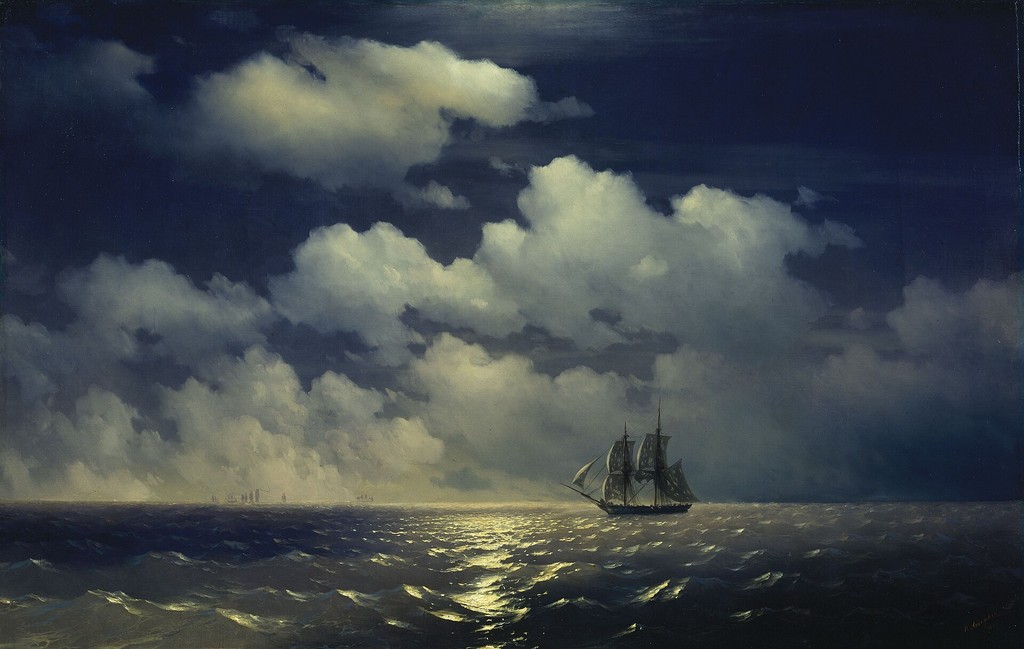
Ivan Aivazovsky’s 1848 painting is often shortened to a picture of the brig Mercury “after victory”, but its actual subject is more precise. The armed encounter has ended. At the right, the damaged brig travels under sail towards a Russian squadron reduced to fine silhouettes on the left-hand horizon. There are no opposing ships, muzzle flashes or cannon splashes. A broad nocturnal reflection and immense banks of cloud transform return, rather than combat, into the visible event.
The State Russian Museum identifies the work as inventory Ж-2209, an oil on canvas measuring 123.5 by 190 centimetres. It entered the museum in 1936 from the Marble Palace collection.[1] The institution’s longer English title explains that Mercury meets a Russian squadron after victory over two “Turkish vessels”. Retaining that sequence protects the canvas from confusion with Aivazovsky’s separate image of the attack itself.
At a Glance
- ArtistIvan Aivazovsky (1817–1900).
- Date and medium1848, oil on canvas.[1]
- Dimensions123.5 by 190 centimetres.[1]
- CollectionState Russian Museum, inventory Ж-2209; received from the Marble Palace collection in 1936.[1]
- Historical vesselthe 18-gun brig Mercury, commanded by Captain-Lieutenant Alexander Kozarsky.[1]
- Depicted momentthe damaged ship proceeds towards its squadron after escaping two Ottoman line ships.[1]
Ivan Aivazovsky in context
Contents
- Introduction
- Why the Long Title Matters
- The Episode behind the Painting
- What Is Actually Visible
- Distance, Light and Damaged Return
- Aftermath Instead of Battle Climax
- Naval Knowledge and Imperial Context
- Distinguishing Other Mercury Subjects
Why the Long Title Matters
Every clause in the museum title performs identifying work. “Brig” specifies the type of vessel; “Mercury” names it; “after her victory” places the action later than the engagement; and “meeting a Russian squadron” tells us what the distant ships represent. The phrase “two Turkish vessels” belongs to the institution’s English rendering. In historical discussion, “Ottoman ships” more accurately locates the opposing navy.
The abbreviated page title preserves the principal visible action, but it must not sever that action from what came before. Without “after”, a viewer might interpret the dark vapour as fresh battle smoke or mistake the distant fleet for an enemy formation. Without “meeting”, the interval across the water could seem like unrelated maritime traffic. Language and image clarify one another.
The remaining object fields complete the safeguard. A canvas dated 1848, measuring 123.5 by 190 centimetres and carrying State Russian Museum number Ж-2209 is this return scene.[1] A different composition in which Mercury is caught between hostile ships cannot be substituted simply because it concerns the same celebrated vessel.
The Episode behind the Painting
The museum connects the picture with Mercury’s action during the Russo-Ottoman War of 1828–29. It identifies an 18-gun brig under Captain-Lieutenant Alexander Kozarsky facing the Ottoman ships Selimiye and Real-Bey, whose combined armament it gives as 184 guns. According to that account, manoeuvring and the crew’s resistance damaged the pursuers sufficiently for the brig to escape and rejoin the Russian force.[1]
Aivazovsky painted the canvas nineteen years after the 1829 encounter. It is therefore a retrospective history painting, not an eyewitness record made during the action. The official interpretation supplies facts that the image alone cannot: the commander, opposing ships, disparity in guns and numerous shot holes. At reproduction scale, viewers can recognise the brig’s profile and rig but cannot responsibly count damage or reconstruct tactical movements.
The museum calls the depicted instant the final moment of combat, then defines it as Mercury moving in full sail towards Russian ships.[1] That qualification is crucial. The military episode still gives the approach its meaning, but the exchange itself has passed beyond the frame. What remains is separation being overcome.
The institutional account frames the episode as part of the brig’s heroic history.[1] That reception should be acknowledged without allowing patriotic commemoration to dictate details absent from the canvas. Aivazovsky does not make victory visible through sinking enemies, captured flags or triumphant portraits. Instead, the historical outcome is compressed into a damaged ship that has escaped pursuit and can once again see its own fleet. The picture’s mode of honour is continuation.
What Is Actually Visible
The composition divides attention between one substantial vessel and several remote ones. Mercury sits to the right of centre, dark against a lighter area of sky and water. Masts and rigging rise clearly from the hull, while some sails catch pale illumination and others merge with shadow. The bow points towards the small formations dispersed along the left horizon.
Those distant ships are easy to miss. They occupy little more than a narrow band of upright marks, separated from the brig by a wide expanse of open water. Their reduced scale converts the title’s “meeting” into a journey not yet completed. The squadron is visible enough to establish direction, yet remote enough to preserve tension.
The broad format strengthens this interval. Mercury is not placed at the canvas centre, where it might appear ceremonially fixed; its position to the right leaves most of the horizontal journey ahead. The distant ships collect towards the opposite side, while open sea between them carries the narrative. Viewers must scan from one group to the other, enacting in looking the approach named by the title.
Low waves cross the foreground in alternating dark and lit ridges. They do not overwhelm the ship, but they prevent the sea from becoming a neutral floor. A bright trail passes through the middle of the water, bending and breaking over the swells before reaching the vessel’s zone. The moon is not exposed as a disc; its concealed nocturnal light is understood through reflection and the illuminated edges of cloud.
No figures can be individually read, and no gunfire punctures the darkness. Pale vapour near the horizon may evoke smoke because of the title’s history, but cloud dominates the entire sky and the exact boundary cannot be proved from the image. Labelling every luminous bank as battle smoke would import an event that Aivazovsky has chosen not to show.
Distance, Light and Damaged Return
The great spatial interval is the painting’s narrative engine. Mercury is close enough for its sails to remain legible, while the squadron sits at the limit of visibility. That difference establishes a before and after within one view: isolation persists around the brig, but collective safety has appeared ahead.
Moonlight reinforces the route without drawing a straight road. Its fragments begin near the lower centre, scatter across wave faces and widen towards the horizon. The ship lies beside this luminous channel rather than squarely inside it. Navigation therefore feels active; the brig must cross a moving surface, not simply glide along a symbolic beam.
Above, the clouds greatly exceed every vessel. Bright, rounded masses rise from the horizon and give way to deep blue-black overhead. Their scale keeps naval achievement within a marine atmosphere larger than human action. The scene can honour survival while still making the returning ship physically small.
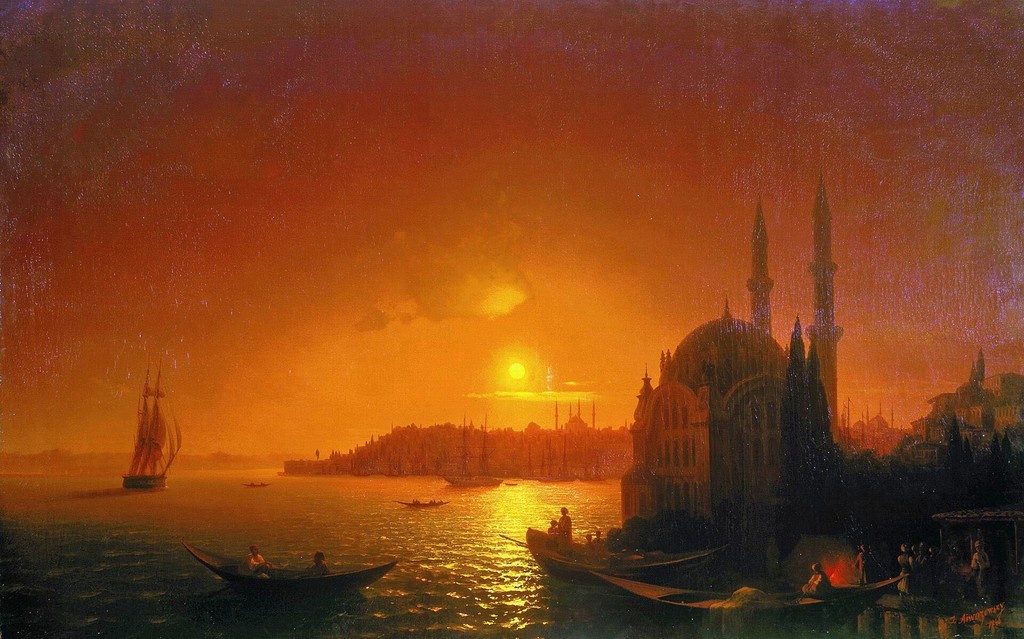
Aivazovsky uses reflected light differently in A View of Constantinople by Moonlight. There, architecture and harbour traffic define an urban nocturne; here, illumination measures the open distance between a single brig and a fleet. The shared device produces contemplation in one painting and delayed recognition in the other.
Aftermath Instead of Battle Climax
Choosing aftermath shifts attention from destructive force to continued capability. The museum reports that Mercury had sustained many shot holes, yet Aivazovsky shows the ship upright and carrying sail.[1] Damage belongs to its history; forward movement supplies the image. Victory is represented not through an enemy’s defeat but through the brig’s return to its own formation.
This decision also changes what heroism looks like. No officer stands forward as a portrait subject, and individual sailors disappear at this distance. The crew’s agency is condensed into the functioning vessel: rig held aloft, sails drawing and hull maintaining course. Collective endurance replaces a staged gesture by one protagonist.
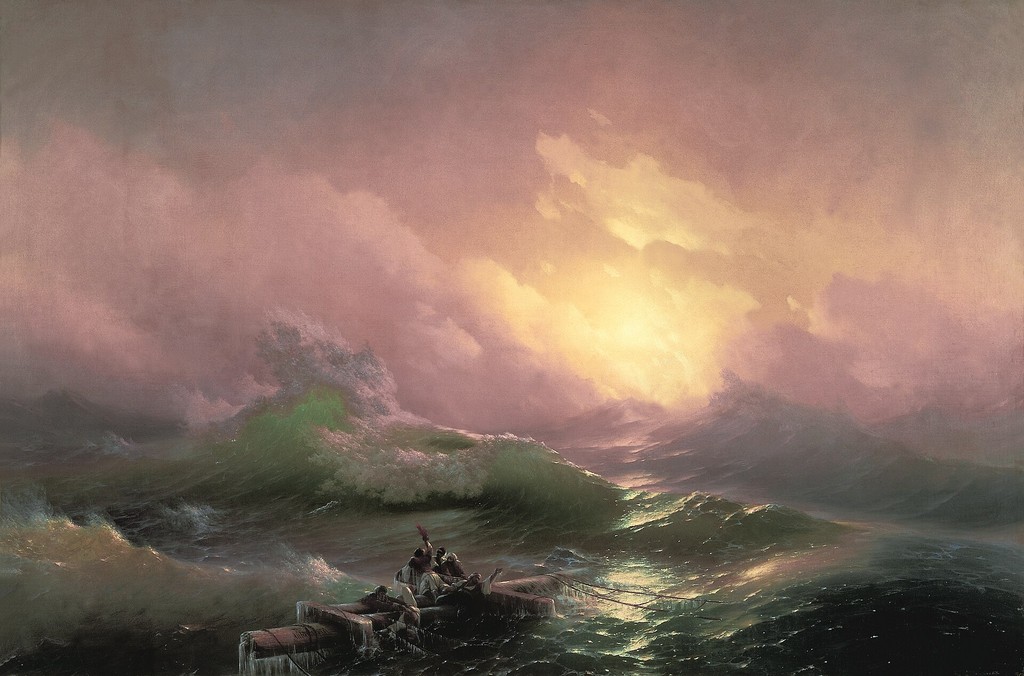
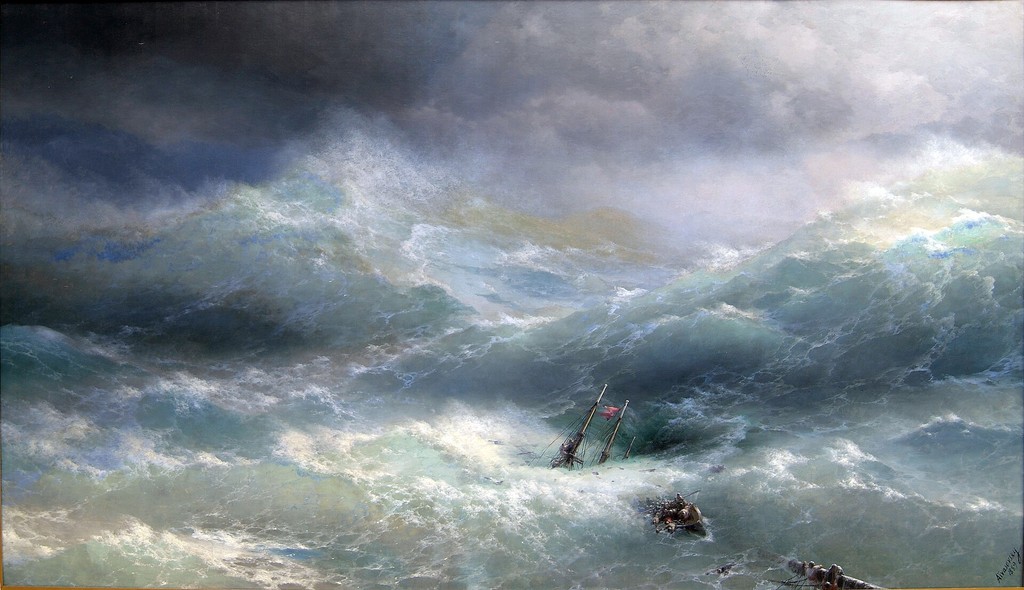
The distinction becomes clearer beside The Ninth Wave. Both paintings concern what follows extreme danger, but the 1850 shipwreck leaves anonymous survivors on broken timber with no rescuing craft visible. The Mercury canvas names a historical vessel, keeps it operational and places its destination within sight. One aftermath remains radically uncertain; the other pictures the final distance before reunion.
Neither scene is merely a diagram of events. Sea, light and scale determine how the human situation is felt. The paintings guide places these different narrative structures within Aivazovsky’s wider range of storms, naval subjects and open-water views.
Naval Knowledge and Imperial Context
Aivazovsky’s ability to construct such a subject grew from sustained access to naval life. Tretyakov scholarship records his 1836 voyage with Grand Duke Konstantin under Fyodor Litke, during which navigation and ship design formed part of the education. In 1844 Nicholas I appointed him a painter attached to Navy Headquarters, an honorary position that brought official maritime subjects within reach.[2]
The relationship supplied practical resources as well as status. Aivazovsky later recalled using Admiralty drawings of ships, rigging and armament, watching naval exercises, and studying the effects of cannon shots on water and smoke over the Gulf of Finland.[2] Those experiences explain why his fleet pictures could draw upon specific maritime knowledge. They do not make every canvas a literal transcript of one observed manoeuvre.
Maritime information and pictorial invention consequently serve different purposes. Plans could guide a recognisable hull or rig; exercises could establish how ships separate into depth. Neither resource prescribed the concealed light, towering cloud banks or long pause between brig and squadron. Those are compositional choices that turn a documented naval subject into an atmospheric account of return.
The context is inseparable from imperial patronage. Court support enabled voyages, purchases and commissions, while naval service helped make episodes of Russian fleet history part of Aivazovsky’s public identity.[2] The biography follows that institutional career, and travel and international experience shows how voyages also expanded his knowledge of Ottoman and Mediterranean waters.
In this picture, naval history and marine painting cannot be pulled apart. The named episode determines why the vessels occupy their positions; atmosphere determines what the return means emotionally. Aivazovsky does not need visible cannon fire to make the earlier danger present.
Distinguishing Other Mercury Subjects
Aivazovsky returned to the brig’s story, including the attack by two opposing ships. That combat composition is a separate object. Its enemy vessels and active engagement must not be read into the quiet approach recorded under Ж-2209. A generic caption such as “the Mercury battle” erases the difference between phases of the episode.
Four checks keep the aftermath secure: the year is 1848; the dimensions are 123.5 by 190 centimetres; the collection is the State Russian Museum; and the composition sends the brig towards a small Russian squadron on the horizon.[1] Its 1936 transfer from the Marble Palace collection adds a further provenance marker. Exact identity makes interpretation clearer: this is a naval victory pictured through survival, spacing and return.
Researched works directory
This searchable evidence census was assembled from public museum records and a reproducible Wikidata snapshot. It is not a catalogue raisonné, not a claim to complete oeuvre coverage, and not a substitute for the published catalogue literature, which was not used to claim absolute completeness.
| Name | Date | Medium |
|---|---|---|
| A bay at dawn. | 1896 | Painting |
| A bay near Venice | 1842 | Painting |
| A Moonlit Night at Sea | 1885 | Painting |
| A Moonlit Night on the Bosphorus | 1894 | Painting |
| A Moonlit Night on the Crimean Coast | Date unknown | Painting |
| A Rocky Coastal Landscape in the Aegean with Ships in the Distance (detail) | 1884 | Painting |
| A. S. Pushkin and Countess M. N. Raevskaya by the sea near Gurzuf | 1886 | Painting |
| A. S. Pushkin at the Black Sea coast | 1887 | Painting |
| A. S. Pushkin at the Black Sea coast | 1897 | Painting |
| A Ship in a Stormy Sea | 1892 | Painting |
| A ship in peril | 1894 | Painting |
| A Ship of the Russian Navy off the Coast | Date unknown | Painting |
| A storm on rocky shores | 1875 | Painting |
| A Summer’s Day in Crimea | 1867 | Painting |
| A View of Constantinople by Moonlight | 1846 | Painting |
| A View of the Bosporus with the Hagia Sophia and the Maiden's Tower in the Moonlight | 1884 | Painting |
| A Wagon Train in the Desert | Date unknown | Painting |
| Abandoning Ship | 1882 | Painting |
| After the Storm | 1854 | Painting |
| Aiju-Dag | Date unknown | Painting |
| Aivazovsky Ivan Konstantinovic - Colon Sortint de Palos | 1892 | Painting |
| Aivazovsky - Oath befory Battle of Avarayr | 1892 | Painting |
| Aivazovsky with Friends | 1893 | Painting |
| Alexander II Crossing the Danube | 1878 | Painting |
| Alexander Pushkin at the Top of Ai-Petri at Sunrise | 1899 | Painting |
| Along the Coast | 1850 | Painting |
| Alushta | 1878 | Painting |
| American Shipping off the Rock of Gibraltar | 1873 | Painting |
| Among the Waves | 1898 | Painting |
| Arrival of Catherine II in Feodosia | 1883 | Painting |
| Azure Grotto, Naples | 1841 | Painting |
| Barge at Sea Shore | 1860–1870 | Painting |
| Battle of Chesma | 1848 | Painting |
| Battle of Chesma (1886) | Date unknown | Painting |
| Battle of Chios on 24 June, 1770 | 1848 | Painting |
| Battle of Sinope | 1853 | Painting |
| Beach | 1845 | Painting |
| Before the Storm: Theodosia | Date unknown | Painting |
| Biarritz | 1889 | Painting |
| Black Sea Fleet in the Bay of Theodosia, just before the Crimean War | 1890 | Painting |
| Boat Ride by Kumkapi in Constantinople | 1846 | Painting |
| Bosphorus | 1878 | Painting |
| Bosporuse väin öösel. | 1890 | Painting |
| Bracing The Waves | Date unknown | Painting |
| Breaking Wave | Date unknown | Painting |
| Brig “Mercury” Attacked by Two Turkish Ships | 1892 | Painting |
| Brig ''Mercury'' meets with the Russian squadron after the victory over two Turkish ships | 1848 | Painting |
| Broad landscape with settlers | 1856 | Painting |
| Byron in Venice | Date unknown | Painting |
| Byron's visit to the Mekhitarists in Surb Ghazar Island | 1899 | Painting |
| Byron's visit to the Mekhitarists on San Lazzaro | 1899 | Painting |
| Ca d'Oro | 1878 | Painting |
| Calm early evening sea | 1884 | Painting |
| Calm Sea | 1887 | Painting |
| Carriage in a Storm | Date unknown | Painting |
| Catholicos Khrimyan Airik near Echmiadzin | 1895 | Painting |
| Caucasus from the Sea | 1894 | Painting |
| Chaos. The Genesis | 1841 | Painting |
| Chapel by the sea | 1847 | Painting |
| Chumaks in Little Russia | Date unknown | Painting |
| Chumaks leisure | 1885 | Painting |
| Chumaks Waggons | 1862 | Painting |
| Clashes between the Shirvans and the Murids on Gunib | 1869 | Painting |
| Clouds | 1865 | Painting |
| Clouds Over a Calm Sea | 1873 | Painting |
| Clouds over the Sea, Calm | 1889 | Painting |
| Coast | 1840 | Painting |
| Coast of Amalfi | 1841 | Painting |
| Coffee-house by the Ortaköy Mosque in Constantinople | 1846 | Painting |
| Constantinople, la mosquée de Top-Kahné | 1884 | Painting |
| Constantinople Sunset | 1899 | Painting |
| Crimean coast by moonlight | 1853 | Painting |
| Crimean Coast by Moonlight | 1898 | Painting |
| Crimean scene. Gurzuf at night | 1865 | Painting |
| Crimean Tartars on the Sea Shore | 1850 | Painting |
| Crimean Views | 1850 | Painting |
| Cruiser in the sea at night | 1844 | Painting |
| Dante Shows an Artist Some Unusual Clouds | 1883 | Painting |
| Daryal Gorge | 1868 | Painting |
| Deluge | 1864 | Painting |
| Der Fluss Rioni in Georgien | 1870 | Painting |
| Descent of Noah from Ararat | 1887 | Painting |
| Destruction of Pompeii | 1889 | Painting |
| Distributing Supplies | 1892 | Painting |
| Dusk on the Golden Horn | 1845 | Painting |
| End of Storm | 1839 | Painting |
| Entrance to the Sevastopol Bay. | 1852 | Painting |
| Entrée de port | 1846 | Painting |
| Exchange Of Peterburg | 1840–1847 | Painting |
| Exploding Ship | 1900 | Painting |
| Farm House and Windmill by moonlight | 1863 | Painting |
| Fight of the steamer Vesta with the Turkish battleship Fehti-Bulend in the Black Sea on July 11, 1877 | 1877 | Painting |
| Figures on a moonlit coast | 1858 | Painting |
| Fishermen and their Families on the Shore of the Bay of Naples | 1873 | Painting |
| Fishermen on the Beach | 1852 | Painting |
| Fishermen on the shore | Date unknown | Painting |
| Fishermen Returning Near Naples | 1874 | Painting |
| Fishing Boats In A Harbor | 1854 | Painting |
| Foggy day on the shores of Italy | Date unknown | Painting |
| French Ships Departing the Black Sea | 1871 | Painting |
| Frigate under sail | 1838 | Painting |
| From Mleta to Gudauri | 1868 | Painting |
| Frozen Bosphorus Under Snow (detail) | 1874 | Painting |
| Gathering Storm | 1899 | Painting |
| Golden Horn Bay Turkey | 1846 | Painting |
| Gondolier on the Sea at Night | 1843 | Painting |
| Gulf of Naples | 1874 | Painting |
| Gunboat off Crete | 1897 | Painting |
| Gurzuf at night | 1849 | Painting |
| Harbour Scene | Date unknown | Painting |
| Ice-Breakers on the Frozen Neva in St. Petersburg | 1877 | Painting |
| Ice on Dnipro | 1872 | Painting |
| Icebergs in the Atlantic | 1870 | Painting |
| In the harbor | 1840 | Painting |
| In the roads, Evening | 1867 | Painting |
| Italian Landscape | 1855 | Painting |
| Italian Landscape (Lago Maggiore), Evening | 1858 | Painting |
| Iwan Konstantinowitsch Aiwasowskij 001 | 1864 | Painting |
| Jalta | 1838 | Painting |
| Jude's the Apostol betrayal | 1834 | Drawing |
| La Vague | 1886 | Painting |
| Landscape in Crimea. | 1860 | Painting |
| Landscape with Windmills | 1860 | Painting |
| Large raid in Kronstadt | 1836 | Painting |
| Little Russian Ox Cart in Winter | 1866 | Painting |
| Loading Provisions off the Crimean Coast | 1876 | Painting |
| Look to the Large Cascade and Large Petergof Palace | 1837 | Painting |
| Marine scene | Date unknown | Painting |
| Marine View | 1899 | Painting |
| Mercury Brig Meeting a Russian Squadron after her Victory over Two Turkish Vessels | 1848 | Painting |
| Meri | Date unknown | Painting |
| Mine attack by boats of the steamer Grand Duke Constantine on the Turkish battleship Assari-Shevket on the Sukhum roadstead on August 12, 1877 | 1877 | Painting |
| Moon night on the Crimea, Gurzuf | 1839 | Painting |
| Moonlight at night near the spring | 1877 | Painting |
| Moonlight in Naples | 1842 | Painting |
| Moonlit coast | 1864 | Painting |
| Moonlit Landing | 1895 | Painting |
| Moonlit Night | 1850 | Painting |
| Moonlit Night | 1878 | Painting |
| Moonlit Night (1958) | 1858 | Painting |
| Moonlit Night (Aivazovsky) | Date unknown | Painting |
| Moonlit night in Crimea | 1859 | Painting |
| Moonlit night on the seashore in Crimea | 1852 | Painting |
| Moonlit Seascape With Shipwreck | 1863 | Painting |
| Morning on the sea | 1883 | Painting |
| Morning on the shore of the bay | 1853 | Painting |
| Mountain Village Gunib in Daghestan. View from the East. | 1869 | Painting |
| Naples Bay | 1842 | Painting |
| Naples with a poet amongst fishermen | 1845 | Painting |
| Naufragiul 1886 | 1886 | Painting |
| Neapolitan lighthouse. | 1842 | Painting |
| Night at Gurzof | 1891 | Painting |
| Night at the Rodos island | 1850 | Painting |
| Night in Constantinople | 1862 | Painting |
| Night in Venice | 1847 | Painting |
| Night. The Tragedy at the Sea of Marmara | 1897 | Painting |
| Nocturnal Voyage | Date unknown | Painting |
| Odessa at Moonlight | 1846 | Painting |
| Odessa, view from the Sea | 1865 | Painting |
| Old Feodosia | 1839 | Painting |
| Old Theodosia | 1845 | Painting |
| Ox-carts in the Ukrainian steppe | 1888 | Painting |
| Panorama of Constantinopole (detail) | 1856 | Painting |
| Parade of the Black Sea Fleet | 1886 | Painting |
| Passage of the Jews through the Red Sea | 1891 | Painting |
| Passing Ship on a Moonlit Night | 1868 | Painting |
| Peter | 1846 | Painting |
| Peter I at Krasnaya Gorka Lighting a Fire on the Shore to Signal to his Sinking Ships | 1900 | Painting |
| Petersburg. Crossing the Neva. | 1870 | Painting |
| Port of Theodosia | Date unknown | Painting |
| Portrait of A. Kaznacheev | 1847 | Painting |
| Portrait of a man | Date unknown | Drawing |
| Portrait of a Teenager | Date unknown | Painting |
| Portrait of archbishop Gabriel Aivazyan (brother of I. Aivazovsky) | 1883 | Painting |
| Portrait of the grandmother of painter Ashhen | 1858 | Painting |
| Portrait of vice admiral M.P. Lazarev | 1839 | Painting |
| Pushkin and Raevskaya in Gurzuf | 1900 | Painting |
| Pushkin in Crimea near Gurzuf rocks | 1880 | Painting |
| Pushkin's Farewell to the sea | 1887 | Painting |
| Q108330660 | 1847 | Painting |
| Q138511047 | 1857 | Painting |
| Q27074794 | Date unknown | Painting |
| Quiet Night: Armenians Thrown Overboard off the Turkish Ships | 1897 | Painting |
| Rainbow | 1873 | Painting |
| Reeds on the Dnieper | 1857 | Painting |
| Rescuers from the shipwreck | 1844 | Painting |
| Reval (Tallinn) | 1845 | Painting |
| Road in the Forest | 1857 | Painting |
| Rocky Cliffs | 1891 | Painting |
| Rocky Seashore | 1876 | Painting |
| Russian squadron at the Sevastopol roadstead | 1849 | Painting |
| Sailboat . | 1859 | Painting |
| Sailing Boat | Date unknown | Drawing |
| Sailing Ship on a calm sea by Moonlight | 1897 | Painting |
| Sailing Ship on the Sea at Moonlight. | 1840 | Painting |
| Sailing Ships on a Calm Day. | 1887 | Painting |
| Sarkizova Ann, second wife of I. Aivazovsky | 1882 | Painting |
| Scenes from Cairo's life | 1881 | Painting |
| Sea | 1864 | Painting |
| Sea Battle at Navarino on October 20, 1827 | 1846 | Painting |
| Sea coast | 1886 | Painting |
| Sea coast at night. Near the beacon | 1837 | Painting |
| Sea on a Moonlit Night | 1857 | Painting |
| Sea on a Moonlit Night | 1858 | Painting |
| Sea View | 1855 | Painting |
| Sea View | 1875 | Painting |
| Sea view from the chapel on the shore | 1845 | Painting |
| Seascape | 1885 | Painting |
| Seascape | Date unknown | Painting |
| Seascape with a steamer. | 1897 | Painting |
| Seascape with full moon | 1857 | Painting |
| Sebastopol | 1852 | Painting |
| Selbstportrait | 1881 | Painting |
| Selbstporträt | 1892 | Painting |
| Self-portrait | 1874 | Painting |
| Self-Portrait | 1898 | Painting |
| Sheep driven by the storm into the sea. | 1855 | Painting |
| Shepherds' Camp | 1858 | Painting |
| Shepherds with a flock of sheep. | 1872 | Painting |
| Ship Amid the Stormy Sea | 1887 | Painting |
| Ship by Moonlight | 1868 | Painting |
| Ship, castle and sea | 1847 | Painting |
| Ship ''Empress Maria'' in a Storm | 1892 | Painting |
| Ship in a storm | 1899 | Painting |
| Ship in a Stormy Sea off the Coast | 1895 | Painting |
| Ship on Stormy Seas | 1850 | Painting |
| Ship "Twelve Apostles | 1897 | Painting |
| Ships at the raging sea | 1866 | Painting |
| Ships on a misty morning | Date unknown | Painting |
| Ships on Stormy Sea, Sunrise | 1871 | Painting |
| Shipwreck | 1843 | Painting |
| shipwreck | 1876 | Painting |
| Shipwreck in the North Sea | 1875 | Painting |
| Shipwreck of "Lefort | 1858 | Painting |
| Shipwreck off the Black Sea Coast | 1887 | Painting |
| Shipwreck on a Stormy Morning | 1895 | Painting |
| Shipwreck on Stormy Seas | 1886 | Painting |
| Shoreline | 1851 | Painting |
| Sinking Ship | 1854 | Drawing |
| Smolny Abbey. Sunset. | 1847 | Painting |
| Solar Eclipse in Feodosia | 1876 | Painting |
| St. George Monastery. Cape Fiolent | 1846 | Painting |
| St. Petersburg | 1850 | Painting |
| St. Petersburg - Galleon on the docks | 1850 | Painting |
| Steamboat on a Moonlit Night | 1884 | Painting |
| Storm | 1851 | Painting |
| Storm | 1854 | Drawing |
| Storm | 1861 | Painting |
| Storm | 1872 | Painting |
| Storm | 1880 | Painting |
| Storm | 1886 | Painting |
| Storm | 1899 | Painting |
| Storm (1871) | 1871 | Painting |
| Storm at sea | 1850 | Painting |
| Storm at sea | 1873 | Painting |
| Storm at Sea on a Moonlit Night | 1866 | Painting |
| Storm off the coast of Odessa | 1898 | Painting |
| Storm on Sea | 1899 | Painting |
| Storm on the Sea | 1876 | Painting |
| Storm over Eupatoria | 1900 | Painting |
| Stormy Sea | 1844 | Painting |
| Stormy Sea | 1850 | Painting |
| Stormy sea at night | 1849 | Painting |
| Strong Wind | 1856 | Painting |
| Stürmische See im Abendrot. | 1896 | Painting |
| Suez Canal | 1869 | Painting |
| Sunny Day | 1884 | Painting |
| Sunset | 1879 | Artwork |
| Sunset at Sea | 1851 | Painting |
| Sunset at sea | 1877 | Painting |
| Sunset at the Sea | 1848 | Painting |
| Sunset over the Golden Horn | 1866 | Painting |
| Sunset over Yalta | 1861 | Painting |
| Survivors | 1844 | Painting |
| Sveaborg | 1844 | Painting |
| The Baptism of the Armenian People. Gregory the Illuminator | 1892 | Painting |
| The Battle of Revel | 1846 | Painting |
| The Battle of Sinope on 18 November 1853 (Night after Battle) | 1853 | Painting |
| The Battle of Vyborg Bay in 1790. | Date unknown | Painting |
| The Battle of Wyborg Bay | 1846 | Painting |
| The Bay of Naples | 1841 | Painting |
| The Bay of Naples | 1844 | Painting |
| The Bay of Naples | 1845 | Painting |
| The Bay of Naples | 1878 | Painting |
| The Bay of Naples. | Date unknown | Painting |
| The Bay of Naples with Capri | 1891 | Painting |
| The Bay of Yalta with the Magobi and Ai Petri mountains | 1850 | Painting |
| The Beach at Biarritz | Date unknown | Painting |
| The birth of Aphrodite | Date unknown | Painting |
| The Black Sea | 1881 | Painting |
| The Black Sea at night | 1879 | Painting |
| The Black Sea Fleet in Feodosia | 1890 | Painting |
| The Black Sea (Marina) | 1882 | Painting |
| The Burning of the Turkish Flagship by Kanaris | 1881 | Painting |
| The Canal Grande with a view of Santa Maria della Salute at sunset. | 1848 | Painting |
| The Caucasus | 1863 | Painting |
| The Disembarkation of Christopher Columbus with Companions on Three Launches, on Friday 12th October 1492, At Sunrise, on an American Island Named San Salvador by Him on the Very Same Day | Date unknown | Painting |
| The Galata Tower by Moonlight | 1845 | Painting |
| The Great Pyramid at Giza | 1871 | Painting |
| The Harbor at Odessa on the Black Sea | 1852 | Painting |
| The Island of Ischia at Sunset (Sunset over Ischia) | 1857 | Painting |
| The Island of Rhodes | 1861 | Painting |
| The Landing of N. N. Raevskyi at Subashi | 1839 | Painting |
| The Maiden's Tower | 1848 | Painting |
| The Massacre of Armenians in Trebizond in 1895 | 1897 | Painting |
| The Mekhitarist Fathers on Lazarus Island, Venice | 1843 | Painting |
| The Mekhitarist Fathers on San Lazzaro Island. Venice | 1843 | Painting |
| The Ninth Wave | 1850 | Painting |
| The Relief Ship | 1892 | Painting |
| The Rescue | Date unknown | Painting |
| The Russian Squadron on the Sebastopol Roads | 1846 | Painting |
| The Sea | 1865 | Painting |
| The Shipwreck | 1873 | Painting |
| The Shipwreck | Date unknown | Painting |
| The Shores of the Mediterranean | 1892 | Painting |
| The storm at Cape Aya | 1899 | Painting |
| The storm at sea | 1850 | Painting |
| The Storm on the Turkish Coast | 1858 | Painting |
| The strip "Swetlana | Date unknown | Painting |
| The Survivor | 1880 | Painting |
| The survivors | 1895 | Painting |
| The Tide | 1870 | Painting |
| The Wrath of the Seas | 1886 | Painting |
| Theodosia Bay, sunrise | 1855 | Painting |
| Theodosia, end of day | 1865 | Painting |
| Theodosia. Moonlight night | 1852 | Painting |
| Trebizond from the sea | 1875 | Painting |
| Ukrainian Landscape at Night | 1870 | Painting |
| Ukrainian landscape with chumaks in the moonlight | 1869 | Painting |
| untitled | Date unknown | Painting |
| Venetian lagoon. View of the island of San Giorgio. | 1844 | Painting |
| Venice | 1844 | Painting |
| Venice at Sunset | 1873 | Painting |
| View in Crimea at sunset | 1862 | Painting |
| View of a bay with numerous sailing-ships (Feodosia?) | Date unknown | Drawing |
| View of Constantinople and the Bosphorus | 1856 | Painting |
| View of Constantinople by evening light | 1846 | Painting |
| View of Moscow from the Sparrow Hills | 1851 | Painting |
| View of Odessa on a moonlit night | 1855 | Painting |
| View Of The Ayu Dag Crimea | 1868 | Painting |
| View Of The Sea From The Mountains At Sunset. Crimea | 1900 | Painting |
| View of Vico near Naples | 1855 | Painting |
| View to the Crim | 1851 | Painting |
| View to the sea coast near St. Petersburg | 1835 | Painting |
| Volga near the Zhiguli Mountains | 1887 | Painting |
| Walking on Water | 1888 | Painting |
| Walking on Water | 1890 | Painting |
| Wave | 1889 | Painting |
| Wave hitting a Rock | 1860 | Painting |
| Wave. Two Ships | Date unknown | Painting |
| Windmill by the Sea | 1837 | Painting |
| Winter Caravan on Road | 1857 | Painting |
| Winter in Ukraine | 1874 | Drawing |
| Winter landscape | 1876 | Painting |
| Winter Scene in Little Russia | 1868 | Painting |
| Wreck of the ship "Ingermanland" in Skagerrak on the night of August 30, 1842. | Date unknown | Painting |
| Yalta | 1899 | Painting |
Frequently Asked Questions
No. The State Russian Museum describes the brig travelling in full sail towards Russian ships after escaping its two Ottoman opponents. The damaged vessel’s return is visible, while the exchange of cannon fire and the enemy ships are outside the scene.[1]
The museum states that the 18-gun Mercury, commanded by Alexander Kozarsky, resisted two Ottoman line ships carrying 184 guns between them. Skilled manoeuvring and the crew’s actions enabled it to break pursuit and regain the Russian squadron.[1]
That wording is part of the Russian Museum’s English title. “Ottoman ships” is the more precise historical description of vessels belonging to the Ottoman navy during the 1828–29 war. The two phrases refer to the same opponents in this episode.
No visible muzzle flash or shell impact accounts for the broad reflection. The light behaves as nocturnal illumination broken across waves, while the moon itself remains concealed. Cloud and smoke-like vapour may overlap atmospherically, but the image does not support identifying each pale form as battle smoke.
It is the 1848 oil on canvas in the State Russian Museum, inventory Ж-2209, measuring 123.5 by 190 centimetres. The museum received it in 1936 from the Marble Palace collection. Its composition shows Mercury approaching distant Russian ships, not caught between two attackers.[1]
Discussion
Use this evidence-led guide as a starting point for close looking rather than a final verdict.
Share an observation about Mercury Brig Meeting the Russian Squadron or a source that adds useful context.
Reader Insights
Which detail most changes your reading of Mercury Brig Meeting the Russian Squadron?
How do scale, support, medium or present museum evidence shape the encounter?
What remains uncertain when visual inference is separated from documented fact?
Join the Conversation
Add your reading below, keeping observations specific and evidence clear.
References
- State Russian Museum, “Mercury Brig Meeting a Russian Squadron after her Victory over Two Turkish Vessels”, accessed 30 August 2026.
- Natalya Buyanova, “The Great Seascape Artist and the Russian Imperial Family”, Tretyakov Gallery Magazine, accessed 30 August 2026.