 by Tom Gurney
Tom Gurney BSc (Hons) is an art history expert with over 20 years experience
Page Created on / Page Updated on
Email: tomgurney1@gmail.com / Phone: +44 7429 011000
Light, Memory and Marine Technique: Introduction
Ivan Aivazovsky’s seas often look as though a fleeting condition has been caught at its most convincing instant: a swell becomes transparent before it breaks, cloud opens just enough to release a path of light, or a tiny boat enters a space far larger than itself. Yet these effects did not depend on making a literal transcript beside the water. His art joined long observation to a studio practice in which remembered impressions could be selected, moved and recomposed.[1][4]
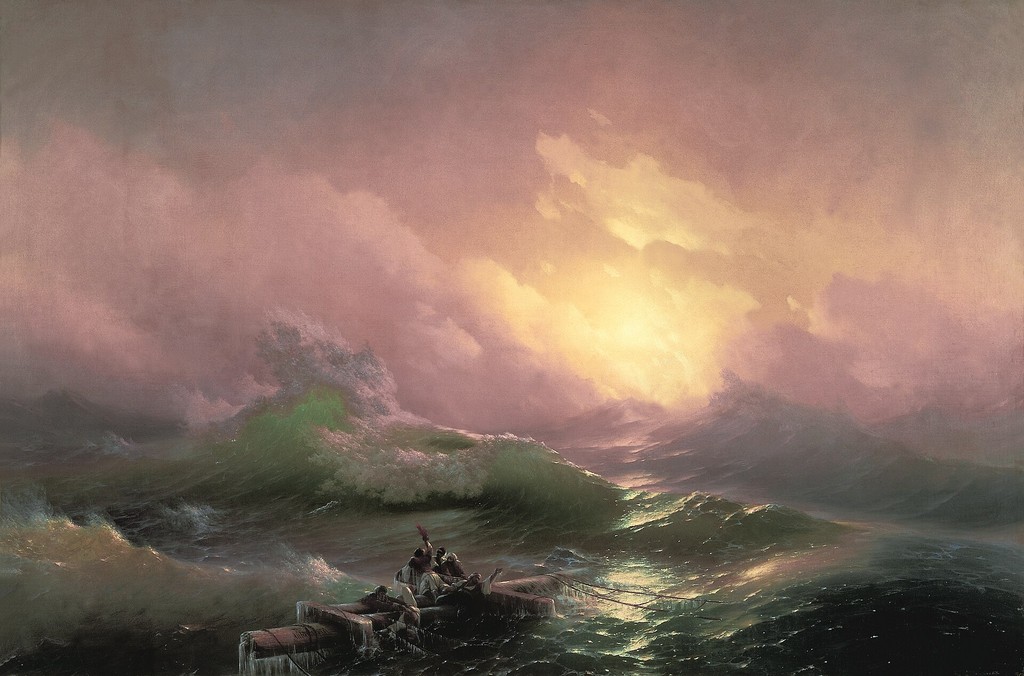
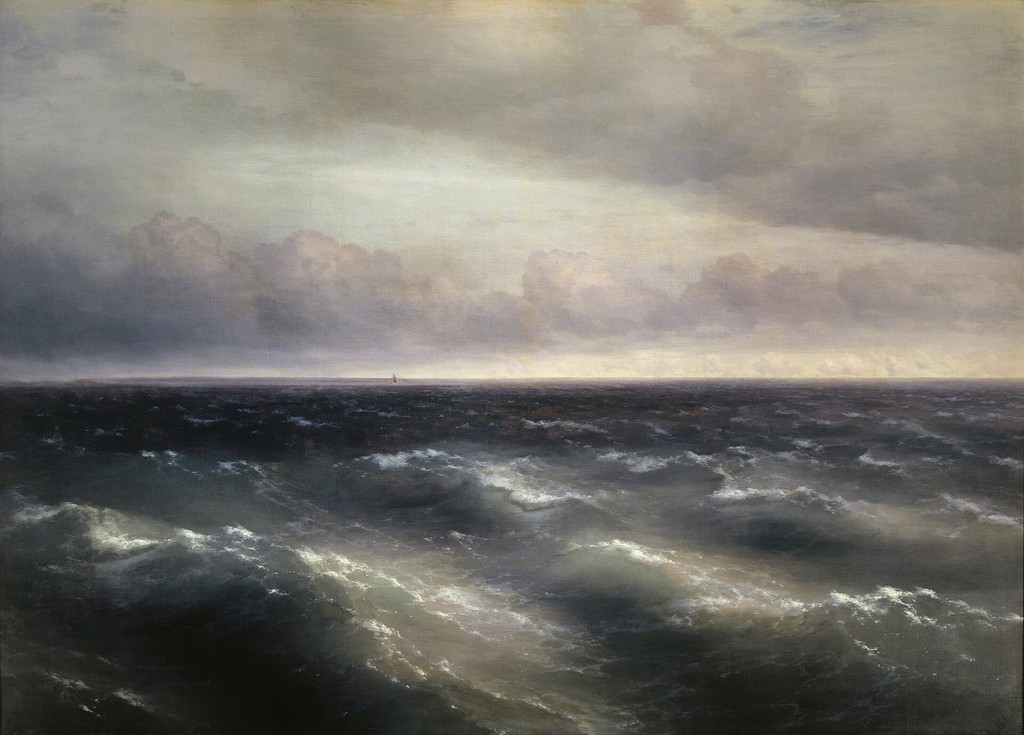
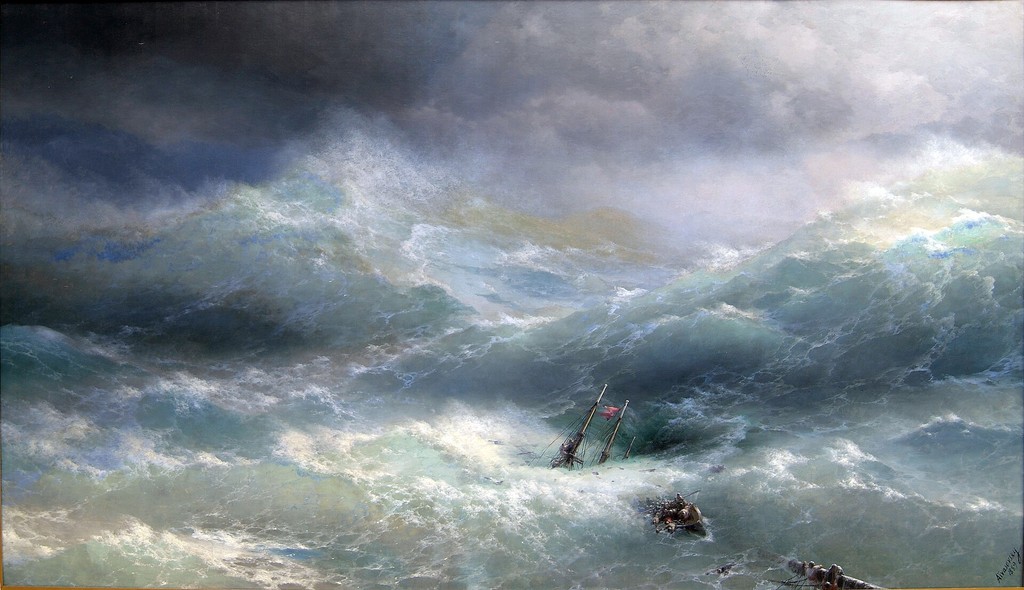
That distinction is central to his technique. Memory gave Aivazovsky freedom to clarify the broad forces of a scene, while close knowledge of weather and water kept invention credible. Horizon, tonal sequence, directional illumination and scale work together before any single wave or ship is considered. Across the paintings, the same elements support very different moods, from the warm ordeal of The Ninth Wave to the gathering darkness of The Black Sea and the immense late turbulence of Wave.
At a Glance
- ObservationRepeated study of coasts, ships and changing weather supplied a durable store of visual experience.[1]
- MemoryHe combined impressions rather than treating one place and moment as an inviolable unit.[4]
- StructureLarge divisions of sea, sky, shadow and illumination establish the scene before detail takes effect.[2]
- WaterApparent transparency comes from tonal relationships, directed light and the placement of foam, not from one formula.
- ScaleSmall vessels and figures measure distance, danger and exposure while also carrying a narrative.
- DevelopmentRadiant early drama gives way, in major later works, to more restrained colour and heavier masses of water.[1][4]
Contents
- Introduction
- Why Memory Mattered
- Sea and Sky as One Atmospheric Field
- Light as Pictorial Structure
- Transparency, Weight and Broken Water
- Figures and Vessels as Measures
- Speed, Repetition and Control
- From The Ninth Wave to Wave
Why Memory Mattered
The sea changes too quickly to offer a stable arrangement. A crest collapses, reflections shift with cloud, and a vessel alters the balance of an open horizon as it moves. Aivazovsky’s answer was not to abandon observation but to retain its useful relationships. Shahen Khachatryan describes an exceptional visual and emotional memory that allowed the artist to combine experiences separated by both time and geography. A tempest encountered near Italy might contribute to a Crimean subject; Bosphorus moonlight could be adapted to another coast.[4]
Memory therefore acted as a form of editing. It could preserve the angle at which light enters a wave, the recession of repeated swells or the way mist removes a distant boundary, without preserving every accidental circumstance around them. Ararat Aghasyan’s monograph likewise connects Aivazovsky’s studio work with visual memory, imagination, clear composition and carefully related light, air and colour.[1] The result is invention founded on sustained looking, not fantasy detached from nature.
This mobility of impressions also explains why location cannot always be inferred from atmosphere. A golden opening, dark headland or moonlit track may belong to the logic of a painting rather than provide documentary evidence for a particular shore. The method could keep a named place recognisable, but it also enabled a marine subject to reach beyond topography. Remembered knowledge became material for constructing a new and internally coherent event.
Sea and Sky as One Atmospheric Field
Aivazovsky’s horizon is rarely just a line separating two coloured zones. It is a hinge between air and water: brightness concentrated there can make the sea recede, while cloud descending towards it can compress the visible distance. A study of his development emphasises simple spatial organisation, numerous gradations and muted transitions in which colour and radiating light interweave.[2] Such continuity lets the weather seem to occupy the whole scene rather than sit above it as a backdrop.
In The Black Sea of 1881, the long horizon passes through a narrow interval of pale atmosphere. The foreground swells are much darker, and their uneven crests become smaller and quieter towards the remote sail. Sky and water remain distinct, but the compressed band between them makes the approaching change feel continuous. The exact work is State Tretyakov Gallery inventory 803. Its current record and an affiliated institutional record disagree slightly over the width—210 against 208 centimetres—without disturbing the identification.[9][10]
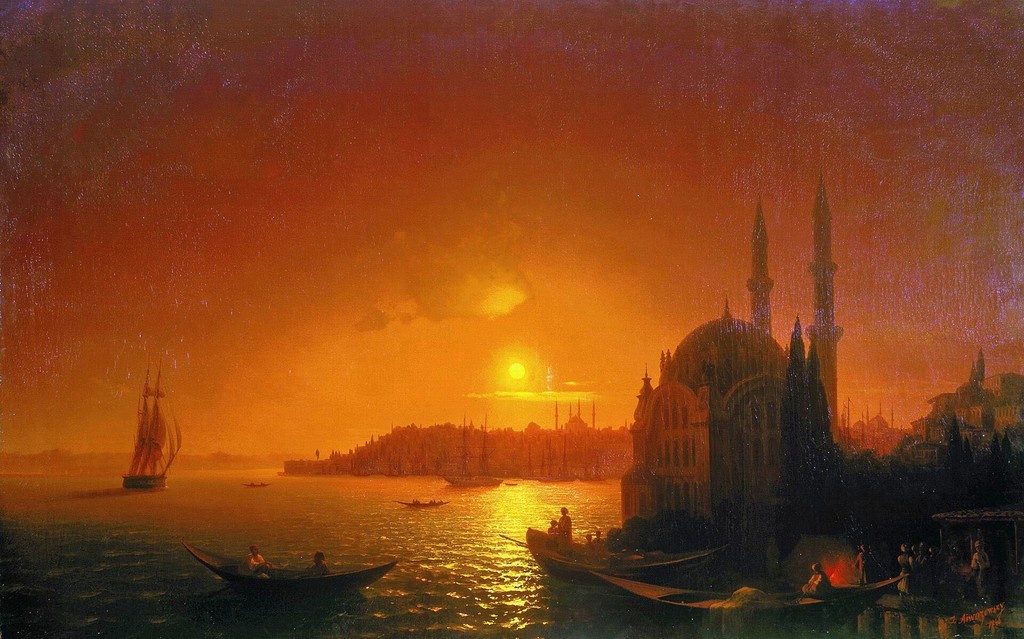
The same principle can serve a nocturne. In A View of Constantinople by Moonlight (1846), State Russian Museum inventory Ж-1787, a warm path crosses the water while architecture at the right and boats at several distances punctuate the surrounding dark.[7] Illumination does not simply pick out objects; it joins the opening in the sky to the reflective surface. Atmosphere is made legible through a connected sequence of values.
Light as Pictorial Structure
Light in Aivazovsky’s strongest paintings tells the eye where space opens, which wave turns towards us and how separate incidents belong to one weather system. It may be spectacular, but spectacle alone does not explain its work. Direction matters. A concentrated glow can anchor the far distance, then return in broken accents on foam, sail or wet hull. Dark masses gain force because they interrupt that route.
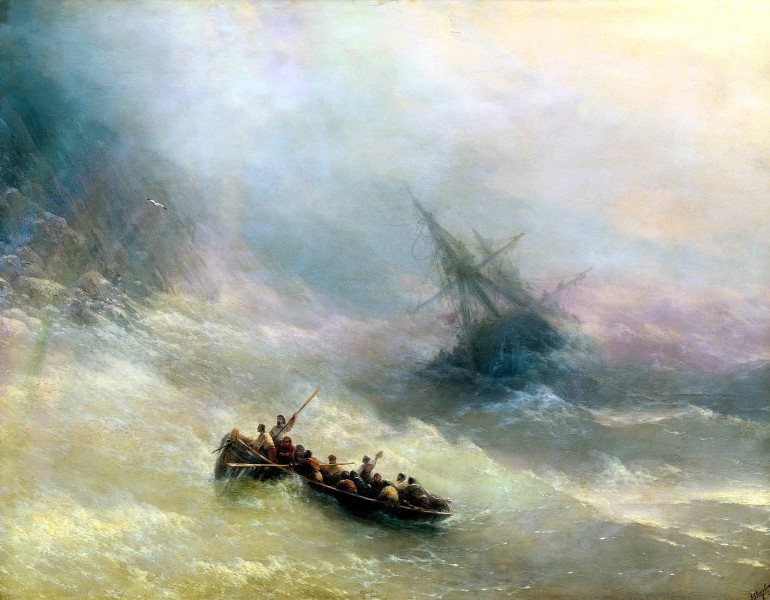
Rainbow (1873) demonstrates this organisation particularly well. A wreck and its broken rigging occupy the stormy middle distance, while the rescue boat crosses the lower field at a diagonal. A pale clearing spreads through spray on the right; darker cloud and rock collect to the left. The rainbow itself is faint, part of the moist air rather than a hard, decorative stripe. Light directs attention from danger towards an opening without cancelling the disorder of the sea. The exact painting is Tretyakov inventory 801; its two institutional records publish different dimensions, 105 by 136 and 102 by 132 centimetres, so identity rests on inventory as well as title and date.[11][12]
In The Ninth Wave (1850), State Russian Museum inventory Ж-2202, the luminous passage is warmer and more expansive. Golden and rose colour reaches into the upper water, so a towering swell can appear threatening and penetrable at once.[5] The survivors remain precarious; radiance offers visual and emotional possibility rather than a guarantee of rescue. One Tretyakov Gallery Magazine essay reads Aivazovsky’s recurring light as an image of life, hope and belief, relating it to Armenian cultural traditions.[3] That interpretation is valuable when kept as an attributed reading, not turned into a fixed meaning for every bright sky. In The Black Sea, for example, the distant light is narrow and withholding.
Transparency, Weight and Broken Water
The appearance of transparent water is built from visible relationships within the picture. A wave seems penetrable when its lit body is lighter or more chromatic than the trough before it, when tones change gradually across the curved surface, and when the crest carries sharper pale marks. Directional illumination makes those contrasts intelligible. Overlapping swells then show where one body of water hides another.
In The Ninth Wave, warm light entering the raised water reduces the sense of a solid wall. In Rainbow, grey-green sea, airborne spray and a bright atmospheric opening soften some boundaries while foam sharpens others. The water can feel both fluid and forceful because gradual transitions coexist with abrupt breaks. This is a perceptual construction: the visible relationships matter more than a presumed material trick.[5][11]
Wave (1889), State Russian Museum inventory Ж-2200, shifts the balance towards weight. Cold blue-green water occupies most of the enormous canvas; cloud compresses the upper zone, and the main crest at the right catches limited illumination. Smaller human signs are almost engulfed below.[6] Even here the sea is not an opaque block. Dark troughs, lighter planes and torn foam separate its moving volumes. Transparency survives locally, while the composition as a whole insists on mass and instability.
Figures and Vessels as Measures
Ships and people do more than supply incidents. Their familiar proportions give the surrounding water a scale that waves alone cannot establish. The survivors clinging to wreckage in The Ninth Wave make the swell immense; the low rescue boat in Rainbow turns a field of spray into traversable but perilous distance. In Wave, the disproportion becomes harsher because human traces sit beneath a far larger moving structure.[5][6][11]
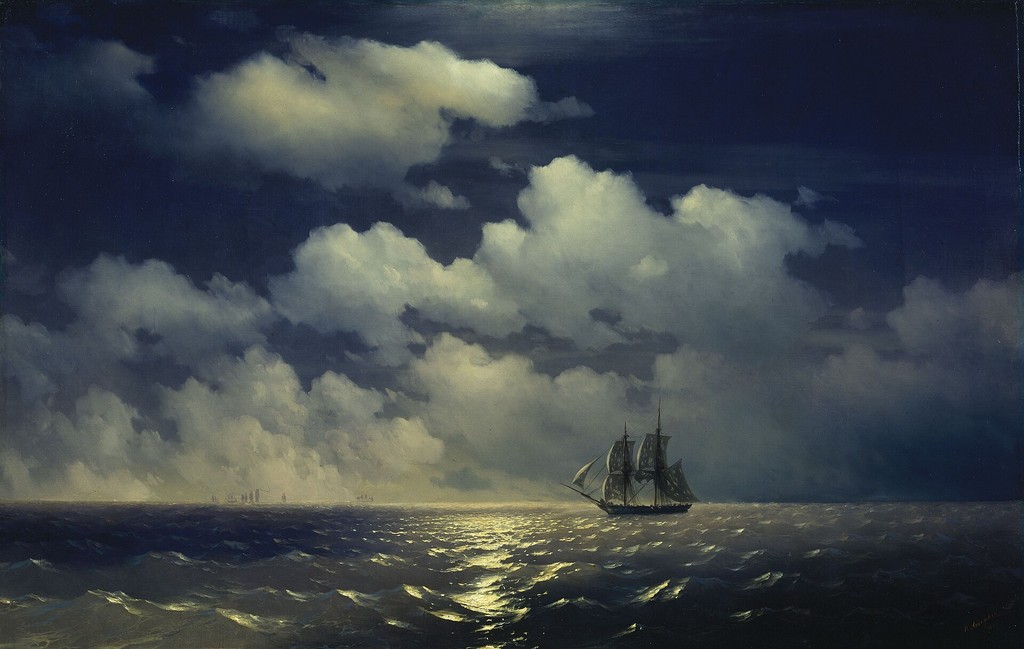
Vessels can also map recession and direction. The 1848 Mercury Brig aftermath, State Russian Museum inventory Ж-2209, shows a reunion rather than the combat mentioned in its full title. The brig, distant squadron and bands of illuminated water distribute the action across depth.[8] In the Constantinople nocturne, boats at different removes articulate the moonlit route through the harbour.[7] Narrative and spatial measurement are performed by the same forms.
Speed, Repetition and Control
Accounts of Aivazovsky’s working life describe extraordinary speed. He could improvise before students and sometimes finish a picture within hours, although contemporaries did not always approve of such displays.[4] Speed should not be confused with an absence of preparation. A painter drawing on familiar marine structures could work rapidly because choices about swell, cloud, silhouette and reflected light had been rehearsed through decades of observation and repeated composition.
Repetition, in this context, was variation rather than duplication. A distant aperture beneath storm cloud can promise release in one picture and deepen foreboding in another. A small ship may lead the gaze, establish remoteness or embody danger. Smooth transitions can unify a calm evening, whereas scattered foam divides a violent surface. The monographic and periodical studies both describe a continuing development in Aivazovsky’s handling of structure, tonal gradation and atmosphere.[1][2]
The recurring vocabulary also allowed scale to change without losing coherence. A modest harbour view and a monumental storm could be built from related spatial principles, yet their emotional pressure depended on proportion, colour and the amount of visible sky. Familiarity with the components made sharper differences possible.
From The Ninth Wave to Wave
The contrast between the two similarly named Russian Museum paintings reveals more than a move from early to late style. The Ninth Wave gives ample room to a radiant sky, carries warm colour into the sea and gathers survivors near a recognisable fragment of wreckage. Wave, made thirty-nine years later, enlarges the water until it dominates the field, restricts the sky and reduces human presence to a fragile sign.[5][6]
Between them, Rainbow and The Black Sea show that the development was not a straight withdrawal from colour. Rainbow turns broken weather into prismatic atmosphere and diagonal movement. The Black Sea strips the scene towards swelling water, distant sail and impending storm. Tretyakov scholarship associates these later works with a graver and more universal conception of nature.[4] Their variety matters: restraint could be luminous, nearly monochrome or violently expansive.
Across this sequence, Aivazovsky’s fundamental intelligence remains relational. Light is understood through surrounding darkness, water through air, immensity through a minute human marker, and movement through successive intervals. Memory allowed those relationships to be recomposed until each painting created a distinct condition rather than merely repeating a recognisable effect.
Researched works directory
This searchable evidence census was assembled from public museum records and a reproducible Wikidata snapshot. It is not a catalogue raisonné, not a claim to complete oeuvre coverage, and not a substitute for the published catalogue literature, which was not used to claim absolute completeness.
| Name | Date | Medium |
|---|---|---|
| A bay at dawn. | 1896 | Painting |
| A bay near Venice | 1842 | Painting |
| A Moonlit Night at Sea | 1885 | Painting |
| A Moonlit Night on the Bosphorus | 1894 | Painting |
| A Moonlit Night on the Crimean Coast | Date unknown | Painting |
| A Rocky Coastal Landscape in the Aegean with Ships in the Distance (detail) | 1884 | Painting |
| A. S. Pushkin and Countess M. N. Raevskaya by the sea near Gurzuf | 1886 | Painting |
| A. S. Pushkin at the Black Sea coast | 1887 | Painting |
| A. S. Pushkin at the Black Sea coast | 1897 | Painting |
| A Ship in a Stormy Sea | 1892 | Painting |
| A ship in peril | 1894 | Painting |
| A Ship of the Russian Navy off the Coast | Date unknown | Painting |
| A storm on rocky shores | 1875 | Painting |
| A Summer’s Day in Crimea | 1867 | Painting |
| A View of Constantinople by Moonlight | 1846 | Painting |
| A View of the Bosporus with the Hagia Sophia and the Maiden's Tower in the Moonlight | 1884 | Painting |
| A Wagon Train in the Desert | Date unknown | Painting |
| Abandoning Ship | 1882 | Painting |
| After the Storm | 1854 | Painting |
| Aiju-Dag | Date unknown | Painting |
| Aivazovsky Ivan Konstantinovic - Colon Sortint de Palos | 1892 | Painting |
| Aivazovsky - Oath befory Battle of Avarayr | 1892 | Painting |
| Aivazovsky with Friends | 1893 | Painting |
| Alexander II Crossing the Danube | 1878 | Painting |
| Alexander Pushkin at the Top of Ai-Petri at Sunrise | 1899 | Painting |
| Along the Coast | 1850 | Painting |
| Alushta | 1878 | Painting |
| American Shipping off the Rock of Gibraltar | 1873 | Painting |
| Among the Waves | 1898 | Painting |
| Arrival of Catherine II in Feodosia | 1883 | Painting |
| Azure Grotto, Naples | 1841 | Painting |
| Barge at Sea Shore | 1860–1870 | Painting |
| Battle of Chesma | 1848 | Painting |
| Battle of Chesma (1886) | Date unknown | Painting |
| Battle of Chios on 24 June, 1770 | 1848 | Painting |
| Battle of Sinope | 1853 | Painting |
| Beach | 1845 | Painting |
| Before the Storm: Theodosia | Date unknown | Painting |
| Biarritz | 1889 | Painting |
| Black Sea Fleet in the Bay of Theodosia, just before the Crimean War | 1890 | Painting |
| Boat Ride by Kumkapi in Constantinople | 1846 | Painting |
| Bosphorus | 1878 | Painting |
| Bosporuse väin öösel. | 1890 | Painting |
| Bracing The Waves | Date unknown | Painting |
| Breaking Wave | Date unknown | Painting |
| Brig “Mercury” Attacked by Two Turkish Ships | 1892 | Painting |
| Brig ''Mercury'' meets with the Russian squadron after the victory over two Turkish ships | 1848 | Painting |
| Broad landscape with settlers | 1856 | Painting |
| Byron in Venice | Date unknown | Painting |
| Byron's visit to the Mekhitarists in Surb Ghazar Island | 1899 | Painting |
| Byron's visit to the Mekhitarists on San Lazzaro | 1899 | Painting |
| Ca d'Oro | 1878 | Painting |
| Calm early evening sea | 1884 | Painting |
| Calm Sea | 1887 | Painting |
| Carriage in a Storm | Date unknown | Painting |
| Catholicos Khrimyan Airik near Echmiadzin | 1895 | Painting |
| Caucasus from the Sea | 1894 | Painting |
| Chaos. The Genesis | 1841 | Painting |
| Chapel by the sea | 1847 | Painting |
| Chumaks in Little Russia | Date unknown | Painting |
| Chumaks leisure | 1885 | Painting |
| Chumaks Waggons | 1862 | Painting |
| Clashes between the Shirvans and the Murids on Gunib | 1869 | Painting |
| Clouds | 1865 | Painting |
| Clouds Over a Calm Sea | 1873 | Painting |
| Clouds over the Sea, Calm | 1889 | Painting |
| Coast | 1840 | Painting |
| Coast of Amalfi | 1841 | Painting |
| Coffee-house by the Ortaköy Mosque in Constantinople | 1846 | Painting |
| Constantinople, la mosquée de Top-Kahné | 1884 | Painting |
| Constantinople Sunset | 1899 | Painting |
| Crimean coast by moonlight | 1853 | Painting |
| Crimean Coast by Moonlight | 1898 | Painting |
| Crimean scene. Gurzuf at night | 1865 | Painting |
| Crimean Tartars on the Sea Shore | 1850 | Painting |
| Crimean Views | 1850 | Painting |
| Cruiser in the sea at night | 1844 | Painting |
| Dante Shows an Artist Some Unusual Clouds | 1883 | Painting |
| Daryal Gorge | 1868 | Painting |
| Deluge | 1864 | Painting |
| Der Fluss Rioni in Georgien | 1870 | Painting |
| Descent of Noah from Ararat | 1887 | Painting |
| Destruction of Pompeii | 1889 | Painting |
| Distributing Supplies | 1892 | Painting |
| Dusk on the Golden Horn | 1845 | Painting |
| End of Storm | 1839 | Painting |
| Entrance to the Sevastopol Bay. | 1852 | Painting |
| Entrée de port | 1846 | Painting |
| Exchange Of Peterburg | 1840–1847 | Painting |
| Exploding Ship | 1900 | Painting |
| Farm House and Windmill by moonlight | 1863 | Painting |
| Fight of the steamer Vesta with the Turkish battleship Fehti-Bulend in the Black Sea on July 11, 1877 | 1877 | Painting |
| Figures on a moonlit coast | 1858 | Painting |
| Fishermen and their Families on the Shore of the Bay of Naples | 1873 | Painting |
| Fishermen on the Beach | 1852 | Painting |
| Fishermen on the shore | Date unknown | Painting |
| Fishermen Returning Near Naples | 1874 | Painting |
| Fishing Boats In A Harbor | 1854 | Painting |
| Foggy day on the shores of Italy | Date unknown | Painting |
| French Ships Departing the Black Sea | 1871 | Painting |
| Frigate under sail | 1838 | Painting |
| From Mleta to Gudauri | 1868 | Painting |
| Frozen Bosphorus Under Snow (detail) | 1874 | Painting |
| Gathering Storm | 1899 | Painting |
| Golden Horn Bay Turkey | 1846 | Painting |
| Gondolier on the Sea at Night | 1843 | Painting |
| Gulf of Naples | 1874 | Painting |
| Gunboat off Crete | 1897 | Painting |
| Gurzuf at night | 1849 | Painting |
| Harbour Scene | Date unknown | Painting |
| Ice-Breakers on the Frozen Neva in St. Petersburg | 1877 | Painting |
| Ice on Dnipro | 1872 | Painting |
| Icebergs in the Atlantic | 1870 | Painting |
| In the harbor | 1840 | Painting |
| In the roads, Evening | 1867 | Painting |
| Italian Landscape | 1855 | Painting |
| Italian Landscape (Lago Maggiore), Evening | 1858 | Painting |
| Iwan Konstantinowitsch Aiwasowskij 001 | 1864 | Painting |
| Jalta | 1838 | Painting |
| Jude's the Apostol betrayal | 1834 | Drawing |
| La Vague | 1886 | Painting |
| Landscape in Crimea. | 1860 | Painting |
| Landscape with Windmills | 1860 | Painting |
| Large raid in Kronstadt | 1836 | Painting |
| Little Russian Ox Cart in Winter | 1866 | Painting |
| Loading Provisions off the Crimean Coast | 1876 | Painting |
| Look to the Large Cascade and Large Petergof Palace | 1837 | Painting |
| Marine scene | Date unknown | Painting |
| Marine View | 1899 | Painting |
| Mercury Brig Meeting a Russian Squadron after her Victory over Two Turkish Vessels | 1848 | Painting |
| Meri | Date unknown | Painting |
| Mine attack by boats of the steamer Grand Duke Constantine on the Turkish battleship Assari-Shevket on the Sukhum roadstead on August 12, 1877 | 1877 | Painting |
| Moon night on the Crimea, Gurzuf | 1839 | Painting |
| Moonlight at night near the spring | 1877 | Painting |
| Moonlight in Naples | 1842 | Painting |
| Moonlit coast | 1864 | Painting |
| Moonlit Landing | 1895 | Painting |
| Moonlit Night | 1850 | Painting |
| Moonlit Night | 1878 | Painting |
| Moonlit Night (1958) | 1858 | Painting |
| Moonlit Night (Aivazovsky) | Date unknown | Painting |
| Moonlit night in Crimea | 1859 | Painting |
| Moonlit night on the seashore in Crimea | 1852 | Painting |
| Moonlit Seascape With Shipwreck | 1863 | Painting |
| Morning on the sea | 1883 | Painting |
| Morning on the shore of the bay | 1853 | Painting |
| Mountain Village Gunib in Daghestan. View from the East. | 1869 | Painting |
| Naples Bay | 1842 | Painting |
| Naples with a poet amongst fishermen | 1845 | Painting |
| Naufragiul 1886 | 1886 | Painting |
| Neapolitan lighthouse. | 1842 | Painting |
| Night at Gurzof | 1891 | Painting |
| Night at the Rodos island | 1850 | Painting |
| Night in Constantinople | 1862 | Painting |
| Night in Venice | 1847 | Painting |
| Night. The Tragedy at the Sea of Marmara | 1897 | Painting |
| Nocturnal Voyage | Date unknown | Painting |
| Odessa at Moonlight | 1846 | Painting |
| Odessa, view from the Sea | 1865 | Painting |
| Old Feodosia | 1839 | Painting |
| Old Theodosia | 1845 | Painting |
| Ox-carts in the Ukrainian steppe | 1888 | Painting |
| Panorama of Constantinopole (detail) | 1856 | Painting |
| Parade of the Black Sea Fleet | 1886 | Painting |
| Passage of the Jews through the Red Sea | 1891 | Painting |
| Passing Ship on a Moonlit Night | 1868 | Painting |
| Peter | 1846 | Painting |
| Peter I at Krasnaya Gorka Lighting a Fire on the Shore to Signal to his Sinking Ships | 1900 | Painting |
| Petersburg. Crossing the Neva. | 1870 | Painting |
| Port of Theodosia | Date unknown | Painting |
| Portrait of A. Kaznacheev | 1847 | Painting |
| Portrait of a man | Date unknown | Drawing |
| Portrait of a Teenager | Date unknown | Painting |
| Portrait of archbishop Gabriel Aivazyan (brother of I. Aivazovsky) | 1883 | Painting |
| Portrait of the grandmother of painter Ashhen | 1858 | Painting |
| Portrait of vice admiral M.P. Lazarev | 1839 | Painting |
| Pushkin and Raevskaya in Gurzuf | 1900 | Painting |
| Pushkin in Crimea near Gurzuf rocks | 1880 | Painting |
| Pushkin's Farewell to the sea | 1887 | Painting |
| Q108330660 | 1847 | Painting |
| Q138511047 | 1857 | Painting |
| Q27074794 | Date unknown | Painting |
| Quiet Night: Armenians Thrown Overboard off the Turkish Ships | 1897 | Painting |
| Rainbow | 1873 | Painting |
| Reeds on the Dnieper | 1857 | Painting |
| Rescuers from the shipwreck | 1844 | Painting |
| Reval (Tallinn) | 1845 | Painting |
| Road in the Forest | 1857 | Painting |
| Rocky Cliffs | 1891 | Painting |
| Rocky Seashore | 1876 | Painting |
| Russian squadron at the Sevastopol roadstead | 1849 | Painting |
| Sailboat . | 1859 | Painting |
| Sailing Boat | Date unknown | Drawing |
| Sailing Ship on a calm sea by Moonlight | 1897 | Painting |
| Sailing Ship on the Sea at Moonlight. | 1840 | Painting |
| Sailing Ships on a Calm Day. | 1887 | Painting |
| Sarkizova Ann, second wife of I. Aivazovsky | 1882 | Painting |
| Scenes from Cairo's life | 1881 | Painting |
| Sea | 1864 | Painting |
| Sea Battle at Navarino on October 20, 1827 | 1846 | Painting |
| Sea coast | 1886 | Painting |
| Sea coast at night. Near the beacon | 1837 | Painting |
| Sea on a Moonlit Night | 1857 | Painting |
| Sea on a Moonlit Night | 1858 | Painting |
| Sea View | 1855 | Painting |
| Sea View | 1875 | Painting |
| Sea view from the chapel on the shore | 1845 | Painting |
| Seascape | 1885 | Painting |
| Seascape | Date unknown | Painting |
| Seascape with a steamer. | 1897 | Painting |
| Seascape with full moon | 1857 | Painting |
| Sebastopol | 1852 | Painting |
| Selbstportrait | 1881 | Painting |
| Selbstporträt | 1892 | Painting |
| Self-portrait | 1874 | Painting |
| Self-Portrait | 1898 | Painting |
| Sheep driven by the storm into the sea. | 1855 | Painting |
| Shepherds' Camp | 1858 | Painting |
| Shepherds with a flock of sheep. | 1872 | Painting |
| Ship Amid the Stormy Sea | 1887 | Painting |
| Ship by Moonlight | 1868 | Painting |
| Ship, castle and sea | 1847 | Painting |
| Ship ''Empress Maria'' in a Storm | 1892 | Painting |
| Ship in a storm | 1899 | Painting |
| Ship in a Stormy Sea off the Coast | 1895 | Painting |
| Ship on Stormy Seas | 1850 | Painting |
| Ship "Twelve Apostles | 1897 | Painting |
| Ships at the raging sea | 1866 | Painting |
| Ships on a misty morning | Date unknown | Painting |
| Ships on Stormy Sea, Sunrise | 1871 | Painting |
| Shipwreck | 1843 | Painting |
| shipwreck | 1876 | Painting |
| Shipwreck in the North Sea | 1875 | Painting |
| Shipwreck of "Lefort | 1858 | Painting |
| Shipwreck off the Black Sea Coast | 1887 | Painting |
| Shipwreck on a Stormy Morning | 1895 | Painting |
| Shipwreck on Stormy Seas | 1886 | Painting |
| Shoreline | 1851 | Painting |
| Sinking Ship | 1854 | Drawing |
| Smolny Abbey. Sunset. | 1847 | Painting |
| Solar Eclipse in Feodosia | 1876 | Painting |
| St. George Monastery. Cape Fiolent | 1846 | Painting |
| St. Petersburg | 1850 | Painting |
| St. Petersburg - Galleon on the docks | 1850 | Painting |
| Steamboat on a Moonlit Night | 1884 | Painting |
| Storm | 1851 | Painting |
| Storm | 1854 | Drawing |
| Storm | 1861 | Painting |
| Storm | 1872 | Painting |
| Storm | 1880 | Painting |
| Storm | 1886 | Painting |
| Storm | 1899 | Painting |
| Storm (1871) | 1871 | Painting |
| Storm at sea | 1850 | Painting |
| Storm at sea | 1873 | Painting |
| Storm at Sea on a Moonlit Night | 1866 | Painting |
| Storm off the coast of Odessa | 1898 | Painting |
| Storm on Sea | 1899 | Painting |
| Storm on the Sea | 1876 | Painting |
| Storm over Eupatoria | 1900 | Painting |
| Stormy Sea | 1844 | Painting |
| Stormy Sea | 1850 | Painting |
| Stormy sea at night | 1849 | Painting |
| Strong Wind | 1856 | Painting |
| Stürmische See im Abendrot. | 1896 | Painting |
| Suez Canal | 1869 | Painting |
| Sunny Day | 1884 | Painting |
| Sunset | 1879 | Artwork |
| Sunset at Sea | 1851 | Painting |
| Sunset at sea | 1877 | Painting |
| Sunset at the Sea | 1848 | Painting |
| Sunset over the Golden Horn | 1866 | Painting |
| Sunset over Yalta | 1861 | Painting |
| Survivors | 1844 | Painting |
| Sveaborg | 1844 | Painting |
| The Baptism of the Armenian People. Gregory the Illuminator | 1892 | Painting |
| The Battle of Revel | 1846 | Painting |
| The Battle of Sinope on 18 November 1853 (Night after Battle) | 1853 | Painting |
| The Battle of Vyborg Bay in 1790. | Date unknown | Painting |
| The Battle of Wyborg Bay | 1846 | Painting |
| The Bay of Naples | 1841 | Painting |
| The Bay of Naples | 1844 | Painting |
| The Bay of Naples | 1845 | Painting |
| The Bay of Naples | 1878 | Painting |
| The Bay of Naples. | Date unknown | Painting |
| The Bay of Naples with Capri | 1891 | Painting |
| The Bay of Yalta with the Magobi and Ai Petri mountains | 1850 | Painting |
| The Beach at Biarritz | Date unknown | Painting |
| The birth of Aphrodite | Date unknown | Painting |
| The Black Sea | 1881 | Painting |
| The Black Sea at night | 1879 | Painting |
| The Black Sea Fleet in Feodosia | 1890 | Painting |
| The Black Sea (Marina) | 1882 | Painting |
| The Burning of the Turkish Flagship by Kanaris | 1881 | Painting |
| The Canal Grande with a view of Santa Maria della Salute at sunset. | 1848 | Painting |
| The Caucasus | 1863 | Painting |
| The Disembarkation of Christopher Columbus with Companions on Three Launches, on Friday 12th October 1492, At Sunrise, on an American Island Named San Salvador by Him on the Very Same Day | Date unknown | Painting |
| The Galata Tower by Moonlight | 1845 | Painting |
| The Great Pyramid at Giza | 1871 | Painting |
| The Harbor at Odessa on the Black Sea | 1852 | Painting |
| The Island of Ischia at Sunset (Sunset over Ischia) | 1857 | Painting |
| The Island of Rhodes | 1861 | Painting |
| The Landing of N. N. Raevskyi at Subashi | 1839 | Painting |
| The Maiden's Tower | 1848 | Painting |
| The Massacre of Armenians in Trebizond in 1895 | 1897 | Painting |
| The Mekhitarist Fathers on Lazarus Island, Venice | 1843 | Painting |
| The Mekhitarist Fathers on San Lazzaro Island. Venice | 1843 | Painting |
| The Ninth Wave | 1850 | Painting |
| The Relief Ship | 1892 | Painting |
| The Rescue | Date unknown | Painting |
| The Russian Squadron on the Sebastopol Roads | 1846 | Painting |
| The Sea | 1865 | Painting |
| The Shipwreck | 1873 | Painting |
| The Shipwreck | Date unknown | Painting |
| The Shores of the Mediterranean | 1892 | Painting |
| The storm at Cape Aya | 1899 | Painting |
| The storm at sea | 1850 | Painting |
| The Storm on the Turkish Coast | 1858 | Painting |
| The strip "Swetlana | Date unknown | Painting |
| The Survivor | 1880 | Painting |
| The survivors | 1895 | Painting |
| The Tide | 1870 | Painting |
| The Wrath of the Seas | 1886 | Painting |
| Theodosia Bay, sunrise | 1855 | Painting |
| Theodosia, end of day | 1865 | Painting |
| Theodosia. Moonlight night | 1852 | Painting |
| Trebizond from the sea | 1875 | Painting |
| Ukrainian Landscape at Night | 1870 | Painting |
| Ukrainian landscape with chumaks in the moonlight | 1869 | Painting |
| untitled | Date unknown | Painting |
| Venetian lagoon. View of the island of San Giorgio. | 1844 | Painting |
| Venice | 1844 | Painting |
| Venice at Sunset | 1873 | Painting |
| View in Crimea at sunset | 1862 | Painting |
| View of a bay with numerous sailing-ships (Feodosia?) | Date unknown | Drawing |
| View of Constantinople and the Bosphorus | 1856 | Painting |
| View of Constantinople by evening light | 1846 | Painting |
| View of Moscow from the Sparrow Hills | 1851 | Painting |
| View of Odessa on a moonlit night | 1855 | Painting |
| View Of The Ayu Dag Crimea | 1868 | Painting |
| View Of The Sea From The Mountains At Sunset. Crimea | 1900 | Painting |
| View of Vico near Naples | 1855 | Painting |
| View to the Crim | 1851 | Painting |
| View to the sea coast near St. Petersburg | 1835 | Painting |
| Volga near the Zhiguli Mountains | 1887 | Painting |
| Walking on Water | 1888 | Painting |
| Walking on Water | 1890 | Painting |
| Wave | 1889 | Painting |
| Wave hitting a Rock | 1860 | Painting |
| Wave. Two Ships | Date unknown | Painting |
| Windmill by the Sea | 1837 | Painting |
| Winter Caravan on Road | 1857 | Painting |
| Winter in Ukraine | 1874 | Drawing |
| Winter landscape | 1876 | Painting |
| Winter Scene in Little Russia | 1868 | Painting |
| Wreck of the ship "Ingermanland" in Skagerrak on the night of August 30, 1842. | Date unknown | Painting |
| Yalta | 1899 | Painting |
Frequently Asked Questions
It meant retaining observed relationships and reorganising them in the studio. He could combine weather, illumination and coastal impressions encountered at different times, while still drawing on extensive knowledge of how sea and sky behave. Memory supported selection and invention; it did not remove the need for close observation.[1][4]
The illusion depends on neighbouring values and colours. A lighter wave body set against a dark trough, gradual change across its curve, a sharply lit crest and consistent illumination can make water seem penetrable. Together, those relationships let the eye read volume and depth across a painted surface.
Their scale helps viewers judge distance and the size of the surrounding sea. They also concentrate narrative: a boat crossing spray, survivors on wreckage or a remote sail can turn weather into danger, endurance or expectation. Spatial and human meanings reinforce each other.
Contemporary accounts describe remarkably rapid demonstrations and say that he could sometimes finish a picture in a short sitting. Such performances represented only one aspect of his practice. Their fluency rested on accumulated observation, visual memory and repeated command of marine composition.[4]
Discussion
Use this evidence-led guide as a starting point for close looking rather than a final verdict.
Share an observation about Light, Memory and Marine Technique or a source that adds useful context.
Reader Insights
Which work most clearly complicates the familiar image of Aivazovsky as a painter of spectacular storms?
Where do Feodosia, Armenian identity, academy training, travel or naval service most productively alter your reading?
Which source or surviving object would you investigate next?
Join the Conversation
Add your reading below, keeping observations specific and evidence clear.
References
- Ararat Aghasyan, Enchanted by the Sea: Ivan (Hovhannes) Aivazovsky, accessed 30 August 2026.
- Ararat Aghasyan, “The Exceptional Master of Seascapes”, accessed 30 August 2026.
- Tretyakov Gallery Magazine, “Aivazovsky Brothers”, accessed 30 August 2026.
- Tretyakov Gallery Magazine, “Artist of the Hellenic Spirit”, accessed 30 August 2026.
- Virtual Russian Museum, “The Ninth Wave”, accessed 30 August 2026.
- Virtual Russian Museum, “Wave”, accessed 30 August 2026.
- Virtual Russian Museum, “A View of Constantinople by Moonlight”, accessed 30 August 2026.
- Virtual Russian Museum, “Mercury Brig Meeting a Russian Squadron after her Victory over Two Turkish Vessels”, accessed 30 August 2026.
- State Tretyakov Gallery, “The Black Sea”, accessed 30 August 2026.
- Tretyakov Gallery Magazine, “The Black Sea” catalogue record, accessed 30 August 2026.
- State Tretyakov Gallery, “Rainbow”, accessed 30 August 2026.
- Tretyakov Gallery Magazine, “Rainbow” catalogue record, accessed 30 August 2026.