 by Tom Gurney
Tom Gurney BSc (Hons) is an art history expert with over 20 years experience
Page Created on / Page Updated on
Email: tomgurney1@gmail.com / Phone: +44 7429 011000
Wave: Introduction
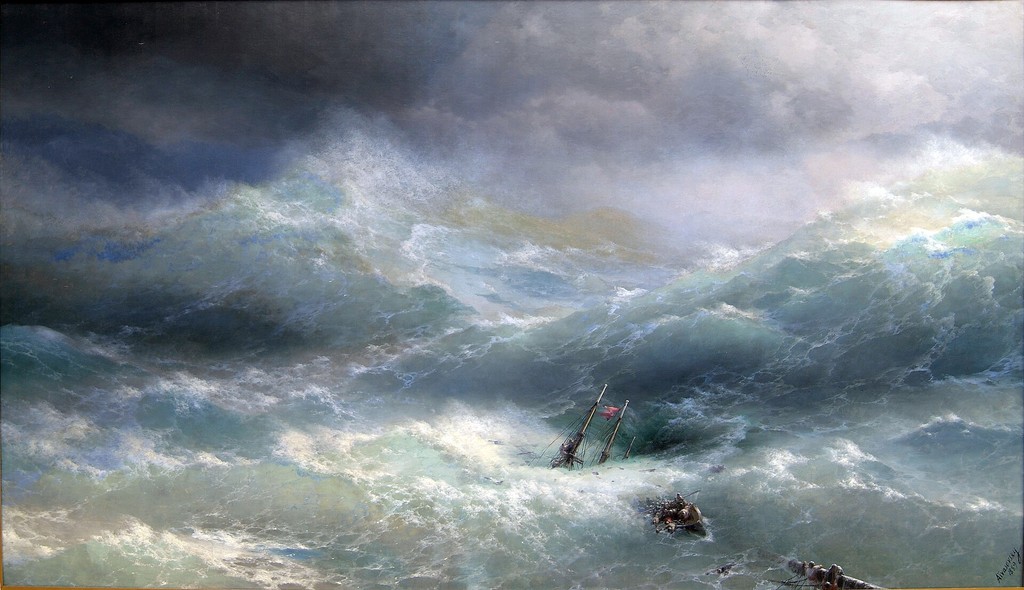
Ivan Aivazovsky’s Wave does not offer one sovereign breaker that can be watched from a safe distance. Water rises across almost the entire field in overlapping masses, while a wrecked vessel and its survivors are pushed towards the lower edge. The eye searches for a horizon, a stable craft or a passage out, but cloud, spray and successive swells keep interrupting every route. Immensity is not background spectacle here. It is the condition in which the human incident is nearly lost.
Painted in 1889, Wave is among Aivazovsky’s largest surviving canvases: 304 by 505 centimetres. It belongs to the State Russian Museum under inventory Ж-2200.[1] The museum interprets its cold, dark palette as a departure from the brighter Romantic colouring associated with earlier work and as an approach towards realism.[1] That is a useful comparison, provided it is not turned into the blunt claim that the seventy-two-year-old artist suddenly ceased to be a Romantic.
At a Glance
- ArtistIvan Aivazovsky (1817–1900).
- Date and medium1889, oil on canvas.[1]
- CollectionState Russian Museum, inventory Ж-2200.[1]
- Dimensions304 by 505 centimetres—more than five metres across.[1]
- ProvenanceAivazovsky gave it to Alexander III in 1891; Nicholas II gave it to the museum in 1897.[1]
- Subjecta broken ship and minute groups of survivors are engulfed by a cold, interconnected field of waves.[1]
Ivan Aivazovsky in context
Contents
- Introduction
- Object, Scale and Imperial Provenance
- A Wave System Rather than One Crest
- Broken Vessel and Nearly Lost Figures
- Cold Light and Compressed Hope
- Monumental Size and Bodily Viewing
- Romantic Inheritance and Late Severity
- Distinguishing Wave from Similar Titles
Object, Scale and Imperial Provenance
The inventory number is essential because Wave is a descriptive title in an oeuvre crowded with storms and breakers. Ж-2200 fixes the name to one oil painting made in 1889, now held by the State Russian Museum. The institution gives its dimensions as 304 centimetres high and 505 wide and identifies it as a late work, completed when Aivazovsky was seventy-two.[1] Title, year, collection, size and inventory must remain together if this canvas is to be distinguished from similarly named pictures.
Its ownership history is unusually concise. The museum’s collection record states that Aivazovsky presented the painting to Emperor Alexander III in 1891. In 1897 it entered the museum as a gift from Nicholas II.[1] The sequence places the work first in an imperial collection and then among the early holdings of the institution founded in Alexander III’s name. It should not be shortened into a claim that the museum obtained the canvas directly from Aivazovsky: the two gifts are separate stages.
At just over five metres wide, the work exceeds the scale of an ordinary domestic seascape. Its area is roughly fifteen square metres, so even the broad measurements understate how much of a standing viewer’s visual field it can occupy. This physical fact is part of the painting’s meaning. The ship and figures are not simply small in an image; they are slight marks within a painted expanse larger than many walls.
The wider guide to Aivazovsky’s paintings places Wave among nocturnes, naval scenes and other storms. On this page, however, the exact object is the starting point. A general account of his marine style cannot substitute for the particular proportions, provenance and visual structure of Ж-2200.
A Wave System Rather than One Crest
No single contour contains the sea. A high swell gathers on the left, breaks into thrown spray near its crown, and descends into a shadowed hollow. Across the centre, lower ridges cross that movement before another illuminated mass climbs at the right. Nearer water folds back in several directions. Foam travels over these bodies in broken diagonals, revealing their surfaces while also making their boundaries harder to follow.
This arrangement matters because the title is singular while the painted action is plural. The “wave” is better understood as a whole regime of motion: crest generates trough, a trough opens onto another rise, and every apparent interval is occupied by further water. The museum describes the movement as chaotic and sets nature’s immense power against the futility of human effort.[1] Yet the composition is not shapeless. Dark and light passages steer attention from left-hand shadow, through the wreck, towards the pale upper right, then down again into the foreground surge.
The horizon is almost unusable as an anchor. It disappears behind spray and elevated water, so recession has to be judged through overlapping scale rather than a clean line between sea and sky. This makes the storm feel deep as well as tall. The viewer cannot reduce it to a flat barrier advancing from one direction; water seems to continue behind, around and in front of every visible crest.
Aivazovsky’s broader practice of composing from stored observation helps explain such coherence. Tretyakov scholarship describes his ability to combine remembered impressions and to create the motions of late seas from seemingly turbulent brushwork, delicate foam and transparent depths.[2] Light, Memory and Marine Technique examines that method across the career. In Wave, it produces a deliberately unstable field whose parts nevertheless belong to one weather system.
Broken Vessel and Nearly Lost Figures
The damaged ship appears below and right of centre. Much of its hull is already concealed; angled masts, rigging and a small red accent remain legible against pale churn. A dark hollow opens immediately behind it, while foam presses across the foreground. The wreck is therefore caught between wave structures rather than displayed as an isolated narrative prop.
Farther to the lower right, people crowd a low fragment or boat, and another slight human cluster reaches the edge of the composition. Their bodies are visible only after sustained looking. Faces cannot be read, and no single gesture controls the scene. What registers first is collective exposure: several people have survived the vessel’s destruction, but their remaining supports are scarcely distinct from the debris around them.
The Russian Museum’s annotation is uncompromising. It describes the ocean as ready to consume the broken ship and judges that the sailors have no hope of escape.[1] The image supports that severity. There is no approaching rescue craft, no shore and no secure platform. Even the brightest water does not lead towards an identifiable refuge.
Nothing in the record names the vessel, the people, a coastline or a historical accident. Aivazovsky knew ships and naval history intimately, but that general knowledge does not authorise a specific identification here. The broken rig and human remnants establish a shipwreck narrative without turning the painting into documentation of a known loss. Its anonymity directs attention towards proportional helplessness rather than biography.
Cold Light and Compressed Hope
Light enters from the upper right, but it does not unfold as a golden dawn. It filters through grey-violet cloud and catches the tops and thin bodies of blue-green waves. White spray flashes against deep slate and turquoise shadow; faint yellow enters a few translucent passages nearer the foreground. These changes prevent the sea from becoming a single dark block, while the overall temperature remains markedly cold.
The lit zone offers visibility rather than deliverance. It lets the right-hand swell become more transparent at its crest and exposes the trough around the wreck. Instead of opening a road beyond danger, brightness clarifies how thoroughly the survivors are enclosed. The darkest cloud weighs over the left half, but even the paler sky on the right contains no clear weather boundary.
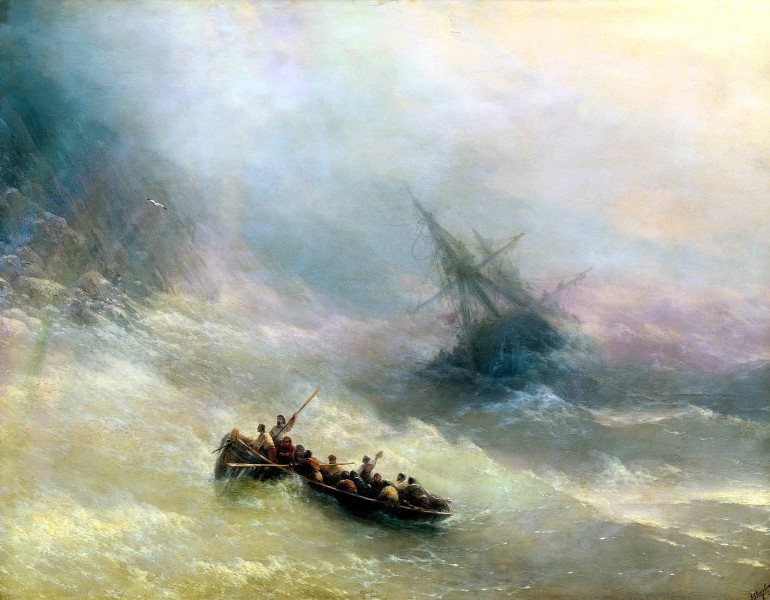
That treatment separates Wave from Rainbow. In the 1873 painting, mist contains a faint spectral arc and a crowded boat moves near a coast; hope remains conditional, yet a change of weather can be imagined. Wave removes land and refracted colour. Its light is scattered through violent water rather than gathered into a sign of transition.[2]
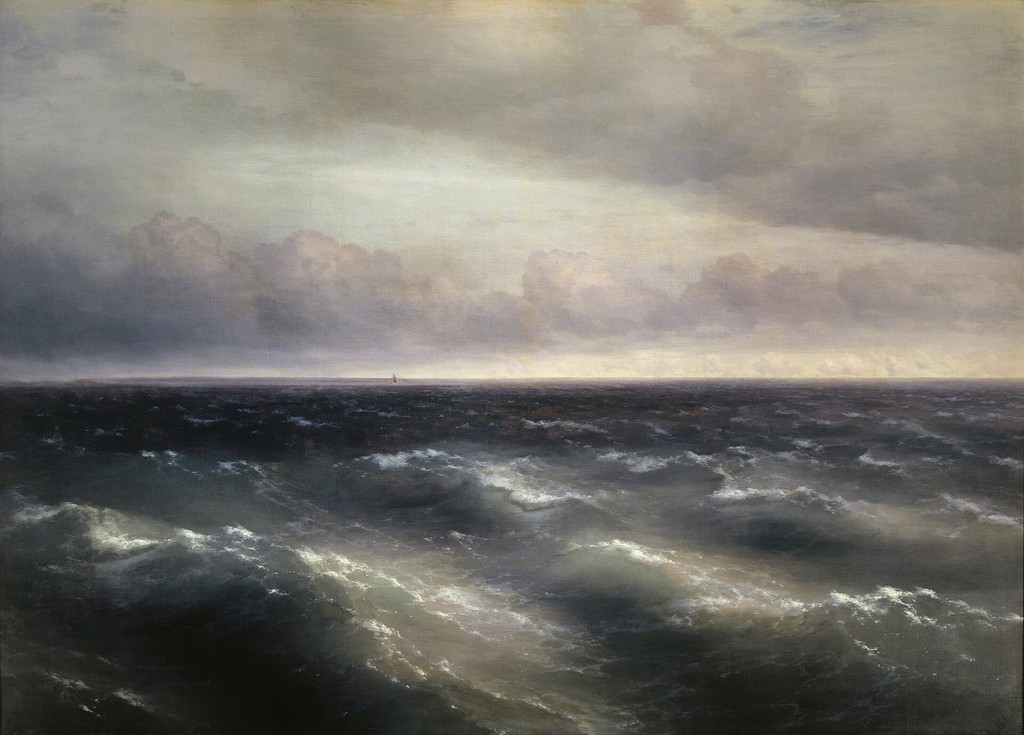
It also differs from The Black Sea of 1881. That canvas builds pressure through an approaching storm, an extended horizon and one remote sail. The later work begins after catastrophe and denies the eye that broad, restrained distance. Both are grave late seas, but one withholds an event while the other submerges its aftermath in continuous motion.[2]
Monumental Size and Bodily Viewing
On a small screen, the wreck may become the obvious centre because it is one of the few recognisable objects. Before the original, scale reverses that priority. Five metres of painted water stretch laterally beyond the incident, and three metres of height place crest above crest. A viewer must either stand back to grasp the total structure or move closer and surrender the whole to local passages of foam and colour.
This oscillation recreates the difficulty of orientation within the subject. From a distance, the figures nearly vanish. At close range, the waves exceed a single glance. Neither position supplies complete mastery, and the body has to negotiate between them. Monumentality therefore does more than magnify drama; it makes looking itself an exercise in changing scale.
Galina Churak groups Wave with the still later Among the Waves and argues that their size and seriousness bring marine landscape nearer to the ambitions of history painting.[2] The comparison concerns rank and interpretive weight, not genre disguise. Wave contains no named historical hero. Its enormous format is instead given to an elemental crisis in which anonymous sailors occupy only a fraction of the surface.
The broken ship is crucial to this effect. Without it, the dimensions would still be impressive, but the water would lack a familiar measure. Masts, boat and bodies convert painted metres into felt disproportion. Human construction has not vanished entirely; it remains just visible enough to show what the storm has overwhelmed.
Romantic Inheritance and Late Severity
The museum says that Wave moves away from Aivazovsky’s earlier Romantic choice of colour and comes closer to a realist solution.[1] The careful words are “moves” and “closer”. They describe a relative shift in treatment, especially from radiant colour towards a colder, darker atmosphere. They do not require the painting to be reassigned wholesale to Realism or detached from six decades of Romantic marine invention.
Romantic structures remain conspicuous: natural force is sublime in scale, human life is exposed at an extreme moment, and weather carries emotional pressure. The sea has also been composed for maximum confrontation rather than offered as an indifferent sample of ordinary conditions. What has changed is the distribution of emphasis. Brightness no longer balances terror with an expansive promise; the wreck is not dignified into a heroic centre; and the palette binds sky, spray and water into one severe environment.
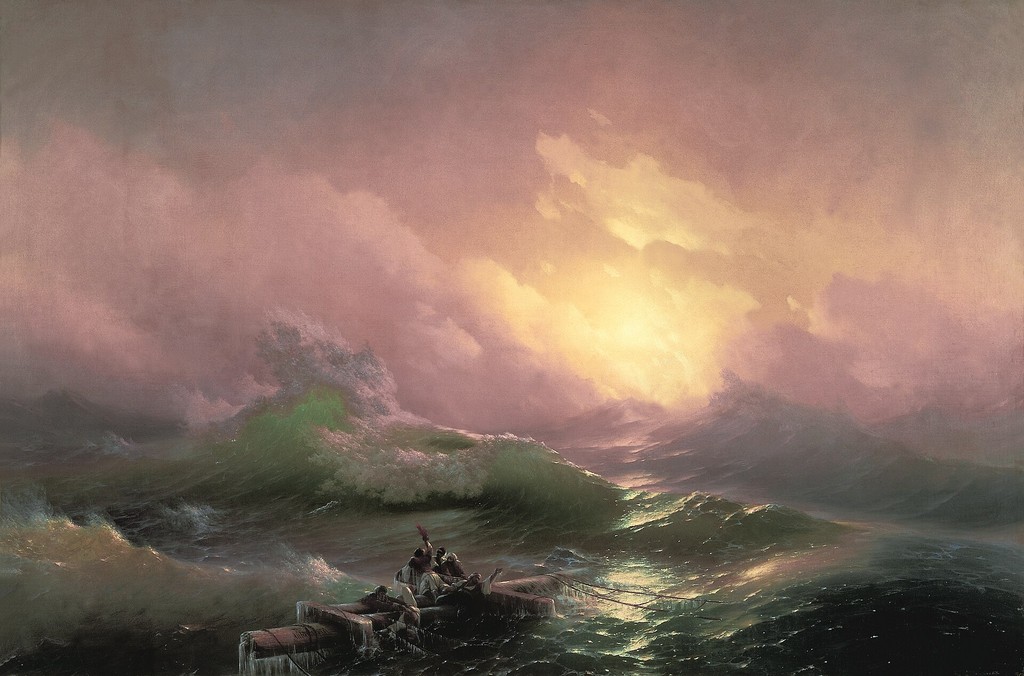
Comparison with The Ninth Wave makes the shift clear without turning chronology into improvement. The 1850 canvas places survivors on mast timbers beneath warm dawn and gives the advancing sea a memorable culminating form. In the 1889 work, cold overlapping swells disperse attention and reduce people to near-incidental marks. Both pictures stage human endurance against water, but they assign radically different emotional work to colour and space.[1][2]
Churak treats the late monumental seas as a deepening pursuit of universal ideas about nature, while also stressing that Aivazovsky remained true to his own artistic temperament as fashions changed.[2] Wave is most convincingly read within that tension. Its severity is a transformation of Romantic inheritance, not proof that the inheritance disappeared.
Distinguishing Wave from Similar Titles
Three famous names must not be collapsed. The Ninth Wave is the State Russian Museum canvas of 1850, centred on survivors at dawn. Wave is the museum’s distinct 1889 work, inventory Ж-2200, measuring 304 by 505 centimetres. Among the Waves is a later monumental painting from 1898 associated with the Aivazovsky Picture Gallery in Feodosia.[1][2]
The short title Wave may occasionally appear with an English article, but that variation does not turn it into either neighbouring object. Date, institution, inventory and dimensions provide the reliable test. The locked image reinforces the distinction: this is the cold storm with the nearly submerged vessel and tiny groups at the lower right, not the warm shipwreck dawn of 1850 and not the Feodosia canvas made nine years later.
Separating the works also improves interpretation. Recurring waves were not interchangeable studio products. The 1850 painting uses one ordeal to hold danger beside possible survival; the 1889 painting multiplies water’s movement until escape appears closed; the 1898 picture belongs to another late conception. Exact identity allows recurrence to reveal change instead of erasing it.
Researched works directory
This searchable evidence census was assembled from public museum records and a reproducible Wikidata snapshot. It is not a catalogue raisonné, not a claim to complete oeuvre coverage, and not a substitute for the published catalogue literature, which was not used to claim absolute completeness.
| Name | Date | Medium |
|---|---|---|
| A bay at dawn. | 1896 | Painting |
| A bay near Venice | 1842 | Painting |
| A Moonlit Night at Sea | 1885 | Painting |
| A Moonlit Night on the Bosphorus | 1894 | Painting |
| A Moonlit Night on the Crimean Coast | Date unknown | Painting |
| A Rocky Coastal Landscape in the Aegean with Ships in the Distance (detail) | 1884 | Painting |
| A. S. Pushkin and Countess M. N. Raevskaya by the sea near Gurzuf | 1886 | Painting |
| A. S. Pushkin at the Black Sea coast | 1887 | Painting |
| A. S. Pushkin at the Black Sea coast | 1897 | Painting |
| A Ship in a Stormy Sea | 1892 | Painting |
| A ship in peril | 1894 | Painting |
| A Ship of the Russian Navy off the Coast | Date unknown | Painting |
| A storm on rocky shores | 1875 | Painting |
| A Summer’s Day in Crimea | 1867 | Painting |
| A View of Constantinople by Moonlight | 1846 | Painting |
| A View of the Bosporus with the Hagia Sophia and the Maiden's Tower in the Moonlight | 1884 | Painting |
| A Wagon Train in the Desert | Date unknown | Painting |
| Abandoning Ship | 1882 | Painting |
| After the Storm | 1854 | Painting |
| Aiju-Dag | Date unknown | Painting |
| Aivazovsky Ivan Konstantinovic - Colon Sortint de Palos | 1892 | Painting |
| Aivazovsky - Oath befory Battle of Avarayr | 1892 | Painting |
| Aivazovsky with Friends | 1893 | Painting |
| Alexander II Crossing the Danube | 1878 | Painting |
| Alexander Pushkin at the Top of Ai-Petri at Sunrise | 1899 | Painting |
| Along the Coast | 1850 | Painting |
| Alushta | 1878 | Painting |
| American Shipping off the Rock of Gibraltar | 1873 | Painting |
| Among the Waves | 1898 | Painting |
| Arrival of Catherine II in Feodosia | 1883 | Painting |
| Azure Grotto, Naples | 1841 | Painting |
| Barge at Sea Shore | 1860–1870 | Painting |
| Battle of Chesma | 1848 | Painting |
| Battle of Chesma (1886) | Date unknown | Painting |
| Battle of Chios on 24 June, 1770 | 1848 | Painting |
| Battle of Sinope | 1853 | Painting |
| Beach | 1845 | Painting |
| Before the Storm: Theodosia | Date unknown | Painting |
| Biarritz | 1889 | Painting |
| Black Sea Fleet in the Bay of Theodosia, just before the Crimean War | 1890 | Painting |
| Boat Ride by Kumkapi in Constantinople | 1846 | Painting |
| Bosphorus | 1878 | Painting |
| Bosporuse väin öösel. | 1890 | Painting |
| Bracing The Waves | Date unknown | Painting |
| Breaking Wave | Date unknown | Painting |
| Brig “Mercury” Attacked by Two Turkish Ships | 1892 | Painting |
| Brig ''Mercury'' meets with the Russian squadron after the victory over two Turkish ships | 1848 | Painting |
| Broad landscape with settlers | 1856 | Painting |
| Byron in Venice | Date unknown | Painting |
| Byron's visit to the Mekhitarists in Surb Ghazar Island | 1899 | Painting |
| Byron's visit to the Mekhitarists on San Lazzaro | 1899 | Painting |
| Ca d'Oro | 1878 | Painting |
| Calm early evening sea | 1884 | Painting |
| Calm Sea | 1887 | Painting |
| Carriage in a Storm | Date unknown | Painting |
| Catholicos Khrimyan Airik near Echmiadzin | 1895 | Painting |
| Caucasus from the Sea | 1894 | Painting |
| Chaos. The Genesis | 1841 | Painting |
| Chapel by the sea | 1847 | Painting |
| Chumaks in Little Russia | Date unknown | Painting |
| Chumaks leisure | 1885 | Painting |
| Chumaks Waggons | 1862 | Painting |
| Clashes between the Shirvans and the Murids on Gunib | 1869 | Painting |
| Clouds | 1865 | Painting |
| Clouds Over a Calm Sea | 1873 | Painting |
| Clouds over the Sea, Calm | 1889 | Painting |
| Coast | 1840 | Painting |
| Coast of Amalfi | 1841 | Painting |
| Coffee-house by the Ortaköy Mosque in Constantinople | 1846 | Painting |
| Constantinople, la mosquée de Top-Kahné | 1884 | Painting |
| Constantinople Sunset | 1899 | Painting |
| Crimean coast by moonlight | 1853 | Painting |
| Crimean Coast by Moonlight | 1898 | Painting |
| Crimean scene. Gurzuf at night | 1865 | Painting |
| Crimean Tartars on the Sea Shore | 1850 | Painting |
| Crimean Views | 1850 | Painting |
| Cruiser in the sea at night | 1844 | Painting |
| Dante Shows an Artist Some Unusual Clouds | 1883 | Painting |
| Daryal Gorge | 1868 | Painting |
| Deluge | 1864 | Painting |
| Der Fluss Rioni in Georgien | 1870 | Painting |
| Descent of Noah from Ararat | 1887 | Painting |
| Destruction of Pompeii | 1889 | Painting |
| Distributing Supplies | 1892 | Painting |
| Dusk on the Golden Horn | 1845 | Painting |
| End of Storm | 1839 | Painting |
| Entrance to the Sevastopol Bay. | 1852 | Painting |
| Entrée de port | 1846 | Painting |
| Exchange Of Peterburg | 1840–1847 | Painting |
| Exploding Ship | 1900 | Painting |
| Farm House and Windmill by moonlight | 1863 | Painting |
| Fight of the steamer Vesta with the Turkish battleship Fehti-Bulend in the Black Sea on July 11, 1877 | 1877 | Painting |
| Figures on a moonlit coast | 1858 | Painting |
| Fishermen and their Families on the Shore of the Bay of Naples | 1873 | Painting |
| Fishermen on the Beach | 1852 | Painting |
| Fishermen on the shore | Date unknown | Painting |
| Fishermen Returning Near Naples | 1874 | Painting |
| Fishing Boats In A Harbor | 1854 | Painting |
| Foggy day on the shores of Italy | Date unknown | Painting |
| French Ships Departing the Black Sea | 1871 | Painting |
| Frigate under sail | 1838 | Painting |
| From Mleta to Gudauri | 1868 | Painting |
| Frozen Bosphorus Under Snow (detail) | 1874 | Painting |
| Gathering Storm | 1899 | Painting |
| Golden Horn Bay Turkey | 1846 | Painting |
| Gondolier on the Sea at Night | 1843 | Painting |
| Gulf of Naples | 1874 | Painting |
| Gunboat off Crete | 1897 | Painting |
| Gurzuf at night | 1849 | Painting |
| Harbour Scene | Date unknown | Painting |
| Ice-Breakers on the Frozen Neva in St. Petersburg | 1877 | Painting |
| Ice on Dnipro | 1872 | Painting |
| Icebergs in the Atlantic | 1870 | Painting |
| In the harbor | 1840 | Painting |
| In the roads, Evening | 1867 | Painting |
| Italian Landscape | 1855 | Painting |
| Italian Landscape (Lago Maggiore), Evening | 1858 | Painting |
| Iwan Konstantinowitsch Aiwasowskij 001 | 1864 | Painting |
| Jalta | 1838 | Painting |
| Jude's the Apostol betrayal | 1834 | Drawing |
| La Vague | 1886 | Painting |
| Landscape in Crimea. | 1860 | Painting |
| Landscape with Windmills | 1860 | Painting |
| Large raid in Kronstadt | 1836 | Painting |
| Little Russian Ox Cart in Winter | 1866 | Painting |
| Loading Provisions off the Crimean Coast | 1876 | Painting |
| Look to the Large Cascade and Large Petergof Palace | 1837 | Painting |
| Marine scene | Date unknown | Painting |
| Marine View | 1899 | Painting |
| Mercury Brig Meeting a Russian Squadron after her Victory over Two Turkish Vessels | 1848 | Painting |
| Meri | Date unknown | Painting |
| Mine attack by boats of the steamer Grand Duke Constantine on the Turkish battleship Assari-Shevket on the Sukhum roadstead on August 12, 1877 | 1877 | Painting |
| Moon night on the Crimea, Gurzuf | 1839 | Painting |
| Moonlight at night near the spring | 1877 | Painting |
| Moonlight in Naples | 1842 | Painting |
| Moonlit coast | 1864 | Painting |
| Moonlit Landing | 1895 | Painting |
| Moonlit Night | 1850 | Painting |
| Moonlit Night | 1878 | Painting |
| Moonlit Night (1958) | 1858 | Painting |
| Moonlit Night (Aivazovsky) | Date unknown | Painting |
| Moonlit night in Crimea | 1859 | Painting |
| Moonlit night on the seashore in Crimea | 1852 | Painting |
| Moonlit Seascape With Shipwreck | 1863 | Painting |
| Morning on the sea | 1883 | Painting |
| Morning on the shore of the bay | 1853 | Painting |
| Mountain Village Gunib in Daghestan. View from the East. | 1869 | Painting |
| Naples Bay | 1842 | Painting |
| Naples with a poet amongst fishermen | 1845 | Painting |
| Naufragiul 1886 | 1886 | Painting |
| Neapolitan lighthouse. | 1842 | Painting |
| Night at Gurzof | 1891 | Painting |
| Night at the Rodos island | 1850 | Painting |
| Night in Constantinople | 1862 | Painting |
| Night in Venice | 1847 | Painting |
| Night. The Tragedy at the Sea of Marmara | 1897 | Painting |
| Nocturnal Voyage | Date unknown | Painting |
| Odessa at Moonlight | 1846 | Painting |
| Odessa, view from the Sea | 1865 | Painting |
| Old Feodosia | 1839 | Painting |
| Old Theodosia | 1845 | Painting |
| Ox-carts in the Ukrainian steppe | 1888 | Painting |
| Panorama of Constantinopole (detail) | 1856 | Painting |
| Parade of the Black Sea Fleet | 1886 | Painting |
| Passage of the Jews through the Red Sea | 1891 | Painting |
| Passing Ship on a Moonlit Night | 1868 | Painting |
| Peter | 1846 | Painting |
| Peter I at Krasnaya Gorka Lighting a Fire on the Shore to Signal to his Sinking Ships | 1900 | Painting |
| Petersburg. Crossing the Neva. | 1870 | Painting |
| Port of Theodosia | Date unknown | Painting |
| Portrait of A. Kaznacheev | 1847 | Painting |
| Portrait of a man | Date unknown | Drawing |
| Portrait of a Teenager | Date unknown | Painting |
| Portrait of archbishop Gabriel Aivazyan (brother of I. Aivazovsky) | 1883 | Painting |
| Portrait of the grandmother of painter Ashhen | 1858 | Painting |
| Portrait of vice admiral M.P. Lazarev | 1839 | Painting |
| Pushkin and Raevskaya in Gurzuf | 1900 | Painting |
| Pushkin in Crimea near Gurzuf rocks | 1880 | Painting |
| Pushkin's Farewell to the sea | 1887 | Painting |
| Q108330660 | 1847 | Painting |
| Q138511047 | 1857 | Painting |
| Q27074794 | Date unknown | Painting |
| Quiet Night: Armenians Thrown Overboard off the Turkish Ships | 1897 | Painting |
| Rainbow | 1873 | Painting |
| Reeds on the Dnieper | 1857 | Painting |
| Rescuers from the shipwreck | 1844 | Painting |
| Reval (Tallinn) | 1845 | Painting |
| Road in the Forest | 1857 | Painting |
| Rocky Cliffs | 1891 | Painting |
| Rocky Seashore | 1876 | Painting |
| Russian squadron at the Sevastopol roadstead | 1849 | Painting |
| Sailboat . | 1859 | Painting |
| Sailing Boat | Date unknown | Drawing |
| Sailing Ship on a calm sea by Moonlight | 1897 | Painting |
| Sailing Ship on the Sea at Moonlight. | 1840 | Painting |
| Sailing Ships on a Calm Day. | 1887 | Painting |
| Sarkizova Ann, second wife of I. Aivazovsky | 1882 | Painting |
| Scenes from Cairo's life | 1881 | Painting |
| Sea | 1864 | Painting |
| Sea Battle at Navarino on October 20, 1827 | 1846 | Painting |
| Sea coast | 1886 | Painting |
| Sea coast at night. Near the beacon | 1837 | Painting |
| Sea on a Moonlit Night | 1857 | Painting |
| Sea on a Moonlit Night | 1858 | Painting |
| Sea View | 1855 | Painting |
| Sea View | 1875 | Painting |
| Sea view from the chapel on the shore | 1845 | Painting |
| Seascape | 1885 | Painting |
| Seascape | Date unknown | Painting |
| Seascape with a steamer. | 1897 | Painting |
| Seascape with full moon | 1857 | Painting |
| Sebastopol | 1852 | Painting |
| Selbstportrait | 1881 | Painting |
| Selbstporträt | 1892 | Painting |
| Self-portrait | 1874 | Painting |
| Self-Portrait | 1898 | Painting |
| Sheep driven by the storm into the sea. | 1855 | Painting |
| Shepherds' Camp | 1858 | Painting |
| Shepherds with a flock of sheep. | 1872 | Painting |
| Ship Amid the Stormy Sea | 1887 | Painting |
| Ship by Moonlight | 1868 | Painting |
| Ship, castle and sea | 1847 | Painting |
| Ship ''Empress Maria'' in a Storm | 1892 | Painting |
| Ship in a storm | 1899 | Painting |
| Ship in a Stormy Sea off the Coast | 1895 | Painting |
| Ship on Stormy Seas | 1850 | Painting |
| Ship "Twelve Apostles | 1897 | Painting |
| Ships at the raging sea | 1866 | Painting |
| Ships on a misty morning | Date unknown | Painting |
| Ships on Stormy Sea, Sunrise | 1871 | Painting |
| Shipwreck | 1843 | Painting |
| shipwreck | 1876 | Painting |
| Shipwreck in the North Sea | 1875 | Painting |
| Shipwreck of "Lefort | 1858 | Painting |
| Shipwreck off the Black Sea Coast | 1887 | Painting |
| Shipwreck on a Stormy Morning | 1895 | Painting |
| Shipwreck on Stormy Seas | 1886 | Painting |
| Shoreline | 1851 | Painting |
| Sinking Ship | 1854 | Drawing |
| Smolny Abbey. Sunset. | 1847 | Painting |
| Solar Eclipse in Feodosia | 1876 | Painting |
| St. George Monastery. Cape Fiolent | 1846 | Painting |
| St. Petersburg | 1850 | Painting |
| St. Petersburg - Galleon on the docks | 1850 | Painting |
| Steamboat on a Moonlit Night | 1884 | Painting |
| Storm | 1851 | Painting |
| Storm | 1854 | Drawing |
| Storm | 1861 | Painting |
| Storm | 1872 | Painting |
| Storm | 1880 | Painting |
| Storm | 1886 | Painting |
| Storm | 1899 | Painting |
| Storm (1871) | 1871 | Painting |
| Storm at sea | 1850 | Painting |
| Storm at sea | 1873 | Painting |
| Storm at Sea on a Moonlit Night | 1866 | Painting |
| Storm off the coast of Odessa | 1898 | Painting |
| Storm on Sea | 1899 | Painting |
| Storm on the Sea | 1876 | Painting |
| Storm over Eupatoria | 1900 | Painting |
| Stormy Sea | 1844 | Painting |
| Stormy Sea | 1850 | Painting |
| Stormy sea at night | 1849 | Painting |
| Strong Wind | 1856 | Painting |
| Stürmische See im Abendrot. | 1896 | Painting |
| Suez Canal | 1869 | Painting |
| Sunny Day | 1884 | Painting |
| Sunset | 1879 | Artwork |
| Sunset at Sea | 1851 | Painting |
| Sunset at sea | 1877 | Painting |
| Sunset at the Sea | 1848 | Painting |
| Sunset over the Golden Horn | 1866 | Painting |
| Sunset over Yalta | 1861 | Painting |
| Survivors | 1844 | Painting |
| Sveaborg | 1844 | Painting |
| The Baptism of the Armenian People. Gregory the Illuminator | 1892 | Painting |
| The Battle of Revel | 1846 | Painting |
| The Battle of Sinope on 18 November 1853 (Night after Battle) | 1853 | Painting |
| The Battle of Vyborg Bay in 1790. | Date unknown | Painting |
| The Battle of Wyborg Bay | 1846 | Painting |
| The Bay of Naples | 1841 | Painting |
| The Bay of Naples | 1844 | Painting |
| The Bay of Naples | 1845 | Painting |
| The Bay of Naples | 1878 | Painting |
| The Bay of Naples. | Date unknown | Painting |
| The Bay of Naples with Capri | 1891 | Painting |
| The Bay of Yalta with the Magobi and Ai Petri mountains | 1850 | Painting |
| The Beach at Biarritz | Date unknown | Painting |
| The birth of Aphrodite | Date unknown | Painting |
| The Black Sea | 1881 | Painting |
| The Black Sea at night | 1879 | Painting |
| The Black Sea Fleet in Feodosia | 1890 | Painting |
| The Black Sea (Marina) | 1882 | Painting |
| The Burning of the Turkish Flagship by Kanaris | 1881 | Painting |
| The Canal Grande with a view of Santa Maria della Salute at sunset. | 1848 | Painting |
| The Caucasus | 1863 | Painting |
| The Disembarkation of Christopher Columbus with Companions on Three Launches, on Friday 12th October 1492, At Sunrise, on an American Island Named San Salvador by Him on the Very Same Day | Date unknown | Painting |
| The Galata Tower by Moonlight | 1845 | Painting |
| The Great Pyramid at Giza | 1871 | Painting |
| The Harbor at Odessa on the Black Sea | 1852 | Painting |
| The Island of Ischia at Sunset (Sunset over Ischia) | 1857 | Painting |
| The Island of Rhodes | 1861 | Painting |
| The Landing of N. N. Raevskyi at Subashi | 1839 | Painting |
| The Maiden's Tower | 1848 | Painting |
| The Massacre of Armenians in Trebizond in 1895 | 1897 | Painting |
| The Mekhitarist Fathers on Lazarus Island, Venice | 1843 | Painting |
| The Mekhitarist Fathers on San Lazzaro Island. Venice | 1843 | Painting |
| The Ninth Wave | 1850 | Painting |
| The Relief Ship | 1892 | Painting |
| The Rescue | Date unknown | Painting |
| The Russian Squadron on the Sebastopol Roads | 1846 | Painting |
| The Sea | 1865 | Painting |
| The Shipwreck | 1873 | Painting |
| The Shipwreck | Date unknown | Painting |
| The Shores of the Mediterranean | 1892 | Painting |
| The storm at Cape Aya | 1899 | Painting |
| The storm at sea | 1850 | Painting |
| The Storm on the Turkish Coast | 1858 | Painting |
| The strip "Swetlana | Date unknown | Painting |
| The Survivor | 1880 | Painting |
| The survivors | 1895 | Painting |
| The Tide | 1870 | Painting |
| The Wrath of the Seas | 1886 | Painting |
| Theodosia Bay, sunrise | 1855 | Painting |
| Theodosia, end of day | 1865 | Painting |
| Theodosia. Moonlight night | 1852 | Painting |
| Trebizond from the sea | 1875 | Painting |
| Ukrainian Landscape at Night | 1870 | Painting |
| Ukrainian landscape with chumaks in the moonlight | 1869 | Painting |
| untitled | Date unknown | Painting |
| Venetian lagoon. View of the island of San Giorgio. | 1844 | Painting |
| Venice | 1844 | Painting |
| Venice at Sunset | 1873 | Painting |
| View in Crimea at sunset | 1862 | Painting |
| View of a bay with numerous sailing-ships (Feodosia?) | Date unknown | Drawing |
| View of Constantinople and the Bosphorus | 1856 | Painting |
| View of Constantinople by evening light | 1846 | Painting |
| View of Moscow from the Sparrow Hills | 1851 | Painting |
| View of Odessa on a moonlit night | 1855 | Painting |
| View Of The Ayu Dag Crimea | 1868 | Painting |
| View Of The Sea From The Mountains At Sunset. Crimea | 1900 | Painting |
| View of Vico near Naples | 1855 | Painting |
| View to the Crim | 1851 | Painting |
| View to the sea coast near St. Petersburg | 1835 | Painting |
| Volga near the Zhiguli Mountains | 1887 | Painting |
| Walking on Water | 1888 | Painting |
| Walking on Water | 1890 | Painting |
| Wave | 1889 | Painting |
| Wave hitting a Rock | 1860 | Painting |
| Wave. Two Ships | Date unknown | Painting |
| Windmill by the Sea | 1837 | Painting |
| Winter Caravan on Road | 1857 | Painting |
| Winter in Ukraine | 1874 | Drawing |
| Winter landscape | 1876 | Painting |
| Winter Scene in Little Russia | 1868 | Painting |
| Wreck of the ship "Ingermanland" in Skagerrak on the night of August 30, 1842. | Date unknown | Painting |
| Yalta | 1899 | Painting |
Frequently Asked Questions
It is in the State Russian Museum, recorded as inventory Ж-2200. The 1889 oil on canvas measures 304 by 505 centimetres, making it more than five metres wide.[1]
Aivazovsky gave the painting to Emperor Alexander III in 1891. The museum records its accession in 1897 as a gift from Nicholas II.[1] Those are two stages in the provenance, not one direct transfer from artist to museum.
No specific vessel, location or disaster is identified by the museum record. The picture clearly contains a wreck and people attempting to survive, but naming an event would go beyond the available evidence.[1]
The Russian Museum reads their position as hopeless, and no shore, rescuer or safe vessel appears.[1] Pale light exposes the wave system without opening an evident escape route. The painting’s human action is therefore survival under immediate pressure, not a completed or promised rescue.
Discussion
Use this evidence-led guide as a starting point for close looking rather than a final verdict.
Share an observation about Wave or a source that adds useful context.
Reader Insights
Which detail most changes your reading of Wave?
How do scale, support, medium or present museum evidence shape the encounter?
What remains uncertain when visual inference is separated from documented fact?
Join the Conversation
Add your reading below, keeping observations specific and evidence clear.
References
- State Russian Museum, “Wave”, accessed 30 August 2026.
- Galina Churak, “An Artist of ‘Hellenic’ Spirit”, Tretyakov Gallery Magazine, accessed 30 August 2026.