 Buy Art Prints Now
from Amazon
* As an Amazon Associate I earn from qualifying purchases.
Image reference [image]
 by Tom Gurney
Tom Gurney BSc (Hons) is an art history expert with over 20 years experience
Published on August 14, 2026 / Updated on August 14, 2026
Email: tomgurney1@gmail.com / Phone: +44 7429 011000
Ariadne: Introduction
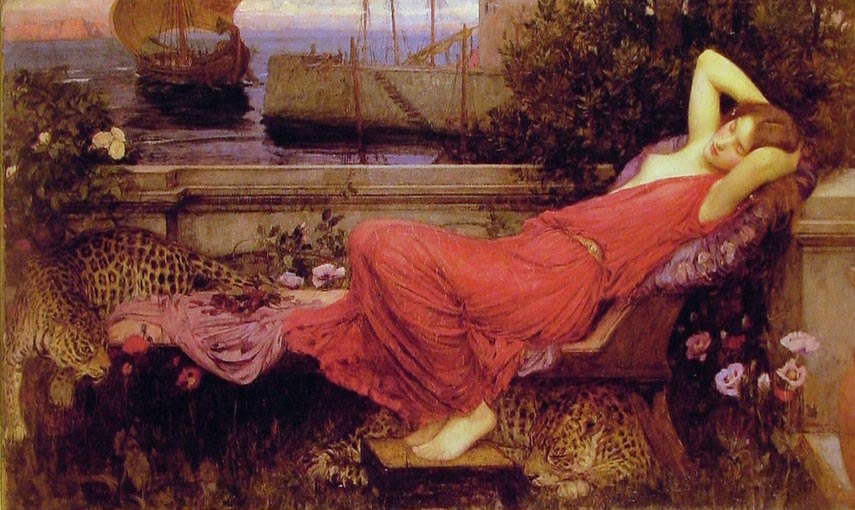
John William Waterhouse's Ariadne shows a heroine at the point where abandonment has occurred but consciousness has not yet caught up with it. Ariadne sleeps on a stone terrace above the sea. Theseus's ship moves away in the distance, while two leopards lie close to her body. The departing lover belongs to the disaster she is about to discover; the animals belong to Dionysus, the god whose arrival will change abandonment into another destiny.
Painted in 1898, the work transforms a familiar classical story into a divided instant. Waterhouse does not show Ariadne helping Theseus through the Cretan labyrinth, waking in grief, or meeting Dionysus. He places her between those episodes. Sleep makes her vulnerable, yet the leopards make the scene more than an image of helplessness. Before Ariadne knows that one life has ended, the painting allows the sign of another to enter. [1] [2] [3]
At a Glance
- ArtistJohn William Waterhouse
- Date1898 [1]
- MediumOil on canvas [1]
- DimensionsApproximately 91 × 151 cm [1]
- CollectionPrivate collection [1]
- SubjectAriadne asleep after Theseus has sailed from Naxos
- Key narrative clueTheseus's ship departing in the distance [1]
- Key symbolic clueTwo leopards associated with the approaching Dionysus
- First public contextRoyal Academy exhibition, 1898 [4]
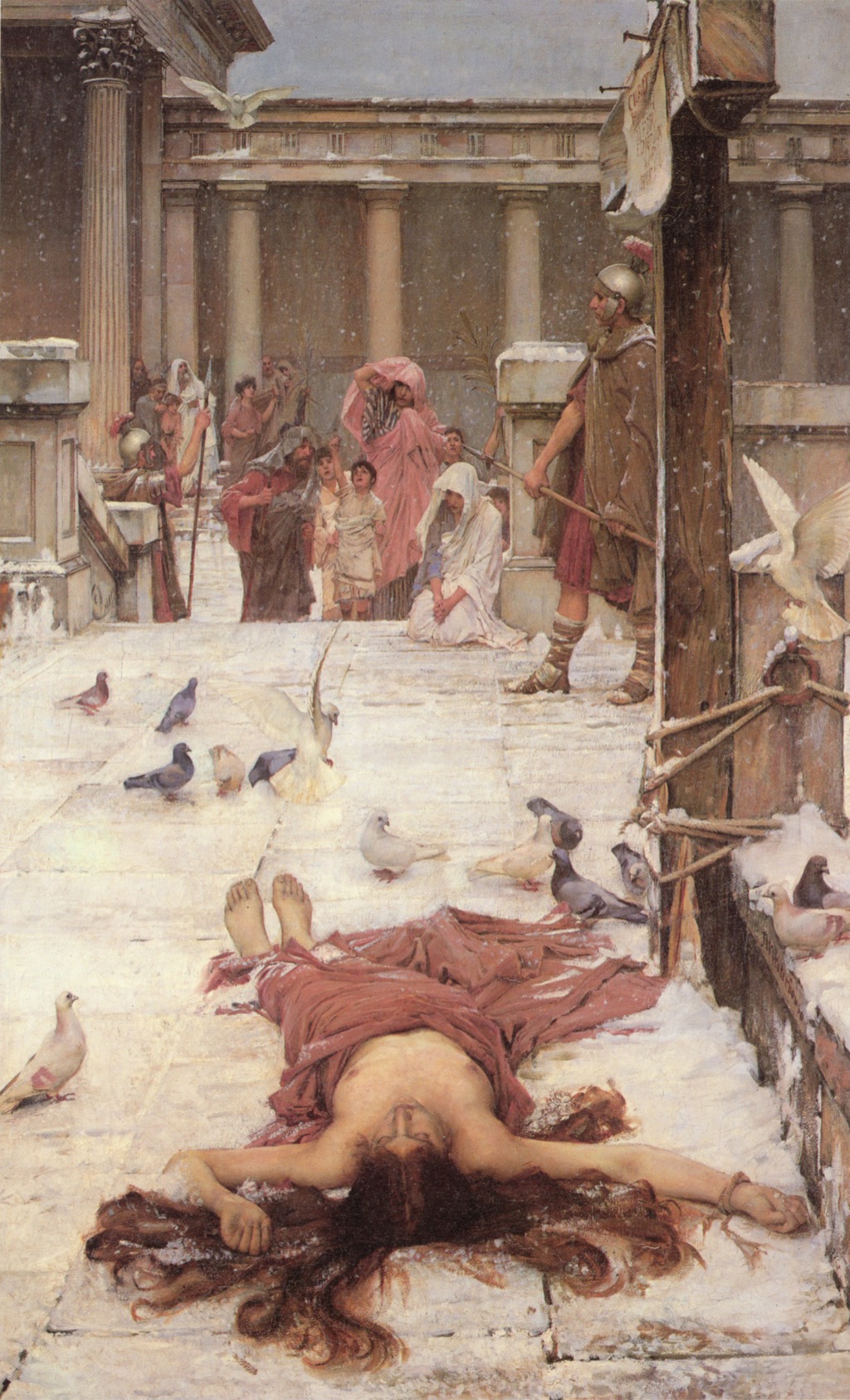
- Related Waterhouse workSaint Cecilia of 1895, another sleeping woman framed by attendants and a glimpse of sea [5]
Contents
- Introduction
- The moment Waterhouse depicts
- Ariadne, Theseus and the labyrinth
- Abandonment on Naxos
- Dionysus and the leopards
- Composition and the distant ship
- Sleep, vulnerability and suspended knowledge
- Colour, surface and Mediterranean atmosphere
- Waterhouse's changes to the myth
- Comparisons and the artistic context of 1898
The moment Waterhouse depicts
The painting is legible through three separated zones. Ariadne occupies the foreground, asleep and wrapped in warm drapery. The sea and departing vessel carry the action away from her. The leopards rest close by, physically present yet belonging to an arrival the picture withholds.
This is not a general portrait of a classical sleeper. The title and ship identify a precise narrative crisis. Theseus has taken Ariadne from Crete after she helped him survive the labyrinth and kill the Minotaur. On the island usually called Naxos, he abandons her. Waterhouse represents the departure while she remains asleep. [1]
The viewer therefore knows more than the heroine. We see the ship and understand its meaning; Ariadne cannot. This unequal knowledge creates pathos without requiring tears or theatrical gesture. Her body remains at rest while the story moves irreversibly beyond her.
Yet the viewer's advantage is incomplete. The leopards introduce Dionysus before he appears. They may be read as his attendants or attributes, announcing the god who will discover and marry Ariadne. The picture holds loss and rescue together but does not tell us how to value the transition.
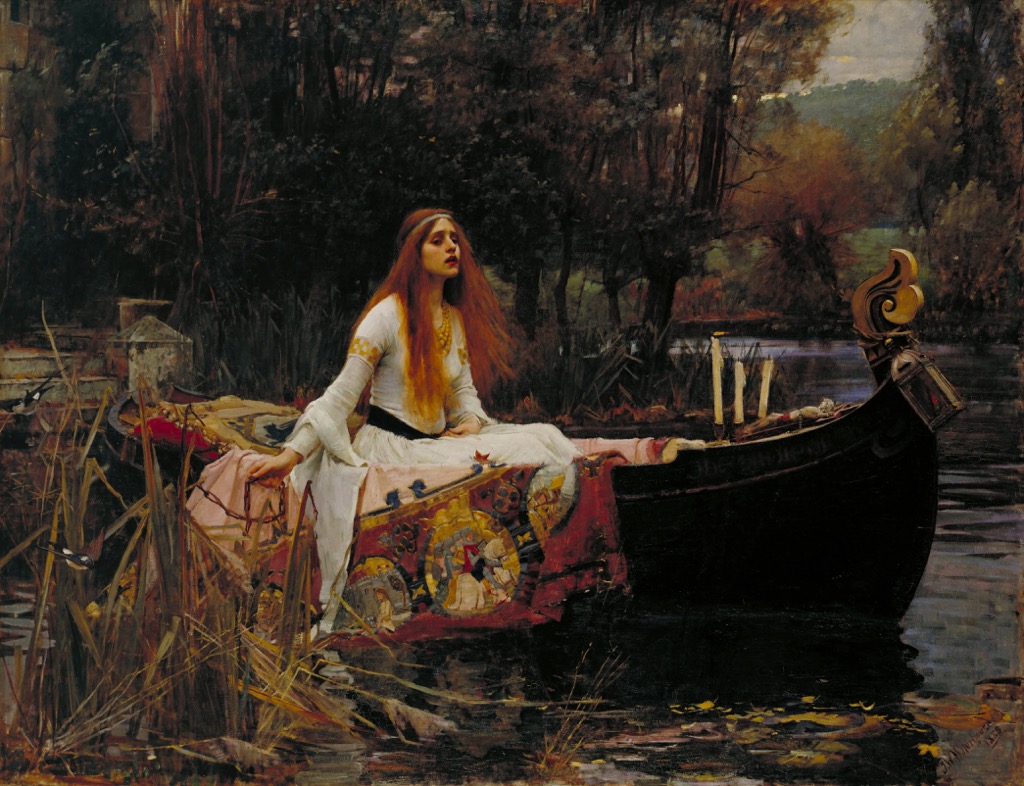
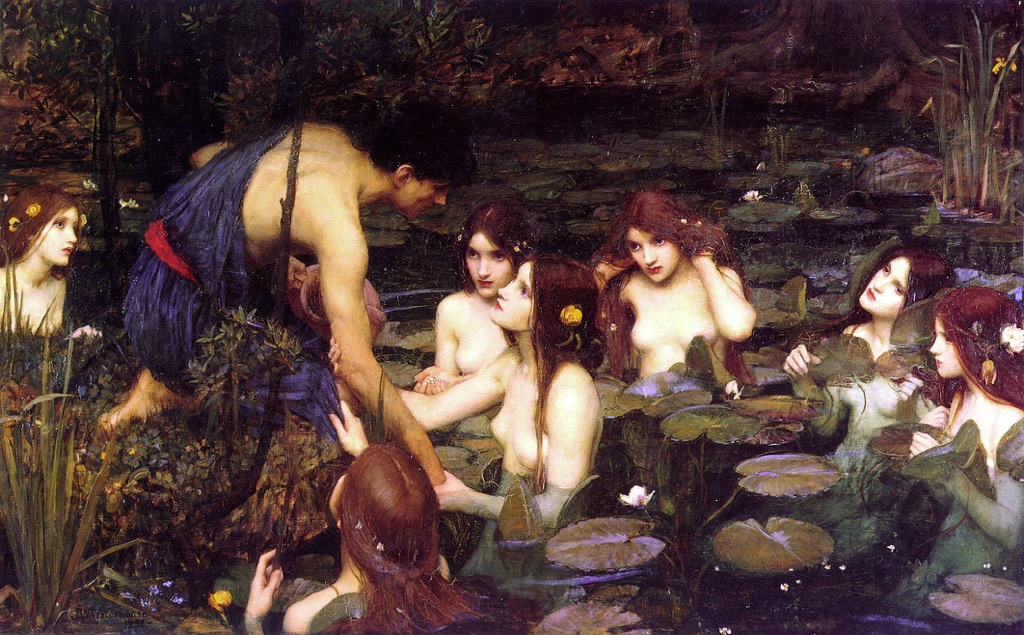
Waterhouse's strongest narrative paintings often choose this structure. The Lady of Shalott has begun her fatal journey but has not died. Hylas leans towards the nymphs but has not disappeared. Psyche touches a forbidden threshold before consequence. Ariadne similarly turns the interval between events into the whole drama.
Ariadne, Theseus and the labyrinth
Ariadne was the daughter of Minos, king of Crete. When Theseus came among the young Athenians sent into the labyrinth, she helped him confront the Minotaur. The most famous form of her aid is the thread by which he could retrace his route after killing the monster. [6]
That earlier achievement is invisible in Waterhouse's painting but essential to its injustice. Ariadne is not a stranger left by a casual traveller. She has betrayed or left her family and country for Theseus, enabling his heroic success. His departure reverses the expected moral balance: the celebrated hero becomes the person who abandons the woman responsible for his escape.
Ancient accounts vary. They differ over the island's name, Theseus's motive, whether a god ordered the separation, and how Dionysus entered the story. Ovid's Heroides gives Ariadne an extended imagined letter of accusation to Theseus, while Catullus's poem 64 describes her seeing the ship depart and crying out from the shore. [3] [7]
These variations matter because no single “original myth” dictates every pictorial detail. Waterhouse participates in a long tradition of selecting and combining. The sleeping abandonment allows him to postpone the rhetorical Ariadne of Ovid and Catullus. Her accusation has not begun.
The labyrinth is absent, but its logic persists. Ariadne once supplied a line that made return possible. Now the ship creates a line of escape for Theseus and leaves her without one. The man who found his way out through her guidance uses distance to remove himself from responsibility.
Abandonment on Naxos
Waterhouse's shore is elevated and architecturally framed rather than an empty stretch of sand. Ariadne lies where human construction meets open water. The setting suggests a Mediterranean terrace but does not document a specific ancient building.
Naxos functions in myth as a threshold. It lies between Crete and Athens, between Ariadne's family and Theseus's home, between mortal partnership and divine marriage. She has no stable social place there. The island is less a destination than the location in which one identity is removed and another imposed.
Sleep intensifies that lack of control. Theseus can depart because Ariadne is not watching. Her stillness may protect her temporarily from knowledge, but it also prevents resistance. Waterhouse does not explain whether the sleep is natural, divinely arranged or simply the narrative condition that makes abandonment possible.
The ship is small because the act has already achieved distance. If Theseus stood beside Ariadne, the scene might become confrontation. If the vessel were gone, the picture would centre discovery after the fact. By keeping it visible at the horizon, Waterhouse makes desertion continuous: the viewer watches it happening while Ariadne cannot.
The composition avoids the violence of the Minotaur and the later noise of a Bacchic procession. Its quiet is morally active. A sleeping body and a receding boat can convey betrayal without movement in the foreground.
Dionysus and the leopards
The two large cats are the picture's most unusual evidence. Leopards and panthers belong to the imagery of Dionysus or Bacchus, whose chariot and followers are often accompanied by such animals. Their presence looks forward to the god's arrival and Ariadne's later marriage. [2] [3]
They do not behave as immediate predators. Resting near Ariadne, they echo her recumbent position. Their dangerous bodies are quiet, creating a strange guardianship. The animals make the terrace supernatural before any god appears.
This foreshadowing changes the emotional structure. If the painting contained only Ariadne and the ship, it would be an image of completed betrayal. The leopards imply that the story remains open. Yet “rescue” should not be used without qualification. Ariadne has not chosen the transition visible to the viewer, and ancient versions differ in tone. Divine marriage may elevate her, but it also moves her from one male-centred narrative to another.
The animals' doubling is important. Two related forms make Dionysian presence feel established rather than accidental. They also balance Ariadne's single human body against a paired, non-human world. Theseus departs among distant men; the new order arrives through animals.
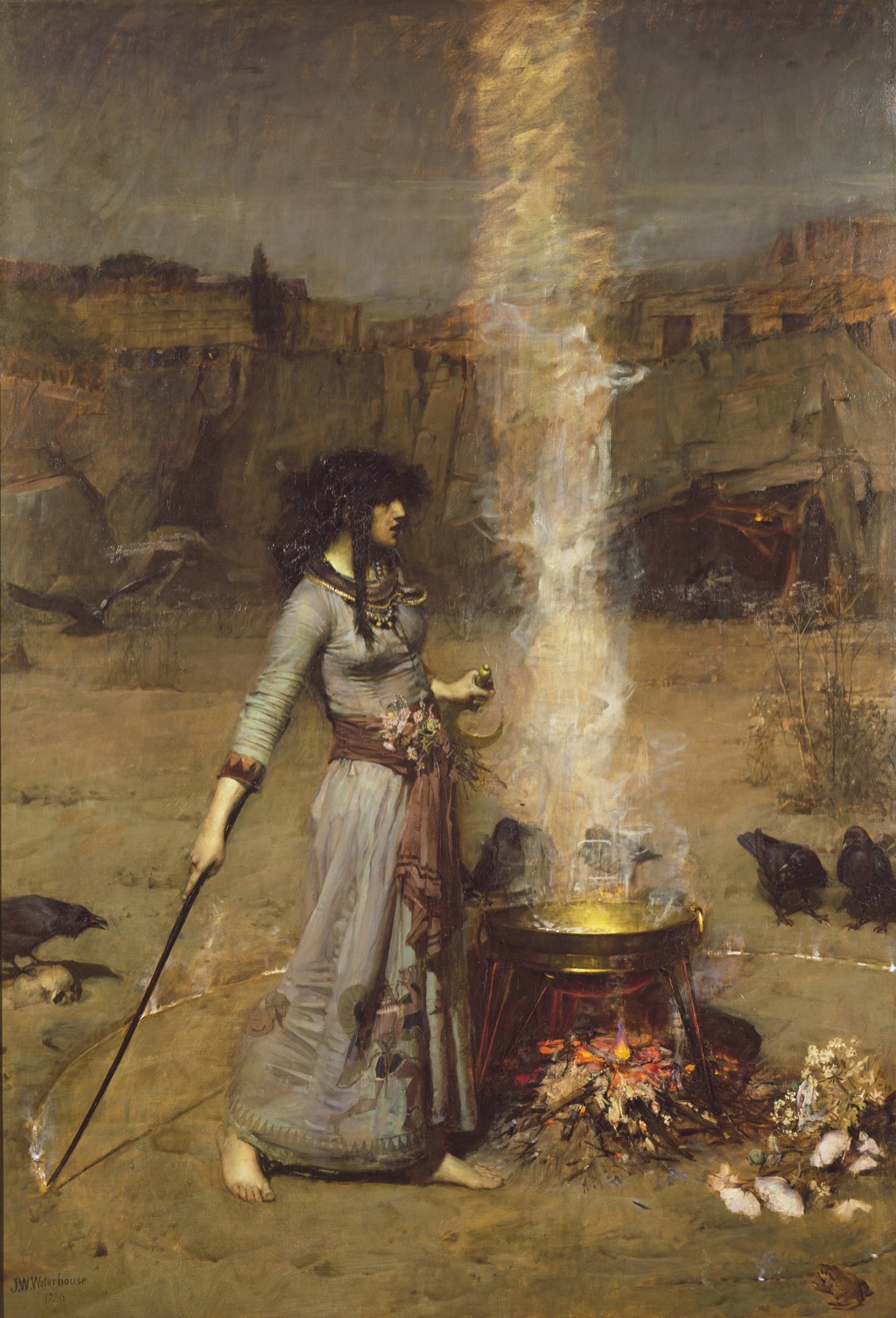
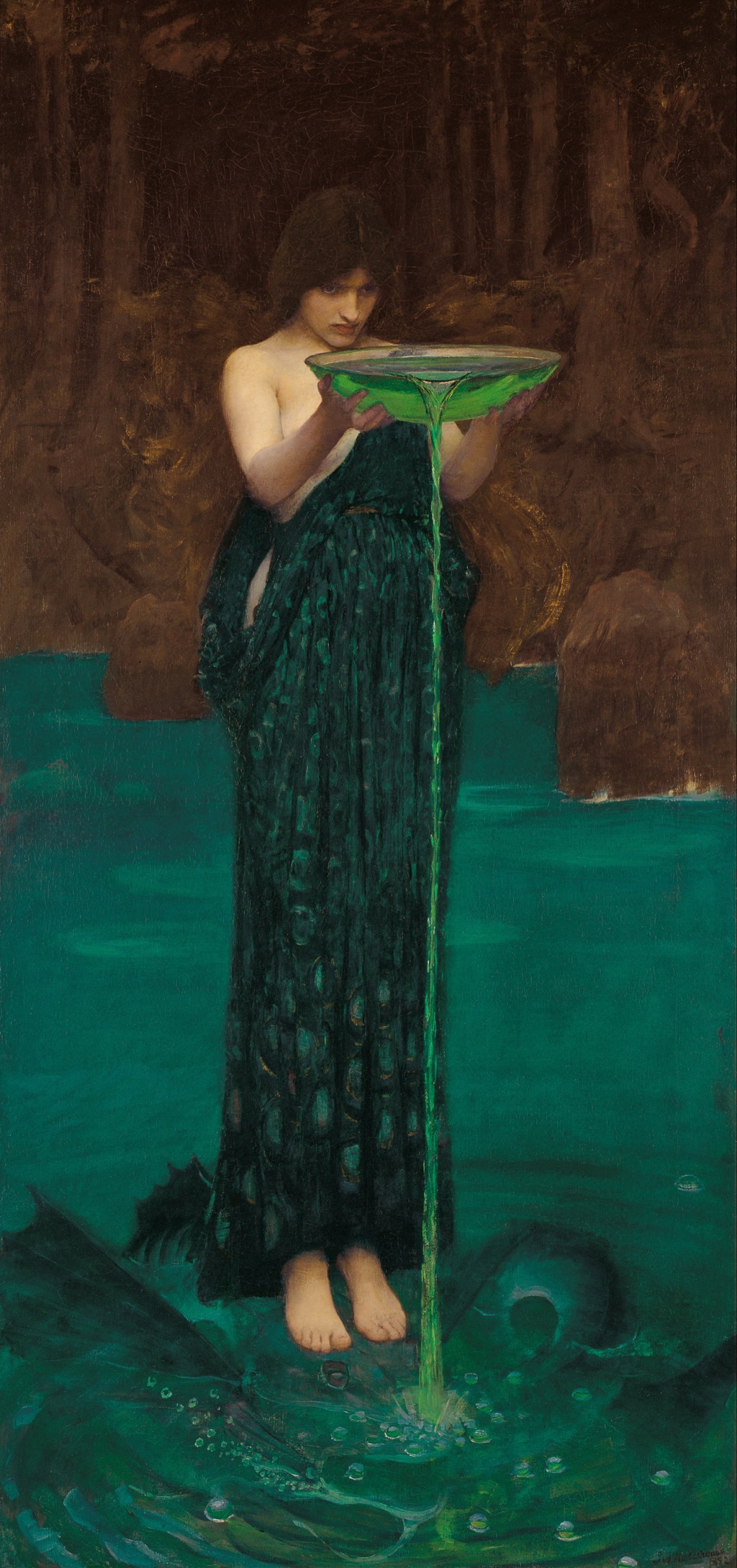
Waterhouse's nymphs, sirens and sorceresses often make beauty dangerous. Here danger is unexpectedly calm. The leopards possess the capacity for violence but do not use it. Their restraint allows them to signal wild divinity without breaking the painting's sleep.
Their spotted coats also offer a painterly transition between figure and setting. Pattern animates the foreground and sets organic irregularity against terrace architecture. What belongs to Dionysus enters through colour and surface before narrative action.
Composition and the distant ship
The long horizontal canvas allows Waterhouse to place emotional weight at opposite distances. Ariadne fills the near field. Theseus's ship is visually small but narratively decisive. The sea between them becomes measurable abandonment.
Ariadne's body follows the breadth of the composition. Her recumbent pose encourages the eye to travel laterally, then outward towards the water. Drapery gathers around her rather than propelling her forward. She belongs to the foreground's arrested time.
The terrace or stone ledge creates a threshold within the threshold. It supports the sleeper while opening towards the sea. Its hard plane distinguishes her temporary place from the fluid route Theseus uses to escape.
Vertical forms and foliage at the sides partially contain the view. A central or off-centre opening towards water acts like a window in several Waterhouse compositions. In Saint Cecilia, a sea glimpse appears between dark masses as the saint sleeps. In Ariadne, the opening is not simply atmospheric: it carries the leaving ship. [5]
Scale directs moral attention. Theseus is too remote to confront as a portrait, so the viewer cannot read his face or motive. The ship turns him into action rather than psychology. Ariadne remains bodily particular; he becomes distance.
The leopards complicate spatial reading. They are as near as Ariadne but belong to the future. Waterhouse uses pictorial depth to arrange narrative time: immediate unknowing in the foreground, present abandonment in the distance, imminent transformation beside her.
Sleep, vulnerability and suspended knowledge
Sleep removes reciprocal looking. Ariadne neither observes Theseus nor responds to the spectator. We can study her without being acknowledged, a situation that can make the image uncomfortably intimate.
Waterhouse controls that exposure through pose and drapery. Ariadne is vulnerable but not presented as a formal nude offered without context. Her clothing, surroundings and mythic identity make sleep part of a narrative condition. Even so, the viewer occupies the privileged position of wakefulness.
This structure recalls Saint Cecilia, where a sleeping woman is approached by angels. Christie's notes the comparison and calls Ariadne a pagan reworking of the earlier arrangement: a recumbent woman, flanking beings and distant harbour or sea. [5] The difference is profound. Cecilia's attendants are visibly celestial and musical; Ariadne's are animals whose divine significance must be inferred.
Sleep also creates emotional delay. Ancient literary Ariadne is famous for lament, anger and accusation after waking. Waterhouse paints before language. Her still face cannot confirm whether the coming response will be despair, rage, disbelief or resilience.
The viewer supplies that knowledge from the myth, making the apparent tranquillity painful. Her calm is not evidence that abandonment has caused no harm. It is the calm of ignorance.
At the same time, sleep resembles metamorphic transition. Ariadne has ceased acting as Theseus's helper but has not awakened into relation with Dionysus. The body at rest becomes a hinge between identities assigned by narrative.
Colour, surface and Mediterranean atmosphere
Warm red and orange drapery concentrates attention on Ariadne against paler stone and cooler sea. The colour gives bodily heat to a sleeping figure and prevents her from dissolving into the terrace.
Red can invite symbolic readings—love, betrayal, danger, Dionysian intensity—but it first performs compositional work. It establishes the foreground as the painting's emotional centre and makes the distant ship appear even more removed.
The spotted leopards answer the patterned warmth without matching it. Their coats introduce gold, brown and dark marks, linking luxurious surface with animal wildness. The pattern is descriptive and emblematic at once.
The sea is relatively open. Waterhouse does not overcrowd the distance with narrative incident. Light and air create a credible route for the vessel while separating human drama from the broad indifference of landscape.
The setting should not be treated as archaeological reconstruction. Waterhouse had classical knowledge and Italian experience, but the terrace is designed for the story. Its architecture, foliage and coast form an imagined antiquity whose emotional geography matters more than a recoverable Naxian site.
As in other mature works, degrees of finish likely guide attention. Face, drapery and animals require greater definition; distant water and ship can remain broader. Reproductions may obscure these surface differences, especially because the painting is privately held.
Waterhouse's changes to the myth
Waterhouse omits the thread, labyrinth and Minotaur. This prevents Ariadne from being defined visually by her earlier service to Theseus, although the story remains necessary background.
He also omits the waking lament. Ovid's Ariadne speaks with fierce rhetorical power, listing dangers and accusing Theseus of cruelty. [7] Waterhouse replaces voice with the viewer's anticipation of voice. The silence is his central invention.
Dionysus is absent, but his animals are present. This allows the god's future to enter without turning the painting into the conventional triumph of Bacchus and Ariadne. Ariadne remains the largest human presence; divine marriage has not yet claimed the composition.
The two leopards therefore function like an ellipsis. They tell an informed viewer what comes next while preserving the heroine's unawareness. A viewer without mythic knowledge may experience them first as inexplicable danger or guardianship.
Waterhouse does not specify why Theseus leaves. Ancient accounts include cowardice, divine command and political necessity. The picture concentrates on the ethical fact of departure rather than defending a motive. [3] [6]
Nor does it present the later marriage as compensation that cancels betrayal. Both narrative directions remain visible at once. That refusal of simple sequence is the painting's interpretive strength.
Comparisons and the artistic context of 1898
Waterhouse exhibited Ariadne at the Royal Academy in 1898, the year associated with Flora and the Zephyrs and Juliet. [4] The group shows his range: classical abandonment, mythic spring pursuit and Shakespearean portrait-like anxiety.
The sleeping heroine follows Saint Cecilia of 1895. Both paintings enclose a recumbent woman between attendants and a distant opening to the sea. The later work exchanges Christian angels for Dionysian leopards, heavenly music for maritime betrayal and sanctified sleep for dangerous unknowing. [5]
The comparison also reaches The Awakening of Adonis, painted around the end of the decade. There, divine and human figures actively gather around sleep; in Ariadne, the human agent leaves and the divine agent remains offstage. Waterhouse repeatedly asked how much of a transformation could be made visible before a sleeper awoke.
Other artists treated Ariadne as lamenting, abandoned, sleeping or triumphantly joined with Bacchus. Waterhouse's most distinctive choice is the paired temporal clue: departing ship and arriving god's animals. He turns a single scene into a compressed before-and-after.
The work also sits within late Victorian interest in women suspended between passivity and agency. Ariadne once acted decisively in Crete; she is now immobilised; she will later awaken and acquire another mythic role. The picture's beauty cannot be separated from that redistribution of power.
Provenance and the limits of the public record
The painting remains in a private collection. [1] A 1898 reproduction in The Studio documents its early visibility and links it with a Henderson collection, although provenance details repeated in later sources require careful separation between principal canvas and possible study. [1] [4]
Private ownership affects interpretation. Dimensions and imagery are documented, but many viewers know the work only from reproduced colour. Surface, frame, condition and true scale are harder to assess than for a permanently accessible museum painting.
The original measures roughly one and a half metres across. [1] That scale gives Ariadne substantial bodily presence and keeps the ship genuinely distant. On a screen, the vessel may seem like an illustrative detail; in the painting, its smallness operates against a large foreground.
The horizontal format deserves emphasis in any later page design. Cropping the sides to create a convenient upright thumbnail would damage the narrative relation among sleeper, animals and sea. A detail of Ariadne can introduce the figure, but the principal reproduction should preserve the departing ship. Without it, viewers may read the work as a decorative classical sleep; without the leopards, they lose the Dionysian future. The full composition is itself the argument.
Its early appearance in an illustrated art periodical also means reproduction belongs to the work's history rather than being only a modern afterthought. [1] Period readers could learn the arrangement without confronting its colour or full scale. Modern digital colour improves one kind of access while continuing to reduce texture. Both forms make the composition portable and both require the original object to remain conceptually distinct from its image.
The private status also helps explain why Ariadne is less famous than The Lady of Shalott or Hylas and the Nymphs. Visibility is not a direct measure of artistic importance. Public collections, postcard sales and continuous display shape canons.
No model identity should be assigned from facial resemblance alone. The literary identity is secure because of title and iconography; the person who posed is not securely named in the sources used here.
Related Pages
- Jason and Medea: Compare another classical painting in which Waterhouse turns myth into a charged pause before consequence.
- Apollo and Daphne: Follow another late mythological subject where flight, transformation and delayed knowledge shape the scene.
- Literary and Mythological Sources: Place Ariadne within Waterhouse's wider handling of classical and literary source traditions.
Frequently Asked Questions
She is the daughter of King Minos who helped Theseus escape the Cretan labyrinth after killing the Minotaur, then was abandoned on Naxos and later joined with Dionysus. [3] [6]
Ariadne sleeps while Theseus's ship sails away. She has not yet awakened to discover the abandonment. [1]
Leopards or panthers are attributes of Dionysus. They foreshadow the god's arrival and Ariadne's next mythic life. [2] [3]
No. His presence is implied through the leopards rather than represented directly.
It is a Greek island in the Cyclades and the most familiar setting for Ariadne's abandonment, although ancient accounts vary in geography and detail. [3] [6]
It is in a private collection. [1]
No model is securely identified in the cited sources. Similarity to other Waterhouse figures is not enough to supply a name.
Discussion
Ariadne turns mythic transition into a problem of knowledge. Theseus knows he is leaving; the viewer knows he is leaving; Ariadne sleeps. The leopards introduce a second knowledge unavailable to her: another god and another future are already near.
This does not make the image simply hopeful. Dionysian arrival cannot erase Theseus's betrayal, and Ariadne's lack of awareness means she has not chosen either direction. Waterhouse holds grief and transformation together before the heroine can speak.
Reader Insights
Which visible detail most changes the way you read this page?
Which source or comparison helps the work feel less familiar and more specific?
What question would you bring back to the painting after reading?
Join the Conversation
Share your reading of this page below.
References
- Image reference
- Victorian Web, “John William Waterhouse's Ariadne,” object data, private-collection status, early Studio reproduction and subject summary. View source
- Christie's, “Sir John Lavery, Ariadne,” catalogue essay comparing Lavery's and Waterhouse's use of the sleeping Ariadne and Dionysian animals. View source
- Theoi Classical Texts Library, “Ariadne,” ancient literary sources for Theseus's abandonment and Dionysus's arrival. View source
- Royal Academy, Royal Academy Pictures, 1898, digitised exhibition volume and record of Waterhouse's Ariadne. View source
- Christie's, “John William Waterhouse, R.A., St Cecilia,” catalogue essay comparing the composition with Ariadne. View source
- Apollodorus, The Library, Epitome 1, Perseus Digital Library, Theseus, the labyrinth and Ariadne. View source
- Ovid, Heroides 10, “Ariadne to Theseus,” Perseus Digital Library. View source