 Buy Art Prints Now
from Amazon
* As an Amazon Associate I earn from qualifying purchases.
Image reference [image]
 by Tom Gurney
Tom Gurney BSc (Hons) is an art history expert with over 20 years experience
Published on August 14, 2026 / Updated on August 14, 2026
Email: tomgurney1@gmail.com / Phone: +44 7429 011000
Juliet: Introduction
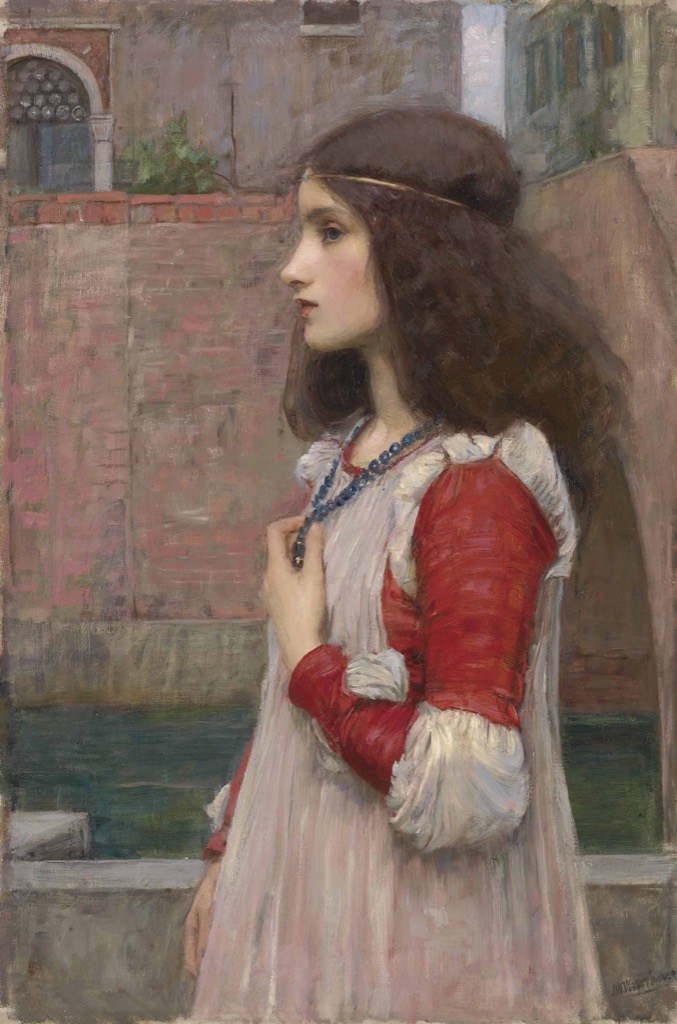
John William Waterhouse's Juliet of 1898 presents Shakespeare's heroine alone beside a river, grasping a blue necklace and glancing sideways as she moves past walls and a bridge. There is no balcony, no Romeo and no identifiable line from the play. The painting compresses the pressure surrounding Juliet into costume, architecture and one guarded look. [1] [2]
Later sales called the picture The Blue Necklace, an alternate title that shifts attention from literary character to visible object. [1] Recovering its original exhibition title restores the dramatic context, but it does not turn the image into a literal illustration of one scene.
At a Glance
- ArtistJohn William Waterhouse (1849–1917)
- TitleJuliet; later sold as The Blue Necklace [1]
- Date1898 [1]
- MediumOil on canvas [1]
- Dimensions72 × 48 cm (28⅜ × 19 in.) [1]
- CollectionPrivate collection [1]
- First exhibitedNew Gallery, London, Summer Exhibition, 1898 [1]
- Literary sourceWilliam Shakespeare, Romeo and Juliet [2]
- SubjectJuliet walking beside a river or canal, holding a blue necklace and looking sideways
- Original or early ownerSir Frederick M. Fry [1]
- Essential distinctionWaterhouse does not specify a moment such as the balcony, secret wedding or tomb; the scene is a psychological invention
Contents
- Introduction
- Juliet without Romeo
- The Heroine in Shakespeare's Tragedy
- A Painting with No Fixed Scene
- Profile, Sidelong Glance and Blue Necklace
- Walls, Bridge, River and Movement
- Costume, Colour and Marriage Imagery
- The New Gallery and Waterhouse in 1898
- Title, Ownership and Rediscovery
Juliet without Romeo
Waterhouse shows a young woman in richly coloured dress crossing a narrow urban space. Her body turns in profile and appears to continue towards the left, while her eyes move sideways towards the viewer. One hand holds a strand of blue beads or jewels close to her chest.
Behind her, brick and stone architecture form a hard framework. A bridge crosses the upper field, a parapet cuts across the foreground and a blue band of water separates Juliet from distant buildings. Open landscape is limited.
This is Verona imagined rather than archaeologically reconstructed. The setting establishes an old Italian city through masonry, water and compact distance, but no landmark identifies an exact street. Waterhouse needs an environment of passage and enclosure, not a topographical record.
Juliet's solitude is striking because Shakespeare's character is nearly always defined through intense exchanges. She speaks with Romeo, the Nurse, her parents, Friar Lawrence and Paris. Even her most private thoughts are delivered to an audience in dramatic speech. [2]
Painting removes that language. The heroine cannot explain whether she has just met Romeo, fears discovery, resists Paris or anticipates the tragedy. Her hand and glance have to suggest a mind under pressure.
The blue necklace supplies a focus for that pressure. Juliet does not display it ceremonially. She grips or touches it nervously, according to Christie's description, converting ornament into a tactile sign of uncertainty. [1]
Her direction of travel and direction of sight are not the same. The body moves on, but attention looks aside. That division provides the painting's drama: forward motion is interrupted by suspicion, awareness or attraction.
Romeo's absence prevents the work from becoming a portrait of reciprocal desire. The viewer occupies the position of an unseen observer. Juliet seems watched, and her glance acknowledges without welcoming that scrutiny.
The Heroine in Shakespeare's Tragedy
At the beginning of Romeo and Juliet, the Capulets and Montagues are trapped in a feud that repeatedly produces public violence. Romeo, a Montague, attends a Capulet feast in disguise, sees Juliet and falls in love with her. Neither initially knows the other's identity. [2]
Juliet is not yet fourteen. Her mother introduces the possibility of marriage to Paris, and Capulet at first says she is very young. Within a short period, however, her parents' pressure becomes coercive when she refuses the match. [2]
After the feast, Romeo enters the Capulet orchard. He and Juliet declare love across the physical and social boundary of her family home. Their language moves quickly from wonder to vows and a plan for marriage. [2]
Friar Lawrence secretly marries them, hoping the union may turn hatred into reconciliation. The marriage instead becomes entangled with violence. Tybalt kills Mercutio; Romeo kills Tybalt and is banished from Verona. [2]
Juliet's parents, unaware of her marriage, arrange for her to wed Paris. When she refuses, Capulet threatens rejection and destitution. The Nurse, previously her intimate ally, advises her to marry Paris because Romeo is absent. Juliet then conceals her intentions even from the Nurse. [2]
Friar Lawrence gives her a potion that will make her appear dead. The plan depends on a message reaching Romeo, but the letter fails. Romeo hears only that Juliet has died, enters the Capulet tomb, kills Paris and drinks poison beside her body. [2]
Juliet wakes, finds Romeo dead and kills herself with his dagger. Their deaths finally move the families towards reconciliation. The ending makes the cost of inherited hatred visible in two young bodies. [2]
Waterhouse's single figure exists beneath this whole arc, but the painting does not tell us where within it she stands. A viewer's knowledge of the tragedy supplies dramatic irony to an image that remains deliberately unspecific.
A Painting with No Fixed Scene
The absence of a secure episode is not a defect to be repaired. No blue necklace drives Shakespeare's plot, and the riverside walk does not correspond plainly to the orchard, Friar Lawrence's cell, Juliet's bedroom or the Capulet tomb. [1] [2]
Calling the scene “Juliet on her way to the secret wedding” would therefore exceed the evidence. So would identifying an unseen Romeo behind the viewer. Christie's offers Romeo or the citizens of Verona as interpretive possibilities for the gaze, not documented figures outside the frame. [1]
Waterhouse instead constructs a character portrait in narrative space. The title supplies identity; setting supplies Verona-like constraint; gesture supplies anxiety. The exact sentence Juliet is thinking remains unavailable.
This approach suits a heroine whose public and private selves rapidly separate. To her parents she must appear an obedient Capulet daughter. To Romeo she is a wife. To Paris she is an unwilling prospective bride. To the Nurse she eventually becomes secretive. The profile body and diverted eyes can hold more than one allegiance at once. [2]
The picture also resists the most familiar visual cliché. Nineteenth-century artists often chose the lovers at the balcony, the wedding, the potion or the tomb. Waterhouse removes the male partner and the climactic prop.
That removal directs attention to the period between public events. Juliet walks through her city carrying knowledge that others do not possess. The tragedy becomes a condition of ordinary movement.
Her glance can be read as fear of surveillance because secrecy is essential to the plot. Yet the image contains no pursuer, family member or guard. A cautious interpretation preserves uncertainty: she notices someone or something beyond the canvas, but we cannot name it.
The scene's invention also separates the work from theatrical costume illustration. Waterhouse does not freeze a famous stage pose. He asks what Juliet might look like when no one in the play is allowed to hear her.
Profile, Sidelong Glance and Blue Necklace
Christie's relates Juliet's profile to Italian Renaissance portraits of women. Fifteenth-century profile portraits often displayed features, clothing and jewellery while averting a young woman's gaze from the viewer, particularly in images associated with marriage. [1] [3]
The Metropolitan Museum notes that the format could present beauty and preserve a convention of chaste non-engagement. [3] Waterhouse invokes that type but destabilises it. Juliet's head remains substantially in profile while her eyes turn outward.
The eyes break the portrait's social discipline. She is not a passive marriage image offered for inspection. She detects the gaze directed at her.
This is especially apt for Shakespeare's Juliet because marriage is contested throughout the tragedy. Her family discusses Paris as a suitable match; Juliet secretly chooses Romeo; household authority tries to reclaim the decision. A marriage-portrait convention becomes a frame for a woman whose desire exceeds the alliance planned for her. [2] [3]
The necklace intensifies the connection with display and wealth. Jewellery in Renaissance portraiture could signal family status, marriage and the economic structures surrounding a bride. [3] [4] Waterhouse does not document one specific Renaissance ornament, but he uses luxury as part of Juliet's social identity.
Blue also creates a concentrated contrast with the warmer reds, purples or rose tones of the gown. The necklace visually echoes the river behind her, linking what she holds close to the strip of space that separates her from the distant town.
No source establishes who gave her the necklace. It should not be confidently labelled a gift from Romeo, Paris or her parents. Its narrative power arises precisely because title history made the object prominent without explaining it.
Touch is more revealing than ownership. Juliet's fingers seek the necklace at a moment of alertness. Jewellery becomes something to grasp, as though a stable object could steady an unstable social position.
The curly hair is unusual within Waterhouse's recurring female types and adds a restless contour around the face. [1] It prevents the profile from becoming a simple smooth silhouette while echoing the small loops of beads and costume detail.
Walls, Bridge, River and Movement
Architecture presses around Juliet. Christie's identifies a massive brick footbridge and wall, a grey parapet and the band of river between her and the townscape. [1] These horizontal and vertical forms create a grid that seems firmer than the moving figure.
The masonry can be read as the social structure of Verona: family name, planned marriage and public surveillance. That is an interpretation rather than a code confirmed by Waterhouse, but it grows from the secure visual fact that Juliet's soft body is set against hard boundaries.
The river offers distance but not escape. It opens a blue interval while another bank and buildings remain beyond. Unlike the river carrying the Lady of Shalott towards Camelot, this water does not move the heroine through the picture.
Waterhouse crops the arch at the upper left and the nearer end of the bridge at the lower right. Christie's argues that these incomplete forms make the setting less symmetrical and allow Juliet to appear as though she is walking leftward. [1]
Cropping turns the image into a segment of continuing space. Juliet has come from somewhere and will leave the visible field. The canvas catches rather than stages her.
This movement distinguishes Juliet from a formal portrait even while the profile recalls one. A commissioned sitter is generally understood to remain in position. Waterhouse's heroine passes by and can withhold herself.
Her head and torso do not twist dramatically. The sidelong movement is small enough to feel involuntary, an instant of attention within walking. Psychological tension enters through restraint.
The distant city lacks crowds. Verona's lethal feud is represented by built environment rather than street fighting. Waterhouse removes the spectacle of male violence but retains the world it has made.
The scale of the painting reinforces intimacy. At 72 by 48 centimetres, it is substantially smaller than Waterhouse's major multi-figure exhibition canvases. [1] The narrow vertical field keeps the viewer close to Juliet while permitting architecture to hem her in.
Costume, Colour and Marriage Imagery
Juliet's richly coloured gown resembles the cut of the dress in Waterhouse's Mariana in the South, as Christie's observes. [1] Both women are defined by frustrated or threatened marriage and shown alone in invented historical settings.
The similarity does not make the costumes evidence for one exact date. Waterhouse's literary dress combines historical suggestion with studio design. Fabric establishes another world without serving as an archaeological reconstruction.
Colour gives Juliet presence against grey, brown and blue masonry. Her body is the warm element within a cool or muted built setting. The contrast makes the social individual visible inside the systems that constrain her.
Neckline, sleeves and jewellery also indicate privilege. Juliet is not materially destitute; her danger arises inside a wealthy household whose resources do not protect her freedom. Shakespeare's Capulets can host an elaborate feast and arrange an advantageous marriage, yet their authority becomes violent towards their daughter. [2]
Renaissance marriage portraits frequently celebrated status through fabric and jewels. [3] [4] Waterhouse adapts that visual splendour while refusing celebration. Juliet's finery accompanies anxiety.
Her profile may initially make her seem idealised and remote. The glance and hand counter that impression. A person emerges from a type.
This is one reason the work should not be reduced to “a beautiful maiden.” Beauty is part of the social problem. Paris and the Capulets evaluate Juliet as a desirable bride; Romeo idealises her through radiant poetic images; the audience knows she is also exceptionally young. [2]
Waterhouse avoids showing her as a child, but the play's age remains relevant. The mature visual elegance of the figure belongs to Victorian casting and artistic convention rather than proof that Shakespeare's Juliet is an adult.
The necklace's later promotion into an alternate title demonstrates how easily costume can detach the painting from literature. The Blue Necklace offers an attractive genre picture. Juliet transforms the same grasped object into part of an impossible network of love and marriage.
The New Gallery and Waterhouse in 1898
Waterhouse exhibited Juliet at the New Gallery's Summer Exhibition in 1898. In the same season, the Royal Academy showed his larger Flora and the Zephyrs and Ariadne. [1]
This distribution reveals a practical exhibition strategy. The New Gallery offered a prestigious setting for more modestly scaled, single-figure works, while spectacular multi-figure or large mythological canvases could command attention at the Academy. [1]
The distinction should not become a hierarchy of seriousness. Juliet is small and narratively economical, but its sideways gaze and cropped architecture are highly controlled. Psychological compression replaces scale.
The year followed Mariana in the South, sent to the New Gallery in 1897. Both works place a named literary woman alone in a vertical canvas, use a richly coloured dress and withhold the man governing the story. [1]
Their spaces differ decisively. Mariana kneels within an interior and confronts her reflection. Juliet walks outdoors and responds to an unseen observer. One is fixed by abandoned memory; the other is caught in active secrecy.
Waterhouse had already explored Shakespeare through Miranda, Cleopatra and versions of Ophelia. Christie's notes his contribution to the Graphic Gallery of Shakespeare's Heroines and the continuing Victorian appetite for Shakespearean women. [1]
Yet he painted Juliet only once. [1] This makes the picture distinct from the repeated Ophelia and Lady of Shalott subjects. There is no Waterhouse sequence showing balcony, potion and tomb.
The New Gallery title was simply Juliet. Contemporary viewers were expected to bring broad knowledge of the play. Waterhouse could depend on recognition without supplying a quotation.
That cultural confidence matters. The painting is literary even when it is not illustrative. It assumes that one name can make a nervous hand, a guarded glance and an Italian city carry tragedy.
Title, Ownership and Rediscovery
Sir Frederick M. Fry was an early, possibly the first, owner of Juliet. He also owned Waterhouse's 1908 Gather Ye Rosebuds While Ye May and the 1909 version of Lamia, bought works at the artist's estate sale and attended his funeral in 1917. [1]
The painting reappeared at Christie's in 1943 from Fry's collection under the title The Blue Necklace. It sold for 17 guineas to Chubb. It then belonged to J. F. Haworth and descended to his daughter Mary, Lady Hayter. [1]
At Sotheby's in 1970 it was again catalogued as The Blue Necklace. [1] The persistence of that name shows how title history can alter identification. Without the literary title, the picture looks like an unnamed historical beauty with jewellery.
Restoring Juliet does more than attach a famous name. It changes the meaning of every restraint. The walls become Verona, luxury enters a marriage plot and the glance acquires the danger of discovery.
At the same time, the alternate title remains part of the object's provenance. It should be recorded rather than dismissed as merely wrong. It documents how the work was understood and transmitted in the twentieth-century market.
The canvas remains privately owned. [1] Its auction reappearance allowed close study after years out of public view, but reproduction cannot fully substitute for the original scale, surface and colour.
No reliable source used here identifies the model. Resemblance to women in other Waterhouse pictures may guide visual comparison, but it does not establish a sitter's name.
The painting's history mirrors its subject in one respect: identity is partly hidden and recovered through recognition. A blue necklace once displaced Juliet's name; exhibition records and scholarship restored it. The object has always remained the same canvas, but its story changed with its title.
Related Pages
- Mariana in the South: Compare another Waterhouse painting drawn from Tennyson and late-Victorian literary culture.
- Ophelia, 1894: Follow Waterhouse's Shakespearean and literary heroines through a different Ophelia composition.
- Literary and Mythological Sources: Trace the broader literary sources behind Waterhouse's art.
Frequently Asked Questions
It was exhibited at the New Gallery in 1898. [1]
It is in a private collection. [1]
The oil on canvas measures 72 × 48 centimetres. [1]
Yes. The painting was sold under that title in 1943 and 1970, although Juliet was its 1898 exhibition title. [1]
No exact scene can be securely identified. The riverside walk and necklace are Waterhouse's psychological invention rather than clear details from the play. [1] [2]
No. Juliet glances towards something beyond the frame, but the unseen observer cannot be identified with certainty.
The pose recalls Italian Renaissance portraits, especially marriage-related images of young women. Waterhouse disrupts the convention by turning her eyes towards the viewer. [1] [3]
The evidence does not say. Assigning it to Romeo, Paris or her family would be speculation.
No other finished Juliet by Waterhouse is documented in the source used here; Christie's describes this as his only treatment of her. [1]
Discussion
1. Who or what might Juliet have noticed outside the frame? 2. How does the sidelong glance change the meaning of a formal profile? 3. Does the blue necklace seem like a gift, a restraint, a comfort or simply an ornament? 4. Why might Waterhouse have avoided every famous scene from the play? 5. How do bridge, wall, parapet and river make social pressure visible? 6. What changes when the work is titled The Blue Necklace instead of Juliet? 7. Compare Juliet's movement with Mariana's stillness in Mariana in the South. 8. Can a painting be strongly literary without illustrating a specific line?
Reader Insights
Which visible detail most changes the way you read this page?
Which source or comparison helps the work feel less familiar and more specific?
What question would you bring back to the painting after reading?
Join the Conversation
Share your reading of this page below.
References
- Image reference
- Christie's, “John William Waterhouse, R.A., Juliet,” lot record and catalogue essay, including dimensions, provenance, 1898 New Gallery exhibition, visual analysis, alternate title and ownership by Sir Frederick Fry, View source.
- William Shakespeare, Romeo and Juliet, Folger Shakespeare Library edition, complete text and scene synopses, View source.
- The Metropolitan Museum of Art, “Piero del Pollaiuolo, Portrait of a Woman,” collection record explaining the profile format in marriage portraits of young women, View source.
- National Gallery, London, “Alesso Baldovinetti, Portrait of a Lady,” collection essay on female profile portraiture, marriage, costume and jewellery in fifteenth-century Florence, View source.