 Buy Art Prints Now
from Amazon
* As an Amazon Associate I earn from qualifying purchases.
Image reference [image]
 by Tom Gurney
Tom Gurney BSc (Hons) is an art history expert with over 20 years experience
Published on August 14, 2026 / Updated on August 14, 2026
Email: tomgurney1@gmail.com / Phone: +44 7429 011000
Mariana in the South: Introduction
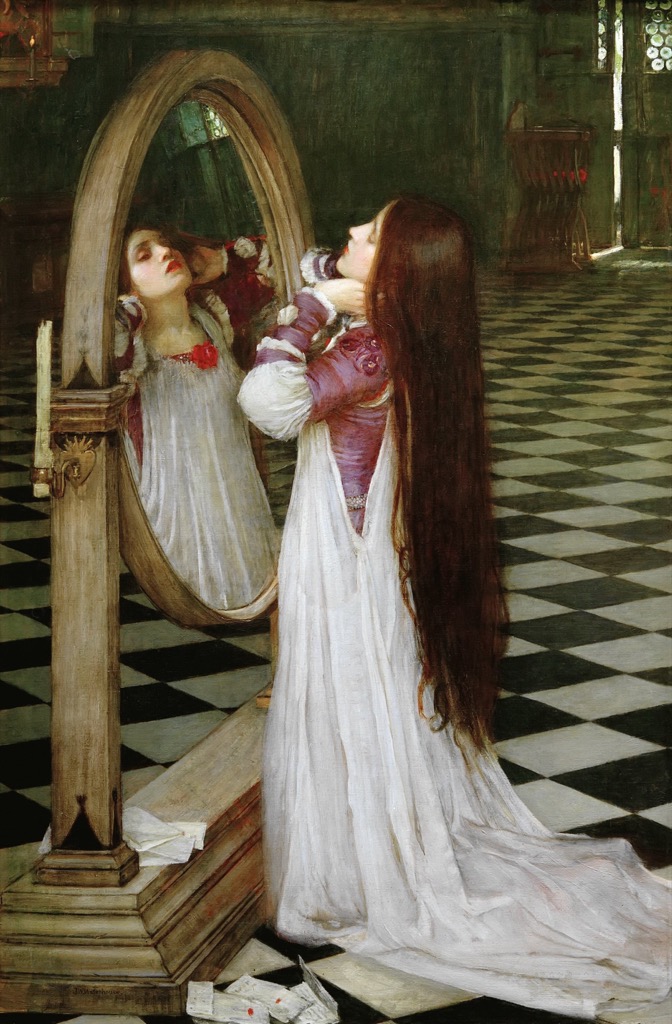
A woman kneels before a tall mirror in a hot, enclosed room. Letters lie near her, but no correspondent arrives. John William Waterhouse's Mariana in the South of 1897 translates Alfred Tennyson's poem of abandonment into a study of looking, waiting and a face reflected back upon its owner. [1] [2] [5]
Two closely related canvases complicate the work's identity. The primary, smaller version measures 114 × 74 centimetres and remains in a private collection; a larger, full-scale oil study belongs to the Cecil French Bequest of Hammersmith & Fulham Council. [1] [2] [3] [4] Treating them as one object produces contradictory dimensions and locations. Their relationship is therefore central to any accurate account.
At a Glance
- ArtistJohn William Waterhouse (1849–1917)
- TitleMariana in the South
- Date1897 [1] [2]
- MediumOil on canvas [1] [3]
- Primary version114 × 74 cm; private collection [1] [2]
- Full-scale oil study134.5 × 86.3 cm; Cecil French Bequest, Hammersmith & Fulham Council [3] [4]
- First exhibition of the primary versionNew Gallery, London, 1897 [2]
- Literary sourceAlfred Tennyson, Mariana in the South, first published in the volume dated 1833 [5]
- Earlier dramatic sourceMariana in Shakespeare's Measure for Measure [6]
- SubjectThe abandoned Mariana kneeling before a mirror, with letters and an absent lover controlling the scene
- Essential distinctionTennyson's southern Mariana is not the same poetic setting as the moated-grange heroine of his earlier poem Mariana, although both develop Shakespeare's character
Contents
- Introduction
- A Woman before Her Own Image
- Shakespeare's Abandoned Mariana
- Tennyson's Southern Transformation
- The Line Waterhouse Selected
- Mirror, Letters and Enclosed Room
- Heat, Prayer and Repeated Time
- The Primary Painting and Full-Scale Study
- Waterhouse, Tennyson and the New Gallery
A Woman before Her Own Image
Mariana kneels on a patterned tile floor before a large oval mirror. Her dress pools around her body and carries the warm red or rose tones that make the figure dominant within the tall interior. She looks into the glass, turning her face away from direct exchange with the viewer.
The mirror is mounted in an elaborate standing frame. It is not a small accessory held for convenience; it occupies much of the picture's vertical structure. Mariana's relation to it becomes the action.
Behind and around her, the room continues through doorways, screens, furniture and patterned surfaces. The interior is richly made but psychologically sparse. Objects cannot answer the question that has brought her to the mirror: why has the beauty once praised by Angelo failed to secure his love?
Letters on or near the floor connect reflection with memory. In Tennyson's poem, Mariana draws out old letters that once testified to her worth. Their words have outlived the relationship they promised. [5]
Waterhouse does not show Angelo, a messenger or another woman. Absence becomes visible through the heroine's fixed attention and through correspondence that belongs to the past. A single figure has to carry an entire history of contract, loss and rejection.
The painting stops before any practical change. Shakespeare's plot will eventually bring Mariana into the Duke's scheme, reunite her sexually with Angelo through the bed trick and end with their marriage. Tennyson instead holds her in prolonged desolation. Waterhouse follows the poem's suspended condition rather than the play's machinery of resolution. [5] [6]
The heroine is not simply admiring herself. Her reflected face is evidence in an argument: Angelo called her beautiful, yet abandoned her. The mirror confirms appearance but cannot explain conduct.
This gap gives the painting its depth. Beauty is visually present and narratively powerless. Mariana can inspect the quality that supposedly inspired praise, but she cannot retrieve the person who praised it.
Shakespeare's Abandoned Mariana
Mariana originates in Shakespeare's Measure for Measure. Before the play begins, she and Angelo have been formally contracted, and their wedding has been appointed. Her brother Frederick then dies in a shipwreck carrying her dowry. [6]
Angelo abandons her after the financial loss and pretends that reports have damaged her reputation. The Duke, disguised as a friar, describes him as unresponsive to her tears and says that she continues to love him despite his unjust rejection. [6]
The play places Mariana at Saint Luke's moated grange. Her isolation is not merely romantic background: it makes her available to the disguised Duke's plan. Isabella is being coerced by Angelo, who promises to spare her brother Claudio if she has sex with him. The Duke proposes that Mariana secretly take Isabella's place. [6]
Mariana agrees. The substitution allows her to meet Angelo under the terms of their former contract while protecting Isabella. Angelo nevertheless orders Claudio's death, and the plot moves towards public exposure and judgement. [6]
In the final scene, Mariana removes her veil, identifies herself and asserts the binding force of her earlier vows. Angelo admits that there had been discussion of marriage five years before and acknowledges that her promised fortune fell short. The Duke orders their marriage and then threatens Angelo with execution; Mariana pleads for his life. [6]
This outcome is uncomfortable to many modern readers. Marriage does not erase Angelo's coercion, hypocrisy or willingness to have Claudio killed. An account of Waterhouse's painting should not turn the play into a simple story of lovers temporarily separated by accident.
Nor should Angelo be called a “dictator” as though that were his Shakespearean title. He is the Duke of Vienna's deputy, given severe governing power during the Duke's apparent absence. His public enforcement of sexual law and his private corruption are essential to the play. [6]
The lost dowry matters because it exposes the economic structure of marriage. Angelo's broken vow follows the destruction of Mariana's “portion and sinew” of fortune, not the disappearance of her beauty. Tennyson and Waterhouse move the emotional emphasis towards solitary longing, but the financial betrayal remains underneath it.
Tennyson's Southern Transformation
Tennyson wrote two poems called Mariana and Mariana in the South. The earlier poem appeared in Poems, Chiefly Lyrical in 1830 and develops the image of a woman in a decaying moated grange. Mariana in the South appeared in the volume dated 1833 and moves the heroine into an arid southern landscape. [5]
The distinction is not minor. The first poem is damp, autumnal and enclosed by rust, moss and black water. The southern poem is governed by glare, dust, heat, an empty riverbed, salt and the long passage from burning day into night. [5]
Both heroines repeat a lament of being alone, forgotten and forlorn. Repetition makes waiting measurable. Days change, but the emotional sentence returns.
In Mariana in the South, the house shines across a level landscape while one black shadow lies at its foot. The poem's opening views the building from outside before moving intimately through Mariana's hair, eyes, prayers, sleep, dreams and letters. [5]
She invokes the Virgin Mary and asks for grace to bear her weary load. At the mirror she questions whether this is the form that once won her lover's praise. Later she dreams of cooler native landscapes, wakes into relentless heat, rereads old letters and imagines a figure at the door alternately confirming permanent abandonment and promising that she will be alone no more. [5]
The poem ends at evening. Mariana opens the lattice, sees the planet Hesper and weeps as night rises through the sky. The daily transition offers beauty but no arrival. Her final lament anticipates a night that “knows not morn.” [5]
Tennyson therefore transforms Shakespeare's supporting character into a complete consciousness. Angelo never enters the poem to speak for himself. The institutional plot of law, disguise and judgement becomes interior duration.
Waterhouse follows that transformation. His painting is not a scene from a staged comedy in which other characters are about to enter. It is a room saturated with one woman's interpretation of old words and present silence.
The Line Waterhouse Selected
The painting is commonly connected with Tennyson's description of Mariana kneeling while the “clear perfection” of her face glows in a liquid mirror. [2] [5] Her posture, glass and reflection make the relation persuasive.
The surrounding stanza is vital. Mariana has fallen to her knees before the Virgin and asks for help with her burden. The mirror appears within prayer, not as a separate toilette scene. Her next question asks whether this is the form that won his praises. [5]
Waterhouse does not include an unmistakable image of the Virgin in the primary action. That omission allows modern viewers to overlook the devotional setting of the verse. Kneeling can appear to be solely a practical pose before a low mirror, but the literary source gives it a second meaning.
Reflection is therefore divided between appearance and appeal. Mariana sees her face at the very moment she seeks grace beyond herself. The “liquid” glass offers perfect form but no spiritual answer.
Waterhouse makes the mirror tall and physically substantial. Its carved frame gives reflection an architectural presence, almost a doorway that leads nowhere. Unlike a door, it returns the room and figure to themselves.
The canvas does not transcribe every detail of the stanza. The exact chronology of prayer, kneeling and mirror sight has been converted into one stable arrangement. Painting replaces Tennyson's unfolding lines with simultaneity.
This compression produces ambiguity. Mariana might be praying, scrutinising herself, remembering Angelo's compliments or performing all three actions together. The poem supports the overlap rather than forcing one choice.
Her reflected image is also partially withheld by the reproduction or version a viewer encounters. The turned body and mirror angle complicate easy access. We observe a woman looking at herself, but do not possess her face in the same way that Angelo's past praise claimed to value it.
Mirror, Letters and Enclosed Room
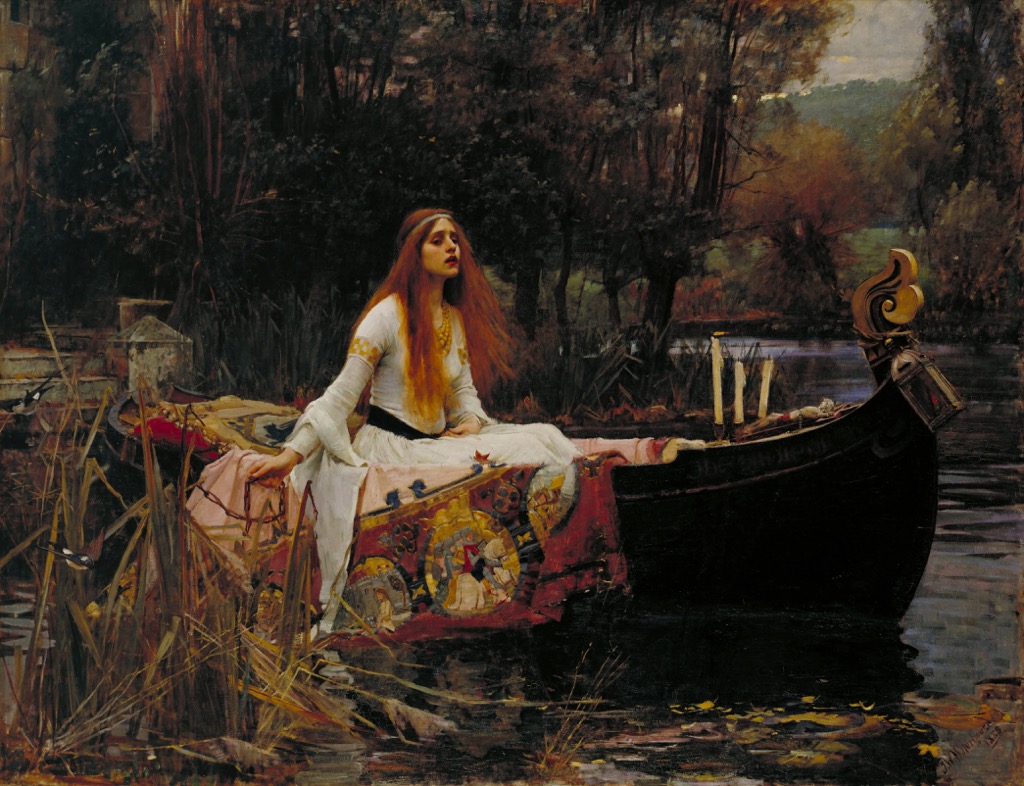
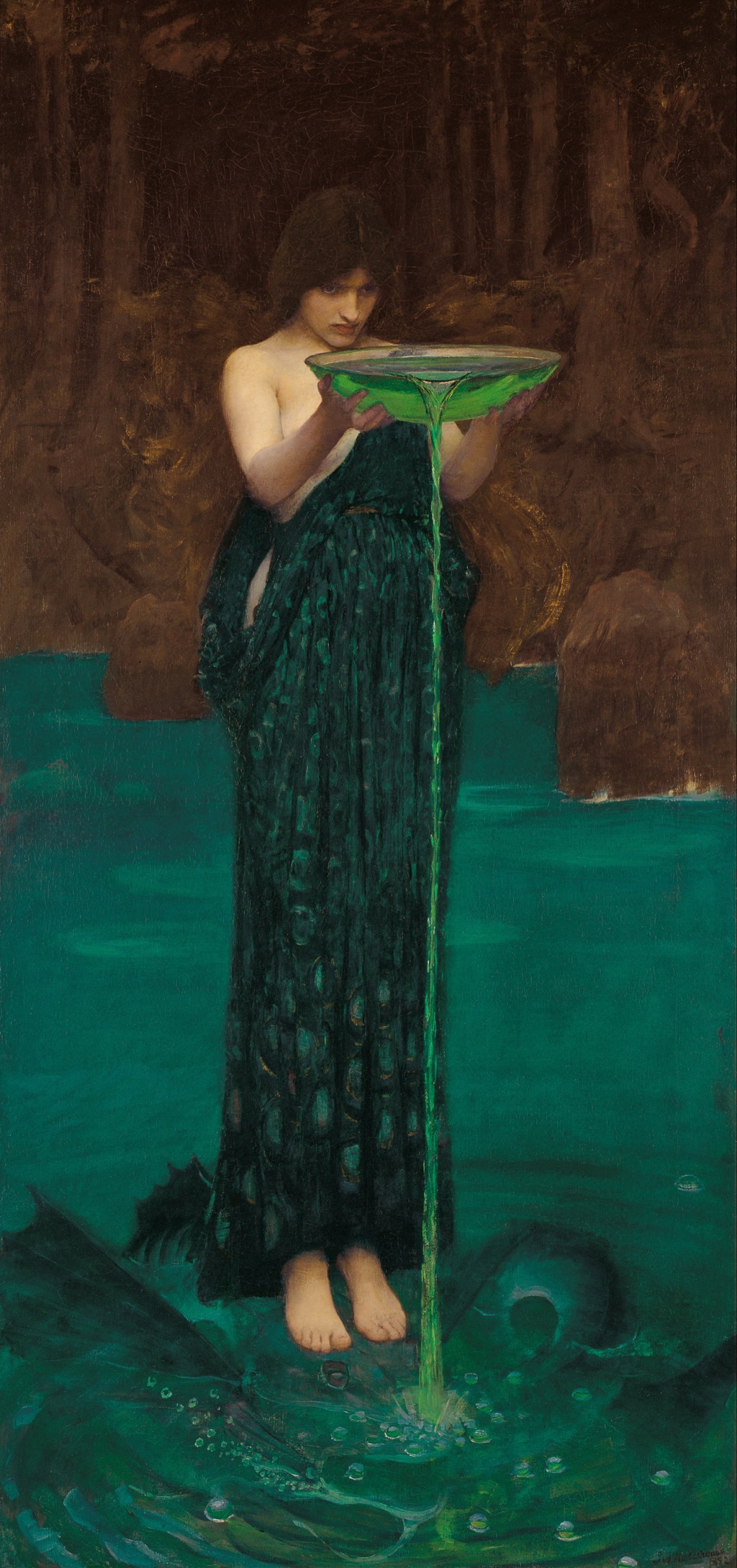
Mirrors recur in Waterhouse's art because they can reveal a second space without introducing a second physical figure. In Circe Offering the Cup to Ulysses, the mirror carries the absent or partially visible hero into the enchantress's room. In later versions of the Lady of Shalott, it mediates the world she is forbidden to see directly.
In Mariana in the South, the mirror returns no lover and opens no exterior. Its subject is the heroine herself. That apparent simplicity makes it severe.
The frame's scale turns looking into labour. Mariana must kneel and orient her whole body. Reflection is not a passing glance but an extended encounter with the evidence of her own unchanged appearance.
The patterned floor measures depth and keeps the figure within a controlled interior. Its repeated units echo the repeated days and refrains of Tennyson's poem without functioning as a literal encoded calendar.
Letters interrupt that order. They are portable fragments of Angelo's earlier voice, displaced onto the floor or low foreground. In the poem, they state that love must remain true to what is loveliest; Mariana's abandonment disproves their assurance. [5]
Written praise and reflected beauty reinforce one another, yet both fail. The letters say what the mirror seems to show, while Angelo's absence says something else. Waterhouse constructs psychological conflict from objects that cannot change their testimony.
Doorways deepen the room but do not deliver a person. Tennyson repeatedly gives Mariana an “image” passing the door, sometimes scornful and sometimes consoling. [5] Waterhouse leaves the threshold available to imagination rather than painting an apparition.
The interior's beauty should not be mistaken for comfort. Fine fabric, carved wood, tile and colour can intensify enclosure because Mariana has no one with whom to share them. Like the soul in Tennyson's Palace of Art, she inhabits cultivated space without sustaining human reciprocity.
Yet the painting is not an allegory with one fixed key. Its power comes from ordinary acts—kneeling, reading, remembering, examining one's face—made continuous with literary sorrow.
Heat, Prayer and Repeated Time
Tennyson's southern landscape is more than a location label. Heat governs consciousness. Birds and lambs fall silent, clouds do not cross the sky and the riverbed turns dusty white. Noon induces sleep, but sleep offers only a temporary dream of cooler native hills. [5]
Waterhouse places Mariana inside, where heavy architecture and rich textiles can feel close and warm. The painting cannot reproduce temperature directly, but enclosed air, saturated colour and bodily stillness invite viewers to imagine it.
Heat slows action. Mariana's wait is not represented by a clock or calendar; it is felt through a scene in which nothing appears likely to move. Even the mirror fixes a transient face into apparent permanence.
Prayer adds another scale of time. The repeated invocations to Mary occur night and morning. Their continuity resembles the refrain, turning daily devotion into a structure for endurance. [5]
The poem does not report an answering miracle. Its heroine continues to dream, wake, read and lament. Waterhouse respects this non-event. He does not add an angel, vision or beam of divine light.
Her dress gathers around the knees like material accumulated by stillness. The body has lowered, but it has not collapsed. Mariana remains capable of attention and appeal.
The reflected face is described by Tennyson as perfect, but perfection does not suspend ageing. Old letters predict that love must remain faithful to beauty; an imagined cruel figure warns that beauty now flows away. [5] The mirror becomes a place where time is feared even when no change can be measured.
Waterhouse often painted the instant before a decisive action. Here the instant is difficult to locate because waiting itself is the subject. The picture's drama does not depend on what Mariana will do in the next second. It depends on how long the same emotional arrangement has endured.
The Primary Painting and Full-Scale Study
The principal finished version measures 114 × 74 centimetres and is privately owned. It was the painting exhibited at the New Gallery in 1897 and later included in Treasures of the North. [1] [2]
A second oil is larger, measuring 134.5 × 86.3 centimetres. Catalogues identify it as a full-scale study, slightly different in detail, and record it in the Cecil French Bequest belonging to Hammersmith & Fulham Council. [2] [3] [4]
The fact that the study is larger than the primary painting can surprise viewers. “Study” describes its preparatory or developmental relation, not a requirement that it be physically small. Waterhouse could work through pose, mirror, costume and interior at substantial scale before determining the exhibited solution.
Online pages frequently combine the primary version's 114 × 74 centimetres with the public study's collection information. That hybrid record creates an object that does not exist. Accurate metadata must keep dimensions and ownership attached to the appropriate canvas.
The Cecil French Bequest came from a collector of later Pre-Raphaelite and traditional British art. Council records describe the bequest as a heritage collection and note that its works have sometimes been lent for exhibition. [4]
Public ownership does not guarantee permanent display. The study has been associated with Leighton House and with council custody, while access and venue can change. A current visit should therefore be checked with the relevant institution rather than inferred from an old catalogue.
Comparison between versions can reveal amendments to the mirror, room and figure, but differences should be assessed from reliable images of both works. Reproductions vary in cropping and colour and can reverse the apparent hierarchy if the study is better photographed than the primary canvas.
The existence of two oils is valuable evidence of process. Waterhouse did not merely dress a model and transcribe an untouched pose. He developed a complex coordination of body, costume, reflective furniture and tiled recession.
Waterhouse, Tennyson and the New Gallery
Waterhouse exhibited the primary Mariana in the South at the New Gallery in 1897. [2] The venue matters because his reputation was not built only through the Royal Academy. He could reserve larger or more spectacular compositions for the Academy while sending intimate single-figure pictures to the New Gallery.
The painting belongs to a concentrated engagement with Tennyson. The Lady of Shalott had helped redirect Waterhouse's work in 1888; the 1894 weaving version revisited the poem; Saint Cecilia of 1895 drew from The Palace of Art; and Mariana in the South followed in 1897. [2]
These were also subjects with important Pre-Raphaelite precedents. Millais painted the earlier Mariana in 1851, and Rossetti illustrated Mariana in the South for the 1857 Moxon Tennyson. Waterhouse joined an established conversation rather than discovering an unused text. [2]
His solution differs from Millais's stretched woman at the embroidery frame and Rossetti's more explicitly devotional and erotic intensity. The standing mirror gives Waterhouse an architecture of self-inspection.
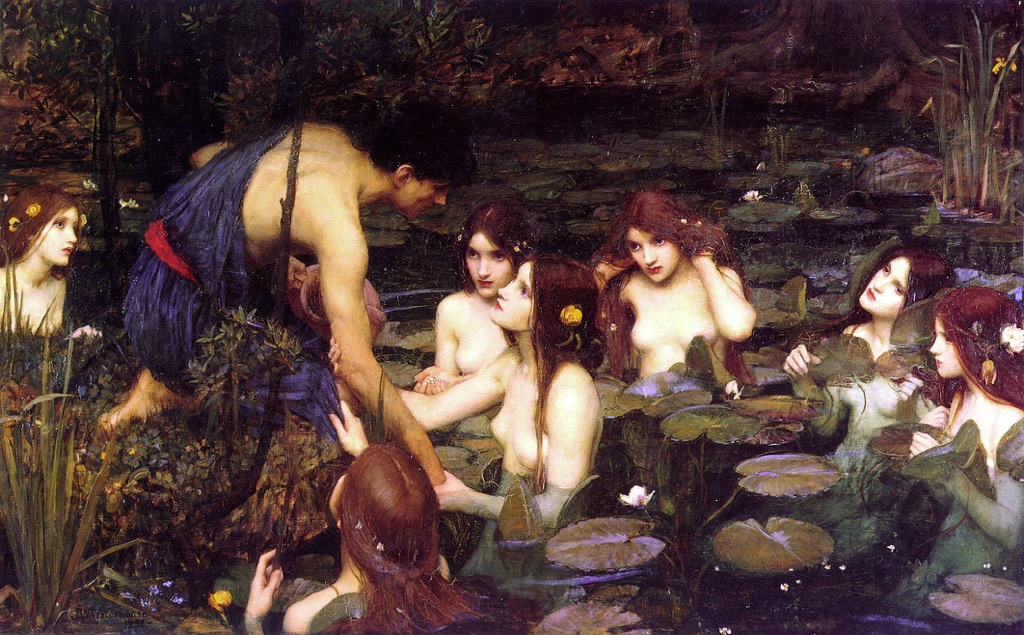
The date also places the work beside Hylas and the Nymphs, exhibited at the Royal Academy in 1896 and often associated with 1896, and before the 1898 Ariadne, Flora and the Zephyrs and Juliet. Across these paintings, a female figure may be isolated by abandonment, multiplied into a chorus or placed within a mythic encounter.
Mariana is neither enchantress nor supernatural victim. Her confinement comes from social and emotional history. No curse prevents her leaving the room; the force that holds her is continuing attachment to a man who has betrayed her.
That distinction prevents the canvas from becoming simply another “beautiful sad woman.” Tennyson and Shakespeare give the sadness economic, legal, erotic and religious dimensions. Waterhouse's concentrated objects preserve those layers for viewers willing to read beyond the face.
The painting's achievement lies in making absence structured. Angelo is not visible, yet his old praise determines the mirror, his letters enter the foreground and his betrayal explains the kneeling body. The unseen character controls the room precisely because Mariana cannot stop addressing him.
Related Pages
- Saint Cecilia: Compare another 1890s Waterhouse canvas drawn from Tennyson.
- Literary and Mythological Sources: Follow the Shakespeare and Tennyson source trail behind Mariana.
- Paintings: Return to the protected Waterhouse paintings hub.
Frequently Asked Questions
It shows Mariana kneeling before a full-length oval mirror in an interior, with old letters helping connect the scene to Tennyson's poem.
The bequest contains a larger, 134.5 × 86.3 centimetre full-scale oil study that differs slightly from the primary version. [2] [3] [4]
Alfred Tennyson's Mariana in the South, first published in the volume dated 1833, is the direct source. [5]
Yes. She is Angelo's abandoned fiancée in Measure for Measure. Tennyson transformed her into the central consciousness of two poems. [5] [6]
In Shakespeare, her brother dies in a shipwreck carrying her dowry. Angelo breaks the contract and alleges damage to her reputation. [6]
That line is the clearest verbal source for the kneeling pose and reflection. Its stanza combines prayer, beauty and doubt about Angelo's former praise. [2] [5]
Discussion
1. Does the mirror confirm Mariana's beauty or expose its powerlessness? 2. How do the old letters function differently from a living speaker? 3. What does Waterhouse gain by omitting Angelo entirely? 4. How does kneeling combine prayer with self-inspection? 5. Compare Waterhouse's interior with the heat and drought in Tennyson's exterior landscape. 6. Why is it important to distinguish the primary painting from the larger oil study? 7. How does knowledge of the lost dowry change the apparent romance of the scene? 8. Is Mariana waiting for Angelo, for divine help or for a change within herself?
Reader Insights
Which visible detail most changes the way you read this page?
Which source or comparison helps the work feel less familiar and more specific?
What question would you bring back to the painting after reading?
Join the Conversation
Share your reading of this page below.
References
- Image reference
- Wikimedia Commons, “File:John William Waterhouse - Mariana in the South (1897).jpg,” file record for the primary Mariana in the South image, with object metadata for Waterhouse, date, oil-on-canvas medium, 114 × 74 cm dimensions, private-collection/Leighton House note and public-domain reproduction status, View source.jpg).
- Christie's, “Frank Cadogan Cowper, R.A., Mariana in the South,” comparative catalogue essay documenting Waterhouse's 1897 New Gallery primary version, its later exhibition and the slightly different full-scale study, View source.
- Bridgeman Images, “John William Waterhouse, Mariana in the South, c. 1897,” record for the 134.5 × 86.3 cm oil in the Cecil French Bequest, View source.
- London Borough of Hammersmith & Fulham, heritage-assets account describing the ownership and management of the Cecil French Bequest, View source.
- Alfred Tennyson, “Mariana in the South,” in The Early Poems of Alfred, Lord Tennyson, Project Gutenberg, text and publication commentary, View source.
- William Shakespeare, Measure for Measure, Folger Shakespeare Library edition, especially Act 3, scene 1 and Act 5, scene 1, View source.