 Buy Art Prints Now
from Amazon
* As an Amazon Associate I earn from qualifying purchases.
Image reference [image]
 by Tom Gurney
Tom Gurney BSc (Hons) is an art history expert with over 20 years experience
Published on August 14, 2026 / Updated on August 14, 2026
Email: tomgurney1@gmail.com / Phone: +44 7429 011000
Saint Cecilia: Introduction
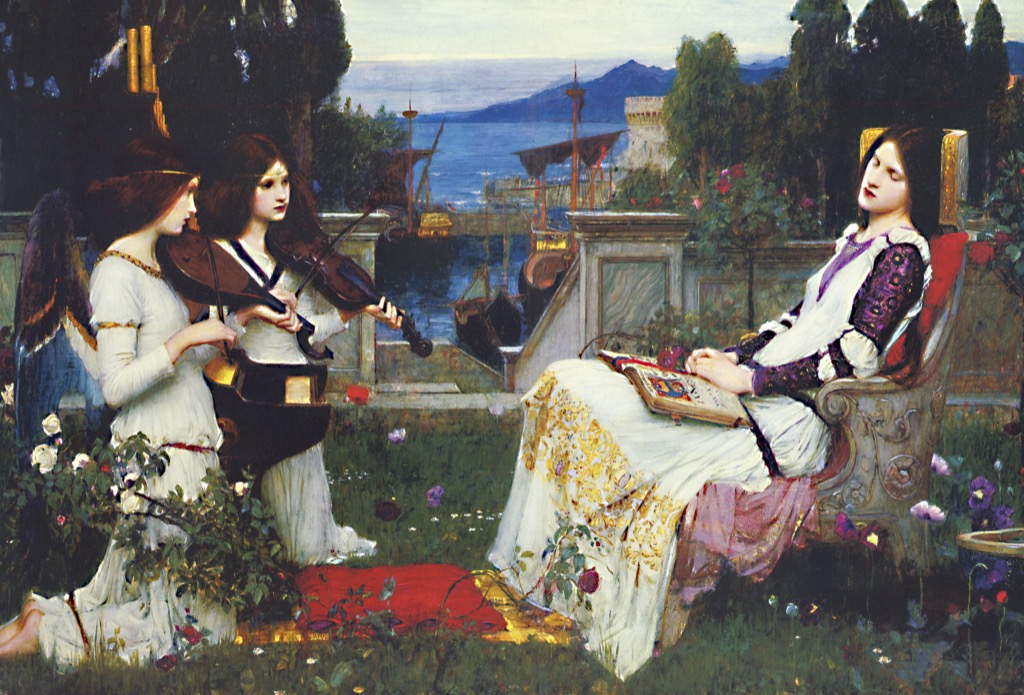
A sleeping saint, an open music book and two angel musicians occupy a garden above the sea. John William Waterhouse's Saint Cecilia of 1895 is not a conventional martyrdom scene. It turns a four-line image in Alfred Tennyson's The Palace of Art into one of the artist's largest and most carefully orchestrated visions of earthly and celestial music. [1] [2]
The picture appeared at the Royal Academy in the year Waterhouse became a full Royal Academician. Its scale, ambitious twilight setting and unusually rich exhibition history make it a flagship work of his mature career, even though it remains in a private collection. [1]
At a Glance
- ArtistJohn William Waterhouse (1849–1917)
- TitleSaint Cecilia; commonly styled St Cecilia in catalogues [1]
- Date1895 [1]
- MediumOil on canvas [1]
- Dimensions123.2 × 200.7 cm (48½ × 79 in.) [1]
- CollectionPrivate collection [1]
- First exhibitedRoyal Academy, London, 1895, no. 97 [1]
- Literary sourceAlfred Tennyson, The Palace of Art, first published in the volume dated 1833 [1] [2]
- SubjectThe sleeping patron saint of music, watched and serenaded by two angels
- Original ownerGeorge McCulloch, who bought the picture from Waterhouse's studio in 1895 [1]
- Essential distinctionWaterhouse illustrates Tennyson's imagined image of Cecilia rather than a specific episode of her martyrdom
Contents
- Introduction
- Music Heard in Sleep
- Tennyson's Palace of Images
- Cecilia, Music and Christian Tradition
- What Waterhouse Adds and Changes
- Twilight, Colour and Composition
- Angels, Instruments and Flowers
- The Royal Academy and Critical Reception
- Ownership, Exhibition and Reputation
Music Heard in Sleep
Waterhouse spreads the scene across a wide horizontal canvas. At its centre, Cecilia reclines in a carved marble chair. A crimson cushion supports her knees, an illuminated book lies open across her lap and gilded organ pipes rise behind her. Her head has fallen sideways in sleep.
Two youthful angels appear at the right. One plays a bowed stringed instrument and the other accompanies it. They do not wake Cecilia or demand her attention. Their music belongs to a state between external performance and inward dream.
The distance behind the figures opens towards a coastal city. Steps lead down beyond a marble barrier, ships rest in the harbour and the last light reaches across sea and mountainous horizon. Dark trees close the composition at either side, so that the distant passage of sky and water appears like a luminous opening within the garden.
This arrangement prevents the saint's sleep from seeming merely domestic. Her body is enclosed by chair, cushions, book and instruments, but the setting extends towards a city and sea. Private devotion occupies a world that remains large, inhabited and historically suggestive.
No halo is required to establish the sacred encounter. The angels and organ identify Cecilia through a long iconographic tradition, while the title completes the recognition. Waterhouse makes sanctity atmospheric: it is present in unearthly music, suspended time and the calm relation between human sleeper and celestial visitors.
The open book indicates that Cecilia has been reading or singing. The small organ suggests completed effort rather than active performance. Sleep arrives after music, and angelic music continues when her own activity has ceased.
That sequence gives the picture an elegant circularity. Cecilia's devotion generates an image of heavenly response; the angels transform her rest into a second form of listening. She is inactive physically yet remains the emotional centre around which every sound is imagined.
The angels' youth and concentration avoid theatrical revelation. They neither descend in a blaze of glory nor gesture towards heaven. They enter the garden as musicians, making the supernatural event feel intimate enough to belong to Cecilia's dream.
Tennyson's Palace of Images
The immediate literary source is The Palace of Art, one of Tennyson's early major poems. Its speaker imagines a magnificent pleasure-house in which the soul isolates itself among works of art, intellectual achievements and images gathered from many cultures. [2]
The poem is therefore not a narrative life of Saint Cecilia. Cecilia appears as one image among the palace's many decorated rooms. Tennyson writes of a clear-walled city by the sea, gilded organ pipes, the saint asleep with white roses in her hair and a single angel watching her. [2]
Those four lines offered Waterhouse a nearly complete visual seed: city, sea, organ, roses, sleep and angel. Yet their place within the larger poem matters. The palace is beautiful but insufficient. A soul that tries to live entirely for cultivated pleasure eventually discovers the sterility of separation from human life. [2]
Waterhouse does not provide an explicit diagram of that moral argument. His Cecilia appears serene rather than numbed by selfish aestheticism. Nevertheless, a painting drawn from the palace's imaginary collection inevitably becomes a picture about the power and limitation of art.
Viewers stand before a beautiful object that depicts a woman surrounded by beautiful objects. Music, manuscript illumination, carved marble, flowers, textiles, architecture and sunset are assembled within one sensuous field. The image invites exactly the absorbed contemplation that Tennyson's poem tests.
The difference is that Cecilia's absorption is devotional rather than acquisitive. She has not built a palace to exclude the world. Music connects her to angels, while the visible city and harbour keep communal life beyond the garden. Waterhouse can therefore preserve Tennyson's image without making the saint embody the soul's pride.
Christie's catalogue relates the painting to Dante Gabriel Rossetti's illustration of the same lines in the 1857 Moxon edition of Tennyson. [1] Rossetti made the angel kiss Cecilia, a dramatic invention far beyond Tennyson's quiet act of looking. Waterhouse chooses another route: he doubles the angel and turns observation into performance.
The result is neither a literal transcription nor a rejection of the poem. Waterhouse extracts an image from Tennyson's sequence and allows it to function independently as a sacred idyll. Knowledge of the larger poem adds tension, but the canvas does not require viewers to read Cecilia as morally condemned.
Cecilia, Music and Christian Tradition
Saint Cecilia is traditionally understood as a Roman Christian virgin and martyr, probably of the second or third century. The historical evidence for the details of her life is limited, and later accounts combine devotion, legend and iconographic development. [3] [4]
According to her legend, Cecilia had vowed herself to God before marrying the nobleman Valerian. She converted her husband, maintained her vow and was eventually martyred. A guardian angel and crowns or garlands of roses became parts of her story. [1] [3]
Her familiar status as patron saint of musicians developed long after the period in which she was believed to have lived. The National Gallery explains that Cecilia was regarded as musicians' patron from the sixteenth century, perhaps because an account described her singing in her heart to God. The organ became her usual attribute. [3]
This distinction is important. Waterhouse is not reconstructing a documented ancient musical performance. He is working within a European tradition that had joined Cecilia to organ, song, angelic music and roses over many centuries.
Earlier artists could show her playing, holding an organ, reading music or abandoning earthly instruments as she listened towards heaven. Angels might accompany her, and a flower crown could recall the miraculous garlands associated with Cecilia and Valerian. [3] [4]
Waterhouse inherits this visual vocabulary but softens its doctrinal emphasis. There is no palm of martyrdom, sword, wound or executioner. The picture identifies a saint through music and roses while withholding suffering.
The omission does not deny martyrdom; it selects another aspect of her afterlife in art. Cecilia had become a figure through whom painters could represent the relation between visible performance and invisible harmony. Sleep lets Waterhouse make that relation especially private.
The vaguely antique coastal setting acknowledges her Roman identity without claiming archaeological exactness. Medieval-looking manuscript illumination and later stringed instruments coexist with classical marble and distant trireme-like ships. Christie's rightly describes such mixtures as anachronistic. [1]
Those mixtures are not accidental failures of research. Tennyson's vision and the saint's accumulated iconography already cross historical periods. Waterhouse constructs a poetic past in which recognisable signs of antiquity, medieval devotion and Renaissance musical culture can meet.
What Waterhouse Adds and Changes
Tennyson gives Cecilia one angel; Waterhouse gives her two. The poem winds white roses through her hair; the painting moves roses into the garden. These changes keep the verbal components while redistributing their visual weight. [1] [2]
Two musicians create an ensemble. A single angel looking at the saint would concentrate attention on gaze, as Tennyson's line does. A pair playing to her makes sound the scene's invisible subject and balances Cecilia's long reclining form across the canvas.
The move from hair to flowering bush also changes the saint's character. A rose-wreathed woman might appear ceremonially adorned or closely echo a decorative poetic type. Garden roses belong simultaneously to natural abundance and to Cecilia's traditional floral attribute. [1] [3]
Waterhouse adds an illuminated songbook, crimson cushions, lute, fountain, harbour vessels and a richly articulated marble setting. These objects make the sparse stanza inhabitable. They also multiply forms of art within the work: painting contains architecture, sculpture, music, book decoration, textile and garden design.
The saint's posture is another major invention. Tennyson simply says that she slept. Waterhouse makes sleep an elaborate bodily state, with the knees low, torso extended and head inclined. The pose has dignity but also physical softness.
Her chair resembles a throne, yet its sideways use reduces formality. Cecilia does not sit frontally to receive homage. She has yielded to fatigue, and the throne-like object becomes a place of rest.
The angels arrive from the right rather than hovering overhead. Their placement brings the supernatural close to the garden path and to the saint's level. Celestial music enters human space horizontally.
Waterhouse also imagines time of day. Twilight is not specified in Tennyson's four lines. It allows the city, flowers and figures to remain visible while making dream and apparition plausible. The day is ending, but the scene has not become nocturnal.
These additions explain why literary illustration need not be secondary art. Waterhouse begins with words but solves problems the poem does not address: spatial balance, bodily pose, light, the number and position of instruments, and the exact relation between saint and angel.
Twilight, Colour and Composition
The painting's breadth is essential. Cecilia's reclining body and marble seat establish a long central axis, while the angels answer from the right. The sea view opens near the middle and prevents the foreground enclosure from becoming airless.
Dark cypresses and garden growth frame a sunset that is narrow in comparison with the whole canvas. This concentration makes distance feel precious. The eye travels from cushions and flowers through architecture to ships and horizon, then returns to the sleeping figure.
Christie's describes a harmony of blues, greens, purples and browns animated by white, red, pink and gold. [1] The crimson cushions are especially forceful. They anchor the saint's pale clothing and flesh without converting the scene into a display of ecclesiastical red.
Gold occurs in organ pipes, illumination and dying light. These separate passages connect music, manuscript and landscape. Gold is not confined to a halo; sacred radiance circulates through made objects and nature.
White flowers and garments carry several associations—purity, light and the Tennysonian roses—but colour should not be reduced to a fixed code. Their clearest compositional task is to remain visible against deep garden tones at twilight.
The broad handling of paint complicates the picture's precise literary detail. Waterhouse does not finish every leaf and textile edge with equal sharpness. Some passages rely on suggestion, allowing atmosphere to bind objects that could otherwise seem catalogued one by one. [1]
The marble elements introduce stability. Chair, balustrade and steps establish a built order against which flowers spread and bodies relax. Cecilia occupies both systems: she is held by stone but surrounded by organic growth.
Her diagonal posture prevents the architecture from becoming rigid. The angels' bows and instruments generate smaller diagonals, while organ pipes and trees repeat vertical accents. Curves of body, cushion and flower bed soften the frame.
The distant harbour is not merely decorative depth. Ships imply arrival, departure and commercial or civic life beyond the sacred garden. Cecilia sleeps apart from that activity, but she is not enclosed in an unreachable tower.
Twilight joins rather than separates the two zones. The same fading light reaches city, water and garden. The angels do not create a competing supernatural illumination; their presence is accepted by the hour's natural ambiguity.
Angels, Instruments and Flowers
The organ is Cecilia's most immediately recognisable attribute. Waterhouse shows its gilded pipes behind her but does not place her hands on keys. Her association with music survives while performance passes to the angels. [1] [3]
An open book rests on her lap. It may be described safely as an illuminated songbook or psalter, as the Christie's catalogue does, but no legible text permits identification of a particular hymn. [1] The manuscript signals cultivated devotion rather than a recoverable score.
A lute lies near the chair, adding another silenced instrument. In contrast, the angels' bowed instruments remain active. Human music has paused; heavenly music continues.
The exact naming of the angels' instruments varies in descriptions. Christie's identifies violin and rebec. [1] Their visual function is more secure than any organological argument: bows convert still bodies into implied duration, and the duet gives viewers a rhythm they cannot literally hear.
Roses connect the scene with both Tennyson's stanza and Cecilia's legend. The poem places white roses in her hair; Christian tradition associates a crown of roses with the saint and Valerian. [1] [2] [3] Waterhouse's flowering garden lets both contexts remain available.
Poppies appear among the flowers and have often been associated with sleep or oblivion. [1] That convention suits the picture, but the saint does not sleep because the narrative says she consumed a drug. The flowers reinforce an atmosphere already established by pose and twilight.
The enclosed garden can evoke the hortus conclusus, the walled garden associated in Christian art with purity. Yet the opening to the sea prevents complete closure. Waterhouse balances protected enclosure with a view into the wider world.
The angels' appearance is youthful and androgynously graceful. Research cited in the Christie's catalogue identifies Muriel Foster as the model for both, noting that she began sitting for Waterhouse in 1893. [1] This identification should be treated as documented scholarly attribution, not as proof that every similar Waterhouse face represents Foster.
Using one model for two angels helps make them a pair while differing gestures prevent mechanical duplication. Their closeness may suggest two aspects of one celestial harmony rather than two independent narrative characters.
Every major object participates in an exchange between silence and sound. Pipes wait, book lies open, lute rests, fountain runs, sea laps and bows move. Painting cannot reproduce any of these noises, so Waterhouse makes the act of imagining sound part of looking.
The Royal Academy and Critical Reception
Saint Cecilia was exhibited as no. 97 at the Royal Academy in 1895. Waterhouse was elected a full Royal Academician that year, after having been an Associate since 1885. [1]
The timing gives the work institutional importance, but it is safer not to claim that one painting alone caused his election. Academy membership reflected an established career. The canvas nevertheless presented a substantial demonstration of ambition, colour and literary invention at a decisive moment.
Contemporary reviews collected in the Christie's catalogue were strongly favourable. F. G. Stephens in the Athenaeum called it “poetical” and praised its brilliant colour. The Illustrated London News singled it out for viewers seeking ideal subjects. [1]
The Magazine of Art regarded it as a further advance in Waterhouse's work, emphasising balanced composition, poetry, handling and colour. The Art Journal reported that the picture represented nearly two years of labour and experiment and described its aim as decorative. [1]
These comments reveal what contemporary viewers valued. They did not treat the picture as a transparent window onto an ancient saint. They responded to its construction as modern painting: arrangement, palette, technique and the artist's individual synthesis of traditions.
The reviews also place Waterhouse between categories. The subject could be called Pre-Raphaelite because of Tennyson, flowers and spiritualised medievalism, but the handling was broader and his professional identity thoroughly connected to the Royal Academy.
Waterhouse was born too late to belong to the Pre-Raphaelite Brotherhood founded in 1848. Saint Cecilia is better described as late Pre-Raphaelite or Pre-Raphaelite-influenced than as a work by an original Brotherhood member.
The picture also shared the 1895 Academy with Frederic Leighton's Flaming June. Both make a reclining or curled female body central and use sleep or languor to suspend action. Their subjects, formats and meanings differ, but the comparison demonstrates that Waterhouse's sleeping saint participated in a wider late-Victorian fascination with rest, heat, beauty and decorative colour. [1]
Critical success did not make the picture publicly accessible. It entered a private collection directly from the studio, and its later appearances have therefore depended on loans, exhibitions and sales.
Ownership, Exhibition and Reputation
George McCulloch bought Saint Cecilia from Waterhouse's studio in 1895. The painting later hung in his collection at 184 Queen's Gate in Kensington. [1]
It was shown at the Corporation of London Art Gallery and Walker Art Gallery in 1897, at the Royal Academy exhibition of McCulloch's collection in 1909, and in the British section of the 1911 International Fine Arts Exhibition in Rome. [1]
After McCulloch's death, the picture appeared in his 1913 Christie's sale and realised 2,300 guineas, bought by Gooden & Fox. It subsequently belonged to Sir Brodie Henderson and was lent to the Royal Academy's 1922 exhibition of works by recently deceased members. [1]
Later ownership included Myriam di Stefano, J. S. Maas & Co. and Robert Walker before the private collection recorded by Christie's. These names trace circulation, not a permanent public home. [1]
Arthur Tooth & Sons published a signed photogravure in 1896. [1] Reproductive prints helped a privately owned painting reach viewers who could not see the original after its Academy display. They also contributed to the stable association between Waterhouse and poetic female subjects.
Private ownership affects modern interpretation. Images differ in colour balance and detail, and the canvas's large physical scale can be lost on a screen. At more than two metres wide, the original places angels, saint and harbour within a field broader than most reproductions suggest.
The work deserves comparison with Waterhouse's famous museum paintings not because size automatically confers quality, but because it unites several central concerns: literary selection, a woman at a suspended moment, water and architecture, flowers, ambiguous consciousness and a carefully staged encounter with the supernatural.
It also offers an important counterweight to his threatening enchantresses. Cecilia is surrounded by beauty without using it to capture another person. The angels approach without coercion. Vision, music and sleep lead towards communion rather than danger.
At the same time, Tennyson's larger poem prevents uncomplicated luxury. A palace of beauty cannot substitute for life. Waterhouse's picture remains most interesting when its serenity and its source's warning are held together rather than forcing one to cancel the other.
Related Pages
- Paintings: Return to the protected Waterhouse paintings hub.
- Literary and Mythological Sources: Read the classical source frame for Waterhouse's Saint Cecilia.
- Technique and Style: Connect Saint Cecilia with Waterhouse's late colour, surface and figure handling.
Frequently Asked Questions
It shows Cecilia asleep in a garden by the sea, with organ pipes and an open music book beside her while two angels play stringed instruments.
He completed and exhibited the painting at the Royal Academy in 1895. [1]
It measures 123.2 × 200.7 centimetres, making it one of Waterhouse's substantial horizontal compositions. [1]
It is in a private collection. [1]
Later Christian tradition made her the patron saint of musicians, perhaps through an account that she sang in her heart to God. The organ became her usual attribute. [3]
Yes. Its immediate source is a four-line image in The Palace of Art describing Cecilia asleep by gilded organ pipes in a walled city on the sea. [1] [2]
That is Waterhouse's invention. Tennyson names one angel. The painted pair creates a musical ensemble and balances the reclining saint. [1] [2]
Research cited by Christie's identifies Muriel Foster as the model for both angels. [1]
Yes. Contemporary reviewers praised its poetry, colour, composition and decorative ambition. [1]
Yes. He was elected to full Royal Academy membership in 1895, the year Saint Cecilia appeared there. [1]
Discussion
1. Does Cecilia seem to hear the angels physically, inwardly or only in a dream? 2. How does the opening towards the harbour change the meaning of the enclosed garden? 3. Why might Waterhouse have replaced Tennyson's watching angel with two performing musicians? 4. What roles do the silent organ, open book and discarded lute play? 5. How does the painting combine Christian iconography with a poetic, historically mixed setting? 6. Does knowledge of The Palace of Art make the scene less serene? 7. Compare Cecilia with Waterhouse's sleeping Ariadne. How does sacred sleep differ from mythological abandonment? 8. Which elements create a sense of sound in a silent medium?
Reader Insights
Which visible detail most changes the way you read this page?
Which source or comparison helps the work feel less familiar and more specific?
What question would you bring back to the painting after reading?
Join the Conversation
Share your reading of this page below.
References
- Main image: John William Waterhouse, Saint Cecilia, public-domain faithful reproduction via Wikimedia Commons.
- Christie's, “John William Waterhouse, R.A., St Cecilia,” lot record and catalogue essay, including dimensions, provenance, exhibitions, Tennysonian source, iconography, model research and contemporary reception, View source.
- Alfred Tennyson, The Palace of Art, in The Early Poems of Alfred, Lord Tennyson, Project Gutenberg, text and publication commentary, View source.
- National Gallery, London, “St Cecilia,” glossary entry on Cecilia's legend, patronage of musicians and organ attribute, View source.
- The Metropolitan Museum of Art, “Saint Cecilia Playing the Organ,” Guercino drawing record, contextual note on Cecilia, the organ, angel and music book, View source.