 Buy Art Prints Now
from Amazon
* As an Amazon Associate I earn from qualifying purchases.
Image reference [image]
 by Tom Gurney
Tom Gurney BSc (Hons) is an art history expert with over 20 years experience
Published on August 14, 2026 / Updated on August 14, 2026
Email: tomgurney1@gmail.com / Phone: +44 7429 011000
Jason and Medea: Introduction
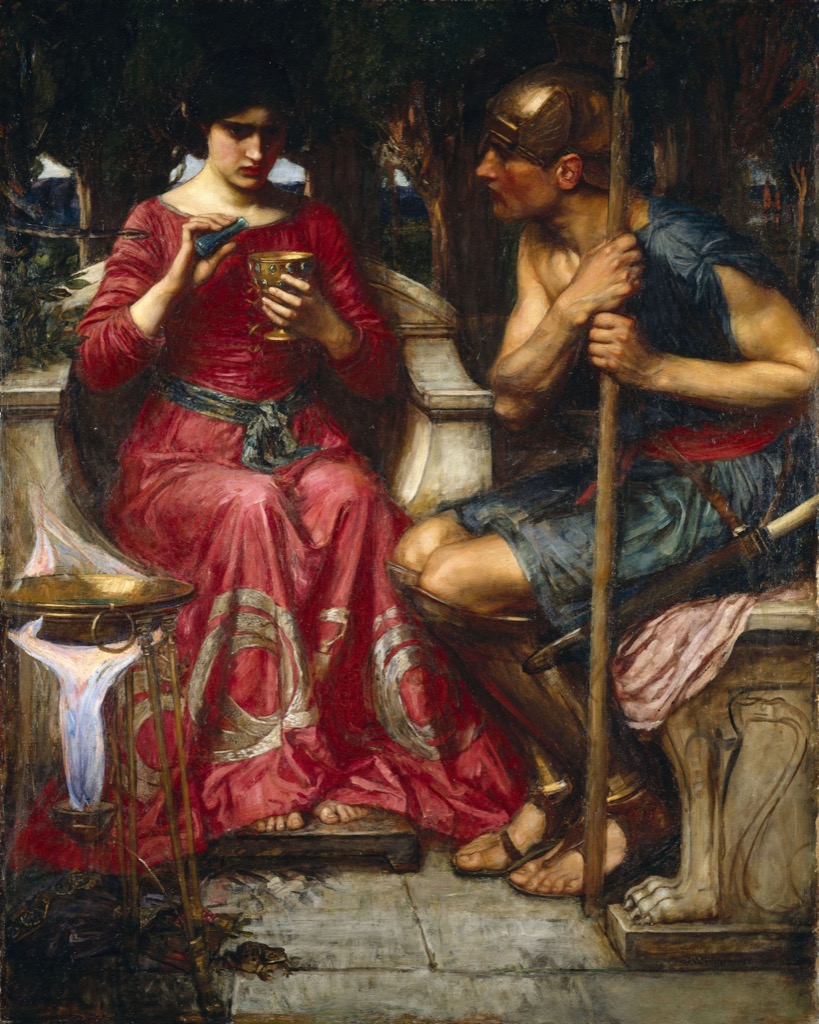
Medea prepares the substance on which Jason's survival will depend. He sits close beside her in helmet and armour, but the heroic equipment is not enough: before he can yoke the fire-breathing bulls and sow the dragon's teeth, he needs knowledge possessed by the king's daughter.
John William Waterhouse's Jason and Medea of 1907 turns the quest for the Golden Fleece into an intimate scene of instruction and manufacture. It presents Medea before the infanticide that dominates her later reputation—young, divided in loyalty and indispensable to the celebrated hero's success. [1] [2]
At a Glance
- ArtistJohn William Waterhouse (1849–1917)
- TitleJason and Medea
- Date1907 [1] [2]
- MediumOil on canvas [1] [2]
- Dimensions134 × 107 cm [1]
- CollectionPrivate collection [1]
- Principal narrative contextMedea helping Jason perform the trials imposed by her father, King Aeëtes, in Apollonius of Rhodes's Argonautica, Book III [2] [3]
- SubjectMedea making or pouring a magical preparation for Jason
- Essential distinctionThis is the helpful Colchian princess at the beginning of the relationship, not the abandoned wife who kills her children in Euripides's later tragedy
Contents
- Introduction
- Power at the Worktable
- Jason's Trial and Medea's Drug
- The Medea before Euripides
- Armour, Vessel and Concentrated Gaze
- Love, Coercion and Divided Agency
- Waterhouse's Women of Dangerous Knowledge
- Preparatory Drawing and Literary Reception
Power at the Worktable
Waterhouse brings Jason and Medea close together but does not make their nearness uncomplicated romance. Medea bends her attention towards the vessel in her hands. Jason, equipped as a warrior, watches from beside her. Their bodies share a narrow space while their tasks remain unequal.
The picture's action is small: liquid is poured or a preparation is mixed. Yet that controlled domestic-scale act determines whether Jason can survive the spectacular public trial awaiting him. Waterhouse places manufacture before combat and knowledge before strength.
Medea's pale clothing and exposed arms distinguish her from Jason's harder surfaces. Helmet, spear and armour declare a conventional male hero. Drapery, containers and ingredients identify a different form of capability. The opposition is not between action and passivity; both figures prepare for action through different materials.
Jason's gaze makes Medea's work the centre. He does not look beyond the room towards the fleece, the bulls or the warriors that will spring from the earth. His dependence is immediate and visible.
Medea does not meet his eyes. This matters because it prevents the scene from becoming a simple exchange of adoring looks. Her downward concentration can accommodate technical focus, emotional conflict and the secrecy of helping a foreigner against her father.
The vessel mediates between them. It is made and held by Medea but intended for Jason's body. According to the narrative tradition, the drug must be applied to his skin, shield and spear so that fire and iron cannot harm him for a limited time. [3]
Waterhouse therefore paints a transfer of power. Jason will appear publicly as the man who masters the bulls, ploughs the field and defeats the earthborn fighters. The image pauses before that spectacle to identify the woman whose preparation makes it possible.
The setting is enclosed and richly arranged rather than the open field of the challenge. Architectural and decorative details evoke an imagined antiquity without claiming archaeological reconstruction of Colchis. The room creates privacy for an act that betrays a royal household.
The painting's tension comes from knowing that assistance, love and disaster have become inseparable. Medea saves Jason here; the long mythic future will make both figures responsible for betrayals and deaths. Waterhouse allows the beginning its own psychological weight without pretending that viewers can forget the end.
Jason's Trial and Medea's Drug
Jason reaches Colchis after sailing with the Argonauts in search of the Golden Fleece. King Pelias has sent him on the quest, expecting its danger to remove a rival. The fleece is guarded within the kingdom of Aeëtes. [3]
In Apollonius of Rhodes's Argonautica, Aeëtes does not simply hand over the object. He orders Jason to perform the same trial the king claims to perform himself: yoke two bronze-footed, fire-breathing bulls; plough a field; sow the teeth of a dragon; and confront the armed men who rise from the ground. [3]
Divine intervention brings Medea into the plan. Hera and Athena seek Aphrodite's help, and Eros strikes Medea with desire for Jason. Apollonius describes the physical and psychological disturbance of that love in extraordinary detail. Medea's assistance is therefore chosen by her, but the poem also shows a god acting upon her emotions. [3]
Medea is a daughter of Aeëtes and a priestess or devotee of Hecate, skilled in drugs and enchantment. She possesses a substance associated with Prometheus that can protect Jason from fire and metal for the day of the trial. [3]
During a secret meeting, she gives him the drug and explains exactly how to use it. He is to bathe at night, sacrifice to Hecate alone, then anoint his body, spear and shield. She also tells him how to defeat the earthborn men: throw a heavy stone among them so that they turn their weapons against one another. [3]
Jason follows the instructions. He withstands the bulls' fire, forces them beneath the yoke, ploughs and sows the field. When the armed crop rises, he provokes confusion with the stone and kills those who remain. [3]
The fleece itself still has a guardian. In the continuing story, Medea helps subdue or charm the serpent so that Jason can take the prize. The couple then flee Colchis, and their escape draws them into further violence.
Waterhouse's vessel most naturally belongs to the preparation for the first trial. Art UK identifies the scene as Medea concocting the magical potion that enables Jason to complete the tasks set by Aeëtes. [2]
The painting should not be reduced to a generic poison scene. Medea's substance here is protective. Its recipient is not a victim she intends to kill but a man she intends to keep alive.
That fact changes every familiar attribute. A sorceress, liquid and armed man could imply entrapment. In this episode, knowledge flows towards the hero as aid, though the aid begins a chain of divided loyalties.
The Medea before Euripides
Medea's name is often immediately associated with Euripides's tragedy of 431 BCE. In that play, Jason has abandoned her to marry the daughter of Corinth's king. Medea secures revenge by killing the new bride and her father and then killing the children she shares with Jason.
Waterhouse does not illustrate that action. His Medea and Jason are not estranged spouses confronting the ruin of a marriage. They are at the beginning of their alliance, while she equips him to survive her father's trial. [2] [3]
The distinction is essential because the later crime can flatten the earlier heroine into a predetermined monster. Apollonius presents a young woman whose love, fear, skill, shame and family loyalty collide. Her thought occupies much of Book III; Jason's triumph depends upon her turmoil. [3]
At the same time, it would be equally misleading to turn the picture into an uncomplicated rehabilitation. The mythic sequence includes betrayal of Aeëtes, violent flight and later catastrophes. Waterhouse's audience could bring those events to the quiet room even though no painted detail literally depicts them.
Art UK places Waterhouse's image within a long history of Medea's representation, from ancient vase painting to modern interpretations. [2] That history repeatedly changes which episode defines her: helper, foreign princess, sorceress, abandoned wife, grieving mother or murderer.
Waterhouse selects helper and maker. Medea occupies more visual and psychological interest than Jason because she acts upon matter while he waits. The famous hero is not humiliated, but his dependence is impossible to miss.
This balance resembles the structure of Apollonius's third book, in which Jason's physical task is framed by Medea's extensive inner conflict and practical planning. The field will display his strength; the private meeting displays the intelligence that directs it.
The title gives both names equal weight, unlike pictures called simply Medea. Yet equality in naming does not mean symmetry in representation. Jason's armour announces who he is expected to be. Medea's activity shows what the story actually requires.
Viewers who know only Euripides may see the vessel as a prediction of poison. That retrospective association is understandable but should remain an effect of reception, not a claim that Waterhouse depicts the Corinthian murders. The represented liquid protects Jason from death.
Armour, Vessel and Concentrated Gaze
The encounter is organized through materials. Metal covers and extends Jason; fabric falls around Medea; ceramic or metal containers cluster around preparation. Each material suggests a different relationship to danger.
Armour is visible protection, designed to resist blows. Medea's ointment is invisible once applied, designed to resist supernatural fire and iron. Jason requires both. The contrast turns magic into another technology of survival.
His helmet creates an especially strong profile and links him to heroic combat before combat begins. The spear rises as a line of future action. Yet neither weapon is being used. The heroic apparatus waits while Medea handles the crucial substance.
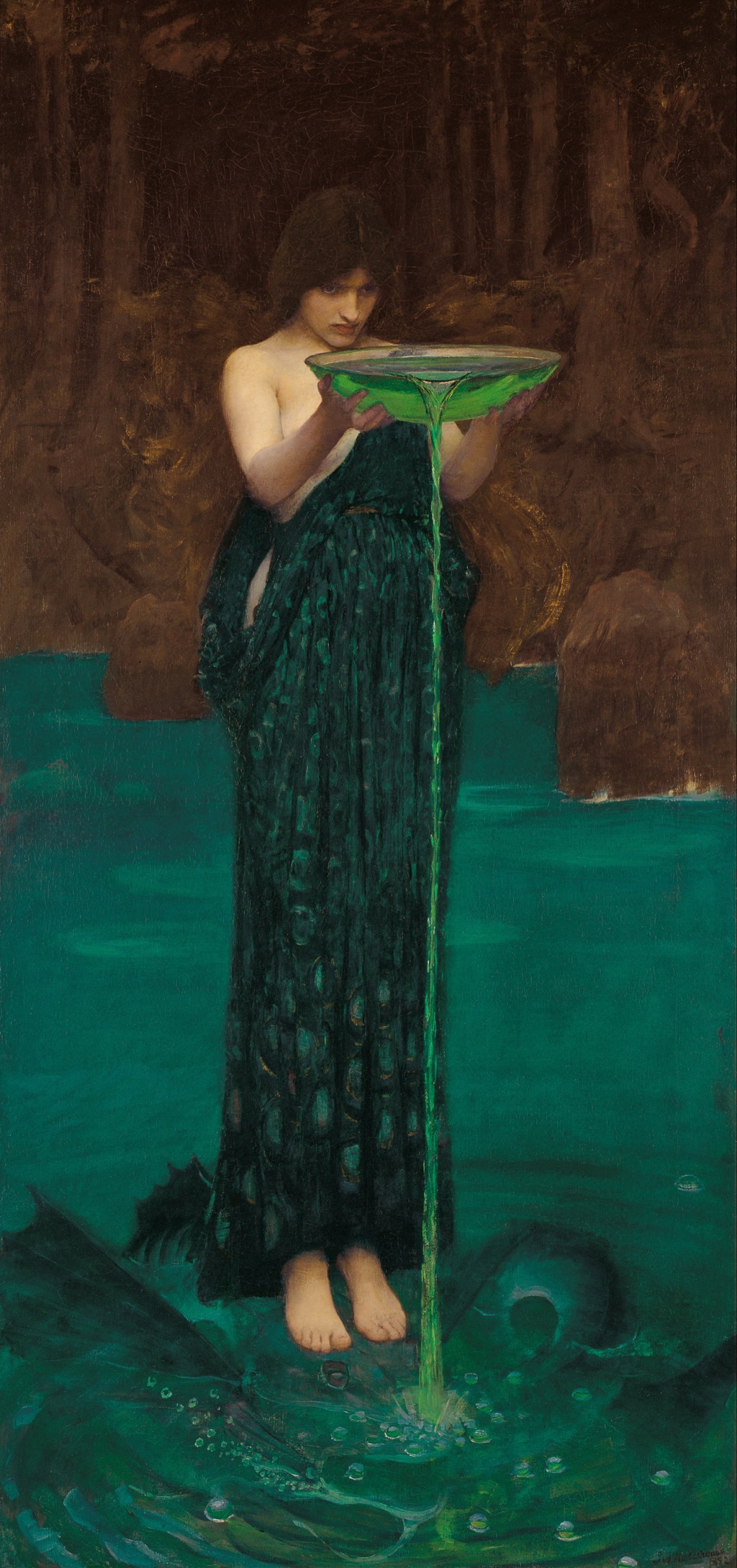
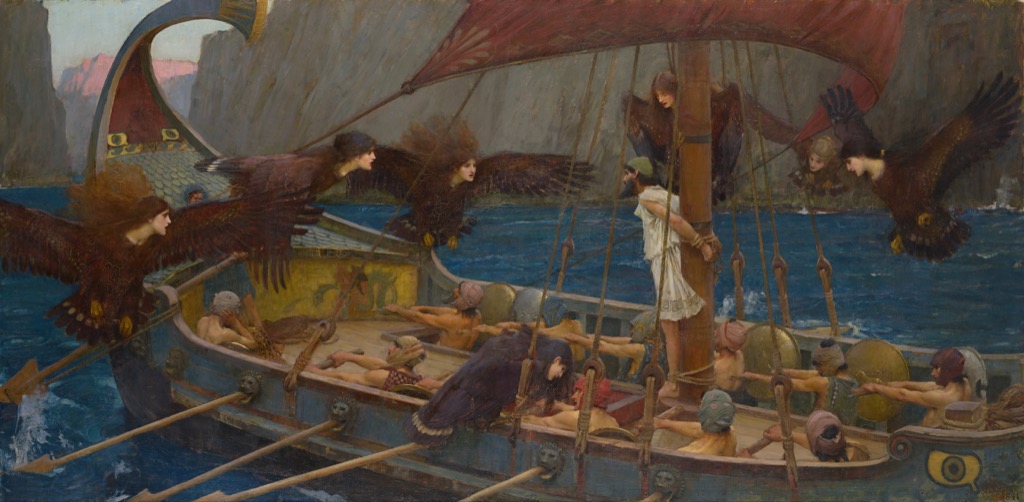
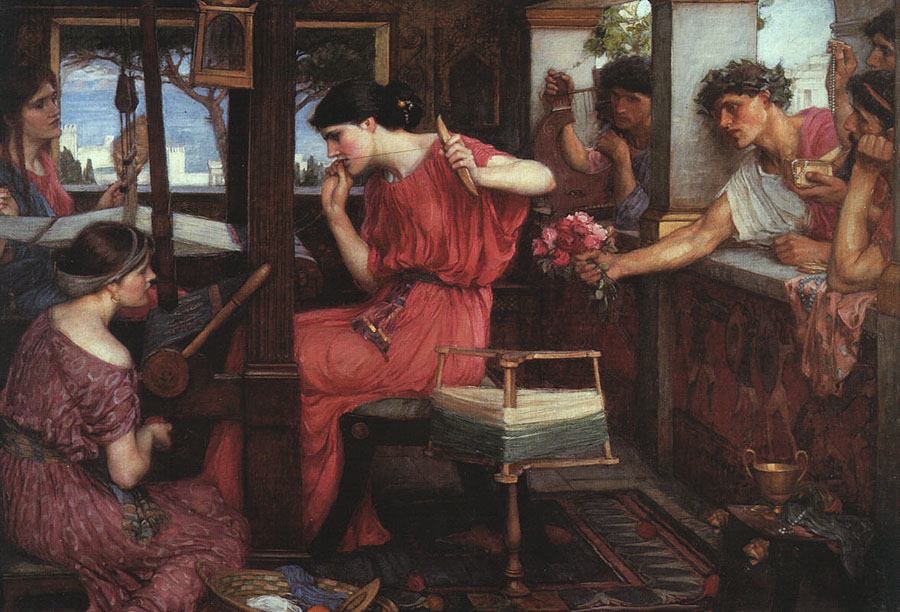
Her hands deserve sustained attention. They measure, steady and pour. Waterhouse often gives women's hands narrative work: Circe raises a cup, Penelope controls thread, Isabella embraces the basil pot and Psyche opens a door or casket. Here manual precision carries intellectual authority.
The vessel itself is ambiguous to viewers who do not know the story. Is it medicine, perfume, poison, ritual libation or magical compound? Literary context answers the broad question while leaving the imagined recipe unknowable.
Medea's lowered eyes protect the work from becoming performance for Jason. She concentrates upon material change. Jason's directed look, by contrast, makes him both recipient and witness.
Their closeness may imply developing intimacy, but Waterhouse does not show touch as the central fact. The substance will touch Jason on Medea's behalf. The picture makes an object carry what bodies have not yet openly expressed.
Decorative richness establishes Medea within a royal and sacred environment. She is not an itinerant witch met outside society. She belongs to the household and religious order that her decision will disrupt.
The vertical format keeps the pair compressed. A wide heroic canvas could have distributed attention among ship, companions, bulls and fleece. Waterhouse instead makes the quest hinge upon two people at nearly conversational distance.
Colour reproductions differ, and privately held works can circulate through uneven photography. Interpretations should therefore begin with stable elements—armoured man, concentrated woman, vessel, enclosed setting—before assigning meaning to exact hues.
The composition gives no visual access to Aeëtes. Paternal and royal power operates outside the room as the source of the impossible command. Like Venus in the Psyche paintings, an absent authority governs the object and the heroine's decision.
Love, Coercion and Divided Agency
Apollonius does not offer a modern psychology of freely chosen romantic love. Gods deliberately make Medea desire Jason because the Olympian plan needs her magic. Eros's arrow creates bodily distress that she experiences as her own. [3]
Yet Medea is not a puppet without deliberation. She argues with herself, fears disgrace, considers death, plans a meeting, instructs Jason and ultimately acts. Divine causation and human agency coexist rather than cancelling one another.
Waterhouse cannot paint that extended interior monologue directly. He condenses it into absorbed work and a face withheld from easy exchange. The image leaves space between external composure and internal conflict.
Jason's role is also morally complicated. In Apollonius he accepts divine and female assistance and makes promises to Medea. The later tradition judges those promises through his abandonment of her in Corinth. At the represented moment, however, he confronts a genuinely lethal demand.
The potion becomes material evidence of trust. Medea must believe Jason sufficiently to betray her father's interests; Jason must apply a substance he cannot independently verify. Their alliance depends on asymmetrical knowledge.
That asymmetry can be read as Medea's power, but it also makes her vulnerable. Once she has disclosed her method and broken allegiance with Colchis, return becomes difficult. Jason can carry the benefit of her knowledge into public glory; she carries the social cost of supplying it.
Waterhouse's intimate scale encourages empathy without issuing a verdict. Medea's help is real, the divine manipulation is real within the poem, and the later suffering is already latent in the names. No single moral label accommodates all three.
The scene also challenges the separation between masculine heroism and feminine enchantment. The myth does not permit Jason's labour to stand alone. His achievement is collaborative even if later retellings place his name at the centre of the voyage.
Medea's magic is not shown as chaotic eruption. It is measured preparation. This disciplined image counters the wild gestures often assigned to witches and makes danger reside in controlled expertise.
At the same time, secrecy surrounds the exchange. Assistance must occur away from Aeëtes and the public field. Private knowledge makes public fame, but it cannot be publicly acknowledged without exposing betrayal.
Waterhouse leaves viewers with that imbalance. The man is already dressed for the visible deed. The woman, whose work enables it, remains in the room where the decisive substance is made.
Waterhouse's Women of Dangerous Knowledge
Waterhouse returned throughout his career to women whose knowledge exceeds that of the men around them. Circe understands transformation, ritual and the cup; the Sibyl or oracle mediates hidden speech; enchantresses control thresholds; Medea combines sacred knowledge with drugs.
These figures are not interchangeable. Circe in Homer confronts a stranger whose men she has transformed. Medea aids the stranger against her own family. Pandora opens what she does not understand. Psyche disobeys a command attached to a hidden content. Their objects look related in the studio—cups, bowls, boxes, vessels—but narrative function differs.
In Circe Offering the Cup to Ulysses, the vessel is directed towards a man who has secretly acquired protection from Hermes. The contest of knowledge produces confrontation. In Jason and Medea, the magical preparation itself is the protection, and the woman gives it willingly.
Medea's position also differs from the fatal seductress type. Jason is not weakened by her presence at this moment; he becomes capable of the trial. Her danger lies in the cost and future of the alliance, not in an immediate plan to destroy him.
The comparison helps explain Waterhouse's sustained interest. Literary women could concentrate drama around a glance, hand or object while retaining histories larger than the chosen moment. A quiet interior could summon a dragon, battlefield and ruined marriage without showing any of them.
The paintings also invite viewers to judge women looking, making or knowing. Waterhouse frequently turns that judgement back upon the observer. We rely on the heroine's action to understand the picture just as the male hero relies on her expertise.
It would be reductive to call all such images celebrations of female power, since many end in punishment, loss or male-authored tragedy. It is equally reductive to call their women merely decorative victims. Medea's working hands make both simplifications difficult.
Her expertise belongs to an ancient idea of pharmaka: substances whose effects can be medicinal, magical or poisonous according to use. The English word “drug” preserves some of this ambiguity better than a fixed label such as poison.
Waterhouse does not show supernatural light or vapour proving the mixture's force. Belief in its efficacy comes from story and from Jason's attention. Magic is represented through serious labour rather than visual spectacle.
Preparatory Drawing and Literary Reception
A double-sided drawing associated with Waterhouse includes a pencil study for Jason and Medea on its verso. Christie's records the sheet at 26 by 17.8 centimetres and identifies the study with the 1907 painting. [4]
Preparatory evidence is useful because it shows the composition emerging through figure and pose rather than arriving as a purely literary concept. A drawing cannot by itself establish which edition of a text Waterhouse read, but it documents close formal work on the painted encounter.
Apollonius provides the ancient narrative closest to the represented preparation. Victorian viewers also knew the Golden Fleece story through translations, handbooks and modern poetry. William Morris's The Life and Death of Jason of 1867 offered a major English retelling available within Waterhouse's cultural world.
Modern scholarship has explored Morris as a possible route into Waterhouse's classical subjects, and the artist's broader relation to Pre-Raphaelite literary culture makes the possibility reasonable. [5] It should not, however, be turned into a documented exclusive source without direct evidence from the artist.
The word “Pre-Raphaelite” also requires care. Waterhouse was younger than the Brotherhood founded in 1848 and was not one of its original members. His detailed surfaces, brilliant colour, literary subjects and later association with artists shaped by Pre-Raphaelitism justify discussion of its influence, not retroactive membership.
The privately owned finished canvas lacks the continuous institutional record supplied by a public museum. Object facts circulate through catalogue records and image repositories, and dimensions or titles should be checked against the specific painting rather than borrowed from studies. [1] [4]
The work's 1907 date places it beside Waterhouse's Isabella and the Pot of Basil, another image in which a woman, a vessel and a disastrous love story converge. Isabella clings to a container associated with loss; Medea prepares one associated with protection. Knowledge of later events darkens both.
The painting also participates in the modern recovery of Medea's many identities. Art UK notes that artists have represented not only the notorious murderer but also the foreign woman, magician and figure through whom questions of gender and power can be examined. [2]
Waterhouse's contribution is to make the helper visible at the point of technical concentration. Jason's name remains first in the title, but the picture's operative intelligence belongs to Medea.
Related Pages
- Paintings: Return to the protected Waterhouse paintings hub.
- Literary and Mythological Sources: Read the classical source frame for Waterhouse's Jason and Medea.
- Technique and Style: Connect Jason and Medea with Waterhouse's late colour, surface and figure handling.
Frequently Asked Questions
She is preparing or pouring a magical drug that will protect Jason while he performs the trials imposed by King Aeëtes. [2] [3]
He must yoke fire-breathing, bronze-footed bulls, plough a field, sow dragon's teeth and overcome the armed men who spring from the earth. [3]
In Apollonius, the gods arrange for Eros to make Medea fall in love with Jason. She then deliberates, chooses to meet him and uses her own knowledge to help him. [3]
Not in this episode. It is a protective preparation intended to keep Jason safe from fire and weapons during the trial. [2] [3]
No. Waterhouse shows the preparation that precedes Jason's ordeal and eventual taking of the fleece.
No. Euripides's tragedy concerns the later crisis in Corinth after Jason abandons Medea. Waterhouse paints their earlier alliance in Colchis.
The painting is in a private collection. [1]
Yes. Christie's has catalogued a pencil study for the composition on the reverse of a double-sided Waterhouse drawing. [4]
Discussion
1. How does Waterhouse make Medea's quiet work more important than Jason's visible armour? 2. What changes when viewers meet Medea before the events of Euripides's tragedy? 3. Does Jason's attentive gaze acknowledge dependence, or does it anticipate possession of her knowledge? 4. How do vessel and armour represent different forms of protection? 5. Can Medea be both divinely compelled and meaningfully responsible for her choice? 6. Why might Waterhouse omit the bulls, dragon and fleece from a painting about a heroic quest? 7. Compare Medea's preparation with Circe's offered cup. How does the direction of danger differ? 8. How does knowledge of the couple's later history affect an apparently cooperative scene?
Reader Insights
Which visible detail most changes the way you read this page?
Which source or comparison helps the work feel less familiar and more specific?
What question would you bring back to the painting after reading?
Join the Conversation
Share your reading of this page below.
References
- Main image: John William Waterhouse, Jason and Medea, public-domain faithful reproduction via Wikimedia Commons.
- Wikimedia Commons, “Jason and Medea – John William Waterhouse,” object and image metadata for date, medium, dimensions and private ownership, View source.
- Lydia Figes, “Representing Medea: the tale of a mythical murderess,” Art UK, including Waterhouse's depiction of Medea preparing the magical potion for Jason in 1907 and the work's place in Medea's visual reception, View source.
- Apollonius of Rhodes, The Argonautica, translated by R. C. Seaton, Project Gutenberg, Book III, Aeëtes' trial, Medea's drug and instructions, and Jason's completion of the tasks, View source.
- Christie's, “John William Waterhouse, R.A., R.I., double-sided figure study,” lot record identifying the pencil study for Jason and Medea and giving its medium and dimensions, View source.
- Emma Aston and Amy C. Smith, eds., New Voices in Classical Reception Studies, article discussing Waterhouse's Jason and Medea and William Morris's The Life and Death of Jason within Victorian classical reception, Open University, View source.