 by Tom Gurney
Tom Gurney BSc (Hons) is an art history expert with over 20 years experience
Published on November 6, 2026 / Page Updated on November 6, 2026
Email: tomgurney1@gmail.com / Phone: +44 7429 011000
Introduction
The Grand Manner was Sir Joshua Reynolds's great answer to a problem that shaped eighteenth-century British art: how could portraiture become more than likeness? Reynolds painted people who wanted recognisable faces, social polish and visible rank, but he also wanted painting to approach the dignity of history, poetry and classical example. His solution was not to abandon portraiture. It was to lift portraiture by giving modern sitters the scale, pose, drapery, moral symbolism and artistic memory of older, more prestigious forms.
The National Portrait Gallery presents Reynolds as the dominant British portrait painter of his generation and as the inaugural President of the Royal Academy, while also linking his Grand Manner to classical antiquity and Old Master example as a way of adding moral or heroic symbolism to portraiture.[4] That definition is helpful because it keeps the term from becoming vague praise. The Grand Manner is not simply a painting that looks large or impressive. It is a method of elevation. Reynolds makes sitters seem more general, more symbolic and more permanent than ordinary social presence.
The method is central to Reynolds's career because it joins theory and commerce. He gave lectures to Royal Academy students, later known as the Discourses on Art, in which he argued for general form, noble selection and the study of great predecessors.[1][2][3] Yet he earned his fame above all through portraits of aristocrats, actors, writers, officers, children and celebrated visitors. His achievement was to make portraiture carry the ambition of a higher genre without losing the sitter completely.
At a Glance
- Core ideaElevating portraiture beyond literal likeness [1]
- Primary theoryDiscourses on Art [1][2]
- Institutional settingRoyal Academy lectures [2]
- MethodSelection, generalisation and imitation of great predecessors [1]
- Visual meansScale, pose, costume, drapery, setting and allusion
- Old Master anchorsRaphael, Michelangelo, Titian, Rubens, Van Dyck and Rembrandt [1][6]
- Genre paradoxHistory-painting ambition realised chiefly through portraiture
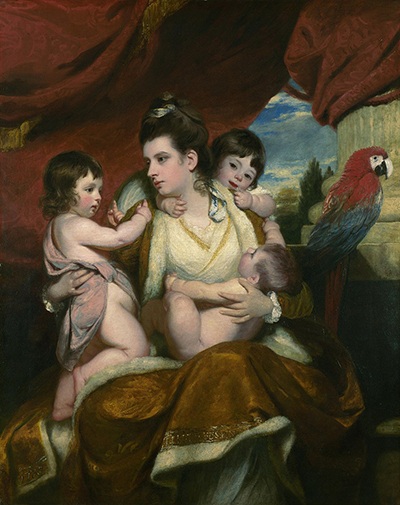
- Representative imageLady Cockburn and her Three Eldest Sons [10]
- Key examplesMai, Siddons, Lady Cockburn and the Waldegrave sisters [8][9][10][11]
- Catalogue backboneMannings and Postle, 2000 [13]
Contents
- Introduction
- What Grand Manner means
- Reynolds's theory in the Discourses
- Old Masters and selective borrowing
- Pose, costume and drapery
- Portraiture as history painting's neighbour
- Portrait of Mai as Grand Manner encounter
- Siddons, theatre and allegory
- Family, femininity and social polish
- Limits and criticisms
What Grand Manner means
Grand Manner portraiture begins with the idea that a portrait should not merely copy visible accidents. Reynolds repeatedly urged artists to move beyond literal detail toward broader, more general ideas of beauty, dignity and character.[1] He believed that a painter should select, combine and refine rather than reproduce everything the eye happened to see. That belief sits behind the polished authority of his best portraits.
In practical terms, the Grand Manner works through scale, pose, costume, lighting, drapery, background and allusion. A sitter may be placed in a heroic stance, wrapped in antique or theatrical fabric, framed by columns, clouds or landscape, or linked to myth, virtue, history or classical sculpture. These devices give modern people an aura borrowed from older art. The sitter remains present, but the image asks the viewer to see more than personal appearance.
The National Gallery of Art, Washington gives a useful general description of the Grand Manner as a late eighteenth-century portrait tradition involving full-length, life-size presentation, impressive costume and attributes of rank or identity, especially within the English tradition associated with Reynolds.[7] Reynolds did not invent every element of that language, but he became its most influential British advocate.
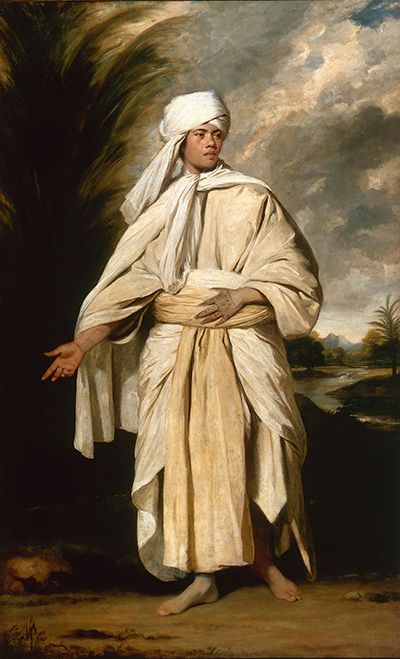
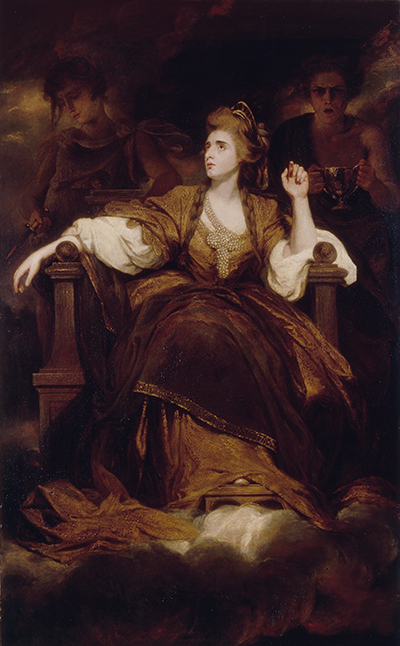
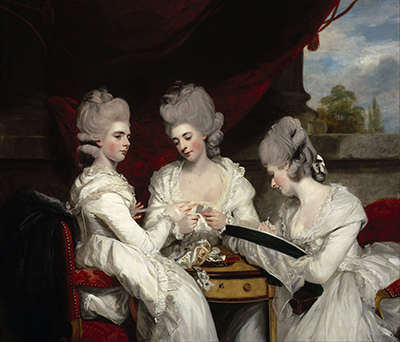
The term can be misleading if it is treated as a single formula. Reynolds's Grand Manner could be severe, theatrical, domestic or aristocratic depending on the sitter. Portrait of Mai (Omai) uses antique pose and heroic scale; Sarah Siddons as the Tragic Muse turns an actress into allegory; Lady Cockburn and her Three Eldest Sons elevates maternity through Charity; The Ladies Waldegrave refines a family group through coordinated action.[8][9][10][11] These works share a method, not a fixed costume.
That flexibility is what made the approach so useful for a portrait painter. Patrons came to Reynolds with different needs: family advancement, political presence, social memory, theatrical fame, military identity or personal commemoration. The Grand Manner gave him a set of tools for converting those needs into art. He could enlarge a sitter without changing the basic fact that a recognisable person had paid to be painted.
It also gave British portraiture a claim to seriousness at a time when continental traditions still weighed heavily on artistic ambition. A plain likeness could be dismissed as skilled service. A Grand Manner portrait could argue for itself as invention. It could show knowledge, judgement and selection. Reynolds's finest examples are therefore not grand because they are merely expensive or imposing; they are grand because they make social identity participate in a larger visual language.
The approach also depends on distance. Reynolds's Grand Manner portraits rarely invite the viewer into casual intimacy. Even when the subject is domestic, as with Lady Cockburn or the Waldegrave sisters, the image is organised to feel considered and public.[10][11] Gesture, dress and setting act almost like a stage. The sitter is not caught unawares. The sitter is presented, and presentation itself becomes part of the meaning.
That is why the Grand Manner is so closely tied to theatre without always being theatrical in subject. It gives social life a deliberate form. A body stands, sits, turns, leans or gestures in ways that announce significance. Reynolds understood that portraits are never neutral records. They are ceremonies of looking, and the Grand Manner makes that ceremony visible.
Reynolds's theory in the Discourses
Reynolds's Discourses on Art are the intellectual core of the Grand Manner. The Royal Academy identifies the Discourses as lectures delivered to Academy students and as a foundational text for English painting in the eighteenth century.[2] Yale University Press and the Paul Mellon Centre record Robert R. Wark's edition as a modern scholarly form of the text.[3] For Reynolds, the artist's task was not mechanical copying but judgement: deciding what to take from nature, what to omit and how to raise the result.
One of Reynolds's repeated themes is generalisation. He argued that the artist should seek general ideas rather than cling to particular irregularities.[1] In portraiture, this did not mean eliminating likeness. It meant finding a form of likeness that could seem dignified rather than accidental. A Reynolds sitter may have a recognisable face, but the body, costume and setting often pull the image toward a broader type: hero, statesman, muse, mother, commander or cultivated aristocrat.
Another major theme is imitation. Reynolds did not understand imitation as lazy copying. He encouraged artists to study Raphael, Michelangelo, the antique, Titian, Rubens, Van Dyck, Rembrandt and other admired predecessors because great art supplied patterns of invention.[1][6] The National Gallery likewise stresses that Reynolds's visit to Italy from 1749 to 1752 and his study of ancient and Renaissance art, together with painters such as Rembrandt, Rubens and Van Dyck, shaped his portrait style.[6]
The paradox is that Reynolds praised history painting as the noblest form while making his greatest contribution through portraiture. This tension is not a failure. It is the engine of his art. Because British patrons wanted portraits, Reynolds used portrait commissions as vehicles for the kinds of grandeur that history painting promised. The Grand Manner is therefore a practical compromise raised to a philosophy.
The Discourses also show why Reynolds disliked narrow literalism. He did not want art to become a census of surface detail. He wanted painters to understand nature through comparison, correction and choice.[1] For portraiture, this meant that a likeness could be true without being merely exact. A sitter's body might be idealised, costume adjusted, background invented and gesture ennobled, yet the portrait could still be considered successful if it conveyed a higher idea of the person.
That view explains both the appeal and the unease of Reynolds's practice. To admirers, he rescued portraiture from everyday accident and placed sitters in the company of great art. To sceptics, he risked making people look as though they were performing dignity rather than possessing it. Reynolds knew the risk. His confidence lay in the belief that art was always a form of intelligent transformation.
This is also why Reynolds's theory remains useful even when his hierarchy of genres feels remote. Modern viewers may not accept history painting as naturally superior to portraiture, yet the question he asks is still powerful: how does an artist move from appearance to meaning? Reynolds's answer was selection. He believed that greatness emerged when the artist refused accidental clutter and chose forms capable of carrying general significance.[1]
In portraiture, that meant selecting not only features but roles. A sitter's profession, rank, beauty, celebrity, courage or maternal identity could be translated into a visual argument. The Grand Manner is therefore less a style of decoration than a style of interpretation. It asks what public shape a private person should take.
Old Masters and selective borrowing
Reynolds's Grand Manner depends on memory. He looked at modern sitters through a stored knowledge of earlier art. The National Portrait Gallery's self-portrait record describes Reynolds's Italian journey before 1752 and later notes the presence of Old Master motifs in his Grand Manner portraits.[5] That is the essential point: Reynolds's portraits often carry several histories inside them.
Borrowing, for Reynolds, was not embarrassment. It was evidence of education. A modern artist could learn from Van Dyck's aristocratic ease, Rembrandt's chiaroscuro, Rubens's colour and movement, Raphael's compositional grace or antique sculpture's bodily authority. The question was how to convert that knowledge into fresh work. Reynolds wanted painters to absorb predecessors until borrowed forms became part of their own invention.
This approach can be seen clearly in Lady Cockburn and her Three Eldest Sons. The National Gallery identifies Van Dyck's Charity as the main compositional model and notes that Reynolds adapted a child figure from Velázquez's The Toilet of Venus through a drawing.[10] The result is not a copy of either source. It is a modern family portrait made more dignified by old-master structure. That is Grand Manner thinking in action.
The same logic operates differently in The Ladies Waldegrave. The painting is not overtly mythological, but its harmony, pale dresses, classical rhythm and theatrical setting raise a needlework scene into something more ideal.[11] Reynolds did not need to call the sisters the Graces. He could suggest inherited models through arrangement and poise.
This is why Grand Manner borrowing should not be confused with plagiarism in the modern casual sense. Reynolds's culture expected educated artists to know and transform admired examples. The question was not whether a painter had seen Van Dyck or Raphael, but whether he could use such knowledge with judgement. The borrowed form had to become appropriate to the new sitter, new commission and new social moment.
The method also required restraint. Too much quotation could turn a portrait into a display of cleverness. Too little could leave the work ordinary. Reynolds's best portraits place the borrowed memory just below the surface. The viewer may sense that a pose has older authority, even without naming its source. This half-recognition gives the Grand Manner much of its power.
Reynolds's Italian experience gave him the confidence to work in this way. The National Gallery describes his journey through Italy between 1749 and 1752 as formative, exposing him to ancient and Renaissance art and helping to give his portraits their dignity and variety.[6] The Grand Manner grows from that education, but it is not simply Italian art transplanted into Britain. It is Italian and European precedent adapted to London patronage, British social ambition and the needs of a portrait market.
That adaptation is important. Reynolds was not painting for popes, princes of the Italian Renaissance or seventeenth-century Antwerp patrons. He was painting for eighteenth-century British clients who wanted images of themselves and their families. His genius was to make those clients appear as though they belonged in the grand visual tradition he had studied abroad.
Pose, costume and drapery
The Grand Manner often begins with the body. Reynolds uses pose to make a sitter appear larger than ordinary life. A turn of the head, an extended arm, a full-length stance or a seated throne-like arrangement can change a portrait's emotional register. The sitter is still an individual, but the pose asks to be read as character and type.
Costume and drapery do similar work. Reynolds frequently softens the boundary between contemporary clothing and timeless fabric. Drapery can make a sitter look antique, poetic, theatrical or morally elevated. It also helps the painter avoid the problem that fashionable dress dates quickly. A robe, mantle or generalized costume can pull the sitter away from one season's style and toward a more durable image.
This does not mean Reynolds rejected fashion altogether. Many of his sitters are recognisably modern. The power of his portraits often comes from tension between the fashionable and the ideal. In The Ladies Waldegrave, modern young women are shown through a refined, almost classical pattern of light dresses and coordinated gesture.[11] In Sarah Siddons as the Tragic Muse, a contemporary actress becomes a timeless tragic power.[9]
Drapery also gives Reynolds pictorial freedom. It can create broad masses of colour, echo antique sculpture, control the line of a figure and bind a composition together. In the Grand Manner, clothing is rarely just clothing. It becomes structure, symbol and atmosphere.
Backgrounds work in a similar way. Reynolds often avoids descriptive specificity when a more suggestive setting will serve. A column may imply architecture and stability; a curtain can create theatre and richness; a landscape may open a sitter into public or poetic space. Such backgrounds are not neutral scenery. They help decide how much history, rank or imagination the viewer should attach to the figure.
Hands and heads carry another part of the burden. Reynolds could make a face vivid while letting the rest of the body belong to a larger type. He could also use gestures to steer interpretation: command, thought, tenderness, display, sorrow or cultivated ease. The Grand Manner is therefore not only about costume and size. It is about the whole rhetoric of the painted body.
That rhetoric could be quiet. In The Ladies Waldegrave, the shared handling of thread does not thunder with heroic meaning, but it turns the sisters into a coordinated image of aristocratic refinement.[11] In Captain George K. H. Coussmaker, the Metropolitan Museum of Art records Reynolds's 1782 portrait as an image built from repeated sittings with both the captain and his horse, producing an equestrian display of military elegance and controlled confidence.[12] Both works are Grand Manner in different keys.
Portraiture as history painting's neighbour
Reynolds's deepest ambition was to move portraiture closer to history painting without pretending that the two were identical. History painting traditionally ranked highest because it could treat scripture, myth, classical history, national events and moral action. Portraiture was more closely tied to patronage and likeness. Reynolds wanted to loosen that hierarchy by making portraiture capable of moral and imaginative generality.
The National Gallery records Reynolds's desire to become a history painter, while also recognising him as the leading English portraitist of the eighteenth century.[6] The Grand Manner emerges from that double identity. If Reynolds could not always paint grand historical subjects for eager patrons, he could make portraits behave with historical ambition.
This is why his portraits so often contain more than the sitter. They contain allegory, stagecraft, old-master recollection, moral type or public role. A military man can become heroic command. An actress can become tragedy. A mother can become Charity. A visiting Pacific islander can be presented with the pose and scale of antique dignity.[8][9][10]
This method gave portraiture intellectual cover. It allowed patrons to receive flattering images while allowing Reynolds to argue that portrait painting could participate in the nobler aims of art. The compromise was commercially brilliant, but it was also aesthetically serious.
The word "neighbour" matters here. Reynolds did not erase the difference between portrait and history painting. A portrait still had to satisfy likeness, patron expectation and social identity. History painting could invent a whole action from literature, scripture or antiquity. Grand Manner portraiture sits between them. It borrows history painting's scale, seriousness and compositional ambition while remaining anchored to a named sitter.
This in-between status gave Reynolds room to manoeuvre. He could paint an officer as more than a uniformed professional, a child as more than a child, an actress as more than a celebrity and an aristocratic woman as more than a fashionable body. But the sitter's name still mattered. The image could not float entirely into allegory unless the sitter's identity gave that allegory force.
The best Reynolds portraits often succeed because they keep this balance unstable. They are not pure symbols and not plain records. They ask the viewer to move back and forth between an individual person and a larger role. That oscillation is one of the pleasures of the Grand Manner.
This also helps explain Reynolds's authority at the Royal Academy. His portraits offered working examples of the principles he discussed in the Discourses. Students could hear about general form, imitation and selection, then see how those ideas might survive the pressures of paid portraiture. Reynolds did not solve every contradiction between theory and practice, but he made those contradictions productive.
The Academy context matters because Reynolds was shaping taste as well as producing pictures. He was not merely a successful painter with a personal manner. He was a public teacher of artistic ambition.[2][4] The Grand Manner became a way of arguing that British art could be learned, elevated and cosmopolitan without abandoning the portrait market that sustained it.
Portrait of Mai as Grand Manner encounter
Portrait of Mai (Omai) is one of Reynolds's most important Grand Manner works because it tests the method against global encounter and imperial display. The National Portrait Gallery identifies the painting as Mai (Omai), around 1776, and records its joint acquisition by the National Portrait Gallery and Getty.[8] The image presents Mai in full-length form with an authority that draws on antique and old-master models.
The painting shows how Reynolds could make a sitter appear monumental through pose and scale. Mai's body is arranged with an elegance that recalls classical sculpture and high portraiture, while his identity remains tied to travel, encounter and British fascination with the Pacific.[8] Grand Manner elevation gives him dignity, but it also frames him through British pictorial expectations.
That doubleness is crucial. The portrait is magnificent, but it cannot be treated as neutral. Reynolds's method dignifies Mai while also placing him inside a European system of looking. The Grand Manner is powerful because it can make a sitter seem heroic; it is also risky because heroism may be shaped by the culture doing the representing.
For this reason, Mai is one of the best examples of both the strength and the tension of Reynolds's approach. The painting is not a simple ethnographic record, nor a simple aristocratic portrait. It is a Grand Manner image of cross-cultural encounter, made inside the social and imperial structures of late eighteenth-century Britain.
Siddons, theatre and allegory
Sarah Siddons as the Tragic Muse shows a different side of the Grand Manner. The Huntington record gives the title as Sarah (Kemble) Siddons as the Tragic Muse, dates the painting to 1783-1784, and describes Siddons enthroned as the Muse of Tragedy with the shadowed figures of Pity and Terror behind her.[9] Here Reynolds does not merely elevate a sitter through pose; he converts her into an allegorical force.
This was especially suited to Siddons because acting already involved transformation. Reynolds did not have to invent the idea that she could become larger than ordinary life. Her tragic reputation supplied the emotional foundation. The Grand Manner supplied the visual structure: throne, shadow, personification, dark palette and commanding stillness.
The painting also proves that the Grand Manner was not limited to inherited rank. Siddons was a professional actress, not an aristocrat. Reynolds gives her the solemnity of myth because her fame had become culturally powerful. In doing so, he shows that modern celebrity could be made grand when it was attached to seriousness, moral intensity and public admiration.
The risk is abstraction. Siddons the working actress partly disappears into Siddons the Muse. But that is also the painting's achievement. Reynolds makes a portrait that is still a likeness, while also becoming a theory of tragedy and public memory.
Siddons also shows how the Grand Manner could respond to modern celebrity. A theatrical performer had no inherited title equivalent to a duchess or a general, but she had a public authority created by performance, criticism and audience memory. Reynolds translates that authority into a form older than celebrity: the enthroned Muse. The image is modern in social material and ancient in pictorial language.
This combination is very Reynolds. He does not simply flatter Siddons as fashionable. He asks what kind of visual form can make her fame seem serious. The answer is allegory, darkness, restraint and scale. The painting's grandeur depends on making a contemporary actress appear as though she belongs to a long history of tragic art.
Family, femininity and social polish
The Grand Manner could also enter family portraiture. Lady Cockburn and her Three Eldest Sons is a key example. The National Gallery identifies the picture as a 1773 oil on canvas and explains its relation to Charity, Van Dyck and Velázquez.[10] Reynolds takes a mother and children and raises the group into a moral image of maternal care.
This elevation is not the same as grandeur through heroism. It is grandeur through virtue. Lady Cockburn is not shown commanding public events; she is shown holding and organising children. Reynolds gives that domestic action a pictorial dignity that connects it to older representations of Charity. The family becomes morally legible.
The Ladies Waldegrave works more quietly. The National Galleries of Scotland identifies the sitters as three Waldegrave sisters engaged in silk and lace work.[11] Reynolds makes their shared needlework the centre of the composition. The result is a portrait of sisterly coordination, accomplishment and aristocratic poise.
These paintings reveal how gender and class shaped the Grand Manner. Women could be elevated as muses, mothers, graces, beauties or symbols of refinement, but the elevation often depended on social ideals imposed upon them. Reynolds's portraits are visually brilliant, yet they also show how aristocratic femininity was performed, displayed and disciplined through art.
The same social pattern appears in portraits of men, though with different signs. Military sitters could be given horses, uniforms, battle references or commanding gestures. Intellectual sitters could be shown as moral or literary presences. Aristocrats could be presented as natural rulers of space, landscape and fabric. The Grand Manner was not politically neutral. It converted social position into visual inevitability.
This is why Reynolds's portraits are so valuable historically. They do not simply show what elite sitters looked like. They show what elite culture wished those sitters to mean. A Reynolds portrait can tell us how authority, gender, rank and refinement were staged. Its beauty is inseparable from that staging.
Limits and criticisms
The Grand Manner has always carried a risk of artificiality. Its strength is elevation; its weakness can be theatrical exaggeration. A sitter may become too ideal, too symbolic or too dependent on borrowed grandeur. When the formula is weak, the result can feel like costume rather than character.
Reynolds was aware of the danger, but he accepted it because he believed art had to rise above literal imitation. His portraits are often most successful when the sitter's public identity genuinely fits the elevated language. Mai, Siddons, Lady Cockburn and the Waldegrave sisters each work because the Grand Manner finds something already present in the sitter's cultural role: encounter, tragic celebrity, maternal virtue or aristocratic harmony.[8][9][10][11]
There are also modern ethical questions. Grand Manner portraiture can dignify, but it can also flatter hierarchy. It can turn rank into virtue, wealth into refinement and empire into magnificence. Reynolds's art is not less important because of this. It is more interesting. His portraits show how beauty, social power and artistic ambition were woven together.
Technique adds another caution. The National Gallery notes Reynolds's ambition and variety, but also the condition problems that affect many of his works.[6] The technical story deserves its own treatment, yet it matters here because Grand Manner splendour depended on surfaces, flesh tones, glazes and materials that did not always age as Reynolds hoped.
Another criticism concerns emotional distance. The Grand Manner can make a sitter look magnificent while reducing ordinary individuality. That is not always a flaw; sometimes distance is precisely what gives a portrait power. But it means that Reynolds's art rarely offers unmediated intimacy. Even tenderness may be composed through precedent. Even spontaneity may be staged.
The modern viewer can therefore admire the pictures while remaining alert to their mechanisms. A Reynolds portrait often wants us to believe in natural dignity, but the dignity has been made. It has been produced through pose, quotation, texture, scale, rhetoric and social agreement. The Grand Manner is not a window. It is a persuasive performance.
Why Reynolds's Grand Manner still matters
Reynolds's Grand Manner still matters because it explains why his best portraits are more than elegant likenesses. They are acts of interpretation. He asks what a sitter could mean, not only what a sitter looked like. He turns portraiture into an art of role, memory, aspiration and public identity.
It also explains his central place in British art. The National Portrait Gallery and National Gallery both present Reynolds as a defining figure in eighteenth-century portraiture and Royal Academy culture.[4][6] His importance lies not simply in the number of important people he painted, but in the intellectual pressure he placed on portraiture. He wanted the genre to think at a higher level.
Mannings and Postle's catalogue raisonné remains essential for understanding the scale and structure of Reynolds's painted production.[13] The museum records for individual works then provide current object facts and interpretive anchors. Together, they show how widely Reynolds applied Grand Manner thinking across sitters, formats and social situations.
The Grand Manner can seem distant now because its ideals are tied to hierarchy, classical education and elite display. Yet the questions behind it remain alive. How does a portrait make a person seem significant? How does style turn likeness into meaning? How much invention can a portrait contain before it stops feeling true? Reynolds spent his career answering those questions in paint.
Those questions are especially clear when Reynolds's portraits are seen together. Mai, Siddons, Lady Cockburn, the Waldegrave sisters and Coussmaker do not belong to the same social category, yet each is made larger through an adjusted form of the same ambition.[8][9][10][11][12] The Grand Manner is therefore not a costume box. It is a flexible grammar. It can speak in the language of theatre, empire, maternity, aristocratic refinement or military display.
That grammar also explains why Reynolds can feel both magnificent and uneasy. His portraits are never innocent of social power. They show who could afford visibility, who could be idealised, and what forms of dignity a culture found persuasive. But they also show a painter thinking hard about how art gives shape to reputation. The Grand Manner remains compelling because its surfaces are beautiful and its assumptions are revealing.
His answer was never simple realism. It was selective, learned, ambitious and sometimes artificial. But at its best, the Grand Manner allowed Reynolds to make modern British portraiture carry the weight of old art and public imagination. That is why his greatest portraits still feel staged, argued and alive.
The performance still rewards close looking.
Frequently Asked Questions
Discussion
When does Reynolds's elevation of a sitter become interpretation, and when does it become flattering performance?
Reader Insights
Where do the Discourses become visible in pose, drapery and setting?
How does Old Master memory become invention rather than quotation?
Whose dignity does the Grand Manner make persuasive, and at what social cost?
Join the Conversation
Share your reading below.
References
- Sir Joshua Reynolds, Fifteen Discourses Delivered in the Royal Academy, Project Gutenberg, https://www.gutenberg.org/files/52436/52436-h/52436-h.htm
- Royal Academy, Discourses on Art, https://shop.royalacademy.org.uk/discourses-on-art
- Yale University Press London, Joshua Reynolds, Discourses on Art, edited by Robert R. Wark, https://yalebooks.co.uk/book/9780300073270/discourses-on-art/
- National Portrait Gallery, “Sir Joshua Reynolds”, https://www.npg.org.uk/collections/search/person/mp03755/sir-joshua-reynolds
- National Portrait Gallery, Sir Joshua Reynolds, self-portrait, NPG 41, https://www.npg.org.uk/collections/search/portrait/mw05282/Sir-Joshua-Reynolds
- National Gallery, London, “Sir Joshua Reynolds 1723-1792”, https://www.nationalgallery.org.uk/artists/sir-joshua-reynolds
- National Gallery of Art, Washington, “Thomas Eakins and the Grand Manner Portrait”, https://www.nga.gov/stories/videos/thomas-eakins-and-grand-manner-portrait
- National Portrait Gallery, Mai (Omai), NPG 7153, https://www.npg.org.uk/collections/search/portrait/mw304993/Mai-Omai
- The Huntington Library, Art Museum, and Botanical Gardens, Sarah (Kemble) Siddons as the Tragic Muse, 21.2, https://www.huntington.org/collections/mus-245
- National Gallery, London, Sir Joshua Reynolds, Lady Cockburn and her Three Eldest Sons, NG2077, https://www.nationalgallery.org.uk/paintings/sir-joshua-reynolds-lady-cockburn-and-her-three-eldest-sons
- National Galleries of Scotland, Sir Joshua Reynolds, The Ladies Waldegrave, NG 2171, https://www.nationalgalleries.org/art-and-artists/5360
- Metropolitan Museum of Art, Sir Joshua Reynolds, Captain George K. H. Coussmaker (1759-1801), 50.189, https://www.metmuseum.org/art/collection/search/437447
- David Mannings, Sir Joshua Reynolds: A Complete Catalogue of His Paintings, with subject pictures catalogued by Martin Postle, Yale University Press / Paul Mellon Centre for Studies in British Art, 2000.