 by Tom Gurney
Tom Gurney BSc (Hons) is an art history expert with over 20 years experience
Published on November 6, 2026 / Page Updated on November 6, 2026
Email: tomgurney1@gmail.com / Phone: +44 7429 011000
Introduction
Joshua Reynolds’s Discourses on Art are the public voice of his authority. They were not private notes, casual essays or decorative opinions added to a painting career after the fact. They were lectures delivered to students at the Royal Academy by its first President, beginning with Discourse I at the opening of the Academy on 2 January 1769 and ending with Discourse XV on 10 December 1790.[1] Across more than twenty years, Reynolds used them to explain what he believed art should study, avoid, imitate, generalise and become.
The Discourses matter because they connect Reynolds the portrait painter to Reynolds the institution-builder. In his pictures he made sitters appear elevated, memorable and often morally charged. In the Discourses he tried to explain the principles behind elevation itself: discipline, study, hierarchy, selection, Old Master example and the difficult passage from likeness to ideal form. They are indispensable for understanding his Grand Manner, but they are wider than that. They are a theory of artistic education in a country still trying to imagine a national school of art.
Modern editions confirm their standing. Yale University Press identifies Robert R. Wark’s edition of Discourses on Art as a 388 pp. Paul Mellon Centre publication, first reissued in 1997, and describes it as the standard modern edition of a fundamental text for eighteenth-century English painting.[2] The Royal Academy presents the Discourses as lectures to Academy students that summarise earlier art theory while pointing toward nineteenth-century ideas.[3] Project Gutenberg’s public-domain text provides a practical way to check the sequence, dates and wording of the lectures against the historical text.[1] Their importance lies not only in Reynolds’s opinions, but in the position from which those opinions were spoken.
At a Glance
- AuthorSir Joshua Reynolds
- InstitutionRoyal Academy of Arts
- RoleFirst President of the Royal Academy
- SequenceFifteen Discourses
- First address2 January 1769 [1]
- Somerset Place address16 October 1780 [1]
- Gainsborough address10 December 1788 [1]
- Final address10 December 1790 [1]
- Modern editionRobert R. Wark, Yale/Paul Mellon Centre [3]
- Core concernsStudy, imitation, general ideas, Grand Style and national education
Contents
- Introduction
- The Royal Academy setting
- Rules before freedom
- Study, imitation and the Old Masters
- General ideas and the Grand Style
- History painting and the portrait painter
- Gainsborough in Discourse XIV
- The farewell of 1790
- Limits of Reynolds’s theory
- Why the Discourses still matter
The Royal Academy setting
The Discourses began with an institution. The Royal Academy was founded in 1768, and Reynolds became its first President. That role gave him a platform no previous British artist had held in quite the same way. He was not only a successful painter addressing patrons through pictures. He was an official voice addressing students, fellow artists and the public idea of British art.
Discourse I was delivered at the opening of the Royal Academy on 2 January 1769.[1] Its stated concerns are revealing: the advantages of the Academy, the duties of professors and visitors, obedience to the rules of art, the need to restrain premature brilliance and the importance of directed diligence.[1] Reynolds begins, in other words, by rejecting the fantasy that genius can be educated by encouragement alone. The Academy exists to discipline talent.
This institutional frame is essential. Reynolds’s lectures are not simply about individual taste. They defend the idea that art needs organised training, shared standards and historical memory. The Academy gave British artists schools, exhibitions, status and a public educational structure. Reynolds’s Discourses supplied that structure with a language of seriousness.
The Royal Academy’s own summary of the Wark edition stresses that the lectures were addressed to students in the late eighteenth century.[3] That student audience helps explain their tone. Reynolds is often stern because he is speaking to beginners and rising artists, not to a relaxed audience of collectors. He wants to prevent bad habits before they harden into style.
The National Portrait Gallery’s record for Reynolds helps explain why he could speak with such authority. It identifies him as painter, first President of the Royal Academy and Britain’s leading portrait painter, while also linking his reputation to the Grand Manner and to the Discourses.[8] Reynolds’s institutional voice was therefore not detached from professional success. He spoke as a painter whose social standing had been built in portraiture, and as a president who wanted that profession to appear intellectually respectable.
That combination gives the opening lecture its urgency. The Academy had to prove that British artists could do more than supply likenesses, decorative pictures and polite accomplishments. It had to show that art could be taught as a serious pursuit. Reynolds’s answer was not to make art easy or democratic in the modern sense. It was to make it demanding, historical and rule-bound enough to command respect.
What kind of book are the Discourses?
The Discourses are best understood as institutional lectures that later became a major art-theory text. They do not form a single seamless treatise. Each address responds to an occasion: the Academy opening, prize distributions, the move to Somerset Place, the character of Gainsborough, Reynolds’s farewell. Yet together they form an argument about artistic education.
The sequence is long enough to show development but coherent enough to reveal habits of thought. Reynolds repeatedly returns to study, imitation, generalisation, rules, high models and the danger of mere facility. He worries about students wanting results without labour. He worries about fashionable detail overpowering dignity. He worries about artists copying great predecessors badly, or rejecting them too soon.
That concern with education distinguishes the Discourses from a simple defence of Reynolds’s own style. He is not merely explaining why he painted as he did. He is trying to produce artists who can think historically and critically. The tone can be paternal, hierarchical and sometimes dogmatic, but it is rarely casual. Reynolds believed art could be raised only if artists learned to judge above appetite.
The modern bibliographic record reinforces the text’s continuing importance. The Open British National Bibliography identifies the Wark edition as a Yale University Press publication with the Paul Mellon Centre, based on the 1797 text and supplied with references and index.[4] That matters because the Discourses are still read not as period curiosities, but as a foundational document in British art history.
The Wark edition matters for another reason: it keeps Reynolds’s lectures from floating around as isolated maxims. The Discourses are often mined for phrases about genius, imitation, fashion or the Grand Style, but their real force depends on sequence and occasion. A statement made to students at a prize distribution is not identical to a statement made at the Academy’s opening or in a farewell address. The modern scholarly frame helps restore those circumstances.
That context is especially important because Reynolds’s prose can sound more absolute than his practice was. He often writes as if rules are clear and hierarchy secure. His paintings show a more flexible mind. Reading the Discourses as occasional lectures helps avoid turning him into a rigid theorist. He was a working painter trying to discipline a new institution, not a philosopher writing outside history.
Rules before freedom
One of Reynolds’s most persistent themes is that young artists must accept discipline before attempting originality. Discourse I warns against a premature desire to appear masterly.[1] He is suspicious of quick effects that imitate the outward look of mastery without its foundation. To him, facility can be a trap: the young artist may learn to dazzle before learning to see.
This is a hard doctrine, and it sits uneasily with modern celebrations of spontaneity. Reynolds’s student must obey before inventing, copy before departing, submit before selecting. Yet his point is not that rules are sacred forever. It is that freedom without knowledge produces weakness. An artist who rejects tradition too soon may simply become the servant of accident, fashion or vanity.
The Academy context makes this emphasis understandable. Reynolds was speaking within a newly formed institution that needed credibility. If British art was to compete with the schools of Italy, France and the Low Countries, it could not rely on charm alone. It needed methods of teaching, standards of judgement and a shared belief that artistic greatness required long preparation.
This is also why Reynolds repeatedly distinguishes between art as liberal activity and art as craft routine. In Discourse IV he warns that without mental labour the profession sinks toward “mechanical trade.”[1] The phrase is brief but central. Art must be more than the production of pleasing surfaces; it must involve judgement, selection and thought.
This is not a minor educational point. It is the foundation of Reynolds’s campaign to raise the social status of artists. If painting is only dexterity, then the painter is a skilled tradesman. If painting requires judgement, knowledge and mental labour, then the painter belongs among intellectual workers. Reynolds’s rules are therefore social as well as aesthetic. They help make the artist into a professional figure worthy of public honour.
There is a stern generosity in this position. Reynolds does not flatter students by telling them that originality will arrive naturally. He offers a harder hope: that talent can be improved through disciplined study. The Discourses make no promise that every student will become great, but they insist that ambition without labour is false ambition. In the new Academy, that lesson had institutional weight.
Study, imitation and the Old Masters
Reynolds never asks students to be isolated originals. He asks them to study deeply. The Old Masters are not a decorative reference pool; they are the disciplined memory of art itself. Raphael, Michelangelo, the antique, the Roman school, the Venetian painters, Rembrandt, Rubens and Van Dyck all appear in the larger world of Reynolds’s thought because he believed young artists needed to learn from tested achievement.
Imitation, however, is not simple copying. Reynolds’s second Discourse concerns the order of study and warns against excessive copying while still insisting that artists must gather materials for later invention.[1] This balance is crucial. Copying can educate the eye, but it can also become passive dependency. The student must learn from great art without becoming a ventriloquist for it.
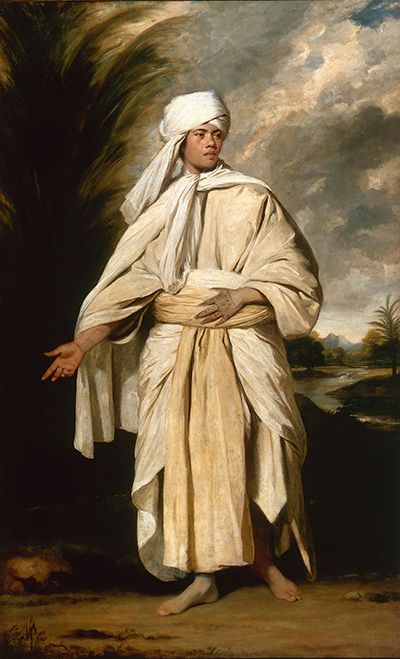
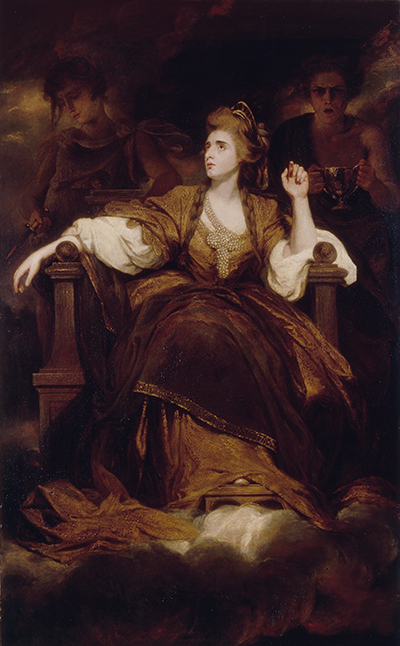
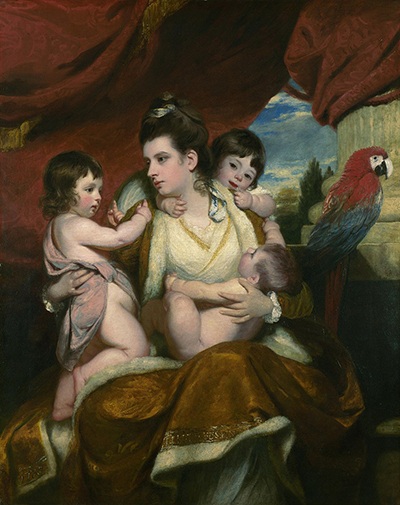
This tension shaped Reynolds’s own paintings. His portraits often borrow poses, compositional strategies or dignifying effects from older art, but their purpose is not archaeological reconstruction. Lady Cockburn and Her Three Eldest Sons draws on earlier models of Charity. Portrait of Mai (Omai) carries antique and Old Master associations into a modern encounter. Sarah Siddons as the Tragic Muse turns theatre celebrity into allegory. The Discourses explain the intellectual habit behind such transformations.
Reynolds’s theory of imitation is therefore active. The great artist does not copy a master’s surface; he absorbs principles. He studies how grandeur, balance, expression or selection work, then applies those lessons to new subjects. This is one reason Reynolds could make portraits carry historical ambition. He understood portraiture as a modern occasion that could be lifted by inherited pictorial language.
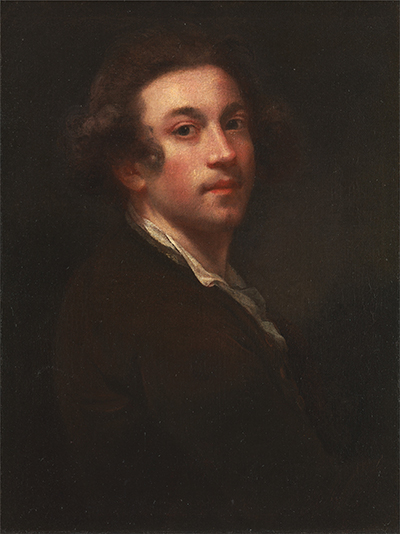
The National Portrait Gallery self-portrait record underlines how early this ambition was present in Reynolds’s self-fashioning. His pre-Italy self-image already connects the young painter to the visual drama of Old Master example, and later NPG interpretation places Reynolds’s Royal Academy presidency and Discourses within that longer pursuit of pictorial elevation.[9] The Discourses are therefore not a late varnish on his career. They grow from an ambition visible before his London triumph.
This also explains his complicated relation to colour. Reynolds admired many effects in Venetian and northern painting, but his theoretical hierarchy often favoured design, form and generalised selection over seductive surface. That preference could make him unfair to kinds of painting that modern viewers value highly. Yet it also clarifies his own priorities. Colour could enchant; form and judgement, in his view, gave art its rank.
General ideas and the Grand Style
Discourse III addresses the Grand Style and beauty; Discourse IV develops the idea that “general ideas” should govern art.[1] Reynolds’s phrase is easily misunderstood. He does not mean vagueness. He means that the artist should rise above accidental detail and search for a more durable form of truth. The general is not empty; it is selected.
This principle helps explain Reynolds’s discomfort with purely descriptive portraiture. A portrait that only records the temporary fashion of dress, the exact irregularities of a face or the particular furniture of a room may satisfy immediate likeness but fail at dignity. The painter’s task is to preserve enough individuality for recognition while lifting the image toward something broader.
That is the heart of Reynolds’s Grand Manner. It is not simply big canvases and sweeping drapery. It is a method of elevation. The sitter is made to look as if he or she belongs to a larger moral, historical or poetic order. Scale, pose, costume, gesture, light, borrowed motifs and background all serve that enlargement.
Reynolds knew this could be risky. If the portrait painter generalises too much, likeness is weakened. If he clings too closely to likeness, dignity may disappear. The Discourses do not solve that tension once and for all; Reynolds’s best portraits live inside it. They are powerful because they make a person look both socially present and somehow more than present.
This tension makes the Discourses valuable even for readers who never intend to paint. They reveal how eighteenth-century viewers were trained to distinguish between surface description and elevated form. A Reynolds portrait asks the viewer to recognise a person, but also to admire the degree of selection that has reshaped that person into a more public image. The Discourses give that reshaping a vocabulary.
The phrase Grand Style, used in the lecture titles and arguments, belongs to a wider academic world, but Reynolds made it press directly on British portraiture.[1] His innovation was not inventing academic hierarchy. It was making the hierarchy useful to a portrait painter. He could not escape the demands of likeness, payment and social rank, so he converted those demands into occasions for elevated design.
Fashion, drapery and modern life
Reynolds’s suspicion of fashion is one of the most revealing parts of the Discourses. Fashion dates a picture. It ties art to the temporary, the familiar and sometimes the ridiculous. For a painter seeking dignity, modern dress could seem like an enemy. The Wallace Collection’s discussion of Reynolds and fashion rightly emphasises this tension between his theory of timeless drapery and his actual responsiveness to clothing, fabric and social display.[5]
The problem was especially sharp in portraiture. A history painter could place figures in antique or imagined costume. A portrait painter had to negotiate with living sitters who wore contemporary clothes, cared about rank and wished to be seen recognisably. Reynolds’s theory urges elevation; his profession required compromise.
The compromise produced some of his finest effects. He could soften modern costume into drapery, make white gowns feel nearly classical, turn military uniform into heroic theatre or allow fashionable detail to carry social meaning. In practice, Reynolds was more subtle than a simple anti-fashion rule would suggest. He knew clothing could threaten dignity, but he also knew it could reveal character, role and desire.
This is why the Discourses should not be read as a rigid manual that Reynolds mechanically followed. They are a pressure system. They show what he valued and feared, while the paintings show how he negotiated with patrons, bodies, fabrics, faces and ambition. Theory pushes toward the general; portraiture pulls back toward the particular.
The Wallace Collection’s analysis of Reynolds and fashion is useful because it shows how this pressure played out in real images.[5] Reynolds could warn against the familiarity of modern dress and still paint textures, hats, lace and gowns with remarkable attention. That apparent inconsistency is not a failure of intelligence. It is the condition of portraiture. Sitters wanted to be known in their own world, while Reynolds wanted them to survive that world’s changes.
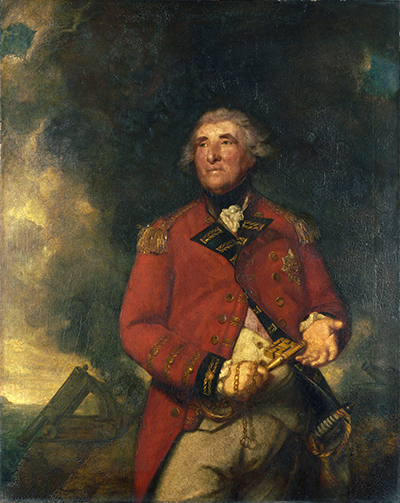
The same problem touched male portraits too. Uniforms, robes, academic dress, swords, books and political costume all carried immediate meaning, but could become dated. Reynolds’s art tries to turn these signs into larger attributes. A military coat becomes command; a book becomes intellect; a key becomes steadfast defence; an antique echo becomes dignity. The Discourses explain why that transformation mattered to him.
History painting and the portrait painter
Reynolds repeatedly upholds history painting as the highest form of art. This was standard academic hierarchy, but it creates the central irony of his career. The National Gallery notes that Reynolds believed history painting was noblest, yet his greatest works are portraits.[6] The Discourses therefore speak from a paradox: Britain’s leading portrait painter teaches an art theory that places portraiture below history painting.
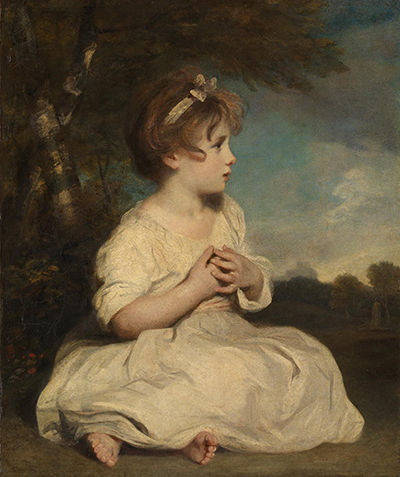
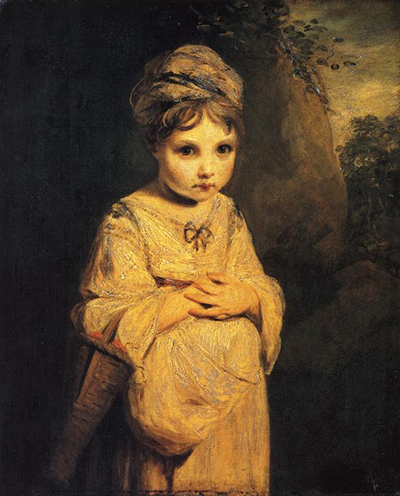
That paradox did not paralyse him. Instead, it helped produce his most ambitious portraits. If history painting was the summit, portraiture could borrow some of its height. A sitter could be posed with the gravity of a hero, saint, muse, philosopher or commander. A family group could be touched by allegory. A child could carry devotional feeling. Portraiture became a field where academic hierarchy and social demand met.
This is why the Discourses are so important for understanding Reynolds’s images. Without them, the Grand Manner may look like mere grandiosity. With them, it appears as an attempt to solve a professional problem: how can a painter dependent on portrait commissions still pursue the dignity of high art?
The answer was not always convincing. Some portraits strain under borrowed authority. Some sitters are flattered into roles that now feel artificial. Some claims of dignity conceal class, gender, empire or wealth. But the effort itself changed British portraiture. Reynolds made portrait painting argue for itself.
This matters for the catalogue of his paintings as well as for theory. Mannings’s catalogue raisonné, with subject pictures catalogued by Martin Postle, remains the backbone for identifying Reynolds’s painted corpus and tracing portraits, versions and subject works.[10] The Discourses tell us what Reynolds said art should be; the catalogue helps keep track of what he actually made. The gap between those two bodies of evidence is often the most revealing place to look.
For instance, the surviving portrait corpus shows how often Reynolds’s highest ambitions had to pass through paid likeness. The Academy President could preach hierarchy, but the working artist had to paint patrons, families, actresses, officers and friends. Far from making the Discourses irrelevant, that practical reality makes them sharper. They are the pressure of an ideal placed against the habits of a profession.
The Academy, Somerset Place and national ambition
Discourse IX was delivered at the opening of the Royal Academy in Somerset Place on 16 October 1780.[1] Its subject is not only a building. It is the Academy’s public standing. Reynolds presents the move as evidence of royal protection and a chance for British art to prove that institutional splendour could be matched by artistic achievement.
This is one of the clearest moments in the Discourses where art theory becomes national rhetoric. Reynolds wants more than good individual painters. He wants a school of English artists. The Academy is the instrument through which that school might be formed, recognised and sustained. Education, exhibition, criticism and shared ambition become part of a national cultural project.
The Royal Academy’s institutional history reinforces that context: the Academy was created as a place where art could be made, exhibited and debated, with annual exhibitions and an art school at its core.[7] Reynolds’s presidency gave that project both prestige and direction. His Discourses taught students, but they also taught the public how to think of British art as something capable of seriousness.
The national ambition of the Discourses should be read with care. It could be generous, because Reynolds wanted British artists to rise. It could also be exclusionary, because academic standards tended to privilege certain subjects, bodies, traditions and social positions. The Academy opened possibilities, but within a hierarchy.
Reynolds’s language of national improvement also helps explain why the Discourses had an audience beyond the students physically present. They were about the reputation of British art as much as the conduct of individual artists. If the Academy succeeded, Britain might no longer appear artistically provincial beside Italy, France or the Netherlands. The Discourses gave that hope a disciplined voice.
Yet national ambition could simplify the art it sought to raise. To build a school, Reynolds emphasised shared principles. To honour older schools, he sometimes reduced them to teachable examples. To raise British art, he asked students to look outward and backward, especially toward Italy and antiquity. This mixture of confidence and dependency is one of the Discourses’ most eighteenth-century features.
Gainsborough in Discourse XIV
Discourse XIV, delivered on 10 December 1788, is devoted to the character of Thomas Gainsborough, who had died earlier that year.[1] It is a remarkable moment because Reynolds turns his official lecture into an assessment of a rival whose gifts did not always fit neatly inside Reynolds’s own theoretical preferences.
The Gainsborough lecture matters for this Reynolds cluster because it prepares the ground for a fuller comparison between the two artists. Reynolds admired Gainsborough’s powers, but he also measured them through his own standards: study, breadth, selection, dignity, relation to earlier art. Gainsborough’s brilliance could appear to Reynolds both natural and insufficiently disciplined.
This should not be flattened into simple rivalry. Reynolds and Gainsborough represented different possibilities for British painting: intellectual structure and institutional authority on one side, lyrical immediacy and painterly freshness on the other. Discourse XIV is valuable because Reynolds had to speak publicly about an artist whose excellence partly challenged his system.
The detailed comparison belongs elsewhere, but the point here is clear: the Discourses are not detached theory. They respond to living artists, institutional moments and current artistic reputations. Reynolds’s thought was official, but it was not sealed off from contemporary competition.
The farewell of 1790
Discourse XV was delivered on 10 December 1790, when Reynolds took leave of the Academy.[1] Its tone is retrospective. He reviews the course of his lectures and returns to the central authority of Michelangelo. The final emphasis is fitting. Reynolds ends by directing students toward the model of overwhelming imaginative power and elevated form.
The farewell also reminds us how long Reynolds had carried the burden of speaking for the Academy. From 1769 to 1790, the Discourses chart an extraordinary period in British art: the Academy’s founding, its move to Somerset House, the rise of public exhibitions, the consolidation of Reynolds’s reputation and the deaths or transformations of major contemporaries.
By the end, the Discourses had become more than addresses to students. They formed a public archive of academic values. They tell us what Reynolds hoped British art might become, what he feared it might settle for, and how he wanted younger artists to imagine their relation to the past.
The final lecture does not resolve every contradiction. Reynolds still values hierarchy, still looks to Michelangelo, still asks students to measure themselves against the highest precedents. Yet the persistence is moving. He had spent more than two decades arguing that British art deserved ambition equal to its talent.
Limits of Reynolds’s theory
The Discourses are powerful, but they are not neutral. Reynolds’s hierarchy privileges certain traditions, especially Italian and antique models. His suspicion of fashion can undervalue modernity, local life and social specificity. His preference for general form can make difference appear like a problem to be corrected. His praise of discipline can sound like distrust of experiment, even though his own painting materials were famously experimental.
There is also a gap between what Reynolds taught and what he did best. His portraits often succeed because they do not fully obey the severity of his theory. They preserve fashionable surface, particular character, theatrical immediacy and social ambiguity. If Reynolds had painted only according to his most austere principles, some of his greatest portraits would be less alive.
This gap is not hypocrisy so much as productive contradiction. The Discourses show Reynolds trying to raise art above habit and fashion; the portraits show him repeatedly pulled back into the richness of living appearance. His greatness lies partly in that struggle. He believed in general principles, but he painted people whose identities were specific, unstable and socially charged.
Modern readers should therefore treat the Discourses as historical arguments, not as final laws. They reveal how academic art theory worked, how British artists sought status, and how portraiture could be intellectually defended in an age that ranked it below history painting. They also reveal the exclusions and pressures built into that defence.
The limitation around colour is especially important. Reynolds’s preference for general form and high design could lead him to distrust the sensual immediacy of colouristic painting. That distrust is understandable inside academic hierarchy, but it can make his criticism feel narrow. It also contrasts with his own appetite for rich pictorial effects. His materials, glazes and surfaces show a painter more tempted by visual seduction than his most severe statements might suggest.
His treatment of fashion poses a similar difficulty. Fashion can trivialise an image, but it can also preserve historical life. Reynolds feared that the temporary would damage dignity; modern viewers often value the temporary because it tells us how people inhabited their moment. The Discourses therefore help us see both Reynolds’s ambition and his blind spots.
Why the Discourses still matter
The Discourses still matter because they make Reynolds’s paintings more legible. They explain why he cared about Old Master models, why he distrusted mere prettiness, why he wanted portraiture to rise above fashionable likeness, why he valued general form and why the Royal Academy mattered so deeply to his idea of art.
They also matter because they are among the clearest statements of British academic art theory. The Royal Academy and Yale descriptions are right to treat them as fundamental to eighteenth-century English painting.[2][3] They gather older European theory, adapt it to British conditions and give it the authority of a painter who was both practitioner and president.
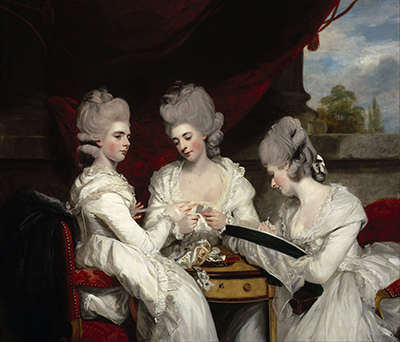
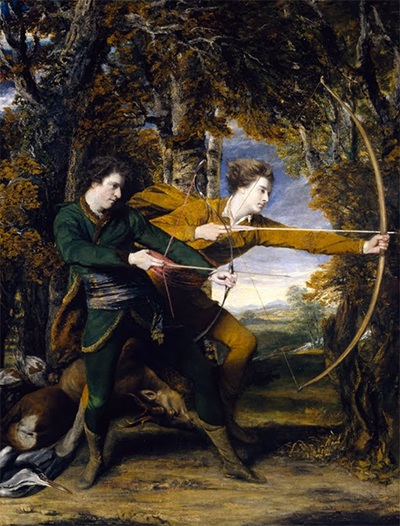
For the Reynolds portraits already considered in this cluster, the Discourses provide a key. Portrait of Mai, Sarah Siddons as the Tragic Muse, Lady Cockburn and Her Three Eldest Sons, The Ladies Waldegrave, The Archers and Lord Heathfield of Gibraltar all make more sense when seen through Reynolds’s language of elevation, selection, dignity and inherited example.
They also help organise the difference between Reynolds’s major themes. The Grand Manner article explains the visual method of elevation; the portraits article explains sitter culture and studio practice; the later technique article will address materials and deterioration. The Discourses sit behind all three. They are where Reynolds turns practice into principle, and where the principles reveal both the nobility and the strain of his artistic programme. Without them, Reynolds can look merely polished; with them, his polish becomes an argument about artistic rank, education, ambition and public cultural authority in British art and beyond. That matters.
Their final value is not that Reynolds was always right. He was too hierarchical for that, too suspicious of some kinds of modern life, too invested in the authority of old models. Their value is that they show the intellectual machinery behind one of the most influential portrait practices in British art. The paintings give Reynolds his visual power; the Discourses reveal the ambition that tried to govern it.
That ambition is why the lectures still repay attention. They show a painter trying to turn professional success into cultural leadership. They show a new Academy searching for authority. They show British art borrowing from European precedent while trying to become itself. And they show Reynolds, persuasive and limited at once, making the case that painting should be judged by thought as well as by hand.
Frequently Asked Questions
Discussion
Do Reynolds's rules liberate artistic judgement, or preserve a hierarchy whose limits are now easier to see?
Reader Insights
At what point does disciplined study become independent judgement?
How do the Discourses change the way you read Reynolds's portraits?
What kind of artistic public did the Royal Academy addresses try to create?
Join the Conversation
Share your reading below.
References
- Joshua Reynolds, Fifteen Discourses Delivered in the Royal Academy, Project Gutenberg, https://www.gutenberg.org/files/52436/52436-h/52436-h.htm
- Yale University Press, Joshua Reynolds, Discourses on Art, edited by Robert R. Wark, https://yalebooks.yale.edu/book/9780300073270/discourses-on-art/
- Royal Academy of Arts, Discourses on Art, Wark edition record, https://shop.royalacademy.org.uk/discourses-on-art
- Open British National Bibliography, Discourses on Art, https://obnb.uk/p9392665-discourses-on-art
- Wallace Collection, “Reynolds and Fashion,” https://www.wallacecollection.org/explore/explore-in-depth/reynolds/the-artist/reynolds-and-fashion/
- National Gallery, London, “Sir Joshua Reynolds 1723-1792,” https://www.nationalgallery.org.uk/artists/sir-joshua-reynolds
- Royal Academy of Arts, “Joshua Reynolds RA 300th Birthday...” institutional product story, https://shop.royalacademy.org.uk/joshua-reynolds-ra-300th-birthday-red-blue-pin-badge
- National Portrait Gallery, Sir Joshua Reynolds person record, https://www.npg.org.uk/collections/search/person/mp03755/sir-joshua-reynolds
- National Portrait Gallery, Sir Joshua Reynolds self-portrait, NPG 41, https://www.npg.org.uk/collections/search/portrait/mw05282/Sir-Joshua-Reynolds
- David Mannings, Sir Joshua Reynolds: A Complete Catalogue of His Paintings, with subject pictures catalogued by Martin Postle, 2 vols, Yale University Press / Paul Mellon Centre for Studies in British Art, 2000.