 by Tom Gurney
Tom Gurney BSc (Hons) is an art history expert with over 20 years experience
Published on November 6, 2026 / Page Updated on November 6, 2026
Email: tomgurney1@gmail.com / Phone: +44 7429 011000
Introduction
Joshua Reynolds and Thomas Gainsborough are often presented as opposites: Reynolds the learned president, Gainsborough the natural painter; Reynolds the theorist, Gainsborough the instinctive colourist; Reynolds the architect of the Royal Academy, Gainsborough the restless member who finally withdrew from its exhibitions. The contrast is useful, but only if it is not made too tidy. Both were ambitious professional portraitists. Both worked for elite sitters. Both knew that British painting needed public grandeur as well as private likeness. Both looked to Van Dyck. Both wanted portraiture to do more than record a face.
Their difference lies in how they imagined that elevation should happen. Reynolds trusted system, hierarchy, quotation, the study of antiquity and the Old Masters, and the public authority of the Academy. Gainsborough trusted eye, touch, colour, music, movement, landscape and the living pressure of looking. Reynolds tried to give British portraiture a language of dignity. Gainsborough made it breathe. Reynolds turned likeness toward public consequence. Gainsborough often made consequence feel as if it had wandered into air, trees, satin and weather.
The comparison matters because it opens the great argument of late eighteenth-century British art. What should a modern British painter become? A scholar of the European past? A courtly heir to Van Dyck? A chronicler of land, rank and sociability? A painter of sensation, movement and natural effect? Reynolds and Gainsborough answered those questions differently, but they did so inside the same competitive world: patrons, exhibitions, prints, clubs, royal favour, newspaper criticism and the rising prestige of native painting.[1][2]
It is also a useful comparison because neither artist fits the role that later shorthand assigns to him. Reynolds was not only a lecturer in a ceremonial chair. He was a working portrait painter who knew the demands of appointment books, patrons, studio labour and public display. Gainsborough was not simply the enemy of theory. He studied earlier art, watched effects closely, cared intensely about display and understood how a painting's setting could alter its power. The most rewarding way to compare them is to treat each as a complete professional intelligence. Reynolds turned ambition into doctrine; Gainsborough turned looking into persuasion.
At a Glance
- ArtistsJoshua Reynolds (1723–1792) and Thomas Gainsborough (1727–1788)
- Shared fieldLeading later eighteenth-century British portraiture [3]
- Common inheritanceVan Dyck and the grand portrait tradition
- ReynoldsFirst Royal Academy President, theorist and Grand Manner portraitist
- GainsboroughPortrait and landscape painter, founding Academician and colourist
- Decisive differenceLandscape, optical touch and institutional temperament
- Royal Academy ruptureGainsborough withdrew eighteen planned works in 1784 [7]
- Flagship comparisonThe Blue Boy, exhibited in 1770 [11]
- Myth cautionThe anti-Reynolds blue story was first recorded in 1820 [12]
- Reynolds's responseDiscourse XIV, delivered 10 December 1788 [9]
Contents
- Introduction
- Two careers, one public stage
- Reynolds: order, ambition and public authority
- Gainsborough: eye, air and freedom
- Van Dyck as common inheritance
- Landscape and the decisive difference
- The Royal Academy rivalry
- The Blue Boy and the colour myth
- Discourse XIV: Reynolds judges Gainsborough
- Why the comparison still matters
Two careers, one public stage
Reynolds was born in Plympton in Devon in 1723, trained with Thomas Hudson, spent the years 1749 to 1752 abroad, mainly in Italy, and quickly established himself in London after his return. The National Gallery describes him as the leading English portraitist of the eighteenth century and emphasises the importance of ancient art, Italian Renaissance painting, Rembrandt, Rubens and Van Dyck in the variety and dignity he brought to British portraiture.[1] His education, ambition and social intelligence all mattered. He was not merely a successful likeness-maker; he became a cultural operator.
Gainsborough, born in Sudbury in 1727, followed a less academically authorised path. He trained in London, worked in Suffolk, settled into a successful Bath practice in 1759, and moved to London in 1774. The National Gallery names him, with Reynolds, as the leading portrait painter in later eighteenth-century England, while stressing his very different character: feathery mature brushwork, rich colour, fashionable contemporary dress and a private inclination toward landscape and rustic subjects.[3] His world was not provincial in any limiting sense, but his art retained a memory of local ground, wooded edges, informal sociability and musical rhythm.
Both careers converged on the public world of London. Reynolds occupied Leicester Fields and became first President of the Royal Academy when it was founded in 1768. Gainsborough was also a founding member. Yet their relation to the Academy was never equivalent. Reynolds embodied the new institution. Gainsborough used it, resisted it, returned to it and finally broke with its exhibitions after the 1784 hanging dispute.[3][7] The Academy was therefore not just a backdrop. It was the arena in which their difference became visible.
This shared stage can distort the comparison if it is treated as a personality drama alone. The rivalry was real, but it was also structural. London offered patrons a choice between two versions of distinction. Reynolds could give a sitter intellectual elevation, antique gesture, symbolic costume and the aura of a European tradition. Gainsborough could give rank a livelier surface, a more immediate grace, a landscape air, a sense that high society had not entirely lost contact with freshness and movement. Patrons, critics and later historians needed both options.
Bath matters in this story because it helped shape Gainsborough's difference before his final London years. A fashionable spa town supplied the sitters and social traffic needed for portrait practice, while also giving him access to collections, music and conversation. London then intensified the comparison. Reynolds was already entrenched as the public figure of national artistic aspiration; Gainsborough arrived as an established rival with a different authority. The question was not whether one could paint and the other could only theorise. The question was whether British portraiture would be defined by institutional grandeur or by a more fluid, sensory command of likeness and surface.
The age also encouraged comparison because public exhibitions made paintings compete in the same rooms. Reputation no longer depended solely on a sitter's house or a private collection. It could be made, damaged or argued over in crowded displays, newspaper columns and engraved afterlives. Reynolds understood this public machinery better than almost anyone. Gainsborough felt its force just as strongly, but he was less willing to surrender the exact conditions under which his paintings would be seen.
Reynolds: order, ambition and public authority
Reynolds's strength was his ability to convert portraiture into an art of public ambition. Portrait painting was the medium that paid, but Reynolds wanted it to borrow force from history painting, classical sculpture and the Old Masters. The National Portrait Gallery links his Grand Manner to classical antiquity and Old Master borrowing, describing how he filled portraits with moral and heroic symbolism.[2] That ambition is essential. Reynolds did not believe likeness alone was enough. He wanted sitters to appear as if their social identity had been lifted into a more permanent register.
His presidency of the Royal Academy made that ambition institutional. The Discourses were not casual opinions. They were lectures delivered to students by the leader of a new national academy, and they argued for study, discipline, hierarchy and the shaping power of great examples.[2][9] Reynolds became the official voice of artistic improvement. If Britain was to develop a serious school of painting, he believed it needed more than talent. It needed education, rules, comparison and continuity with the art of the past.
That position gave Reynolds immense authority, but it also created tensions. The National Gallery notes that he believed history painting was the noblest work of the painter, yet his greatest works are portraits.[1] His career was therefore built on a productive contradiction. He taught the hierarchy of genres from within the genre that British patrons most eagerly supported. Portraiture was not the summit in academic theory, but in practice it became the place where Reynolds tested ambition most successfully.
Mannings's complete catalogue of Reynolds's paintings, with Martin Postle cataloguing the subject pictures, helps clarify the scale of that practice.[6] Reynolds was not the painter of a few famous images only. He created, repeated, adapted and circulated a vast body of portraits and subject works, many entangled with sitter identities, versions, studio participation, engravings and changing collections. His authority came not only from office and theory, but from sustained professional reach. He made himself indispensable to the visual culture of rank, intellect, performance and empire.
Compared with Gainsborough, Reynolds seems more deliberate in his conversion of social portraiture into cultural argument. Drapery, pose, attribute and borrowing matter because they carry the sitter beyond a temporary likeness. This is why his portraits of actors, military men, aristocratic women, children and public figures often feel constructed around a governing idea. The person is present, but so is a thesis about greatness, sensibility, lineage, patriotism, virtue or fame.
That governing idea could be flexible. Reynolds did not apply one formula to every sitter. He could make theatrical celebrity monumental, aristocratic motherhood allegorical, childhood devotional or military command heroic. The constant is not a single pose but the belief that portraiture should rise above contingency. A dress, gesture or background becomes successful when it seems to belong to a larger pictorial order. Reynolds wanted the image to feel considered even when it preserved animation.
This explains why his learning was not decorative. Old Master memory gave Reynolds a way to solve a modern British problem: how to make portraiture, the most demanded genre, look like serious art. A sitter's face alone might satisfy family and friends, but a portrait meant for wider admiration needed amplitude. Borrowing from Van Dyck, Rubens, Rembrandt, antique sculpture or Italian art helped Reynolds give portraiture intellectual depth. It also allowed him to argue that British painting could join a European conversation instead of merely flattering local patrons.
Gainsborough: eye, air and freedom
Gainsborough's authority was different. He was a major portraitist, but his art repeatedly suggests that portraiture was only part of what he cared about. The National Gallery states that his private inclination was toward landscape and rustic scenes, even while portrait commissions supplied his professional livelihood.[3] That division matters for almost every comparison with Reynolds. Gainsborough's portraits often carry the memory of landscape even when the sitter dominates. Trees, skies, ground, breeze and uncertain distances are not just settings. They are part of his way of giving life to the figure.
The National Galleries of Scotland describes him as a painter who excelled in portrait and landscape, built on the grand manner of Van Dyck, and introduced informality through imaginative landscape backgrounds and fluid, lively brushwork.[4] This is a useful formulation because it avoids the false idea that Gainsborough ignored tradition. He did not. He absorbed Van Dyck deeply. He knew aristocratic elegance, full-length scale and courtly precedent. But he made those inheritances lighter, more mobile and more atmospheric.
Where Reynolds often makes the sitter bear a structure of meaning, Gainsborough makes the sitter participate in a visual climate. The result can feel less doctrinal. A Gainsborough portrait may still advertise class, refinement and possession, but it usually does so through tone rather than emblem. Costume catches light; edges flicker; trees dissolve; limbs move with an almost musical ease. Reynolds builds dignity. Gainsborough releases it into sensation.
Rosenthal's Paul Mellon study of Gainsborough is valuable here because it places the painter's life and diverse output within the changing commercial and technological conditions of his time.[5] Gainsborough was not an innocent outside commerce. He negotiated clients, exhibition culture, fashion and reputation as shrewdly as any successful painter had to do. But his art often protects a sense of pleasure that seems less official than Reynolds's. He could serve rank while making rank appear momentarily unguarded.
This quality does not make Gainsborough simpler. In fact, it makes him difficult to summarise. He could paint local gentry, royal sitters, musicians, actresses, children, rustic figures and imagined landscapes. He could work with elegance and impatience in the same career. His brushwork could look spontaneous while being carefully judged. His informality is not the absence of artifice. It is artifice turned into liveliness.
That liveliness gave Gainsborough a special kind of authority with viewers. Reynolds often asks us to recognise the cultural architecture of a portrait. Gainsborough asks us first to respond with the eye. The glimmer of satin, the bend of a tree, the loosened edge of hair, the uncertainty of a background or the rhythm of a hand may persuade before any programme can be named. His art often seems to trust sensation as a form of knowledge.
This does not mean that Gainsborough lacked seriousness. It means his seriousness frequently appears through mood, tact and optical intelligence rather than through overt iconography. A Reynolds portrait can announce its elevation. A Gainsborough portrait may let elevation emerge through the sitter's relation to air, touch and distance. The difference is subtle but profound: Reynolds often dignifies a person by association; Gainsborough often dignifies a person by vivacity.
Van Dyck as common inheritance
Van Dyck stands behind both Reynolds and Gainsborough, but not in the same way. For Reynolds, Van Dyck belonged to a larger structure of Old Master study, alongside Italian, Flemish and Dutch examples. The National Gallery names Van Dyck among the painters through whom Reynolds brought variety and dignity to British portraiture.[1] Van Dyck offered a model for aristocratic presence: elongated grace, costume, gesture, status and a painterly grandeur suited to elite likeness.
For Gainsborough, Van Dyck was more intimate and perhaps more liberating. The Huntington's history of The Blue Boy explains that in Bath, Gainsborough studied Old Master paintings including Van Dyck's courtly portraits, with their full-length figures, rich fabric, architectural details and breezy landscapes.[11] The same account contrasts Gainsborough's preference for contemporary dress with Reynolds's habit of including classical or Renaissance references to raise the intellectual level of portraiture.[11] That contrast is central. Both artists used the past, but Reynolds tended to make it conceptual, while Gainsborough often made it sensuous.
The National Gallery's 2022 interpretation of The Blue Boy places Gainsborough in a wider British Van Dyck tradition, linking child portraiture, costume, Old Master admiration and modern portrait making.[12] It also notes that Mr and Mrs Andrews combines French and Dutch art with topographical traditions of land and estate ownership.[14] Gainsborough's old masters were not a single inheritance. Van Dyck, Dutch landscape, French sociability and native topography all entered the mix.
Reynolds's version of inheritance was more programmatic. His Discourses repeatedly insist on the value of studying great examples, generalising from nature and avoiding mere imitation of accident or fashion.[9] He wanted artists to learn from the past without sinking into copying. Gainsborough, by contrast, often makes influence harder to separate from handling. A Van Dyckian costume may appear, but it is translated through blue satin, flickering edge and living surface.
This is why the comparison is richer than academic versus natural. Reynolds was not without painterly brilliance, and Gainsborough was not without tradition. The difference is one of emphasis. Reynolds uses precedent to discipline modern portraiture. Gainsborough uses precedent to animate it.
Van Dyck also gave both painters a way to address aristocratic ease without making portraiture stiff. In seventeenth-century England, Van Dyck had shown how nobility could be expressed through long lines, poised informality, relaxed command and decorative richness. Eighteenth-century British painters inherited that example as both opportunity and burden. Reynolds treated it as part of a learned vocabulary to be expanded by other precedents. Gainsborough treated it as a living manner that could be softened, brightened and set moving again.
That difference matters when looking at costume. Reynolds's historicising or classicising dress can remove a sitter from the ordinary present and place them in a more abstract field of virtue, fame or beauty. Gainsborough's costume, even when Van Dyckian, tends to remain closer to the pleasures of cloth and appearance. The garment is not just symbolic clothing. It is colour, sheen, motion and theatre for the eye.
Portraiture as performance
Portraiture in Reynolds and Gainsborough is never simply private. Sitters performed rank, gender, profession, family, taste and aspiration. Reynolds understood this as well as anyone. His portraits create roles: tragic muse, imperial traveller, military defender, aristocratic mother, cultivated man, heroic youth. Even when a sitter is recognisable, the portrait may ask the viewer to read character through a larger pictorial grammar.
Gainsborough's performance is often less emblematic but no less staged. The National Gallery stresses his use of fashionable contemporary dress, in contrast to Reynolds's references to Italian Renaissance art or the Antique.[3] That choice is not merely a lack of learning. Contemporary dress allowed Gainsborough to make sitters appear alive within their own social moment. In his mature portraits, silk, hair, lace, landscape and pose become a performance of immediacy.
The rivalry therefore offered patrons two modes of self-fashioning. Reynolds could make a sitter appear historically enlarged. Gainsborough could make a sitter appear socially vivid. Reynolds gave permanence. Gainsborough gave presence. One mode was not automatically deeper than the other. Each answered a different anxiety in a culture where wealth, lineage, celebrity and public reputation needed images.
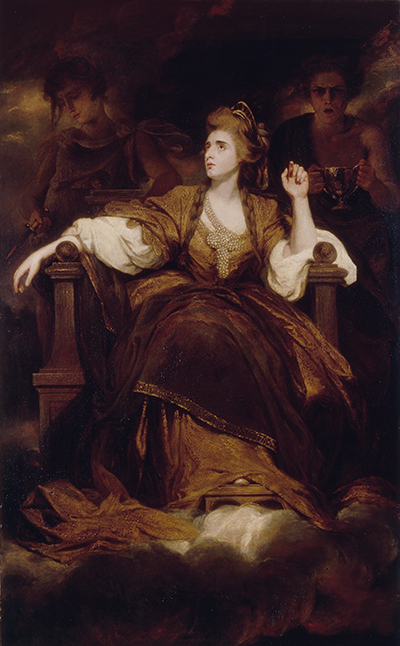
Actors expose the difference particularly well. Reynolds's Sarah Siddons as the Tragic Muse turns the actress into an allegorical presence, almost enthroned within the idea of tragedy. Gainsborough's portrait of Siddons, painted in the winter of 1784-85, is described by the National Gallery as showing her not in character but as herself.[3] The two images are not interchangeable. Reynolds makes performance monumental. Gainsborough lets celebrity return to personhood.
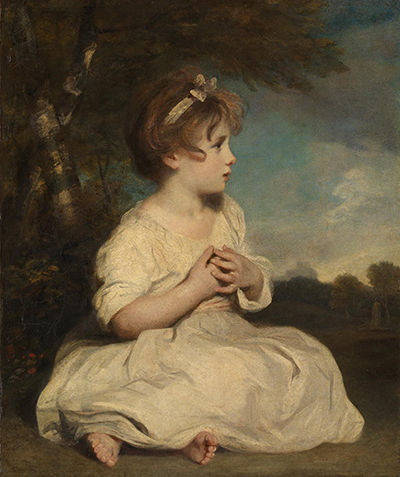
Children offer another contrast. Reynolds could idealise childhood into innocence, devotion or fancy. Gainsborough often treats children with quickness, affection and unstable movement. The National Gallery's Blue Boy interpretation points to Van Dyck's admired naturalness in representing children and links that tradition to British artists including Hogarth, Gainsborough and Reynolds.[12] Both artists cared about childhood, but Gainsborough's best child images often feel less like moral emblems and more like flashes of life.
Women sitters also reveal the divergence. Reynolds frequently gives female portraiture a grand rhetorical structure: virtue, maternity, tragedy, grace, noble lineage or cultivated fashion turned into elevated display. Gainsborough could produce grandeur too, but his strongest women often live through changing surfaces: glancing fabric, animated posture, landscape openness or the exact charge of a face caught between pose and temperament. Reynolds tends to stabilise the role; Gainsborough lets the role vibrate.
The same difference applies to men of power. Reynolds can make military or public identity feel sculptural, with gesture and setting arranged to carry fame. Gainsborough is usually less interested in converting male status into moral architecture. His male sitters may seem more conversational, more bodily, more held in the particular texture of a moment. That difference is one reason Reynolds suited national hero-making so well, while Gainsborough could make elite portraiture feel unexpectedly porous.
Landscape and the decisive difference
Landscape is the strongest dividing line. Reynolds painted portraits with settings, but landscape was not the private engine of his art. Gainsborough, by contrast, never stopped thinking through landscape. Even his portraits often seem to ask what happens when a figure is placed inside a breathing world. This is why his early and later works can be read through fields, lanes, wooded banks, clouds and light.
The National Gallery's account of Mr and Mrs Andrews gives an early example. Painted about 1750, the work shows Robert and Frances Andrews before a wide view east across land connected to family, marriage and property.[14] It has been described as a portrait of the sitters and their land, and the Gallery notes that Gainsborough knew the area well because he and Mr Andrews had attended Sudbury Grammar School and because Gainsborough was born locally.[14] Reynolds could dignify a sitter through tradition. Gainsborough could bind a sitter to place.
That binding is not innocent. Mr and Mrs Andrews is a brilliant picture of possession as well as landscape. The view carries class, inheritance, agricultural order and social confidence. The unfinished area in Mrs Andrews's lap remains unresolved, with the National Gallery noting possible interpretations including a child or a game bird.[14] The work's power lies partly in that tension: freshness of air and precision of ownership, private marriage and public land, informal handling and social structure.
Reynolds's portrait settings, especially in his Grand Manner works, usually serve figure and idea. Landscape may add drama, movement or allusion, but it rarely competes with the governing role. Gainsborough's landscapes press harder. They are not simply scenery. They alter the psychological weather of the sitter. A figure may seem to emerge from foliage, drift through a park or exist in a shared atmosphere with animals, trees and sky.
This difference helps explain why Gainsborough could frustrate academic categories. Reynolds's hierarchy placed history painting at the top, with portraiture elevated by borrowing from higher traditions.[1][9] Gainsborough's deepest visual intelligence often moved sideways through portrait, landscape and fancy. He did not need landscape to become history painting in order to matter. He needed it to carry feeling, touch and visual pleasure.
Landscape also gave Gainsborough a way to complicate social display. A sitter outdoors may appear freer, but that freedom is often built on property, leisure and rank. Mr and Mrs Andrews makes this especially clear. The picture's freshness does not cancel its claim to land; it makes that claim visually persuasive. Gainsborough's genius lies in the way the eye can enjoy the open view while the mind recognises the structures that make such a view socially meaningful.[14]
For Reynolds, by contrast, the most important space is often cultural rather than geographical. His portraits open onto histories of art, allegory, theatre, empire, war, literature or public office. The setting may be landscape, architecture or darkness, but it usually serves an idea of the sitter's role. Gainsborough's space more often seems to push back. It has weather, growth and instability. It may support status, but it also loosens the figure from pure emblem.
Colour, finish and the eye at work
The old comparison often turns on finish: Reynolds as designed and elevated, Gainsborough as loose and rapid. Reynolds himself contributed to that reading in Discourse XIV, where he discussed Gainsborough's handling, lightness and apparent irregularity as qualities that resolved at the proper distance.[9] He admired the effect, yet folded it into an academic warning. Gainsborough's beauties could be acknowledged, but students should not mistake them for a licence to neglect discipline.
Modern viewers may find Reynolds's caution revealing. He saw Gainsborough's strength, but he translated it into the language of instruction. That was his habit and office. As President of the Royal Academy, he could rarely discuss a painter without turning the discussion toward what students should learn. Gainsborough's art became evidence in an argument about practice, attention, finish and the whole effect of a picture.
Gainsborough's own technical world was experimental. The Morgan record for a 1773 letter to William Hoare describes it as concerning Reynolds's discourse on fresco and their differing techniques.[15] The record alone is enough to show that their divergence was not merely a later critical invention. Technique, surface and the purpose of painting were already part of the conversation around them.
The Huntington's conservation account of The Blue Boy gives a particularly vivid modern view of Gainsborough's method. Technical study in 2018-19 revealed underlayers, a reused canvas, a painted-out dog, complex blue pigments and energetic layers of brushwork.[10] Those findings sharpen the meaning of Gainsborough's apparent ease. The final shimmer is not casual. It is the result of revision, experiment and a calculated desire to attract public admiration.
Reynolds's technique raises a different issue. The National Gallery records preservation problems in his pictures, including fading red pigments and cracking in dark passages.[1] That fragility will need fuller treatment in a technical discussion, but it matters here because it complicates the idea of Reynolds as purely controlled. The theorist of discipline was also a painter willing to experiment with materials in ways that could prove unstable. The instinctive and the experimental do not belong to Gainsborough alone.
The two artists therefore reverse expectation. Reynolds, the theorist of order, could be materially restless. Gainsborough, the painter of apparent ease, could be technically calculating. Both remind us that style is not the same thing as method. A picture may look free because many choices have been made; another may look grand while its material structure remains vulnerable. The rivalry becomes more interesting when it moves beyond surface labels.
The Royal Academy rivalry
The Royal Academy made Reynolds and Gainsborough comparable in public. Reynolds was elected first President in 1768 and became the face of the institution.[1][2] Gainsborough, also a founding member, never settled into the same relationship with it. His tension with Academy display was not a minor annoyance. It touched the way he believed his pictures should be seen.
The 1784 rupture is the clearest example. The Royal Academy Chronicle records that Gainsborough withdrew a full-length portrait of the three eldest princesses, along with seventeen other works he had planned to exhibit, after the Hanging Committee refused to place the portrait at the height he wanted.[7] The disagreement was practical, aesthetic and symbolic at once. Hanging height changed visual effect; visual effect mattered to reputation; reputation mattered to patronage and artistic honour.
That withdrawal shaped Reynolds's own reception in 1784. The same Chronicle notes that Gainsborough's absence still cast a shadow over his long-time rival, even as Reynolds exhibited seventeen paintings and won intense admiration for Sarah Siddons as the Tragic Muse.[7] A critic could praise Reynolds and still wonder what might have happened had Gainsborough remained in the room. Rivalry became part of the exhibition's drama even when one rival was absent.
British Art Studies gives the broader frame. Reynolds and Gainsborough were often perceived as great rivals; they shared patrons, sitters and a stake in the future of British art, yet their differing artistic approaches caused friction.[8] Gainsborough's relation to the Academy and its president was distant and conflicted, including a boycott from 1773 to 1776 and the 1784 secession.[8] This is stronger than gossip because it connects artistic difference to institutional behaviour.
At the same time, rivalry should not be flattened into hatred. Competition, jealousy, admiration, distance and professional respect could coexist. The National Galleries of Scotland records that Gainsborough was artistically and temperamentally different from Reynolds, but that the two developed sincere mutual respect.[4] That balance is important. The British art world did not need them to be enemies in order for their contrast to matter.
The Academy dispute also shows how aesthetics and logistics were inseparable. A painting hung too high was not merely inconvenient. For Gainsborough, whose effects depended on distance, light, surface and the relation of figure to viewing body, placement could change the work itself. Reynolds's system imagined art as teachable through principle. Gainsborough's anger over display insists that art is also made in the encounter between painting and viewer. One argument belongs to doctrine; the other belongs to the room.
This is why the 1784 exhibition remains such a revealing episode. Reynolds could triumph with Sarah Siddons while Gainsborough's absence still haunted the judgement. The rivalry was not only about what each artist painted, but about what kind of public situation allowed a painting to win admiration. Reynolds was at home in institutional theatre. Gainsborough needed conditions in which delicacy, colour and effect could survive.
The Blue Boy and the colour myth
The Blue Boy is the most famous painting in the Reynolds-Gainsborough comparison, partly because it seems to offer a perfect story: Reynolds supposedly warned against blue as a dominant colour, and Gainsborough answered with a triumphant blue portrait. The story is tempting. It is also unsafe if told too confidently.
The National Gallery's 2022 interpretation calls the anti-Reynolds story a persistent myth and notes that the circumstances of the dispute were first recorded in 1820.[12] It explains that Reynolds's 1778 lecture argued for masses of light in warm, mellow colour and treated cooler colours such as blue, grey or green as sparing supports rather than dominant forces.[12] But The Blue Boy had been exhibited at the Royal Academy in 1770, before that lecture. A neat cause-and-effect tale therefore collapses.
That does not make the painting irrelevant to Reynolds. It makes the comparison better. The Blue Boy shows how Gainsborough could occupy a territory that Reynolds also valued: large-scale portraiture, Van Dyckian memory, public exhibition and aristocratic grace. The Huntington describes the painting as first exhibited at the Royal Academy in 1770, where Gainsborough aimed to attract wider patronage, and as a possible statement of talent, ambition and Van Dyckian emulation.[11]
The painting is also a technical and optical showpiece. The Huntington records that conservation revealed multiple blue pigments, complex layering, vigorous slashes, fine strokes, reuse of canvas and revision of the composition.[10] The blue is not merely a colour argument. It is a demonstration of control, sparkle, movement and public command. Gainsborough takes the courtly inheritance of Van Dyck and turns it into modern spectacle.
Christine Riding's Gainsborough's Blue Boy: The Return of a British Icon belongs in this discussion because the 2022 return to London reopened the painting's British myth while also allowing more careful interpretation.[13] The work had become an icon large enough to carry stories about national art, rivalry and colour theory. A responsible comparison should keep the myth visible without pretending that myth is proof.
The most interesting point is not whether The Blue Boy defeated Reynolds in a colour debate. It is that later viewers wanted it to. The story survives because it dramatises something real: Reynolds's preference for ordered theory and warm grand harmony against Gainsborough's seductive confidence in blue, shimmer and living surface. The anecdote may be unstable, but the contrast it expresses is historically meaningful.
The painting also reveals Gainsborough's ambition at its boldest. A young figure in Van Dyck costume could have become an exercise in nostalgia. Instead, the work feels charged with exhibition consciousness. The costume summons the courtly past; the blue turns that past into modern spectacle; the handling keeps the whole image alive rather than embalmed. It is not anti-Reynolds proof, but it is a brilliant answer to the kind of world in which Reynolds was the dominant public voice.
That is why The Blue Boy sits so powerfully in this comparison. It shares Reynolds's belief that portraiture can be more than likeness, yet it reaches that height by another road. Reynolds might elevate through reference, moralising structure and noble arrangement. Gainsborough elevates through colour as event. The result is not less ambitious. It is ambition translated into optical seduction.
Discourse XIV: Reynolds judges Gainsborough
Reynolds's most important public statement on Gainsborough came after Gainsborough's death. Discourse XIV was delivered to Royal Academy students on 10 December 1788 and explicitly addressed Gainsborough's character, excellences and defects.[9] It is a remarkable document because it shows admiration and control working at the same time. Reynolds praises Gainsborough, but he does so as a teacher managing a lesson.
He recognises Gainsborough as one of the great ornaments of the Academy and places his name among those who could help form an English school.[9] He admires the force of nature in Gainsborough's portraits and landscapes, his children, his eye for colour, his lightness of effect and the surprising way apparent irregularity resolves into form when seen properly.[9] This is not contempt. Reynolds knew he was discussing a major painter.
Yet the praise is not unconditional. Reynolds repeatedly turns Gainsborough's strengths into warnings about what students may and may not imitate. Gainsborough's lack of academic training, his non-Italian formation, his particular observation of nature and his seemingly loose finish become matters of instruction.[9] Reynolds admires the phenomenon but protects the Academy's hierarchy. He will not allow Gainsborough's success to overthrow the educational system Reynolds has spent two decades defending.
This makes Discourse XIV both generous and defensive. Reynolds is moved by Gainsborough's art, but he cannot abandon the doctrine of disciplined study. He can describe lightness, colour and general effect with sensitivity, yet he ultimately frames them as special gifts rather than general rules. Gainsborough becomes the exception that proves the need for caution.
For a modern reader, the tension is almost the point. Reynolds understands Gainsborough well enough to make the comparison enduring. He also misunderstands him productively, because he cannot quite value Gainsborough without translating him into academic terms. The result is not a neutral memorial. It is Reynolds's final effort to absorb his rival into a theory of art.
The Discourse is therefore one of the most revealing documents in British art criticism of the period. It shows Reynolds at his most perceptive and most institutional. He recognises that Gainsborough's power lies in the total effect of a picture, not in painstaking finish of every part. But he also warns that such an approach cannot become the Academy's general rule. The same passage can be read as praise, anxiety and containment.
It also shows how hard it was for Reynolds to imagine artistic greatness without educational consequence. Gainsborough's career posed a problem because it appeared to flourish without the full apparatus Reynolds valued: Italy, academic training, antique study and systematic theory. Reynolds's solution was to honour the genius while limiting the lesson. That solution preserved the Academy, but it also preserved Gainsborough's singularity.
Friendship, jealousy and professional respect
The personal relation between Reynolds and Gainsborough is difficult because later stories love drama. The safer view is mixed. They were rivals in the same profession, competing for fame, patrons, exhibition attention and royal favour. They were also fellow Academicians, fellow portraitists and fellow builders of British art's reputation. Competition did not exclude respect.
The National Galleries of Scotland's phrase about sincere mutual respect is important because it interrupts caricature.[4] Gainsborough could resist the Academy and still admire Reynolds. Reynolds could criticise Gainsborough's deficiencies and still praise his genius. The rivalry was not a simple feud. It was a professional relationship formed under pressure.
That pressure included class and sociability. Reynolds was famous for his social network, his connection to Johnson and his ability to move among writers, patrons and public figures.[1][2] Gainsborough had his own sociability, especially around music, theatre, Bath society and royal favour, but he did not occupy the same official intellectual role. Reynolds became a public institution. Gainsborough became a beloved and unpredictable alternative.
Royal patronage sharpened the difference. Gainsborough became a favourite painter of George III and his family, according to the National Gallery.[3] Reynolds, though central to the Academy and ultimately painter to the king, was not equally popular with George III.[1] The result was a deliciously Georgian imbalance: the official president was not always the royal favourite, while the more awkward Academician could be closer to the monarch's taste.
Their mutual respect therefore has to be imagined inside rivalry, not outside it. Each could see what the other possessed. Reynolds had office, theory, social machinery and intellectual prestige. Gainsborough had colour, immediacy, landscape, royal favour and a form of grace that theory struggled to contain. Each represented a success the other could not wholly absorb.
There is something almost companionable in that imbalance. Reynolds needed Gainsborough as the great exception, the painter whose gifts forced theory to become more elastic. Gainsborough needed Reynolds as the public measure against which his own independence could be felt. They did not have to collaborate closely for their careers to answer one another. The eighteenth-century viewer could compare them simply by moving through the same exhibition culture, reading the same critical noise or watching patrons choose between different forms of distinction.
The pair also complicates the idea of Britishness in art. Reynolds looked outward to Italy and the grand European canon to raise British painting. Gainsborough looked outward too, especially to Van Dyck and Dutch and French traditions, but he often made the result feel locally rooted. Reynolds made British art cosmopolitan by study. Gainsborough made it cosmopolitan by absorption into English air, dress and social ground.
What they reveal about British art
Reynolds and Gainsborough together show that British art did not rise through one programme. Reynolds wanted discipline, public instruction, Old Master study and elevation. Gainsborough showed that native painting could also be built from local observation, landscape feeling, fluid touch and the pleasures of the eye. The future needed both.
Their shared dependence on portraiture is crucial. Neither artist could ignore the market. British patrons wanted images of themselves, their families, their land, their careers, their beauty, their children and their public identities. Reynolds and Gainsborough turned that demand into art by different means. Reynolds expanded portraiture upward into moral and historical language. Gainsborough expanded it outward into air, setting, colour and sensation.
This double achievement explains why later British portraiture could inherit both models. Thomas Lawrence, for example, could look back to Gainsborough, Reynolds and Van Dyck as intertwined predecessors in the making of modern portrait glamour.[12] Later painters did not have to choose one ancestor. They could borrow Reynolds's stagecraft and Gainsborough's shimmer, Reynolds's dignity and Gainsborough's movement.
The comparison also clarifies the role of the Royal Academy. Reynolds used the Academy to define public standards; Gainsborough's clashes with its display practices revealed how fragile those standards could be in practice.[7][8] A national institution promised dignity, but the actual room involved crowding, height, visibility, jealousy and critical noise. British art was made not only in studios and lectures, but on crowded walls.
Their contrast should also be read ethically and socially. Both artists worked for a society structured by rank, wealth, empire, land and gender. Reynolds's Grand Manner could dignify power; Gainsborough's landscape grace could naturalise possession. Neither painter stands outside the world he served. Their brilliance lies partly in how much complexity they brought to that service, and partly in how much modern viewers can still see beneath the surface of elegance.
This is especially clear when comparing Reynolds's more public sitters with Gainsborough's landed or rural images. Reynolds could make status appear as service, virtue, fame or cultivated character. Gainsborough could make status appear as ease, taste and belonging. The difference is not merely stylistic. It changes how power feels. Reynolds's power often declares itself; Gainsborough's power may seem to have grown naturally around the sitter, which can make it more seductive and more difficult.
The history of British painting needed both forms because British society wanted contradictory things from art. It wanted hierarchy to look noble and modern life to look effortless. It wanted national prestige and private pleasure. It wanted learning without pedantry, elegance without weakness, likeness without banality and display without crude self-advertisement. Reynolds and Gainsborough supplied rival solutions to the same cultural appetite.
Why the comparison still matters
Reynolds without Gainsborough can look too official. Gainsborough without Reynolds can look too instinctive. Together they become sharper. Reynolds helps us see the ambition behind Gainsborough's informality. Gainsborough helps us see the constraint inside Reynolds's grandeur. Each supplies the other's missing pressure.
The old opposition between mind and eye is too crude, but it points toward something real. Reynolds believed painting needed cultivated judgement, inherited greatness and a national educational structure. Gainsborough believed, or at least painted as if he believed, that art could not survive without visual freshness, touch, colour and the vitality of nature. Reynolds's best portraits are not merely learned; Gainsborough's best pictures are not merely spontaneous. But their deepest instincts diverge.
This is why Discourse XIV remains so moving. Reynolds tries to judge Gainsborough fairly, yet the language of judgement itself belongs to Reynolds's world. He can praise what he cannot fully institutionalise. Gainsborough, in turn, continues to evade the lecture even when the lecture honours him. His paintings keep making arguments through light rather than doctrine.
The pairing is therefore not a decorative rivalry attached to two famous names. It is one of the central ways to understand eighteenth-century British art. Reynolds and Gainsborough show a culture discovering that portraiture could be intellectual, fashionable, poetic, commercial, theatrical, territorial, experimental and national all at once. Reynolds gave that discovery a theory. Gainsborough gave it air.
Frequently Asked Questions
Discussion
Does Reynolds's learned grandeur or Gainsborough's atmospheric immediacy make the stronger case for portraiture?
Reader Insights
Where do the two painters seem closest despite their different public identities?
How does landscape change the way social power feels in Gainsborough's portraits?
Why has the Blue Boy colour story remained persuasive despite its weak chronology?
Join the Conversation
Share your reading below.
References
- National Gallery, London, “Sir Joshua Reynolds 1723-1792,” https://www.nationalgallery.org.uk/artists/sir-joshua-reynolds.
- National Portrait Gallery, “Sir Joshua Reynolds,” https://www.npg.org.uk/collections/search/person/mp03755/sir-joshua-reynolds.
- National Gallery, London, “Thomas Gainsborough 1727-1788,” https://www.nationalgallery.org.uk/artists/thomas-gainsborough.
- National Galleries of Scotland, “Thomas Gainsborough,” https://www.nationalgalleries.org/art-and-artists/artists/thomas-gainsborough.
- Michael Rosenthal, The Art of Thomas Gainsborough: "A Little Business for the Eye", Yale University Press / Paul Mellon Centre for Studies in British Art, 1999; publication record: https://www.paul-mellon-centre.ac.uk/publications/browse/9780300081374/search/tags%3Athomas-gainsborough.
- David Mannings, Sir Joshua Reynolds: A Complete Catalogue of His Paintings, with subject pictures catalogued by Martin Postle, Yale University Press / Paul Mellon Centre for Studies in British Art, 2000.
- Meredith Gamer, “1784: Dialogues, Defections, and Disputes,” in The Royal Academy Summer Exhibition: A Chronicle, 1769-2018, edited by Mark Hallett, Sarah Victoria Turner and Jessica Feather, Paul Mellon Centre / Royal Academy of Arts, 2018, https://chronicle250.com/1784.
- Georgina Cole, “A beautiful assemblage of an interesting nature: Gainsborough's Charity Relieving Distress and the Reconciliation of High and Low Art,” British Art Studies, Issue 1, November 2015, https://britishartstudies.ac.uk/issues/01/gainsboroughs-charity/.
- Joshua Reynolds, Fifteen Discourses Delivered in the Royal Academy, Discourse XIV, delivered 10 December 1788, Project Gutenberg, https://www.gutenberg.org/files/52436/52436-h/52436-h.htm.
- Huntington Library, Art Museum, and Botanical Gardens, “The Blue Boy,” MUS.244, https://www.huntington.org/collections/mus-244.
- Huntington Library, Art Museum, and Botanical Gardens, “Project Blue Boy: History,” https://www.huntington.org/art-museum/blue-boy/project-blue-boy-history.
- National Gallery, London, “Gainsborough, Van Dyck and the Old Masters: the story of British art,” https://www.nationalgallery.org.uk/exhibitions/past/gainsborough-s-blue-boy/gainsborough-van-dyck-and-the-old-masters-the-story-of-british-art.
- Christine Riding, Gainsborough's Blue Boy: The Return of a British Icon, National Gallery Company, 2022.
- National Gallery, London, Thomas Gainsborough, Mr and Mrs Andrews, NG6301, https://www.nationalgallery.org.uk/paintings/thomas-gainsborough-mr-and-mrs-andrews.
- Morgan Library & Museum, Thomas Gainsborough, “Autograph letter in third person, not signed: [n.p.], to [William] Hoare, [1773],” https://www.themorgan.org/literary-historical/102188.