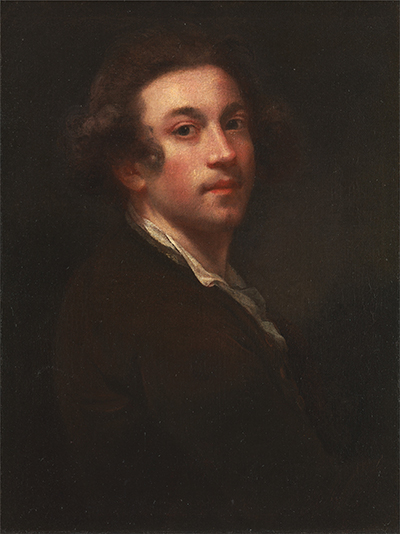
 by Tom Gurney
Tom Gurney BSc (Hons) is an art history expert with over 20 years experience
Published on November 6, 2026 / Page Updated on November 6, 2026
Email: tomgurney1@gmail.com / Phone: +44 7429 011000
Introduction
Joshua Reynolds became the dominant British portrait painter of the eighteenth century because he understood portraiture as more than likeness. A Reynolds portrait could advertise rank, preserve family ambition, stage theatrical celebrity, record friendship, convert military service into public virtue or turn childhood into an emblem of innocence. The National Portrait Gallery identifies him as Britain’s leading portrait painter, first President of the Royal Academy and the artist associated with 1,441 portraits in its collection data.[1] The number matters because it points to a career built through social range as well as pictorial invention.
Reynolds’s own ambition was paradoxical. He believed history painting occupied the highest rank in art, yet the National Gallery notes that his greatest works are portraits.[2] That tension shaped his art. He used portrait commissions to bring the dignity of history painting, Old Master composition and antique sculpture into the world of living sitters. He did not simply paint the fashionable. He trained the fashionable to appear in a more elevated visual language.
Portraiture also made Reynolds a social force. His sitters included aristocrats, politicians, writers, actors, soldiers, children, colonial celebrities and members of his own intellectual circle. His studio became a place where appearance, reputation and ambition were negotiated. A sitter came to Reynolds for a likeness, but also for a version of the self that could survive public display, family inheritance and print reproduction.
At a Glance
- ArtistSir Joshua Reynolds (1723–1792)
- Primary fieldPortrait painting [1][3]
- Professional statusBritain’s leading eighteenth-century portrait painter
- Royal AcademyFirst President from 1768
- Studio baseLeicester Square from 1760 [6]
- Studio systemAssistants, drapery painters and copyists [6]
- EvidenceSitter books, accounts, archives and catalogue records
- Catalogue backboneMannings and Postle, 2000 [5]
- Portrait networkAristocrats, families, children, actors, writers and soldiers
- Representative splashExisting artist-root portrait image
Contents
- Introduction
- Portraiture as public ambition
- The studio as a working machine
- Likeness, character and elevation
- Women, visibility and performance
- Children and the invention of innocence
- Soldiers, empire and command
- Global sitters and the limits of admiration
- Sitter books, catalogue order and evidence
- Why Reynolds portraits still matter
Portraiture as public ambition
Reynolds’s career was built in London after his return from Italy in 1752. The National Gallery connects his mature achievement to his study of ancient and Italian Renaissance art, and of Rembrandt, Rubens and Van Dyck.[2] Those models gave him a way to enlarge British portraiture without abandoning its commercial basis. A face still had to be recognisable, but the surrounding pose, lighting, costume and allusion could make recognition feel more important.
This is the central Reynolds move. He takes portraiture, a genre often treated as dependent on vanity and patronage, and pushes it toward intellectual seriousness. The sitter remains the occasion, but not the whole purpose. A naval officer may recall antique heroism. An actress may become a tragic muse. A family group may borrow the authority of Van Dyck. A child may be painted with the emotional gravity of religious or fancy imagery. Reynolds’s portraits are therefore not just records of people; they are arguments about what portraiture can do.
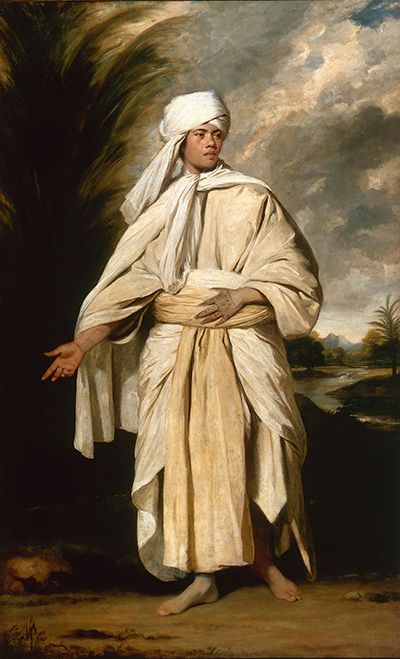
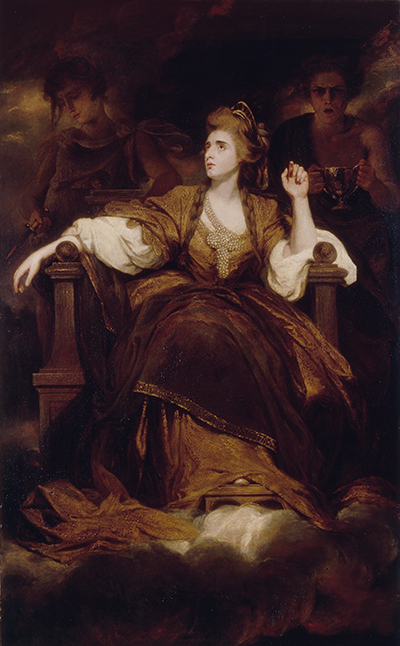
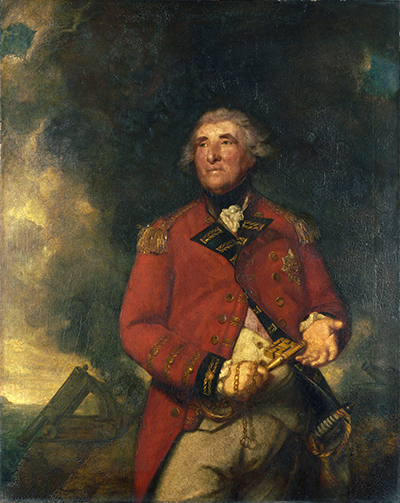
The National Portrait Gallery connects his Grand Manner with antique and Old Master models, and with a portrait language capable of moral or heroic suggestion.[1] That idea can sound abstract until it is tested against the paintings. Portrait of Mai (Omai) turns a Pacific visitor in London into a full-length figure of classical poise. Sarah Siddons as the Tragic Muse transforms a celebrated actress into an embodiment of tragedy. Lord Heathfield of Gibraltar compresses a siege, a military reputation and a strategic fortress into the sitter’s grip on a key.
These portraits also show why Reynolds could be persuasive and problematic at once. He gave sitters grandeur, but grandeur often served power. Aristocratic lineage, imperial possession, military fame and celebrity could all be made to appear natural, dignified and enduring. A good Reynolds portrait is rarely innocent in the modern sense. It is a beautiful machine for turning social claims into visual authority.
The sitter and the social network
Reynolds’s success depended on access. He was not born into the highest circles, but he became fluent in their language. The National Portrait Gallery’s record calls attention to his social ambition and self-promotion, and also to the role of his contacts in his rise.[1] That judgement is useful because it prevents a sentimental view of the artist as merely waiting for genius to be recognised. Reynolds made recognition happen.
His social gifts mattered because eighteenth-century portraiture was a relationship business. A commission might lead to another commission within the same family, circle or political group. A portrait seen in a studio, exhibition or engraved form could become a form of advertisement. The National Gallery archive record for John Julius Angerstein is a good example: Angerstein commissioned family portraits from Reynolds between 1765 and 1783, acquired other Reynolds works and later became part of the collecting history that helped form the National Gallery.[9]
The apprenticeship behind that rise should not be forgotten. Reynolds trained with Thomas Hudson, the fashionable London portraitist, before travelling to Italy and forming the visual habits that distinguished his mature career.[2] Hudson gave him access to the existing trade of polite likeness. Italy gave him a larger grammar of pose, composition and pictorial authority. Reynolds’s mature portraiture grew from the friction between those two inheritances: the London business of getting sitters and the European ambition of making portraits look like major art.
The painter’s friendships also enlarged his range. Reynolds was close to Samuel Johnson and belonged to a literary and intellectual world in which portraiture could preserve conversation as much as rank. Portraits of Johnson, Goldsmith, Burke, Garrick and other public figures belong to a culture in which authors, actors and politicians were becoming visible as personalities. Reynolds did not invent celebrity, but he gave it a serious pictorial language.
That language worked because it balanced individuality with type. A sitter needed to be recognisable, but also legible as a statesman, actor, mother, naval officer, beauty, child, scholar or commander. Reynolds’s art often begins with that double demand. It asks: what kind of person is this, and what kind of image will make that identity persuasive?
The studio as a working machine
Reynolds’s portraits were not produced by solitary inspiration alone. The Wallace Collection’s account of his studio makes clear that his commercial success after Italy made him increasingly reliant on pupils, assistants, drapery painters and copyists.[4] Giuseppe Marchi, whom Reynolds had met in Rome, became a long-serving assistant, while specialist drapery painters such as Peter Toms and George Roth also contributed to the practical production of portraits.[4]
This does not diminish Reynolds’s authorship. It shows the scale of his practice. A successful portrait painter had to handle sittings, compositions, clothing, frames, payments, copying, delivery and engraving as well as paint. Wallace notes that Reynolds’s memorandum book recorded the colour and style of sitters’ clothing, inscriptions and frames, and that sitters’ clothing could be sent out with portraits to drapery painters.[4] The portrait was an artwork, but also an organised transaction.
The economics are revealing. Wallace records that in the 1750s Reynolds charged 48 guineas for a full-length portrait and that Peter Toms received 15 guineas for drapery work from that amount.[4] The full-length portrait was therefore not only larger in scale; it required a more complex division of labour. Drapery, accessories and replicas belonged to the machinery through which fashionable portraiture was made.
Reynolds’s 1760 move to Leicester Square signalled that he had arrived. Wallace describes the move from Great Newport Street to a grander establishment, and the construction of a spacious octagonal painting room behind the house.[4] There, sitters could take their ease in a leather armchair now held by the Royal Academy.[4] That detail is wonderfully concrete. Reynolds’s portrait practice rested on conversation, staging and comfort as well as brushwork.
The studio also functioned as a showroom. Patrons did not only come to be painted; they came to see what kind of painter Reynolds was. The National Gallery’s account of Captain Robert Orme notes that Reynolds liked to keep heroic full-length portraits on display in his studio so sitters might be persuaded to commission something more ambitious than a simple head-and-shoulders likeness.[7] In other words, earlier portraits helped sell later portraits. The studio was a theatre of aspiration.
Formats and the price of ambition
Portrait format mattered. A head-and-shoulders likeness, a half-length, a three-quarter length, a full-length, a pair, a family group and an equestrian portrait did different social work. Reynolds’s genius was not only that he painted faces well. It was that he understood how much meaning could be loaded into scale. A full-length portrait gave the sitter a body, a setting and a field of action. It could turn possession, command, lineage or glamour into something physically imposing.
The economics recorded by Wallace help explain why format mattered so much.[4] The full-length portrait was expensive, and its cost included not only canvas and labour but social theatre. A patron who chose that format was choosing a public claim. The result might hang in a town house or country seat, but the ambition was larger than decoration. It said that the sitter deserved space.
Reynolds exploited that ambition carefully. His studio display of heroic full-lengths such as Captain Robert Orme was a kind of visual persuasion.[7] A visitor could see what a grander format might do: lengthen the body, widen the setting, introduce action, borrow Old Master authority and turn a military or aristocratic identity into a memorable design. It is easy to imagine the effect on a potential patron. The portrait promised not just resemblance, but enlargement.
This is why Reynolds’s portraiture cannot be separated from aspiration. Some sitters already possessed rank, but others were consolidating reputation, seeking cultural polish or converting money into visible gentility. Reynolds offered a sophisticated service: he made social ambition look historical, tasteful and inevitable. That service could be ethically slippery, but it was also artistically fertile.
Likeness, character and elevation
The most delicate problem in Reynolds portraiture is the relationship between likeness and elevation. A portrait had to satisfy those who knew the sitter, but Reynolds also wanted it to speak beyond private recognition. He solved the problem by making character visible through pose, costume, gesture and setting. The face matters, but the body and surrounding invention carry the larger claim.
This is why his portraits often feel both social and theatrical. The sitter may appear in modern dress, classical drapery, military uniform or a loosely historical costume. A hand rests on a book, a dog, a key, a bow, a column, a curtain, a child or a landscape opening. These details are not decorative padding. They are signs that guide the viewer’s reading of the person.
Reynolds’s theory could be severe about fashion. In the Wallace Collection’s fashion essay, his Royal Academy advice is used to show the tension between modern dress and a more timeless pictorial dignity.[5] Reynolds wanted portraiture to avoid being trapped by the latest garment, hairstyle or fabric. Yet his best portraits often gain energy from exactly that tension. He could idealise clothing into drapery, but he could also paint fashionable textures with sensuous intelligence.
The Discourses clarify the intellectual pressure behind this practice. Reynolds urged young artists to look beyond petty detail toward general form, selection and dignity, yet portraiture constantly pulled him back toward the particular.[11] The sitter’s face, the cut of a sleeve, the sheen of silk or the meaning of a uniform could not simply be dissolved into theory. Reynolds’s portraits are interesting because they negotiate with his principles rather than merely obey them.
Nelly O’Brien is a good reminder that Reynolds was not always austere. Wallace presents her portrait as a vivid example of dress, surface and bodily presence, while also noting how another image of her moved toward more imaginative eroticised invention.[5] Reynolds’s portraits could therefore slide between social fact and staged fantasy. He knew that clothing was never merely clothing. It could reveal taste, wealth, availability, rank, sexual reputation or aspiration.
The same issue appears in aristocratic women’s portraits, where white dress, dark landscape, classical allusion and controlled gesture could turn fashionable modern sitters into something like secular icons. Reynolds did not erase the present. He softened it into a form that seemed fit for memory.
Women, visibility and performance
Women’s portraits occupy a large and complicated part of Reynolds’s achievement. Some were aristocratic display pictures, some family images, some theatrical portraits, some portraits of celebrated beauties, some images touched by scandal or gossip. They show Reynolds working inside a social order that valued women’s appearance intensely while restricting their authority in public life.
That contradiction gives many of the portraits their charge. A woman sitter might be presented as graceful, maternal, learned, fashionable, alluring, dignified or theatrically powerful, but the terms of visibility were rarely neutral. A portrait could secure status and reputation, yet it could also expose the sitter to judgement. Reynolds’s skill lay in finding forms of display that felt elevated rather than merely exposed.
The distinction between timeless drapery and modern fashion mattered especially here. Wallace’s fashion essay shows how Reynolds could theorise against the distracting specificity of modern dress while still producing portraits whose fabrics, hats, lace, petticoats and hair register the energy of contemporary fashion.[5] The result is not inconsistency so much as pressure. Reynolds wanted women to appear beyond fashion, but fashion was one of the ways their social identity became visible.
This is why Sarah Siddons as the Tragic Muse, Mrs Abington, Mrs Mary Robinson, Nelly O’Brien, Lady Bampfylde and Jane Fleming, Countess of Harrington should not be treated as variations on one type. They occupy different positions within eighteenth-century femininity, celebrity and status. Some images lean toward allegory, others toward theatrical charm, others toward aristocratic polish or seductive ambiguity. Reynolds’s portraits of women are not a single category; they are a field of negotiation.
Aristocracy, family and inheritance
Many Reynolds portraits are family instruments. They were made for houses, heirs and lineages. A likeness could preserve the face of a parent, child, spouse or ancestor, but it could also display continuity: bloodline, estate, marriage alliance, social standing and cultivated taste. This is one reason Reynolds’s family groups are so important. They show portraiture working as social architecture.
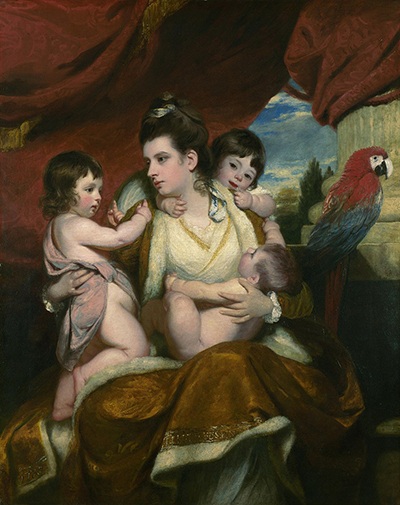
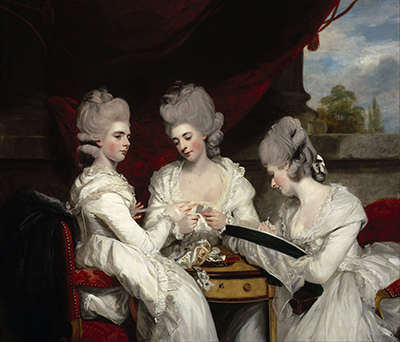
Lady Cockburn and Her Three Eldest Sons is one kind of family image: maternal, allegorical, glamorous and self-consciously indebted to older art. The Ladies Waldegrave is another: three sisters absorbed in needlework, a conversation-piece structure made grander by Reynolds’s handling of pose and surface. Lady Elizabeth Delmé and her Children, still to receive its own detailed treatment in this cluster, belongs to the same broad culture of aristocratic family display.
Reynolds’s family portraits rarely present family life as casual. Even when the mood is affectionate, the image is shaped by inheritance and status. Children are not just loved; they are future names, estates and alliances. Women are not just individuals; they may be presented as mothers, beauties, patrons, heirs or participants in dynastic arrangement. Reynolds’s achievement is that he makes such social pressure look graceful.
Angerstein’s commissions show the patronage structure behind this world. The National Gallery archive record states that he commissioned Reynolds to paint four family portraits between 1765 and 1783, including his earliest known likeness, and later acquired other Reynolds works.[9] A patron did not simply buy a picture. He entered a cultural circuit in which family identity, collecting and reputation could reinforce one another.
Children and the invention of innocence
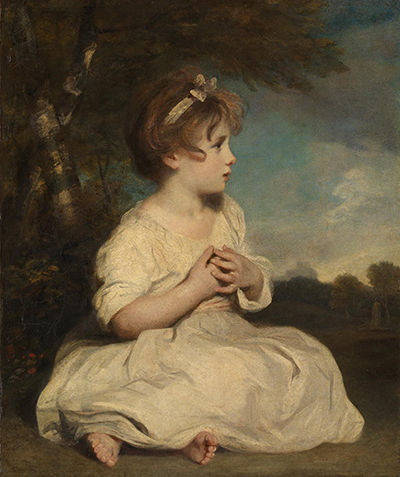
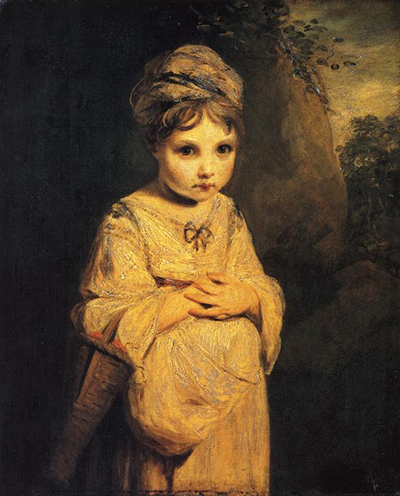
Reynolds’s child portraits are among his most popular images, but they need careful reading. Their charm is real, yet it is constructed. The Age of Innocence, The Strawberry Girl, The Infant Samuel, Miss Bowles, Master Hare and Lady Caroline Howard all belong in different ways to a late eighteenth-century fascination with childhood as emotional theatre.
The child in Reynolds may be playful, devotional, melancholy, self-possessed or mysteriously withdrawn. The sitter’s social identity sometimes matters less than the mood created around childhood. In The Strawberry Girl, the little figure is not just a child with a basket. She becomes an image of vulnerability and feeling. In The Infant Samuel, childhood is turned toward prayer and religious sentiment. In The Age of Innocence, uncertain sitter identity has become part of the picture’s afterlife, because the title invites viewers to read the figure as an idea.
These works are not detached from portrait practice. They grow from the same studio culture, the same patron networks and the same appetite for images that could be copied, engraved and cherished. But they also test the edge between portrait and fancy picture. A Reynolds child may begin as a likeness and end as a widely shared emotional type.
That doubleness helped the pictures travel. A named child portrait could become, through repetition and print, a more general image of childhood. This is one of Reynolds’s quiet powers. He could turn individual sitters into social symbols without fully abandoning the claim of likeness.
Actors, writers and public personalities
Reynolds was especially gifted at painting people whose fame depended on performance, speech or intellect. Writers, actors and public talkers presented a different challenge from aristocratic landowners. Their rank could not be expressed only by estate, lineage or uniform. Their portraits had to suggest presence, mind and reputation.
Samuel Johnson is the obvious literary case. Reynolds’s friendship with Johnson matters because the portrait becomes part of a larger culture of conversation, print, criticism and biography. Johnson’s image is not simply that of a private friend. It is an image of intellectual authority. Reynolds knew how to make the thinking face carry weight.
Actors posed another problem. Their fame was embodied but unstable: a voice, a gesture, a role, a night’s performance. Sarah Siddons as the Tragic Muse is Reynolds’s most magnificent answer. Rather than paint Siddons as merely herself or merely in costume, he turns her celebrity into allegory. The actress becomes the governing figure of tragedy, flanked by the emotional forces her art commands.
Mrs Abington and Mrs Mary Robinson open other routes through theatrical and social portraiture. With actresses, Reynolds had to negotiate glamour, respectability, sexuality, performance and public curiosity. These women were visible in ways that could be empowering and dangerous. A portrait could elevate them, but it could also feed the appetite that made their reputations vulnerable.
This is where Reynolds’s skill as a social reader becomes crucial. His portraits do not all dignify sitters in the same way. A writer may require inward weight; an actress may require theatrical charge; a courtesan or fashionable woman may require a more ambiguous play of candour, display and idealisation. Reynolds adjusted the language without abandoning his overall ambition.
Soldiers, empire and command
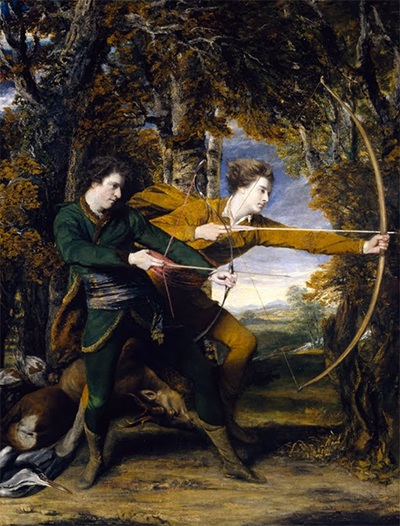
Reynolds’s military portraits are among the clearest examples of portraiture aspiring to history painting. The sitter is not only a person in uniform. He becomes the visible sign of action, command and national conflict. Captain Robert Orme, Colonel Acland and Lord Sydney: The Archers, Colonel Tarleton and Lord Heathfield of Gibraltar all show different ways Reynolds could make military identity theatrical.
The National Gallery’s Captain Robert Orme record is especially useful because it reveals Reynolds’s studio strategy. The painting’s Old Master source material and urgent heroic stance were not private experiments; Reynolds kept such full-length portraits on display to encourage sitters toward more ambitious commissions.[7] The heroic portrait advertised both the sitter and the painter.
Colonel Tarleton shows the speed with which Reynolds could respond to current military celebrity. The National Gallery records nine sittings, the first only ten days after Tarleton’s return to England at the end of the American War of Independence.[8] It also notes that once the head and shoulders were sufficiently finished, an image was produced for publication with an account of Tarleton’s exploits.[8] Portraiture, news and reputation were moving together.
Modern writing cannot treat such images as neutral. The National Gallery’s Tarleton record also identifies the sitter’s later defence of the slave trade and the family wealth behind that connection.[8] Reynolds’s portraits often dignify power, and power has histories attached to it. A responsible reading can admire the invention of the image while refusing to let military glamour erase violence, empire or slavery-linked wealth.
Lord Heathfield of Gibraltar works differently. The sitter is made almost immovable, gripping the key of Gibraltar while smoke and artillery evoke siege. The portrait turns defensive command into moral steadiness. Yet, as with Tarleton, the grandeur of the image belongs to a world of imperial possession and strategic rivalry. Reynolds’s military portraiture is impressive because it understands public myth so well; that is also why it must be read with care.
Global sitters and the limits of admiration
Portrait of Mai (Omai) is one of Reynolds’s greatest portraits, but it also tests the limits of the Grand Manner. Mai was not an aristocratic British patron, nor a conventional military or literary sitter. He was a Polynesian visitor to Britain whose image became entangled with Pacific exploration, imperial curiosity and European ideas about natural humanity.
Reynolds gives Mai extraordinary dignity. The full-length pose, classical reference and calm command make the portrait visually equal to the grandest aristocratic images. Yet that dignity is not simple freedom from European projection. The picture also translates Mai through a visual language Reynolds and his audience controlled. It asks viewers to admire him, but also to see him through British classicising imagination.
This is a pattern in Reynolds at his best. He can elevate a sitter and frame that sitter at the same time. The result may be visually generous and culturally possessive. A modern account should hold both truths. Reynolds’s portraiture created some of the most powerful images of eighteenth-century identity, but those identities were never made outside unequal social structures.
The same caution applies more quietly to portraits of women, children, actors and servants. Reynolds’s art often gives sitters grace, but it also places them inside available categories. The child becomes innocence. The actress becomes tragedy, comedy, glamour or desire. The aristocratic woman becomes lineage, beauty or maternal virtue. Reynolds’s greatness lies partly in how compelling those transformations are. Their danger lies in how natural they can seem.
Sitter books, catalogue order and evidence
Reynolds’s portrait career is unusually rich in documentary traces. The Paul Mellon Centre notes that its digitised Photo Archive contains more than 4,200 images associated with Reynolds, arranged according to David Mannings’s catalogue raisonné, and that it includes facsimiles of Reynolds sitter books from 1757 to 1790.[3] Those sitter books are essential because they connect finished images to the practical rhythm of appointments, returns, payments and studio time.
Mannings’s catalogue is equally important for keeping the portrait corpus under control.[10] Reynolds produced originals, versions, studio works, copies and images that circulated through engravings. Titles changed. Sitters were misidentified. Paintings moved through families, sales and museums. A responsible account of Reynolds portraits needs that catalogue structure because visual memory alone can be misleading.
This matters especially for famous images. The Age of Innocence is not secure in sitter identity. The Strawberry Girl exists in multiple versions. The Infant Samuel belongs to a version history that can confuse related compositions. Portraits of writers and aristocrats often survive in copies after Reynolds or studio versions. A name on a frame or an old title is not always enough.
The documentary record also reminds us that portraiture is temporal. A sitter did not arrive once and become immortal. He or she sat repeatedly, changed clothing, chose format, waited for completion, paid or delayed payment, displayed the work, had it copied or engraved, and sometimes saw it altered by later ownership. Reynolds portraits are objects, but they are also events extended over time.
The sitter books give that temporality a practical shape. A completed portrait may look as if it came into being in one decisive moment, but the record behind it is iterative: appointments, absences, returns, changes of costume, unfinished heads, later draperies and payments. Reynolds’s art is therefore grand in effect but serial in process. The finished image hides the calendar that produced it.
That hidden calendar is especially useful for avoiding romantic myths about portraiture. Reynolds did not simply capture a sitter. He managed time, access and expectation. His studio had to hold together the sitter’s impatience, the patron’s demand, the assistant’s task, the engraver’s opportunity and the painter’s own desire for pictorial dignity. The result could look effortless only because so much effort had been made invisible.
Prints, replicas and reputation
Reynolds understood the power of circulation. A portrait in a private house could impress family and visitors. A portrait in an exhibition could reach a broader public. A print after a portrait could travel much further. His collaboration with engravers and publishers helped turn painted likenesses into public images.
The studio system supported this process. Wallace describes copyists and assistants as part of Reynolds’s working practice, and notes that he worked with engravers, distributed commissions and gave instructions on inscriptions.[4] Print culture therefore belongs close to the heart of Reynolds portraiture. It was not merely an afterlife. It was one of the ways portraits became famous.
The Earlom print after Lord Heathfield, the Haward print after Sarah Siddons as the Tragic Muse, the print after Portrait of Mai and the many later reproductions after child pictures all show the same principle. Reproduction detached the image from the room in which the painting hung. It also strengthened the sitter’s public identity. The face, pose and emblem could become familiar even to those who never saw the original.
Repetition also complicates authorship. A painting by Reynolds, a studio version, a copy after Reynolds and a print after Reynolds do different things. They may preserve the same design, but they do not carry the same material or evidentiary value. This is why the Mannings catalogue and current museum records matter so much. They help separate the original act of portrait invention from the long chain of transmission that followed.
The afterlife could also change emphasis. A painted portrait might have begun as a commission for a particular patron or family, while an engraving turned it toward a broader audience that cared less about private obligations and more about fame, beauty or moral example. This shift is crucial for Reynolds. Many of his images are best understood as moving between private possession and public familiarity.
Prints also helped certain Reynolds types become self-reinforcing. The tragic actress, the heroic officer, the innocent child and the elegant beauty could be recognised across different objects because engraving spread the formula. Reynolds’s reputation was therefore built not only by what he painted, but by how his paintings travelled.
Why Reynolds portraits still matter
Reynolds portraits still matter because they reveal how eighteenth-century Britain wanted to see itself. The world they picture is elegant, articulate, ambitious and deeply hierarchical. It values rank, taste, military service, literary fame, theatrical feeling, family continuity and cultivated self-command. It also hides or softens many of the forces that sustained those values.
They also matter because Reynolds changed what British portraiture could claim. He did not make every sitter heroic, but he made portraiture capable of heroic pressure. He gave likeness the ambition of history painting, and he gave social ambition the glow of Old Master art. The result is sometimes flattering, sometimes morally uneasy, often technically risky and frequently unforgettable.
The Wallace Collection’s Reynolds Research Project is useful here because it frames Reynolds not only as a celebrated portraitist but as an experimental painter whose materials, patrons, poses, genres and exhibition choices need to be studied together.[6] That is exactly how the portraits should be read. They are not just faces. They are negotiated objects shaped by social desire, studio labour, theory, material experiment and public circulation.
The best Reynolds portraits have a strange double life. They belong to individual sitters, yet they quickly become more than individual. Mai becomes a global image, Siddons tragedy, Heathfield steadfast defence, Johnson intellect, a child innocence, a fashionable woman grace or danger. Reynolds’s art made those transformations look inevitable. Looking closely restores the work behind the illusion.
Frequently Asked Questions
Discussion
When does a Reynolds portrait reveal character, and when does it make social status look like personal virtue?
Reader Insights
How should specialist collaboration change our understanding of Reynolds's authorship?
What do pose, dress and setting ask viewers to believe about a sitter?
Whose lives became public through portraiture, and whose labour or wealth remained outside the frame?
Join the Conversation
Share your reading below.
References
- National Portrait Gallery, Sir Joshua Reynolds person record, https://www.npg.org.uk/collections/search/person/mp03755/sir-joshua-reynolds
- National Gallery, London, “Sir Joshua Reynolds 1723-1792,” https://www.nationalgallery.org.uk/artists/sir-joshua-reynolds
- Paul Mellon Centre for Studies in British Art, “Joshua Reynolds (1723–1792),” https://www.paul-mellon-centre.ac.uk/archives-and-library/artist-subject-guides/joshua-reynolds
- Wallace Collection, “Reynolds's Studio,” https://www.wallacecollection.org/explore/explore-in-depth/reynolds/the-artist/reynoldss-studio/
- Wallace Collection, “Reynolds and Fashion,” https://www.wallacecollection.org/explore/explore-in-depth/reynolds/the-artist/reynolds-and-fashion/
- Wallace Collection, “The Reynolds Research Project,” https://www.wallacecollection.org/explore/explore-in-depth/reynolds/the-reynolds-research-project/
- National Gallery, London, Sir Joshua Reynolds, Captain Robert Orme, NG681, https://www.nationalgallery.org.uk/paintings/sir-joshua-reynolds-captain-robert-orme
- National Gallery, London, Sir Joshua Reynolds, Colonel Tarleton, NG5985, https://www.nationalgallery.org.uk/paintings/sir-joshua-reynolds-colonel-tarleton
- National Gallery, London, “Joshua Reynolds receipts for Angerstein family portraits,” NGA60, https://www.nationalgallery.org.uk/research/research-centre/archive/record/NGA60
- David Mannings, Sir Joshua Reynolds: A Complete Catalogue of His Paintings, with subject pictures catalogued by Martin Postle, 2 vols, Yale University Press / Paul Mellon Centre for Studies in British Art, 2000.
- Joshua Reynolds, Fifteen Discourses Delivered in the Royal Academy, Project Gutenberg, https://www.gutenberg.org/files/52436/52436-h/52436-h.htm