 by Tom Gurney
Tom Gurney BSc (Hons) is an art history expert with over 20 years experience
Published on June 19, 2020 / Page Updated on November 6, 2026
Email: tomgurney1@gmail.com / Phone: +44 7429 011000
Introduction
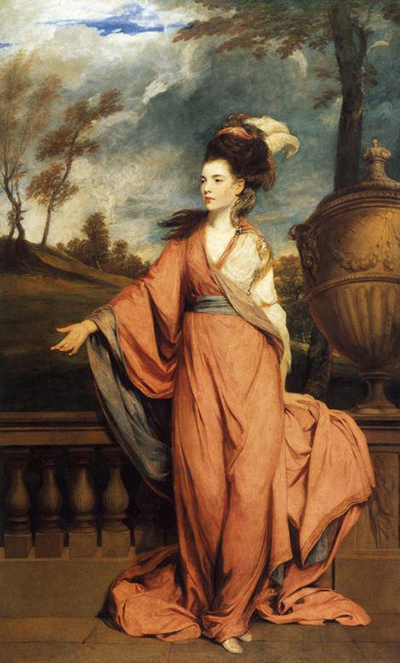
Joshua Reynolds's Jane Fleming, later Countess of Harrington is a full-length aristocratic portrait from about 1778-1779, now in the Huntington Library, Art Museum, and Botanical Gardens. The Huntington identifies it as oil on canvas, accession 13.3, measuring 94 1/4 by 58 1/16 inches, and describes the sitter standing on a terrace before a cloudy blue sky.[1] Wikimedia's image metadata corroborates the Huntington identity, date range, medium and dimensions, while rightly remaining secondary to the museum entry.[2]
The sitter was Jane Fleming, born in 1755 and later Jane Stanhope, Countess of Harrington. The National Portrait Gallery identifies her as Lady of the Bedchamber to Queen Charlotte and as a society hostess, a compact description that helps explain why Reynolds gives her such public presence.[6] She is not shown in domestic retreat. She appears on a balustraded terrace, dressed in a rose-coloured classical robe, with one arm extended and the other holding the sweep of her fabric. The portrait is about rank, fashion, performance and self-command.
This matters because the painting is easily misdated or confused with other Reynolds portraits of Jane. The local title is useful, but the Huntington painting is not an 1788/89 work and Jane was not born Jane Stanhope. Reynolds painted more than one image connected with her, and later prints multiplied the identities further. David Mannings's catalogue tradition is therefore essential: Christie's distinguishes the Huntington full-length as Mannings no. 1695, while the separate Harewood full-length is Mannings no. 1694.[10] The whole article depends on keeping that distinction clear.
At a Glance
- TitleJane Fleming, later Countess of Harrington
- ArtistJoshua Reynolds
- SitterJane Fleming, later Jane Stanhope [6]
- Datec. 1778–1779 [1]
- MediumOil on canvas [1]
- CollectionThe Huntington [1]
- Accession13.3 [1]
- Dimensions239.4 × 147.5 cm [1]
- SettingBalustraded terrace with cloudy sky [1]
- CatalogueMannings 1695 [10]
Contents
- Introduction
- The Huntington portrait
- Gesture and theatrical presence
- Dress, feathers and fashion
- Jane Fleming and the Harrington world
- The Harewood portrait and Mannings 1694
- Reynolds and the female full-length
- Print afterlife and later images
- Why Jane Fleming, Countess of Harrington matters
The Huntington portrait
The Huntington portrait presents Jane at nearly life-size, standing on an architectural terrace with landscape and stormy light behind her.[1] The composition is simpler than some of Reynolds's grandest mythological portraits, but it is not plain. The balustrade, urn, trees, sky and swept fabric create a stage on which the sitter can appear at once natural and highly arranged.
The rose robe is central to the effect. Huntington's description notes a classical robe fastened over the left shoulder with a rose silk band.[1] Reynolds uses that dress to move Jane away from everyday fashion and toward an antique, theatrical mode. It is not costume in the narrow sense of disguise. It is a form of portrait language, allowing a modern woman of rank to appear with the dignity of a figure from poetry, drama or ancient ceremony.
The cloudy sky gives the portrait motion. Reynolds does not place Jane against a neutral interior or a plain studio curtain. He sets her before weather. The landscape behind her looks unsettled, and that unsettledness makes her calm more visible. Her body is poised; the air around her moves. The result is a portrait of composure under atmospheric pressure.
The great urn at the right contributes to the same effect. It enlarges the setting, anchors the terrace and gives the composition an antique architectural weight. Reynolds uses it almost like a second vertical figure. Jane's upright body, the urn and the dark tree work together to create a structure of elegance and authority.
The terrace is not just a convenient platform. It creates a threshold between cultivated architecture and open landscape. Jane stands at that threshold as if she belongs to both. Behind her are trees, sky and distance; around her are stone, urn and balustrade. Reynolds makes aristocratic identity seem capable of ordering nature without shutting it out.
That setting also changes the viewer's position. We are not inside a drawing room, nor are we wandering in a rustic field. We meet Jane in a controlled outdoor theatre, where landscape has been brought close enough to animate the portrait but kept far enough away to remain decorative. It is a world made for appearance, and Jane is its central actor.
Gesture and theatrical presence
The most arresting feature is Jane's extended right arm. The Huntington label calls the outstretched arm a conventional theatre gesture.[1] That phrase is valuable because it stops the movement from being read as a random flourish. Reynolds gives Jane a gesture associated with performance, address and display. She seems to indicate something beyond the frame, but the real point is not the unseen object. The point is the authority of indicating.
That gesture makes the portrait feel active. Jane is not merely being looked at; she appears to direct attention. The hand opens outward, the head turns in profile, and the drapery follows the movement. Reynolds turns a society portrait into something closer to a scene. The viewer arrives as if just after she has begun to speak or move.
The gesture also gives Jane a public bearing. Many eighteenth-century female portraits are built around softness, availability or contemplative stillness. This one is more declarative. Jane's body opens into space; her hand crosses the boundary between the terrace and the viewer's world. The pose is elegant, but it has command inside it.
This command is carefully artificial. Reynolds is not pretending to catch Jane by accident. He is staging her. Theatricality is not a weakness in the portrait; it is the means by which the sitter's social identity becomes visible. As Lady of the Bedchamber and society hostess, Jane belonged to a world in which appearance, timing and public grace mattered intensely.[6] Reynolds gives those qualities a pictorial form.
The pose has another effect: it keeps her psychologically reserved. Jane's hand opens, but her face remains turned away from direct address. Her profile is cool, almost withheld. Reynolds balances invitation and distance, allowing the sitter to command attention without surrendering too much interiority. The viewer receives the performance, not an easy confession.
That balance is one reason the picture is stronger than a simple fashion portrait. Dress and feathers might have made Jane merely stylish. Gesture and profile give her authority. The body moves outward, while the face retains composure. Reynolds's best full-length portraits often depend on this double action, where surface glamour is supported by structural control.
Dress, feathers and fashion
Huntington's label also notes the ostrich feathers in Jane's hair, connecting them with a fashion recently popularised by Georgiana, Duchess of Devonshire.[1] That detail shifts the portrait from timeless classicism back into the late 1770s. The robe may look antique, but the feathers are fashionable. Reynolds makes Jane both classical and up to date.
The combination is typical of Reynolds at his most sophisticated. He rarely allows idealisation to erase the present completely. Instead, he lets the present pass through old art, theatre and antique costume. Jane's feathers tell the viewer that she is a woman of fashion; the classical robe tells the viewer that fashion can be elevated into something grander.
The rose colour is equally important. It warms the figure and keeps the portrait from becoming marble-like. Jane is not presented as a cold statue. Her clothing has weight, sheen and softness. The folds fall in long vertical rhythms, then gather and swell around the feet. Reynolds uses the robe to give her both body and theatre.
The colour also separates her from the cloudy distance. Against the grey-blue sky and darker foliage, the rose fabric becomes a controlled flare of social presence. Jane seems to generate warmth within a cooler landscape. The portrait's beauty depends on that contrast: cultivated polish against unstable weather, fashionable colour against aristocratic restraint.
The costume also reveals Reynolds's skill at making invention look wearable. The robe is not a literal court dress, but it does not feel absurd on the sitter. Its looseness gives the figure grandeur and movement, while the bodice and sash keep the form legible. The painting asks viewers to accept theatrical costume as the natural clothing of high status.
In that sense, Jane's portrait belongs to a broader eighteenth-century taste for mixing antiquity, fashion and performance. The sitter could appear modern enough to be recognisable, yet elevated enough to avoid seeming bound to one passing season. Reynolds understood the social value of that ambiguity. It made portraits feel both current and enduring.
Jane Fleming and the Harrington world
Jane Fleming married Charles Stanhope, third Earl of Harrington, and became Countess of Harrington. The NPG's brief sitter biography gives the most useful public identity: Jane Stanhope, née Fleming, 1755-1824, Lady of the Bedchamber to Queen Charlotte and society hostess.[6] Reynolds's portrait fits that identity because it treats Jane as someone whose social role was performed in rooms, courts, gatherings and networks of display.
The Harrington connection also had military and imperial dimensions. Yale's account of Charles Stanhope notes his service in North America and the Caribbean, and says his regiment arrived in Jamaica in 1780. Yale further notes that Jane accompanied him there and that she was the stepdaughter of a prominent Caribbean plantation owner.[7] Those facts do not turn the Huntington painting into a direct colonial allegory, but they widen the world around it.
That wider world matters because aristocratic elegance did not float above politics, war or empire. Jane's polished image belongs to a society connected to court service, military appointment, transatlantic movement and plantation wealth. Reynolds does not paint those structures directly. He paints a woman in rose drapery on a terrace. Yet the portrait's refinement is part of the same social order.
The safest reading holds both truths together. The painting is not a hidden map of colonial history, but neither is it an innocent fantasy detached from power. It is a portrait of rank and fashionable visibility made for a world in which rank had deep institutional and imperial supports. Reynolds's art turns that world into grace.
This broader context also helps keep the portrait from becoming merely decorative. Jane's elegance is not an isolated personal quality. It belongs to a social position, and that position was maintained through marriage, court service, family wealth, military appointment and reputation. Reynolds compresses all of that into an image of a woman who seems simply and effortlessly composed.
The effortless quality is deceptive. Portraits like this required the labour of painters, dressmakers, engravers, patrons, servants and viewers trained to recognise coded status. The Huntington painting conceals that labour behind the fluent fall of rose drapery. That concealment is part of the art. Reynolds makes social construction look like natural distinction.
The Harewood portrait and Mannings 1694
One reason this painting needs careful treatment is the existence of another Reynolds portrait of Jane at Harewood. Harewood House identifies its Portrait of Lady Harrington as a separate work from about 1775, showing Jane Fleming before marriage as Aurora, goddess of dawn, in a white satin gown with a flower wreath and a gold-starred sash.[5] That painting is not the Huntington image.
The distinction is more than pedantic. The Harewood portrait presents Jane as a mythological dawn figure before marriage, while the Huntington portrait shows her in rose classical dress on a terrace around 1778-1779. One is more explicitly allegorical; the other is more theatrical and fashionable. Both belong to Reynolds's language of aristocratic female display, but they solve different pictorial problems.
The print evidence confirms why confusion is so easy. The British Museum records Valentine Green's 1780 mezzotint after Reynolds, Jane, Countess of Harrington, as a whole-length figure standing to the right, head almost in profile, holding a wreath of flowers while managing her scarf.[3] It identifies that print as after Reynolds, Mannings 1694.[3] The National Gallery of Art holds another impression and likewise describes the figure in profile with flowing gown, wreath or bouquet, and landscape.[4]
Those details fit the Harewood/Aurora-type image more closely than the Huntington rose-robe portrait. Christie's then supplies the catalogue distinction: Huntington's full-length is Mannings no. 1695, while Harewood's is Mannings no. 1694.[10] That is the cleanest way to handle the two paintings. The Huntington work is not the same image as the Green mezzotint tradition attached to Mannings 1694.
The numbers matter because they protect the paintings from being flattened into a single glamorous Jane Harrington image. Mannings 1694, 1695 and 1696 mark separate inventions: the Aurora-like full-length, the Huntington terrace portrait and the later mother-and-children composition.[10][11] Each gives Jane a different public role, and each belongs to a different visual problem.
For the Huntington painting, the key identity is therefore not simply "Countess of Harrington by Reynolds." It is the rose-robed terrace portrait, made about 1778-1779, in which Jane's authority is carried through gesture, colour, weather and theatrical poise.[1][10] That sharper identity makes the picture easier to read and harder to misuse.
Reynolds and the female full-length
The Huntington painting belongs to a broader Reynolds project of turning aristocratic women into large, public, pictorial inventions. Christie's discussion of related Reynolds female full-lengths cites Mark Hallett's argument that the 1770s portraits crafted a new imagery of aristocratic beauty, often shaped by exhibition visibility and print circulation.[10] Jane's portrait fits that world even when its own public history is less straightforward than the better-known engraved examples.
Reynolds's problem was how to make a society portrait feel ambitious without turning it into pure allegory. In the Huntington picture, he does this through scale, gesture, costume and atmosphere. Jane remains recognisably a woman of late Georgian rank, but she is also made to act like a figure on a stage. The painting is not history painting, yet it borrows history painting's sense of action and consequence.
The portrait is also less intimate than it first appears. Jane is close enough to be seen in detail, but her pose refuses privacy. The outstretched arm and profile turn her away from direct exchange with the viewer. She is present, but not offered. Reynolds gives her visibility without making her merely available.
This is one of the painting's strongest qualities. It does not reduce aristocratic femininity to prettiness. It presents beauty as poise, timing, dress, command and social intelligence. Jane's hand, robe and profile all say that she knows how to occupy a public stage.
Print afterlife and later images
Jane's Reynolds identity continued through prints and related images. The NPG holds an 1805 stipple engraving by Mackenzie after Reynolds, identifying her as Jane Stanhope, née Fleming, Countess of Harrington.[6] The National Galleries of Scotland holds an 1808 stipple engraving by R. Cooper of the same sitter, showing how Jane's image remained available in print beyond the first Reynolds generation.[8]
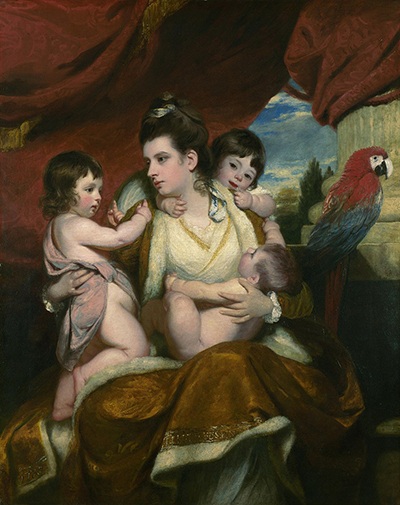
There was also a separate mother-and-children image. The Metropolitan Museum of Art records a later reproduction after Bartolozzi and Reynolds titled Jane, Countess of Harrington, connected with a print published in 1789.[9] Sanders of Oxford gives the fuller printed title as Jane, Countess of Harrington, Lord Viscount Petersham & the Honble Lincoln Stanhope, after Reynolds, engraved by Francesco Bartolozzi and published on 15 March 1789.[11]
This group portrait belongs to another Mannings number. Sanders identifies it as after Reynolds, Mannings 1696.[11] It should therefore remain separate from both the Huntington full-length and the Harewood/Aurora portrait. Jane's Reynolds afterlife is not one image repeatedly retitled; it is a small cluster of related but distinct portraits and prints.
That cluster is useful because it shows how portrait identity worked in Reynolds's world. A sitter could be represented as mythological maiden, fashionable full-length, courtly society woman and mother with children. Prints then carried those roles into wider circulation. Reynolds did not simply paint Jane once; he helped create a set of visual identities around her name.
Why Jane Fleming, Countess of Harrington matters
Jane Fleming, later Countess of Harrington matters because it shows Reynolds using the full-length portrait to create an image of aristocratic female command. The painting is beautiful, but its beauty is not passive. Jane stands, turns, gestures and holds the stage. Her rose robe gives warmth, her feathers declare fashion, and the cloudy landscape makes her composure feel deliberate.
The portrait also matters because it demands good version control. Without Mannings and print evidence, the Huntington painting can be confused with the Harewood Aurora portrait or with later engravings of Jane and her children. Once those works are separated, the Huntington picture becomes clearer: it is the rose-robed, theatrical, late-1770s full-length, Mannings no. 1695, not the wreath-bearing Aurora image attached to Mannings no. 1694.[10]
Seen this way, the painting becomes one of Reynolds's most elegant studies of social performance. Jane is classical without becoming remote, fashionable without seeming trivial, and commanding without any overt symbol of office. Reynolds gives her the resources of theatre and old art, then lets her use them as aristocratic self-possession.
The result is a portrait that feels poised between worlds. It belongs to the court and to fashion, to marriage and military networks, to classical costume and modern celebrity. It also belongs to the larger Reynolds experiment: making portraiture grand enough to carry the ambitions of history painting while still preserving the flicker of a living sitter.
Frequently Asked Questions
Discussion
How does Reynolds turn Jane Fleming's fashionable presence into a full-length image of aristocratic command?
Reader Insights
How does the extended arm make Jane appear to direct attention rather than simply receive it?
What happens when contemporary feathers meet a rose-coloured classical robe?
How does separating Mannings 1694, 1695 and 1696 change the way we understand Jane's public images?
Join the Conversation
Share your reading below.
References
- The Huntington Library, Art Museum, and Botanical Gardens, Jane Fleming, later Countess of Harrington. https://www.huntington.org/collections/mus-203
- Wikimedia Commons, Jane Fleming, later Countess of Harrington, by Joshua Reynolds. https://commons.wikimedia.org/wiki/File:Jane_Fleming,_later_Countess_of_Harrington,_by_Joshua_Reynolds.jpg
- British Museum, Valentine Green after Reynolds, Jane, Countess of Harrington, 1830,0714.51. https://www.britishmuseum.org/collection/object/P_1830-0714-51
- National Gallery of Art, Washington, Valentine Green after Reynolds, Jane (Fleming), Countess of Harrington. https://www.nga.gov/artworks/56276-jane-fleming-countess-harrington
- Harewood House, Portrait of Lady Harrington. https://harewood.org/object/portrait-of-lady-harrington/
- National Portrait Gallery, Jane Stanhope (née Fleming), Countess of Harrington, NPG D23520. https://www.npg.org.uk/collections/search/portrait/mw122494/Jane-Stanhope-ne-Fleming-Countess-of-Harrington
- Yale Center for British Art, Charles Stanhope, third Earl of Harrington and Marcus Richard Fitzroy Thomas. https://interactive.britishart.yale.edu/slavery-and-portraiture/287/charles-stanhope-third-earl-of-harrington
- National Galleries of Scotland, R. Cooper, Jane Stanhope (née Fleming), Countess of Harrington, 1755-1824. https://www.nationalgalleries.org/art-and-artists/104067
- Metropolitan Museum of Art, Reichsdruckerei after Bartolozzi and Reynolds, Jane, Countess of Harrington. https://www.metmuseum.org/art/collection/search/376628
- Christie's, Sir Joshua Reynolds, Portrait of Lucy Long, Mrs George Hardinge, lot essay. https://www.christies.com/lot/lot-6011502
- Sanders of Oxford, Francesco Bartolozzi after Reynolds, Jane, Countess of Harrington, Lord Viscount Petersham & the Honble Lincoln Stanhope. https://www.sandersofoxford.com/shop/product/jane-countess-of-harrington-lord-viscount-petersham-the-honble-lincoln-stanhope/