 by Tom Gurney
Tom Gurney BSc (Hons) is an art history expert with over 20 years experience
Published on June 19, 2020 / Page Updated on November 6, 2026
Email: tomgurney1@gmail.com / Phone: +44 7429 011000
Introduction
Joshua Reynolds's Lady Sunderland is more accurately identified in museum records as Lady Sunderlin. Painted in 1786, it is a full-length oil on canvas in the Gemäldegalerie, Staatliche Museen zu Berlin, inventory number 83.4. The Berlin partner record on Google Arts & Culture gives the dimensions as 238.5 by 147.9 cm and describes the portrait as one of Reynolds's major late works.[1] Wikimedia's Google Art Project metadata corroborates the Berlin collection, 1786 date, oil-on-canvas medium, accession 83.4 and the alternative title Lady Sunderlin.[2]
The sitter was Phillippa Elizabeth Dorothy Malone, née Rooper, Lady Sunderlin. The National Portrait Gallery identifies her as the wife of Richard Malone, Baron Sunderlin, and gives her dates as 1745-1831.[5] Romantic Circles similarly identifies her as Philippa Elizabeth Dorothy Malone, Lady Sunderlin, daughter of Godolphin Rooper of Berkampstead, and notes that she married Lord Sunderlin in 1778.[6] The inherited spelling “Sunderland” is therefore best treated as a familiar title variant, while the article itself should follow the sitter and collection evidence.
That correction matters because the painting has often been blurred by weak retellings. It is not an 1876 work, nor a portrait of “Landy Sunderland,” nor a picture connected with George VI. It belongs to 1786, after Richard Malone had been created Baron Sunderlin of Lake Sunderlin by George III in 1785.[1] Reynolds's task was to translate that newly elevated social position into a life-sized image of aristocratic presence.
The Staatliche Museen zu Berlin object address confirms the same institutional identity by resolving to Lady Sunderlin, object 868647.[3] The live Berlin collection interface is not easily readable without scripts, so the safest method is to treat that museum address as identity confirmation and use the Berlin partner record for accessible title, date, dimensions and interpretation.[1][3] Nicholas Hall's object entry supplies a further concise check: 1786, oil on canvas, 238.5 by 147.9 cm, in the Gemäldegalerie, Staatliche Museen zu Berlin.[7]
At a Glance
- Local titleLady Sunderland
- Institutional titleLady Sunderlin
- ArtistJoshua Reynolds
- SitterPhillippa Elizabeth Dorothy Malone, née Rooper [5]
- Date1786 [1]
- MediumOil on canvas [1]
- CollectionGemäldegalerie, Berlin [1]
- Inventory83.4 [1]
- Dimensions238.5 × 147.9 cm [1]
- CatalogueMannings 1179 [4]
Contents
- Introduction
- The Berlin portrait
- Lady Sunderlin and the Malone marriage
- Van Dyck and the Grand Manner
- Dress, light and social theatre
- Landscape and atmosphere
- Mannings 1179 and the printed afterlife
- Collecting and later reputation
- Why Lady Sunderland matters
The Berlin portrait
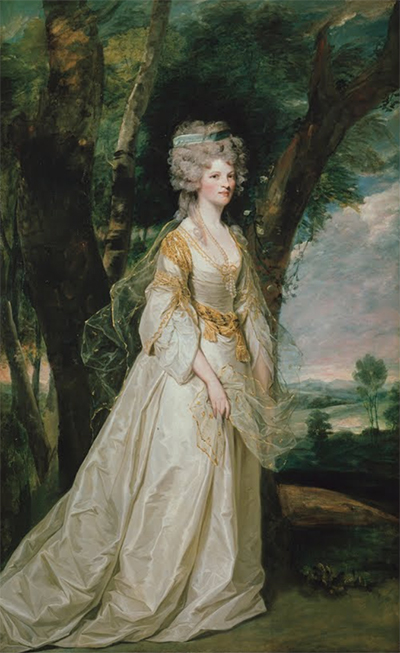
The Berlin portrait shows Lady Sunderlin standing at full length before a dark wooded screen. She wears a luminous white silk dress, a veil or transparent shawl, pearls and a high powdered hairstyle. Her body is directed slightly to the right, while her face turns outward enough to meet the viewer. Behind her, the dense trees open to a distant evening landscape.
The composition depends on contrast. The sitter's dress catches the light and expands across the lower half of the canvas, while the trees behind her create depth and shadow. The right side of the picture opens toward hills, sky and distance. Reynolds sets white silk against dark foliage, human polish against landscape, and social stillness against atmospheric movement.
Google Arts & Culture's Berlin record stresses the importance of that landscape. It notes that the warm palette and loose execution make the landscape contribute more to the splendid effect of the portrait than scenic backdrops usually do.[1] This is exactly right. The landscape is not filler. It gives the figure scale, air and emotional temperature.
The painting is late Reynolds, but it is not tired Reynolds. The figure is slender, poised and bright. The brushwork in the dress and landscape is relaxed without becoming careless. The image has glamour, but also a certain coolness. Lady Sunderlin is displayed magnificently, yet she remains reserved.
That reserve is important. The sitter does not act out a mythological role, unlike some of Reynolds's most theatrical female portraits. She stands as herself, but her selfhood has been enlarged by the full apparatus of Grand Manner portraiture. The painting's power comes from making a recently ennobled identity look calm, continuous and inevitable.
The local image shows why the portrait has remained visually memorable. The white dress fills the foreground like a column of light, while the black-green woodland folds around it. A bright figure in dark landscape is not unusual in Reynolds, but here the contrast is especially clean. The painting is built to be read immediately, even before the viewer knows the sitter's name.
Lady Sunderlin and the Malone marriage
The sitter's social identity gives the portrait its occasion. The Berlin record states that Lady Philippa Elizabeth Dorothy Sunderlin was the eldest daughter of Godolphin Rooper from Great Berkhamstead in Hertfordshire. In 1778 she married Richard Malone, described there as a wealthy London attorney, and in 1785 he was created Baron Sunderlin of Lake Sunderlin by George III.[1]
Romantic Circles adds a useful compact biography of the couple. Richard Malone, Lord Sunderlin, was an Irish politician, barrister and landowner, elder brother of the Shakespeare critic Edmond Malone, and received his title in 1785.[6] The same source says Philippa Elizabeth Dorothy Malone, née Rooper, married him in 1778 and that the couple had no children.[6]
The timing explains the portrait. The Berlin record says Reynolds received the commission after Malone's elevation to the peerage and was paid £157.10 in November 1786.[1] This makes the painting a status portrait in a precise sense. It is not simply an image of a wealthy woman. It is a portrait made in the wake of a new title.
That title was not ancient. It had to be made visible. Reynolds therefore supplies the visual grammar of inherited aristocracy: full length, silk dress, wooded estate-like landscape, dignified pose and van Dyckian reference. The portrait performs continuity for a newly ennobled household.
The payment detail gives the painting a useful material anchor. Reynolds's grand portraits can look effortless, but they were also expensive social objects. The fee recorded in the Berlin account connects the picture to the economy of late Georgian portraiture: rank required representation, and representation required a painter capable of giving new rank convincing form.[1]
There is also a gendered logic to the commission. The peerage belonged legally to Richard Malone, yet the portrait makes Lady Sunderlin the visible bearer of its elegance. Her dress, pose and setting advertise the household's new status through female display. Reynolds does not show the legal act that created the title; he shows the social grace that allowed the title to be seen.
Van Dyck and the Grand Manner
The Berlin interpretation places the painting in a classical Baroque pictorial type introduced into England by Anthony van Dyck in the seventeenth century.[1] That is the crucial art-historical point. Reynolds is not inventing the full-length status portrait from nothing. He is adapting a courtly formula that British aristocratic portraiture had long associated with rank, elegance and command.
The van Dyckian inheritance appears in the length of the figure, the elegant proportions, the relation between body and landscape, and the sense that the sitter belongs to a world of courtly display. Lady Sunderlin does not need an explicit crown, title document or heraldic sign. Her status is carried by pose, dress, setting and inherited pictorial memory.
The Berlin record also connects this to Reynolds's own theory. As President of the Royal Academy, Reynolds repeatedly argued for the importance of traditional pictorial formulae, and in portraits calling for the grand style he cited masters from Michelangelo to van Dyck.[1] The point was not casual borrowing. For Reynolds, old-master reference was a way of raising portraiture above mere resemblance.
This portrait shows that theory operating smoothly. Lady Sunderlin is recognisably a late-eighteenth-century sitter, but the design asks us to see her through the authority of seventeenth-century court portraiture. Reynolds makes the new title look old by placing it inside an older visual tradition.
The van Dyck comparison also helps explain the unusual length and elegance of the body. Reynolds stretches the figure without making her weightless. She becomes slender, vertical and courtly, but the folds of silk keep her grounded. The portrait therefore combines aspiration with substance: Lady Sunderlin is elevated by style, yet fixed in the heavy material fact of paint and fabric.
Reynolds's use of tradition can sometimes seem academic, but here it is practical. A newly titled family needed an image that spoke an old language fluently. Van Dyck gave Reynolds the grammar; the late eighteenth-century sitter supplied the occasion. The painting's success lies in how little strain the translation shows.
Dress, light and social theatre
Lady Sunderlin's dress carries much of the painting's energy. The white silk expands downward in broad luminous folds, while gold accents and transparent fabric complicate the surface. The costume is fashionable and theatrical at once. It announces wealth, but it also gives Reynolds a large field of light to organise.
The dress is not passive decoration. It creates movement. The fabric falls, gathers, flares and trails, making the still figure feel alive. Reynolds uses the dress almost as landscape within the figure, full of ridges, hollows and glancing light. The body remains controlled while the material around it moves.
The veil adds another layer. It softens the transition between figure and surrounding space, while also suggesting delicacy and refinement. The pearls, headdress and pale dress all contribute to a language of elevated femininity. Yet the portrait avoids fragility. Lady Sunderlin's stance is firm, and the scale of the canvas gives her unmistakable public weight.
This is social theatre, not private intimacy. The sitter appears dressed for display, placed in a setting that magnifies her, and held in a pose that can be read from across a room. Reynolds's late female full-lengths often work in this way. They turn fashion into architecture and fabric into public statement.
The pearl necklace and headdress sharpen that display. They draw light toward the face and keep the upper body from dissolving into pale fabric. Reynolds makes the viewer move upward from the wide dress to the smaller but more socially charged signs of refinement. The body is grand; the face and jewels make that grandeur personal.
The veil has a different function. It both reveals and softens, moving between dress and air. In reproduction it can seem like a delicate accessory, but in the painting's design it helps bind figure to landscape. The thin fabric catches the light while allowing the dark setting to remain visible through it. Reynolds turns transparency into transition.
Landscape and atmosphere
The wooded background is unusually important. On the left, dark trunks and foliage create a screen that pushes Lady Sunderlin forward. On the right, the view opens toward a softer, more distant landscape. The figure stands between enclosure and openness, shadow and air.
The Berlin record observes that the viewer's gaze moves across hills and shrubbery toward distant mountains.[1] That movement matters because it prevents the portrait from becoming a simple vertical display. The eye travels from dress to trees, from face to sky, from the near silk surface to the far landscape. Reynolds gives the portrait a slow horizontal breathing space.
The evening atmosphere also moderates the sitter's brilliance. Against a plain background, the white dress might look too stark. Against the dark green and warm distance, it becomes richer and more persuasive. The landscape absorbs some of the figure's brightness while returning a softer glamour.
This is one reason the painting feels closer to Gainsborough than some of Reynolds's more sculptural portraits. Nicholas Hall's Reynolds profile notes that Lady Sunderland shows a dress as fashionable as any by Gainsborough.[8] The comparison is not exact, but it is suggestive. Reynolds keeps his Grand Manner structure, yet allows landscape and fabric to carry a freer, more atmospheric elegance.
The nearby Berlin comparison with Gainsborough also matters. The Berlin record says Lady Sunderlin is almost exactly contemporary with Gainsborough's Marsham Children of 1787, another major late British work in the Gemäldegalerie.[1] The juxtaposition is useful because both paintings use landscape and fabric to heighten social presence, though Reynolds remains more formal and dynastic.
In this portrait, landscape is not a mere sign of property. It behaves like atmosphere. The trees are dark enough to suggest shelter and depth, while the open distance suggests a wider world beyond the sitter. Lady Sunderlin appears both protected and displayed, set apart from ordinary space by the stage-like woodland around her.
Mannings 1179 and the printed afterlife
David Mannings's catalogue is important here because the painting's title and sitter can be confused. The British Museum records Frederick Bromley's mezzotint and etching after Reynolds as Lady Sunderlin, describing the figure standing whole-length before a tree, directed to the right and looking forward, with headdress, pearl necklace, veil and silk dress.[4] The British Museum identifies the image as after Reynolds, Mannings 1179.[4]
That number anchors the painting within the modern catalogue tradition. Mannings 1179 allows the Berlin image, the sitter name and the later print afterlife to be kept together. It also helps separate the correct title, Lady Sunderlin, from the familiar but misleading “Sunderland” form.
The National Portrait Gallery holds a related Bromley mezzotint after Reynolds, published in 1862, with the sitter named as Phillippa Elizabeth Dorothy Malone, née Rooper, Lady Sunderlin.[5] This print is much later than Reynolds's painting, but it shows that the image remained legible in the nineteenth century as part of Reynolds's portrait legacy.
The print afterlife changes the portrait's audience. The Berlin canvas was a large painted assertion of status, made around a specific peerage moment. Bromley's print translated it into a smaller, reproducible Reynolds image. What had once announced a household's title became part of a wider Victorian appetite for engraved British portraiture.
Bromley's print also confirms which details nineteenth-century viewers considered essential. The British Museum description names the tree, the rightward direction, the forward look, the headdress, pearl necklace, veil and silk dress.[4] Those are still the features by which the image is most readily recognised. The print did not need to reproduce the painting's scale in order to preserve its status formula.
The NPG's version gives the sitter's name with particular clarity: Phillippa Elizabeth Dorothy Malone, née Rooper, Lady Sunderlin.[5] That matters because the title has drifted in later use. The print record helps restore the sitter's correct identity while also showing the endurance of Reynolds's pictorial formula.
Collecting and later reputation
The painting's later collecting history also matters. The Berlin record states that the Gemäldegalerie acquired it in 1983 by purchase from Rodney Padmore of West Baldwin on the Isle of Man.[1] Before that, it had already moved through a distinguished collecting history. A Christie's essay on Reynolds's Lady Frances Marsham, later Countess of Romney notes that Lady Sunderlin, now in Berlin, was bought directly from Baron Ferdinand de Rothschild by George Burton for Chesterfield House.[9]
That same Christie's account says Burton used Lady Sunderlin as one of two exceptional female full-lengths by Reynolds in the principal rooms of Chesterfield House.[9] This is revealing. The painting continued to function as a work of display long after it had left the first Sunderlin context. Collectors valued it not only as a likeness, but as a grand decorative and social object.
The afterlife at Chesterfield House makes sense. The portrait is tall, elegant and architectural. It was made to command space. Even when removed from the Malone family story, it could still perform aristocratic atmosphere for later owners. Reynolds's invention proved portable because it spoke the broad language of rank, beauty and old-master prestige.
Its presence in Berlin adds another layer. The painting now sits within a European museum context, where it can be compared with continental old masters and with British contemporaries. The Berlin record itself notes that it is almost exactly contemporary with Gainsborough's Marsham Children of 1787, also in the Gemäldegalerie.[1] That pairing helps viewers see late Reynolds not as an isolated English portraitist, but as part of a broader European museum conversation.
Why Lady Sunderland matters
Lady Sunderland, or more accurately Lady Sunderlin, matters because it shows Reynolds using old pictorial authority to manufacture new social authority. Richard Malone's peerage was recent, but the portrait makes the title appear visually settled. Lady Sunderlin stands as if she belongs naturally to the long tradition of courtly full-length portraiture.
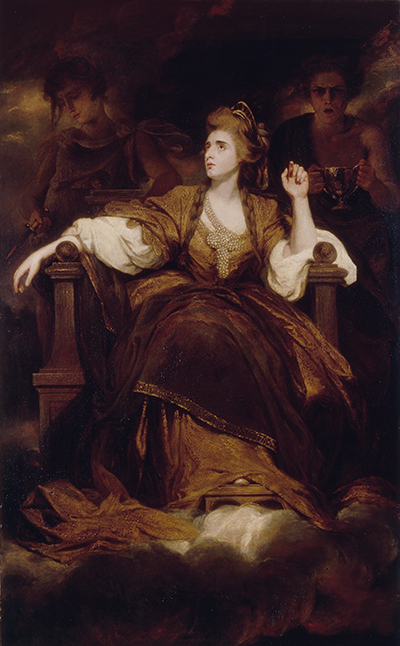
The painting also matters as a late example of Reynolds's Grand Manner. It is not one of the mythological showpieces like Sarah Siddons as the Tragic Muse, but it is no less dependent on performance. The theatre here is quieter: white silk, trees, evening distance, van Dyckian pose and the full authority of a life-sized figure.
Its beauty depends on restraint. Reynolds gives Lady Sunderlin glamour without narrative distraction. Her dress, veil and pearls are lavish, yet the painting does not become merely decorative. The dark landscape, the grand scale and the inherited court-portrait structure keep the image serious.
The corrected title sharpens the painting. Once the sitter is recognised as Phillippa Elizabeth Dorothy Malone, née Rooper, Lady Sunderlin, and the work is placed in 1786 Berlin rather than in the muddled chronology of weak retellings, it becomes one of Reynolds's clearest late statements about aristocratic appearance. It is a portrait of a woman, a title, a marriage and a social performance made luminous in white silk.
Frequently Asked Questions
Discussion
How does Reynolds use white silk, dark woodland and old pictorial authority to make a new peerage appear established?
Reader Insights
How does recognising Lady Sunderlin change the way the familiar Lady Sunderland title is understood?
How do silk, veil and pearls turn fashion into a public structure of rank?
Does the atmospheric woodland soften the portrait's social performance or make it more commanding?
Join the Conversation
Share your reading below.
References
- Google Arts & Culture / Gemäldegalerie, Staatliche Museen zu Berlin, Lady Sunderlin. https://artsandculture.google.com/asset/lady-sunderlin-sir-joshua-reynolds/vgEF17-0kQTHJQ?hl=en
- Wikimedia Commons, Joshua Sir Reynolds - Lady Sunderland - Google Art Project.jpg. https://commons.wikimedia.org/wiki/File:Joshua_Sir_Reynolds_-_Lady_Sunderland_-_Google_Art_Project.jpg
- Staatliche Museen zu Berlin, object redirect, Lady Sunderlin, object 868647. https://id.smb.museum/object/868647/lady-sunderlin
- British Museum, Frederick Bromley after Reynolds, Lady Sunderlin, 1915,0508.482. https://www.britishmuseum.org/collection/object/P_1915-0508-482
- National Portrait Gallery, Frederick Bromley after Reynolds, Phillippa Elizabeth Dorothy Malone (née Rooper), Lady Sunderlin, NPG D4333. https://www.npg.org.uk/collections/search/portrait/mw38622/Phillippa-Elizabeth-Dorothy-Malone-ne-Rooper-Lady-Sunderlin
- Romantic Circles, Southey personography biographies, Lady Sunderlin and Lord Sunderlin entries. https://romantic-circles.org/editions/southey_letters/editions.southey_letters.bios.html
- Nicholas Hall, Lady Sunderland. https://www.nicholashall.art/artwork/sir-joshua-reynolds/lady-sunderland/
- Nicholas Hall, Sir Joshua Reynolds artist profile. https://www.nicholashall.art/artist/sir-joshua-reynolds/
- Christie's, Sir Joshua Reynolds, Portrait of Lady Frances Marsham, later Countess of Romney, lot essay. https://www.christies.com/lot/lot-sir-joshua-reynolds-pra-portrait-of-lady-5813603/