 by Tom Gurney
Tom Gurney BSc (Hons) is an art history expert with over 20 years experience
Published on June 19, 2020 / Page Updated on November 6, 2026
Email: tomgurney1@gmail.com / Phone: +44 7429 011000
Introduction
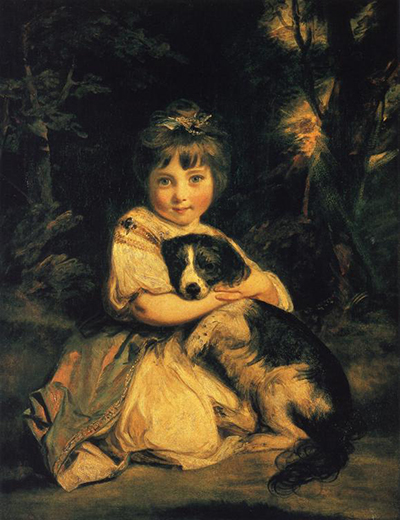
Joshua Reynolds's Miss Bowles is one of the most engaging child portraits in eighteenth-century British art. Painted about 1775-6, it shows Jane Bowles kneeling in a wooded setting, holding a pet spaniel close to her chest and looking outward with bright, direct attention. The Wallace Collection records the painting as Miss Jane Bowles, oil on canvas, 91 by 70.9 cm, inventory number P36.[1] Its object record gives the same date range, medium, image dimensions and Wallace Collection number, and places the work in the Boudoir.[2]
The sitter was Jane Bowles, born in 1772, the eldest daughter of Oldfield Bowles of North Aston in Oxfordshire. Wallace identifies Oldfield Bowles as a landowner, amateur painter and musician, and notes that payment evidence places the portrait between 1775 and 1776, when Jane was three or four years old.[2] Fitzwilliam Museum records add that she later married Richard Palmer in 1791.[3]
The portrait's charm is obvious, but its artistry is more complex than sweetness alone. Reynolds makes Jane a particular child and a theatrical figure at the same time. She is a daughter, a sitter, a little performer, an emblem of affection and, eventually, a widely reproduced image. The spaniel matters because it turns the portrait into an encounter: Jane does not merely pose beside an attribute; she clutches a living companion, making the picture feel animated, affectionate and lightly comic.
Mannings's catalogue identifies the painting as no. 231, a number corroborated by the Fitzwilliam print record and the What Jane Saw reconstruction of the 1813 British Institution exhibition.[3][5][9] That catalogue control is useful because the portrait has circulated under several titles. Modern Wallace records favour Miss Jane Bowles, while other references use Miss Bowles, Juvenile Amusement and “Love me, love my Dog.” The changing names do not signal different works; they show how one image moved between family identity, exhibition culture and sentimental print circulation.
At a Glance
- TitleMiss Jane Bowles / Miss Bowles
- ArtistJoshua Reynolds
- SitterJane Bowles
- DateAbout 1775-6 [1]
- MediumOil on canvas [1]
- CollectionWallace Collection, Boudoir [2]
- InventoryP36 [1]
- Dimensions91 × 70.9 cm [1]
- Sitter's ageThree or four
- CatalogueMannings 231 [3]
Contents
- Introduction
- Jane Bowles and the commission
- Reynolds and the child portrait
- Likeness, play and performance
- The theatrical child
- Eyes, dog and direct address
- Woodland, light and paint
- Preservation and experiment
- From family portrait to public image
- Why Miss Bowles matters
Jane Bowles and the commission
The commission began with a hesitation. Wallace's account explains that Oldfield Bowles was considering whether to employ Reynolds or George Romney. The problem was not reputation, but materials: Reynolds was famous, yet his experimental pigments and media could age badly. Sir George Beaumont reportedly urged Bowles toward Reynolds despite that risk, arguing that even a faded Reynolds would be worth having.[1]
That story is useful because it frames the painting as a gamble. Bowles was not simply choosing the safest painter for a family likeness. He was choosing the artist whose portraits promised something larger than accurate resemblance. Reynolds could turn a child into a work of cultivated feeling, and that promise outweighed practical worries about long-term condition.
Wallace also preserves the memorable anecdote of Reynolds meeting Jane at dinner. The artist played with her, won her confidence, and had her sit the following day in unusually lively spirits.[1] The story should not be treated as a transparent window into the whole event, but it does help explain the painting's unusual energy. Jane looks alert rather than arranged, as if Reynolds has caught the confidence he had just coaxed from her.
The portrait therefore begins in a social scene, not only a studio one. Reynolds's success depended on handling people as well as paint. With adult sitters, that might mean conversation, flattery, status and shared cultural references. With Jane, it meant play. The resulting image still belongs to an aristocratic and professional world, but its emotional charge depends on a child's willingness to meet the painter's attention.
Oldfield Bowles's own artistic interests make the commission more revealing. Wallace describes him as an amateur painter and musician, and notes that he had been tutored by the Welsh landscape painter Thomas Jones.[1] He was therefore not an entirely passive patron. His choice of Reynolds involved taste, judgement and awareness of artistic reputation. A father who painted and played music himself would have understood, perhaps more keenly than many sitters' families, that a portrait could be both a likeness and a display of artistic intelligence.
That makes Jane's apparent ease even more carefully charged. Reynolds had to satisfy a father who wanted his daughter recognisable, a patron who cared about art, and a culture that expected child portraiture to be tender without seeming crude. The painting's success lies in the way those requirements disappear into the immediate appeal of the girl and her spaniel.
Reynolds and the child portrait
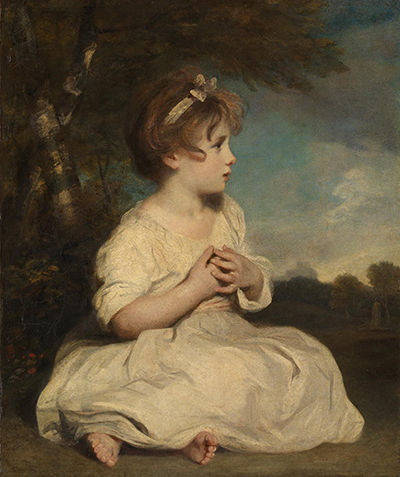
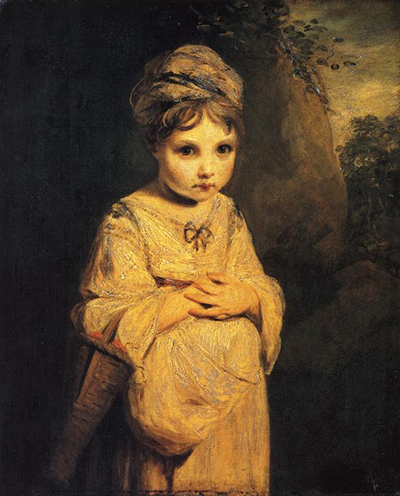
The National Gallery in London describes Reynolds as the leading English portrait painter of his generation, a painter who absorbed Italian and northern European models and used them to raise portraiture's status.[8] Miss Bowles belongs to that larger ambition, even though its subject is small, playful and domestic. Reynolds did not reserve pictorial elevation for statesmen, generals or actresses. He could bring learned artistic memory to a three- or four-year-old child with a dog.
This is part of the painting's historical importance. Child portraits in Reynolds's hands were not merely reduced adult portraits. Nor were they only informal family keepsakes. They could become images through which ideas of nature, feeling, class, gender and artistic taste were carefully negotiated. A child might appear spontaneous, but the appearance of spontaneity was itself a cultural achievement.
In Miss Bowles, that achievement depends on a soft paradox. Jane is presented as too young to perform adulthood, yet she is placed in a costume and setting that are openly theatrical. She seems delightfully immediate, yet her image is organised through old-master allusion, material experiment and social display. Reynolds's gift was to let those tensions remain pleasurable rather than heavy. The viewer feels the child's presence first, and only gradually senses how much pictorial thought has gone into making that presence persuasive.
The painting also differs from child portraits that lean toward moral instruction. Jane is not praying, reading, presenting flowers or learning a lesson. She is holding a dog. That action is morally mild but emotionally rich. It lets Reynolds suggest affection, vitality and confidence without forcing a heavy allegory onto the child. The result is intimate, but not trivial.
Likeness, play and performance
Jane kneels low in the picture, nearly at the dog's level, wrapping her arms around the spaniel while both faces turn outward. Wallace describes her as embracing her pet spaniel, with both child and animal looking toward the viewer.[1] That shared outward gaze is one of the work's cleverest decisions. It makes the dog more than a prop and Jane more than a decorative child. They become a pair of performers who have noticed us noticing them.
The painting is a portrait, but it also borders on the category of Reynolds's fancy pictures: child images that blend likeness, sentiment, costume, play and generalised emotional appeal. The Wallace object record makes that connection explicit, saying the lively and spontaneous composition recalls Reynolds's fancy pictures.[2] That does not mean Jane loses her identity. It means Reynolds has placed her likeness inside a pictorial language that could travel beyond family memory.
This boundary is central to the painting. If it were only a family portrait, the viewer might concentrate on Jane's biography. If it were only a fancy picture, the child would become a type. Reynolds holds both possibilities together. Jane is named and historically traceable, yet the image also offers a broader scene of childhood affection: a little girl, a dog, a woodland opening and a sudden moment of connection.
The spaniel helps keep that balance alive. The animal is held tightly, perhaps a little too tightly, creating a mild pressure between affection and comic discomfort. Reynolds does not turn this into cruelty. Instead, he gives the scene the recognisable physicality of childhood, where love can be enthusiastic, awkward and absolute. The dog is loved, possessed and displayed all at once.
The title “Love me, love my Dog,” attached to the later Cousins print, catches this emotional logic with unusual directness.[3] It turns the dog into a condition of knowing Jane. The viewer is not asked to admire the child in isolation, but to accept the bond she insists upon. The animal becomes her chosen companion, her comic co-star and a sign of the force with which children attach meaning to beloved creatures.
The theatrical child
Jane's costume is not ordinary nursery dress. Wallace describes it as fanciful and theatrical, and the detailed essay notes a shot-silk overskirt trimmed in gold, painted with thick white highlights.[1][2] The effect is important. Jane is not shown in plain daily clothing, but dressed for pictorial transformation. Reynolds makes her appear both very young and oddly stage-ready.
The theatricality gives the portrait its sparkle. The costume separates Jane from ordinary time and places her in the world of art. It also lets Reynolds play with fabric, sheen and colour. Wallace links the pearly blue and pink effects in the costume to old-master practice, especially Italian ways of rendering shimmering textiles.[1] Jane's childhood is therefore mediated through the painter's learned eye.
The essay also notes that the costume recalls Rembrandt.[1] That reference should be understood as atmosphere rather than imitation. Reynolds admired old-master effects and often used them to lift contemporary portraits into a richer artistic register. Here, Rembrandtian fancy dress gives a child portrait the air of a small masquerade. Jane seems to have stepped into a role, but not so completely that her own lively presence disappears.
This is one reason Miss Bowles is stronger than a simple image of innocence. Reynolds does not pretend that childhood appears without artifice. He lets artifice become visible: costume, woodland, light, pet, pose and painterly finish all collaborate. The result feels spontaneous because it is carefully staged, not because it is untouched by staging.
The costume also changes the emotional temperature of the portrait. Without it, the scene might seem like a domestic snapshot before photography existed: a child hugging a dog outdoors. With it, Jane becomes a small figure of display. Her clothing asks us to look at texture, shine, trim and historical association. Reynolds lets affection and connoisseurship occupy the same canvas.
Eyes, dog and direct address
Jane's eyes are a technical and emotional centre of the painting. Wallace notes the small white catchlights that give them brightness.[1] Those tiny marks are easy to overlook, but they help animate the whole scene. The child seems present because her gaze has been sharpened into an instant of contact.
The dog doubles that contact. A viewer meets not one face, but two. The spaniel's presence makes the portrait warmer and more immediate, yet it also adds humour. Jane's embrace presses the animal toward the front of the composition, so the dog becomes part of the child's presentation of herself. She appears to say, wordlessly, that to see her properly is to see the dog as well.
This directness distinguishes the painting from many child portraits that place the sitter in dreamy absorption. Jane is not lost in reverie, nor absorbed by a toy, flower or book. She looks out. The scene may be set in a woodland clearing, but the relationship is frontal and social. Reynolds invites the viewer into the affectionate performance.
The effect depends on restraint. Jane does not grin broadly. Reynolds avoids making her a caricature of childish delight. Her expression is lively but contained, and that containment keeps the portrait elegant. The image offers pleasure, but it is not merely cute. It turns the meeting between child, animal, painter and viewer into a refined act of attention.
Woodland, light and paint
The setting is not a neutral backdrop. Wallace describes dense foliage built with thick yellow paint and brown translucent glazes, with a shaft of light on the right made by dragging strokes of yellow across the surface.[1] This is Reynolds at his most theatrical: light does not simply fall; it enters the scene as a visible painterly event.
The woodland gives the portrait a sense of enclosure. Jane and the dog occupy a small stage of ground, framed by leaves and shadow. The setting is natural in subject, but artificial in effect. It surrounds the child with a darker richness that makes her costume, face and dog stand forward.
That contrast matters because Reynolds often used landscape to elevate portraiture. In adult portraits, background scenery could suggest estate, rank, history or classical association. Here it works differently. The woodland turns childhood into a sheltered performance, somewhere between a garden, a theatre and a remembered game.
The right-hand shaft of light also gives the composition movement. It cuts through the foliage and prevents the background from becoming heavy. Jane's world is not fully enclosed; it is pierced by illumination. The light makes the scene feel discovered, as though the viewer has come upon a vivid moment in the woods.
Preservation and experiment
Reynolds's technique is famous partly because it could be unstable. Many of his paintings suffered from fading, cracking or altered surface effects. That makes Miss Bowles especially interesting. Wallace states that the painting remains in good condition and that its pigments have retained their colour more successfully than those in many Reynolds works.[1]
This does not mean the painting is untouched by time. It means that, compared with some other Reynolds works, its colouristic ambition has survived well enough for the original effect to remain legible. The costume's sheen, the foliage, the light shaft and the face all still show the painter's interest in layered, experimental handling.
Wallace's technical observations are particularly valuable around the face. The essay notes blue-grey underpaint visible through the flesh and hatched lines modelling the shadowed side.[1] These details reveal that Jane's apparent freshness is not made by simple smoothness. It is constructed through layers, tints and visible decisions.
The surface may also include a beeswax layer, perhaps connected with a softened or polished appearance.[1] That note fits Reynolds's broader habit of experimenting with effects that could make a picture look richer, older or more sensuous. In Miss Bowles, such experiment serves tenderness rather than grandeur. The painting's refined surface helps transform a child and dog into an image of lasting charm.
From family portrait to public image
The painting did not remain only a private family likeness. Wallace records that the fourth Marquess of Hertford bought it in 1850 from the sale of Jane Bowles's brother, where it was described as the celebrated picture of a little girl with a spaniel.[1] That description is telling. By then, the subject could be recognised through image and motif as much as through name.
The portrait was also lent to the Manchester Art Treasures Exhibition in 1857, where Wallace notes that it was among the most popular works.[1] This wider reception changed the painting's emphasis. A portrait once tied to Oldfield Bowles and his daughter became part of a broader nineteenth-century admiration for Reynolds, childhood imagery and British painting.
Modern image metadata from the Wallace Collection record, preserved through Wikimedia Commons, repeats the title, date, medium, dimensions and P36 inventory number, and links the work to Art UK's artwork identifier.[6] That kind of cross-reference is prosaic, but it helps explain the portrait's present life. Miss Bowles has moved from family possession to aristocratic collecting, from exhibition display to print, and now to internationally searchable museum documentation.
Prints extended that afterlife. Wallace states that William Ward first engraved the picture in 1798 under the title Juvenile Amusement.[2] The British Museum record for Ward's mezzotint identifies the subject as Jane Bowles as a young girl in a glade with a dog, after Reynolds, and associates it with Mannings number 231.[4] The print title is important because it converts Jane's portrait into a more general image of childhood play.
Fitzwilliam Museum records a later Samuel Cousins print after Reynolds under the titles Miss Bowles and “Love me, love my Dog.”[3] Its description identifies the original as the 1775-76 Wallace Collection painting and gives Mannings 231.[3] This later title makes explicit what the painting already implies: the child's identity is bound to affection for the animal she holds.
The Metropolitan Museum of Art records another later print, Samuel Arlent Edwards's Bosom Friends (Miss Jane Bowles) of 1900, after Reynolds.[7] By then the painting had become a durable image of companionship, not simply a record of Jane Bowles's appearance. The title Bosom Friends shifts attention again, from family identity to emotional partnership between child and dog.
What Jane Saw records the portrait in the British Institution exhibition of 1813 as “Portrait of Miss Bowles, afterwards Mrs. Palmer,” and also identifies the work with Mannings 231 and the Wallace Collection.[5] The changing titles show the portrait's double life. It could be Jane Bowles, Mrs Palmer, a little girl with a spaniel, Juvenile Amusement, or “Love me, love my Dog.” Each title pulls a different thread from the same image.
That title history is a small lesson in reception. The more the image circulated, the more viewers could detach it from the Bowles family and read it as a universal scene of childhood affection. Yet the named sitter never quite disappears. The best titles keep both levels in view: Jane Bowles is the child, but the painting's emotional subject is the bond she stages with the spaniel.
Why Miss Bowles matters
Miss Bowles matters because it shows Reynolds using charm without surrendering to it. The portrait is delightful, but its delight is controlled by intelligence: the commission story, the theatrical costume, the old-master echoes, the dog, the woodland light, the technical surface and the print afterlife all deepen the first impression.
It is also a key example of how eighteenth-century child portraiture could move between likeness and type. Jane Bowles is a real child from a known family, painted at a specific moment in the 1770s. Yet the image became memorable partly because it could speak beyond that identity. Viewers did not need to know North Aston, Oldfield Bowles or Richard Palmer to feel the pull of the girl and her dog.
Reynolds's achievement lies in keeping those two levels together. He does not dissolve Jane into an anonymous emblem, but neither does he restrict the painting to private biography. The portrait has enough individuality to feel alive and enough theatrical structure to become iconic.
Seen beside Reynolds's other child portraits, Miss Bowles is one of his most persuasive solutions to the problem of childhood in art. It avoids solemn adult imitation, but it also avoids careless informality. Jane is playful, dressed up, affectionate, slightly comic and beautifully painted. She is a child performing and a child being herself, and Reynolds understood that the tension between those states could make a portrait unforgettable.
Frequently Asked Questions
Discussion
How does Reynolds make a carefully staged child portrait feel immediate, affectionate and lightly comic?
Reader Insights
How does the shared outward gaze turn Jane and the dog into a pair of performers?
Where does the painting reveal the artifice behind its apparent ease?
What changes when a named family portrait circulates as Juvenile Amusement or Bosom Friends?
Join the Conversation
Share your reading below.
References
- Wallace Collection, “Miss Jane Bowles,” https://www.wallacecollection.org/explore/explore-in-depth/reynolds/the-paintings/miss-jane-bowles/
- Wallace Collection / Wallace Live, Miss Jane Bowles, P36, https://wallacelive.wallacecollection.org/eMP/eMuseumPlus?module=collection&objectId=64926&service=ExternalInterface
- Fitzwilliam Museum, Samuel Cousins after Reynolds, Miss Bowles / “Love me, love my Dog,” P.14983-R, https://data.fitzmuseum.cam.ac.uk/id/object/240030
- British Museum, William Ward after Reynolds, Juvenile Amusement, 1887,0406.14, https://www.britishmuseum.org/collection/object/P_1887-0406-14
- What Jane Saw, British Institution 1813, Middle Room East Side no. 46, https://www.whatjanesaw.org/1813/rooms.php?location=MRES
- Wikimedia Commons / Wallace Collection image metadata, Miss Jane Bowles, P36, https://commons.wikimedia.org/wiki/File:Joshua_Reynolds_(1723-1792)_-_Miss_Jane_Bowles_-_P36_-_The_Wallace_Collection.jpg
- Metropolitan Museum of Art, Samuel Arlent Edwards after Reynolds, Bosom Friends (Miss Jane Bowles), https://www.metmuseum.org/en/art/collection/search/843168
- National Gallery, London, “Sir Joshua Reynolds 1723-1792,” https://www.nationalgallery.org.uk/artists/sir-joshua-reynolds
- David Mannings, Sir Joshua Reynolds: A Complete Catalogue of His Paintings, with subject pictures catalogued by Martin Postle, Yale University Press / Paul Mellon Centre for Studies in British Art, 2000.