 by Tom Gurney
Tom Gurney BSc (Hons) is an art history expert with over 20 years experience
Published on June 19, 2020 / Page Updated on November 6, 2026
Email: tomgurney1@gmail.com / Phone: +44 7429 011000
Introduction
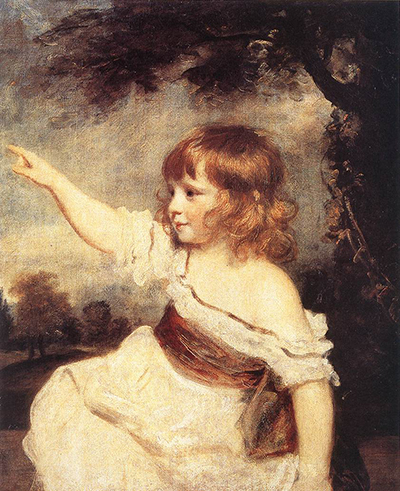
Joshua Reynolds's Master Hare is one of his most famous portraits of childhood. The best-known version is in the Louvre, where it is catalogued as Portrait de Francis George Hare (1786-1842) dit Master Hare et dit aussi Infancy. The Louvre records the painting as an oil on canvas by Reynolds, dated 1788-1789, 77 by 64 cm, inventory number RF 1580, and currently displayed in Salle 713 in the Denon wing.[1]
The child is Francis George Hare, shown at the age of two. He was the eldest son of Francis Hare Naylor, a writer, and Georgiana Shipley, an amateur painter and friend of Reynolds.[1] The painting was made for his aunt, Anna Maria Shipley, Lady Jones, who was married to the orientalist painter Sir William Jones.[1] INHA's Rothschild collection account describes Lady Jones as both the child's aunt and later adoptive mother.[2]
At first glance, the image seems wonderfully simple: a small boy in a pale muslin frock, seated in a wooded landscape, turning and pointing to something beyond the frame. Yet Master Hare is not only a charming likeness. It is a highly constructed image of childhood, one that turns a named boy into a broader emblem of infancy, truth, innocence and aristocratic promise.
That transformation is the reason the painting needs careful handling. Reynolds was not only painting a toddler; he was translating toddlerhood into a public language of feeling. The modern viewer may be tempted to treat the picture as spontaneous because the child looks lively, but nearly every element is arranged: costume, hand, tree, sky, landscape and title. The portrait's freshness is real, but it is made freshness.
At a Glance
- TitleMaster Hare / Infancy
- ArtistJoshua Reynolds
- SitterFrancis George Hare
- Date1788-1789 [1]
- MediumOil on canvas [1]
- CollectionMusée du Louvre, Salle 713 [1]
- InventoryRF 1580 [1]
- Dimensions77 × 64 cm [1]
- Sitter's ageTwo
- Version notePrivate autograph version: Mannings 838 [3]
Contents
- Introduction
- The child in the Louvre
- A seated boy who points
- Costume, gender and childhood
- Reynolds and the new child
- Versions and Mannings
- From family portrait to Infancy
- Rothschild and the Louvre
- Why Master Hare matters
The child in the Louvre
The Louvre record provides the secure modern identity of the public museum version. It identifies the sitter as Francis George Hare, born in 1786 and died in 1842, and says he is represented at the age of two.[1] His family background matters because the portrait belongs to a cultivated circle rather than a generic childhood scene. His mother, Georgiana Shipley, was not only an amateur painter but also a friend of Reynolds.[1]
The commission through Lady Jones adds another layer. Lady Jones was Francis's maternal aunt, and the Louvre identifies her as the person for whom the painting was made.[1] INHA adds that she became the boy's adoptive mother, tightening the emotional connection between portrait, child and household.[2] This was therefore not a detached society commission. It belonged to a family network deeply invested in the child's image.
The painting's size also matters. At 77 by 64 cm, the Louvre work is intimate rather than grand.[1] It is not a full-length dynastic display in the manner of an adult aristocratic portrait. Reynolds gives a small child a concentrated, memorable format. The result is portable in feeling, easy to reproduce, and perfectly suited to becoming an emblem.
That emblematic future is already present in the alternate title Infancy. The Louvre title preserves both the specific name and the general type: Francis George Hare, Master Hare, and Infancy.[1] Those titles do different work. The first anchors the image in biography; the second in family rank and childhood status; the third turns the sitter into a symbolic stage of human life.
Wikimedia's image metadata, derived from Louvre-linked records, repeats the RF 1580 identity, 1788-1789 date, oil medium, 77 by 64 cm dimensions and current Louvre association.[7] It is not needed as the primary authority, but it confirms how the painting now circulates digitally: not just as a museum object in Paris, but as a widely available public-domain image of British portraiture.
The painting's present accessibility can make its family origin seem remote. In Reynolds's first context, however, this was an intimate picture of a child connected to a web of Shipley, Hare and Jones relationships. The later name Infancy encourages general feeling; the Louvre record pulls the image back toward a named family history.
A seated boy who points
The painting's visual power depends on a small but decisive gesture. Christie's describes the sitter as seated in a woodland setting, turned three-quarters, with his right arm pointing to the left.[3] INHA similarly describes the child in three-quarter view, with long hair, a muslin outfit, a slight smile and a raised right index finger.[2] The pose creates action without requiring a visible object of attention.
That absent object is one of the portrait's quiet strengths. Francis points beyond the painted scene, but Reynolds does not show what he sees. The viewer is left with the gesture itself: a child's command, curiosity or discovery. The painting becomes active because the child's attention reaches outward, beyond the bounds of the image.
The blue sky around his head and the tree that frames him help isolate the child from the darker landscape. Christie's notes the tree rising to his right and the blue sky setting off his blond hair.[3] INHA describes a brown-toned background that makes the lightness of the child stand forward.[2] Reynolds turns the landscape into a stage that both shelters and spotlights him.
The raised finger has invited interpretation. INHA connects the gesture with Reynolds's Saint John the Baptist at the Wallace Collection and suggests that it may relate to the theme of the child as bearer of truth.[2] That comparison should not make Francis into a religious figure, but it does show how Reynolds could borrow the authority of sacred or old-master motifs for a modern child portrait.
The gesture also gives the portrait its rhythm. Francis's body remains seated, but the arm carries energy across the composition. The child does not run, climb or play with an object; the entire action is concentrated in pointing. Reynolds turns a tiny movement into the organising drama of the picture.
Because the pointed-at object is absent, the viewer supplies meaning. Francis might be noticing something, commanding someone, discovering a marvel or repeating a gesture learned from adults. That openness lets the portrait survive changes in taste. It can be read as sweet, assertive, symbolic or comic without losing its basic clarity.
Costume, gender and childhood
Modern viewers can easily misread the costume. Francis wears a pale muslin frock with a sash, and his long hair falls freely around his face. Christie's cites costume historian Aileen Ribeiro to explain that such white muslin clothing could resemble little girls' dress, and that boys were generally not put into breeches until around three or four, sometimes later.[3] Francis was only about two and a half when his portrait was painted.[3]
This matters because the portrait belongs to a period before modern children's clothing categories hardened into familiar forms. The frock does not make Francis feminine in any simple sense. It places him within an eighteenth-century convention for very young boys before breeching. Reynolds paints a child whose age is visible through dress before adult gender codes have fully taken over.
At the same time, the gesture works against costume ambiguity. Christie's cites Anja Müller on the pointing pose as a way of marking the child unambiguously as a boy.[3] The dress may be soft, white and flowing, but the arm is assertive. Reynolds creates a balance between tenderness and command.
That balance is central to the portrait's success. Francis is small, round-faced and delicately dressed, yet he is not passive. He occupies the landscape with a miniature authority. The raised arm turns infancy into action. He does not merely sit to be admired; he directs attention.
This is where the portrait differs from a merely pretty image of a child. Reynolds allows softness to remain visible, but he gives it structure. The sash, frock and hair make Francis seem young and carefully tended; the hand gives him a role. The viewer receives infancy not as helplessness, but as a stage already full of intention.
The costume also helps locate the portrait in a particular historical world. It reminds us that childhood categories were made through custom, clothing and family practice. Reynolds's task was not to paint a timeless boy in modern terms, but to make an eighteenth-century child legible to an eighteenth-century audience. The picture is charming now partly because its codes have changed, but those codes once carried precise social meanings.
Reynolds and the new child
INHA presents Master Hare as an image that rapidly came to embody a new eighteenth-century view of childhood, shaped by Enlightenment debates.[2] That interpretation is important because the portrait is not only a family likeness. It belongs to a wider culture in which childhood was increasingly imagined as a special moral and emotional state.
The idea of innocence is not simply natural in the painting; it is constructed. INHA links the image to pastoral and pre-industrial ideals, suggesting that the landscape helps associate the child with a kind of uncorrupted freshness.[2] Reynolds gives Francis a setting that feels removed from the pressures of adult society, even though the portrait itself was produced within a highly sophisticated social world.
This is the elegant contradiction of Master Hare. The painting seems to show nature, but it is full of culture: costume, pose, family status, old-master memory, commissioned portraiture and later print circulation. Reynolds makes childhood look immediate while building it through artifice.
The National Gallery's artist biography places Reynolds at the centre of eighteenth-century English portraiture and emphasises his use of Italian and northern European models.[8] Master Hare shows that ambition in a child-sized register. Reynolds does not need heroic scale to elevate the sitter. He uses gesture, landscape and association.
This is why the painting can feel both tender and intellectual. Reynolds does not turn Francis into a miniature philosopher, but the image thinks seriously about what childhood means. It asks how a young child can be shown as innocent without being inert, natural without being ordinary, and individual without being trapped inside private biography.
The answer is a carefully poised fiction. Francis appears in a natural landscape, but he is dressed, posed and framed. He appears innocent, but his raised finger carries authority. He appears particular, but the title Infancy invites viewers to treat him as a type. Reynolds's art lies in making those contradictions feel effortless.
Versions and Mannings
The history of Master Hare is complicated because there is more than one Reynolds version. The Louvre record notes another version in a private collection and identifies it as Mannings no. 838. It also states that Mannings recorded two copies after the Louvre painting, numbered 839a and 839b.[1] That distinction is essential: the familiar Louvre painting is not the only object in the composition's history.
Christie's 2015 account of the privately held Portrait of Master Hare, or “Infancy” gives its measurements as 76 by 63.5 cm and cites Mannings no. 838.[3] The account states that Reynolds painted two autograph versions: the private portrait and the Louvre painting.[3] It also reports Mannings's judgement that the private painting was probably the first version, while the Louvre work was a contemporary variant, quite possibly by Reynolds himself.[3][9]
This version history should change how the painting is discussed. The Louvre version is the accessible museum work and the image most viewers know. But it is not safe to present it as a single, uncomplicated original. Reynolds's studio, patrons and later collectors produced a more layered story, in which one successful composition existed in several closely related forms.
The distinction also helps explain the British Museum print evidence. Its hand-coloured mezzotint after Reynolds is described as after Mannings 839, not 838.[4] That number belongs to the copy/afterlife field rather than the autograph private version. The Mannings references therefore help keep original, variant, copy and print from collapsing into one another.
The version question also reminds us that fame can attach to a composition rather than to one canvas alone. Many viewers know Master Hare through the Louvre version, reproductive prints or modern image files. Yet the composition's authority was built through more than one painted object. The article of fame is not only a single surface; it is a recognisable arrangement of child, frock, tree, sky and pointing hand.
From family portrait to Infancy
The title Infancy is one of the keys to the painting's fame. The Louvre says Robert Thew engraved the image in 1790 under that title.[1] INHA similarly says the portrait was engraved in colour from 1790 and commercialised as Infancy, helping it become an iconic image of the young English aristocratic child.[2]
The title shifts the viewer's attention. Master Hare names a particular boy; Infancy names a stage of life. Once the image entered print culture, it could be admired by people who had no personal connection to Francis George Hare or the Shipley family. The portrait became a type without fully losing the sitter's identity.
The Albertina's record of Robert Thew's 1790 print after Reynolds, published by John and Josiah Boydell, is useful evidence for this early reproductive life, despite the record's confusing “Hoare” title form.[6] It confirms that the image moved quickly from painted portrait into print. That speed matters: the fame of Master Hare was not a slow Victorian invention alone, but began close to the work's creation.
Later prints kept the image alive. The National Portrait Gallery records Samuel William Reynolds's mezzotint Infancy (Francis George Hare), after Reynolds, published in 1835.[5] The British Museum records a hand-coloured mezzotint of Master Hare from 1820-1835, with Francis George Hare named as the associated sitter.[4] These prints show how the child portrait continued to circulate long after Francis himself had grown up.
The change from child to emblem is especially poignant because Francis George Hare lived a full adult life. Christie’s notes later biographical details, including his marriage, life between England and Italy, and death in Palermo in 1842.[3] The printed image, however, held him permanently in infancy. Art fixed a brief age and then allowed that age to outlast the person.
The print history also changes the social reach of the portrait. A painted child in a family or elite collection could be seen by a limited circle. A print could enter albums, portfolios and domestic interiors far beyond the original household. Through that circulation, Francis's gesture became less a family memory than a widely legible sign of childhood.
Rothschild and the Louvre
The Louvre version has its own collecting history. The Louvre traces it from Lady Jones through Mrs Louisa Shipley, Mrs Townshend and members of the Hare family, including a later legal dispute over ownership, before it passed into another branch of the family and then to Baron Alphonse de Rothschild.[1] The painting was given to the Louvre by Rothschild's heirs in 1905.[1]
INHA emphasises the Rothschild chapter. It states that the painting was in Alphonse de Rothschild's collection by at least 1875 and that it decorated the boudoir of Leonora de Rothschild alongside a Gainsborough.[2] The account also notes that Alphonse's decision to give the painting to the Louvre helped enrich the museum's young British painting holdings.[2]
This French collecting history is important. Master Hare is a British portrait by Reynolds, but its best-known museum life is in Paris. The painting became part of the Louvre's representation of British art, and its Rothschild provenance helped carry it from family image to public masterpiece.
The movement also suits the painting's character. A portrait that had already become Infancy through print could cross national boundaries more easily than a purely private family likeness. Viewers did not need the full Hare genealogy to respond to the child. The image's appeal had already been translated into a broadly readable language of childhood.
Why Master Hare matters
Master Hare matters because it shows Reynolds turning a small child into a large cultural idea without erasing the sitter's identity. Francis George Hare remains a real boy, tied to parents, aunt, family inheritance and later life. Yet the painting also became Infancy, a portable image of early childhood shaped by gesture, costume, landscape and print.
The portrait is especially strong because it avoids mere softness. The child is tenderly painted, but his pointing arm gives the image direction and force. Reynolds balances delicacy with assertion. The frock and hair emphasise youth; the gesture gives agency; the landscape frames him as a small figure in a larger moral world.
The version history adds another reason to take the painting seriously. Master Hare is not just a familiar Louvre image. It is a composition with autograph variation, copies, engravings, mezzotints, Rothschild collecting history and Mannings catalogue complexity. Its fame was made through repetition, but that repetition began with a precise pictorial invention.
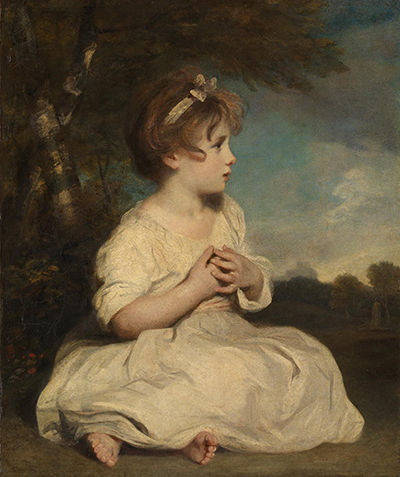
Seen beside Reynolds's other child portraits, Master Hare offers a counterpart to images such as The Age of Innocence and Penelope Boothby. It belongs to the late eighteenth-century reimagining of childhood as innocent, expressive and culturally meaningful. But Reynolds's best child portraits are never innocent of art. Their freshness is made. In Master Hare, that made freshness is exactly the point.
Frequently Asked Questions
Discussion
How does Reynolds turn a two-year-old's pointing gesture into a public image of infancy, truth and agency?
Reader Insights
What does the unseen object of Francis's attention add to the portrait?
How does pre-breeching dress complicate modern assumptions about the child?
How did painted variants and reproductive prints shift the image from family likeness to cultural emblem?
Join the Conversation
Share your reading below.
References
- Musée du Louvre, Portrait de Francis George Hare (1786-1842) dit Master Hare et dit aussi Infancy, RF 1580, https://collections.louvre.fr/en/ark:/53355/cl010063598
- INHA / Collections Rothschild, “Master Hare, par Joshua Reynolds,” https://collections.rothschild.inha.fr/fr/uvres/selection-d-oeuvres/toutes-les-oeuvres/master-hare-par-joshua-reynolds.html
- Christie's, Sir Joshua Reynolds, Portrait of Master Hare, or “Infancy”, 2015, https://www.christies.com/en/lot/lot-5868333
- British Museum, Samuel William Reynolds after Reynolds, Master Hare, 1897,1106.1, https://www.britishmuseum.org/collection/object/P_1897-1106-1
- National Portrait Gallery, Samuel William Reynolds after Reynolds, Infancy (Francis George Hare), NPG D2592, https://www.npg.org.uk/collections/search/portrait/mw36806/Infancy-Francis-George-Hare
- Albertina, Robert Thew after Reynolds, Infancy; Master Henry Hoare, E/II/11/15, https://sammlungenonline.albertina.at/objects/618364/infancy-master-henry-hoare
- Wikimedia Commons, Joshua Reynolds - Master Hare - WGA19342.jpg, https://commons.wikimedia.org/wiki/File:Joshua_Reynolds_-_Master_Hare_-_WGA19342.jpg
- National Gallery, London, “Sir Joshua Reynolds 1723-1792,” https://www.nationalgallery.org.uk/artists/sir-joshua-reynolds
- David Mannings, Sir Joshua Reynolds: A Complete Catalogue of His Paintings, with subject pictures catalogued by Martin Postle, Yale University Press / Paul Mellon Centre for Studies in British Art, 2000.