 by Tom Gurney
Tom Gurney BSc (Hons) is an art history expert with over 20 years experience
Published on June 19, 2020 / Updated on August 21, 2026
Email: tomgurney1@gmail.com / Phone: +44 7429 011000
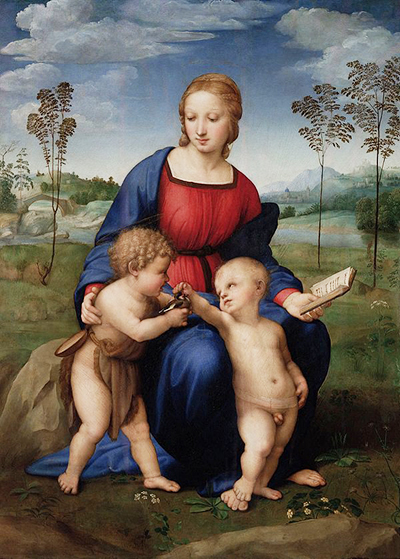
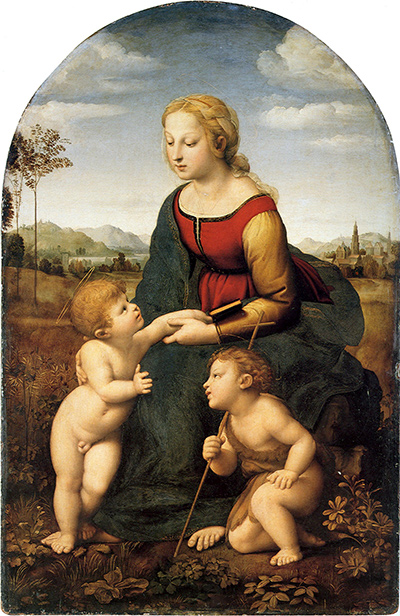
Raphael's La Belle Jardinière gathers the Virgin Mary, the standing Christ Child and the young John the Baptist into a landscape of extraordinary calm. Mary sits in a flowering meadow, her red dress and blue mantle forming the broad centre of an arched panel. Christ stands close against her, turning his face upward. John kneels nearby with his small cross, attentive to the child whose future he announces.
The picture is formally known as The Virgin and Child with the Young Saint John the Baptist. Its familiar French name, La Belle Jardinière—the beautiful gardener—came into use much later. It refers to Mary's modest dress and the pastoral setting, not to a Gospel episode in which she tends a garden.[1][4]
Signed and dated 1507 according to a Louvre publication, the painting belongs to the final phase of Raphael's Florentine years. It brings together lessons from Leonardo and Michelangelo while preserving the lucidity that made Raphael's sacred figures immediately approachable. A recent conservation treatment recovered a clearer, more brilliant range of colour and renewed the depth of the landscape.[3][4]
At a Glance
- ArtistRaphael
- Formal titleThe Virgin and Child with the Young Saint John the Baptist
- Common titleLa Belle Jardinière
- Date1507–08; a Louvre publication describes it as signed and dated 1507
- Mediumoil on poplar panel
- Formatarched top
- Dimensions122 × 80 cm
- Figural actionChrist stands within Mary's embrace as John kneels nearby
- Central attributesJohn's small cross and the book on Mary's lap
- Possible early associationTaddeo Taddei, recorded by the Louvre as uncertain
- Possible royal acquisitionFrancis I, also recorded as uncertain
- Former collectionFrench Crown
- Major recent treatment2020
- Current locationMusée du Louvre, Paris, Room 710
- Inventory numbersINV 602; MR 433
Contents
- Why the title is later than the painting
- An arched panel and an upright child
- Mary seated in the meadow
- Christ standing within Mary's protection
- John kneeling with the cross
- A book, a cross and unequal knowledge
- A triangle animated from within
- The flowering landscape
- Colour after the 2020 treatment
- Raphael's preparatory drawing in the Louvre
Why the title is later than the painting
Raphael did not name the work La Belle Jardinière. The Louvre records the descriptive title The Virgin and Child with the Young Saint John the Baptist, while the affectionate French nickname became established centuries later.[1][4]
The phrase draws attention to the pastoral atmosphere. Mary is seated outdoors in comparatively simple clothing, surrounded by plants and an expansive landscape. To later viewers she could resemble an idealised young woman resting in her garden.
Yet the nickname can mislead if read literally. Mary is not shown gardening. No tool or horticultural task defines her action. She is supporting Christ, attending to John and holding a book within a sacred encounter.
The title nevertheless captures something important about Raphael's transformation of devotional imagery. Holiness appears in cultivated natural ease rather than ceremonial distance. The Virgin can occupy ordinary earth without losing grandeur.
Its French form also belongs to the painting's long life in the royal collection and the Louvre. The name through which millions now know the work arose from reception, not from its first Florentine setting.
An arched panel and an upright child
The panel rises to a rounded crown. That arched boundary gives the group a vertical emphasis unlike a simple horizontal landscape.
Mary's head occupies the upper centre beneath the curve. Her shoulders, mantle and knees widen below, while the standing Christ creates a strong upright movement through the middle of the family.
The arch does more than frame the figures decoratively. Its narrowing upper space concentrates attention around Mary's face. The broader lower field admits the kneeling John, meadow plants and the spreading blue mantle.
Raphael coordinates the human group with the support. The figures do not look inserted into a pre-existing opening; their proportions answer its rise and width.
Christ's standing body is crucial to that fit. He is taller within the group than a seated infant would be, linking the children's lower zone to Mary's head and shoulders.
The format therefore produces intimacy without smallness. At 122 centimetres high, the panel grants the sacred family substantial physical presence while preserving the closeness of a private devotional image.[1]
Mary seated in the meadow
Mary sits low in the landscape rather than on an architectural throne. Her posture belongs broadly to the tradition of the Madonna of Humility, in which contact with the ground becomes a sign of spiritual modesty.
Raphael turns that humility into quiet monumentality. Mary's body is the largest continuous form in the panel. The red of her dress, blue of her mantle and pale oval of her face establish the picture's dominant colour and scale.
Her torso inclines toward the children without collapsing into them. One arm curves around Christ's body; the other hand rests near the book and completes an enclosing sequence across her lap.
She is neither remote queen nor casual bystander. Every element of the group depends on her steadiness, yet she allows Christ and John their own field of attention.
The low seat also aligns sacred flesh with grass, flowers, soil and water. Raphael does not oppose divine presence to nature. He lets earthly setting become the place where sacred relationship can be seen most clearly.
Mary's calm has emotional depth because the children's attributes point beyond the moment. The cross held by John transforms her watchfulness into foreknowledge.
Christ standing within Mary's protection
Christ stands between or close against Mary's knees, balancing through her protective embrace. His body is active, elongated and more independent than that of an infant resting on her lap.
He looks upward toward his mother. The direction of his gaze creates a private vertical exchange inside the broader triangle. Mary's attention descends; his rises.
This upward turn makes dependence emotional as well as physical. Christ may stand, but he still seeks Mary. Raphael preserves the tenderness of childhood even as the body begins to announce future agency.
The child's position also divides the composition without splitting it. His pale flesh lies against the saturated red and blue of Mary's clothing, making his outline clear while keeping him within her form.
Hands and legs communicate balance. Mary's arm provides security; Christ's stance introduces the slight tension of a body learning how to carry its own weight.
The theology remains understated. The incarnate Christ is presented through credible human development. Divinity does not cancel childhood; it becomes visible through trust, touch and growth.
John kneeling with the cross
The young John the Baptist approaches from the lower side of the group. He kneels, directing his attention toward Christ and carrying the slender cross that identifies his prophetic role.
John's adult mission is to prepare the way and recognise the Messiah. Raphael gives that mission a childhood form: a small body, an earnest gaze and an attribute light enough to be held near the ground.
The cross introduces the Passion without disturbing the landscape's calm. Its future meaning is grave, but its present scale belongs to the children's world.
John's kneeling posture differs from Christ's upright stance. One child lowers himself in recognition; the other rises within Mary's protection. Their contrast creates hierarchy without sacrificing natural relation.
The Baptist also extends the composition laterally. His body occupies the meadow beside Mary, while his attention draws back toward the centre.
Raphael makes prophecy social. John does not display the cross to the viewer as an isolated emblem. He brings it into an exchange among the three figures, where its meaning is carried by gaze and proximity.
A book, a cross and unequal knowledge
A book rests with Mary, while John bears the cross. The two objects provide different forms of sacred knowledge.
The book suggests scripture, prayer and Mary's understanding of the divine plan. Its pages belong to reading and recollection. The cross belongs to the event still to come.
Christ stands between these signs. Behind and beside him is the knowledge held by his mother; before him is the instrument presented by the Baptist.
Raphael does not turn this arrangement into an explicit lesson. The figures remain absorbed in one another. Meaning emerges because viewers recognise what the children cannot be expected to understand in ordinary human terms.
Mary's calm is therefore not innocence. Her downward regard can contain affection and foreknowledge at once. John carries a prophetic identity larger than his age. Christ's upward trust exists beside the destiny announced by the cross.
The picture's serenity depends on this unequal distribution of knowledge. Present tenderness remains real even though future sorrow is already legible.
A triangle animated from within
Mary and the two children create a broad triangular group. Her head forms its summit; mantle, knees and John's low figure widen its base.
Raphael had encountered Leonardo's use of pyramidal composition in Florence. Such geometry could bind several figures into a single living unit rather than a row of separate sacred presences.[3]
In La Belle Jardinière, the triangle is especially tall because Christ stands and looks upward. The group does not settle into a compact base. It seems to grow.
Curves continually soften the geometry. Mary's arms bend around the child, her head inclines, John's body turns and the edge of the mantle flows across the meadow.
Gazes animate the form in another direction. Christ looks toward Mary, Mary attends to the children, and John directs himself toward Christ. The eye circulates rather than stopping at the apex.
The group is stable because relationships hold it together. Geometry is not an invisible cage; it is the visible result of protection, recognition and response.
The flowering landscape
The foreground meadow is more than a pleasant stage. Plants establish the scale of knees, feet and trailing cloth, bringing the sacred group into contact with a particular patch of earth.
Small blossoms punctuate the green. They slow the eye near the figures before the landscape opens outward.
Beyond the meadow, water, paths, buildings, hills and distant mountains create several bands of recession. The terrain grows cooler and less distinct toward the horizon.
This atmospheric transition reflects Raphael's Florentine encounter with Leonardo, but the result remains unusually clear. Distance is soft without becoming mysterious or dark.
The open setting also enlarges the emotional world of the figures. Their intimate exchange occupies only one place within a landscape that seems capable of continuing far beyond the panel.
Nature does not mirror the Passion with storm or barren ground. Its calm creates temporal contrast. The cross foretells suffering in a world still flowering around the children.
The later nickname fixes attention on this setting, but the landscape matters because it carries spatial and emotional structure, not because Mary performs the work of a gardener.
Colour after the 2020 treatment
The Louvre treated the painting in 2020. Its institutional account says that conservation revealed a clear, brilliant palette and restored the full depth of the space.[4][5]
Those qualities are central to the work's meaning. Mary's red dress creates warmth and bodily presence. Her blue mantle spreads a cooler, protective field across the lower group.
Christ's and John's flesh is modelled through light rather than hard contour. Their bodies remain distinct from fabric and greenery while sharing the same atmosphere.
The landscape moves from stronger foreground greens and earth colours into cooler blues and paler distance. This recession prevents the meadow from appearing like a flat decorative ground.
Conservation can affect interpretation because discoloured coatings compress both colour and depth. When tonal relations become clearer, the viewer can better perceive how Raphael coordinated saturated figures with spacious air.
The 2020 work did not make a new painting. It made surviving relationships of colour, modelling and distance more available to sight.[4]
Raphael's preparatory drawing in the Louvre
The Louvre preserves a study directly connected with La Belle Jardinière, inventory RF 1066 recto. It shows the seated Virgin, Christ and young John in a landscape.[2]
The sheet measures 30 by 20.5 centimetres. Raphael combined pen and brown ink with black and red chalk, then used squaring and stylus marks.[2]
That mixture records several stages of thought. Chalk permits searching, correction and bodily softness. Pen can reinforce selected contours. Squaring creates a measured network for transferring or enlarging the arrangement.
The drawing is not simply a miniature copy of the finished panel. It belongs to the process by which relations were tested before paint fixed them.
Particularly important is the integration of figures and landscape. Raphael was considering not only isolated poses but also how the family would occupy an outdoor world.
Stylus traces and the grid make planning visible. The finished image feels effortless because calculation has been absorbed into living posture.
The sheet entered the Louvre in 1881. Painting and study can now be understood within the same collection, one preserving the resolved colouristic world and the other the marks of invention.[2]
Leonardo, Michelangelo and Raphael's synthesis
A Louvre publication describes the painting as poised between Leonardo's Virgin and Child with Saint Anne and Michelangelo's Bruges Madonna.[3]
Leonardo offered Raphael a model for binding bodies through pyramidal order, gestures and exchanged attention. He also demonstrated how atmospheric landscape could surround figures rather than sit behind them like scenery.
Michelangelo offered a different resource: sculptural weight and convincing anatomy. Christ's upright body and Mary's monumental form have a physical assurance that exceeds fragile courtly grace.
Raphael does not merely split the difference. His group is more immediately legible in feeling, and the landscape remains bright and open. He turns powerful precedents toward an ideal of social clarity.
The figures know where to look, whom to support and how to occupy shared space. No movement seems arbitrary, yet none advertises the effort of design.
This is Raphael's distinctive synthesis: Leonardesque cohesion, Michelangelesque bodily presence, an inheritance of Umbrian lucidity and his own gift for making complex relations appear natural.
At the end of the Florentine years
Raphael worked in Florence before moving to Rome in 1508. La Belle Jardinière, dated around 1507–08, stands close to that transition.[1][3]
The Louvre has called it the last great masterpiece of his early period, made when the artist was about twenty-four.[3] That description captures both culmination and departure.
Several Florentine Madonnas show Raphael testing how Mary, Christ and John might form a natural group in landscape. Here the arched support, standing child, preparatory grid and expansive colour achieve a particularly complete resolution.
The Roman works would demand larger walls, more figures and a new relation to ancient architecture. Yet the intelligence required for those projects is already present: the ability to organise complexity so that viewers grasp an overall order before discovering its parts.
The painting should not be treated merely as practice for later fame. Its domestic scale and maternal subject pose problems of their own, answered with a concentration that monumental decoration could not duplicate.
It is both a closing statement and an independent achievement.
An uncertain early history
The Louvre catalogue connects the painting questioningly with Taddeo Taddei and, later, with Francis I.[1] Those question marks matter.
Taddei was Raphael's Florentine friend and patron, and other Madonna paintings are associated with him. A possible connection is historically plausible, but plausibility is not proof of continuous ownership.
Francis I assembled an exceptional royal collection and brought major Italian works into France. The painting's eventual place in the French Crown collection is secure, while the precise manner and date of its royal arrival remain less certain in the catalogue record.[1]
Responsible provenance distinguishes documented possession from retrospective reconstruction. It is better to preserve an open interval than to convert a hypothesis into a story with false precision.
By the time of the historic Crown collection, the panel had entered a new setting of dynastic display. The Louvre inherited that royal history and now identifies the work as INV 602 and MR 433.[1]
Its French nickname, global fame and museum setting all belong to this later life, layered over an early history that is only partly recoverable.
How to look at La Belle Jardinière
Begin with Christ's upward gaze. Follow it to Mary's face, then trace the curve of her arm back around his standing body.
Move toward kneeling John and find the slender cross. Compare his low posture with Christ's vertical rise.
Notice the book near Mary. The book and cross place the child between written foreknowledge and future event.
Allow the strong red and blue of Mary's clothing to hold the group, then look beyond them into water, buildings and pale mountains.
Study the arched top. Its curve narrows above Mary while the lower meadow opens around the children.
Finally, look for the intervals between hands and bodies. Raphael's clarity depends on carefully measured spaces where touch is about to occur or has just become secure.
Why the painting matters
La Belle Jardinière makes monumental design feel intimate. The arch, tall triangle and saturated colour give Mary and the children commanding presence, but every structural decision arises from believable human relation.
The painting also shows Raphael at a point of mastery before Rome. He has absorbed lessons from Florence without losing the devotional clarity and emotional openness that distinguish his art.
Its recent conservation and surviving study deepen that achievement. One lets viewers recover the colour and spatial range of the finished panel; the other shows the measured searching from which its ease emerged.[2][4]
Above all, the work holds present love and future suffering together. A child stands safely within his mother's arms while another kneels with the cross. The landscape flowers around a destiny already known.
Artist Up Close
Look at the direction of Christ's face rather than only at his body. His upward gaze binds the tall composition to Mary.
Notice how the blue mantle widens the base of the group and separates warm flesh from the meadow.
Then compare the rounded panel with the triangular family. Curve and pyramid cooperate without becoming the same shape.
Frequently Asked Questions
Discussion
What detail most changes how you read La Belle Jardinière?
Reader Insights
Which source detail gives the page its strongest anchor?
Which visual or historical distinction should readers keep in mind?
How does this page change the wider picture of Raphael's career?
Join the Conversation
Share your reading below.
References
- Musée du Louvre, “La Vierge à l'Enfant avec le petit saint Jean Baptiste, dite La Belle Jardinière,” Collections database, INV 602 / MR 433. View source.
- Musée du Louvre, “La Vierge assise, l'Enfant Jésus et le petit saint Jean dans un paysage,” RF 1066 recto. View source.
- Musée du Louvre, Grande Galerie: Le Journal du Louvre, 2021 addendum, discussion of Raphael's Belle Jardinière. View source.
- Musée du Louvre, “Raphael: La Belle Jardinière,” institutional publication description, Solo no. 74. View source.
- Musée du Louvre, Rapport d'activité 2020, conservation listing for La Belle Jardinière. View source.