 by Tom Gurney
Tom Gurney BSc (Hons) is an art history expert with over 20 years experience
Published on June 19, 2020 / Updated on August 21, 2026
Email: tomgurney1@gmail.com / Phone: +44 7429 011000
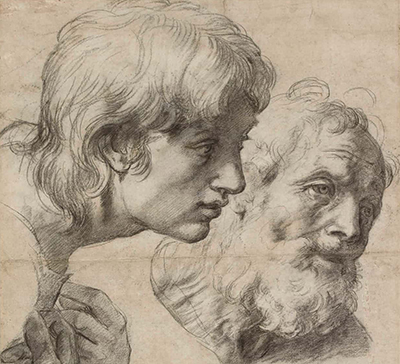
Raphael's Studies of Two Apostles for the Transfiguration concentrates the emotional crisis of a monumental altarpiece into two heads and several hands. Made about 1519–20, the large black-chalk sheet belongs to the final years of his life and is now one of the Ashmolean Museum's greatest treasures.[1]
The drawing was not an early search for the entire composition. Raphael had already established the figures in a full-size line cartoon. Dotted transfer marks brought selected outlines onto this sheet, where he could refine expression, light and bodily character without reopening the whole arrangement.[1]
The descriptive title “Heads and Hands of Two Apostles” is useful, but the exact museum identity matters: Studies of Two Apostles for the Transfiguration, WA1846.209. It is a working object, a tonal masterpiece and evidence of Raphael's late method at once.
At a Glance
- ArtistRaphael
- Museum titleStudies of Two Apostles for the Transfiguration
- InventoryAshmolean Museum WA1846.209
- Dateabout 1519–20
- Mediumblack chalk with faint white chalk highlights, over transferred or pounced outlines
- Supportlaid paper
- Dimensions49.9 × 36.4 cm
- Functionlate auxiliary study for figures in the lower half of the Transfiguration
- Figuresan elderly bearded follower and a younger man responding to the possessed boy
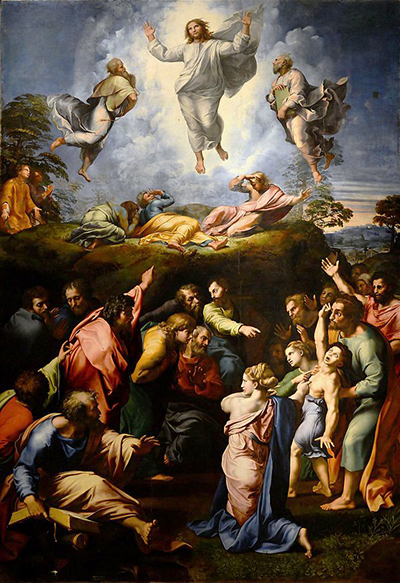
- Related paintingThe Transfiguration, Vatican Museums, 1517/18–20
- Transfer evidencedotted marks tracing key heads and hands from a full-size design
- Acquisitionpresented to the Ashmolean by a body of subscribers in 1846
Contents
- A large sheet for selected details
- The lower half of the Transfiguration
- Cardinal Giulio de' Medici's commission
- A late-stage study
- The transfer dots
- Why transfer from a cartoon to another drawing?
- Black chalk
- Faint white highlights
- The elderly apostle
- The younger figure
A large sheet for selected details
At nearly fifty centimetres high, the paper gives Raphael room to work close to the intended scale of the figures.
He does not fill it with a miniature version of the altarpiece. Instead, heads and hands occupy the field as separate but related problems.
The selection reveals priority. Faces carry fear, age and attention; hands direct the narrative and make emotion visible at a distance.
Everything unnecessary to that task is left out.
The lower half of the Transfiguration
The finished altarpiece joins two Gospel episodes.[2]
Above, Christ is transfigured in radiance between Moses and Elijah. Below, the remaining disciples confront a possessed boy whom they cannot cure until Christ returns.
The studied figures belong to that troubled lower world. Their bodies react to a crisis they do not yet understand or resolve.
The drawing explores human limitation beneath the painting's vision of divine power.
Cardinal Giulio de' Medici's commission
Cardinal Giulio de' Medici commissioned the Transfiguration for the cathedral of Saint-Just in Narbonne, where he was archbishop.[2]
Raphael's altarpiece was paired in competition with Sebastiano del Piombo's Raising of Lazarus. Both projects carried exceptional artistic and political expectations.
After Raphael died, Giulio kept the painting in Rome rather than sending it to France. It later stood at San Pietro in Montorio and now belongs to the Vatican Museums.[2]
The Ashmolean sheet was therefore made within one of Raphael's most prestigious final commissions.
A late-stage study
Raphael's sequence had moved beyond first invention.
The Ashmolean explains that the composition was already finalised and a full-size line drawing had been prepared.[1] That cartoon established where the apostles belonged and how their gestures fitted the crowd.
Raphael then returned to crucial parts in a separate, more richly modelled study.
Late-stage does not mean mechanical. It means freedom concentrated on expression, light and character within an established structure.
The transfer dots
Small dotted marks follow portions of the heads and hands.
They show that outlines were transferred from the full-size cartoon onto this sheet.[1] Pouncing normally involved pricking a design and passing dark powder through the holes, leaving points on the surface below.[3]
The dots provided an armature, not a finished answer.
Raphael could trust the placement and use black chalk to rebuild living form around it.
Why transfer from a cartoon to another drawing?
The process may seem reversed because cartoons usually carry designs toward paintings.
Here the established full-scale outline gave Raphael exact positions for an auxiliary study. He did not need to guess whether a head would fit the final group.
He could develop tone and emotion at the correct scale, then use the result as a visual guide during painting.
Transfer made experimentation precise rather than eliminating it.
Black chalk
Black chalk is the dominant visible medium.[1]
Raphael varies pressure and width to move from fine eyelids to deep beards and soft facial shadow. Hatching remains visible in places, while rubbing or close strokes produce gentler transitions elsewhere.
The darkest accents sit beside untouched paper, creating an extensive tonal range.
Monochrome becomes capable of anticipating the painting's contrasts of light and colour.[1]
Faint white highlights
White chalk appears sparingly.[1]
Small accents catch projections and sharpen the direction of light. Because the paper already supplies a middle-light tone, white is not required across every illuminated surface.
Its restraint keeps the figures integrated with the sheet rather than turning them into isolated bright silhouettes.
Light feels discovered inside the modelling.
The elderly apostle
The older man's lined face, beard and lowered concentration convey experience under pressure.
Raphael avoids a generic emblem of age. Brow, cheek and mouth respond individually, while the beard changes the way light crosses the lower face.
His expression seems burdened by the group's inability to heal the boy.
Age brings gravity but not effortless knowledge.
The younger figure
The youthful head offers a different surface and emotional speed.
Smoother flesh catches light more broadly. The turn of face and direction of attention make him responsive to something beyond himself.
Raphael contrasts types without caricature. Youth is not empty beauty, and age is not merely decay.
Their difference gives the lower crowd psychological variety.
No secure apostle names
The sheet's museum title identifies two apostles in relation to the altarpiece but does not assign them universally secure personal names.[1]
The Gospel narrative concerns a group of disciples. Later interpreters have proposed identities, yet visual type alone cannot prove them.
It is safer to describe age, gesture and place than to turn inference into fact.
The absence of a name does not weaken the figures' narrative force.
Hands as speech
Several hand studies translate thought into visible action.
Fingers point, open or turn in ways that connect one person to the afflicted boy and to companions. A hand can acknowledge helplessness, request attention or redirect hope.
Raphael isolates these gestures because their silhouette must remain legible in the crowded altarpiece.
They function like verbs within the composition.
Repetition and adjustment
Studying a hand separately permits small changes in angle, finger spacing and tension.
A gesture that works in outline may still appear stiff when modelled. Raphael could thicken a palm, relax a joint or redirect a fingertip without disturbing the neighbouring figures.
Repeated studies are not indecision without purpose.
They measure how anatomical credibility and narrative clarity meet.
Expression through tone
Raphael does not depend on dramatic contour alone.
Shadow under an eye can make attention anxious; a darkened cheek can turn a head away; a highlight across the forehead reveals strain. Tonal transition carries feeling.
The Ashmolean describes the sheet as anticipating colour as well as light and shade.[1]
That statement reflects how value structures later relationships among flesh, hair, cloth and surrounding darkness.
Old age and youth
The two principal heads establish a controlled contrast.
Hair texture, skin, bone and emotional register all differ. Their proximity invites comparison while preventing the lower scene from becoming a mass of interchangeable followers.
Raphael's mature art often makes large groups coherent by differentiating individuals.
The sheet shows that variety was built before the brush reached the panel.
The possessed boy's crisis
The boy himself is not the central drawn figure here, but his condition determines every response.
In the painting, his twisting body and unfocused gaze become the axis of the lower drama. Relatives support him while disciples point and debate.
The studied apostles register that human emergency through face and hand.
Absence becomes active: viewers infer the unseen object of their attention.
The unseen Christ
Christ is also absent from the sheet.
In the completed altarpiece he appears in glory above, spatially separated from the failed cure below. The gestures of lower figures help connect the two realms.
Raphael's detail study therefore participates in a theological structure much larger than its paper edges.
Human bewilderment gains meaning through the radiance it cannot yet see.
Relationship to the painted figures
The finished altarpiece preserves the essential placement and emotional contrast developed here.
Paint adds colour, neighbouring bodies and the pressure of the complete scene. Some chalk subtleties become less visible at viewing distance; others guide modelling beneath the surface.
The drawing is not simply an incomplete painting.
It is a specialised investigation whose concentration cannot be replicated in the crowded final work.
Raphael's final months
The sheet dates from about 1519–20, close to Raphael's death on 6 April 1520.[1]
The Transfiguration was finished or nearly finished at that moment, and the exact participation of assistants in final passages has been much discussed. The Vatican identifies it as Raphael's last painting.[2]
The drawing securely demonstrates his intense personal attention to key figures.
It replaces a vague story of late workshop production with direct evidence of the master's hand at a crucial stage.
A drawing as an independent work
The Ashmolean calls the sheet Raphael's greatest drawing.[1]
Such praise is necessarily evaluative, but its basis is clear: technical range, emotional depth, scale and connection to a major final painting converge.
The paper remains functionally preparatory while offering a complete visual encounter.
Utility and independent artistic power are not opposites.
Laid paper and physical presence
The support is laid paper, made in a mould whose wire pattern can remain visible in transmitted light.[4]
Its fibres receive chalk differently from a smooth modern sheet. Texture can break a stroke, hold loose particles and soften rubbed tone.
At nearly half a metre high, the paper also has bodily scale.
The viewer meets faces that feel studied for human presence, not miniaturised notation.
Condition and display
Black chalk and white heightening are vulnerable to abrasion, handling and extended light exposure.
Museums control display to preserve subtle tonal relationships. A sheet may be famous without being permanently on view.
Mounting protects the paper but can affect how edges and reverse are examined.
Current access should always be checked with the Ashmolean rather than assumed.
Thomas Lawrence and public subscription
The drawing entered the Ashmolean in 1846, presented by a body of subscribers.[1]
It came from the celebrated holdings assembled by the portrait painter Sir Thomas Lawrence, whose Raphael and Michelangelo drawings were exceptional in quality.[4]
Public fundraising helped keep the group together for study in Oxford.
The acquisition history explains the 1846 embedded in the inventory number WA1846.209.
The inventory number
WA1846.209 is the most precise compact identity for the sheet.
Titles can vary between “Studies of Two Apostles,” “Heads and Hands” and longer descriptive forms. The accession number remains tied to one museum object.
Using it prevents confusion with other apostle studies for the same altarpiece.
Exact identity is especially important in Raphael's enormous and dispersed graphic corpus.
Why the drawing matters
The sheet makes Raphael's late method visible at the point where structure and feeling meet.
A full-size cartoon fixed placement; transferred dots preserved scale; black and white chalk developed the emotional and luminous life of selected faces and hands. Mechanical assistance enabled more concentrated artistry.
It also explains the lower half of the Transfiguration. The crowd's crisis succeeds because its members do not repeat one response. An older man and a youth meet helplessness differently.
Most importantly, the drawing shows harmony being made. Raphael's finished figures may appear inevitable, but on paper he measured every glance, shadow and finger that would guide the viewer through disorder toward revelation.
Artist Up Close
Begin by locating the dotted transfer marks. Separate their regular points from Raphael's broader chalk modelling.[1]
Compare the two heads through age, direction and tonal range. Notice how beard and smooth skin receive light differently.
Move to the hands and follow each fingertip beyond the paper. Ask what unseen person or event the gesture addresses.
Look for faint white heightening rather than expecting bright opaque passages.
Finally, compare the sheet with the lower portion of the Vatican altarpiece. Identify what the complete composition adds and what the drawing reveals more intimately.[2]
Frequently Asked Questions
Discussion
What detail most changes how you read Studies of Two Apostles for the Transfiguration?
Reader Insights
Which source detail gives the page its strongest anchor?
Which visual or historical distinction should readers keep in mind?
How does this page change the wider picture of Raphael's career?
Join the Conversation
Share your reading below.
References
- Ashmolean Museum, “Studies of Two Apostles,” WA1846.209 View source.
- Vatican Museums, “Raffaello Sanzio, The Transfiguration,” View source.
- National Gallery, London, “Studying Raphael: Drawings and Cartoons,” View source.
- Ashmolean Museum, “Drawings by Raphael and His School at the Ashmolean Museum,” View source.