 by Tom Gurney
Tom Gurney BSc (Hons) is an art history expert with over 20 years experience
Published on June 19, 2020 / Updated on August 21, 2026
Email: tomgurney1@gmail.com / Phone: +44 7429 011000
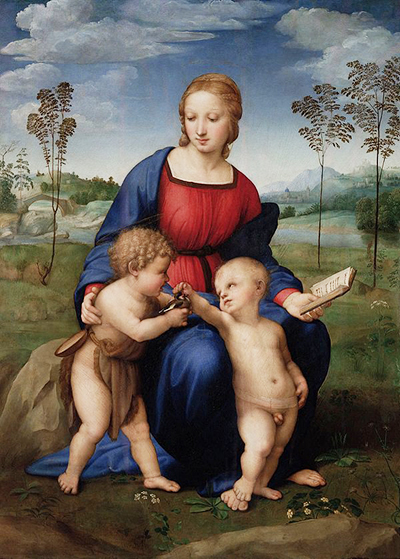
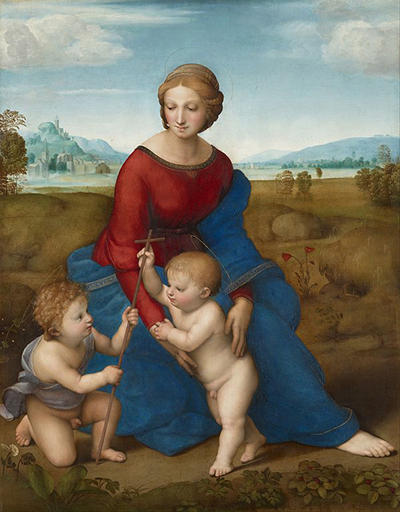
Raphael's Madonna of the Meadow places a prophecy of death inside the first uncertain steps of childhood. Mary sits low in an open pasture, lightly supporting the standing Christ Child. The young John the Baptist kneels before him and holds a slender cross. Jesus reaches toward it as though it were a shared plaything, while Mary looks down with tenderness shadowed by knowledge.[1][2]
Painted in 1505 or 1506 for the Florentine patron Taddeo Taddei, the panel belongs to Raphael's transformative years in Florence. The group is contained within a lucid pyramid, but every limb and glance keeps that geometry alive. Behind them, grass, poppies, strawberries, water, a distant town, hills and mountains recede into a pale atmospheric horizon.[1][2]
The work is also known as the Madonna del Prato or Madonna in the Meadow. Its name identifies more than a pleasant setting. Raphael makes earth and distance essential to a new sacred intimacy: Mary no longer requires a throne, and the future Passion arrives through an object held between two children.
At a Glance
- ArtistRaphael
- TitleThe Madonna of the Meadow
- Italian titlesMadonna del Prato or Madonna in the Meadow
- Date1505 or 1506
- Supportpoplar panel
- Dimensions113 × 88.5 cm
- PatronTaddeo Taddei
- Human arrangementMary steadies Christ while the kneeling Baptist presents his cross
- Central objectJohn's slender cross
- Date inscription
M.d.V, possibly readable asM.D.V.I, on the hem of Mary's dress - Acquired by Archduke Ferdinand Karl1662
- In the Ambras collection1663
- Transferred from Ambras to Vienna1773
- Current locationKunsthistorisches Museum, Vienna, Gemäldegalerie Room I
- Inventory numberGemäldegalerie 175
Contents
- A private work for Taddeo Taddei
- Mary on the ground
- Christ's first steps
- John the Baptist and the cross
- A triangular relationship
- A composition built on supported movement
- The cross as toy and prophecy
- Poppies, strawberries and the meadow
- Lake, town and distant horizon
- Light, flesh and colour
A private work for Taddeo Taddei
The Kunsthistorisches Museum records that Raphael painted the panel for Taddeo Taddei, a Florentine patrician and art patron.[1] The Albertina describes the Madonna in the Meadow as one of two paintings Raphael made for his friend.[3]
Taddei belonged to the cultivated circle through which the young artist encountered Florentine taste and artistic debate. A Madonna for such a home could function as devotion, intimate possession and demonstration of new pictorial intelligence.
The scale is substantial enough to give the figures bodily presence, yet still appropriate to a palace rather than a high church altar. Viewers could approach the plants, child's hands and date on Mary's hem.
Private setting encouraged a different relation from Raphael's Umbrian altarpieces. Mary sits in nature rather than within an enthroned celestial hierarchy. John and Jesus behave as children even while their attributes carry future history.
Taddei's patronage also locates the work within Raphael's Florentine exchange. He was not simply visiting to study famous masters; he was producing ambitious pictures for people able to recognise and support his synthesis.
The later journey to Tyrol and Vienna transformed this intimate Florentine object into an imperial collection highlight, but its first world was one of close domestic looking.
Mary on the ground
Mary has set aside a formal throne. She sits upon an almost concealed natural support, close to earth and grass.[2]
This humility does not diminish her. Her body is the largest and most stable form, rising through the centre and enclosing the children within her reach.
One arm extends to support Christ as he stands. The touch is light enough to acknowledge his growing independence and secure enough to prevent a fall.
Her other arm and bent leg help close the triangular group. Practical maternal action becomes compositional structure.
Mary's downward gaze carries warmth but also awareness. The small cross between the boys foretells what she cannot prevent.
Raphael avoids theatrical grief. Her knowledge remains internal, allowing the ordinary beauty of the moment to persist. That restraint gives prophecy greater poignancy: future sorrow is present without destroying present tenderness.
Christ's first steps
The Christ Child stands with Mary's help, his feet testing the soft ground. The KHM's account emphasises that he seems only recently to have begun walking.[2]
This precarious uprightness introduces time into the image. He is moving from complete dependence toward bodily autonomy.
His reach toward the cross is simultaneously playful and grave. A new walker encounters the instrument on which his adult body will die.
Mary's supporting hand becomes the emotional hinge. She enables movement toward John and the cross while protecting the child who must eventually pass beyond her protection.
Christ's pale body catches light against Mary's strong colour. His small scale does not weaken his importance because the surrounding gestures converge upon him.
The pose also keeps the pyramid open. Rather than sitting compactly on Mary's lap, he extends downward to earth and outward to John.
John the Baptist and the cross
The young Baptist kneels at the opposite side, holding a slender cross. His posture creates reverence without abandoning childhood.[1][2]
John's later role is to prepare the way and identify Christ. Here he presents the sign of Christ's mission before either child can articulate it.
The cross can look like a stick or toy within their interaction. That visual ambiguity is purposeful: children share an object whose adult meaning exceeds their game.
Its diagonal points back toward Mary, making her part of the prophecy.[2] The object binds all three figures rather than belonging to John alone.
John's kneeling body stabilises the lower side of the triangle. His upward attention answers Mary's downward gaze and Christ's reaching motion.
Unlike the Madonna of the Goldfinch, where a bird passes between the boys, this panel centres a constructed emblem with an unmistakable future shape. The interaction is less about caressing life than approaching sacrifice.
A triangular relationship
The KHM describes the group as a pyramid embedded in the meadow.[1] Mary's head forms the apex; children and drapery broaden the base.
Geometric clarity does not reduce the figures to points. The triangle emerges from relationships: Mary's arms, Christ's unstable stance, John's kneeling body and the directions of gaze.
Raphael had learned from Leonardo how a pyramidal group could unify complex bodily interaction. His own version is more open, illuminated and directly devotional.
The landscape gives the triangle room. It is not pressed against a dark backdrop, and its edges breathe into sky and water.
Internal diagonals prevent static symmetry. The cross tilts, Christ reaches, Mary's head inclines and John rises toward the centre.
Balance is therefore an active condition. Each figure occupies a different posture, yet none could be removed without weakening the whole.
A composition built on supported movement
The painting can appear perfectly still at first glance, but its stability is made from actions that are not yet finished. Christ is in the process of standing and reaching. John remains poised on one knee as he presents the cross. Mary inclines, steadies and watches. Raphael suspends these movements at the instant when they depend most clearly upon one another.
Christ's balance is especially important. His upright body might suggest precocious strength, yet the contact of Mary's hand makes dependence visible. He can turn toward John because she secures him. The gesture is maternal in subject and structural in effect: it prevents the child's vertical from becoming isolated within the broader triangle.
John answers with a different kind of support. His planted knee anchors the side of the group, while his raised arms carry the thin cross into the central interval. Mary provides physical safety; John provides the object that gives the encounter its prophetic direction. Their roles meet in Christ's reaching body.
Raphael also keeps small openings between limbs. Sky and meadow appear around the children's contours, so the figures do not harden into a single mass. These intervals let viewers read who touches whom, where weight rests and where the next movement might go. Clarity comes from spacing as well as outline.
The result is a composition whose geometry cannot be separated from care. The pyramid is not a diagram laid over the figures. It is the visible consequence of a mother helping one child stand while another approaches. Formal order and human dependence describe the same event.
That dependence gives the scene a precise rhythm. The eye pauses at Mary's supporting hand, crosses the child's torso, follows his extended arm and arrives at the object John holds. It then returns through John's upward regard to Mary's inclined head. No painted line encloses this circuit, yet posture makes it unmistakable.
The open meadow ensures that the movement never feels cramped. Broad distance surrounds a compact exchange, allowing an instant of bodily uncertainty to coexist with compositional confidence. Raphael's order is persuasive because it does not freeze life. It lets the possibility of a next step remain present.
Even the prophecy gains force from this poised transition: the child reaches toward a distant fate while his mother still governs every immediate movement.
The cross as toy and prophecy
The most unsettling idea in the painting is also the simplest: Jesus and John appear to share the cross like a toy.[2]
Renaissance sacred childhood often carries signs of the Passion. Theological time allows infancy and death to coexist because Christ's identity is understood from the beginning.
Raphael makes foreknowledge bodily. Jesus does not merely sit beside a symbolic object; he stretches toward it while learning to stand.
The cross's thinness matters. It does not dominate the landscape as Calvary would. It can pass between small hands.
Mary's gaze gives the object emotional weight. The children may experience contact and play; she appears to understand destiny.
The image thus depends on unequal knowledge. Viewers and Mary see the future inside an innocent exchange, while the boys remain fully credible as children.
Poppies, strawberries and the meadow
The foreground contains short grass or moss, bushes, a poppy and strawberries, according to the KHM's close description.[2]
Such plants make the sacred group inhabit a touchable world. They give texture to the ground on which Christ experiments with standing.
Poppies have often carried associations with sleep, death or Passion, while red fruits can invite devotional readings. Specific symbolic claims should remain cautious because ordinary meadow plants also create natural plausibility.
The painting's force does not require every botanical form to function as a coded emblem. Nature can support meaning through season, fragility and colour.
Red notes in flower and fruit answer Mary's clothing and the future blood implied by the cross.
Close vegetation gradually yields to wider space. The eye moves from grass around infant feet toward water and mountains, extending intimate action into a large world.
Lake, town and distant horizon
A lake occupies the middle distance, with buildings along its shore. Hills and mountains soften toward the horizon beneath a pale blue sky with fair-weather clouds.[2]
The KHM interprets the pasture as emphasising the human and earthly, while the far recession suggests something timeless.[1]
Raphael uses aerial perspective to let colour and contour fade with distance. The landscape feels continuous even though its details are highly selected.
Water creates a horizontal interval behind the group, helping separate bodies from more distant terrain. A town makes the world inhabited but does not intrude on the sacred encounter.
The horizon grants the small cross an enormous temporal backdrop. A brief moment of childhood is set against space that seems to continue indefinitely.
Landscape and group perform complementary work. The pyramid gives permanence; the recession gives extension. Together they make tenderness feel both immediate and enduring.
Light, flesh and colour
An unseen sun illuminates the figures and meadow under a clear sky.[2] Light is even enough to model bodies without dramatic shadow.
Christ's ivory-toned skin and reddish cheeks make him palpable and warm. John's flesh answers his while differing in posture and exposure.
Mary's red dress and blue mantle form the composition's largest chromatic structure. Their saturated weight holds the lighter children against the landscape.
Green pasture surrounds the trio without absorbing them. Warm and cool colours alternate, letting bodies remain clear inside nature.
Atmospheric blue in distance links Mary's mantle to sky and mountain. Sacred colour enters the world around her.
Raphael's harmony is not a uniform softness. It depends on a controlled hierarchy: strongest colour near Mary, brightest flesh at the children, faintest tones at the horizon.
The date on Mary's hem
The panel carries a date along the hem of Mary's garment. The KHM reads it as M.d.V, while allowing that M.D.V.I may be visible.[1]
The ambiguity supports the museum's dating of 1505 or 1506. It should not be resolved by confidence greater than the inscription permits.
Placing the date on cloth integrates chronology into the fictional world. It is not a modern label outside the image.
The hem follows Mary's body, so the written marks participate in drapery and movement.
The uncertain final numeral also demonstrates how material details resist perfect transcription. Wear, paint and letter form can keep a seemingly simple fact open.
The narrow range remains significant. It fixes the work near the beginning of Raphael's Florentine period, when rapid compositional experimentation produced several distinct Madonna groups.
Raphael drawing the relationships
The Albertina preserves a double-sided sheet with four studies for the Madonna in the Meadow. Raphael worked through arrangements and individual poses across both sides.[3]
On the reverse he concentrated largely on the two children and their relation. On the recto he explored connections between Mary, Christ and John.[3]
The sequence of studies is difficult to determine because ideas developed in close succession. This uncertainty is valuable: invention did not follow one simple linear path.
One version already brings Christ's support against Mary's arm close to the painted solution. Other sketches test how bodies might touch and balance.[3]
The regular distribution of studies across the page reflects the geometric clarity Raphael sought in the final group.[3] Drawing space becomes an orderly field of alternatives.
The sheet reveals that the pyramid was not imposed after figures were invented. Relationships and geometry developed together.
Leonardo and the Florentine encounter
Raphael's move into Florentine artistic culture exposed him to Leonardo's interlocking figure groups, Michelangelo's sculptural bodies and Fra Bartolomeo's monumental compositional calm.
Leonardo is especially relevant to the pyramid and to the way gestures transmit meaning through a group. Raphael absorbs the principle without reproducing Leonardo's darker psychological atmosphere.
His meadow is open, lucid and spacious. Each figure remains individually legible even as bodies connect.
Raphael also retains the clarity learned in Umbria. Florentine complexity does not dissolve outline or devotional accessibility.
The painting is therefore an act of translation. A new language of bodily unity is adapted to a domestic sacred image whose emotional sequence can be understood immediately.
The Albertina studies show this assimilation happening through repeated invention rather than passive observation.[3]
A Madonna of humility and a new Renaissance ideal
Mary seated low in nature belongs to the older type of the Madonna of Humility. Raphael renews it through bodily naturalness and expansive landscape.
Humility here is not smallness. Mary commands the panel through scale, colour and compositional function even without a throne.
The KHM calls the work an emblem of a new Renaissance spiritual outlook, joining the human-earthly meadow to a distant sense of the eternally valid.[1]
That claim helps explain the panel's enduring appeal. The divine does not arrive by breaking nature apart; it becomes intelligible through touch, growth, light and space.
Yet nature is not merely reassuring. The cross introduces death, and Mary's gaze registers knowledge within beauty.
Raphael's ideal is therefore balanced rather than naive. Harmony contains the future sorrow it cannot remove.
From Florence to Ambras
The KHM records that Archduke Ferdinand Karl acquired the painting in 1662.[1]
By 1663 it was in the Ambras collection. Schloss Ambras near Innsbruck housed Habsburg collections with deep roots in princely display and learned collecting.
The panel's move transformed a Florentine private devotional picture into an object of dynastic possession.
In 1773 it was transferred from Ambras to Vienna.[1] That relocation brought it into the developing central imperial collection from which the Kunsthistorisches Museum emerged.
The concise provenance is unusually clear at its major points but does not explain every transfer between Taddei ownership and Ferdinand Karl's acquisition.
Today the painting remains in the KHM's Picture Gallery, where its quiet meadow stands within a dense history of Habsburg collecting.
How to look at the Madonna of the Meadow
Begin with Christ's feet. His uncertain stance makes Mary's supporting hand essential.
Follow his reach toward John's cross, then trace the object's diagonal back toward Mary.
Look closely at poppy, strawberries and short grass before allowing the eye to travel across water toward distant mountains.
Find the date written along Mary's hem and preserve its ambiguity between 1505 and 1506.
Finally, compare the visible triangle with the bodily actions that create it. Geometry is not behind the family; it is their relationship.
Why the painting matters
The Madonna of the Meadow gives sacred foreknowledge a completely human form. A mother supports a toddler; another child offers an object; their bodies organise themselves through care.
At the same time, the slender cross makes innocence temporally deep. First steps point toward final sacrifice.
Raphael's synthesis of figure, landscape and prophecy established a Madonna type that feels both ideal and alive. Its harmony endures because it does not deny vulnerability.
Artist Up Close
Look at the small interval between Christ's hand and the cross. Desire, play and destiny occupy that space.
Notice how Mary conceals what she sits upon, making her body appear to rise naturally from the meadow.
Then move from the children's warm flesh to the faint mountains. Raphael coordinates touchable presence with almost limitless recession.
Frequently Asked Questions
M.d.V or possibly M.D.V.I.[1]Discussion
What detail most changes how you read Madonna of the Meadow?
Reader Insights
Which source detail gives the page its strongest anchor?
Which visual or historical distinction should readers keep in mind?
How does this page change the wider picture of Raphael's career?
Join the Conversation
Share your reading below.
References
- Kunsthistorisches Museum, Vienna, “The Madonna of the Meadow,” Gemäldegalerie 175. View source.
- Kunsthistorisches Museum, Vienna, “Balance and Harmony,” 2017. View source.
- Albertina, Vienna, “Vier Studien zur ‘Madonna im Grünen’,” inventory 207 recto/verso. View source.