 by Tom Gurney
Tom Gurney BSc (Hons) is an art history expert with over 20 years experience
Published on June 19, 2020 / Updated on August 21, 2026
Email: tomgurney1@gmail.com / Phone: +44 7429 011000
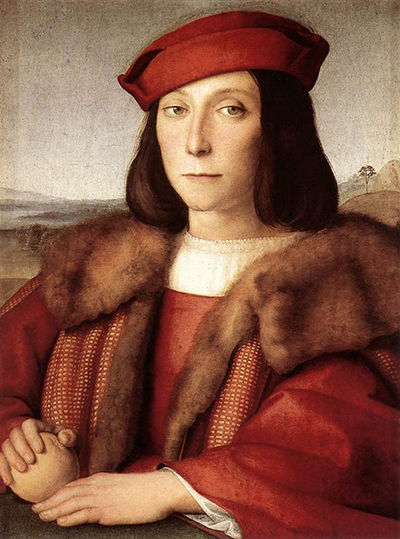
An unidentified young man holds a golden apple near the lower edge of Raphael's portrait. His hands rest on a green parapet, his red velvet coat is bordered with fur, and a river of long dark hair runs beside his sharply modelled face. Behind him, delicate trees and distant hills open the confined half-length image onto a far larger world.
The Uffizi calls the painting Young Man with an Apple. The web address “portrait of a man holding an apple” describes the same work but wisely does not turn an uncertain identity into a fact. Francesco Maria della Rovere, heir to Urbino in 1504, is an attractive candidate. No surviving early record settles the matter, and the golden fruit cannot serve as a name tag.[1]
Uncertainty is not a defect in the portrait. It shifts attention toward Raphael's real achievement: a young person is made socially specific through clothes, pose and bearing even though the name that once completed the likeness has been lost.
At a Glance
- ArtistRaphael
- Collection titleYoung Man with an Apple
- Dateabout 1504
- CollectionPalatine Gallery, Pitti Palace, Uffizi Galleries, Florence
- Inventory1890 no.8760
- Mediumoil on wood
- Dimensions48 × 35.5 cm
- Sitterunidentified
- Leading proposalFrancesco Maria della Rovere, not proved
- Key objecta golden apple held in one hand
- Clothingred velvet
robone, gold-square embroidery, fur edging, white shirt and red cap - Spatial deviceboth hands meet a green foreground parapet
- Provenance anchorreached Florence in 1631 with the Urbino inheritance of Vittoria della Rovere
- Attribution historyonce recorded as Francesco Francia; recognised as Raphael from the early twentieth century and now catalogued as his work
Contents
- What can be said with confidence?
- The proposed Francesco Maria della Rovere
- Why the title remains anonymous
- The three-quarter turn
- An intense but unreadable gaze
- The sharp face
- The red cap and flowing hair
- The robone
- Gold squares without a coat of arms
- The green parapet
What can be said with confidence?
The object itself supplies a firm starting point. It is a small oil painting on wood, now in the Pitti Palace, of a fashionably dressed young man seen to half length. His head turns three-quarters toward us. One hand encloses a golden apple while both hands touch a green ledge. A luminous landscape occupies the distance.[1]
Its historical record also preserves an important limit. When the picture came from Urbino to Florence in the seventeenth century, the people compiling the inventory did not know the sitter's identity.[1]
Any name attached today is therefore a reconstruction. The quality of a proposal depends on how well date, age, provenance and attribute align—not on how confidently the name is repeated.
The proposed Francesco Maria della Rovere
The best-known identification is Francesco Maria della Rovere. He was the nephew of Pope Julius II and became the adopted son of Guidobaldo da Montefeltro and Elisabetta Gonzaga, the childless rulers of Urbino.
In 1504 he was named heir to the duchy. The Uffizi notes that this event corresponds with its approximate date for the painting and suggests that the apple could allude to the new succession.[1]
The combination is meaningful: an Urbino picture, a boy of elite rank, a dynastic moment and a prominent golden object. It establishes plausibility. It does not provide documentary proof that Francesco Maria sat before Raphael.
Why the title remains anonymous
Museums often preserve a descriptive title when identification rests on hypothesis. Here that practice protects the object from a biography that could overwhelm what is visible.
Calling the figure Francesco Maria without qualification would encourage every feature to become evidence of princely destiny. The costly coat would prove ducal birth, the gaze would prove command, and the apple would prove succession. Such reasoning moves in a circle.
Young Man with an Apple keeps observation and interpretation in their proper order. A candidate can be discussed fully while the title continues to acknowledge doubt.
The three-quarter turn
The sitter's face is neither strictly frontal nor a clear profile. One cheek opens toward us while the other recedes, and the line of the nose marks the turn.
This angle gives Raphael more information to coordinate: forehead, cheekbone, jaw and hair change as they pass into shadow. It also makes looking reciprocal. The youth is not merely presented; he appears to direct his attention outward.
The Uffizi places this active three-quarter construction between Raphael's solemn frontal portraits of Guidobaldo and Elisabetta and the more complex Doni portraits painted in Florence.[1] The comparison is useful as a formal sequence, not a claim that Raphael's development followed one smooth line.
An intense but unreadable gaze
The eyes are dark, narrow and concentrated. They give the face what the Uffizi describes as an intense quality.[1]
Intensity is not the same as a known emotion. The youth may seem proud, cautious, watchful or simply composed according to the viewer's expectations.
Raphael supplies enough asymmetry to make the gaze alive, but he does not narrate its cause. The sitter's identity may be unknown; his inward life is no more available than that of a named person.
The sharp face
Long hair frames a slim face with a pronounced nose and firmly closed lips. Shadows run along the cheek and beneath the jaw without hardening the flesh into a rigid mask.
The precision of the profile within a three-quarter view makes the youth seem older in bearing than his smooth skin might suggest. Raphael balances delicacy with definition.
That balance suits a court portrait. Beauty and discipline coexist, and neither needs to be translated into moral character.
The red cap and flowing hair
A red cap sits over long, straight brown hair. Cap and coat answer one another across the figure, creating a warm vertical structure.
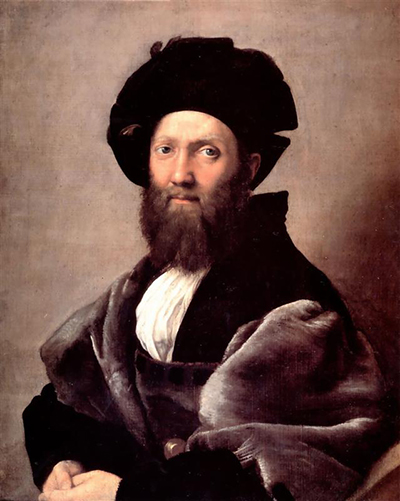
The hair is not arranged into Bindo Altoviti's soft blond masses. Here it falls in denser, straighter lengths and darkens the boundary between cheek and garment.
Its length identifies fashionable presentation rather than an individual. Hairstyles can help date and contextualise a portrait, but they rarely recover a lost name on their own.
The robone
Over a white shirt and woollen vest, the young man wears a red velvet robone, a loose and costly overgarment. Gold squares embroider its surface and fur trims its edge.[1]
The coat communicates rank before any heraldic badge appears. Velvet, metal thread and fur required resources; representing them required equally controlled differences of colour and light.
Raphael does not flatten those materials into ornament. The garment also gives the torso breadth, helps stage the turn and forms the warm middle ground from which hands and face emerge.
Gold squares without a coat of arms
The embroidered units repeat across red velvet. Their regularity differs from the irregular trees and slopes behind the sitter.
Pattern makes clothing feel made, owned and maintained. Yet the squares do not clearly state a family identity. To treat them as a deciphered emblem would exceed the museum's evidence.
Their stronger role is visual: small points of gold prepare the eye for the much larger, smooth fruit held below.
The green parapet
A green horizontal surface crosses the foreground. The young man's hands touch or rest upon it, giving the body a boundary inside the painted space.
The parapet does several things at once. It separates our world from his, offers support for the hands and creates measurable depth between figure and distant landscape.
Its colour also connects foreground to the vegetation beyond. Raphael turns a simple architectural edge into the hinge between contact and distance.
Two hands at the threshold
Portrait hands are demanding because they can either enliven a likeness or distract from the face. Raphael places both at the bottom, where their pale forms interrupt the green ledge.
One gathers around the apple. The other lies more quietly, stabilising the composition. Together they turn possession into an action rather than an inventory item.
Their nearness is striking. Face belongs beyond the parapet; fingers approach its front edge. The viewer feels invited close, though never past the boundary.
The golden apple
The fruit is round, smooth and unnaturally precious in colour. It is the picture's most conspicuous clue and its greatest interpretive trap.
Golden apples carried numerous associations in classical, courtly and Christian culture. A viewer might recall beauty, judgement, desire, rule or exceptional reward. A Renaissance object could activate more than one resonance without being a rebus with a unique answer.
For this specific portrait, the Uffizi's restrained proposal is best: if the sitter is Francesco Maria, the apple may refer to his selection as Urbino's heir.[1] Both halves of that sentence matter—“if” and “may.”
Is it a real fruit or a symbolic object?
Raphael paints the apple as something the sitter can hold. It has volume, weight and contact with the fingers.
Its golden appearance nevertheless separates it from ordinary orchard fruit. This doubleness is precisely what allows an attribute to work in portraiture. It can belong credibly to a body and carry meanings beyond use.
The safest interpretation does not choose between object and symbol. It begins with their coexistence.
The landscape beyond
Rolling hills, fine trees and far blue-green forms recede behind the sitter. The landscape is calm where his costume is dense.
Its small scale increases his apparent size. It also supplies air around the head, allowing hair and cap to detach cleanly from the distance.
No source identifies this as a measured view of a particular Urbino site. It is better understood as an idealised landscape language capable of joining local memory, atmospheric space and cultivated calm.
Court and countryside
The portrait brings costly court dress before open land. These zones might appear opposed: artificial pattern against nature, controlled rank against free distance.
Raphael uses each to strengthen the other. Landscape keeps splendour from becoming claustrophobic, while the clothed body gives human scale to hills that might otherwise seem generic.
If the sitter did belong to the ruling family of Urbino, the conjunction would have had an additional aptness. The painting itself does not label the land as his future domain.
From Urbino to Florence
The picture formed part of the inheritance that reached Florence in 1631 with Vittoria della Rovere, wife of Grand Duke Ferdinando II de' Medici and last heir of the Urbino dynasty.[1]
That provenance makes the proposed ducal identity more credible, because the object remained attached to the family collection. Yet collections contain gifts, purchases and portraits of many people. Provenance narrows possibility without naming the face.
The transfer also explains the work's present home in the Pitti Palace. Dynastic marriage moved not only titles and property but also the visual memory of one court into another.
A forgotten name in the inventory
By 1631 the inventory keepers did not know who the youth was.[1] The loss is instructive.
Portraits are commissioned to preserve identity, but names can detach from images as generations change. An attribute that was obvious within one household may cease to communicate when context disappears.
The painting survived more securely than its explanation. Modern scholarship must work from that uneven inheritance rather than pretend that beauty guarantees memory.
From Francesco Francia to Raphael
The work was originally recorded under the name of Francesco Francia. In the early twentieth century it began to be attributed to Raphael, whose authorship the Uffizi now recognises.[1]
This change should not be caricatured as earlier blindness followed by instant certainty. Attributions respond to comparison, conservation knowledge, provenance and changing ideas of an artist's early development.
The former name is part of the painting's history. It shows that the graceful finish and courtly stillness once belonged to a wider field of Renaissance styles before today's Raphael catalogue took shape.
An early portrait problem
Around 1504 Raphael was moving among the artistic worlds of Urbino, Umbria and Florence. Portraiture offered a compact arena in which to combine what he had learned.
The frontal dignity associated with court images remains, but the head turns and the hands become active. The landscape carries Umbrian clarity, while the spatial relation between body and ledge anticipates more complex Florentine solutions.
It would be too neat to call the panel merely a bridge. It solves its own problem: how to make rank legible when the sitter is young and the composition small.
Comparison with Guidobaldo da Montefeltro
Raphael's portrait of Guidobaldo uses dark, gold-trimmed clothing and a measured setting to give the duke solemn authority. The Uffizi identifies him securely through comparison with another reliable likeness.[2]
The apple-holder shares courtly richness but behaves differently in space. His red is more expansive, his hands occupy the threshold and the fruit creates a focal action.
This contrast cautions against identifying people from style alone. Two pictures from a related milieu can organise power in markedly different ways.
Comparison with Elisabetta Gonzaga
Elisabetta's portrait is rigorously frontal and excludes her hands. Her patterned dark dress and scorpion jewel carry attention toward a face held in formal balance.[3]
The young man's angle and foreground gesture create another kind of court presence. He appears ready to enter action; she appears to preside.
These are pictorial effects, not diagnoses of gender or temperament. Raphael adjusted format to commission, sitter and desired address.
What anonymity gives the modern viewer
An unknown sitter can become a screen for fantasy. Because no biography resists us, it is easy to call the youth melancholy, arrogant, romantic or destined.
Responsible looking does not require emotional silence. It requires recognising which responses arise in the viewer and which facts belong to the object.
The portrait's strongest mystery is not “What secret does the apple reveal?” It is how a face can remain compelling after the social network that once named it has fallen away.
Artist Up Close
Raphael makes three distances coexist in this small panel. The apple and fingers occupy the immediate foreground; the face resides just beyond the green ledge; the landscape recedes into pale atmosphere. Each zone has a different scale and texture, yet none breaks from the others.
Colour performs the joining. Red cap and coat surround dark hair, gold moves from embroidery to fruit, and green passes from parapet into countryside. The sitter is both isolated from nature and woven into its palette.
This integration is more revealing than a forced identity. Raphael could persuade a viewer that clothes, body, object and land belonged to one social presence. The name has vanished; the coherence has not.
Frequently Asked Questions
robone?Discussion
What detail most changes how you read Young Man with an Apple?
Reader Insights
Which source detail gives the page its strongest anchor?
Which visual or historical distinction should readers keep in mind?
How does this page change the wider picture of Raphael's career?
Join the Conversation
Share your reading below.
References
- Uffizi Galleries, “Young Man with an Apple,” object record by Anna Bisceglia View source.
- Uffizi Galleries, “Portrait of Guidobaldo da Montefeltro,” object record by Anna Bisceglia View source.
- Uffizi Galleries, “Portrait of Elisabetta Gonzaga, Duchess of Urbino,” object record by Anna Bisceglia View source.