 by Tom Gurney
Tom Gurney BSc (Hons) is an art history expert with over 20 years experience
Published on June 19, 2020 / Updated on August 21, 2026
Email: tomgurney1@gmail.com / Phone: +44 7429 011000
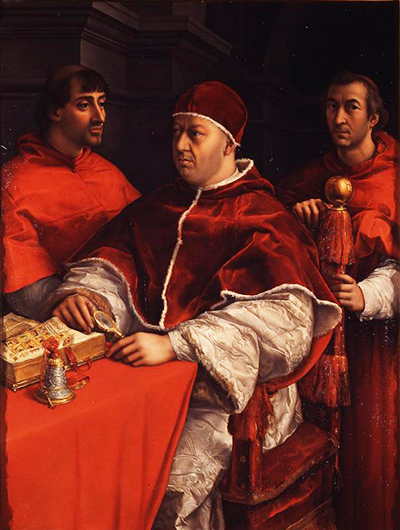
Raphael's Portrait of Leo X with Cardinals Giulio de' Medici and Luigi de' Rossi is a painting about looking at power. The pope has paused over a lavish illuminated Bible. A gold-rimmed lens remains in his hand, the pages lie open before him and two Medici cardinals close the space behind. Red silk, velvet, fur, gold and silver create extraordinary splendour, yet the three men do not dissolve into ceremony. Each face remains watchful and distinct.
The picture travelled to Florence in September 1518 to preside over a Medici wedding feast in Leo's physical absence. It was therefore more than a record of appearance: it made the pope and his family government present at a dynastic event. Five centuries later, conservation has disclosed how carefully Raphael planned that presence. Scientific study during the 2017–20 treatment established that all three sitters belonged to his design and that the whole painting is by his hand.[1]
The work combines family, church office, collecting, reading and representation. Its centre is a pope who examines a book while being examined by everyone before him.
At a Glance
- ArtistRaphael
- TitlePortrait of Leo X with Cardinals Giulio de' Medici and Luigi de' Rossi
- Date1518
- CollectionGallerie degli Uffizi, Florence
- InventoryPalatina 1912 no.40
- Mediumoil on poplar panel
- Dimensionsabout 155.5 × 119.5 cm, often rounded to 154 × 119 cm
- Central sitterPope Leo X, born Giovanni de' Medici (1475–1521)
- Cardinal behind on the pope's right sideGiulio de' Medici, later Pope Clement VII
- Cardinal behind the chair on the pope's left side: Luigi de' Rossi
- First documented functiondisplayed over the table at a Medici wedding feast in Florence, September 1518
- Booka lavish fourteenth-century Neapolitan illuminated Bible, open at the Gospel of John
- Hand-held objectgold-rimmed magnifying glass
- Conservation resultthe two cardinals were planned from the outset; the Uffizi describes the picture as entirely autograph Raphael
Contents
- Who was Leo X?
- Raphael under the Medici pope
- A papal portrait becomes a family group
- Giulio de' Medici
- Luigi de' Rossi
- A triangle of power
- A scene without a named conversation
- The monumental grey setting
- Red upon red
- White, gold and silver
Who was Leo X?
Leo X was born Giovanni de' Medici in Florence in 1475. He was the son of Lorenzo de' Medici, known as Lorenzo the Magnificent, and grew up in a family that made collecting, letters, music and artistic patronage central to political identity.
He became a cardinal while young and was elected pope in March 1513. The Holy See records his pontificate from 1513 until his death on 1 December 1521.[2]
His reign coincided with both the brilliance of High Renaissance Rome and the beginning of Martin Luther's challenge. Culture, finance, diplomacy and religious crisis cannot be separated into different centuries. Raphael's portrait emerges from that dense present.
Raphael under the Medici pope
Raphael had risen under Julius II, but his responsibilities expanded further under Leo X. Painting, tapestry design, architecture, antiquarian study and a large collaborative studio all demanded direction.
Leo continued the Vatican rooms, commissioned the Sistine Chapel tapestry cycle and placed Raphael in positions connected with Saint Peter's and the study of ancient Rome.
The portrait therefore joins men already bound through sustained work. Raphael knew how Leo's cultural authority functioned and how to translate it into objects, surface and behaviour.
A papal portrait becomes a family group
Unlike Raphael's Portrait of Julius II, this picture does not isolate its pope. Leo sits with two cardinals who are also Medici relatives.
Giulio de' Medici stands behind on the pope's right side. Luigi de' Rossi occupies the opposite rear position, nearer the chair. The Uffizi calls both members of the Medici family and identifies them as Leo's cousins.[1]
Their presence makes the image dynastic as well as ecclesiastical. Papal government appears through a small family constellation.
Giulio de' Medici
Giulio was born in 1478, the illegitimate son of Giuliano de' Medici, who had been murdered in the Pazzi conspiracy. He rose with his cousin Giovanni and became one of Leo's closest political collaborators.
As cardinal and vice-chancellor, he belonged near the centre of papal administration. Raphael also worked on projects associated with him, including Villa Madama and the Transfiguration commission.
After Leo's death, Giulio eventually became Pope Clement VII. Later viewers therefore see not only a cardinal beside a pope, but a future pope whose reign would confront the Sack of Rome.
Luigi de' Rossi
Luigi de' Rossi was another Medici relative and close companion of Leo. He received the cardinal's hat in 1517 and died in 1519, soon after the portrait was completed.
In the painting he stands behind the chair, his face nearer the edge and his attention directed outward. His placement is close without equalling the central sitter's authority.
It is misleading to call the two cardinals merely Leo's nephews. The Uffizi's family description is more precise: these are related Medici prelates within the pope's trusted circle.[1]
A triangle of power
The three heads form a broad triangle. Leo occupies its lower and central point through his seated mass, while the cardinals rise behind.
The arrangement is compact, but not symmetrical. Giulio turns with guarded reserve; Luigi presses closer to the chair and appears more directly responsive. Leo is physically between and before them.
Raphael transforms hierarchy into spatial relation. The pope does not require a separate throne platform because every line leads toward him.
A scene without a named conversation
The painting can resemble a meeting interrupted. Leo has raised his lens from the page, and the cardinals appear attentive.
No document identifies a specific discussion. It would be tempting to assign the scene to one political decision, but the image provides no such transcript.
Raphael constructs readiness: reading has paused, officials are present and authority may turn toward the viewer. The absence of fixed speech keeps the group active.
The monumental grey setting
Behind the men is a severe architectural interior. The Uffizi describes it as monumental grey stone, a setting that allows red, white, gold and silver to command attention.[1]
The walls do not identify a precise Vatican chamber. They establish gravity and depth.
Recent treatment recovered a stronger sense of this architecture after old layers had made the background appear unusually flat.[1] Space is an active part of the portrait, not a neutral darkness.
Red upon red
The painting's dominant colour is red. Papal cape, cardinal robes, table covering, chair and cap create a field of related but distinct materials.
Raphael differentiates them through sheen, pile, fold, lining and light. Silk does not behave like velvet; fur does not behave like woven cloth.
Red signifies church office and Medici magnificence, but it also presents a painterly challenge. Three figures must remain separate within a restricted family of hues.
White, gold and silver
White fur around Leo's shoulders focuses the centre. It separates face from cape and records the density of luxury through soft, irregular edges.
Gold appears in the lens rim, book, bell and furniture. Silver contributes cooler flashes. These materials punctuate rather than overwhelm the red structure.
The palette makes rank visible through controlled accumulation. Nothing is accidental, yet the result avoids the rigid spacing of a treasury display.
Leo's face
Raphael does not idealise Leo into generic beauty. Heavy cheeks, small eyes, rounded nose and soft chin are observed with extraordinary care.
The pope's head turns slightly while his attention seems divided between book, companions and space beyond the picture. His expression is neither a smile nor a public blessing.
Physical specificity becomes authority. Raphael implies that the office is strong enough to survive unflattering features.
The pope's hands
One hand holds the magnifying glass above the open pages. The other rests near the book, its fingers made visible by rings and strong illumination.
The hands connect body to object. Leo is not posed beside a symbolic volume that he never touches; he has apparently been using it.
Their careful observation also helps counter the monumental clothes. Intelligence and sensory limitation become present through small bodily actions.
The magnifying glass
The gold-rimmed lens is the portrait's most distinctive object. The Uffizi suggests that it may refer to Leo's shortsightedness while also expressing his interest in the book.[1]
It is practical and prestigious. A lens enables close looking, while gold makes the aid worthy of papal presentation.
Raphael's choice produces a layered relation: Leo inspects a painted page as viewers inspect Raphael's painting.
Vision and authority
A ruler is expected to see, judge and understand. Leo's need for magnification complicates that ideal without cancelling it.
The lens admits bodily limitation. It also shows adaptation: culture supplies an instrument through which knowledge can remain accessible.
In a group portrait, this private optical aid becomes public identity. Leo rules partly as a reader and collector who knows how to look closely.
The illuminated Bible
The open volume is not a generic prayer book. The Uffizi identifies it as a lavish mid-fourteenth-century Bible made in Naples and now associated with the Kupferstichkabinett in Berlin.[1]
Its illuminations are connected with Cristoforo Orimina and his workshop, a leading centre for Neapolitan book painting. The page is open at the beginning of the Gospel of John.[1]
Raphael therefore paints another artwork inside his own: parchment, script, image, binding and metal details become evidence of Leo's collecting culture.
“In the beginning was the Word”
The Gospel of John begins with the relation between Word, God and creation. Opening the Bible there gives the page profound theological significance.
The Uffizi also proposes a dynastic reason for the codex's selection. Its possible connection with Queen Joanna I of Naples and the French Roger de Beaufort family could have suited the Franco-Medici wedding context.[1]
That political reading is possible rather than certain. The securely visible fact is an illuminated Bible open to John's first page.
Cristoforo Orimina's book art
Cristoforo Orimina and his assistants worked within a sophisticated Neapolitan tradition responsive to developments associated with Giotto.[1]
By including the codex, Raphael folds fourteenth-century art into a sixteenth-century portrait. Leo's taste is presented as historical and acquisitive, not confined to his own moment.
The small illumination also creates a test of Raphael's own descriptive skill: painted pigments imitate pigments on parchment.
The bell
A richly worked bell rests on the table. It belongs to the apparatus of a household and office in which attendants could be summoned.
Unlike the book and lens, it is not being used at this instant. Its availability extends the pope's reach beyond the room.
The contrast is telling. Lens draws the world inward for inspection; bell sends a command outward.
The chair and its finial
Leo's chair is partly hidden by body and cardinals, but its gold detail and red upholstery contribute to the central structure.
The finial near Luigi de' Rossi echoes the Medici family's famous balls through its rounded form. It also catches reflected light, turning furniture into another surface for close study.
The chair makes Leo stationary while the men behind him lean into his orbit. Authority is seated; service stands.
The table as threshold
The table occupies the lower foreground and pushes book, bell and hands toward the viewer.
It creates distance, but unlike a blank parapet it carries evidence of activity. Reading has occurred on this boundary.
The red covering continues the figures' colour into the viewer's zone, visually joining body, object and audience.
The 1518 Medici wedding
The Uffizi records that the completed portrait reached Florence in early September 1518. It was displayed over the table at the wedding feast for Lorenzo de' Medici, Duke of Urbino, and Madeleine de la Tour d'Auvergne.[1]
Lorenzo was Leo's nephew. Madeleine belonged to a prominent French family. Their marriage served Medici and French dynastic interests.
The portrait allowed Leo, absent from the feast, to preside metaphorically. Its original documented use was therefore active and situational, not merely decorative.
Presence by image
Placing a portrait over a banquet table creates a particular relationship. The represented pope watches the family while the family looks up at him.
Leo's raised lens and open book strengthen the illusion that he has paused and might attend to what occurs below.
The two cardinals extend the effect from one absent person to a governing family group. Painting becomes a proxy court.
Why the cardinals matter at the feast
Giulio and Luigi show that Medici power was distributed through church office and kinship. The group does not represent a solitary ruler detached from family.
Their red garments make them visually continuous with Leo, while height and placement maintain distinction.
At a wedding designed to continue the dynasty, their inclusion was especially apt. Religious rank, blood relation and political future gathered around one seated centre.
Was the portrait first planned with Leo alone?
For years, some scholars proposed that Raphael initially painted a single portrait of Leo and that another hand added the cardinals later.[1]
The idea responded to differences within the group and questions about the planning process. It remained influential enough to require direct scientific testing.
The recent conservation campaign changed the answer decisively at the Uffizi.
Evidence that all three belonged from the start
Investigators found that the incised grid for the architecture and the paint applied over it stop cleanly at the silhouettes of all three figures.[1]
The reserved spaces show that Giulio and Luigi were already painted or at least established in preparatory drawing before the surrounding setting proceeded.
The Uffizi consequently rejects the hypothesis of later additions by a different painter and calls the work entirely Raphael's.[1]
Two kinds of underdrawing
Reflectography disclosed two kinds of underdrawing derived from sketches made at separate times when the prelates were available to pose.[1]
This explains how a unified group could emerge from non-simultaneous sittings. Raphael did not need all three men permanently assembled before him.
Individual studies became cartoons for transfer, and transferred information became the basis for further adjustment on the panel.
Reworking Leo freehand
The Uffizi states that Raphael returned to Leo's figure freehand and developed it in great detail, perhaps with the sitter again before him.[1]
“Perhaps” is important. The technical evidence demonstrates freehand revision; the pope's physical presence during that stage remains a reasonable possibility.
The result gives the central face and body unusual density. Planning did not prevent observation from continuing.
Cartoons and transfer
Large, complex portraits could not be made from spontaneous brushwork alone. Raphael used drawn studies, cartoons and transfer procedures to place figures accurately.
These methods belong to accomplished painting, not mechanical weakness. They allow separate sittings and carefully calculated architecture to meet on one panel.
Visible naturalness rests on hidden preparation. The portrait's courtly ease was laboriously organised.
Why conservation began
The recent project started in autumn 2017 because small areas of original paint were in danger of detaching. Ridges had been compressed and damaged during earlier treatments.[1]
Nineteenth-century crosspieces attached to the back also exerted conflicting forces as the wooden support moved. A rigid support system could transmit strain to the painted face.[1]
Conservation therefore addressed structural risk before aesthetic enhancement.
Old retouching and varnish
Earlier restorers had applied careful retouching and multiple translucent layers. A slightly coloured, deteriorated varnish further reduced clarity.[1]
The accumulated effect made details less distinct and the architectural setting flatter. Even sophisticated previous treatment can age and alter how relationships are perceived.
Removal and adjustment required discrimination between Raphael's paint, later additions and vulnerable original surface.
The wooden support
The poplar panel responds to humidity and temperature by changing dimension. Crosspieces must support it without preventing all movement.
The Uffizi's team treated stiffness in the wood and made the back structure more flexible so that it could accommodate natural movement over time.[1]
This invisible work is as important as cleaning. A brilliant surface cannot remain safe if its support is under damaging stress.
What the treatment recovered
The intervention restored a wider range of nuanced colour and clarified details in garments, fabrics and objects. It also recovered the depth of the stone interior.[1]
The result was not simply “brighter red.” Relations became more legible: one red material against another, body before wall, page beneath hand and gold against shadow.
Conservation changed understanding because it made Raphael's decisions easier to see.
Methods of investigation
The Uffizi lists X-radiography, photographic and other imaging, optical microscopy, scanning microprofilometry and reflectography among the methods used.[1]
Each answers different questions. Some reveal internal structures or hidden drawing; others inspect surface height, pigment condition and earlier intervention.
Together they connected physical care with art-historical judgement about planning and authorship.
From Rome to Florence
The portrait's early journey was purposeful. A Roman papal likeness became a Florentine dynastic presence almost immediately after completion.
This movement also returned Giovanni de' Medici to his native city as Leo X. The son of Lorenzo the Magnificent presided in papal dress over the next Medici marriage.
Florence received not only his face but a compact claim about Medici culture, church authority and European alliance.
In the Medici collections
The painting later belonged to the grand-ducal collections and was displayed in the Uffizi Tribuna by 1589, alongside other celebrated works by Raphael.[3]
The Tribuna transformed a banquet image into an artistic treasure among rare objects and famous pictures. Court function became collection prestige.
Its modern association with both the Uffizi and the Palatine Gallery reflects institutional arrangements within the Gallerie degli Uffizi. Visitors should verify current location before travelling.
Vasari's praise
Giorgio Vasari admired the illusion of materials and the lifelike character of Raphael's group. His response helped establish the portrait as a benchmark for imitated fabric, metal, book and flesh.
Such praise can sound like a simple claim that painting deceives the eye. The work does more. Material description communicates culture and hierarchy.
The fur is not a trick detached from meaning; it tells us how papal identity was worn.
A group of individuals
Leo, Giulio and Luigi share family and office, but Raphael does not give them one expression.
Leo's attention is divided and weighty. Giulio appears controlled and inward. Luigi's face approaches the viewer more directly.
These are visual impressions rather than complete character diagnoses. Their value lies in preventing a political group from becoming three interchangeable red forms.
Dynasty and church
The Catholic Church is not hereditary in the manner of a duchy, yet Renaissance papal government was deeply shaped by kinship, patronage and family advancement.
Raphael shows that reality without adding a family tree. Three Medici churchmen occupy one compressed interior.
The painting's wedding use then extends their ecclesiastical rank into secular dynastic continuity.
Reading before viewers
Leo is represented with the Bible, but the portrait does not simply certify piety. The book is also rare, illuminated, collectible and historically valuable.
Sacred word and artistic object coexist. That union suits a pope formed within Medici humanism.
Raphael's own painting behaves similarly: it is an image of church government and an object made to display supreme visual culture.
Leo X and Julius II
Raphael's two great papal portraits offer sharply different solutions to the same problem of representing supreme church office. Julius II sits alone against a green field. His lowered gaze, handkerchief and gripping hand make authority feel physically concentrated. Leo X occupies a deeper, more crowded interior whose book, lens, bell and attendants multiply the signs of cultivated government.
The difference is not a simple opposition between a military Julius and a cultured Leo. Julius commissioned a vast artistic transformation of Rome, while Leo's pontificate faced war, finance and religious conflict. Portrait form selects aspects of public identity rather than supplying complete reigns.
Julius's chair encloses a solitary body. Leo's table opens a working surface among three related prelates. The earlier pope seems withdrawn from an audience; the later pope appears to have paused within one. Raphael adjusted proximity, object and human company to two different historical persons.
Their early functions also differed. Julius's image was displayed in Santa Maria del Popolo after his death, where lifelikeness served commemoration. Leo's travelled during his life to a wedding banquet, where it substituted for his absence. One made a dead patron present within a church; the other projected a reigning family head into dynastic celebration.
Together they established that papal portraiture did not require one fixed formula. Office could be represented through solitude or company, austere concentration or material abundance, lowered attention or suspended reading. What remains constant is Raphael's refusal to let the institution erase the body that carries it.
What the painting does not prove
It does not record one named political consultation. It does not show that the cardinals were added after completion; current Uffizi analysis rejects that theory.[1]
The lens may relate to Leo's shortsightedness, but it also belongs to reading and collecting. The Bible may have carried French dynastic resonance at the wedding, but that specific intention remains proposed.[1]
Careful uncertainty strengthens the object. Its documented function and physical evidence are already unusually rich.
Looking sequence
Begin with the lens, then trace Leo's hand to the open page. Notice how the book occupies the plane closest to you.
Move upward through fur to the pope's face, then compare the cardinals behind. Their different distances form a human enclosure.
Finally, let the reds separate. What first seems one colour becomes a study of silk, velvet, cloth, shadow and reflected light.
Artist Up Close
Raphael was directing numerous late projects when he made this portrait, yet the conservation evidence identifies the whole panel as his work. That matters because it reveals where he invested sustained personal attention.
The picture is both planned and revised. Separate sittings became cartoons; transferred drawings became painted bodies; the pope's form received further freehand adjustment. Technical structure and living observation are not opposites.
Raphael also understood that a portrait can perform after travel. He made Leo and his cardinals capable of entering a Florence banquet without leaving Rome in person. Scale, gaze, open book and compressed depth produced a convincing substitute presence.
The gold-rimmed lens offers the perfect emblem for his achievement. Every large political claim is carried by close particulars. Power becomes visible because Raphael has inspected how a finger, page, pile of velvet and cautious face inhabit the same air.
Frequently Asked Questions
Discussion
What detail most changes how you read Portrait of Leo X with Cardinals Giulio de' Medici and Luigi de' Rossi?
Reader Insights
Which source detail gives the page its strongest anchor?
Which visual or historical distinction should readers keep in mind?
How does this page change the wider picture of Raphael's career?
Join the Conversation
Share your reading below.
References
- Uffizi Galleries, “The Medici Pope Returns to Florence: Raphael and the Return of the Medici Pope — Restoration and Discovery,” 2020 View source.
- The Holy See, “Leo X,” biographical record of the 217th pope View source.
- Uffizi Galleries, “Madonna of the Chair,” collection record including its 1589 Tribuna display with Raphael's Leo X portrait View source.