 by Tom Gurney
Tom Gurney BSc (Hons) is an art history expert with over 20 years experience
Published on June 19, 2020 / Updated on August 21, 2026
Email: tomgurney1@gmail.com / Phone: +44 7429 011000
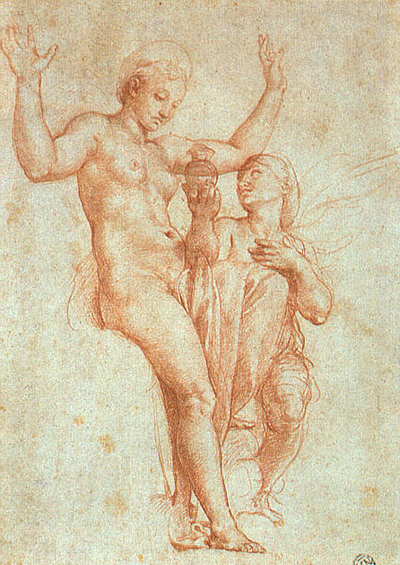
Psyche approaches Venus with a small vessel containing water from the Styx. The action occupies a curved pendentive high in the entrance loggia of the Villa Farnesina, not a portable panel. Its figures belong to a larger 1518 fresco cycle in which Raphael's designs, his assistants' painting and Giovanni da Udine's astonishing fruit-and-flower pergola transform architecture into an open garden of myth.[1]
The scene is often called Psyche and Venus. Its fuller descriptive title explains the moment: Psyche has survived one of the impossible tasks imposed by the goddess and returns with proof. In Apuleius's story, she did not collect the terrifying water alone. Jupiter's eagle carried the vessel between dragons and filled it for her.[2]
That prior rescue is absent from this meeting. The artists concentrate instead on presentation—Psyche's dangerous labour compressed into the cup she gives to an implacable authority.
At a Glance
- Governing artistRaphael, designer of the overall scheme and individual figures
- ExecutionRaphael's Roman studio; Giulio Romano is especially associated with the pendentives
- TitlePsyche Presenting Venus with Water from the Styx, also called Psyche and Venus
- Date1518
- SiteLoggia of Cupid and Psyche, Villa Farnesina, Rome
- Object typefresco episode in a pendentive
- Literary sourceApuleius, Metamorphoses or The Golden Ass, Books 4–6
- Narrative momentPsyche returns to Venus with Stygian water after Jupiter's eagle has completed the dangerous collection
- PatronAgostino Chigi, Sienese banker and papal financier
- Architect of villaBaldassarre Peruzzi
- Preparatory evidenceRaphael drawing in the Louvre, inventory 3875; a related, sketchier study is in the Ashmolean Museum
- Surrounding designfictive pergola with festoons by Giovanni da Udine; episodic pendentives and spandrels; two large central scenes like suspended tapestries
- Conservation warningthe once-open loggia suffered weather damage and underwent extensive restoration led by Carlo Maratti from 1693
Contents
- This is part of a ceiling, not a detached painting
- Where is the Loggia of Cupid and Psyche?
- Agostino Chigi's villa
- The story before the task
- Venus's tasks
- Why the Styx water is impossible to collect
- The eagle's intervention
- The vessel as compressed narrative
- Why “presenting” is the useful title
- Water contained
This is part of a ceiling, not a detached painting
The episode is physically bound to plaster and architecture. Its curved field responds to the point where vault and supporting wall meet.
A cropped reproduction can make it appear self-contained. In the room, the eye sees it among neighbouring episodes, dense festoons, open arches and the two large central compositions.
Its meaning is sequential and spatial. Psyche's task belongs to a story that unfolds as viewers turn and look upward.
Where is the Loggia of Cupid and Psyche?
The loggia occupies the ground-floor entrance side of the Villa Farnesina in Trastevere. Five arches are now closed with protective glazing; originally they opened toward the garden.[1]
This openness mattered. Painted leaves, fruit and flowers extended the real vegetation into the building, weakening the boundary between cultivated nature and fictional heaven.
Guests entered under myth. The ceiling did not merely decorate a room; it altered the transition from garden to villa.
Agostino Chigi's villa
Agostino Chigi was among the wealthiest bankers of early sixteenth-century Rome. He commissioned Baldassarre Peruzzi to create a suburban residence suited to entertainment, art and prestigious hospitality.[3]
The entrance loggia served as a setting for feasts and theatrical performances.[1] Its imagery therefore met viewers in a space already associated with spectacle.
Cupid and Psyche offered an ideal theme: desire, ordeal, divine hostility, eventual marriage and immortality could all become courtly celebration.
The story before the task
In Apuleius, Psyche is a mortal princess whose beauty provokes worship and Venus's jealousy. Cupid is sent to punish her but falls in love.
Their union begins under a prohibition: Psyche must not look upon her unseen husband. Persuaded by fearful sisters, she lights a lamp, discovers Cupid and loses him when a drop of oil wakes him.
Her search then brings her into Venus's power. The goddess sets tasks designed less to test fairly than to destroy or humiliate her.[2]
Venus's tasks
Psyche must sort an immense mixed heap of grains, acquire golden wool from dangerous sheep, fetch water from the Styx and descend toward the underworld for a portion of Proserpina's beauty.
At each stage, non-human helpers intervene: ants, reeds, an eagle and other guides. Psyche's perseverance matters, but the story repeatedly denies the fantasy of solitary triumph.
The Farnesina cycle distributes these episodes around the vault, turning repeated hardship into movement toward reconciliation.
Why the Styx water is impossible to collect
Venus orders Psyche to fill a vessel with black water flowing from a precipitous source that feeds the Styx and Cocytus. Dragons guard it, and the terrain itself is deadly.[2]
The Styx is no ordinary river. Divine oaths depend on it; even gods treat it with dread.
The task therefore magnifies the imbalance between goddess and mortal. Venus asks for a household errand whose material belongs to cosmic terror.
The eagle's intervention
Jupiter's royal eagle pities Psyche and takes the small container. It manoeuvres between danger, gathers the water and returns it.[2]
Raphael's circle also designed images of this rescue, and later prints after Giulio Romano show the eagle-bearing episode. Those are separate compositions from the Farnesina pendentive of Psyche before Venus.[4]
Keeping them distinct clarifies the narrative. Collection and presentation are two moments, not alternative titles for one object.
The vessel as compressed narrative
In the meeting with Venus, a small container bears the weight of everything that occurred offstage: height, dragons, divine river and the eagle's flight.
This is an efficient narrative device. The artists do not need to repeat the dangerous landscape. An object carries memory into a new confrontation.
The vessel also gives hands a purpose. Gesture is not generic courtliness; it is the transfer of proof.
Why “presenting” is the useful title
The shorter museum language Psyche and Venus identifies the two figures but not their place in the story. “Presenting Venus with Water from the Styx” makes the action legible to a reader encountering a cropped pendentive.
It remains a descriptive title rather than an early inscription. The wording should not imply that Psyche herself reached into the river; Apuleius is explicit about the eagle's aid.[2]
The title works best when paired with the site name. Without “Farnesina loggia,” it can be confused with drawings, prints or other moments in the same task.
Water contained
The Styx is represented not as a black river but as liquid enclosed in a small vessel. Vast mythic danger has become portable.
Containment changes power. Venus can command a mortal to fetch what even the gods fear, but Psyche returns holding the result within human hands.
The cup does not erase dependence on the eagle. It gives Psyche responsibility for carrying help to completion. Rescue becomes meaningful only because she resumes the task and faces Venus again.
Psyche before authority
Psyche has completed the demand, yet completion does not place her on equal terms with Venus. One approaches; the other receives or judges.
The curved space intensifies their relation by limiting distance. Bodies must address one another within a narrow architectural frame.
Psyche's endurance becomes visible through controlled presentation rather than heroic combat.
Venus as antagonist and future relation
Venus is cruel to Psyche because beauty and Cupid's disobedience threaten her authority. Yet the story eventually makes the mortal her daughter-in-law.
That later reconciliation changes how the pendentive works inside the complete cycle. The hostility is real, but viewers know it will not be the final order.
The loggia surrounds ordeal with the imagery of wedding and divine feast, giving the episode a destination beyond itself.
How a pendentive shapes figures
A pendentive is not a free rectangle. Its narrowing curves demand figures that fill broad lower space while resolving toward an upper point.
Raphael's design makes posture answer this geometry. Lean, turn and reaching arms convert architectural pressure into human action.
This is one reason a preparatory drawing matters. It shows that the relation between bodies and curved field was invented before execution on wet plaster.
Seen from below
The fresco was never meant to be inspected at eye level. Visitors stand beneath it, looking across the curve and through surrounding foliage.
Gestures therefore need breadth, and the gap between vessel and recipient must remain readable at distance. Small facial nuance cannot carry the episode alone.
Photography can bring the surface close, revealing repairs and brushwork unavailable from the floor. It also removes the bodily act of looking upward that Raphael's design assumed.
Raphael's Louvre drawing
A drawing by Raphael in the Louvre, inventory 3875, prepares the Psyche and Venus pendentive. The Royal Collection preserves a nineteenth-century photograph of that sheet and identifies its exact relation to the Farnesina fresco.[5]
Another, sketchier study in the Ashmolean may represent an earlier stage.[5]
These drawings anchor Raphael's authorship as designer. They do not prove that he personally painted every visible part of the wall.
From drawing to wall
The design had to be enlarged or transferred, adjusted to the built curve and painted during the limited working time of fresco plaster.
An assistant following Raphael's drawing still made material decisions: how to model flesh, join daily plaster sections and integrate figure colour with surrounding decoration.
The finished scene is therefore neither independent invention by an unnamed helper nor an entirely autograph Raphael surface.
Who painted the pendentive?
The Villa Farnesina states that Raphael devised the whole arrangement and individual scenes, while numerous studio artists worked on the frescoes, including Giovan Francesco Penni, Giulio Romano and Giovanni da Udine.[1]
Recent institutional material specifically associates the pendentive paintings with Giulio Romano.[6] It is prudent to describe this episode as designed by Raphael and executed within his studio, especially connected with Giulio.
Attribution becomes more accurate when design and wall painting receive separate verbs.
Giulio Romano's role
Giulio was no anonymous extender of Raphael's lines. By 1518 he had become a powerful interpreter of bodily form and would soon lead major projects.
His involvement helps explain why the pendentives feel robust within awkward spaces. Bodies press, pivot and command their curved compartments.
Recognising Giulio does not detach the scene from Raphael. It locates it within the living structure of a late Roman studio.
Giovan Francesco Penni
Penni also worked on the Cupid and Psyche cycle.[1] His role across Raphael's late projects included helping translate complex designs into finished images.
Public accounts cannot assign every passage to one assistant with equal confidence. The presence of several capable painters warns against a simple Raphael/Giulio binary.
The loggia is a coordinated ensemble whose unity outlasts uncertainty about individual sections.
Giovanni da Udine's pergola
Giovanni da Udine specialised in natural and decorative painting. His fruit and flower festoons create the loggia's exuberant fictive pergola.[1]
These garlands are not a neutral border around more important human scenes. They establish the garden illusion and mediate between architecture and myth.
The Styx episode is thus framed by abundance even though its story concerns deadly water. The cycle holds ordeal within fertility.
Two central “tapestries”
At the vault's centre, the Council or Feast of the Gods and Wedding of Cupid and Psyche appear like large textiles stretched beneath the pergola.[1]
Their scale and apparent rectangular suspension differ from the smaller curved episodes around them.
The central images show outcome: Psyche admitted among the gods and joined to Cupid. The pendentives show the path of suffering that gives celebration weight.
A marriage programme
The story of Cupid and Psyche had long appeared on wedding furniture. At the Farnesina, its relevance was sharpened by Agostino Chigi's relationship and marriage with Francesca Ordeaschi.
The cycle can celebrate union without becoming a simple portrait allegory of the couple. Apuleius's story contains violence, mistrust and hierarchy alongside eventual marriage.
Its richness made it more suitable to a learned court than a single emblem of love.
Female endurance and divine power
Psyche's trials are often described as a journey of the soul. Her Greek name can mean breath or soul, and later interpretation has made the tale an allegory of purification.
The narrative is also a story of a woman exposed to arbitrary power. Helpers repeatedly answer the unfairness of Venus's demands.
The pendentive holds these registers together. Moral allegory should not make the cruelty of the task disappear.
The garden and the Styx
An open pleasure loggia seems far removed from the underworld river. That contrast is purposeful.
Chigi's guests stood among cultivated plants while looking at a vessel filled from the most terrible water in myth. Artificial abundance contained danger as learned entertainment.
The real garden, painted pergola and narrated Styx created three different natures inside one view.
Dialogue with antiquity
The Villa notes that the frescoes originally interacted with classical sculpture from Chigi's collection.[1]
Ancient bodies existed both as excavated objects and newly painted figures derived from an ancient text. Raphael's Rome did not treat antiquity as one fixed model.
The loggia remade it across architecture, painting, sculpture and social use.
Weather exposure
The arches were originally open, allowing rain, humidity and changing temperature to affect the paintings. By the late seventeenth century the vault was seriously compromised.[1]
The condition history is especially important for close attribution. Surfaces now contain original passages, loss, consolidation and later integration.
What appears uneven may reflect exposure as much as sixteenth-century difference of hand.
Carlo Maratti's restoration
In 1693, Carlo Maratti and his team began a major campaign. They consolidated plaster with numerous clamps, filled losses and extended Giovanni da Udine's festoons down toward the springing of the arches.[1]
They worked according to a seventeenth-century ideal of respectful visual unity. Later taste may judge some additions extensive, but the intervention helped preserve a vulnerable room.
The present loggia is inseparable from that conservation history.
Later additions to the walls
Maratti's campaign also added false doors, architectural niches and painted windows in zones that had originally remained undecorated.[1]
These changes influence the room's appearance even when the 1518 vault remains the focus.
A visitor does not enter one untouched moment. The site layers Chigi, Raphael's studio, weather, Farnese ownership and later restoration.
Why the episode deserves its own page
Within the complete loggia, the Styx presentation can be missed as one transitional scene. Isolating it reveals a tightly designed encounter among mortal endurance, divine command and a tiny object.
The page also clarifies a common attribution problem. “Raphael's Psyche” can mean his conception, a surviving drawing or a fresco painted through his studio.
Naming each object preserves the achievement of the whole.
Artist Up Close
Raphael solved a narrative and architectural problem together. The scene had to identify Psyche, Venus and the completed task without repeating the eagle's adventure. It also had to fit a curved support and remain legible from below.
The vessel supplies the narrative centre; opposing bodies supply hierarchy; the pendentive makes their approach spatially inevitable. Studio painters then converted this design into wall surface within a room unified by other specialists.
The result is best understood as coordinated authorship. Raphael's imagination governs the episode, while the surviving fresco records the labour and history of many hands.
Frequently Asked Questions
Discussion
What detail most changes how you read Psyche Presenting Venus with Water from the Styx in Raphael's Farnesina Loggia?
Reader Insights
Which source detail gives the page its strongest anchor?
Which visual or historical distinction should readers keep in mind?
How does this page change the wider picture of Raphael's career?
Join the Conversation
Share your reading below.
References
- Villa Farnesina, “La Loggia di Amore e Psiche,” Accademia Nazionale dei Lincei View source.
- Apuleius, Metamorphoses (The Golden Ass), Book 6, Project Gutenberg edition View source.
- Accademia Nazionale dei Lincei, “Villa Farnesina,” institutional history View source.
- National Gallery of Art, “Jupiter Bringing Water of the Styx to Psyche,” Léon Davent after Giulio Romano, 2006.162.5 View source.
- Royal Collection Trust, “Psyche and Venus,” photograph of Raphael's Louvre drawing, RCIN 853945 View source.
- Accademia Nazionale dei Lincei, Villa Farnesina study programme, discussion of Giulio Romano's pendentives, 2024 View source.