 by Tom Gurney
Tom Gurney BSc (Hons) is an art history expert with over 20 years experience
Published on June 19, 2020 / Updated on August 21, 2026
Email: tomgurney1@gmail.com / Phone: +44 7429 011000
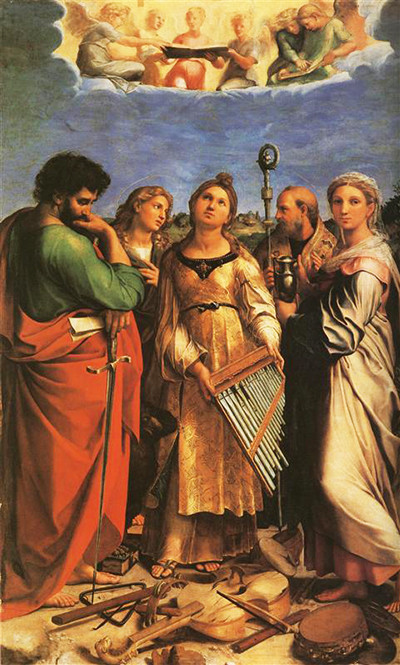
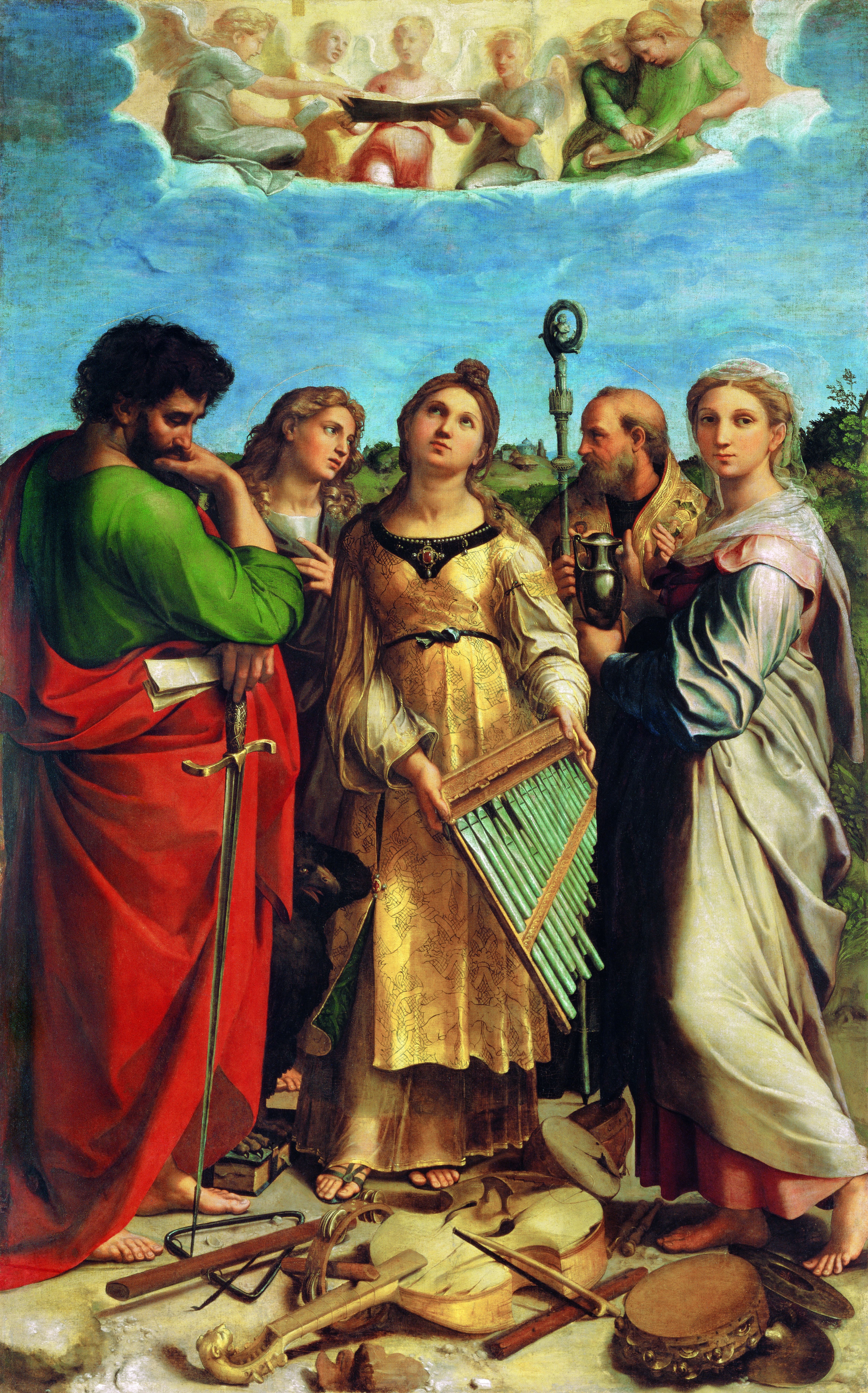
Raphael's Ecstasy of Saint Cecilia is a painting about music at the moment when earthly instruments fall silent. Cecilia stands at the centre holding a small organ, but its pipes are sliding from her grasp. Broken and discarded instruments lie at her feet. She does not look down. Her face rises toward a choir of angels singing from an opening in the sky.[1]
Four saints share the earthly register: Paul with his sword, John the Evangelist, Augustine in episcopal dress and Mary Magdalene with her ointment vessel. They neither perform nor merely watch. Each embodies a different form of attention around Cecilia's ecstatic turn from material sound toward divine harmony.
Painted in Rome for Elena Duglioli dall'Olio's chapel in San Giovanni in Monte, Bologna, the altarpiece arrived as a commanding statement of Raphael's mature classicism. The Pinacoteca Nazionale di Bologna dates it to 1518, records its original panel transferred to canvas and identifies Giovanni da Udine as the painter of the remarkable foreground instruments.[1]
At a Glance
- ArtistRaphael
- Full titleThe Ecstasy of Saint Cecilia between Saints Paul, John the Evangelist, Augustine and Mary Magdalene
- Current museum date1518; the Pinacoteca's Renaissance guide also uses 1515–16
- Medium/supportoil originally on panel, transferred to canvas
- Dimensions236 × 149 cm
- Original destinationElena Duglioli dall'Olio's chapel, San Giovanni in Monte, Bologna
- Central actionCecilia hears or sees the angelic choir as her organ pipes slip
- Foregrounddamaged and abandoned musical instruments
- Identified collaboratorGiovanni da Udine painted the instruments
- Surrounding saintsPaul, John the Evangelist, Augustine and Mary Magdalene
- Present collectionPinacoteca Nazionale di Bologna
- Inventory577
- GalleryRaphael and Central Italian art
Contents
- Cecilia before Raphael
- The instant of ecstasy
- Annotated Details
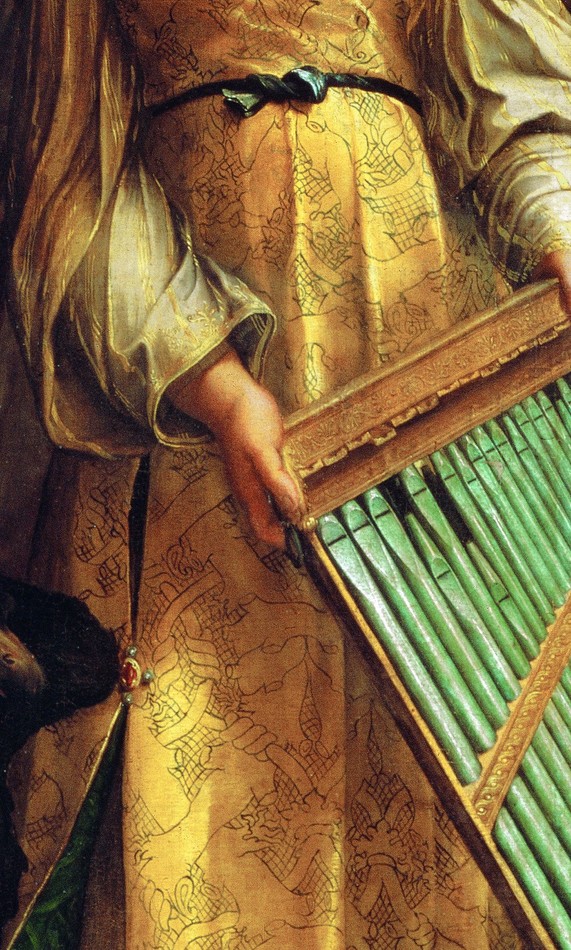
- The organ coming apart
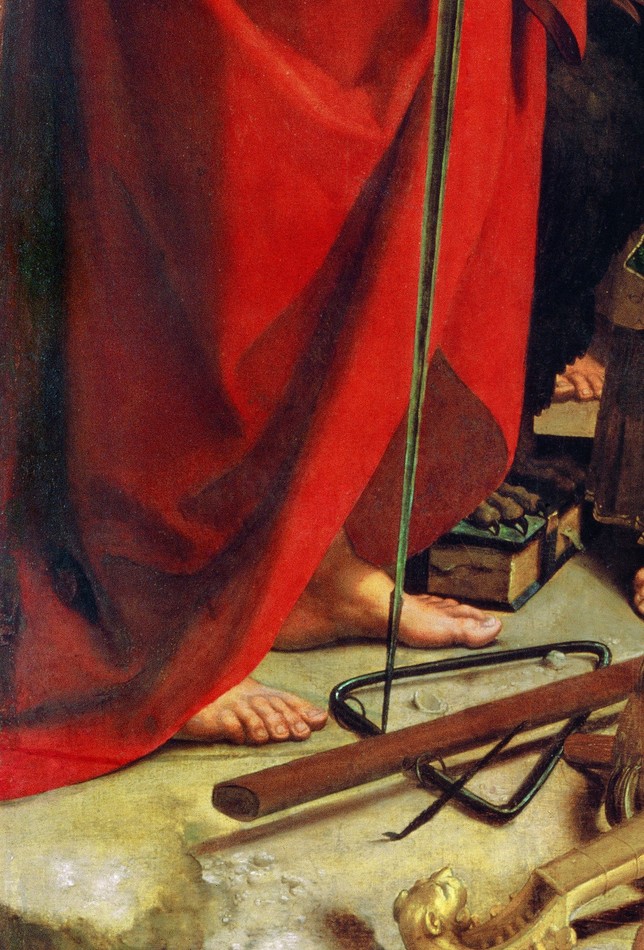
- A foreground of broken instruments
- Giovanni da Udine's contribution
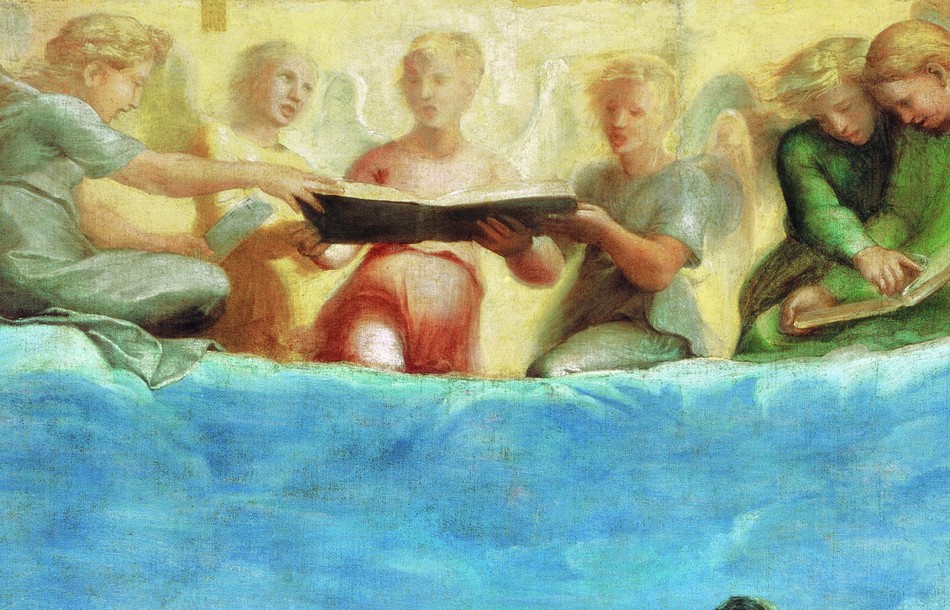
- The choir in the clouds
- Saint Paul and the downward gaze
- John the Evangelist
- Saint Augustine in episcopal dress
- Mary Magdalene and the viewer
Cecilia before Raphael
Cecilia was venerated as an early Roman virgin martyr. Her historical life is difficult to recover, and later tradition greatly expanded the surviving sacred narrative.
Her association with music developed from a line in the Latin Passion describing her singing inwardly to God while instruments sounded at her wedding. Through changing readings, organs became her attribute and she eventually became music's patron saint.[3]
By the fifteenth century, artists often showed Cecilia playing a portative organ or receiving music through an angelic companion. The instrument could signify both earthly art and access to heavenly concord.[3]
Raphael takes that familiar attribute and destabilises it. Cecilia still holds the organ, but she no longer plays. Its pipes come loose as her attention crosses into another realm.
The result does not reject Cecilia's musical identity. It redefines the hierarchy of what she hears.
The instant of ecstasy
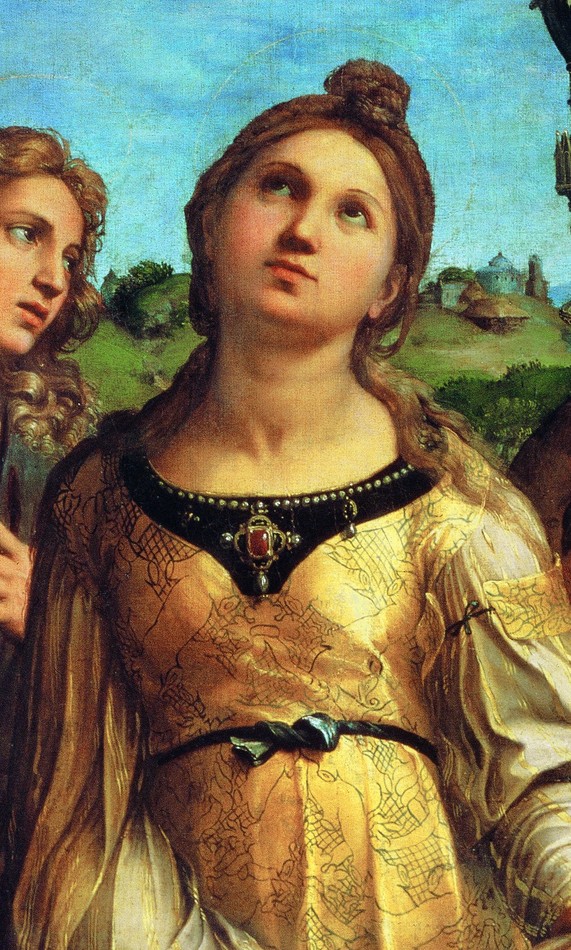
Cecilia's body remains upright and present among the saints, while her face turns sharply toward heaven. This split between bodily place and spiritual attention creates the ecstasy.
Her lips part slightly. The eyes appear moist and fixed above, conveying an encounter too intense for ordinary conversation.[5]
Raphael avoids violent convulsion. Ecstasy is not shown as loss of bodily order but as complete concentration.
The saint's hands still hold the instrument even as its parts slip. Earthly attachment does not disappear before the vision; it loosens in real time.
That interval is crucial. A fully discarded organ would show a decision already completed. Falling pipes let viewers witness the moment when one form of music becomes inadequate beside another.
Annotated Details from St Cecilia
The annotated view keeps the whole work in sight while isolating visible details that reward close looking. The source image is a public-domain Wikimedia Commons reproduction used only for this local close-reading feature.
Details from ST CECILIA
Close looking highlights visible details in the work while keeping source and image posture controlled.
Cecilia listening upward
Cecilia's lifted face makes listening the centre of the altarpiece.
Angelic music above
The choir of angels establishes the music Cecilia hears but cannot be contained by earthly instruments.
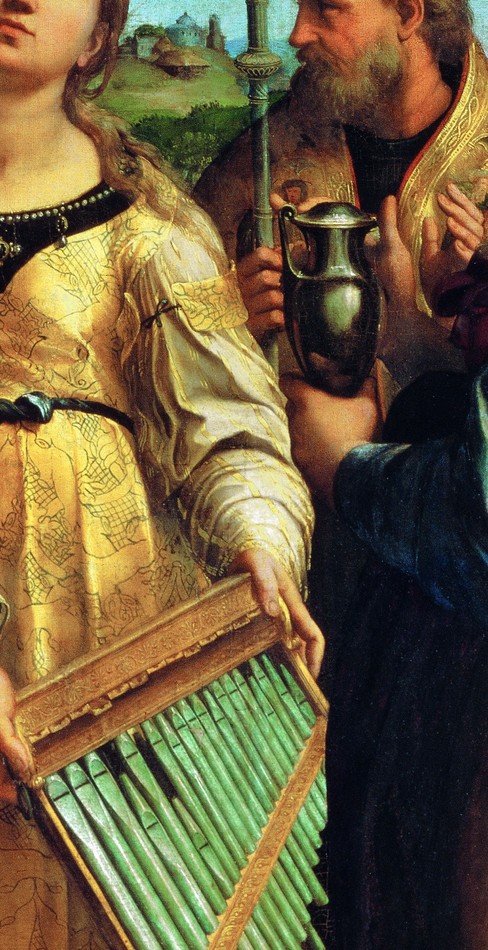
Organ pipes
The portable organ marks Cecilia's musical identity while also becoming an object she no longer plays.
Discarded instruments
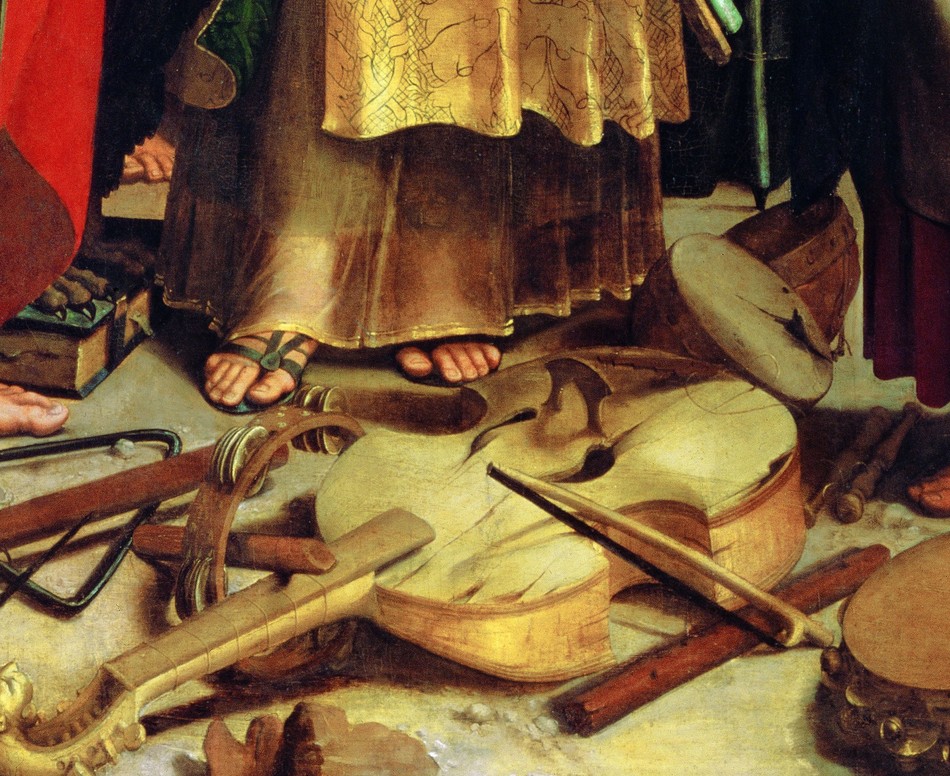
The instruments at Cecilia's feet turn earthly sound into a broken, silent foreground.
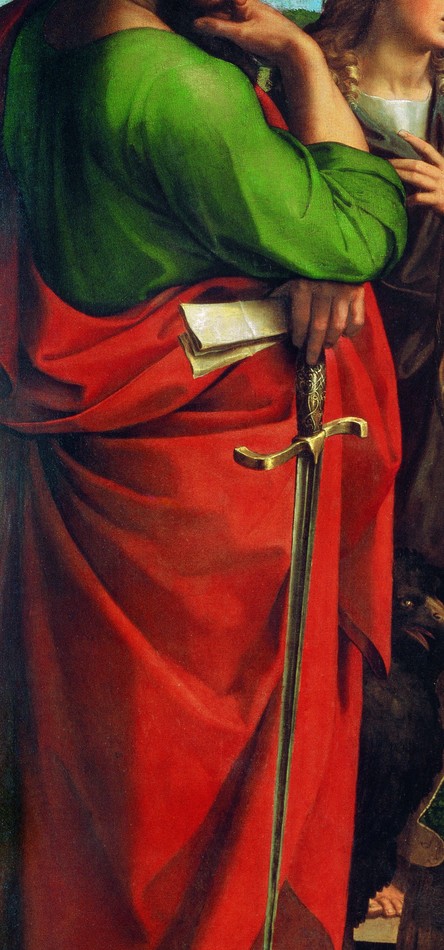
Saint Paul
Paul's heavy figure and sword give the left side a grave, grounded force.
John and Augustine
The two male saints behind Cecilia create a compact intellectual and devotional company.
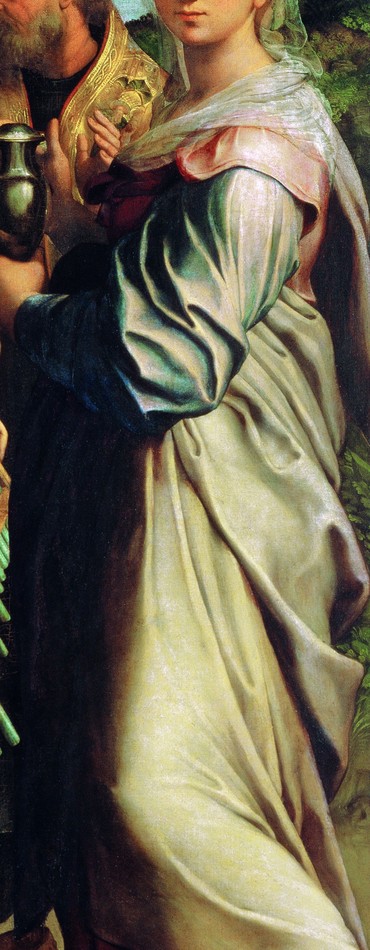
Mary Magdalene
Mary Magdalene's outward glance brings the beholder into the sacred gathering.
Sword and lower edge
The sword and scattered objects prevent the lower foreground from becoming decorative filler.
The organ coming apart
The portative organ rests across Cecilia's hands. Its small pipes tilt and descend, no longer secured for performance.[1]
An organ normally coordinates breath, mechanism and touch into ordered sound. Here the mechanism loses coherence precisely because a higher harmony has seized the player's attention.
The falling pipes also bridge the vertical composition. They begin near Cecilia's torso and direct the eye toward the scattered instruments below.
The object is precious, not crude. Renunciation means more when what is relinquished possesses genuine beauty and skill.
Raphael therefore does not stage a crude opposition between bad objects and good heaven. Earthly art is admirable but limited; angelic song exceeds it.
A foreground of broken instruments
At the saints' feet lies a dense still life of musical objects: strings, pipes, drums and parts of instruments overlap, turn and break across the ground.[1][3]
Some appear damaged; others seem simply abandoned. Their silence contrasts with the choir above, whose music can be imagined but not physically heard by the viewer.
The foreground is unusually tactile. Wood, metal, string and stretched surfaces offer different textures beneath the ideal bodies.
These objects are not random studio debris. They materialise worldly pleasure and the accomplishments of human music, now surpassed in Cecilia's ecstatic perception.[1][2]
Their horizontal disorder also opposes the upright assembly of saints. What lies broken below is plurality without concord; what appears above is a choir acting as one.
Giovanni da Udine's contribution
The Pinacoteca assigns execution of the musical instruments to Giovanni da Udine, Raphael's gifted collaborator.[1][2]
Giovanni specialised in the close observation of objects, plants, animals and decorative forms. His work in Raphael's Roman circle supplied material exactness to large imaginative programmes.
The attribution makes the still life a documented zone of collaboration. Raphael conceived the altarpiece's structure and symbolism; Giovanni gave the fallen instruments extraordinary specificity.
This division is not a weakness. The realism of the objects intensifies their theological role. Earthly sound is represented through things that look usable, valuable and materially convincing.
No comparable museum statement assigns the five principal saints to named assistants, so individual figure attributions should not be invented.
The choir in the clouds
At the top, clouds open around a group of singing angels. They hold music and join in vocal praise, an image of divine love and heavenly harmony.[1]
The choir occupies much less space than the saints but controls Cecilia's gaze. The smallest register becomes the cause of the whole scene.
Their song is represented visually through open mouths, grouped faces and sheets of music. Painting cannot sound, so Raphael depicts the shared act of singing.
The contrast with the foreground is exact. Below, instruments lie separated and silent. Above, unbroken voices unite without mechanical support.
This does not necessarily place vocal music above every instrument in ordinary worship. Within Cecilia's ecstasy, the choir stands for an unmediated divine concord against which worldly performance falls away.
Saint Paul and the downward gaze
Paul stands at the left with a sword, the instrument of his martyrdom and one of his principal attributes.[2]
His head inclines downward toward the instruments. Where Cecilia looks upward, Paul studies what has been relinquished.
The opposition creates an arc of attention through the altarpiece. Heaven, saint and object remain connected by different gazes.
Paul's broad body and heavy drapery give the left side exceptional weight. The sword forms a strong vertical and reminds viewers that spiritual transformation has physical consequences.
He is not distracted by the still life. His contemplation gives the broken objects seriousness, as if measuring the relation between worldly knowledge and divine calling.
John the Evangelist
John stands just behind Cecilia, youthful and attentive. His presence brings the language of divine love and visionary revelation into the group.
Tradition identified him as the beloved disciple and author of both the Fourth Gospel and Revelation. Those associations make him an apt companion to an ecstatic saint.
He turns within the semicircle rather than addressing the viewer directly. His attention helps bind Cecilia to the other figures.
John's youth also balances the more aged authority of Paul and Augustine. Raphael creates difference without fragmentation.
Because the figures stand close and overlap, identity depends upon relation as much as attribute. John participates in a spiritual conversation that no one speaks aloud.
Saint Augustine in episcopal dress
Augustine appears behind the central group in bishop's vestments. His mitre and pastoral authority identify him within the assembly.[2][3]
As a major theologian of love, desire and ordered enjoyment, Augustine deepens the distinction between earthly delight and its divine end.
He looks across the group rather than upward with Cecilia. The ecstatic event is surrounded by reflective witnesses whose responses differ.
His ecclesiastical clothing adds patterned richness near the upper bodies. It also represents the Church's learned interpretation of the saintly experience.
Raphael places theology close to ecstasy without allowing it to contain the vision completely. Augustine sees Cecilia; Cecilia sees beyond the visible gathering.
Mary Magdalene and the viewer
Mary Magdalene stands at the right holding the vessel associated with ointment and Christ's anointing.[2][3]
Unlike the others, she turns outward. Her direct gaze creates a bridge between the sacred semicircle and the person standing before the altar.
The jar is polished and intact, a contrast to the damaged instruments. Material objects are not rejected in themselves; meaning depends upon their use and relation to devotion.
Magdalene's elegant posture completes the composition's right edge and answers Paul's heavier mass on the left.
Her role is both saintly and presentational. She seems to invite the viewer into an event the other figures experience from within.
Five figures as an apse
The fuller Pinacoteca account describes the saints as a compact semicircle suggestive of a church apse.[2]
That arrangement transforms bodies into architecture. Paul and Magdalene form the outer supports; John and Augustine deepen the curve; Cecilia occupies its central opening.
Very little landscape separates them. The altarpiece concentrates on human presence rather than extending into a broad natural world.
The apse-like group also suits the original chapel. Painted sacred figures echo the architectural setting that once surrounded them.
Raphael's balance is not static symmetry. Heights, attributes and gazes vary, but the group feels complete because each difference contributes to the curve.
Earth, saints and heaven
The composition divides into three linked registers. Broken instruments occupy the ground; five saints form the human middle; angels sing above.
Cecilia crosses all three. Her organ belongs to the objects, her body to the community of saints, and her gaze to heaven.
This vertical movement gives the altarpiece a devotional path. The viewer begins with recognisable material things and travels through sacred example toward invisible harmony.
The other saints prevent ecstasy from becoming isolated private sensation. It occurs within a communion of martyrs, evangelist and theologian.
Heaven remains open but not fully entered. Cecilia still stands among viewers' bodily world, making her experience exemplary rather than unreachable.
Elena Duglioli dall'Olio
The chapel belonged to Elena Duglioli dall'Olio, a cultivated Bolognese woman known for piety, charity and a chaste marriage. Veneration around her had grown in Bologna from about 1506.[2]
Her life was compared with Cecilia's through continence and mystical visions. The altarpiece's ecstasy and renunciation consequently carried a personal dimension.[2]
It would be too simple to call Cecilia a portrait of Elena. The connection operates through sacred analogy, not necessarily facial likeness.
An elite female patron could present her devotional ideals through a saint whose body, music and virginity spoke to her own reputation.
The painting therefore belonged both to public chapel worship and to the construction of Elena's spiritual identity within Bologna.
Lorenzo and Antonio Pucci
Vasari, the earliest source cited by the Pinacoteca, assigned the commission to Cardinal Lorenzo Pucci.[2]
Lorenzo's brother, Bishop Antonio Pucci, had encountered Elena during a Bolognese stay and could connect her chapel project with Raphael's Roman circle.[2]
Modern accounts often treat the Pucci as agents or high-level facilitators for Elena rather than replacing her as the chapel's motivating patron.
This layered structure was normal for major commissions. Devotional desire, finance, access to a sought-after artist and ecclesiastical authority could belong to different people.
The responsible account keeps both sides visible: Elena's chapel and identification with Cecilia; Pucci mediation powerful enough to secure Raphael.
San Giovanni in Monte
Raphael painted the work in Rome, after which it travelled to Bologna for installation in Elena's family chapel in San Giovanni in Monte.[2]
The church setting gave the painted semicircle architectural force. Viewers approached not a portable collector's picture but a large altarpiece embedded in worship and memorial identity.
Its destination also explains the careful local programme. Cecilia and Elena, music and continence, papal prestige and Bolognese devotion met at a specific chapel.
The present museum provenance field still names San Giovanni in Monte.[1]
Although the altarpiece no longer occupies its original altar, understanding that first site prevents its figures from becoming a free-standing museum group without purpose.
Papal prestige in Bologna
The Pinacoteca connects the painting's arrival with the restoration of papal power in Bologna.[2]
A major work by the leading artist of the papal court carried institutional meaning even without displaying a pope or coat of arms prominently.
Roman classicism arrived as evidence of cultural authority. The chapel could honour Elena while also demonstrating Bologna's renewed place within a papal artistic sphere.
The politics did not cancel devotion. They amplified who could make the devotional programme visible and why Raphael's participation mattered locally.
The altarpiece's balanced order itself could appear as a model of restored concord: diverse saints, objects and realms organised around divine love.
The impact on Emilian painting
The Pinacoteca describes the work's influence in Bologna and Emilia as enormous, extending into the seventeenth century.[2]
Local artists encountered a new kind of monumental sacred gathering: figures both ideal and emotionally responsive, close to the surface but arranged with architectural gravity.
Some quoted individual poses; others absorbed the relation between ecstatic experience and a stable classical group.
Prints and copies widened that influence. The composition could circulate beyond viewers able to enter San Giovanni in Monte.
The painting became more than an imported masterpiece. It acted as a hinge in local artistic development, provoking imitation, resistance and transformation.
From panel to canvas
The Pinacoteca records oil on a wooden panel transferred to canvas.[1]
Raphael's original support was therefore removed at a later stage, and the paint-bearing layers were attached to fabric.
This intervention altered the object's structure profoundly. The canvas seen from the back is not the material on which the Roman studio first painted.
The live museum page does not provide a transfer date, so one should not be supplied by borrowing the history of another Raphael.
Material precision matters because “oil on canvas” alone would imply an original choice that was not made. The work is best described through both its first and present supports.
Dating the altarpiece
The current object page says 1518.[1] A Pinacoteca Renaissance guide uses 1515–16, and the Prado's 2012 Late Raphael exhibition also described it as 1515–16.[4]
The variation reflects continuing study of commission chronology, preparation and delivery rather than uncertainty about which picture is meant.
For a concise identifying statement, the holding museum's current 1518 date should lead. The earlier range remains relevant in a deeper account.
This approach avoids pretending that art-historical dating is always a single immovable year.
The work belongs securely to Raphael's Roman maturity under Leo X, whether its development began around 1515–16 or culminated in 1518.
Harmony without uniformity
Raphael's famous equilibrium does not mean that every figure behaves alike. Cecilia looks upward, Paul downward, Magdalene outward, and the inner saints across the group.
The instruments scatter; the saints gather; the angels cluster. Each register has its own organisation.
Colour also differentiates bodies without breaking the whole. Cecilia's golden garment fixes the centre while reds, greens and patterned vestments move across the flanks.
The composition achieves harmony by coordinating contrasts. Earthly and heavenly music, broken object and living voice, private rapture and communal witness all remain distinct.
That is why the picture feels balanced without becoming emotionally neutral. Order makes ecstasy intelligible.
How to look at the Ecstasy of Saint Cecilia
Begin with the pipes slipping from Cecilia's organ. Their fall identifies the exact instant.
Move down into Giovanni da Udine's instrument group and try to distinguish playable, damaged and separated parts.
Then follow four directions of sight: Paul downward, Magdalene outward, the inner saints laterally and Cecilia toward heaven.
Look at the angels last. Their small choir governs the larger figures through attention rather than scale.
Finally, imagine the semicircle inside a chapel apse. The bodies once cooperated with an architectural and devotional setting now absent.
Why the painting matters
The altarpiece transformed Saint Cecilia's musical identity by showing instrumental sound relinquished before a heavenly choir.
Its patronage gave that transformation local force. Elena Duglioli's chastity and visions found a sacred counterpart, while Pucci connections brought Raphael's papal-court authority to Bologna.
The work documents collaboration without dissolving authorship. Raphael governs the total conception; Giovanni da Udine's named instrument still life makes specialised contribution visible.
Its arrival altered Emilian painting for generations. Formal balance became a carrier of spiritual intensity rather than its opposite.
Most memorably, Raphael makes silence visible. Falling pipes, broken strings and raised eyes allow a painted choir to be heard in the imagination.
Sound imagined through sight
The altarpiece asks painting to represent an experience that belongs to another sense. No actual note survives in a painted organ, an open mouth or a page of music. Raphael therefore builds sound from the visible evidence of attention.
Cecilia hears through her whole posture. Her raised chin, parted lips and fixed eyes allow viewers to infer a music that remains beyond their ears. The saints register different consequences of that encounter, while the objects below show what has ceased.
The painting's silence is not emptiness. It is crowded with potential noises: loose metal pipes striking one another, strings snapping, a drum skin sounding under impact, voices joining above. Each can be imagined because Giovanni da Udine made the instruments materially persuasive.
The angelic singers add another paradox. Their open mouths and music sheets identify a performed work, but no earthly instrument accompanies them. Their concord seems complete through voices alone. Below, the many crafted objects are mute and separated; above, a small community produces an indivisible song. Cecilia's awakening lies between those alternatives.
Her suspended organ makes the transition bodily. She has not stepped outside the world; she still feels its weight in her hands while responding to a harmony that cannot be held.
This imagined acoustic world changes with viewing distance. From across a church, Cecilia's upward turn and the cloud-borne choir establish the contrast. Closer inspection reveals precisely constructed objects whose ordinary sounds the vision has surpassed.
Raphael also distinguishes hearing from seeing. Cecilia alone directs her gaze fully toward the choir. Paul, John, Augustine and Magdalene help the viewer understand an ecstasy they do not copy. Their differing attention prevents the sacred event from becoming a simple illustration of five people seeing the same thing.
For the person before the altar, the final act of listening occurs inwardly. Painted bodies supply no audible performance, yet their relationships organise a passage from remembered instrumental sound to imagined heavenly song. The image becomes most musical at the point where the earthly player stops playing.
Artist Up Close
Find the organ pipes that have not yet reached the ground. The work's meaning lives in their suspended fall.
Compare the intact ointment vessel in Magdalene's hand with the scattered instruments. Objects take their value from sacred use, not materiality alone.
Trace the semicircle from Paul's sword through Cecilia to Magdalene's outward gaze.
Then separate what can be seen from what can only be imagined: instruments are visible and silent; angelic song is invisible as sound but spiritually dominant.
Frequently Asked Questions
Discussion
What detail most changes how you read Ecstasy of Saint Cecilia?
Reader Insights
Which source detail gives the page its strongest anchor?
Which visual or historical distinction should readers keep in mind?
How does this page change the wider picture of Raphael's career?
Join the Conversation
Share your reading below.
References
- Pinacoteca Nazionale di Bologna, “Estasi di Santa Cecilia fra i Santi Paolo, Giovanni Evangelista, Agostino e Maria Maddalena,” INV 577. View source.
- Pinacoteca Nazionale di Bologna, archived extended collection account, “Estasi di Santa Cecilia.” View source.
- Catalogo Generale dei Beni Culturali, “L'evolversi dell'iconografia della Santa Cecilia nel Seicento,” 2021. View source.
- Museo Nacional del Prado, “Late Raphael,” exhibition record, 2012. View source.
- Carmen C. Bambach, Metropolitan Museum of Art audio guide, “The Ecstasy of Saint Cecilia.” View source.