 by Tom Gurney
Tom Gurney BSc (Hons) is an art history expert with over 20 years experience
Published on June 19, 2020 / Updated on August 21, 2026
Email: tomgurney1@gmail.com / Phone: +44 7429 011000
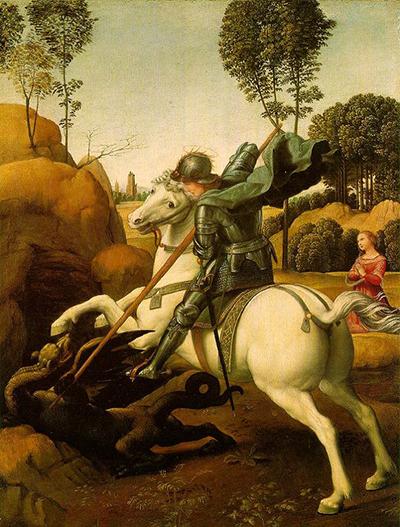
Raphael's Washington Saint George and the Dragon turns a legendary rescue into a diplomatic image. A fully armoured George drives a long lance down toward the dragon beneath his rearing white horse. A princess kneels in prayer beyond the combat. Around the saint's left calf is a blue-and-gold garter bearing the word HONI, the opening of the motto of England's Order of the Garter.[1]
That tiny inscription anchors the panel in a specific event. King Henry VII invested Duke Guidobaldo da Montefeltro of Urbino into the Order in 1504, and Saint George was its patron. Current National Gallery of Art research says Raphael's painting was made for Henry's emissary Gilbert Talbot, not sent directly to the English king as older accounts often claimed.[1]
Raphael painted the panel about 1506, after his move to Florence but for the refined courtly world of his native Urbino. At only 28.5 by 21.5 centimetres, it operates like a precious visual message: courage, Christian defence, dynastic prestige and international honour compressed into a miniature battle.
At a Glance
- ArtistRaphael
- TitleSaint George and the Dragon
- Dateabout 1506
- Medium/supportoil on panel
- Dimensions28.5 × 21.5 cm
- SubjectGeorge plunges an intact lance into the dragon while the princess prays
- Order insigniablue-and-gold garter inscribed
HONI - Painted name
RAPHELLO .V.on the horse's breast strap - Political contextGuidobaldo da Montefeltro's 1504 investiture into the Order of the Garter
- Intended recipient according to current NGA research: Gilbert Talbot, Henry VII's emissary
- First secure recordWilton House by 1627
- Credit lineAndrew W. Mellon Collection
- Present collectionNational Gallery of Art, Washington
- Accession number1937.1.26
Contents
- The dragon legend
- The lance as a single descending force
- George in armour
- The blue garter and the word HONI
- Guidobaldo's investiture
- Gilbert Talbot, not a direct gift to Henry VII
- The horse as controlled instability
- The dragon by its cave
- The princess at prayer
- Hills, towers and a miniature world
The dragon legend
According to medieval Christian legend, George was a Roman soldier who encountered a city menaced by a dragon. The creature consumed victims chosen by lot, and the king's daughter was to be sacrificed. George subdued the dragon with his lance. The princess then led it toward the city, where the saint completed the victory and the inhabitants converted.[1]
Raphael selects the mounted attack. He omits the later procession with the defeated beast and places the rescued princess at a safe distance.
The story made George a protector and model knight. His courage served Christian faith, but his military form could also speak directly to courts where honour, service and international orders structured political identity.
The legend is not historical reportage. It is a moral narrative whose repeated elements—saint, horse, lance, dragon and princess—allowed artists to create new meanings for different patrons.
In Washington, the Garter makes that patronal meaning unusually visible. The mythic battle becomes a language for a contemporary diplomatic relationship.
The lance as a single descending force
George's lance runs from his upper body toward the dragon, creating the picture's most forceful line. Unlike the broken weapon in Raphael's Louvre version, this shaft remains intact.[1]
The saint braces in the stirrup and commits his weight through the weapon. Horse, rider and lance become a coordinated mechanism of attack.
The strong diagonal links high chivalric authority to the low creature under the hooves. It also brings the viewer's eye quickly from George's calm profile to the dragon's twisted resistance.
Raphael avoids confusion by keeping the shaft long and visually continuous. It cuts through landscape, harness and bodily movement without losing its destination.
The lance is both weapon and compositional axis. Its straightness measures the instability around it: billowing cape, rearing horse, serpentine neck and splayed wings.
George in armour
Metal armour covers George's body, and a gold-trimmed grey helmet frames his profile. His expression is concentrated rather than furious.[1]
The armour translates a late-antique saint into the visual world of a Renaissance knight. Viewers at Urbino could recognise the ethics of chivalry through contemporary equipment.
A black sword hangs at George's side. It is available but not yet needed. The intact lance identifies an earlier phase of the combat than the sword-raised climax in Paris.
His thin halo keeps sacred status visible without interrupting the helmet or action. Martial splendour does not replace sainthood; it becomes its courtly surface.
The rider's controlled face matters. Courage appears not as rage but as command over body, horse and weapon.
The blue garter and the word HONI
A narrow indigo band encircles George's left calf. Gold ornament and the word HONI identify it as the Garter.[1]
The complete French motto is Honi soit qui mal y pense, commonly rendered as “Shamed be whoever thinks ill of it.” Saint George was patron of the English order, making him the ideal subject through which to commemorate an investiture.
The insignia is tiny, yet its position on the forward leg makes it available to close inspection. Raphael understood that a miniature panel could carry political specificity through minute details.
The Garter changes the scene from a broad celebration of knighthood to an image tied to England and Urbino. George's virtue reflects upon Guidobaldo's honour.
It also helps identify which of Raphael's two Saint Georges is meant. Only the Washington panel makes this English institutional link explicit on the saint's body.
Guidobaldo's investiture
Guidobaldo da Montefeltro was formally invested as a Knight of the Garter in May 1504, in the presence of Pope Julius II and the papal court. The occasion followed his appointment as captain-general of the Church and was marked by ceremony and public display.[2]
The honour repeated one held by his father Federico da Montefeltro. Federico's famous court portrait displays the Garter on his armoured leg while he reads, joining military prowess with learning.
Raphael's George converts that courtly ideal into action. The saint wears the insignia while defeating evil, giving the Order's honour a sacred and heroic model.
The painting was probably completed after the 1504 ceremony, around 1505–06. Its date reflects the time required for a commemorative idea to become a refined portable object.[1][2]
The panel therefore belongs to Raphael's Florentine development but remains rooted in Urbino's patronage network. Geography of study and community of use are not the same thing.
Gilbert Talbot, not a direct gift to Henry VII
Older accounts often described the picture as a gift from Guidobaldo to Henry VII. The National Gallery of Art states that scholarship has shown it was made for Gilbert Talbot, the king's emissary.[1]
Talbot had carried the Garter insignia and represented the English monarch in the diplomatic exchange. A small Raphael panel would have been an exceptionally apt acknowledgement of his role.
This correction changes the human chain without weakening the political meaning. The English king authorised the honour; Guidobaldo received it; Talbot enacted the connection and became the painting's recipient.
The National Gallery in London uses slightly broader language, saying the panel may have been presented to one of Guidobaldo's English sponsors.[2] The Washington museum's more specific identification governs the object here.
The distinction also explains why the work could enter an English collection early. Diplomatic gifts moved through households as well as courts.
The horse as controlled instability
The cream-white horse rears on its hind legs and turns its head outward. Its hazel-brown eye meets the viewer with a vividness distinct from George's downward concentration.[1]
Raised forelegs expose the dragon below and create a bodily arch around the descending lance. The animal's fear and movement increase the difficulty of the saint's action.
Blue saddle and bridle repeat the colour of George's cape. Gold trim connects harness, armour and garter, making rider and mount a coordinated courtly unit.
The horse is not merely transport. Its rotation supplies depth, and its head opens the combat toward the viewer.
Raphael makes control visible through contrast. The animal reacts; the rider directs. Both are caught at a point where balance might fail.
The dragon by its cave
The dragon occupies the ground beneath the horse near a rocky outcrop and cave. Its tawny body, greenish head, long neck and bat-like wings combine familiar animals into a convincing monster.[1]
It grips the earth with claws and pushes at the lance with a forefoot. Its resistance prevents the weapon from seeming to pass through an inert symbol.
The cave marks a boundary between inhabited landscape and dangerous enclosure. George meets the creature at the edge of its own terrain.
The dragon's smaller scale helps keep the miniature composition legible, but its twisting neck and open teeth preserve threat.
Raphael's fantasy remains observational. Wings have membranes, feet carry weight, and the body responds to pressure. The beast becomes credible enough for courage to matter.
The princess at prayer
Farther back, the princess kneels with her hands together. She wears a red dress and a translucent white wrap, and her head turns toward the battle.[1]
Prayer distinguishes her action from the retreating princess in the Louvre panel. She does not participate physically, but her posture frames the knight's combat within faith.
Her red clothing makes her legible across distance. Scale places her beyond immediate danger while preserving the reason for the fight.
The separation between foreground warrior and background woman also creates deep space. A narrative hierarchy becomes a spatial one.
Her calm kneeling form answers the horse's vertical agitation. She gives the composition a smaller point of stillness on the opposite side.
Hills, towers and a miniature world
Bands of straw-coloured hills and green trees recede toward a pale blue horizon. Two orange towers rise in the distance.[1]
These tiny buildings imply the threatened community without illustrating its population. Raphael gives the dragon legend a civic destination.
The landscape also expands a very small support. Foreground rock, middle-distance princess and far towers create several zones the eye can enter.
The National Gallery's 2022 catalogue relates Raphael's early detailed landscapes to northern European painting known at Urbino and filtered through Perugino.[2] Precision and atmospheric recession allow courtly fantasy to feel inhabited.
The bright world contrasts with the dragon's cave. George's action defends open, cultivated space against a creature associated with darkness and enclosure.
Raphael's name on the harness
Across the horse's breast strap Raphael painted RAPHELLO .V., meaning Raphael of Urbino.[1]
The signature is woven into the equipment rather than placed outside the scene. Gold letters belong to the harness and to the artist's identity simultaneously.
Naming Urbino is particularly apt on a picture bound to Montefeltro diplomacy. Raphael presents himself not only as maker but as a product of the same courtly culture the panel celebrates.
The location also rewards intimate viewing. From a distance the inscription appears as ornament; close attention converts it into authorship.
Signature and Garter form two bands of text within the image. One names the artist and origin; the other names the chivalric institution. Together they fix a legendary scene in a real network of people and places.
A related drawing in Washington
The National Gallery of Art owns a drawing titled Saint George and the Dragon, also dated about 1506. It is made with brush and brown ink, heightened with white over black chalk and incised with a stylus.[3]
The sheet shows a rider bracing in the stirrup and driving a spear toward a serpentine dragon. The horse is viewed more from behind, and washes create an atmospheric, partially unresolved space.[3]
Its dimensions, about 24.5 by 20.3 centimetres, are close to those of the panel. Scholars have connected the sheet with Raphael's painted Saint George, and the NGA bibliography includes John Shearman's study of that relationship.[3]
The drawing is not a full-size pounced cartoon known to have transferred every contour. It is better understood as evidence of Raphael testing the hard problem of horse, rider and thrust in depth.
White heightening clarifies forms against toned paper, much as light must separate armour and horse within the finished landscape.
More confident space
The National Gallery in London calls the Washington Saint George more confident than Raphael's slightly earlier small court pictures in arranging rider, horse and especially the writhing dragon in space.[2]
That confidence appears in overlap. The lance crosses the horse's body; the dragon turns beneath its feet; the rider presses into the saddle; the cave recedes behind them.
Raphael does not arrange figures like signs on a flat field. Every body occupies and contests depth.
The achievement is especially striking at miniature scale. A small error in overlap would make the action unreadable. Instead, the downward thrust remains clear within a dense knot of forms.
This spatial control marks development after Raphael's move toward Florence, where Leonardo and Michelangelo offered radically ambitious examples of bodies in motion.[2]
From Wilton House to Charles I
The first secure record places the painting at Wilton House with William Herbert, third Earl of Pembroke, by 1627. It may have passed through his brother Philip before being given to Charles I between 1628 and 1639.[1]
That English presence accords with the panel's Garter connection without proving every earlier step from Gilbert Talbot onward.
After Charles I's execution, the Commonwealth sold the royal collection. Edward Bass bought the painting at Somerset House on 19 December 1651.[1]
It may then have belonged to the Marquis de Sourdis before reaching Laurent Le Tessier de Montarsy and Pierre Crozat in Paris by 1729.[1]
The passage from diplomatic object to English royal picture and then sale commodity shows how political images acquire new values across regimes.
Crozat, Catherine II and the Hermitage
The panel descended through the Crozat family. In 1772 Catherine II of Russia bought the heirs' collection, using philosopher Denis Diderot as an intermediary.[1]
The purchase carried Raphael's miniature from Paris to the Imperial Hermitage in Saint Petersburg, where it became part of a collection designed to assert Russia's place within European culture.
Its scale again proved an advantage. A portable court picture could move across courts, sales and national borders while retaining a highly specific English-Urbino sign.
For more than a century and a half, the work's public identity was tied to the Hermitage. The next transfer came through Soviet sales of major collection objects.
The provenance is not peripheral. It explains why a painting about diplomatic honour between Urbino and England passed through the royal collections of England and Russia before reaching the United States.
Andrew Mellon and the National Gallery of Art
Andrew W. Mellon bought the painting in March 1931 through a consortium involving the Matthiesen Gallery, Colnaghi and Knoedler.[1]
He deeded it to the A. W. Mellon Educational and Charitable Trust in 1932. Five years later, that trust transferred the painting to the National Gallery of Art, helping form the nucleus of the new national collection.[1]
The credit line reads Andrew W. Mellon Collection, and the accession number is 1937.1.26.[1]
The Washington setting creates an accidental title complication: “Washington Saint George” refers to the city's museum location, not to George Washington. Collection and accession number keep the object clear.
The NGA's current record lists it in the West Building. Gallery positions can change, so visitors should check the live page.[1]
How to look at the Washington Saint George
Begin with the word HONI around George's calf. It turns legend into political commemoration.
Move up the leg into the stirrup, then follow the rider's force down the lance into the dragon.
Find RAPHELLO .V. on the horse's breast strap and notice how artist and institution both enter the painted world as text.
Look beyond the action to the kneeling princess and orange towers. Rescue concerns a person and a community, not victory in isolation.
Finally, compare the intact lance with the Louvre version's broken shaft and raised sword. Raphael chose different seconds of the same battle.
Why the painting matters
The Washington Saint George is a small picture with an unusually large political geography. It links an Italian duke, an English king and emissary, a Christian patron saint and a young artist who identified himself through Urbino.
Its visual economy is equally impressive. One descending lance organises horse, rider and monster; a kneeling princess explains the action; a garter supplies the historical key.
The painting also demonstrates Raphael's increasing ability to build depth through entangled motion. Chivalric calm does not mean static form. It means control sustained inside danger.
Its later path through Charles I, Crozat, Catherine II and Mellon confirms that diplomatic objects can keep generating public history long after their first exchange.
Artist Up Close
Look for the two inscriptions before attending to the landscape: HONI on the leg and RAPHELLO .V. on the horse.
Notice the dragon's forefoot pushing at the lance. That small resistance gives the attack physical credibility.
Compare the horse's outward glance with George's downward gaze. Animal alarm and human concentration diverge.
Then follow the colour blue through cape, saddle, bridle and garter. Courtly coordination binds rider and mount.
Frequently Asked Questions
RAPHELLO .V., meaning Raphael of Urbino, appears on the horse's breast strap.[1]Discussion
What detail most changes how you read Saint George and the Dragon: The Washington Version?
Reader Insights
Which source detail gives the page its strongest anchor?
Which visual or historical distinction should readers keep in mind?
How does this page change the wider picture of Raphael's career?
Join the Conversation
Share your reading below.
References
- National Gallery of Art, Washington, “Saint George and the Dragon,” 1937.1.26. View source.
- Carol Plazzotta and Tom Henry, “The Dream of a Knight,” National Gallery Catalogues: The Sixteenth Century Italian Paintings, Volume 4: Raphael, 2022, especially attribution, dating and Urbino court context. View source.
- National Gallery of Art, Washington, “Saint George and the Dragon,” drawing, 1982.42.1. View source.