 by Tom Gurney
Tom Gurney BSc (Hons) is an art history expert with over 20 years experience
Published on June 19, 2020 / Updated on August 21, 2026
Email: tomgurney1@gmail.com / Phone: +44 7429 011000
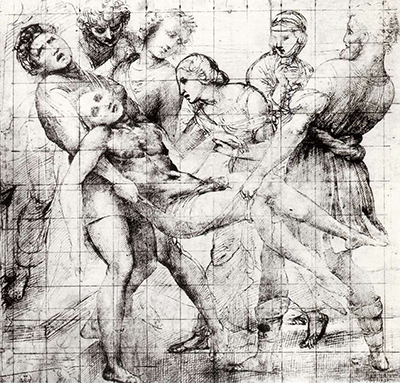
Raphael's Uffizi Compositional Study for the Deposition is a drawing close to becoming a painting. The main carrying group has been resolved in pen and ink: Christ lies across the bearers, Mary Magdalene reaches his hand, and bodies lock into a tense procession. Dense hatching distributes darkness and volume. Two systems of squaring cross the page, and partial pricking records the transfer of a selected detail.[1]
The sheet is not the finished Deposition, nor is it the Louvre's earlier Lamentation study. It occupies a late stage between them. Raphael has already changed the project from mourners gathered around Christ to a body carried toward burial, but some decisions seen in the 1507 Galleria Borghese panel have not yet been made.[1][2][3]
At 29 by 29.7 centimetres, the drawing is almost square.[1] It contains only the principal transport. The fainting Virgin and holy women are absent because Raphael studied that second group separately. What appears to be incompleteness is therefore evidence of a compositional method: solve parts, control scale, then assemble them.
At a Glance
- ArtistRaphael
- TitleCompositional Study for the Deposition
- Object typenear-final compositional model
- ProjectBaglioni Altarpiece, completed 1507
- Inventory number538 E recto
- Mediumpen and ink, red-chalk squaring, pen-and-stylus squaring, black-chalk traces and partial pricking on paper
- Dimensions290 × 297 mm
- Watermarkthree-rung ladder inside a circle surmounted by a star
- Collection markRoyal Gallery of the Uffizi ink stamp at lower left
- Present collectionGabinetto dei Disegni e delle Stampe, Gallerie degli Uffizi
- Key omissionthe Virgin and holy women, designed separately
- Functionprobably the last surviving model before a cartoon or another enlargement support
Contents
- The exact sheet
- Christ carried across the page
- The missing Virgin is evidence, not absence
- Two grids moving in opposite directions
- Pricking and selective reuse
- Hatching as preparation for paint
- Changes that continued on the panel
- Meleager, Mantegna and Michelangelo
- Provenance and a possible Borghese trace
- How to look at 538 E recto
The exact sheet
The Uffizi identifies the object as inventory 538 E recto and attributes it to Raphael.[1] Its title names the relation to the Deposition in the Galleria Borghese, but “study” should not imply a loose page of unrelated sketches. The composition fills the sheet and has reached an unusually high level of finish.
Its materials are complex. Pen and ink carry the main design. Red chalk creates one grid; pen and stylus contribute another. Black chalk survives in traces beneath the ink, and selected contours were pricked.[1] These layers record separate operations rather than one uniform act of drawing.
The page also bears a watermark resembling a three-rung ladder in a circle topped by a star, and the Uffizi's historic collection stamp at lower left.[1] Such details locate the drawing as a physical sheet with its own manufacture and collecting history, not merely a transparent window onto the altarpiece.
The upper edge has been trimmed, but the Uffizi notes no corresponding cut along the right margin.[1] That material observation is important because it confirms that the missing Virgin group was not simply sliced away. Raphael conceived it on another sheet.
Christ carried across the page
Christ's body forms the strong horizontal around which every living figure works. His weight passes from bearer to bearer. The hanging arm and tilted torso make death visible not through facial expression alone but through the absence of self-support.
The procession is already the central invention of the final painting. This distinguishes 538 E from the Louvre sheet, where mourners gather around a body at rest.[3] Raphael has changed the subject's organising action from lament to transport.
The bearers create opposing diagonals. One advances toward the unseen tomb; another turns beneath the legs; figures around Christ counterbalance the pull. Raphael builds movement by making different bodies solve the same burden from different directions.
Mary Magdalene remains close enough to take Christ's hand. Her gesture introduces attachment into the mechanics of carrying. The men must raise and move him; she tries to preserve contact. This small relationship survives into the painted panel.[2]
Because no landscape surrounds the group, its structure is exposed. White paper enters between limbs and drapery, revealing where Raphael needs an interval and where overlap creates pressure. The drawing is a laboratory of load, not a miniature coloured picture.
The missing Virgin is evidence, not absence
In the final panel, the swooning Virgin and three supporting women form a major group at the right. They do not appear on 538 E. The Uffizi concludes from the uncut right margin that Raphael studied that scene separately.[1]
This method helps explain the painting's doubled structure. Christ is physically carried toward burial; Mary collapses and must also be held. The two groups echo one another, but each presents a different problem of weight.
Designing them separately allowed Raphael to resolve their internal mechanics before joining them. It also created risk: individually coherent groups might fail to communicate. The final painting overcomes that danger through shared diagonals, turned heads, colour and the hinge figure of Magdalene.
Technical investigation of the panel supports this account. The Galleria Borghese reports that the main group was painted first and that the women were then developed as a corresponding unit.[2] Drawing and under-surface evidence thus describe the same constructive logic.
The omission also gives this sheet a precise identity as an artwork. It is a study of the transport group, not a failed record of the entire altarpiece. Its incompleteness relative to the panel is functional completeness at this stage of design.
Two grids moving in opposite directions
Squaring allows a design to be copied at a new scale, cell by cell. On 538 E, the Uffizi distinguishes a red-chalk grid from another system made with pen and stylus.[1]
The catalogue interprets the red grid as part of bringing a design onto this sheet and the pen grid as preparation for moving it onward to a cartoon or another support.[1] The page may therefore sit between two acts of translation: receiving an earlier composition and preparing a larger successor.
This double function makes the drawing unusually revealing. It is neither the first invention nor the full-size cartoon. Raphael is refining the image while it passes through scale. Composition and transmission happen together.
Grid lines do not mechanise the figures completely. Within their cells, contours remain alert and hatching responds to bodily form. The measured system secures proportion, while the pen continues to model expression, weight and space.
The almost square page becomes a matrix. A shoulder, head or hand can be checked against fixed coordinates. Relations that feel spontaneous in the finished panel rest on disciplined control of distance.
Pricking and selective reuse
Partial pricking appears around the face of the far-left bearer.[1] Small holes allowed a contour to be transferred by pouncing or another tracing process. The marks demonstrate that at least part of the sheet had practical use beyond contemplation.
Only selected areas needed such treatment. Raphael could reuse a head, adjust a profile or carry a feature forward without transferring every contour at the same moment. Partial pricking records focused attention.
This is different from the grid, which controls the larger composition. Pricks can isolate a local motif. The sheet therefore operates at two scales: global geometry and individual revision.
Later collectors valued drawings like this as autonomous works, but these holes recall the risk and wear of studio purpose. A beautiful line might be punctured because its value lay in generating another image.
The marks also complicate the idea of a single final drawing. Even a highly finished model can be mined, corrected and selectively passed forward. “Final” here means close to the painting, not immune from change.
Hatching as preparation for paint
The Uffizi describes the dense network of hatching as a means of studying balanced masses, light and shadow in preparation for coloured volume and spatial arrangement.[1] Ink does not predict hue directly, but it can establish where forms project, recede and overlap.
Lines follow the turn of limbs and folds. Darker passages separate one body from the next. Broad reserves of paper preserve light on Christ and open intervals within the crowd.
The degree of finish is functional. A painter transferring or enlarging the design needs more than silhouettes. Tonal structure helps anticipate whether the central body will remain visible once vivid garments, flesh and landscape enter the panel.
Hatching also disciplines drama. Repeated strokes make strain visible, but they are organised. The page does not dissolve into agitation. Raphael turns many directional marks into coherent masses.
This balance explains why the Uffizi considers 538 E the latest surviving study in the sequence.[1] It is close enough to the panel to predict its architecture, yet still materially a drawing whose energy belongs to the pen.
Changes that continued on the panel
Near-final does not mean identical. In the drawing, a woman stands behind Magdalene. Raphael removed her during painting, opening the space around Christ and intensifying the body's prominence.[1][2]
The far-right bearer also changed in physical type and pose. The Uffizi connects these late modifications with pentimenti discovered during the 1995 diagnostic campaign.[1] Some decisions occurred only after paint was already being applied.
The evidence overturns a simple step-by-step myth in which sketch leads to model, cartoon and perfectly faithful painting. Raphael could move backward and sideways, using the panel itself as a site of composition.
He also redeployed an idea from the removed woman when shaping a figure in the separately designed Virgin group.[2] Rejection did not necessarily mean waste. A pose could migrate to another function.
The drawing and painting should therefore be compared for differences as much as likeness. Their closeness establishes 538 E's late role; their divergences reveal that invention remained active until the surface was substantially complete.
Meleager, Mantegna and Michelangelo
The Uffizi situates Raphael's design among several possible sources: ancient reliefs of the carrying of Meleager, Mantegna's engraved Deposition, Signorelli's Lamentation at Orvieto and works by Michelangelo.[1]
Ancient sarcophagi offered a grammar for the horizontal dead body, hanging arm and procession of bearers. Mantegna demonstrated how engraved line could make burial severe and rhythmic. Michelangelo supplied problems of torsion and monumental bodily force.
The connections matter most as acts of synthesis. The Uffizi cautions that an antique model alone cannot explain so original a composition.[1] Raphael studies forms because they solve expressive and structural problems, then changes their sacred context and relation.
The drawing medium makes this synthesis visible. Pen can quote a contour, test a remembered pose and immediately alter it. The page becomes the place where antiquity, rival art and patronal need are forced into one coherent event.
Provenance and a possible Borghese trace
The first firm inventory evidence for the sheet in the grand-ducal collections appears in Giuseppe Pelli Bencivenni's late eighteenth-century catalogue.[1] The Royal Uffizi stamp records its institutional life.
A 1608 letter to Cardinal Scipione Borghese mentions a drawing that might be 538 E, but the description is too general to exclude another lost study.[1] The Uffizi preserves the possibility without converting it into certainty.
The date is suggestive because 1608 was the year the main panel was secretly removed from Perugia and entered Borghese possession.[2] A drawing could plausibly have attracted attention around the same event, yet plausible context is not identification.
This distinction models responsible provenance writing. The grand-ducal record is secure. The Borghese connection is an informed hypothesis. Both belong on the page, but not at the same level of confidence.
How to look at 538 E recto
First ignore the grid and find Christ's horizontal body. Trace how each bearer counters its weight.
Then allow the squares to return. Distinguish red chalk from darker pen and ask why two transfer systems occupy the same page.
Find the partial pricking at the far-left head. A local face has a different transfer history from the whole procession.
Finally, look at the empty right edge. It is not a lost half of the sheet; it marks the decision to design the Virgin's group elsewhere.
Why the drawing matters
Uffizi 538 E recto brings viewers close to the hinge between invention and production. The central drama is resolved, but grids, pricks and pentimenti prove that translation continues.
It reveals Raphael as both storyteller and organiser. Emotional force depends on measured scale, separately constructed groups and disciplined tonal planning.
The sheet also preserves the cost of finality. A figure can be drawn beautifully and still disappear; an idea can migrate; paint can overrule the model. Completion is achieved through selection.
Artist Up Close
Compare the free turn of a wrist with the rigid geometry crossing it. Measurement and living line occupy the same surface.
Look for the tiny holes around the left bearer's face. They are scars of usefulness.
Then imagine the missing women's group as a separate problem waiting to be assembled with this one.
Frequently Asked Questions
Discussion
What detail most changes how you read Compositional Study for the Baglioni Deposition?
Reader Insights
Which source detail gives the page its strongest anchor?
Which visual or historical distinction should readers keep in mind?
How does this page change the wider picture of Raphael's career?
Join the Conversation
Share your reading below.
References
- Gallerie degli Uffizi, Progetto Euploos, “Studio compositivo per la Deposizione,” 538 E recto. View source.
- Galleria Borghese Collection, “Deposition (The Carrying of the Dead Christ to the Sepulchre),” inventory 369. View source.
- Musée du Louvre, Département des Arts graphiques, “Lamentation sur le Christ mort,” INV 3865 recto. View source.